FLAKPANZER T-34
conversion of a captured Russian tank
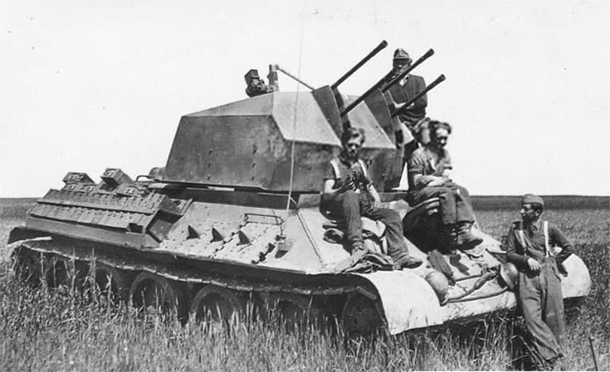
the Flakpanzer T-34 and its crew; this photograph clearly shows the ready ammunition supply stored in the long rack on the right side of the hull, source: Flickr.com with permission of the publishing user, edited
The T-34 Tank
At the moment of the German invasion of the Soviet Union, the Red Army had only around a thousand T-34 tanks at its disposal — but their numbers began to grow very rapidly. By the end of 1941, more than two thousand had been produced, and the following year alone saw over 12,000 roll out of the factories. In German service, the first captured examples of this type began appearing as early as the summer of 1941, under the official designation Panzerkampfwagen T34 747(r), where the letter r stood for russisch — Russian.
Compared to German tanks, the T-34 was better armoured, more heavily armed, and far better suited to the Russian terrain. On the other hand, it was mechanically unreliable, and its poor ergonomics, combined with a crew of only four, significantly reduced its combat effectiveness. German enthusiasm for captured T-34s was also tempered by concerns about confusion — both in logistics (different fuel, dependence on captured spare parts, and so on) and directly on the battlefield, where the risk of friendly fire was very real. Front-line units were grateful for every available tank, however, and so captured T-34s saw fairly extensive use.
It is estimated that the Germans deployed somewhere between 500 and 600 captured T-34s in the combat tank role. The vehicles were repaired at their former home, Factory No. 183 in occupied Kharkiv — which was no easy task, as most of the factory's equipment had been evacuated by the Soviets to the east. Some of the tanks also received minor modifications and improvements, such as repainting in German colours, the installation of German radio sets and headlights, and in some cases even German commander's cupolas.
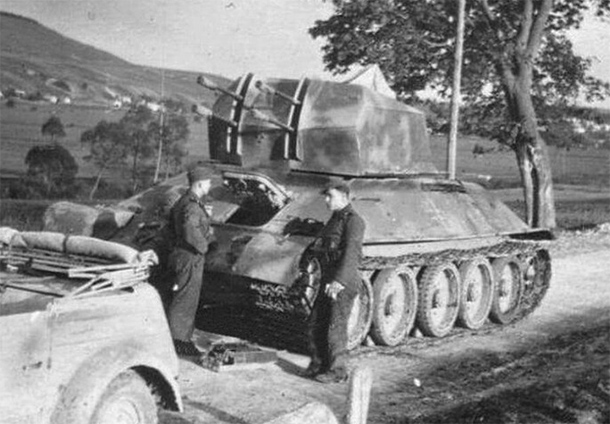
the conversion of an original ammunition-carrier T-34 into a Flakpanzer took place in the workshops of the 653rd Heavy Tank Destroyer Battalion, source: Flickr.com with permission of the publishing user, edited
The Ammunition Carrier Conversion
Beyond their use as combat tanks, captured T-34s were also employed for other purposes — most notably as turretless recovery and service vehicles (Bergepanzer) or as ammunition carriers (Munitionspanzer). Several such T-34-based ammunition carriers also served with the 653rd Heavy Tank Destroyer Battalion (Schwere Panzerjäger-Abteilung 653, abbreviated sPzJgAbt 653), which had been fighting on the Eastern Front since the summer of 1943. Incidentally, this battalion was equipped with the famous Ferdinand tank destroyers (later redesignated Elefant following their modernisation).
Fitting the Flak Gun
One of these ammunition carriers, based on a captured T-34, was converted in the field workshops of the 653rd Battalion into an improvised Flakpanzer — an anti-aircraft tank — armed with the quadruple-barrelled 20 mm automatic cannon Flakvierling 38. According to some sources, this conversion took place in May or June 1944. In any case, the vehicle already appears in the unit status report of 1 July 1944, listed within the anti-aircraft platoon at battalion headquarters under the designation 2cm Flakvierling auf T34.
The technical author of the conversion was reportedly the battalion's chief armourer, Stabsfeldwebel Anton Brunnthaler. Since the T-34-based ammunition carrier already lacked a combat turret, one might assume that the conversion was correspondingly straightforward. In reality, it was far from as simple as it appears at first glance. The available literature does not describe the mounting method in any detail, and the surviving photographs reveal only limited technical information. The simplest solution would have been to place the gun on its standard mount directly on the hull roof where the turret had once been. However, the photographs show that the gun sat relatively low above the hull roof, which most likely rules out this approach — a gun on its full standard mount would have sat considerably higher. The mechanics presumably cut away just the rotating gun cradle from the original mount and secured it to the hull roof by some means, or suspended it directly within the original turret ring. In any case, the gun's traversing mechanism had to be preserved, since the Flakvierling 38 was designed to engage low-flying targets and would have been entirely useless without the ability to track them quickly.
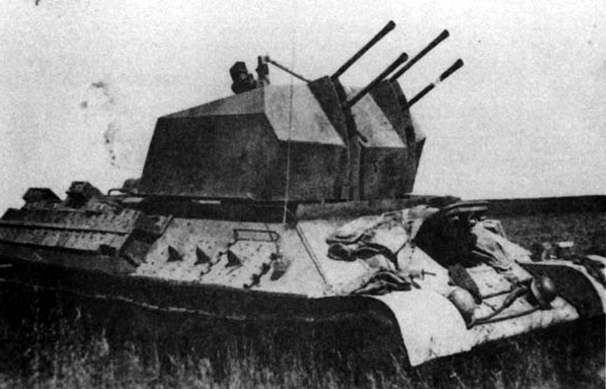
despite appearances in this photograph, the vehicle did not have a full combat turret — only a large shield attached to the gun itself, source: Flickr.com with permission of the publishing user, edited
The mechanics fitted an armoured shield to the gun, which rotated with the weapon and provided its crew with at least minimal protection. According to some sources, the shield was welded together from armour plates taken from a written-off Sd.Kfz. 251 half-track. The shield consisted of a front plate with vertical cutouts for the gun barrels and two side plates. Being quite large, it could easily be mistaken at first glance for a proper combat turret. It was, however, truly nothing more than a shield — without a roof and without a rear wall. Because of its considerable size, the side panels of the shield extended over the engine deck, which created an additional headache for the "designers". The engine deck of the T-34 was higher than the hull roof around the turret ring, which meant the shield panels had to be mounted high enough that they did not scrape against the raised engine cover when the gun traversed. The mechanics therefore raised the entire shield assembly upward — but this in turn left an unprotected gap between the hull roof and the bottom edge of the shield, estimated at around 10 to 15 cm. To cover this gap from the outside, the mechanics welded steel sections to the hull roof beneath the shield (highlighted in the photograph HERE).
Although the gun shield was fairly large, it clearly offered little room on either side of the weapon. Yet it was precisely from the sides that the Flakvierling 38 was loaded. From the photographs, the side walls of the shield do not appear to have been foldable — which was otherwise fairly common on German Flakpanzers. It can therefore be assumed that loading the gun with this shield in place was considerably more difficult than on the standard towed version of the Flakvierling 38, and this would certainly have affected the practical rate of fire. On the classic towed version, the practical rate of fire was around 700 to 800 rounds per minute across all four barrels combined. Achieving such a rate required a very smooth flow of ammunition, fed in 20-round magazines. With a shield that restricted the loaders' access to the weapon, the practical rate of fire of the Flakpanzer on the T-34 chassis must have been significantly lower — most likely less than half.
Even so, the Flakpanzer certainly needed to carry a substantial ammunition supply. There was no shortage of space, since the hull interior remained largely unused — but there was a catch. Access to the interior through the turret ring was completely blocked once the gun had been installed. The only remaining entry into the hull was through the driver's hatch in the front plate. Passing ammunition through this route was quite slow and cumbersome. The crew were evidently well aware of this, and so they fabricated racks on the right side of the hull to hold a fairly large ready-use ammunition supply (photo HERE). Based on the photographs, it appears that up to 18 boxes of two magazines each — that is, 720 rounds — could be stored on the hull side in this way. Once this ready supply was expended, the crew would replenish it from the ammunition stored inside the hull. One photograph shows the left side of the vehicle without any ammunition racks, though another surviving image shows no racks on the right side either. It is therefore possible that the racks were added later during the vehicle's service life and may ultimately have been fitted on both sides of the hull. As for crew size, some sources suggest four men — most likely a gunner/commander, a driver/ammunition handler, and two gun loaders.
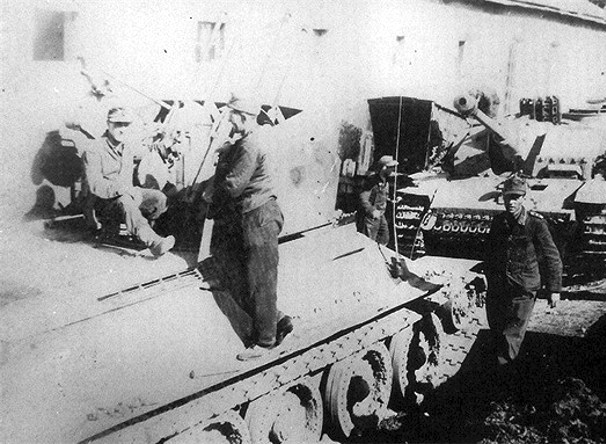
this view into the interior of the Flakpanzer T-34 shows how low the Flakvierling 38 sat above the hull roof; in our view, this rules out the use of the weapon's complete original mount, source: Flickr.com with permission of the publishing user, edited
Combat Deployment
From May to July 1944 — the period during which the Flakpanzer described here is believed to have been created — the schwere Panzerjäger-Abteilung 653 was fighting across various sections of the front west of Ternopil, from where it was slowly but steadily retreating westward. At the end of July 1944, the remnants of the battalion received orders to withdraw from the Eastern Front, and during August the unit made its way back to the Reich (and subsequently to Poland). In the unit status report of 5 August 1944, the "2cm Flakvierling auf T34" is still listed (whereas by this point not a single T-34 ammunition carrier is mentioned). It is, however, highly unlikely that the unit brought this vehicle with it from the Eastern Front back to Germany — if for no other reason than that servicing it there would have been far more complicated, since spare parts for the T-34 were considerably more readily available on the Eastern Front. The sources do not record what ultimately became of the improvised Flakpanzer. It is possible that it remained on the Eastern Front and simply continued in service with some other unit that effectively adopted it as its own.
ARTICLE
CONTENTS:
Reproducing text from the Panzernet website without the written consent of the operator is prohibited.