MERCEDES-BENZ L4500
Flakwagen on a lorry chassis
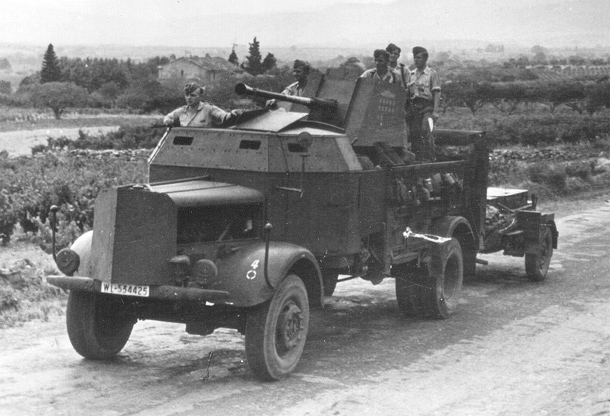
Mercedes-Benz L 4500 with armoured cab, 37 mm Flak 36 gun, and a trailer ammunition vehicle, deployed most likely in Italy (although the original source states this photograph was taken in southern France), source: panzerserra.blogspot.com, edited
German self-propelled anti-aircraft guns emerged as a response to the growing losses inflicted on troops by enemy aircraft — not only during actual combat operations, but above all during movements and road marches. A specific category of these vehicles were the anti-aircraft tanks (or Flakpanzers), which were built on fully tracked chassis. This gave them the ability to handle more demanding terrain and allowed them to accompany and protect conventional battle tanks and other tracked vehicles without difficulty. Another group of self-propelled anti-aircraft guns consisted of half-tracked vehicles, whose cross-country performance was marginally lower, but which could still keep pace with friendly tanks reasonably well.
The Wheeled Flakwagen
However, it was not only German tanks and other tracked vehicles that needed protection from enemy air attack. There was also an enormous number of wheeled vehicles — most notably supply lorries — which frequently moved in long convoys and made tempting targets for enemy fighters and ground-attack aircraft. Owing to their wheeled chassis, lorries were inevitably confined to roads or at least to tracks and dirt roads. Assigning a tracked Flakpanzer to protect them would have been a complete waste of resources. Tracked self-propelled anti-aircraft guns were there to protect other tracked vehicles; for the protection of wheeled transport, anti-aircraft weapons mounted on wheeled chassis were more than sufficient — and considerably cheaper to produce.
It was precisely this line of thinking that gave rise to the series of self-propelled anti-aircraft weapons based on the heavy lorry chassis of the Mercedes-Benz L 4500. Unfortunately, the available literature does not record exactly when or in what numbers these vehicles were built, so we must limit ourselves to what is known about the history of the Mercedes-Benz L 4500 itself. It entered production in 1939 and was assembled for the following five years at the plant in Gaggenau in south-western Germany. During September and October 1944, the factory was targeted by Allied bombing raids which caused sufficient damage to force production to be relocated — to the Sauer factory in Vienna, where it continued until 1945.
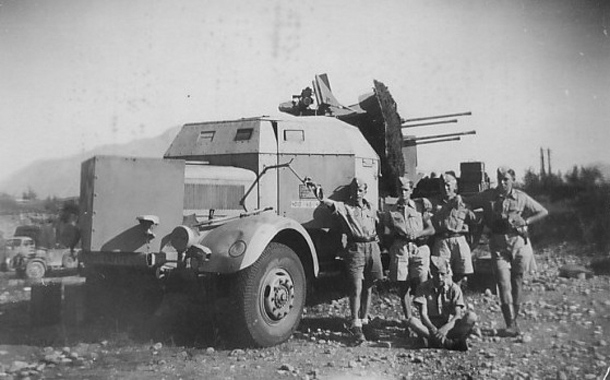
Mercedes-Benz L 4500 with the quadruple-barrelled 20 mm Flakvierling 38; in this variant the vehicle did not yet require side stabiliser legs, source: panzerserra.blogspot.com, edited
Mercedes-Benz L 4500
The Mercedes-Benz L 4500 was offered in three configurations: the L 4500 S with rear-wheel drive, the L 4500 A with all-wheel drive, and the L 4500 R, which had a tracked unit in place of the rear wheels, making it a half-track vehicle. The lorry was powered by a Mercedes-Benz OM 67/4 six-cylinder diesel engine with a displacement of 7.274 litres and an output of 111 horsepower. The gearbox was a manual unit with five forward gears and one reverse. The front wheels were single, the rear wheels twin, and all were sprung on leaf springs. The maximum speed is generally quoted at 66 km/h.
The payload capacity ranged from 4,685 kg on the L 4500 A to 4,950 kg on the L 4500 S. It was precisely this high load rating that made the Mercedes L 4500 an ideal candidate for conversion into an anti-aircraft weapon carrier, and so it came about that no fewer than three variants of a wheeled "Flakwagen" were developed on its basis, each with a different armament. All three shared a common official designation that was something of a mouthful — judge for yourself: Schwere Geländegängiger Lastkraftwagen 4,5t Mercedes-Benz L 4500 als Flakwagen, meaning literally "heavy cross-country lorry 4.5t Mercedes-Benz L 4500 as Flakwagen". The order in which the individual variants were developed is not clear from the literature, so we will simply describe them in sequence from the smallest to the largest calibre.
2 cm Flakvierling 38
We must therefore begin with the installation of the quadruple-barrelled 20 mm Flakvierling 38. The single-barrel Flak 38 in 20 mm calibre had been considered a weapon of limited future potential virtually from the start of the war — at least in its original role as an anti-aircraft gun. The Luftwaffe had long been looking for something more powerful (in the 37 or 50 mm calibre range) when, in 1940, Rheinmetall came up with the idea of compensating for the small calibre of the Flak 38 with an enormous rate of fire by combining four of these guns into a single unit. This arrangement could put more rounds in the path of an enemy aircraft in a given time than a single-barrel gun of larger calibre — and it turned out to be a very good idea indeed. A total of 3,851 Flakvierling 38 quadruple mounts were produced from 1940 until the end of the war.
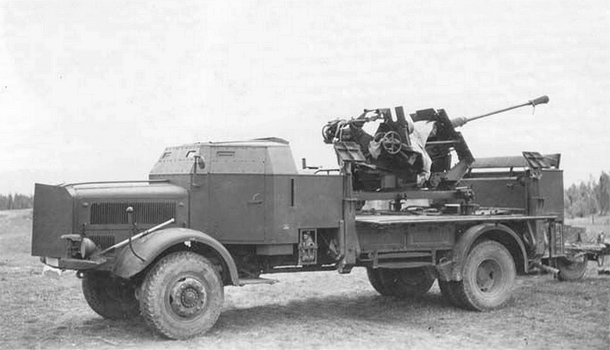
Mercedes-Benz L 4500 with the 37 mm Flak 36 gun; this photograph clearly shows the side panels folded down into the horizontal position, source: panzerserra.blogspot.com, edited
The combat weight of the Flakvierling 38 mount was "only" 1,520 kg, so even after installing this weapon the Mercedes L 4500 still had plenty of payload capacity to spare — and the designers intended to make use of it. The driver's cab and engine cover received light armour protection, a bench seat for the gun crew was added behind the cab, and ammunition storage boxes for the ready-use supply were fitted at the rear of the vehicle. The individual armour plates of the cab were riveted together. As to the thickness of this armour, sources vary — some cite 8 mm, others 10 mm, and some 14.5 mm (the last figure being the German standard for armour resistant to armour-piercing rounds from rifles and machine guns of 7.92 mm calibre). The fighting compartment (formerly the cargo bed) also received new folding side panels. Whereas the original panels had been wooden, the new ones were filled with heavy-gauge wire mesh and could be locked in the horizontal position, effectively extending the working space available to the gun crew.
The ammunition carried aboard the vehicle was strictly a ready-use supply. The Flakwagen had to either tow an ammunition trailer or rely on a dedicated resupply vehicle accompanying it, because the four-barrelled gun assembly devoured ammunition at a ferocious rate. Its theoretical rate of fire was approximately 1,800 rounds per minute (each barrel was capable of 420 to 480 rounds per minute). The practical rate of fire was "only" around 700 to 800 rounds per minute — but even this is a deeply impressive figure. Each of the four linked guns was loaded independently using 20-round magazines. When the gunner fired all four barrels simultaneously, the weapon could empty up to 40 magazines per minute — one magazine every 1.5 seconds.
3.7 cm Flak 36
The next weapon to be mounted on the Mercedes-Benz L 4500 was the 37 mm Flak 36. Compared to the Flakvierling 38 described above, this gun was an outright slowpoke, with a theoretical rate of fire of "only" 160 rounds per minute. On the other hand, it could send shells weighing 635 grams to an altitude of 4.8 kilometres (though considerably different figures can also be found in the literature). The combat weight of the 3.7 cm Flak 36 in its firing position was 1,544 kg — much the same static load on the chassis as the quadruple mount described earlier. For the dynamic loading during firing, however, this was a very different matter: each shot generated far greater recoil forces than the lighter 20 mm gun. For this reason, the vehicle was fitted with stabiliser legs — two on each side. During travel these were raised, but before opening fire they were lowered to the ground to prevent the vehicle from rocking or even tipping over. As the photographs show, later-production Flakwagens received a wider frontal shield for the engine compartment, and the position of the vision ports in the crew cab's frontal armour was also changed. In addition, it appears that the ammunition boxes at the rear of the fighting compartment were eliminated entirely.
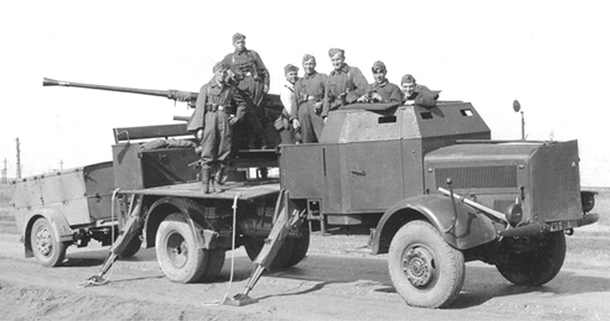
the L 4500 with the 37 mm Flak 36 gun once more; note the stabiliser legs lowered into position. This photograph suggests the vehicle's crew may have been as many as eight men (seven visible in the photo, plus the photographer), source: panzerserra.blogspot.com, edited
5 cm Flak 41
And the heaviest armament for last. In an effort to further increase the combat value of the wheeled Flakwagen, the Germans tried fitting the Mercedes-Benz L 4500 chassis with an even more powerful weapon — the 50 mm Flak 41. With a combat weight of 3,100 kg, this gun made quite a significant dent in the lorry's overall payload capacity. The designers presumably saved a few hundred kilograms by removing the gun from its standard mounting, but it was still a very substantial piece of hardware. It is therefore no surprise that the first examples of the vehicle in this configuration were completed without cab armour (photo HERE). The designers apparently feared that adding an armoured cab on top of the weight of the gun, ammunition, and crew would overload the chassis. Later, however, they seem to have changed their minds, as photographs confirm that this Flakwagen variant also existed in an armoured version.
The 5 cm Flak 41 had a vertical elevation range of -10° to +90°. Its theoretical rate of fire was up to 180 rounds per minute, with the practical rate quoted at around 130 rounds per minute — still a remarkable figure given the size of the ammunition. The gun was not generally regarded as a particularly successful weapon, mainly due to poor stability when firing and a slow traverse speed when tracking targets. This was also the reason why fewer than 200 were produced in total (some sources put the figure as low as 60 or 80). The standard ammunition type for the Flak 41 was the 5 cm Sprgr Patr. 41 L'spur, with a total weight of 4.28 kg, of which 2.2 kg was the projectile itself, which left the muzzle at 840 m/s. For use against armoured ground targets, a special round was available that used the same shell as the Pak 39 anti-tank gun. The maximum ceiling of the Flak 41 was 9,000 metres, though the effective engagement altitude was approximately 5,600 metres. The gun installation also included a mount for a coincidence rangefinder.
As photographs confirm, alongside the official factory-built Flakwagens, a number of unofficial field conversions of standard Mercedes L 4500 lorries were also carried out. One such "field" conversion armed with the Flakvierling 38 can be seen in the photograph HERE. It can be distinguished from the official Flakwagen by its plain wooden side panels and unarmoured cab. A similarly unofficial origin was likely also the case for the armed variant of the half-track Mercedes-Benz L 4500 R (which is described in a separate article HERE). Surviving photographs also confirm that a comparable Flakwagen was produced on the chassis of the similar Büssing-NAG 4500 lorry. Judging by the rarity of photographs showing it — we have come across only two, which can be viewed HERE and HERE — these vehicles must have been produced in negligible numbers compared to the Mercedes-based versions. They can be distinguished from the Mercedes-Benz L 4500 Flakwagens by the treatment of the engine bonnet sides.
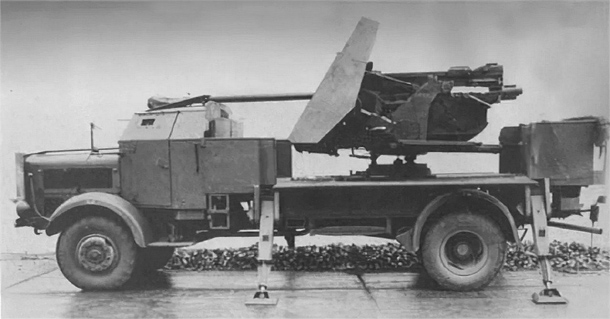
the most powerful weapon installed on the Mercedes lorry chassis was the 50 mm Flak 41, source: panzerserra.blogspot.com, edited
Almost nothing is known about the actual combat deployment of the Flakwagens on the Mercedes-Benz L 4500 chassis. Photographs exist showing them in action in France, most likely after the opening of the Western Front in 1944, and images apparently taken in Italy in 1943. Unofficial conversions of the same vehicle are also recorded in service on the Eastern Front, and even in North Africa. What actual combat results these vehicles achieved, however, is not recorded. The literature likewise offers no answer to the question of crew size. From the photographs and the general context, one can speculate that it may have been six to eight men — for the Flakvierling 38 variant, for example, this could have been a driver, a commander, a gunner, two loaders, and at least two additional ammunition handlers.
ARTICLE
CONTENTS:
Reproducing text from the Panzernet website without the written consent of the operator is prohibited.