FLAKPANZERS – INTRODUCTION
origins and development of anti-aircraft tanks
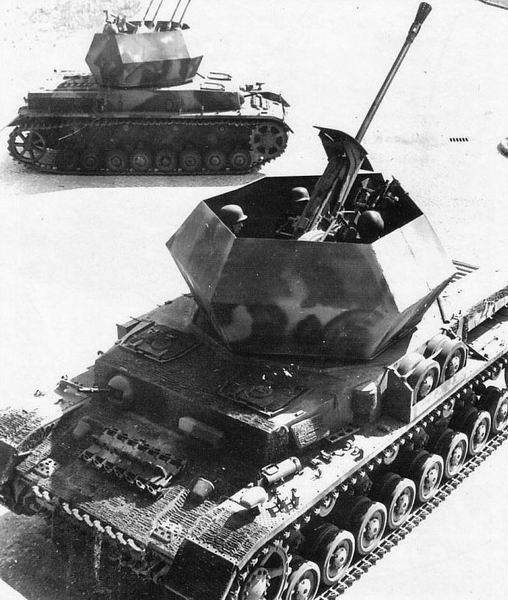
Ostwind (foreground) and Wirbelwind anti-aircraft tanks, source: Flickr.com with permission of the publishing user, edited
Although the first anti-aircraft tanks — the so-called Flakpanzers — appeared as early as 1941, truly intensive development and production of this type of vehicle only got underway in the second half of the war, as enemy air superiority on both fronts continued to grow. Göring's Luftwaffe was growing progressively weaker and could no longer spread its protective wings simultaneously over German cities at home and over German forces still deployed across a vast expanse of territory.
German units on the move and supply columns were attacked with increasing impunity by enemy bombers and fighters, and their losses were mounting. In roughly the final year of the war on the newly opened Western Front, more tanks and other vehicles were being destroyed by enemy air power than by conventional ground combat or artillery fire combined.
Conventional anti-aircraft guns towed by various prime movers required time to be brought into action and were incapable of providing effective cover for units on the move. The Germans therefore addressed this problem by mounting anti-aircraft guns — so-called Flak (Flak = Flugabwehrkanone = anti-aircraft cannon) — on various chassis that could provide the mobility they needed.
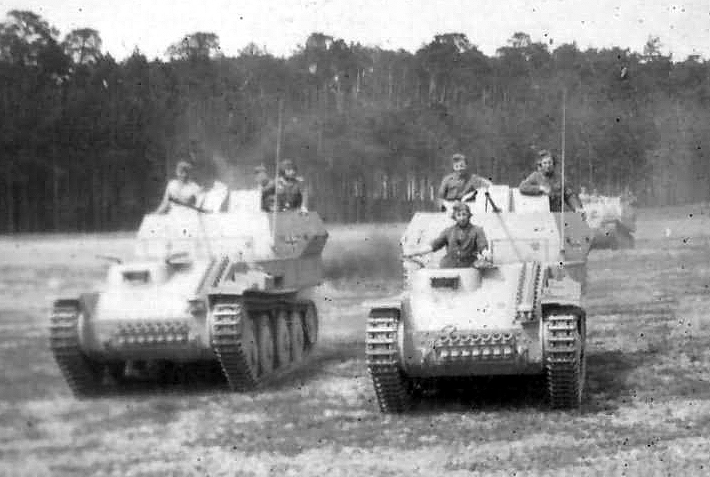
Flakpanzer 38(t) light anti-aircraft tanks armed with 20 mm guns, source: Flickr.com with permission of the publishing user, edited
If such a vehicle's role was limited to protecting supply lorry columns, a wheeled chassis was perfectly adequate, since it moved along roads just as the lorries did. Providing anti-aircraft cover for tracked vehicles was a somewhat greater challenge, however, as these machines routinely operated across rough terrain where wheeled vehicles would have had no chance of keeping up. The solution was to mount anti-aircraft guns on half-tracked or fully tracked chassis. In the latter case, the chassis of existing tanks served as the basis, and an entirely new category of fighting vehicle was born — the anti-aircraft tank, or Flakpanzer.
In parallel, the Germans were also working on improving the tanks' own resistance to attacks from above — not only through additional roof armour, but also through far-reaching changes to their overall design (see the schwerer kleiner Panzerkampfwagen project). They were also considering the development of a kind of universal tank capable of engaging both ground and aerial targets (see the Porsche Typ 245-010 project). All of this illustrates just how serious a problem air attack had become.
In May 1943, the question of ground forces' anti-aircraft defence reached the top of the agenda at meetings of two German military-technical committees — the so-called Panzerkommission (responsible for the development of new tanks) and the Waffenkommission (responsible for the development of weapons themselves). At a session on 27 May 1943, it was decided that every German tank regiment would receive 18 self-propelled anti-aircraft guns on fully tracked chassis to improve its air defence capability. This was the moment that set off the true flowering of the German Flakpanzer.
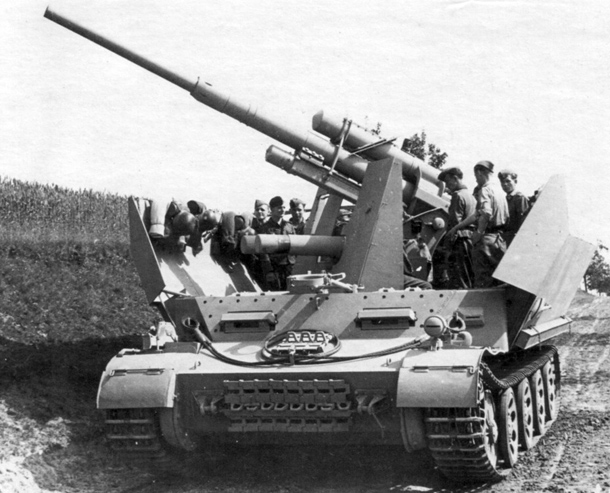
the Germans also developed Flakpanzers armed with heavy 88 mm guns; shown here is the so-called 8.8 cm L/71 Versuchsflakwagen, source: Flickr.com with permission of the publishing user, edited
Nazi Germany ultimately achieved considerable success in the field of Flakpanzers and stood at the forefront of the technology worldwide. The same cannot be said, however, for the numbers of vehicles produced. By the second half of 1943, German arms manufacturers were already operating at full stretch, and even though the Army itself became directly involved in converting tanks into Flakpanzers — with some types being built in the workshops of the training battalion Panzer Ersatz und Ausbildungs Abteilung 15 in Żagań, Poland — demand permanently outstripped supply.

Reproducing text from the Panzernet website without the written consent of the operator is prohibited.