Sd.Kfz. 8
self-propelled gun on the half-track tractor chassis
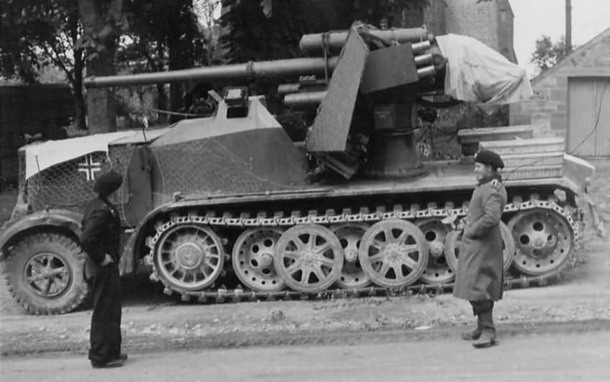
8,8cm Flak 18 auf schwerer Zugkraftwagen 12t; source: worldwarphotos.info, used with permission of the operator
Origins of the Half-track
In the early 1930s, the German Army Ordnance Office launched an extensive programme for the development and production of half-track artillery tractors across six weight categories. The second heaviest type in this family was the vehicle that would later receive the ordnance designation Sd.Kfz. 8 (Sd.Kfz. = Sonderkraftfahrzeug = special purpose vehicle). The specification called for a towing capacity of 12 tonnes, and the vehicle was intended to pull the heaviest artillery pieces in service. Development was entrusted to Daimler-Benz AG, a firm with considerable experience in building vehicles of this kind.
During the First World War, the firms of Daimler and Benz — then still independent — had both contributed to the development of half-track vehicles: the Marienwagen (Daimler) and the Kraftprotze (Benz). Daimler-Benz built on its Marienwagen experience in 1931, when it received a contract to develop a half-track artillery tractor for the Soviet Army. Germany and the Soviet Union had been cooperating quite intensively on the development and testing of armoured vehicles during the interwar period, right up until Hitler's rise to power in 1933. The vehicle that Daimler-Benz developed for the Red Army between 1931 and 1932 carried the designation ZD 5.
The ZD 5 was structurally closer to the First World War-era Marienwagen than to the later modern German half-tracks, but it is possible that the project provided significant inspiration. It is true that the German programme to develop an entire family of half-track tractors followed shortly after the ZD 5 project, and some authors suggest this was no coincidence. The German Waffenamt (Army Ordnance Office), however, demanded a more modern design and dictated many of its engineering requirements itself.
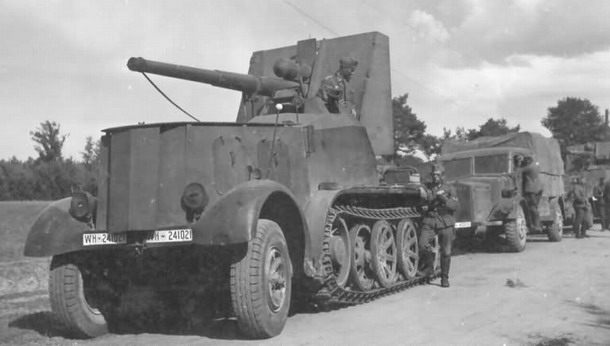
8,8cm Flak 18 auf schwerer Zugkraftwagen 12t; source: worldwarphotos.info, used with permission of the operator
The first generation of the new tractor for the German Army appeared in 1934 under the factory designation DB s7 (DB for Daimler-Benz, s presumably for schwerer = heavy). The vehicle weighed 14.4 tonnes and was powered by a twelve-cylinder Maybach DSO 8 engine developing 150 hp — the same engine used in the ZD 5. The track unit of the DB s7 had only five road wheels, and the engine bonnet resembled the older ZD 5. This version was produced between 1934 and 1936, though the total number built has unfortunately proved impossible to establish.
In 1936 a new generation appeared under the factory designation DB s8. The track unit was extended by one additional wheel, bringing the total to six on each side. The design of the engine bonnet — and particularly its front grille — moved significantly closer to the later production appearance. The engine appears to have remained the same as in the previous variant. Although the DB s8 was produced until 1939, only a limited number were built, and again the exact figure is not available.
In 1938 yet another version appeared, designated DB 9. This tractor received a new and more powerful Maybach HL 85 TUKRM engine with a maximum output of 185 hp. The stronger powerplant increased the vehicle's towing capacity from the original 12 to 14 tonnes. The engine bonnet design reached its final form with this variant, and the DB 9 also received newly designed drive sprockets and idler wheels.
The definitive version of the tractor, designated DB 10 by the manufacturer, appeared in October 1939. Most authors describe only minor changes to the road wheels or mudguards relative to the DB 9, while others maintain that this version introduced a significant new feature in the form of torsion bar suspension for the road wheels. How the suspension was arranged on the earlier variants is rarely specified, but if torsion bars were not used, leaf springs are the likely answer — as on the Sd.Kfz. 7, for example. Either way, the DB 10 was the definitive production version, manufactured from October 1939 until 1944. Its official designation was schwerer Zugkraftwagen 12t (Sd.Kfz. 8). At first glance the DB 10 was very similar to the preceding DB 9, but the most reliable way to tell the two apart was the front wheels: the DB 9 had spoked wheels, while the DB 10 used solid pressed-steel disc wheels.
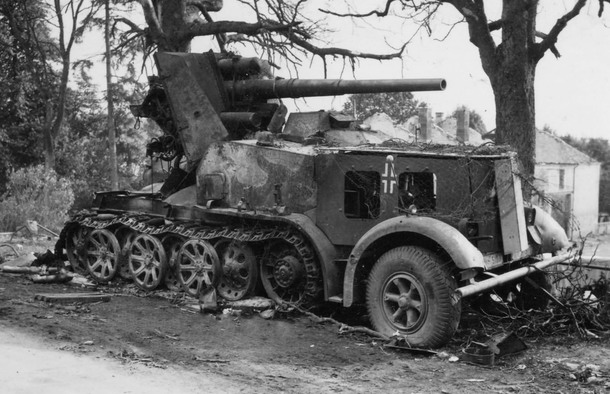
8,8cm Flak 18 auf schwerer Zugkraftwagen 12t, destroyed in France; source: worldwarphotos.info, used with permission of the operator
The definitive version was again powered by the twelve-cylinder Maybach HL 85 TUKRM, with a displacement of 8.52 litres and an output of 185 hp. The gearbox offered four forward speeds and one reverse, supplemented by a two-speed reduction gearbox, giving the driver a total of eight forward gears and two in reverse. Fuel was carried in two tanks with a combined capacity of 250 litres. The half-track could reach a top speed of 51 km/h on roads. The driver steered using a conventional steering wheel: gentle turns moved only the front wheels, while larger steering inputs additionally applied braking to the track on the inside of the turn.
Vehicle Description
The chassis consisted of a front steered axle and a rear track unit. The track assembly comprised a front drive sprocket, a rear idler, and six road wheels. The road wheels were sprung by torsion bars and fitted with rubber tyres to improve ride characteristics. Each wheel was a double unit, made up of two steel discs — so the half-track effectively had twelve road wheel discs arranged on six axles. The wheels were arranged in interleaved rows overlapping one another, a configuration typical of German half-tracks and, later, tanks as well. The discs of the even-numbered wheels were mounted further apart on their axles, with the odd-numbered wheels — whose discs sat close together — fitting into the gap between them. Viewed from the side, only the even-numbered wheels were fully visible, specifically their outer discs.
The engine compartment occupied the front of the vehicle, followed by the driver and commander's cab, with the main payload area at the rear. The Sd.Kfz. 8 served primarily as an artillery tractor for the heaviest weapons in service, such as the 21 cm Mörser 18, the 15 cm Kanone 18, and the 10.5 cm Flak 38. In its basic configuration, the payload area was fitted with two rows of seats and a small cargo space at the very rear.
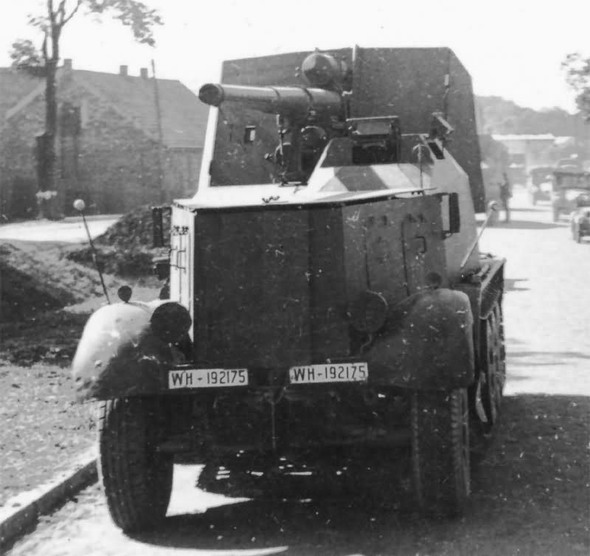
8,8cm Flak 18 auf schwerer Zugkraftwagen 12t; this photograph clearly shows the enormous height of the vehicle; source: worldwarphotos.info, used with permission of the operator
The Armed Version
As with several other half-tracks, the Sd.Kfz. 8 chassis was also used as the basis for a self-propelled gun — and a particularly heavy one at that. The official designation of this vehicle was 8,8cm Flak 18 auf schwerer Zugkraftwagen 12t. The entire engine section and the forward cab received armour protection, while an 88 mm Flak 18 anti-aircraft cannon was installed in the rear of the vehicle. According to some authors the armour was 14.5 mm thick on all faces; others indicate that thickness varied between panels, ranging from 8 to 14 mm. The sides of the engine compartment were fitted with openable louvres to allow adequate airflow to the engine.
Rising from the engine bonnet was a relatively small armoured superstructure protecting the driver, fitted with three openable vision ports providing forward and lateral views. To the driver's right — where the commander sat in the standard tractor — there was only a low, flat roof panel, far too low to accommodate a seated occupant. One can therefore conclude that the commander's position was eliminated and the freed-up space used for ammunition stowage. In the centre of the cab roof was a folding support cradle for the gun barrel, used during longer road moves to spare it from vibration. No access doors were cut into the side armour of the driver's compartment, so the driver presumably had to enter through the open rear of the armoured cab.
Behind the armoured cab was a completely open fighting platform carrying the Flak 18 cannon. The weapon was mounted complete with its shield on a rotating pedestal. Some authors state, however, that traverse was not a full 360 degrees but was restricted to 302 degrees due to the shield. Certain sources attribute a very limited vertical elevation to the gun, from -3 to +15 degrees, but photographs — such as THIS ONE — suggest that the maximum positive elevation was in practice considerably greater than 15 degrees.
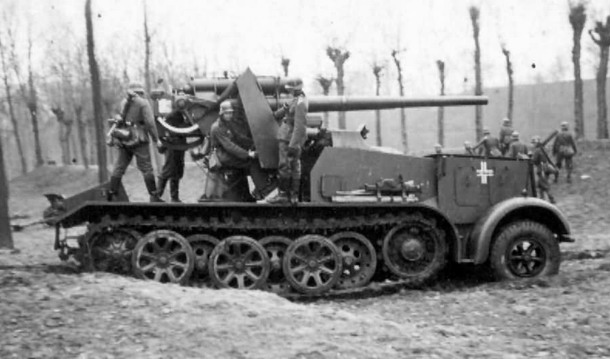
8,8cm Flak 18 auf schwerer Zugkraftwagen 12t; source: worldwarphotos.info, used with permission of the operator
The truth is that this vehicle was not primarily intended for engaging enemy aircraft, despite being armed with an anti-aircraft gun. The Flak 18 — and its more modern successors — was a highly versatile weapon that proved equally effective against tanks and field fortifications. Some authors suggest that the development of this armed half-track was commissioned specifically for one purpose: destroying French bunkers on the Maginot Line. Administratively, however, all Sd.Kfz. 8 vehicles fitted in this way were assigned to an anti-tank unit — specifically the 1st Company of Panzerjäger-Abteilung 8.
Returning to the vehicle itself: on the inner face of the gun shield, to the left of the breech, was a box holding six rounds of ready ammunition. A similar container was placed on the floor behind the gun, and a few additional rounds could theoretically be stowed inside the armoured cab to the driver's right. In any case, the on-board ammunition supply served only as an immediate-use reserve, with an accompanying vehicle expected to carry the bulk of the ammunition supply.
According to some authors, the conversion of Sd.Kfz. 8 tractors into self-propelled guns took place as early as 1939; others place it in 1940. The work was carried out by the firm Krupp, and total production figures vary across sources from as few as 10 to as many as 30 vehicles. Notably, the conversions were not based on the most modern DB 10 tractors but on the older DB 9 variant — a fact clearly demonstrated by the spoked front wheels visible on all converted vehicles. The vehicle's weight rose to as much as 20 tonnes as a result of the armour and heavy gun installation.
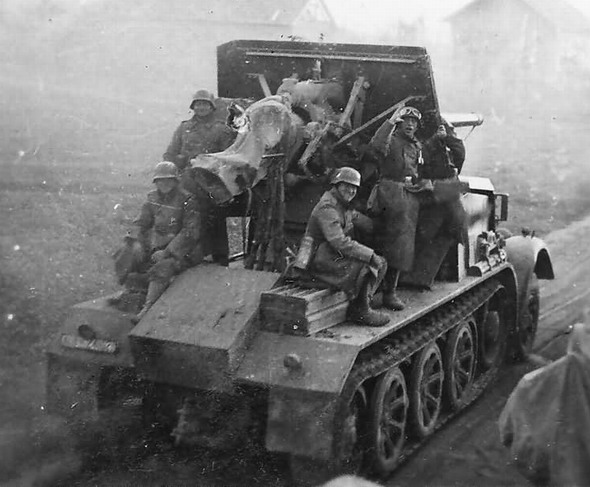
Rear view of the 8,8cm Flak 18 auf schwerer Zugkraftwagen 12t, showing how exposed the gun crew was; source: worldwarphotos.info, used with permission of the operator
As for the vehicle's combat debut, this depends on which production start date one accepts. Some sources indicate that the half-tracks saw action in Poland as early as 1939; others suggest they did not appear until the Western Campaign of 1940. What is certain is that they fought in France as part of the aforementioned Panzerjäger-Abteilung 8, and subsequently participated in the campaign against the Soviet Union, by which point the unit appears to have carried a different designation. All of the self-propelled guns were eventually lost on the Eastern Front, with the last apparently destroyed in March 1943.
Like other combat variants of half-track tractors, the Sd.Kfz. 8-based self-propelled gun suffered from the fundamental weakness of poor crew protection — particularly for the soldiers manning the gun on the open platform. A further liability was the vehicle's considerable height, which made it a conspicuous target. Its greatest asset, however, was undoubtedly the Flak 18 cannon itself: with such a powerful weapon, the half-track was capable of destroying virtually any opponent at quite considerable range.
ARTICLE
CONTENTS:
Reproducing text from the Panzernet website without the written consent of the operator is prohibited.