10,5 cm leFH 16 auf FCM 36
self-propelled gun on a French tank chassis
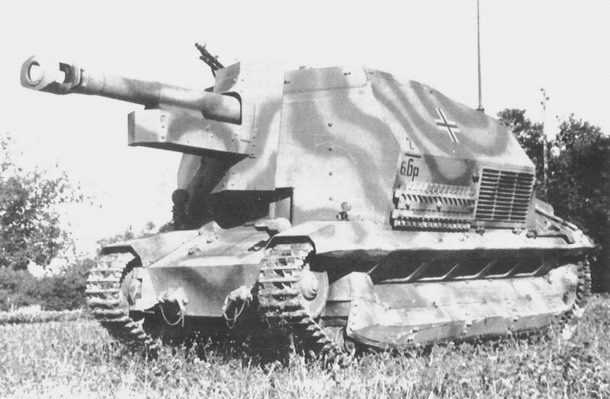
The leFH 16 self-propelled howitzer on the chassis of the captured French FCM 36 tank, source: Flickr.com, with permission of the publishing user, edited
Origins of the Vehicle
The self-propelled gun with the official designation 10.5 cm leFH 16 (Sf.) auf Geschützwagen FCM 36(f) was one of the first creations of the so-called Baukommando Becker, a specialist unit tasked with making the fullest possible use of captured French equipment for the benefit of the German army. The unit was headed by experienced mechanical engineer and artillery officer Alfred Becker. This battery commander of the 227th Artillery Regiment had drawn the attention of the German Ordnance Office at the end of 1941, when his battery on the Eastern Front successfully deployed improvised self-propelled guns that Becker and his men had built "with their own hands" on the chassis of captured British Vickers Mk. VI tanks. Early in 1942, Becker was withdrawn from the Eastern Front and sent to the Alkett factory in Berlin to investigate, together with the firm's engineers, the possibility of mounting various artillery weapons on the chassis of the French Lorraine 37L cargo tractor.
The results of this effort were encouraging, and it appeared that converting captured French equipment offered a quick and inexpensive way to obtain armoured vehicles of solid combat value. Captain Becker therefore received orders to organise, directly in France, the conversion of further usable French chassis into self-propelled weapons. A special unit was established under the German Ministry of Armaments for this purpose, known as either Baukommando Becker or Baustab Becker. The Baukommando was allocated three originally French factories located in Paris or its immediate surroundings: the Matford factory in Poissy, the Talbot factory in Suresnes, and the Hotchkiss factory in Paris itself.
Becker recalled his old comrades from the 12th Battery of the 227th Artillery Regiment from the front and set to work with them. The first conversions undertaken by Becker's team were based on vehicles that the Germans had captured in serviceable condition after the fall of France and which were held as such in reserve depots. Among these were the FCM 36 light infantry tanks (FCM = Forges et Chantiers de la Méditerranée). The French had built only 100 of these vehicles before the war, and of these only 37 fell into German hands in usable condition after the capitulation. The FCM 36 was exactly what an infantry tank was supposed to be: reasonably well armoured (40 mm) and desperately slow (24 km/h maximum). It also featured very futuristic lines, with angled armour on virtually every surface of both the hull and the turret.
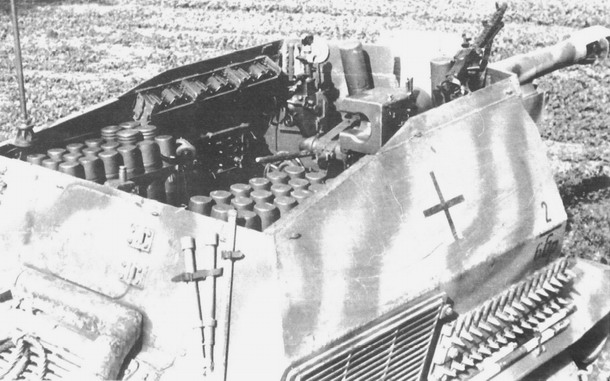
An excellent view into the fighting compartment packed with artillery ammunition — note also the machine gun ready to fire over the top of the front armour, source: Flickr.com, with permission of the publishing user, edited
Baukommando Becker designed and subsequently carried out the conversion of this tank into a self-propelled gun armed with the 105 mm leFH 16 light howitzer.
Design Description
The original FCM 36 tank had its engine and gearbox at the rear, which meant the fighting compartment had to be positioned in the middle of the vehicle. Because of the angled side armour mentioned above, the hull of the original tank narrowed significantly toward the top — precisely the opposite of what the Germans needed for a self-propelled gun conversion, since mounting the bulky howitzer required the widest possible fighting space on top of the hull. A substantial section of the original hull was therefore removed and replaced by a fixed superstructure whose side walls began directly above the tracks and were angled in exactly the opposite direction to the sides of the original hull. The engine air intake louvres were relocated to the side walls of this new superstructure, while the hot-air exhaust outlets could remain in their original position on the angled roof of the engine compartment at the rear of the vehicle. The original pair of exhaust pipes with their large silencers was also retained there.
The running gear itself consisted of eight road wheels plus one additional wheel at the front, slightly above ground level, whose purpose was to assist the vehicle in climbing over obstacles. At the very front was the idler wheel and at the rear the large toothed drive sprocket. The upper run of the track was supported by three return rollers. The tracks were 320 mm wide and each consisted of 148 links. Along with the running gear, the internal components of the French tank were naturally also retained — in particular the Berliet V-4 diesel engine producing 90 horsepower and the five-speed gearbox.
Armament
The newly created fighting compartment was fitted with the 105 mm leFH 16 light field howitzer — a weapon dating from the First World War era, which in its original form ran on wooden spoked wheels and was horse-drawn. The howitzer used separate-loading ammunition, meaning the shell was rammed first followed by the cartridge case with the appropriate propellant charge. The propellant was inserted into the cartridge in the form of bags, and the number and size of bags determined the shell's initial velocity and therefore its range. The standard towed leFH 16 could send a high-explosive fragmentation shell weighing 14.81 kg to a maximum range of 9,225 metres. In similar installations of powerful guns on self-propelled chassis, the use of the heaviest propellant charge was frequently prohibited to avoid placing excessive stress on the running gear.
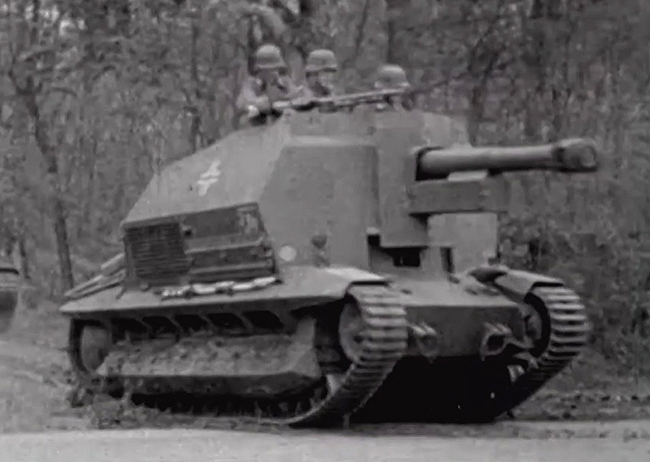
10.5 cm leFH 16 (Sf.) auf Geschützwagen FCM 36(f) during exercises, source: Youtube.com, Public domain, edited
Whether such a restriction was applied in the case of the leFH 16 on the FCM 36 chassis is not clear from the available literature. In theory it need not have been, for two reasons. First, the 10.5 cm leFH 16 (Sf.) auf Geschützwagen FCM 36(f) was lighter than the original FCM 36 tank, meaning the running gear was not overloaded from the outset. Second, the howitzer was newly fitted with a muzzle brake, which reduced the forces acting in the opposite direction to the shell's flight — that is, on the vehicle itself. It is therefore not impossible that this self-propelled gun retained the full maximum range of the original towed howitzer, namely 9,225 metres. In addition to the muzzle brake, the howitzer also received a new armour shield protecting its recoil mechanism beneath the barrel.
The fighting compartment armour was 15 mm thick, sufficient to stop armour-piercing steel bullets from infantry rifles and machine guns in 7.92 mm calibre. The roof of the compartment was left open at the top, which for a vehicle of this type was actually a very practical arrangement. It gave the crew better observation and made aiming easier, while the open compartment also provided better ventilation and allowed freer movement and easier ammunition handling. The absence of a fixed roof also represented a considerable saving in weight and production cost. The crew was of course exposed to the elements, but this could simply be addressed by stretching a waterproof tarpaulin over the opening. From a safety perspective the open top was no serious drawback, since the self-propelled gun was not intended to engage the enemy in direct combat. Its role was to provide fire support to front-line units from a relatively safe distance.
Among comparable self-propelled guns, the 10.5 cm leFH 16 (Sf.) auf Geschützwagen FCM 36(f) was something of a rare exception in one respect: it was actually lighter than the original tank on whose chassis it was built. The FCM 36 tank weighed 12.35 tonnes, while the self-propelled gun weighed "only" 12.20 tonnes — a negligible difference, but a genuinely unusual one in this context. The weight saving was of course mainly due to the removal of a large part of the original tank hull and turret, which had 40 mm armour and represented considerable mass. As a result, the self-propelled gun also suffered no reduction in maximum speed compared with the original tank — a shame, perhaps, that the original tank's top speed was only 24 km/h to begin with. The Panzer Tracts series states that with 260 litres of diesel in the tanks, the vehicle could cover up to 200 km on road. Comparing this with the specifications of the FCM 36 tank itself reveals an apparent inconsistency: the original tank had tanks for only 217 litres of diesel yet achieved a range of up to 225 km. The self-propelled gun may of course have received larger tanks, but at comparable overall weight its range should if anything have been greater than the tank's, not smaller (?).
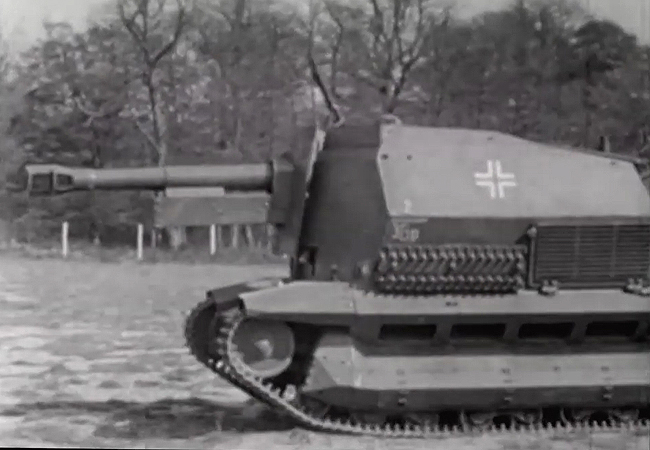
10.5 cm leFH 16 (Sf.) auf Geschützwagen FCM 36(f) during exercises, source: Youtube.com, Public domain, edited
The new self-propelled gun was operated by a four-man crew consisting of driver, commander, gunner and loader. The driver was the only crew member seated inside the hull, positioned at the front centre — practically directly beneath the howitzer barrel. A large hatch extending into the nose of the hull served as his entry and exit point. The remaining crew members were stationed in the open fighting compartment. To the left of the gun sat the gunner in front and the commander behind him; the loader sat to the right of the gun. At the rear of the compartment, in the centre and on both sides, 105 mm ammunition was stowed — 50 rounds in total. A small door in the rear wall of the compartment served primarily for ammunition loading rather than crew access, since it offered no advantage over simply climbing over the armour for boarding and dismounting. The self-propelled howitzer had no integral close-defence weapon against enemy infantry, but the loader could if needed hang an MG 34 machine gun on a bracket in front of his station and fire it over the top of the armour. The crew also carried two MP 38 submachine guns. To the left of the gunner, a Fu.Spr.Ger. radio set was mounted on the side wall of the compartment, connected to a whip antenna in the left rear corner of the fighting space.
Production and Organisation
The first 8 vehicles of the 10.5 cm leFH 16 (Sf.) auf Geschützwagen FCM 36(f) were built in September and October 1942, with a further 4 following in March 1943, bringing the total production to just 12 units. A figure of 48 vehicles built is sometimes encountered, but this is almost certainly incorrect. Records from Baustab Becker itself, dated September 1943, refer to 12 vehicles of this type having been built, and it is hard to see how any further examples could have been produced after that date. In any case, the first 8 vehicles built were divided between two batteries of a specialist artillery battalion, the gepanzerte Artillerie-Abteilung (Sfl.) z.b.V. (z.b.V. = zur besonderen Verwendung = for special use). This battalion came under the gepanzerten Artillerie-Brigade (Sfl.), which was the primary recipient of Baukommando Becker's output. In February 1943 the battalion was redesignated verstärkte Sturmgeschütz-Abteilung 931 and expanded with a third battery equipped with the remaining 4 self-propelled guns — making the full complement of 12 vehicles. The entire brigade to which the battalion belonged was simultaneously enlarged and renamed verstärkte Schnelle Brigade West.
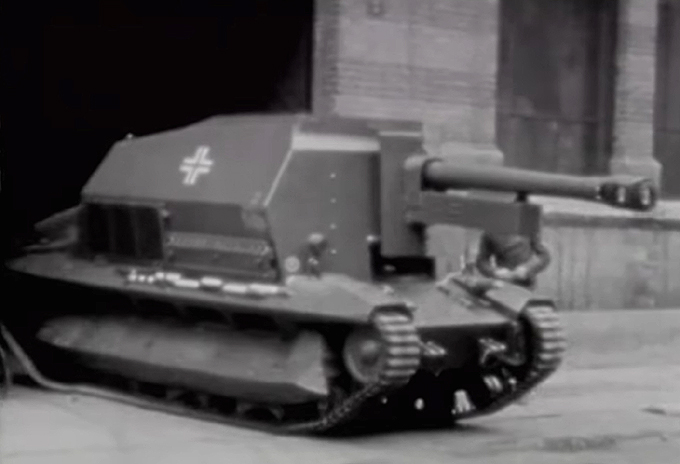
10.5 cm leFH 16 (Sf.) auf Geschützwagen FCM 36(f) leaving the factory hall, source: Youtube.com, Public domain, edited
In July 1943 the vehicles were probably incorporated into the new Sturmgeschütz Abteilung 200, the command of which was entrusted directly to Captain Becker himself. By early 1944, not a single self-propelled howitzer of this type was appearing in the unit's returns. If that is accurate, it means that not one of them lived to see combat against the Allies after the Normandy landings. All examples therefore appear to have served solely for training and garrison duties, and were most likely withdrawn from service by the end of 1943 — a process no doubt accelerated by the scarcity of available spare parts.
Technical Data
|
weight: |
12.2 t |
|
length: |
4.60 m |
|
width: |
2.14 m |
|
height: |
2.15 m |
|
engine: |
Berliet V-4 |
|
engine power: |
90 hp |
|
max. speed: |
24 km/h |
|
fuel capacity: |
260 l |
|
road range: |
200(?) km |
|
crew: |
4 men |
|
armament: |
10.5 cm leFH 16 |
ARTICLE
CONTENTS:
Reproducing text from the Panzernet website without the written consent of the operator is prohibited.