7,5 cm FK231(f) auf BREN
making do with whatever was at hand
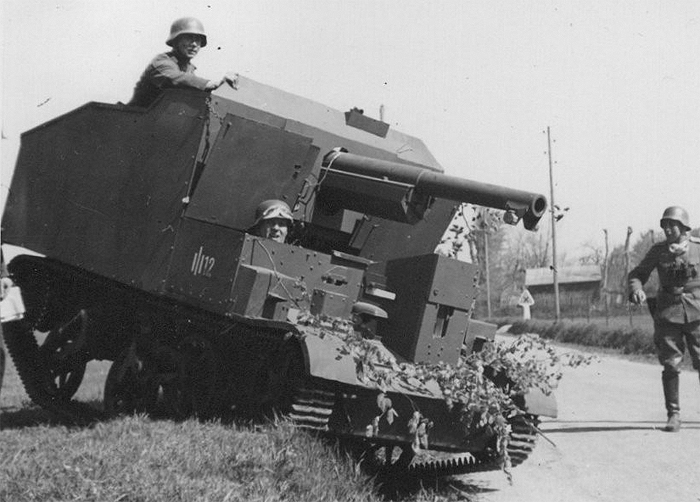
most likely the only built example of the FK231(f) self-propelled gun on the chassis of an ex-British Universal Carrier; source: Flickr.com, published with the permission of the original contributor, edited
Yet another entirely marginal curiosity, yet another pure improvisation, yet another fighting vehicle about which almost nothing is known — and what little can be said is gleaned solely from available photographs... of which we have only two. This is the self-propelled gun 7.5 cm FK231(f), built on the chassis of an ex-British Universal Carrier. Who built it, when, and in how many examples — none of that can be read from the photo.
The British chassis
The Germans captured a sizeable number of these British carriers in France in 1940 — and later some more in North Africa — and pressed them into service under the designation Gepanzerter MG-Träger Bren 731 (e). It was a light vehicle powered by a Ford V-8 petrol engine producing 85 horsepower, with coil-spring suspended road wheels and thin armour ranging from 7 to 10 mm. The 3.2-tonne machine could reach a top road speed of around 48 km/h. Being of British origin, the driver sat on the right-hand side, while the gunner was positioned to his left and could fire a machine gun through an aperture in the frontal armour ahead of him.
The French weapon
The Germans mounted another captured weapon onto the captured carrier — the ex-French FK231(f) of 75 mm calibre. This gun had originally been developed by the French firm Schneider between 1891 and 1896 (yes, it was genuinely a weapon designed before the First World War). The French army adopted it under the designation Canon de 75 modèle 1897. The Polish army also purchased a significant number from France. The Canon de 75 modèle 1897 saw intensive combat use during the First World War, but its service life was far from over — by 1939, the Polish army still had more than 1,300 of these guns in service, while the French army had as many as 4,500 of them that same year. Following the capitulation of both countries, the Germans thus found themselves in possession of several thousand of these weapons.
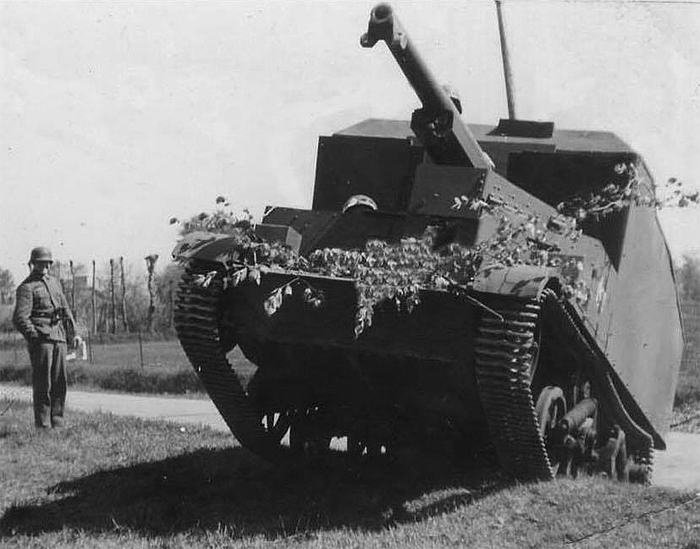
the FK231(f) self-propelled gun on the chassis of a former British Universal Carrier, most likely during driving trials, source: Flickr.com, edited
Where the standard Universal Carrier had its cargo area, a partially enclosed fighting compartment was created instead. Its front wall consisted of a large shield mounted directly to the gun. Relatively tall steel plates were bolted to the sides. The forward driver's and gunner's positions were fitted with simple roof hatches that opened rearward. As can be seen in one of the photographs, an open hatch could be secured with a chain attached to the gun shield. The roof of the fighting compartment, however, remained open, and the same was most likely true of its rear. That said, the armour described must necessarily have been very thin, as the chassis had a limited load capacity.
How many men made up the crew of the resulting self-propelled gun is unknown, but there must have been at least three: a driver, a loader, and a gunner/commander. Whether the vehicle ever saw action is not known, nor is it clear whether it was ever truly combat-capable. The surviving photographs may have been taken during trials, as the vehicle is shown first climbing a roadside embankment and then driving back down over it.

ARTICLE
CONTENTS:
Reproducing text from the Panzernet website without the written consent of the operator is prohibited.