SELBSTFAHRLAFETTE RSO
experimental conversions of an artillery tractor
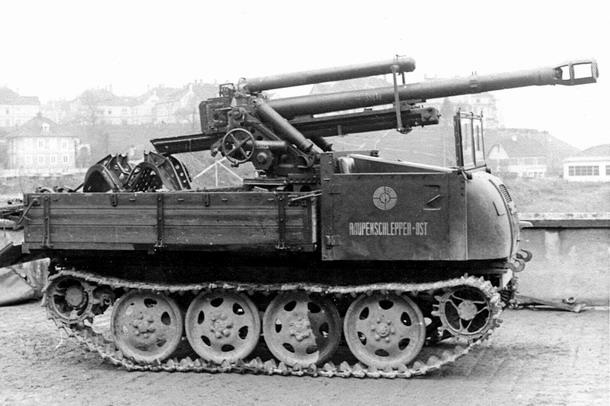
the 10.5 cm Gebirgshaubitze 40 mountain howitzer mounted on an RSO tractor chassis — was this truly intended as a self-propelled gun, or merely a new way of transporting the weapon instead of towing it? Source: Flickr.com, published with the permission of the original contributor, edited
Detailed information on the development and possible production of self-propelled guns based on the RSO cargo tractor chassis is unfortunately scarce in the literature. The existence of such vehicles — or at least attempts to build them — is, however, clearly confirmed by several surviving photographs. In total, three different artillery weapons are documented as having been installed on the RSO (not counting the Pak 40 anti-tank gun installation, which is covered in a separate article HERE): the 7.5 cm Gebirgsgeschütz 36, the 10.5 cm Gebirgshaubitze 40, and the 15 cm schwere Infanteriegeschütz 33. But first, let us say a few words about the RSO tractor itself.
A tractor for the Eastern Front
The very first autumn on the Eastern Front made it abundantly clear to the Germans that wheeled trucks and Russian unpaved roads simply were not going to get along. No sooner had the soldiers struggled through oceans of mud brought by the autumn rains than their vehicles found themselves wading through deep snow. And when the snow melted, the endless Russian mud returned. The Germans simply needed a new vehicle capable of hauling loads under these extreme conditions. The basic requirements for such a machine included low procurement costs, the ability to enter series production very quickly, no dependence on scarce materials such as rubber, excellent cross-country mobility, reliability in all weather conditions, and a high tractive force-to-weight ratio. Travel speed, by contrast, was not a priority.
The task of developing this rugged all-weather workhorse was assigned to the Austrian firm Steyr (Steyr-Daimler-Puch A.G., part of the Reichswerke Hermann Göring conglomerate). In the summer of 1942, Steyr presented the German army with a design that made extensive use of components from the already-produced Steyr 1500 A cross-country vehicle. After successful trials, series production began in November 1942 under the designation Raupenschlepper Ost (literally "tracked tractor East"), abbreviated RSO. Early operational experience on the Eastern Front confirmed that the vehicle met the soldiers' expectations, and large-scale production got underway. The RSO could carry a payload of 1.5 tonnes directly on its cargo bed and tow an additional 2 tonnes behind it. Thanks to its fully tracked running gear and 55 cm ground clearance, the vehicle could handle mud and deep snow alike. Production apparently continued until the end of the war, with several firms joining the original manufacturer Steyr. Across three production generations designated RSO/01, RSO/02, and RSO/03, approximately 27,000 vehicles were built (other figures are sometimes cited). The troops used these machines to transport all manner of supplies and to tow lighter artillery pieces.
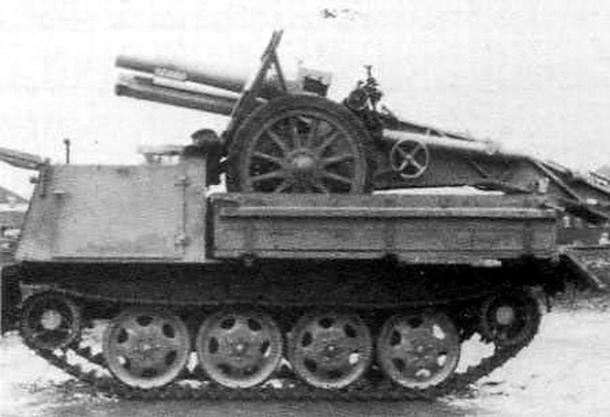
the 150 mm heavy infantry gun sIG 33 mounted on an RSO tractor chassis — again it is not entirely clear whether this was intended as a genuine permanent installation or merely a test of its transport capacity; source: Flickr.com, published with the permission of the original contributor, edited
A closed load-bearing frame ran along the centre of the chassis, housing a 180-litre fuel tank, a four-speed gearbox, and a Steyr V-8 air-cooled petrol engine of 3.517 litres displacement, producing 80 horsepower at 3,000 rpm. The engine sat essentially above the level of the frame, meaning that a large part of it was actually located inside the cab, between the driver and his co-driver (the vehicle commander). The drive sprockets were positioned at the rear — somewhat unusually. The front wheels served as track tensioners but also assisted with steering, as they were fitted with brakes (and were therefore toothed as well). The running gear on each side consisted of four large road wheels, paired on shared swing arms. Two swing arms on each side were attached to a long tubular beam running alongside the main frame. This beam was connected to the frame at its midpoint via a single pivot, allowing the frame to rock fore and aft over the running gear. This movement was damped by leaf springs. The tracks were 340 mm wide, each comprising 69 links (some sources say 65). At the front of the vehicle sat the cab for the driver and commander, its walls welded from unhardened steel plate just 3 mm thick. The driver operated the vehicle using the standard three-pedal arrangement, a gear lever, and two steering brake levers.
15 cm sIG 33
The cargo bed at the rear of the vehicle was naturally used for mounting the weapons. The order in which the various gun types were experimentally fitted to the RSO chassis is not clear from either the literature or the photographs. We shall therefore venture a little speculation. The heavy infantry gun sIG 33 of 150 mm calibre was very commonly used as the basis for various more or less improvised self-propelled guns. This made sense in its case, since the weapon had only a very limited range (4,700 metres maximum). When supporting fast-moving units, the gun therefore had to change position frequently, and mounting it on a self-propelled chassis would naturally make this much easier. Moreover, the German army had large numbers of sIG 33 guns in service, making them readily available for various "experiments".
There is probably only one photograph showing the sIG 33 mounted on the RSO chassis, but even from that single image quite a lot can be read. The designers evidently made no modifications to the gun before fitting it, which suggests the purpose of the trial was simply to see how the vehicle would behave with such a load at all. Even with the gun positioned right at the front of the cargo bed — its shield almost touching the rear wall of the driver's cab — the massive trail spade assembly still protrudes enormously beyond the rear of the vehicle. In an effort to reduce the load on the chassis, the designers used an older version of the gun fitted with wooden wheels, but this was most likely not enough. The weapon weighed somewhere between 1,700 and 1,800 kg, which already exceeded the cargo bed's rated capacity of 1,500 kg on its own — to say nothing of the dynamic stresses during firing. It seems likely that further work with this particular weapon was abandoned, and the designers turned to something smaller and lighter.
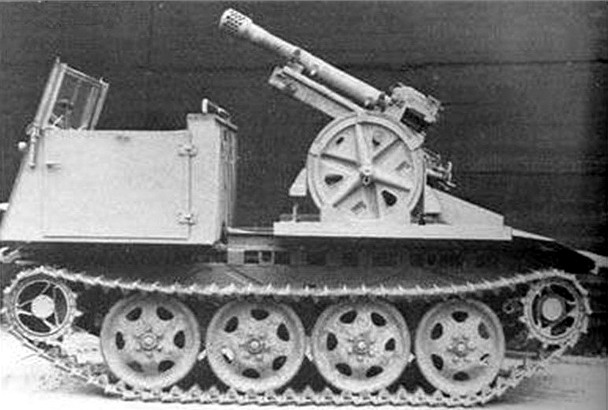
the light mountain gun 7.5 cm Gebirgsgeschütz 36 was the only one of all the weapons tested to fit within the RSO tractor's load capacity, and the way it was installed — without rear trail legs — fairly clearly points to the intention of a proper permanent mounting; source: Flickr.com, published with the permission of the original contributor, edited
10.5 cm Gebirgshaubitze 40
The next candidate was most likely the Gebirgshaubitze 40 mountain howitzer of 105 mm calibre. This too turned out to be an unfortunate choice. Although it was a significantly smaller-calibre weapon than the sIG 33, the weight difference was negligible — the GebH 40 came in at around 1,660 kg, again exceeding the vehicle's payload capacity. The surviving photographs suggest that at least two experimental examples were built in this case, both based on factory test vehicles. One used a tractor with solid road wheels (without lightening holes), and the howitzer was mounted complete with its own wheels and long rear trail legs. The dismounted spades — used to anchor the trail legs in the ground — were even stored on board. The second example (the only one captured in a photograph of reasonable quality) had the howitzer installed without its wheels, but the trail legs were retained in full length, again protruding behind the vehicle, and again with the dismounted spades stowed on board. But what would be the point of that? Why would a self-propelled gun need to carry trail spades, which the weapon only needs when emplaced on the ground?
Looking at the sIG 33 and GebH 40 installations — with their long trail legs, wheels, and spades still aboard — the obvious question arises: were these really intended as permanent installations, i.e. as true self-propelled guns? Might the actual goal of the experiments have been to explore the possibility of transporting these weapons on the RSO's cargo bed rather than towing them behind? But if so, there would have been no need to go to the trouble of actually loading the guns — a simple comparison of their weight and dimensions against the RSO's specifications would have made it obvious to anyone with a clear head that the vehicle stood no chance of accommodating them. And even if it somehow could, how on earth were soldiers in field conditions supposed to unload such heavy guns from the tractor — and, heaven forbid, load them back on again? Then there is the question of why one of the GebH 40 examples had the howitzer mounted without its wheels. That particular installation does not look like a transport test.
7.5 cm Gebirgsgeschütz 36
Let us leave those questions unanswered and turn to the third and final artillery weapon to find its way onto the RSO's cargo bed: the Gebirgsgeschütz 36 mountain gun of 75 mm calibre. In this one case we can say with reasonable confidence that the experimental vehicle was intended to be a genuine self-propelled gun. Before being loaded onto the tractor, this weapon had been substantially modified: its rear trail legs were cut to less than half their original length so they would not extend beyond the vehicle's footprint. The wheels were retained, but secured in special brackets built into the floor of the cargo bed. The Gebirgsgeschütz 36 is also the only one of the three weapons for which a permanent installation on the RSO is at all conceivable — it weighed just 750 kg (and certainly even less after the trail legs were shortened).
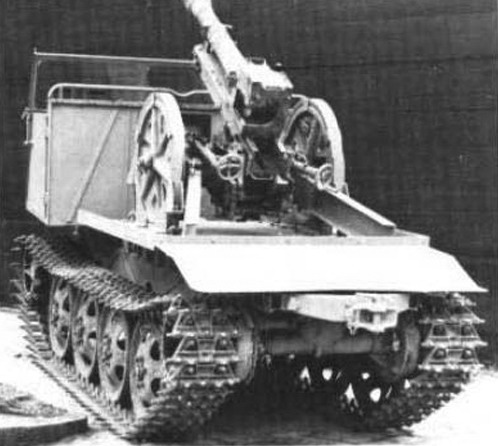
the 7.5 cm Gebirgsgeschütz 36 on the RSO tractor chassis — this view clearly shows the shortened rear trail legs; source: Flickr.com, published with the permission of the original contributor, edited
The Gebirgsgeschütz 36 was designed (as its name implies) for mountain units. Weapons of this type are built from the outset for use in very rugged terrain where motor vehicles have no chance of going, and must therefore be light and capable of being broken down into individual loads that can be carried on the backs of horses or mules. The Gebirgsgeschütz 36 was no exception: weighing the already-mentioned 750 kg, it could be disassembled into eight separate components. The weapon used separate-loading ammunition, allowing the gunner to adjust range not only by elevating the barrel but also by selecting a stronger or weaker propellant charge — five charges of varying strength were available in total. With the largest charge, the gun could send a 5.75 kg high-explosive shell to a maximum range of 9,150 metres.
The mount allowed 20 degrees of traverse to each side and elevation from -2 to +70 degrees. Given its low weight, the gun had difficulty absorbing the energy generated by firing. At high elevations this was less of a problem, as the recoil energy was directed downward into the mount; but at low angles the rearward recoil force caused the light gun to bounce and rear up. For this reason, the use of the maximum propellant charge was prohibited at elevation angles below 15 degrees.
The Gebirgsgeschütz 36 was the only one of the three guns to fall within the RSO's payload capacity, with enough margin left over for the crew's weight and a basic load of ready ammunition. Additional ammunition could furthermore be carried in a towed trailer. What remains unknown, however, is how the gun would have behaved when fired while bolted to the tractor's cargo bed with shortened trail legs — no source addresses this. It is likely it was far from ideal, and the entire project probably went no further than the construction of a single proof-of-concept demonstrator.
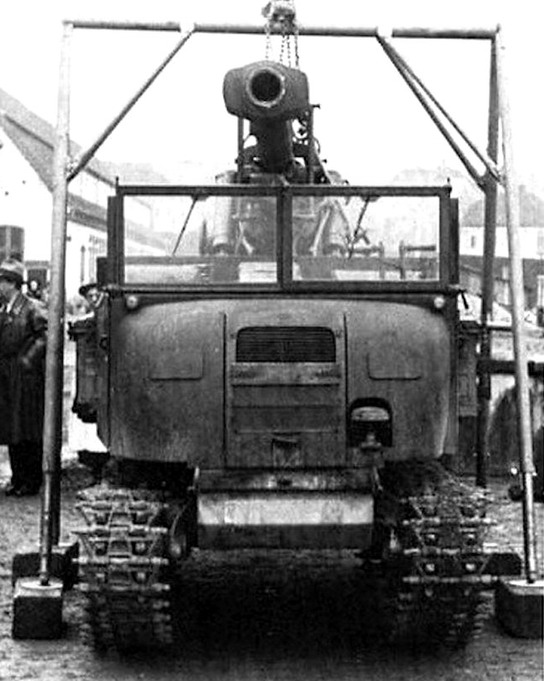
the 10.5 cm Gebirgshaubitze 40 being lifted onto an RSO chassis using a simple gantry crane; source: Flickr.com, published with the permission of the original contributor, edited
Who actually carried out the experiments of fitting artillery weapons to the RSO chassis? The photographs suggest it was not a field workshop of some frontline unit, but most likely the Steyr factory itself. The backgrounds visible in the available photographs point more to a factory environment than field conditions — though this does not apply to all the images. Furthermore, as the very first photograph in this article clearly shows, the Gebirgshaubitze 40 was mounted on a factory test vehicle with the company logo visible on the side of the cab. It is possible that this was even a Steyr initiative, with the firm trying to expand the range of applications for its own product.

ARTICLE
CONTENTS:
Reproducing text from the Panzernet website without the written consent of the operator is prohibited.