3.7 cm PaK 36 auf RENAULT UE
improvised tank destroyer
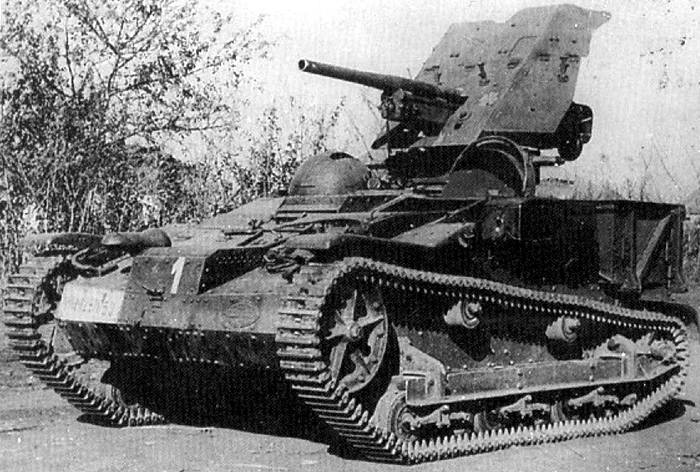
3.7 cm PaK 36 auf Infanterieschlepper UE (f), source: Aviarmor.net, edited
Among the captured equipment that fell into German hands in France were several hundred small tracked cargo carriers of the type Renault UE. These vehicles had served the French army primarily as ammunition carriers. Despite their compact dimensions, the Renault UE could carry 400 kg of supplies in its own rear cargo compartment, plus a further 500 kg in a towed trailer. The running gear on each side consisted of six small road wheels, suspended and sprung in pairs, separated by a flat longitudinal beam connected at the rear to a spoked idler wheel. At the very front was a spoked drive sprocket. The upper run of the track rested on two return rollers.
The engine was located at the very front of the hull. Behind it was space for the two-man crew. Above their positions, the hatch covers projected above the roofline in the form of small domes — the roof itself was too low for the crew's heads to fit beneath it otherwise. These dome-shaped covers had a narrow vision slit at the front. Armour protection reached 7 mm on the nose and sides, and only 4 mm at the rear. The powerplant was a four-cylinder engine of 2.1 litres displacement, producing a maximum of 38 horsepower.
An unknown number of these vehicles were converted for the German army into improvised light tank destroyers. A German PaK 36 anti-tank gun in 37 mm calibre was mounted on a pivot at the edge of the former cargo compartment, directly behind the crew's dome covers. No special structural modifications were made to the superstructure, and the gun's own frontal shield remained the only protection for the crew operating it. The vehicle received the official designation 3,7cm PaK 36 auf Infanterieschlepper UE (f).
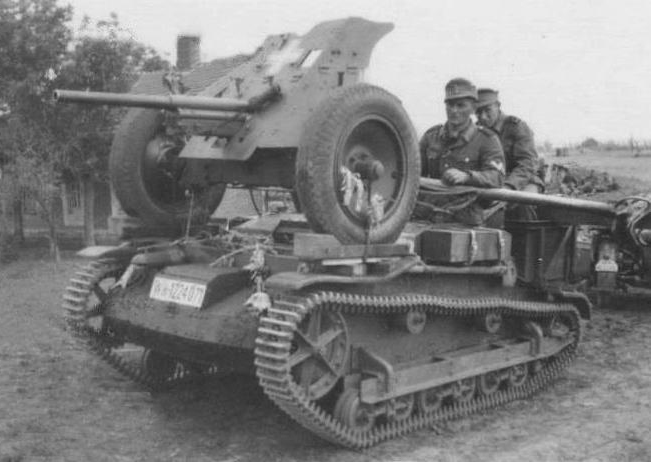
a field-expedient installation of the 3.7 cm PaK 36 gun on a Renault UE chassis, source: forum.warthunder.com, edited
As is immediately apparent, this was an extremely makeshift solution, and the vehicle was never destined for any significant combat success — both because of its overall design and the choice of weapon. The 37 mm gun was already considered inadequate at the very start of the war. German soldiers had taken to calling it the "door knocker," a reference to its inability to penetrate the armour of modern tanks.
Photographs — such as the one above — also document an unofficial variant of this vehicle. It appears that in field conditions, soldiers simply placed a towed PaK 36 anti-tank gun directly onto an unmodified chassis, complete with its wheels. The vehicle in the photograph could theoretically be just a test prototype checking whether the chassis could bear the gun's weight rather than an actual combat vehicle — but several details argue against this interpretation. A Balkenkreuz was painted on the gun's shield, which was not standard practice and would have been unnecessary on a mere test prototype. Further photographs also show this same vehicle festooned with branches for camouflage.
In addition to this improvised tank destroyer, the Germans also made use of the French carrier as the basis for a self-propelled rocket launcher — a vehicle described in a separate article.
Reproducing text from the Panzernet website without the written consent of the operator is prohibited.