M.K.A.
the export tank that never was
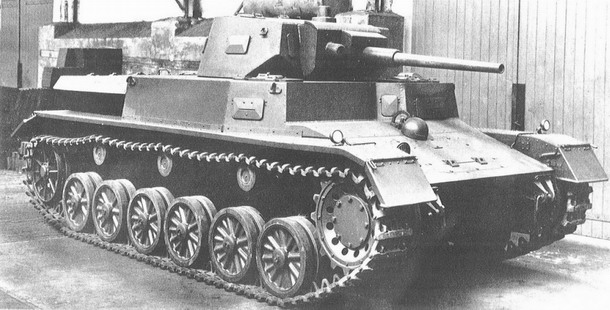
prototype of Krupp's M.K.A. export tank; the vehicle is sometimes incorrectly regarded as an intermediate development stage of the Panzer IV; source: Flickr.com with permission of the publishing user, edited
Krupp and Tanks for Export
In the years following the First World War, tanks gradually became an increasingly common part of the arsenal not just of European armies but of many others around the world. Naturally, they also became an increasingly attractive commercial commodity. Many tank manufacturers soon realised that they did not have to simply wait for orders from their own home armies — they could develop "commercial" tank types and actively market them abroad, particularly to countries that were unable, for various reasons, to develop their own armoured vehicles. In 1936, the German firm Krupp joined this group of manufacturers. The first type they began planning was a light tank designated the L.K.A. 1. By early 1937, however, the export tank programme had expanded to encompass six different types, based on three distinct chassis.
A shared chassis was to underpin the light L.K.A. 1 with twin machine guns and the L.K.A. 2 with a 20 mm gun. A heavier chassis was intended for the more heavily armoured 2 cm K.A.v, also carrying a 20 mm gun, and the M.K.A. with a 45 mm gun. A third chassis type was to serve as the basis for the 4.5 cm K.A.v (a more heavily armoured version of the M.K.A.) and the S.K.A. with a 75 mm gun. Of all these planned vehicles, only three made it to the prototype stage. The light L.K.A. 1 and L.K.A. 2 are covered separately, while the medium M.K.A. is described in the following paragraphs. The vehicle's full designation was mittlerer Kampfwagen Ausland — literally "medium tank (for) foreign (use)". In various official documents it was also referred to as the 4,5 cm K.A.
Design Parameters
In June 1937, a list of expected basic parameters for the tank was drawn up. The design called for a weight of around 12 tonnes, a top speed of up to 40 km/h, a four-man crew, and armament consisting of a 45 mm gun and two 7.92 mm machine guns. The M.K.A. was to be powered by an engine delivering 180 to 200 horsepower, with the specific unit still to be selected. The designers' attention was focused on the Maybach HL 76, a 200 hp engine then still under development. As progress on that powerplant was not going entirely to plan, an alternative was also under consideration in the form of the twelve-cylinder Maybach DSO 8, which produced only 150 horsepower.
Krupp planned to develop a new gun of its own design for the M.K.A., work on which apparently began in October 1937. The weapon was to have a calibre of 45 mm with a barrel 50 calibres long (L/50). The gun's expected weight was 1,385 kg, and with a muzzle velocity of around 750 m/s it was to be capable of penetrating 40 mm of vertical armour at a range of 1,000 metres.
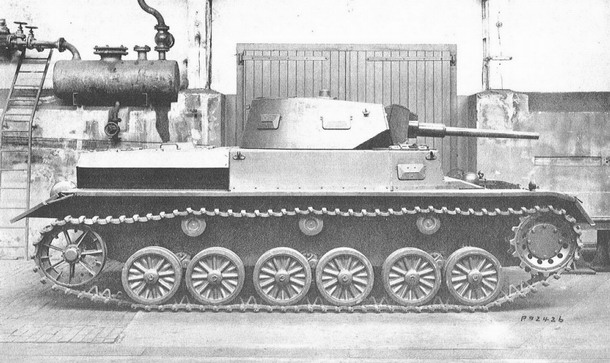
the M.K.A. medium export tank with a 45 mm gun; only a single prototype was ever built; source: Flickr.com with permission of the publishing user, edited
As with the light L.K.A., Krupp was required to apply to the German Waffenamt for permission to export the M.K.A. abroad. The Waffenamt's initial response of 7 October 1937 was broadly favourable, subject to certain conditions. Just two days later, however, the Waffenamt apparently reversed its position and refused to permit the export. One of the stated reasons was that the design of the entire engine compartment and cooling system followed too closely the solution used in the Panzer IV — a solution that had been developed, tested, and refined at considerable expense by the German Army, and from which Krupp would therefore be profiting without due justification. It is certainly true that the M.K.A. bore a strong resemblance to the Panzer IV Ausf. A — which is hardly surprising, given that both vehicles were designed by the same firm.
Krupp continued negotiations with the Waffenamt while pressing ahead with the construction of the first prototype. The hull and running gear were completed first, and the driving trials went well, so work continued. The completed prototype was not finished until sometime around the turn of 1939 and 1940 — by which point the war had already begun.
Prototype Description
The M.K.A. did indeed share a great deal with the medium Panzer IV. The running gear in particular resembled that of the B.W. II prototype, another Krupp design. At the front was a toothed drive sprocket, at the rear a spoked idler wheel, and between them six rubber-tyred road wheels. These were mounted and sprung in pairs, with two adjacent wheels sharing a single common bogie. The upper run of the track was supported by three small return rollers. The front face of the crew compartment was stepped in a similar fashion to the Panzer IV Ausf. A. Behind the crew compartment sat the engine bay, whose layout again closely resembled that of the Panzer IV, with air intake louvres on both sides. Although the original specification called for two machine guns, the prototype clearly had only one, mounted in the turret. Frontal armour thickness was 25 mm and the sides were 16 mm. The prototype was ultimately fitted with a Maybach HL 98 engine producing 230 horsepower.
The available sources do not make clear whether Krupp eventually succeeded in obtaining export approval from the Waffenamt. In any case, no sale of the M.K.A. to any foreign customer ever took place, and the first prototype built remained the only one. Whether this was due to an official ban by the Waffenamt, a lack of interest from potential buyers, or the outbreak of war, the historical record does not say.
ARTICLE
CONTENTS:
Reproducing text from the Panzernet website without the written consent of the operator is prohibited.