TANK IS-3
Stalin's heavyweight
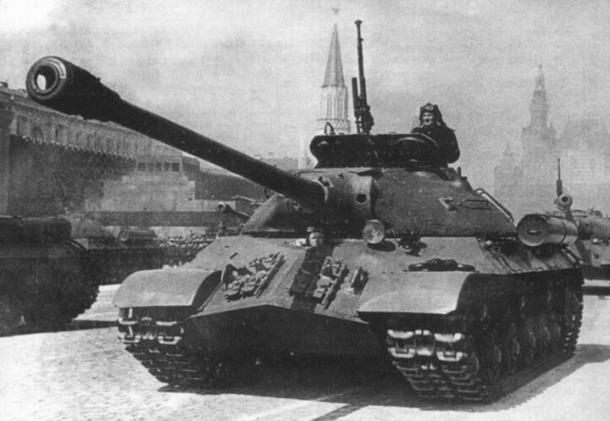
IS-3 tanks on parade in Red Square, source: Aviarmor.net with permission, edited
Origins of the Tank
The initial impetus for the development of the IS-3 can be traced back to the Battle of Kursk in the summer of 1943. Despite emerging victorious, the Soviets lost an enormous number of tanks in that battle and were determined to learn from the experience. They therefore dispatched a commission of experts from the Military Academy of Mechanisation and Motorisation to the battlefield, led by engineer A. Zavyalov. The commission's task was to examine the wrecks of destroyed vehicles and formulate recommendations for future tank development. One of the main conclusions was the need to increase the protection of tanks at the front, as this was where enemy rounds most frequently struck and penetrated.
Two competing design teams took this recommendation to heart and began development work on a new tank. The first, from the Kirov plant in Chelyabinsk, was led by N. L. Dukhov and M. F. Balzhi. The second team, from experimental factory No. 100, was headed by J. Y. Kotin and A. S. Yermolaev. The result was two competing projects, which were presented to the head of the tank industry, V. A. Malyshev, in the summer of 1944. Each caught his attention for a different reason. The Chelyabinsk factory's project featured a very modern conical turret whose design allowed for excellent armour effectiveness. Kotin's project, on the other hand, impressed with its highly distinctive hull front, designed by G. N. Moskvin and V. I. Tarotko.
After evaluating both projects, it was decided that in the interest of efficiency, work would continue on a single vehicle combining the best elements of each design — namely the turret from one and the hull front from the other. The project was given the designation Object 703, though it is also referred to as Kirovec-1. Work proceeded at the Chelyabinsk factory, and the first prototype of the new tank was completed in October 1944. After factory driving trials, it was sent to Moscow for army testing. Marshal of Armoured Forces P. A. Rotmistrov came in person to observe the trials and was very pleased with the tank's performance. Upon the completion of testing, the prototype was presented in December 1944 to A. M. Vasilevsky and G. K. Zhukov, who then briefed Stalin personally. Stalin subsequently approved the start of series production under the designation IS-3.
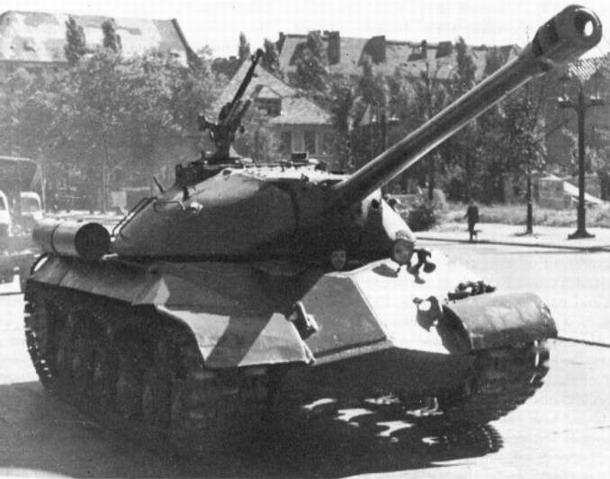
tank IS-3, source: Aviarmor.net with permission, edited
Technical Description
The running gear of the IS-3 was derived from that of the older IS-2. Again we find six road wheels on each side, all-steel with lightening indentations, each individually suspended and sprung by a torsion bar. The front idler wheel was of the same design as the road wheels. At the rear was the toothed drive sprocket. Three small all-steel return rollers supported the upper run of the track. The tracks were 65 cm wide.
The hull caught the eye immediately with its distinctive pike-nose front. At the very tip of the hull, the upper and lower armour plates met at a sharp angle. The upper plate was itself further kinked — or more precisely, it consisted of two panels angled both horizontally and vertically, so that the upper hull rose from the nose tip toward the rear while simultaneously sloping downward from the centreline toward the sides. The individual armour plates were joined by welding. Hull frontal armour was 120 mm thick (110 mm is sometimes given). The hull sides were 90 mm and the rear wall 60 mm.
This distinctive hull nose design improved protection by causing incoming rounds to deflect more readily off the angled armour. With a little imagination, the hull front resembled the nose of a pike, and soldiers did indeed sometimes give the tank that nickname. Connecting to the upper angled plates was a further slightly sloped triangular surface, only beyond which the flat hull roof began. Cut into this triangular section was the driver's entry and exit hatch — a significant improvement over the IS-2, in which the driver had no dedicated hatch of his own and in an emergency had to make his way out through the turret hatches.
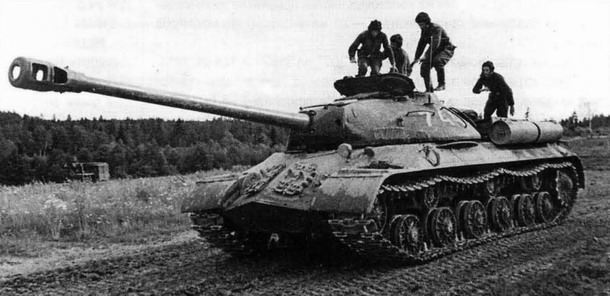
IS-3 tanks remained in Soviet Army service long after the war, source: Topwar.ru with permission, edited
At the front of the flat hull roof was mounted the fully rotating turret — another distinctive feature of the IS-3. It was cast, circular in plan, and conical in shape with steeply angled walls. The only element projecting from these sharply sloped sides was the rounded gun mantlet at the front. Armour thickness on the turret decreased from the ring upward toward the roof: while the lower portion measured 220 mm, the upper section was only 110 mm. The roof armour was 30 mm thick (20 mm is also cited). The gun mantlet was 250 mm thick. The sides and rear of the turret were studded with welded handholds for tank riders.
The main armament was the 122 mm D-25T gun, the same weapon fitted to the older IS-2. The barrel length was 48 calibres, or 5.85 metres. The rate of fire was two to three rounds per minute. Ammunition stowage was just 28 rounds — 10 armour-piercing and 18 high-explosive fragmentation. This makes clear that the tank's primary role was not fighting other tanks but engaging unarmoured targets and infantry. Gun elevation ranged from -2° to +19°. A coaxial 7.62 mm DT machine gun was fitted alongside the cannon, with 945 rounds carried.
At the rear of the turret roof was a wide oval hatch closed by two covers. In the right cover was a periscope used by the loader. In the left cover was a smaller circular hatch serving the commander when he needed to look outside without opening the full hatch. Adjacent to the left cover was a rotating ring mount for an additional machine gun — a DShK of 12.7 mm calibre, with 250 rounds of ammunition. This weapon was operated by the loader, who would open his hatch, swing the ring mount over the opening, pull himself up through it, and open fire when needed.
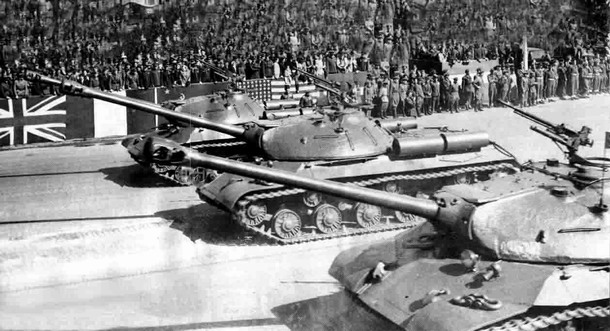
IS-3 tanks at the Victory Parade of the Allied powers in Berlin, September 1945, source: Aviarmor.net with permission, edited
The rear of the hull housed the engine compartment, containing a twelve-cylinder diesel V-2IS producing a maximum of 520 horsepower at 2,200 rpm — again the same powerplant as in the IS-2. Fuel was distributed across four separate internal tanks with a combined capacity of 450 litres. In addition, four external cylindrical tanks were fitted along the hull sides around the engine compartment — two on each side, each holding 90 litres. The external tanks were connected to the internal ones, and a remote-release mechanism was installed for jettisoning the external tanks in the event of fire.
The tank's total weight was 46.5 tonnes — a relatively modest figure given the strength of its armour and armament. The weight limit had been set by the army at the outset of development, at a level corresponding to the older IS-2 at 46 tonnes. The IS-3 could reach a maximum road speed of 40 km/h, though cross-country speed was limited to just 17 km/h.
The crew consisted of four men: the driver, seated in the front of the hull on the centreline; the gunner, positioned in the turret to the left of the gun; the commander, seated behind the gunner; and the loader, seated to the right of the gun. External communications were handled by a 10-RK-26 radio set with a whip antenna mounted on the right side of the turret.
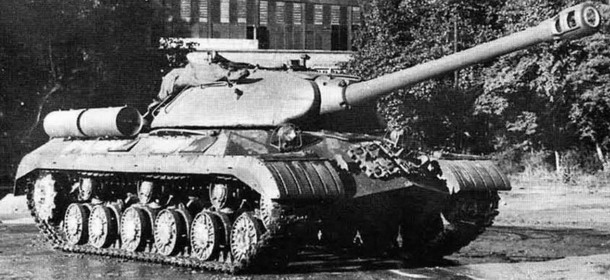
modernised IS-3M, source: Topwar.ru with permission, edited
The first production IS-3s left the Chelyabinsk factory in mid-May 1945. This date makes clear that the IS-3 never saw combat against Nazi Germany. The possibility that any took part in the fighting against Japan in the Far East also seems highly unlikely, though some sources do claim this occurred. The IS-3 thus belongs to the category of Second World War tanks by virtue of when it was developed, not by any combat record. Production continued until mid-1946, with a total of 2,311 vehicles built. As an interesting aside, the price of a single tank was 350,000 roubles.
The world learned of the existence of the new heavy tank on 7 September 1945, when a victory parade of the Allied armies was held in captured Berlin. Among the vehicles that passed the reviewing stand were 52 IS-3 tanks. The new vehicle, with its modern design and formidable power, left Western military and political figures stunned. For many of them, it was immediately apparent that they were watching a tank that could theoretically soon be turned against them.
The IS-3 was undeniably a very modern and forward-thinking design that set the direction of armoured vehicle development for decades to come. Nonetheless, it suffered from a number of shortcomings. These included the small ammunition load and the low rate of fire. The turret interior was cramped and uncomfortable — the price paid for the low silhouette and steeply angled walls. The engine was inadequate for such a heavy vehicle and frequently suffered from overloading and the mechanical failures that resulted. The gearbox, too, was less than reliable.
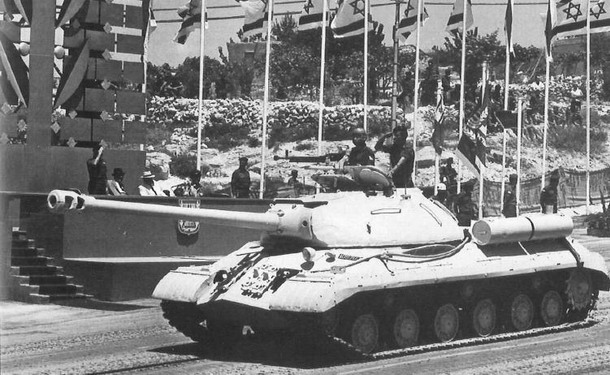
IS-3M originally in Egyptian service, captured by Israel, source: Aviarmor.net with permission, edited
The Modernised IS-3M
As early as 1946 a technical commission was formed to analyse the tank's most serious shortcomings and propose solutions. In 1948 a two-year modernisation programme was launched, known under the abbreviation UKN (Ustranenie Konstruktivnykh Nedostatkov — elimination of design deficiencies). This programme addressed the gearbox, the engine mounting arrangement, the radio equipment, and a number of other areas. As a result of the modifications, the tank's weight increased to 48.8 tonnes. Despite the improvements, the IS-3 remained unreliable.
A further modernisation was carried out in the late 1950s. The tanks received new machine guns, a new engine and gearbox, night vision devices, an upgraded cooling system, fire suppression equipment, new radios for both internal and external communications, and other improvements. The modernised vehicles received the new official designation IS-3M.
Beyond the Soviet Union, several other countries also received this tank. In 1946 Poland tested a number of IS-3s but ultimately did not adopt the type in large numbers. One or two evaluation examples were also acquired by Czechoslovakia in 1950, again without leading to any wider procurement. Egypt purchased a full hundred tanks — a mix of original IS-3s and modernised IS-3Ms — and committed them to combat against Israel. The Israelis captured several of these vehicles during the fighting and thus became another country in whose service the IS-3 appeared. An unknown number of tanks were also purchased by North Korea.

ARTICLE
CONTENTS:
Reproducing text from the Tankist website without the written consent of the operator is prohibited.