FLAMMPANZER III
Germany's most advanced flame tank
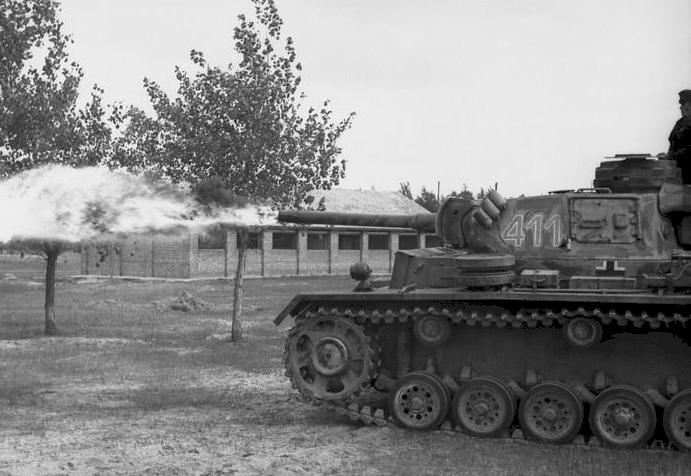
Flame tank PzKpfw III (Fl) during a burst of flame; source: Flickr.com with permission of the publishing user, edited
Origins
The Panzerkampfwagen III (Flamm), or less formally the Flammpanzer III, was Germany's most advanced and most numerous flame tank of the Second World War. It will come as no surprise that it was based on the Panzer III combat tank. Specifically, a batch of one hundred Panzer III Ausf. M tanks with hull numbers 77609 to 77708 was selected for conversion into Flammpanzers. The conversion work took place between February and April 1943 at the Wegmann factory in Kassel. The resulting flame tanks were assigned the ordnance designation Sd.Kfz. 141/3.
Design Description
The vehicle rode on six road wheels per side, each 520 mm in diameter, fitted with rubber tyres for a smoother ride and suspended by torsion bars. The guide teeth of the tracks ran through the narrow gap between the two discs of each road wheel. Because torsion bar suspension requires offset mounting points, the wheels on the right side of the hull were positioned slightly further forward than those on the left. The first and last road wheels were each fitted with an additional shock absorber, as these positions absorbed the greatest stress during travel. The running gear was completed by a front drive sprocket, a rear idler wheel, and three return rollers 310 mm in diameter, which supported the upper run of the 380 mm wide tracks.
Power came from a Maybach HL 120 TRM twelve-cylinder petrol engine with a displacement of 11.9 litres and an output of 300 horsepower. The engine was mounted at the rear of the hull, along with a 320-litre fuel tank, the batteries, and a cooling system comprising a radiator and two fans. A driveshaft connected the engine to the manual Zahnradfabrik SSG 77 gearbox at the front of the hull, positioned between the driver and radio operator. The gearbox offered six forward gears and one reverse.
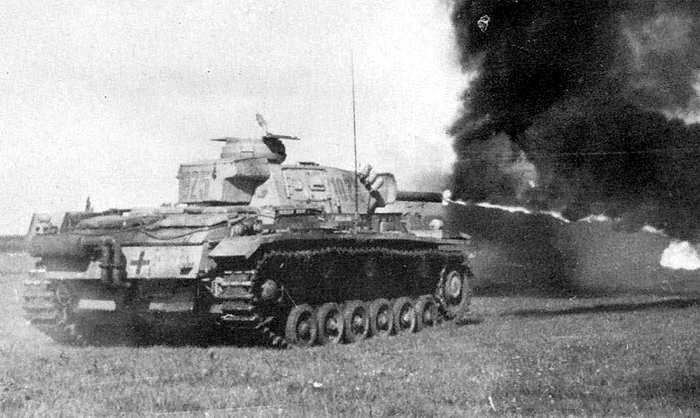
PzKpfw III (Fl), also known as the Flammpanzer III, during training; source: Worldwarphotos.info with the permission of the site operator, edited
On the standard Panzer III Ausf. M, the nose plates of the hull were 50 mm thick. On the Flammpanzer, however, these were reinforced by welding on additional 30 mm plates. The additional armour on the upper nose plate covered only the area between the steering brake cooling vents (see photo HERE, Public domain). The reason for this reinforcement was straightforward: a flame tank must close with its target far more than a conventional gun tank, which exposes it to enemy fire at much shorter range – and the extra protection was therefore very welcome.
The rest of the Flammpanzer's armour matched that of the standard Panzer III. The front plate of the driver and radio operator's compartment was 50 mm thick, with an additional spaced armour plate 20 mm thick mounted 100 mm in front of it. The hull sides were 30 mm thick and the rear plate 50 mm. The turret's front plate was also 50 mm thick, again supplemented by a 20 mm spaced plate. Both the turret sides and rear were 30 mm thick. The Panzerkampfwagen III (Flamm) weighed 23.8 tonnes – 1.3 tonnes more than the standard Panzer III Ausf. M – though its driving characteristics are likely to have remained very similar to those of the base vehicle.
Flamethrower
In place of the standard 50 mm gun, the turret was fitted with a flamethrower supplied by the firm Koebe. On either side of the hull, beneath the turret, were two large tanks holding a combined total of 1,020 litres of Flammöl – a mixture of petrol and coal tar. The pump that forced the fuel mixture into the projector barrel was driven by a small two-stroke Auto Union ZW 1101 auxiliary engine producing 28 horsepower, making the flamethrower system entirely independent of the tank's main engine. It is not clear from the available sources whether the auxiliary engine had its own dedicated fuel tank or drew petrol from the same tank as the main engine.
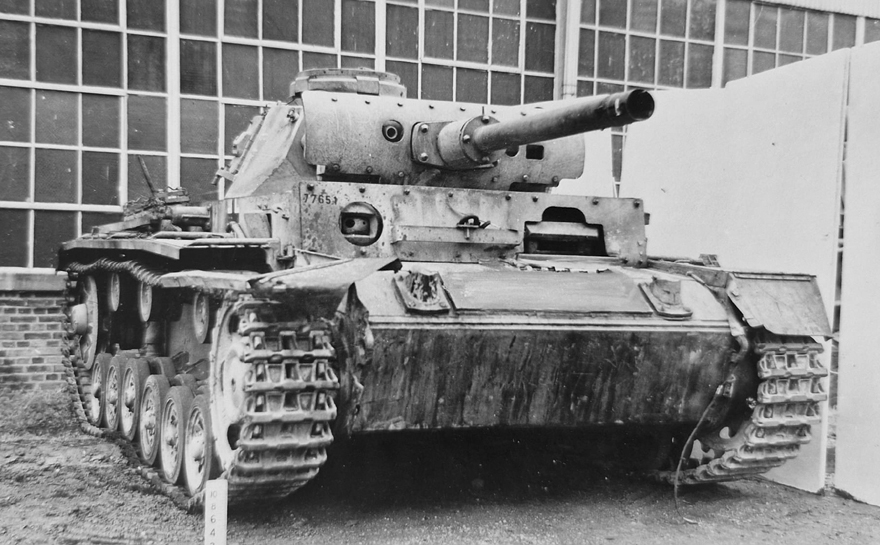
A Flammpanzer III captured by American forces; this photograph clearly shows the additional armour plate welded onto the hull nose; source: Flickr.com, Public domain, edited
The pump delivered the fuel mixture to the barrel at a pressure of 15 to 17 atmospheres, giving the flamethrower a range of 50 to 60 metres and a flow rate of approximately 7.8 litres per second. This meant the tank could deliver up to 130 one-second bursts. Ignition was provided by electric glow plugs (Smitskerzen). The flamethrower nozzle itself was quite narrow, with a bore of only 14 mm, but it was deliberately encased in a much wider tube designed to imitate a gun barrel and disguise the Flammpanzer at first glance as a standard combat tank. The rotating turret allowed unlimited traverse, while the mantlet permitted vertical elevation from −10° to +20°.
Crew
Whereas the standard Panzer III was crewed by five men, the flame variant was operated by just three. The other two positions were unnecessary and, in any case, the space they would have occupied was taken up by the fuel tanks. As usual, the driver sat at the front left. The radio operator doubled as the hull machine gunner. The crew was rounded out by the commander, who in addition to his command duties also served as both the flamethrower operator and the turret machine gunner.
In the standard Panzer III, turret traverse was controlled by the gunner; in the flame tank, however, all the relevant controls had to be relocated rearward to the commander's position. The commander was therefore provided with handwheels for traversing the turret and elevating the weapon, as well as two foot pedals acting as triggers – the left pedal fired the flamethrower and the right pedal fired the turret machine gun. The commander had to use the machine gun sparingly, however, since he could not reach it from his seat and was therefore unable to reload it quickly. That said, the gun was fed by a belt of 150 rounds, so reloading was not required all that frequently. For aiming both weapons, the commander used the forward vision port in his cupola, which was fitted with a sight on the inside; a simple post sight was also mounted on the flamethrower barrel.
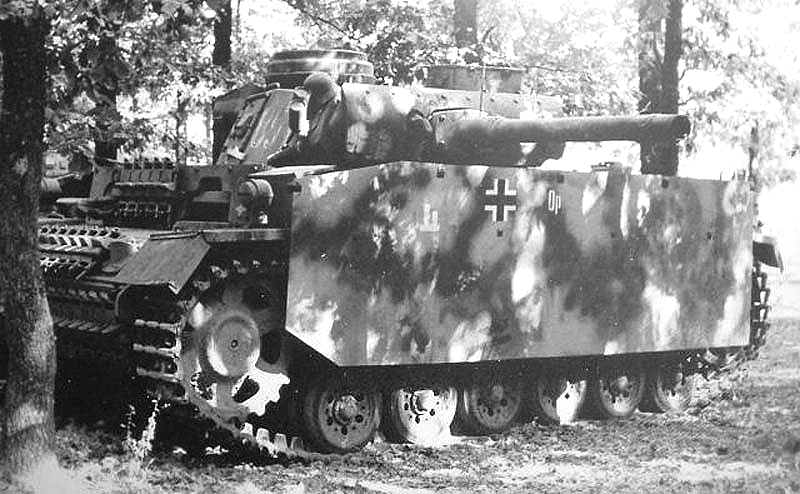
From May 1943, at least some Flammpanzer IIIs were fitted with the side skirt armour known as Schürzen; source: Worldwarphotos.info with the permission of the site operator, edited
From May 1943 onwards, standard Panzer III Ausf. M tanks began to be retrofitted with spaced armour plates along the hull and turret sides. Known as Schürzen (skirts), this armour was intended to provide additional protection against Soviet anti-tank rifles – though the more widely accepted theory is that it was primarily designed to defeat shaped-charge ammunition. As photographs confirm, these skirts also made their way onto the hull sides of at least some Panzer III (Fl) flame tanks.
Production and Organisation
As already noted, a total of one hundred Flammpanzer IIIs were built. The first 65 were accepted by ordnance inspectors from the Wegmann factory in February 1943, a further 34 followed in March, and the final example was delivered in April. The basic organisational unit for the Panzerkampfwagen III (Fl) was the armoured flame platoon (Panzer-Flamm-Zug), whose structure was laid down in directive K.St.N. 1190, issued on 25 January 1943. Each such platoon consisted of seven flame tanks and was assigned to the headquarters of a tank regiment within a standard panzer division.
The hundred vehicles were distributed among combat units as follows: 1st Panzer Division received 14 vehicles (two platoons); 6th Panzer Division received 15 vehicles (more than two platoons); 14th Panzer Division received 7 vehicles (one platoon); 16th Panzer Division received 7 vehicles (one platoon); 24th Panzer Division received 14 vehicles (two platoons); 26th Panzer Division received 14 vehicles (two platoons). The Panzergrenadier Division Grossdeutschland was originally allocated 28 vehicles (four platoons), but subsequently transferred 13 of them to the 11th Panzer Division. In addition to all of the above, one vehicle went to the tank training school at Wünsdorf.
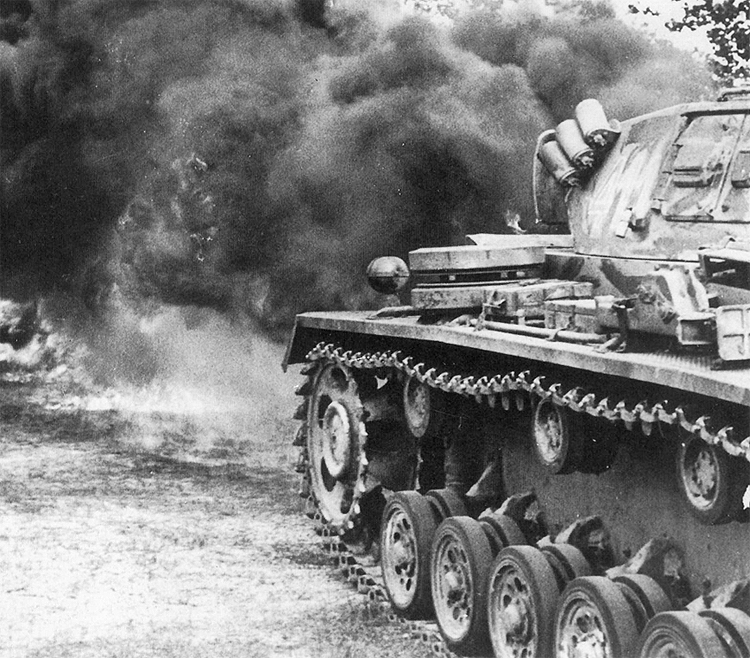
PzKpfw III (Fl) during training; source: Flickr.com with permission of the publishing user, edited
Combat Deployment
With the units listed above, the flame tanks saw action both on the Eastern Front and in Italy. Several detailed after-action reports have survived, giving us a clear picture of how they were employed in practice. We will begin with the account of the 26th Panzer Division's vehicles operating in central Italy in November and December 1943.
On the evening of 27 November 1943, Allied forces broke through the German defensive line and occupied the village of Mozzagrogna. Soldiers of the 26th Panzer Division immediately organised a counterattack. Five Panzer III (Fl) flame tanks, five Panzer IVs, three ex-Italian Semovente da 105/25 assault guns, and three ex-Italian Semovente da 75/18 assault guns were committed to the operation. The attack went in at 5 o'clock in the morning on 28 November. The objective was to drive out the Allies, retake the village, and restore the original defensive line before daylight gave enemy aircraft a chance to intervene.
By around 6 a.m. the Germans had entered the village, and after roughly 90 minutes of fighting they had it firmly back under their control – though the battle in the surrounding area continued for some time. One Flammpanzer III was knocked out by enemy fire and the crew subsequently had to destroy it themselves to prevent it falling into enemy hands. The commander of another Flammpanzer, Feldwebel Hoffmann, was fatally struck in the head. The Germans took prisoner one British officer and 13 soldiers from the Indian contingent. Once the operation was concluded, German infantry moved up to hold the defensive line while all the armoured vehicles began to withdraw. Unfortunately they then came under air attack, and all four of the remaining Panzer III (Fl) tanks were lightly damaged.
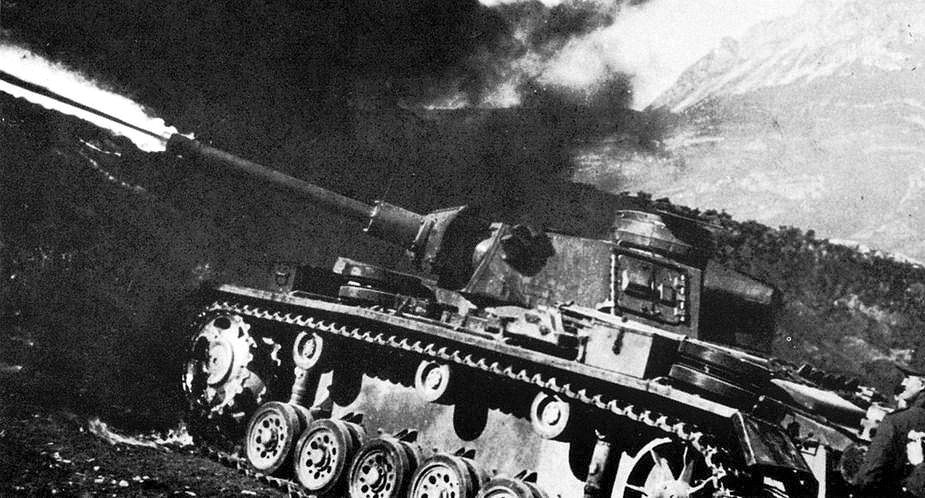
PzKpfw III (Fl) during training; source: Worldwarphotos.info with the permission of the site operator, edited
Barely three weeks later and roughly 20 km further north, the flame tanks of the 26th Panzer Division went into action again. On 16 December 1943, five Flammpanzer IIIs, along with one gun tank and one Semovente da 105/25 assault gun, attacked Allied troops dug in around the road running from the village of Orsogna towards the coastal town of Ortona. During the engagement the flame tanks fired more than 150 bursts and succeeded in flushing out and destroying a considerable number of enemy infantrymen. One Flammpanzer even managed to set fire to and knock out an enemy tank that had concealed itself in a haystack. German casualties amounted to two wounded, one missing, and two Flammpanzers damaged beyond repair.
How did the flame Panzer III (Fl) fare on the Eastern Front? During Operation Zitadelle in July 1943 they made a generally positive impression. On the southern flank of the German attack, 35 were deployed in total, of which 14 belonged to the Panzergrenadier Division Grossdeutschland. The vehicles reportedly proved their worth when clearing fortified positions in villages along the first Soviet defensive line. Although none was completely destroyed, 60% were put out of action. A report also survives concerning the use of Flammpanzers from the 36th Panzer Regiment in January 1944. In this instance the Germans committed the flame tanks in unsuitable terrain and against a well-armed opponent. On the very first attack, the vehicles found themselves in open, exposed ground and came under fire from Soviet anti-tank rifles and guns before they could close to effective range. Two Flammpanzers were destroyed, and the objectives of the operation were not achieved.
Over the course of 1943, 60 of the 100 PzKpfw III (Fl) built were lost. At least four flame tanks that returned from the front to Germany for major overhaul in 1944 were converted into StuG III assault guns. On 27 November 1944, Hitler ordered that at least 20 to 30 flame tanks be made available for a planned but unspecified special operation. To fulfil this order, 15 Flammpanzer IIIs were to be prepared: nine were to be older vehicles brought back to operational condition through major overhaul, while the remaining six were to be created by converting Bergepanzer III recovery vehicles. It is therefore possible that the total production figure for the Flammpanzer III reached 106 examples.
Technical Data
|
weight: |
23.8 t |
|
length: |
cca 6 m |
|
width: |
2.97 m |
|
height: |
2.5 m |
|
engine: |
Maybach HL 120 TRM |
|
engine output: |
300 hp |
|
max. speed: |
40 km/h |
|
fuel capacity: |
320 l |
|
range – road: |
155 km |
|
range – cross-country: |
95 km |
|
hull armour: |
|
|
- front: |
50+30/50+20 mm |
|
- sides: |
30 mm |
|
- rear: |
50 mm |
|
turret armour: |
|
|
- front: |
50+20 mm |
|
- sides: |
30 mm |
|
- rear: |
30 mm |
|
crew: |
3 men |
|
armament: |
1x flamethrower 2x MG 34 machine gun, 7.92 mm |
|
flame fuel capacity: |
1020 litres |

ARTICLE
CONTENTS:
Reproducing text from the Panzernet website without the written consent of the operator is prohibited.