7,5 cm Pak 40 auf Zgkw S307 (f)
a tank destroyer on a French artillery prime mover chassis
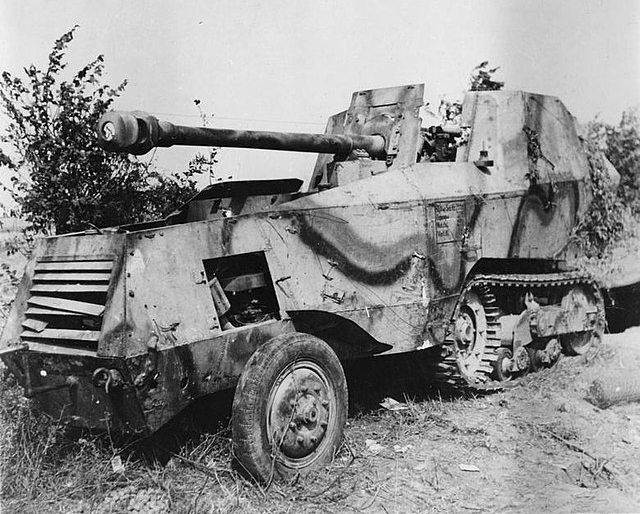
the wreck of a destroyed 7.5 cm Pak 40 auf Zgkw S307 (f), i.e. a tank destroyer built on the chassis of the SOMUA MCG artillery prime mover, source: Flickr.com, Public domain, edited
The SOMUA MCG cargo tractor
In the years before the Second World War, the company SOMUA (Société d'outillage mécanique et d'usinage d'artillerie) was one of the major suppliers to the French Army. It manufactured trucks, tanks, and also half-track tractors. The cargo and artillery prime mover designated MCG belonged to this last category. The tracked portion of its running gear was based on the patented design of engineer Adolphe Kégresse. Kégresse had originally developed this type of running gear for passenger cars while serving at the court of the Russian Tsar Nicholas II. The French engineer replaced the rear wheels of some of the Tsar's automobiles with rubber tracks, which greatly improved their ability to negotiate not only deep snow but also, for instance, soft mud.
When Kégresse returned from Russia to his native France in 1917, he began collaborating with Citroën on its half-track vehicle program, intended for both the commercial market and the military. The program proved successful, and licenses to manufacture half-tracks of Kégresse's design were soon acquired by several other companies, including the aforementioned SOMUA.
The half-track tractor designated SOMUA MCG entered production in 1932 and was intended for transporting infantry and cargo, towing 155 mm howitzers, and serving as a maintenance and recovery vehicle. The 6.8-tonne machine was powered by a 4.7-litre four-cylinder petrol engine producing up to 60 horsepower. The tracked portion of the running gear consisted of a front-mounted drive sprocket, a large rear idler wheel, four small road wheels, and one roller supporting the upper run of the track. The track itself was made of rubber, though fitted with metal cleats for better traction. The vehicle could carry a load of up to 1,500 kg directly on its bed and tow a trailer weighing up to 3,500 kg.
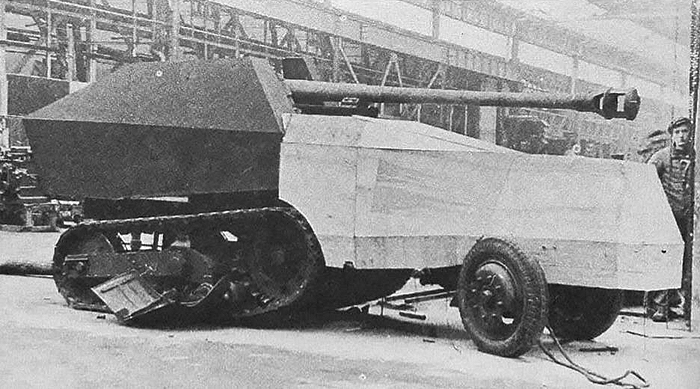
a partly wooden mock-up used to work out the armour design of the entire vehicle, source: Flickr.com, public domain, edited
Top road speed was around 31 km/h. The half-track was entirely unarmoured — the engine bonnet, driver's cab, and rear load bed (on the version fitted with one) all looked just like those of an ordinary civilian truck of the period. Unfortunately, the exact number of units produced remains rather unclear. According to some authors it was just over three hundred, according to others just under eight hundred, and figures as high as 1,500 sometimes appear as well, though this last number is most likely an exaggeration.
Baukommando Becker
With the capitulation of the French Army in 1940, the Wehrmacht came into possession of a considerable number of vehicles, including a substantial quantity of SOMUA MCG half-tracks. The Germans pressed these vehicles into service under the designation Leichter Zugkraftwagen S307 (f) and employed them in their original role as cargo and artillery tractors. Beyond that, however, they also undertook several conversions of the vehicle into weapons carriers. Behind these conversions stood an organisation known as Baukommando Becker (also referred to as Baustab Becker).
The driving force and commander behind Baukommando Becker was an artillery captain and trained mechanical engineer, Alfred Becker. From the summer of 1942, he and his men operated in France, tasked with breathing new life into a wide range of captured vehicles. In doing so, the Germans sought to obtain reasonably usable combat vehicles at minimal production cost, and above all without placing additional demands on the capacity of their already overburdened domestic arms industry. In time, the SOMUA MCG half-track tractor's turn came as well. In the Baukommando's workshops, this vehicle served as the basis for the self-propelled mortar Reihenwerfer and for a tank destroyer armed with a 75 mm Pak 40 gun. It is this second conversion that concerns us in this article.
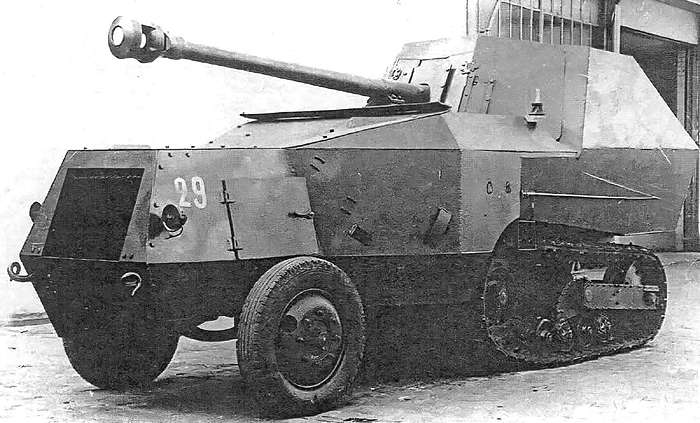
possibly one of the first completed 7.5 cm Pak 40 auf Zgkw S307 (f) vehicles, source: Flickr.com, used with the permission of the publishing user, edited
The half-track tank destroyer
It must be said right away that not a great deal of information is available on this vehicle. Even its official designation is far from clear-cut. Many different variants can be found in the literature, but we won't dwell on that and will stick with the short and reasonably unambiguous 7.5 cm Pak 40 auf Zgkw S307 (f). The total number of units built is likewise very uncertain. A German newsreel document from 7 September 1943, summarising the activities of Baukommando Becker up to that point, states that 16 examples of the half-track tank destroyer on the SOMUA chassis had been built. Other sources, however, claim that a total of 72 of these vehicles were built, along with a further 48 as unarmed ammunition carriers.
The German newsreel mentioned above suggests that the vehicles were converted at the Matford automobile factory in Poissy, west of Paris. As surviving photographs also show, the vehicle's design was first worked out using a wooden mock-up, after which the workers proceeded to "series" production. The engine compartment received a new bonnet with ventilation louvres and service access panels. Behind the engine sat the driver's and commander's cab. Although traffic in France drove on the right, meaning ordinary cars had the steering wheel on the left, many heavy military vehicles were built with the driver’s position on the opposite side (that is, on the right). The reason was simple: the driver of such a vehicle could then keep a better eye on the road shoulder while driving, and so avoid slipping or rolling over into the ditch.
This layout also applied to the SOMUA MCG tractor, and consequently to the tank destroyer described here, which was built on its chassis. The driver therefore sat in the cab on the right and the commander on the left. The commander also doubled as the radio operator, which is reflected in the placement of the antenna on the left side of the cab. The driver's and commander's cab had an open top, and it was through this opening that both men entered and exited the vehicle — there were no access doors in the side walls. This can hardly have been very comfortable, especially if one imagines being wounded and trying to quickly abandon a burning vehicle. The rear of the vehicle housed the fighting compartment, protected at the front and partly at the sides by light armour. Here, two further crew members had their stations — the gunner and the loader. According to some sources the crew numbered five men, though this is most likely inaccurate.
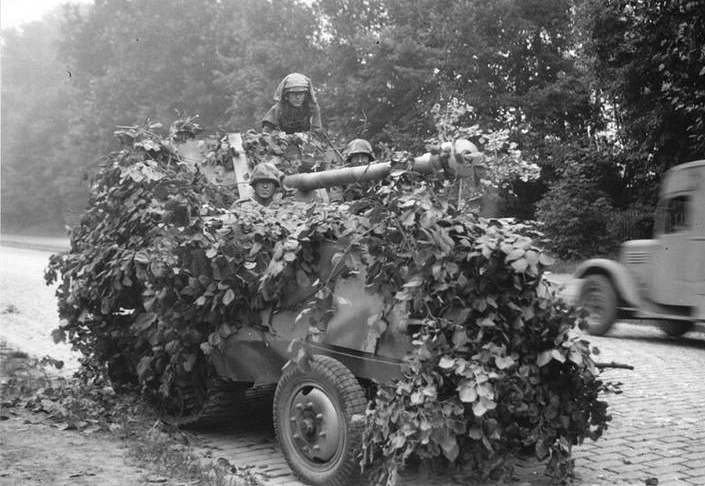
a 7.5 cm Pak 40 auf Zgkw S307 (f) on the move toward the front; owing to the Allies' overwhelming air superiority, the crew had to thoroughly camouflage the vehicle with foliage, source: Flickr.com, used with the permission of the publishing user, edited
Certain minor differences can be spotted in photographs of different vehicles. For instance, the louvres protecting the vent in the vehicle's front plate are horizontal on most examples, but there were evidently also vehicles fitted with vertically arranged louvres. The towing-cable eyes at the front were, on most machines, shaped rather like ram's horns, though at least one surviving photograph shows a vehicle fitted with eyes of an entirely different type. Some vehicles were fitted with simple round headlights, while others retained the original French headlights with their elongated armoured housings (the so-called phare blindé).
The 7.5 cm Pak 40 gun
The vehicle's main armament was the aforementioned 75 mm Pak 40 gun. This was a highly effective anti-tank weapon from Rheinmetall, with a barrel 46 calibres long. The gun featured automatic ejection of spent cartridge cases and a barrel bore with progressive (variable) rifling twist. This meant that the projectile's rotation increased gradually as it travelled down the barrel, reducing stress on both the projectile and the barrel itself.
Several types of ammunition were available for the gun, though we will focus on the two main anti-tank rounds: the armour-piercing Panzergranate 39 and the sub-calibre, tungsten-cored Panzergranate 40. As far as their performance is concerned, the literature offers a wide range of differing figures. Here, however, we will rely on Ian W. Hogg's German Artillery of World War Two. The 6.8 kg Panzergranate 39 projectile left the barrel at a muzzle velocity of around 792 m/s. At a range of 500 metres, this round could penetrate 104 mm of sloped homogeneous armour, and at a range of one kilometre it could defeat 89 mm of armour. The 3.18 kg Panzergranate 40, with its tungsten core, reached a muzzle velocity of 990 m/s and could penetrate 115 mm of sloped armour at 500 metres and 96 mm of armour at 1,000 metres.
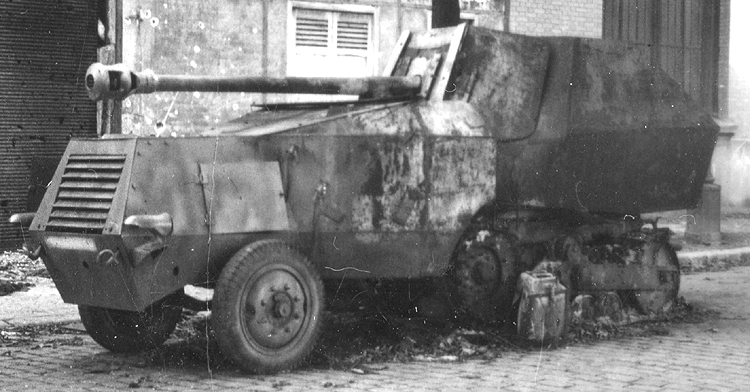
this 7.5 cm Pak 40 auf Zgkw S307 (f) has vertical protective louvres on the front grille and the original French headlights, source: Flickr.com, used with the permission of the publishing user, edited
The Pak 40 gun was aimed using a ZF 3x8 sight with 3x magnification and an 8-degree field of view. A small closable opening for the sight was cut into the front armour to the left of the gun. The ammunition for the gun was stored in a large bin in the middle of the fighting compartment. The front armour of the fighting compartment was connected to the gun and traversed sideways together with it. The secondary armament was an MG 34 or MG 42 machine gun, which could be mounted in a bracket on the armour in the right front corner of the cab. In addition, the soldiers on board carried an MP 40 submachine gun and a K98k rifle.
Organisation and deployment
The tank destroyers built on the SOMUA MCG chassis were, like other equipment produced by Baukommando Becker, most likely assigned to the so-called verstärkte Schnelle Brigade West, i.e. the reinforced "West" fast brigade. This unit was formed as part of German preparations for an anticipated Allied landing in France. It was intended to be a fully motorised formation capable of rapid movement to any point of unexpected threat. In July 1943, the High Command of the German Army issued an order under which the verstärkte Schnelle Brigade West was to be reorganised, expanded, and used as the foundation for reconstituting the 21. Panzer-Division (the original 21. Panzer-Division having been destroyed in North Africa in May 1943).
It was within this reconstituted 21. Panzer-Division that the vehicles described here saw actual combat use. Some sources cite specific engagements against the Allies, for instance near the villages of Bénouville, Colombelles, and Lassy (all in the vicinity of Caen). No further details are available, but it is likely that the last of the SOMUA MCG-based tank destroyers were lost no later than September 1944.
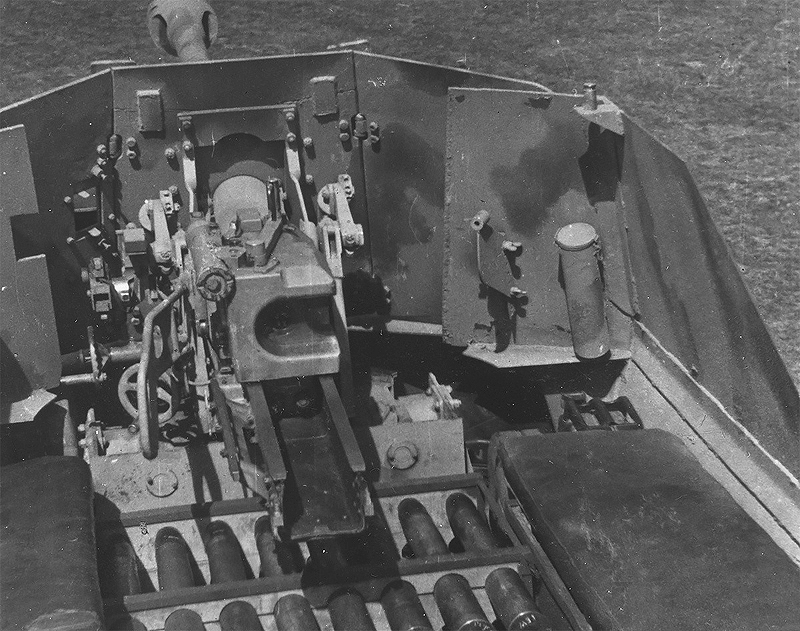
a view into the interior of a 7.5 cm Pak 40 auf Zgkw S307 (f); note the stowage for the gun's ammunition and the machine gun mount on the right side armour plate, source: Flickr.com, used with the permission of the publishing user, edited
Ammunition-carrier version
How many rounds for the Pak 40 gun could be carried aboard the half-track is not known, though it is clear the number was not large. For this reason, Baukommando Becker also built, on the same chassis, accompanying vehicles for transporting ammunition. These unarmed vehicles (not counting the crew's small arms) were also given armour, but compared to the combat vehicles described above, it was generally lower in height.
OBSAH ČLÁNKU:
Reproducing text from the Panzernet website without the written consent of the operator is prohibited.