VILLERS-BOCAGE
Michael Wittmann's demolition derby
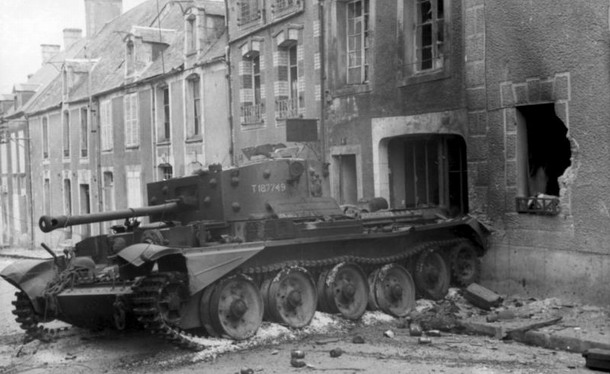
A British Cromwell tank destroyed at Villers-Bocage, source: Bundesarchiv_Bild_101I-738-0276-25A, Wikimedia, Creative Commons, edited
By the end of the first week of fighting after the Normandy landings, the American Fifth Army had succeeded in forcing the German 352nd Infantry Division to retreat, thereby exposing the flank of the elite Panzer Lehr Division, which was operating in the Caen area. General Montgomery decided to exploit this opportunity and launched Operation Perch. The 22nd Armoured Brigade of the British 7th Armoured Division was to swing around the German positions from the west, break through to Caen, and encircle the German forces there.
Leading the units tasked with carrying out the encirclement were three squadrons of the 4th County of London Yeomanry and A Company of the 1st Rifle Brigade. The units advanced along an arc centred on the city of Caen with a radius of roughly 30 km, successively occupying the towns and villages of St. Paul-du-Vernay, Livry, Briquessard, Amaye-sur-Seulles, and finally Villers-Bocage itself – which they reached on the morning of 13 June 1944.
Villers-Bocage lay at a crossroads of several important roads, including Route 175 leading from there to Caen. About 2 km east of the town itself was a prominent ridge known as Point 213. This position commanded an excellent view of the surrounding countryside and thus gave a considerable strategic advantage to whichever side held it.
This was recognised not only by the British but by the Germans as well, and they also dispatched troops towards Villers-Bocage – specifically part of the 2nd Company of the 101st SS Heavy Tank Battalion, under the command of SS-Obersturmführer Michael Wittmann.
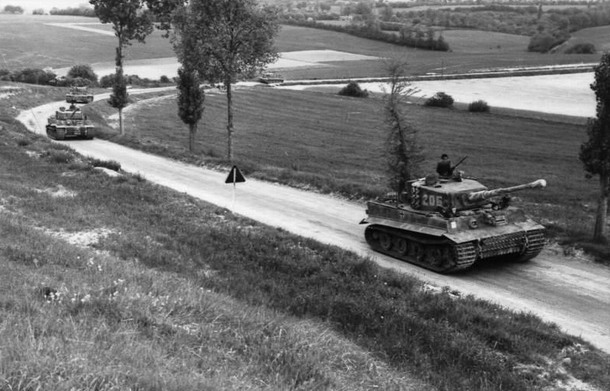
Tiger tanks moving through France towards the enemy in June 1944, source: Bundesarchiv_Bild_101I-299-1804-07, Wikimedia, Creative Commons, edited
The Germans reached Point 213 during the night of 12–13 June 1944, moving under cover of darkness to avoid the troublesome Allied air forces. When Wittmann went forward on a morning reconnaissance, he spotted a column of Allied vehicles on the road to Villers-Bocage. Wittmann hesitated momentarily over what to do. He himself had just six Tiger tanks at his disposal, while the Allied column comprised around two hundred armoured vehicles of all types. Calling for reinforcements by radio was out of the question, since it was more than likely that the enemy would intercept any transmission and act accordingly.
Which tanks exactly Wittmann had available that morning is not entirely clear, and the sources differ on this. Most likely they were Wittmann's own Tiger number 205, along with tanks number 221 (SS-Untersturmführer Georg Hantusch), 222 (SS-Unterscharführer Kurt Sowa), 223 (SS-Oberscharführer Jürgen Brandt), 233 (SS-Oberscharführer Georg Lötzsch), and 234 (SS-Unterscharführer Herbert Stief). Tiger number 233, however, had a damaged track and could not be committed to battle.
Meanwhile the British had split up at Villers-Bocage. A Squadron of the 4th County of London Yeomanry continued eastwards from the town towards Point 213, which it was to occupy. The rest of the units remained in the town itself. The British were inviting disaster by their behaviour. They left their vehicles parked nose-to-tail in the road without dispersing them or taking up defensive positions. Soldiers had dismounted to stretch their legs and rest after the journey. They were chatting, making tea, and accepting the thanks of the local population. Unit commanders held a briefing in the town square. In short, everyone was behaving as if they were nowhere near the front line at all.
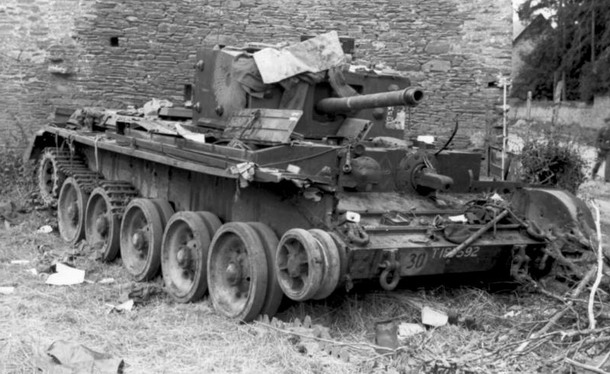
One of many British Cromwell tanks destroyed at Villers-Bocage, source: Bundesarchiv_Bild_101I-494-3376-20A, Wikimedia, Creative Commons, edited
When Wittmann saw that part of the British force was heading towards his position, he had to act. He ran to his tank, but to save precious time he ultimately boarded the nearest available vehicle – number 234 – and moved off. After just a few metres, however, the driver reported abnormal engine behaviour. Wittmann could not risk a breakdown in the middle of the fight. He therefore switched with his gunner Bobby Wohl to Kurt Sowa's tank number 222. It was approximately 9 o'clock when Wittmann set off towards the enemy.
Wittmann's plan was to cut off A Squadron of the 4th County of London Yeomanry, which was advancing towards Point 213, from the rest of the British forces in the town, and then attack the town directly. He moved in this direction alone, while the remaining four serviceable Tigers were to fall on the isolated A Squadron and destroy it.
Before he even reached the edge of the town, Wittmann destroyed two Cromwell tanks and one Sherman Firefly from A Squadron of the 4th County of London Yeomanry. On the eastern edge of town he then engaged A Company of the 1st Rifle Brigade, destroying nine of its half-tracked armoured carriers, four Bren Carriers, two other carriers of a different type, and two six-pounder anti-tank guns. At the junction with the road to Tilly-sur-Seulles he effortlessly knocked out three more light Stuart tanks and one half-tracked vehicle with his 88 mm gun, and then finally drove into the town itself.
In fairness it should be noted that not all the vehicles destroyed were in a position to offer resistance at the time. As already mentioned, the British crews had used the stop in town to stretch their legs, and when Wittmann's lightning attack began many of them did not even have time to get back to their vehicles, let alone place them in a suitable firing position. On top of this, they were being raked with machine-gun fire courtesy of radio operator Günther Jonas, which kept them more than busy trying to find cover.
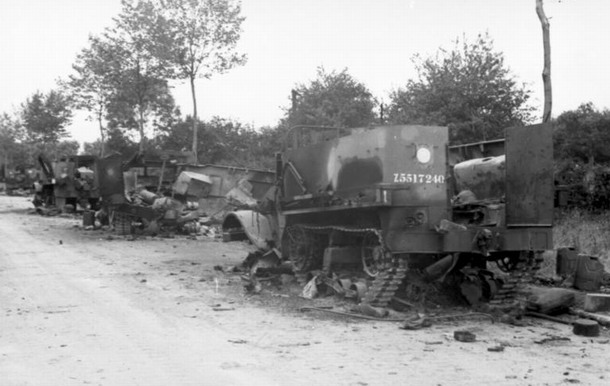
The road to Villers-Bocage was left literally strewn with destroyed Allied vehicles after the battle, source: Bundesarchiv_Bild_101I-494-3376-22A, Wikimedia, Creative Commons, edited
On entering the town along the main Rue Georges Clémenceau, Wittmann immediately ran into four Cromwell tanks. He destroyed three of them, while the fourth, commanded by Captain Dyas, managed to slip away into a side street between the buildings. Wittmann pressed on along the main street towards the town centre. His tank destroyed two more Sherman command tanks, one scout car, and one half-tracked carrier before coming face to face on Rue Pasteur with the Sherman Firefly of Sergeant Lockwood.
The Sherman Firefly was at that time the only Allied tank capable of penetrating even the front armour of a German Tiger at a reasonable range. Sergeant Lockwood fired four rounds at Wittmann. Only one scored a hit, and that only glancingly – it failed to knock out the Tiger but caused minor damage. As Wittmann's Tiger manoeuvred it pushed a section of wall onto Sergeant Lockwood's Sherman, inadvertently immobilising it and putting it out of the fight.
At that point, however, Wittmann realised that in the heat of battle he had pushed too far ahead of the rest of his unit – he was now in the very centre of town – and decided to withdraw. He retraced his route back through the town, again passing the spot where Captain Dyas's Cromwell had eluded him. This time Dyas was ready and fired twice at the passing Tiger. Although neither shot missed, neither penetrated the heavy German armour. The reverse, however, was not true: an 88 mm round from the Tiger passed through the wall of Dyas's Cromwell like a knife through butter.
The qualitative superiority of the Tiger tank was decisive in the Villers-Bocage engagement. Although Wittmann was a true master of armoured combat, he could hardly have achieved anything comparable that day had he been sitting in a different tank. The mistakes made by the British and the element of complete surprise also played their part, of course. Yet for all its qualities, even the Tiger was not indestructible, as Wittmann was about to discover.
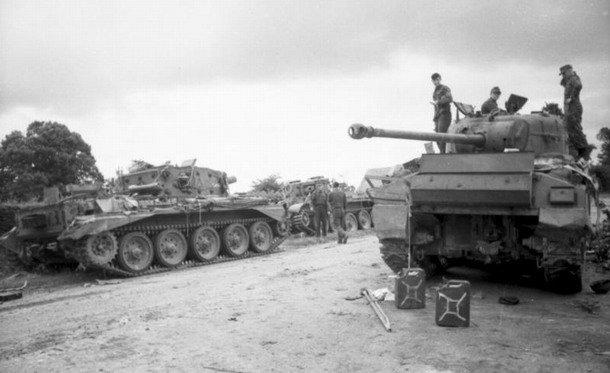
German soldiers examining the wrecks of Allied tanks at Villers-Bocage, source: Bundesarchiv_Bild_101I-738-0275-02, Wikimedia, Creative Commons, edited
As he continued withdrawing along the main street, Wittmann took a hit from a six-pounder anti-tank gun of A Company, 1st Rifle Brigade. The round damaged the left track and Wittmann was forced to stop. The disabled Tiger came to rest in front of a textile shop on Rue Pasteur. The crew abandoned the tank and made off on foot out of the town. Wittmann believed they would be able to bring up reinforcements and retake the whole town, and for this reason he did not order the relatively lightly damaged tank to be blown up – which was otherwise standard practice. The Germans were well aware of how valuable the Tigers were not only to themselves but also to the enemy, and they tried as far as possible to ensure that none of these tanks fell into enemy hands in working order.
Wittmann set off on foot to the headquarters of the Panzer Lehr Division, seven kilometres away. When he arrived and briefed the divisional commander Fritz Bayerlein on the situation, it was decided to send 15 Panzer IV tanks north of Villers-Bocage to prevent any British attempt at withdrawal. The advance of these tanks north of the town was eventually halted, however, by heavy British artillery fire. Bayerlein therefore ordered a withdrawal, regrouping, and a direct assault on the town with the hurriedly summoned 1st Company of the 101st SS Heavy Tank Battalion.
The aforementioned 1st Company under Rolf Möbius had meanwhile reached Point 213. Here Möbius met with Wittmann, who had been brought up from the Panzer Lehr Division headquarters by Kübelwagen, to discuss the coming attack. Shortly afterwards the Germans threw their full strength at the town. The British had by now naturally organised a more effective defence and the element of surprise was no longer a factor. Yet even though the British this time expected the attack and were still numerically superior, they could not hold the German onslaught, and at four o'clock in the afternoon their commanding officer finally gave the order to withdraw from the town.
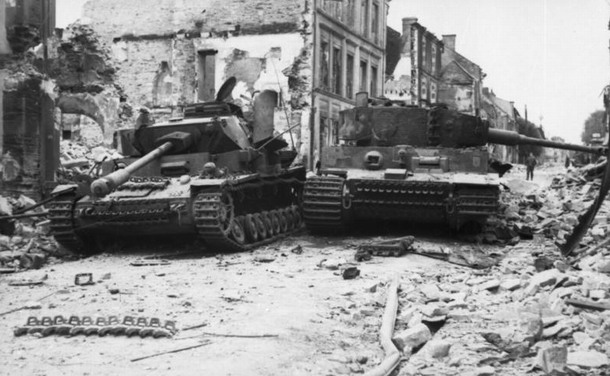
The Germans also lost more than one tank at Villers-Bocage – here specifically a destroyed Panzer IV and Tiger, source: Bundesarchiv_Bild_101I-494-3376-08A, Wikimedia, Creative Commons, edited
Villers-Bocage was thus back in German hands. During the fighting the British lost a total of 30 tanks, roughly the same number of other armoured vehicles, and several guns. The Germans lost five PzKpfw IV tanks and six Tiger tanks, though three of the Tigers were subsequently repaired, so their actual total loss was eight vehicles. The fighting also destroyed countless buildings in the town.
Wittmann himself destroyed 11 tanks and 16 other armoured vehicles that day and cemented his reputation as an armoured ace and a hero. German propaganda had a field day and credited Wittmann with 27 destroyed tanks – not 27 destroyed vehicles in total, but 27 tanks specifically, which was of course not true. Nevertheless, the courage and cool-headedness that Wittmann displayed at Villers-Bocage made this engagement a legend among tank crew members.

Reproducing text from the Panzernet website without the written consent of the operator is prohibited.