OPERATION ZITADELLE
the German attempt to eliminate the Kursk salient
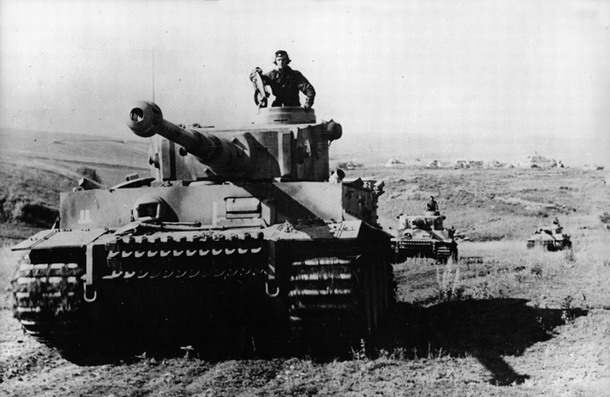
Tiger heavy tanks in the Kursk salient, source: Flickr.com with permission of the publishing user, edited
The Situation at the Front
After the Russians encircled the German Sixth Army (and other formations) at Stalingrad in November 1942, they launched a rapid drive westward. A German counteroffensive in December temporarily slowed their momentum (Operation Winter Storm), but it was repulsed, and through January and February the Soviets pressed forward at full speed. They drove the Germans from the Caucasus, captured Rostov, Luhansk, Izyum and Belgorod. On 16 February 1943 they also managed to push the Germans out of Kharkiv, but their advance was running out of steam. The Soviets had two months of marching and fighting behind them; their forward troops were exhausted, their equipment worn, their supply lines stretched. Field Marshal von Manstein had meanwhile managed to concentrate sufficient forces around Kharkiv and on 19 February 1943 launched his counterattack.
By 14 March Kharkiv was back in German hands. Belgorod was retaken two days later, and Manstein was preparing to continue the attack against the exhausted Russians. His plans were frustrated by the spring thaw, however, which turned roads and fields to mud and made further combat operations impossible. A strange calm settled over the battlefield, and both sides prepared to use the respite for rest, replenishment and planning their next moves. The front line had frozen in a rather awkward shape. The Germans held a salient with the recaptured Kharkiv and Belgorod; to the north of it lay a Russian salient centred on the city of Kursk; and further north still, the front formed another German salient around the city of Orel.
The victory at Kharkiv was celebrated by German propaganda, but in the broader picture it was no more than a partial success. The strategic situation of Germany was far from rosy. Stalingrad had been a catastrophe, costing the Wehrmacht enormous numbers of men and materiel; in North Africa the Germans were retreating before the Allies and their final defeat there was approaching; and the U-boat wolfpacks hunting Allied convoys in the Atlantic were also losing their edge. The civilian population back in the Reich was increasingly feeling not only Allied bombing but also the general hardships of a war economy. Many Germans were beginning to doubt the promised final victory — to say nothing of the Italians and Romanians. Hitler felt he needed a new triumph on the Eastern Front to show his nation and the world that it was the Germans who still held the strategic initiative.
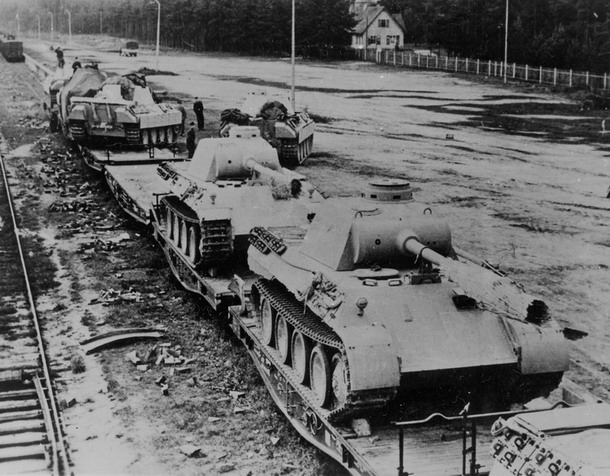
Kursk was also the combat debut of the Panther tank, source: Flickr.com with permission of the publishing user, edited
The German Plan
The German supreme command — and Hitler himself — was well aware that the Wehrmacht did not have the strength for a grand offensive along a broad front as in previous years. From the start of Operation Barbarossa to the end of March 1943, the German army in the east had sustained nearly 2.4 million killed, wounded or missing. In 1942 alone the Germans lost almost 2,500 tanks on the Russian front (Soviet tank losses that year amounted to around 20,000, but unlike the Germans, the Russians were able to replace them in abundance). When members of the German General Staff studied their maps in search of an ideal target for a limited offensive, the answer was not hard to find. The elimination of the Russian salient around Kursk presented itself as the obvious choice.
Some senior officers — such as Model and Guderian — recommended that Hitler go on the defensive instead and prepare to repel further large Soviet offensives. Hitler, however, would not hear of defence; he wanted to attack and advance. As early as March 1943 he therefore tasked his General Staff with drawing up plans for a future offensive. The basic concept for the operation, codenamed Zitadelle, was prepared by the Chief of the General Staff, General Zeitzler, and presented to Hitler on 11 April 1943. The plan called for a parallel attack from the northern and southern bases of the Russian salient. Both jaws of the pincers were then to close in around the city of Kursk, encircling vast numbers of Soviet soldiers. The northern attack was to be carried out by units of Army Group Centre, while units of Army Group South were to strike from the south.
On 15 April 1943 OKH issued Operational Order No. 6, which described the planned operation in further detail and placed the commanders of the relevant armies on combat alert. No specific date was set for the attack, but the order called for the operation to begin as soon as weather conditions permitted. Hitler's generals were far from united in their views on the offensive plan. Field Marshal von Manstein (commanding Army Group South) supported the proposal and wanted to attack as soon as possible, before the Russians had time to recover from their March defeat at Kharkiv. Field Marshal Günther von Kluge (commanding Army Group Centre) also backed the operation and played down the strength of the Russian defences. Generaloberst Walther Model (commanding the 9th Army) was against it. He warned Hitler that the operation would produce heavy losses and little or no gain. Generaloberst Heinz Guderian, Inspector of Panzer Troops, likewise considered Zitadelle a bad idea.
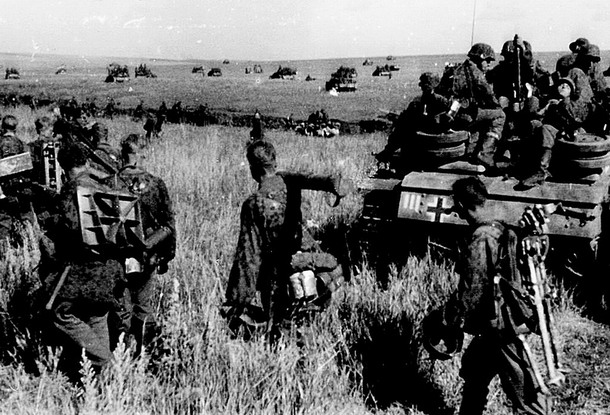
Fully armed grenadiers and tanks of the Das Reich division advancing across open country at the southern base of the Kursk salient, source: Flickr.com with permission of the publishing user, edited
Hitler himself apparently was not entirely certain about Operation Zitadelle either. He hesitated to issue the final order and postponed the start of the operation several times. He wanted to assemble the largest possible force for the attack and was also waiting for deliveries of new weapons — particularly Panther tanks and Ferdinand tank destroyers, in which he placed almost irrational hopes. In trading time for strength, however, he also gave the enemy time to build up — and the Russians made full use of every day they were given.
The Soviet Plan
Stalin wanted the Red Army to pick up where it had left off in mid-February as soon as the spring thaw ended — to renew the offensive and push the Germans off Soviet soil. Two of his best generals, Marshal Zhukov and Marshal Vasilevsky, came to him with a different proposal. Both commanders appreciated that the Wehrmacht was still powerful enough that another Soviet offensive carried a real risk of being repulsed, or succeeding only at enormous cost. At the same time, it was clear to them that Hitler himself would want to attack, and since they were looking at the same maps as the Germans, they reached the same conclusion: from the enemy's perspective, the most logical option was an attack on the bases of the Kursk salient.
On 12 April 1943 Zhukov and Vasilevsky appeared before Stalin and put forward the following proposal. The Red Army would temporarily go on the defensive, massively fortify the Kursk area and allow the Germans to attack. In the meantime the Soviets would concentrate as many reserves as possible, and once the best German divisions at the tip of the attack had sufficiently worn themselves down, the Red Army would launch a general counteroffensive. Stalin approved the plan and ordered preparations to begin. On the northern side of the salient, the defence against the Germans was to be handled by the Central Front under General Rokossovsky; on the south, the Voronezh Front under General Vatutin. The Steppe Front under General Konev was tasked with gathering the reserves and preparing the Soviet counterattack once the German assault had been beaten off.
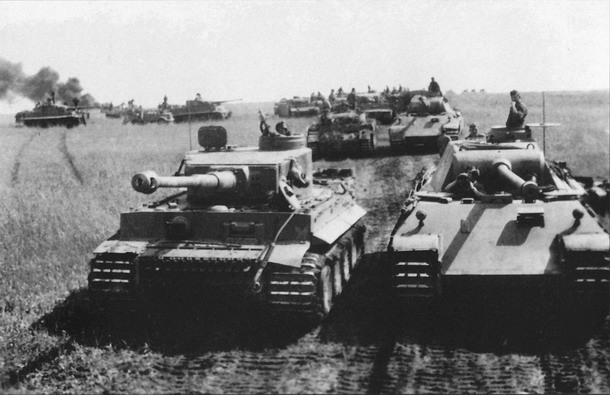
The German command was counting on its Tigers and Panthers to overcome any Russian defences — a miscalculation, source: Flickr.com with permission of the publishing user, edited
Three defensive lines were built in the Kursk salient. More than 100,000 civilians were mobilised to help soldiers dig around 5,000 kilometres of trenches and anti-tank ditches. A total of 943,000 anti-tank and anti-personnel mines were laid, 80 per cent of them in the first defensive line alone. The minefields were very wide to prevent easy bypassing, generally around 100 metres deep, and covered by Soviet artillery tasked with finishing off any enemy that became stuck in them.
Meanwhile the Germans were assembling the necessary reinforcements. The list of age groups subject to military service was extended both downward and upward, and existing exemptions for students and key workers were reviewed. Women were to fill the places of newly conscripted men in the factories. Pressure was also intensified to maximise military production at the expense of civilian output. Everything that could be spared was sent to the Kursk area. The original plan called for the operation to begin in early May 1943. At the end of April, Generaloberst Walther Model sent Hitler a memorandum summarising his arguments against the Kursk attack. On 3 May 1943 Hitler summoned his commanders to a conference to discuss the whole operation. Model showed everyone the latest aerial reconnaissance photographs of the area, from which it was abundantly clear that the Soviets were intensively fortifying the Kursk salient. There could be no counting on any element of surprise. Model and Guderian again asked the Führer to call off the offensive, arguing that attacking an outnumbering, fortified enemy that was expecting the assault amounted to suicide. Hitler stubbornly repeated that his German Tigers, Panthers and Ferdinands would break through any defences, but in the end he pushed the attack date back to 12 June. He postponed it twice more after that — first to 1 July and finally to 5 July 1943.
German Forces
The Germans managed to concentrate impressive forces for Operation Zitadelle. Attacking from south to north, the units of Army Group South under the already-mentioned von Manstein were to drive out of the area around Belgorod. The main striking force in the south was to be the 4th Panzer Army under Generaloberst Hermann Hoth. The right wing of the attack was to be covered by Army Detachment Kempf (under General der Panzertruppen Werner Kempf). The 4th Panzer Army comprised the 48th Panzer Corps (XXXXVIII Panzerkorps, Otto von Knobelsdorf), the 2nd SS Panzer Corps (II SS-Panzerkorps, Paul Hausser) and the 52nd Army Corps (LII Armeekorps, Eugen Ott). Kempf had at his disposal the 3rd Panzer Corps (III Panzerkorps, Hermann Breith), the 11th Army Corps (XI Armeekorps, Erhard Raus) and the 42nd Army Corps (XXXXII Armeekorps, Franz Mattenklott). In total, between 330,000 and 350,000 German soldiers were to attack from the south, along with 1,246 tanks (including 89 heavy Tiger tanks), 113 tank destroyers, 266 assault guns and 124 self-propelled guns. In the air, the Germans in the south could count on the support of 1,021 aircraft from Luftflotte 4 (of which 293 were bombers).
The concentration of troops in the Kursk salient was truly enormous, source: Flickr.com with permission of the publishing user, edited
From the north the attack was to be carried out by units under Army Group Centre, which was commanded by the already-mentioned Field Marshal Kluge. The striking force here was formed by the 9th Army of Generaloberst Walther Model and the 2nd Panzer Army of General Erich-Heinrich Clössner. The 9th Army consisted of five corps in total: the 20th Army Corps (XX Armeekorps, Rudolf von Roman), the 23rd Army Corps (XXIII Armeekorps, Johannes Friessner), the 41st Panzer Corps (XXXXI Panzerkorps, Josef Harpe), the 46th Panzer Corps (XXXXVI Panzerkorps, Hans Zorn) and the 47th Panzer Corps (XXXXVII Panzerkorps, Joachim Lemelsen). The 2nd Panzer Army was made up of three corps: the 35th Army Corps (XXXV Armeekorps, Lothar Rendulic), the 53rd Army Corps (LIII Armeekorps, Friedrich Gollwitzer) and the 55th Army Corps (LV Armeekorps, Erich Jaschke).
Generaloberst Model had to plan his northern attack with somewhat more caution. He was himself positioned in the Orel salient and was thus exposed to the risk that the Russians might attempt to encircle it — in other words, do to him exactly what the Germans themselves were planning to do. He therefore had to leave a considerable number of troops and vehicles in defensive positions. From the north only 581 tanks ultimately attacked (of which just 31 were heavy Tiger tanks), along with 227 assault guns, 97 self-propelled guns, 90 Ferdinand tank destroyers and an unspecified number of tank destroyers of other types. The attack also involved around 330,000 soldiers and 686 aircraft from Luftflotte 6 (of which 244 were bombers).
These figures should, however, be taken with some caution, as different sources frequently give very different numbers. We can say with reasonable confidence that the Germans committed around three quarters of a million soldiers to Operation Zitadelle, along with somewhere between 2,700 and 2,900 armoured fighting vehicles (encompassing not only tanks but also assault guns, self-propelled guns and tank destroyers — of which tanks alone numbered somewhere between 1,900 and 2,200). The Germans could send approximately 1,700 aircraft into the air, and to all of this must be added some 7,500 guns, mortars and rocket launchers.
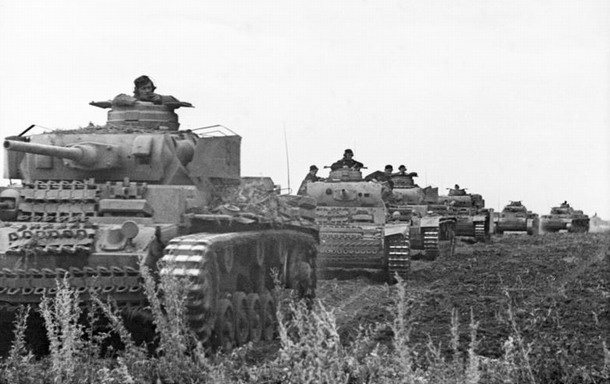
Everything capable of fighting was sent to southern Russia for Operation Zitadelle — here Panzer III tanks, source: Bundesarchiv_Bild_101I-219-0562A-06, Wikimedia, Creative Commons, edited
Soviet Forces
How well prepared were the Russians to repel the attack? The northern side of the salient was to be defended by the Central Front under General Konstantin Rokossovsky. This Front consisted of the 13th Army (Lieutenant General Pukhov), 48th Army (Lieutenant General Romanenko), 65th Army (Lieutenant General Batov), 70th Army (Lieutenant General Galanin) and 2nd Tank Army (Lieutenant General Rodin). The Front also had two independent tank corps (the 9th and 19th). Air support for the Russians in the north was provided by the 16th Air Army (Lieutenant General Rudenko). Rokossovsky had a total of 1,749 tanks — of which 1,273 were T-34 (roughly 72 per cent). Only 40 tanks were the heavy KV-1, and the rest (436 tanks) were the light T-60 and T-70 types. The Russians in the north also had a smaller number of SU-152 self-propelled guns. Soviet air strength on the northern side of the salient amounted to 951 aircraft, including 241 of the formidable Il-2 Shturmovik ground-attack aircraft.
The defence of the southern base of the Kursk salient was entrusted to the Voronezh Front under General Nikolai Vatutin. This Front comprised the 6th Guards Army (Lieutenant General Chistyakov), 7th Guards Army (Lieutenant General Shumilov), 38th Army (Major General Chibisov), 40th Army (Lieutenant General Moskalenko) and 1st Tank Army (Lieutenant General Katukov). The Voronezh Front also had under its command two independent Guards tank corps — the 2nd and 5th. Air support in the south was provided by the 2nd Air Army and the 17th Air Army. In total Vatutin had 1,537 tanks and self-propelled guns prepared for defence. Of these, 946 were T-34 (approximately 61 per cent), 34 were the heavy KV-1, 302 were the light T-60 and T-70, and around 160 were American and British types supplied under the Lend-Lease programme. On the southern side, 1,419 Soviet aircraft were ready to take to the air, of which a full 515 were Shturmoviks.
Here too the principle holds that every author gives different tank, troop, aircraft and gun totals — and it is hardly surprising. Some cite figures for Operation Zitadelle alone, i.e. the German attack. Others give totals for the Battle of Kursk as a whole, including the subsequent Soviet counteroffensive. Some work only with the numbers of combat-ready tanks, while others use total vehicle counts regardless of actual operational status. A further variable is whether figures represent only the tanks in units directly assigned to the defence of the salient, or whether reserve totals are included. With reasonable tolerance, however, we can say that on the Russian side approximately 1.9 million soldiers were prepared to defend the Kursk salient, along with around 3,300 tanks (rising to somewhere between 4,900 and 5,100 when reserves are included) and more than 31,000 guns, mortars and rocket launchers.
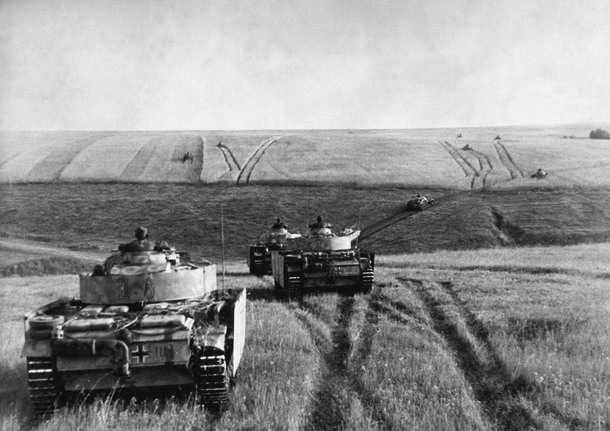
Panzer III tanks of the Das Reich division leaving their tracks across the vast Russian fields at the southern base of the Kursk salient, source: Waralbum.ru with permission of the operator, edited
The start of the German attack was set, as we know, for 5 July 1943. On the southern sector, however, the first actions took place on the afternoon of the preceding day, when the Germans attacked forward Soviet positions in the villages of Butovo, Gershovka and Bubnï. On the northern wing, preliminary operations were limited to overnight mine-clearing. This German activity confirmed to the Soviet command that D-Day was coming, and both in the north and in the south the Russians opened a pre-emptive artillery barrage during the night of 4 to 5 July. The Russians, however, did not know the precise German assembly positions, and their fire went essentially blindly into the German side. It therefore caused no serious disruption to German preparations, despite what is often claimed.
The fighting at the northern and southern bases of the Kursk salient proceeded essentially independently of each other. We can therefore afford to describe the events at each base separately — in our view this makes it easier for the reader to follow the sequence of events day by day (jumping back and forth between north and south would be harder to follow). Let us begin with the fighting in the north.
Northern Wing, 5 July 1943
The German artillery in the north opened fire at around 4:30 a.m. Shortly afterwards the first German aircraft swept over the enemy positions, and the ground assault followed around 5:30. The main striking force in the north was Walther Model's 9th Army, which deployed as follows: the 47th and 41st Panzer Corps (XXXXVII and XXXXI Panzerkorps) in the centre, the 46th Panzer Corps (XXXXVI Panzerkorps) on the right wing and the 23rd Army Corps (XXIII Armeekorps) on the left wing. Let us work through them from left to right. The 23rd Army Corps set out from the area of the villages of Glazunovka, Krasnaya Slobodka and Panskaya. Its operational objective was the town of Maloarkhangelsk, roughly 9 kilometres from the starting line. Model, fully aware of the strength of the Russian defences, had requested special mine-clearing equipment for his engineers — the remotely controlled demolition vehicles Goliath and Borgward B-IV. The engineers of the 23rd Corps used the Goliath vehicles on the very first day and managed to create sufficiently wide gaps through the minefields in their sector. The German infantry then stormed the fortified positions of the first Russian defensive line and succeeded in taking them fairly quickly. By the end of the day, however, the 23rd Corps had advanced only 3.5 to 4 kilometres and had not come close to Maloarkhangelsk.
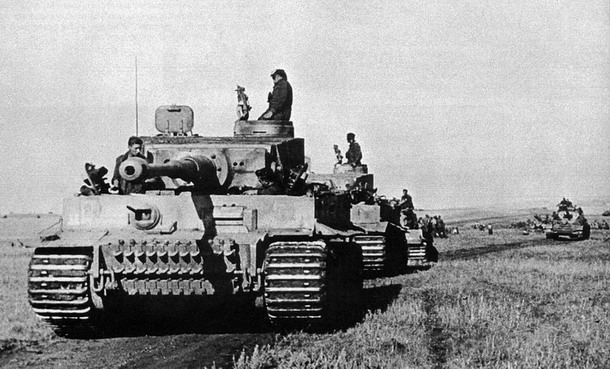
Thanks to propaganda, the Tiger heavy tank became one of the symbols of Operation Zitadelle — in reality, only 120 of them were deployed, source: Flickr.com with permission of the publishing user, edited
A little further west, the 41st Panzer Corps (XXXXI Panzerkorps) was attacking. Its main thrust ran west of the Orel–Kursk railway line, which the Russians had anticipated and where they had prepared strong defences. The German engineers went forward first again, attempting to use the remotely controlled Borgward B-IV demolition vehicles to create gaps in the minefields. Soviet artillery, however, smothered them with shellfire and many Borgwards were destroyed before they could complete their task. Even though the gaps in the minefields were far from complete, the Germans decided not to wait and sent the heavy Ferdinand tank destroyers forward to break through the Russian positions. The Ferdinands ground slowly but surely forward, with Russian anti-tank rounds simply bouncing off their frontal armour. One by one, however, they ground to a halt as they drove onto uncleared anti-tank mines. Very slowly and at heavy cost, the Ferdinands and infantry edged forward. By the end of the day the soldiers of the 41st Panzer Corps had advanced 3 to 5 kilometres, captured the railway junction at Stantsiya Maloarkhangelsk and encircled the Russian 676th Rifle Regiment near the village of Ozerki.
Further west still was the sector of the 47th Panzer Corps (XXXXVII Panzerkorps). The Russian defenders here were hit particularly hard by the German artillery preparation and air bombardment. As a result the Germans managed a breakthrough considerably more easily than elsewhere. They captured the villages of Tagino, Yasnaya Polyana and Podolyan and encircled the Russian 47th and 321st Rifle Regiments. Around 6 p.m. the German 20th Panzer Division reached the village of Soborovka and took it shortly afterwards. In this sector the Germans advanced some 8 to 9 kilometres on 5 July.
On the far right, the 46th Army Corps (XXXXVI Armeekorps) closed out the German northern assault formation. Its units attempted to capture the high ground between the villages of Krasnaya Zarya, Tureyka and Gnilëts. During the morning the Germans reached a hill at elevation 244.9 where they ran into very strong Russian defences. The Luftwaffe was called in; its Stukas arrived shortly after noon and plastered the hill with bombs and fire. After further very bitter fighting, the exhausted Germans finally managed to take the hill at around 4:45 p.m. The 46th Army Corps thus advanced only about 4 kilometres over the course of the entire day and suffered significant personnel casualties.
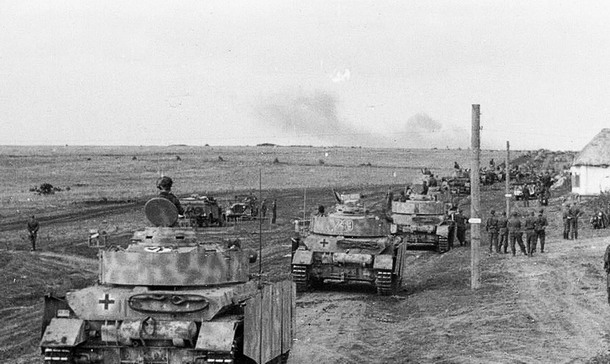
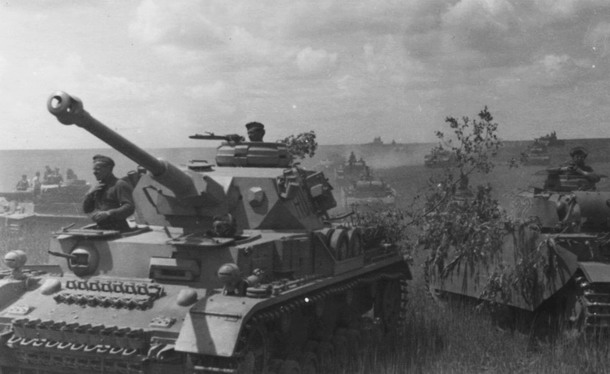
The Panzer IV was, as usual, the main German tank at Kursk, source: Flickr.com with permission of the publishing user, edited
Overall, the first day of the operation at the northern base of the Kursk salient was a rather unhappy one for the Germans. The number of tanks and other armoured vehicles completely destroyed was not dramatically high, but many machines had been damaged — mainly by mines — and the Germans lacked sufficient spare parts for repairs. They therefore had to cannibalise parts from other damaged vehicles, which was of course not a sustainable solution. Most worrying, however, were the infantry losses. On 5 July, Model's 9th Army suffered 1,301 killed or missing and 5,922 wounded. Model therefore ordered the 2nd and 9th Panzer Divisions, which had until then been waiting roughly 15 kilometres behind the front, to move up during the night. If anyone had a good day in the north, it was undoubtedly the German Luftwaffe, which flew 2,088 sorties and shot down exactly 100 Russian aircraft for the loss of only 25 of its own.
But the Soviets were not satisfied with the first day in the northern sector either. General Rokossovsky was forced during the evening to order several units to make a night withdrawal to the second defensive line, if he was not to risk their encirclement the following day. He also perhaps somewhat prematurely began preparing a counterattack for 6 July.
Northern Wing, 6 July 1943
If there was one area of the northern sector where things were busy this day, it was the front of the 47th Panzer Corps (XXXXVII Panzerkorps). General Rokossovsky had been somewhat hasty the previous evening and ordered a powerful counterattack by three of his tank corps for the morning. These, however, first had to move up to the front line, which proved rather problematic. Time passed; it was already half past ten in the morning, and only two Soviet tank brigades (the 107th and 164th of the 16th Tank Corps) were ready to attack. These two brigades did not have 100 tanks between them, but the impatient Russians sent them in regardless. The Soviet tanks set off from the town of Olkhovatka roughly in the direction of the village of Bobrik, without troubling themselves with any reconnaissance. To their misfortune, Bobrik happened at that moment to be where the Tigers of the 505th Heavy Tank Battalion (sPzAbt 505) were concentrated. In open country the Germans had the Russian tanks as if on a shooting range. The Soviets tried to avoid the Tigers and swung their advance westward — which did them no good, as they drove straight into the German 2nd Panzer Division. In this hasty counterattack the Soviets lost 69 tanks in a short engagement and were forced to pull back. The Germans lost only 10 tanks.
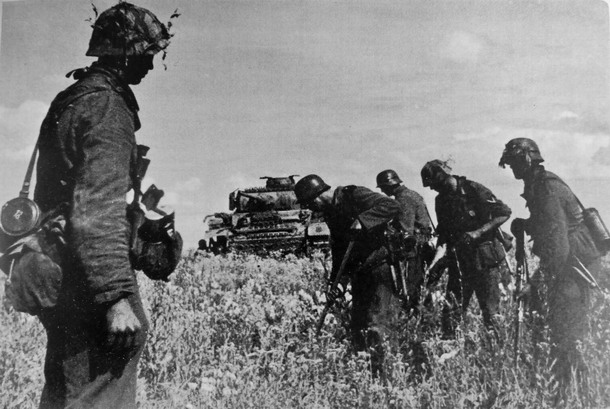
The Russians laid 943,000 mines in the Kursk salient — most of the minefields had to be cleared by hand, often under fire, source: Waralbum.ru with permission of the operator, edited
As soon as the Russian counterattack had been repelled, the 2nd Panzer Division and the Tigers of sPzAbt 505 drove forward toward the town of Olkhovatka. On the way, however, they ran into extensive minefields and strong anti-tank artillery. Twelve Tiger tanks were knocked out by mines. When late in the afternoon the Germans then ran up against the defensive positions of the 70th and 75th Guards Rifle Divisions, their advance stopped for the day.
The 41st Panzer Corps (XXXXI Panzerkorps) continued its advance toward the town of Ponyri. Along the way it clashed among other things with the Soviet 1442nd Self-Propelled Artillery Regiment, which was equipped with SU-152 self-propelled guns. At least one German Ferdinand fell victim to these Russian machines. Around 5 p.m. the Germans stood on the northern outskirts of Ponyri. The town was defended by the Soviet 307th Rifle Division and very powerful artillery, and the Germans decided to try to bypass the defenders from the west. After 10 p.m. the 9th Panzer Division, supported by other units, managed to cross the Snova river west of the town.
On the rest of the northern base of the Kursk salient, 6 July was not particularly dramatic. The German 23rd Army Corps (XXIII Armeekorps) continued to try to advance toward Maloarkhangelsk but made minimal progress and barely approached the town. The 46th Panzer Corps (XXXXVI Panzerkorps) captured the town of Gnilëts during the morning but could go no further because of dense minefields. Only the Luftwaffe again had a good day in the north, shooting down 91 Russian aircraft for the loss of just 11 of its own. At the end of the second day of Operation Zitadelle, the German 9th Army counted its personnel losses as follows: 645 killed or missing and 2,351 wounded. The first line of Russian defences had essentially been overcome, but the second was still virtually untouched. Generaloberst Model began preparing to commit his first reserves.
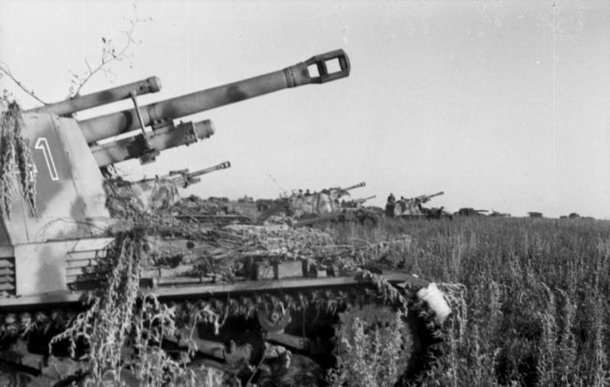
The Wespe self-propelled howitzer also had its combat debut at Kursk, source: Bundesarchiv_Bild_101I-219-0553A-15, Wikimedia, Creative Commons, edited
Northern Wing, 7 July 1943
The German 41st Panzer Corps (XXXXI Panzerkorps) was preparing this day to strike with full force against the town of Ponyri, defended by the 307th Rifle Division and very powerful artillery. At half past six in the morning the 292nd Infantry Division was sent in from the north, supported by assault guns and Ferdinand tank destroyers. Overnight, however, the Russians had laid fresh minefields in the area and the Germans drove into them. The moment they were forced to stop in the minefield, the full weight of Russian artillery including Katyusha rocket launchers crashed down on them. The attackers had to pull back, regroup and try again. The same scenario played out a second time, a third time and eventually a fourth. Ponyri simply could not be taken by direct assault. The Germans therefore sent the 86th Infantry Division to bypass Ponyri from the east and the 18th Panzer Division to outflank it from the west. The already-mentioned 9th Panzer Division was also approaching the town from the west, but its advance was heavily bogged down and it never reached the town at all. In the afternoon the first German soldiers of the 292nd Infantry Division finally managed to fight their way into the northern part of the town. The Russians immediately tried to drive them out, but the Germans hung on tenaciously. Street fighting continued until the evening and the Germans held their ground — at enormous cost.
The German 47th Panzer Corps (XXXXVII Panzerkorps) was attempting further west to capture the small town of Olkhovatka. This task was assigned to the 2nd Panzer Division, supported by the remaining Tigers of sPzAbt 505. Simultaneously, the 20th Panzer Division was to attack the village of Samodurovka, located roughly 7 kilometres northwest of Olkhovatka. On both axes, however, the Germans were halted after heavy fighting without reaching their objectives.
The German air force also had a good third day of the operation, flying 1,687 sorties, shooting down 43 enemies and losing only 9 of its own aircraft. Overall, however, this day was again a failure for the Germans. The 9th Army's losses at the northern base of the Kursk salient were 657 killed and missing and a further 2,204 wounded. Model's army was losing men and equipment, consuming hundreds of tonnes of fuel and thousands of rounds of ammunition, without having achieved any meaningful success.
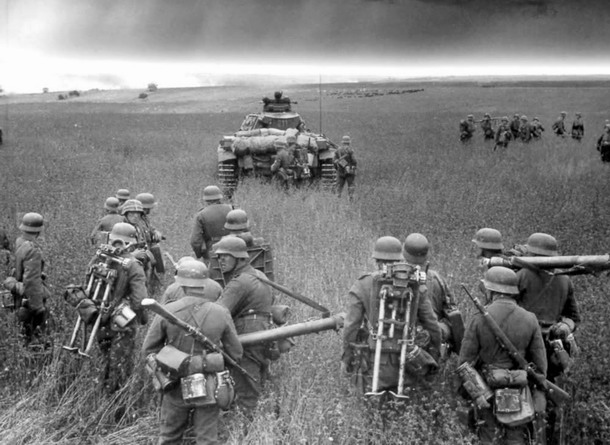
Tanks and infantry advancing side by side, source: Flickr.com with permission of the publishing user, edited
Northern Wing, 8 July 1943
Units of the German 47th Panzer Corps (XXXXVII Panzerkorps) were preparing on this day to break through the second Soviet defensive line at the town of Teploe. The 2nd, 4th and 20th Panzer Divisions were to take part. The attack began at 5:15 a.m. Within the first hour or so, the 4th and 20th Panzer Divisions captured the village of Samodurovka, roughly 2.5 kilometres north of Teploe. The 4th Panzer Division then drove straight for Teploe with around fifty tanks, including the last three operational Tigers of the 505th Battalion. The 20th Panzer Division advanced on its right flank and part of the 2nd Panzer Division attacked on the left, while the remainder of the 2nd Panzer Division moved toward the town of Olkhovatka. The area around Teploe was, however, very strongly defended. Russian guns and tanks were thoroughly dug in and surrounded by extensive minefields. On virtually every approach to Teploe the German tanks soon became stuck in the minefields and could go no further. Firefights with Russian tanks and anti-tank artillery ensued, with neither side moving much from their positions.
A few kilometres to the east, units of the German 41st Panzer Corps (XXXXI Panzerkorps) continued fighting for the town of Ponyri. The 292nd Infantry Division, which had captured the outskirts of the town the day before, was completely exhausted and was relieved by the 18th Panzer Division. Its soldiers then fought street by street through the afternoon, slowly making progress. By the end of the day Ponyri was essentially in ruins, but the Germans still held only half of it.
The 9th Army's losses at the northern base of the salient on 8 July reached 764 killed and missing and 2,456 wounded. The vast majority of Tiger tanks and Ferdinand tank destroyers were out of action, and shortages of fuel and ammunition were beginning to make themselves felt. The Luftwaffe in the north destroyed exactly 60 Soviet aircraft that day for the loss of 11 of its own.
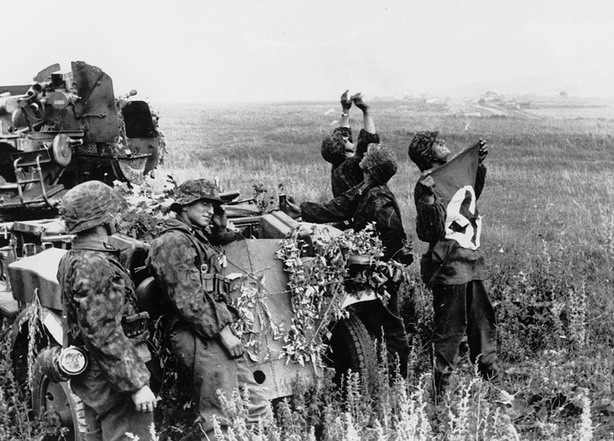
The crew of an Sd.Kfz. 10 half-track with an automatic 20 mm cannon waves to their comrades of the Luftwaffe; German aviation clearly dominated the skies over Kursk, source: Waralbum.ru with permission of the operator, edited
Northern Wing, 9 July 1943
The fifth day of Operation Zitadelle brought little action in the north. The German 47th Panzer Corps (XXXXVII Panzerkorps) was bogged down in the sectors of Olkhovatka and Teploe. None of its divisions was capable of achieving a breakthrough, and they essentially fell quietly into a defensive posture. The Soviets launched a few small counterattacks in this sector to test the enemy, but the front barely moved all day.
The 41st Panzer Corps (XXXXI Panzerkorps) continued its efforts to drive the Russian defenders out of the town of Ponyri. The main burden of this task continued to fall on the 18th Panzer Division and the 292nd Infantry Division. The battle for Ponyri lasted until evening but brought the Germans almost no gains. The entire 9th Army suffered 456 killed or missing and 1,405 wounded that day. Nor was it a particularly successful day for the Luftwaffe, which shot down only 20 Russian aircraft and lost 10 of its own.
Northern Wing, 10 July 1943
After a day of respite, the German 2nd and 4th Panzer Divisions of the 47th Panzer Corps (XXXXVII Panzerkorps) renewed their pressure on the town of Teploe and, after exhausting fighting, finally managed to capture it at around 6 p.m. It was a success, but when one considers that two panzer divisions had spent several days taking one fairly small and insignificant Russian town, it was clear that Operation Zitadelle could not have ended any differently than it did. The 41st Panzer Corps (XXXXI Panzerkorps) continued fighting for Ponyri a little further east. Both Germans and Russians fed fresh units into the town to relieve the men worn down by the existing fighting. Several days of artillery bombardment and street battles had turned the town to smouldering rubble. By evening the Germans held roughly two thirds of Ponyri, but the Soviet defences on its southern outskirts were still holding.
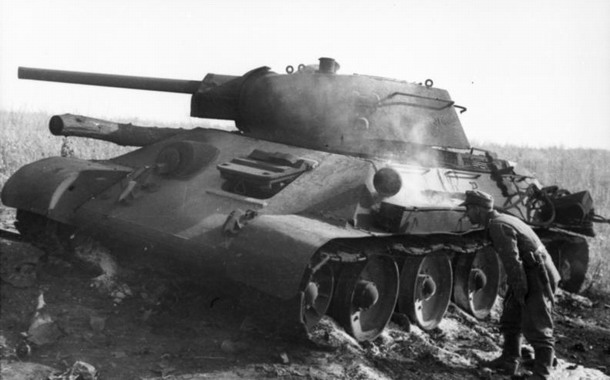
Russian losses in men and equipment were enormous — here a T-34 destroyed near Pokrovka, source: Bundesarchiv_Bild_101I-219-0553A-36, Wikimedia, Creative Commons, edited
The Luftwaffe shot down 43 Russian aircraft in the north that day and lost 7 of its own. The continuing debacle of the Russian air force on the northern battlefield did not escape the attention of the Soviet high command, and the existing commander of the 6th Fighter Aviation Corps, Major General Yumashev, was dismissed. German losses at the northern base of the Kursk salient on 10 July rose to 564 killed or missing and 1,996 wounded.
The commander of the 9th Army, Generaloberst Walther Model, fully realised on this day that his units were no longer capable of achieving a decisive breakthrough of the Russian second defensive line and that capturing Kursk was a complete chimera. He therefore ordered all his commanders to prepare to transition to the defensive. The German supreme command pressed him to continue the attack at least on his right wing, but Model ignored the order. He knew he would very shortly need his soldiers and tanks to repel a Russian counteroffensive.
Northern Wing, 11 July 1943
This day in the north was dominated by regrouping. Ground fighting continued only on a limited scale, with artillery playing more of a role than infantry and tanks. The German 9th Army lost 304 killed or missing that day and a further 1,176 wounded.
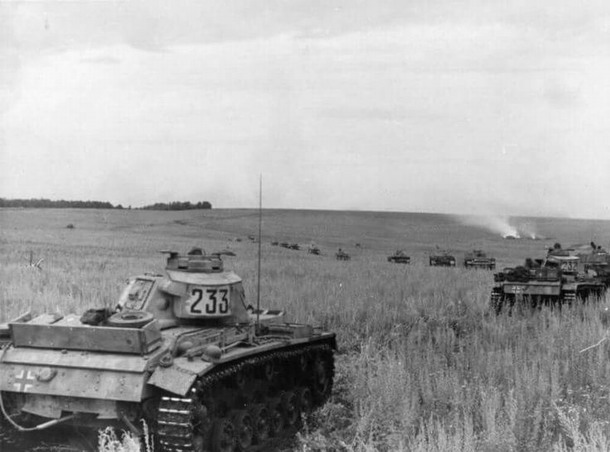
Panzer III tanks on the march, their commanders cautiously scanning the terrain from their half-open cupolas, source: Flickr.com with permission of the publishing user, edited
The Russians sensed that the Nazi offensive in the north had exhausted itself and began preparing to launch their own attack, codenamed Operation Kutuzov. The Soviet Western and Bryansk Fronts were to strike at the German salient around the city of Orel. On 11 July, reconnaissance detachments from both Russian fronts began probing the strength of the German defences on the north and northeast faces of the Orel salient.
Northern Wing, 12 July 1943
At 3:30 a.m. the Russians opened an enormous artillery barrage against the German units in the Orel salient. Operation Kutuzov had begun, and Operation Zitadelle on the northern base of the Kursk salient was thereby essentially over. Units of the 9th Army held on to the ground they had taken for the time being, but only because Rokossovsky's Central Front was still drawing breath before joining Operation Kutuzov as well.
NORTHERN BASE OF THE KURSK SALIENT, 15 JULY 1943: After three days of regrouping, the Soviet Central Front joined Operation Kutuzov and launched its attack against the spearheads of the German 9th Army near the town of Teploe. Generaloberst Model did not wait a day longer than necessary and ordered his troops to make a rapid withdrawal back to the positions from which they had set out ten days earlier for Operation Zitadelle. Model's only concern from this point on was the defence of the Orel salient.
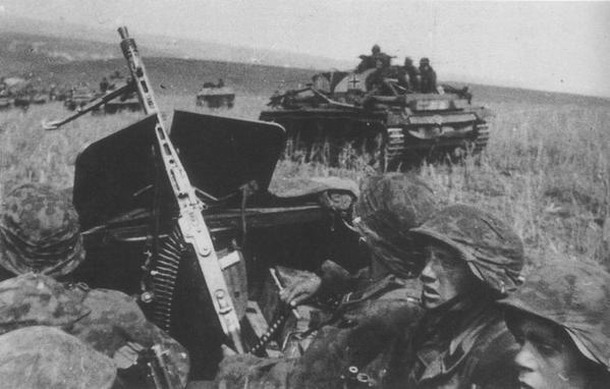
Grenadiers aboard a half-track accompany Panzer III tanks, source: Flickr.com with permission of the publishing user, edited
Now let us look at the course of the fighting in the south:
Southern Wing, 5 July 1943
At 4:15 a.m. German guns, mortars and rocket launchers opened a powerful artillery barrage. Around 4:30, the first Luftwaffe aircraft flew over the heads of German soldiers and struck the enemy positions. The ground attack began at 5:00, with further units joining the action as it unfolded.
The main striking force in the south was the 4th Panzer Army, composed of the 48th Panzer Corps (XXXXVIII Panzerkorps) and the 2nd SS Panzer Corps. The attack of the 48th Panzer Corps was complicated by the fact that the Germans had failed to destroy the Soviet forward positions at the village of Bubnï the previous day. Fighting there continued throughout 5 July, which slowed progress on the left wing. The forward positions at the villages of Gershovka and Butovo were cleared, however, allowing the Germans to advance toward Korovino and Cherkasskoye. Their advance was halted very quickly by the flooded Berezovy ravine and the anti-tank ditch with minefields surrounding it on either side. This obstacle was not overcome until after four in the afternoon, and only then could the attack on those towns begin. Korovino fell at 8:20 p.m. and most of Cherkasskoye was taken at around 9 p.m. The 48th Panzer Corps thus essentially achieved its operational objective for the first day, albeit at a fairly high cost. The corps had 1,505 killed, missing or wounded, 43 tanks destroyed or damaged, and 9 assault guns destroyed or damaged. On average, the 48th Corps advanced roughly 5 kilometres on the first day of the attack.
To the right of the 48th Panzer Corps advanced the 2nd SS Panzer Corps under Paul Hausser. This corps consisted of three elite Waffen-SS divisions: Leibstandarte SS Adolf Hitler (LSSAH), Das Reich and Totenkopf. The advance of the LSSAH division was halted very shortly after the attack began by a minefield and Russian artillery fire. The 2nd SS Panzer Corps had been allocated virtually all available air support for the first day, however, and the enemy fire was soon silenced by the dive-bombing Stukas, allowing LSSAH to resume its advance. At 4:50 p.m. it captured the village of Bykovka and pressed north toward Pokrovka. By the end of the first day this division had advanced 9 kilometres. The Das Reich division spent the first eight hours of the attack fighting for the small town of Berezov, which was not taken until late in the afternoon. It then continued north and by the end of the day had captured the town of Stroitel as well. Das Reich thus advanced around 6 kilometres on the first day. Totenkopf spent the first day of the operation fighting in the area of the village of Gonki and advanced only minimally. The entire 2nd SS Panzer Corps suffered 1,081 killed, wounded or missing and 44 tanks and assault guns damaged or destroyed on 5 July.
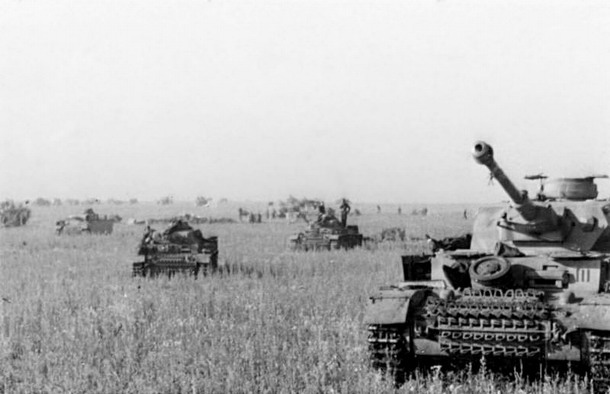
Panzer IV and Panzer III tanks of the Totenkopf division at the southern base of the Kursk salient, source: Bundesarchiv_Bild_101III-Merz-014-12A, Wikimedia, Creative Commons, edited
To the right of the 4th Panzer Army attacked Army Detachment Kempf with its 3rd Panzer Corps (III Panzerkorps) and the 11th and 42nd Army Corps (XI and XXXXII Armeekorps). Kempf launched his attack from the city of Belgorod in a northeasterly direction. This meant his soldiers had to cross the Northern Donets river on the very first day, which proved rather problematic. At the moment the attack began, Kempf had only one tank-capable bridge available — at Mikhailovka. This bridge had been damaged by Russian artillery during the night of 4 to 5 July and was therefore unusable. The engineers of the 3rd Panzer Corps crossed the river by rubber dinghy before dawn and managed to construct a pontoon bridge at Solomino by around 8 a.m. The first German tanks began crossing at 8:30. The 3rd Panzer Corps thus managed to launch its attack and by evening had advanced roughly 5 kilometres. The 11th Army Corps managed to get only its infantry and a few assault guns across the river. Its soldiers were therefore able to advance only one kilometre and suffered heavy losses in a Russian counterattack.
On the first day of Operation Zitadelle the Germans in the southern sector had 6,334 killed, wounded or missing and 154 tanks and assault guns destroyed or damaged. The Luftwaffe flew 2,387 combat sorties in the south that day and, for the loss of only 19 of its own aircraft, destroyed 187 Soviet machines. Some of the operational objectives had been reached, but already after this first day it was clear that the offensive would be neither swift nor painless.
Southern Wing, 6 July 1943
On the second day of the operation the Russians were still holding the village of Bubnï and its surroundings. The German 48th Panzer Corps (XXXXVIII Panzerkorps) therefore had its left flank exposed and could not advance as planned, since it had to divert forces to cover its left side. It could commit no more than 40 tanks from the 3rd Panzer Division for the attack on the town of Rakovo. There was an important bridge over the Pena river at Rakovo that the Germans needed to capture intact. The tanks approached the town but came under heavy Soviet fire and pulled back, with the command deciding that a larger assault force would be needed later. The Soviets then blew the bridge up for good measure. A little further east, the Grossdeutschland division was fighting its way from Cherkasskoye toward Lukhanino, but could not capture even that small town by the end of the day due to minefields and Russian counterattacks. Further east still, the 167th Infantry Division (also part of the 48th Panzer Corps) advanced roughly 7 kilometres and took the villages of Dmitriyevka and Olkhovka.
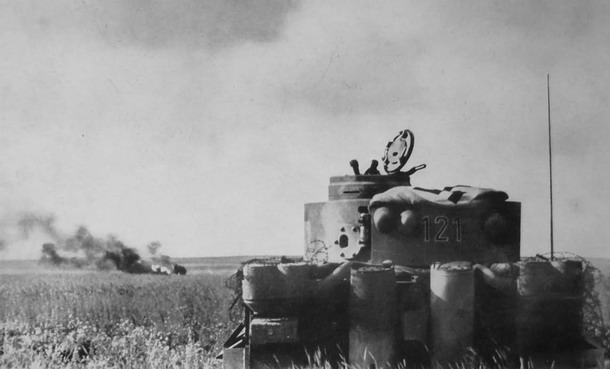
Direct hit! A Russian tank is in flames and the commander of a German Tiger searches through his periscope for the next target, source: Worldwarphotos.info with permission of the operator, edited
Hausser's 2nd SS Panzer Corps achieved considerably greater success that day. After five hours of hard fighting, the LSSAH division broke the positions of the Soviet 51st Guards Rifle Division and swept north around Pokrovka along the road toward Prokhorovka. The Grossdeutschland division provided strong support on the right flank. The Soviets were alarmed by the unexpected LSSAH breakthrough and sent in their 5th Guards Tank Corps against it. Unfortunately for the Soviets, the terrain in this area was flat — ideal fighting ground for German Tiger tanks with their long-range guns. Within two hours of fighting the Russians had lost 110 tanks and decided to withdraw. But LSSAH and Grossdeutschland also had to halt, as they had outrun the rest of their forces by more than 20 kilometres and found themselves in too vulnerable a position.
The units of Army Detachment Kempf continued on 6 July trying to break out of their bridgehead at Solomino. By the end of the day they had managed to advance only 5 to 6 kilometres and at considerable cost. The Luftwaffe flew 1,686 combat sorties that day, sending 79 Russian aircraft to the ground for the loss of just 7 of its own. The Germans in the south were advancing more slowly than they had planned, but were still doing better than the enemy had expected. The Russians were growing nervous; General Vatutin committed his reserves to the battle and requested the release of reinforcements from Konev's Steppe Front.
Southern Wing, 7 July 1943
The third day of the German attack. After the Russians destroyed the bridge over the Pena river at Rakovo, the 48th Panzer Corps (XXXXVIII Panzerkorps) abandoned its attempt to cross the river there — the high bank on the Russian side made the rapid construction of an improvised bridge nearly impossible. Instead the corps moved along the Pena river in a northeasterly direction. During the advance it captured the towns and villages of Alekseyevka, Lukhanino and Dubrova, then turned toward the town of Syrtsewo.
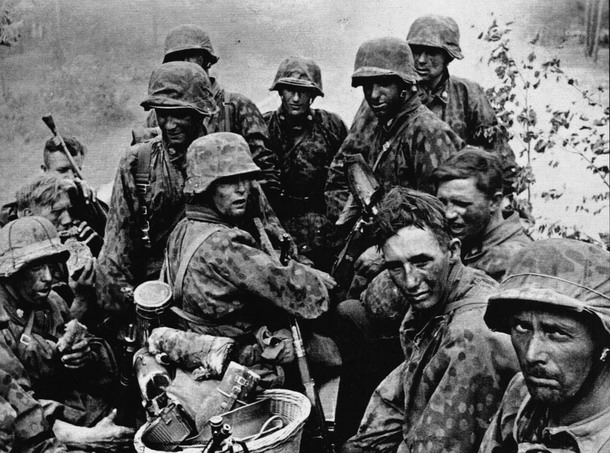
Panzergrenadiers of the Das Reich division. This photograph is probably not staged, judging by the fact that the soldiers make no attempt to conceal the exhaustion from several days of hard fighting, source: Waralbum.ru with permission of the operator, edited
The 2nd SS Panzer Corps, which had advanced so successfully the previous day, now found itself more on the defensive, having to repel one Russian counterattack after another. Nevertheless, the LSSAH division managed to capture the village of Maliye Mayachki and Das Reich took Tetervino. The Waffen-SS thus remained about 14 kilometres ahead of the rest of the German forces. Among the units of Army Detachment Kempf, the 3rd Panzer Corps (III Panzerkorps) made the most progress — but even that amounted to just 6 kilometres. The Luftwaffe flew 1,829 sorties that day and shot down 87 Russian aircraft for the loss of 10 of its own.
Southern Wing, 8 July 1943
The 48th Panzer Corps (XXXXVIII Panzerkorps) continued its advance toward the town of Syrtsewo. German tanks reached the edge of the town around 1:50 p.m. but could not capture it. The Soviet 3rd Mechanised Corps of Major General Krivoshein was hastily withdrawing northward from this sector and the Grossdeutschland division pursued it as far as the town of Verkhopenye, capturing the village of Gremyachy on the way.
The 2nd SS Panzer Corps, still at the tip of the German advance, set out on the morning of 8 July from the area of the village of Maliye Mayachki northwestward toward the village of Veselyy. The Russians, alarmed by the relentless advance of the Waffen-SS, sent their 31st Tank Corps reinforced by the 192nd Tank Brigade against the LSSAH division. The Soviets advanced frontally straight at the Germans and the battle began around noon. After the Soviets had lost 58 tanks, they chose to withdraw. LSSAH was successful, but had also lost a number of tanks including two Tigers.
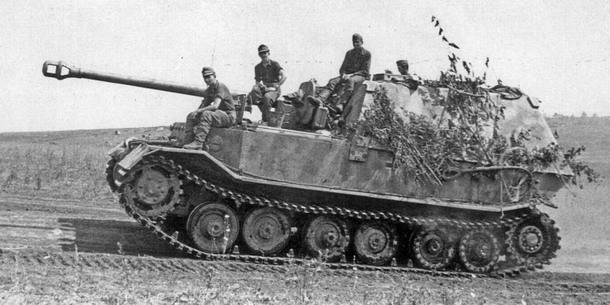
Another German weapon making its first appearance at Kursk was the Ferdinand heavy tank destroyer, source: Waralbum.ru with permission of the operator, edited
The Das Reich division was preparing on 8 July to push northeast toward Prokhorovka. The Russians, however, had brought in fresh reinforcements here as well and launched a fairly substantial counterattack against the German right wing. Four Soviet tank corps took part in this counterattack: the 10th Tank Corps of Lieutenant General Burkov, the 2nd Tank Corps of Major General Popov, the 5th Guards Tank Corps of Lieutenant General Kravchenko and the 2nd Guards Tank Corps of Colonel Burdeinyy. These corps had around 500 tanks combined, but fortunately for the Germans the Soviets could not coordinate their units, so their attacks came piecemeal rather than simultaneously.
Burkov's 10th Tank Corps threw itself at the Germans near Tetervino at 11:25 a.m. The Russians suffered substantial losses but ultimately forced the Das Reich division to evacuate Tetervino around 6 p.m. The SS soldiers managed to repel the attacks of the next two Soviet corps, and called in the Luftwaffe to deal with the 2nd Guards Tank Corps. The Germans deployed their tank-killing aircraft, the Henschel Hs 129 B equipped with 30 mm cannon. The German airmen literally saved their comrades on the ground, smashing the Russian tank attack before it could reach them — possibly the first instance in history of a larger-scale tank attack being repelled by air power alone. The four Russian tank corps lost a total of 100 tanks in their counterattack without inflicting significant losses on the Germans. They did, however, force the Germans to slow down, which was crucial for the Soviets — they needed time to move reserves released by Konev from his Steppe Front into the weakly defended area around Prokhorovka.
Army Detachment Kempf was unable to make any decisive breakthrough on this day either, merely inching slowly northeastward from Belgorod. The 6th Panzer Division belonging to the Detachment did manage to take the town of Melikhovo, but overall Kempf was failing in his primary operational role — covering the right flank of the advancing 4th Panzer Army. The German air force flew 1,686 sorties in the south on 8 July, lost only 5 aircraft and destroyed 61 Soviet machines.
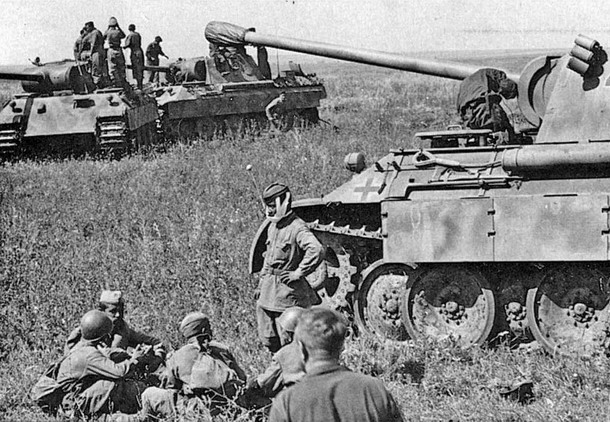
A group of Russian prisoners sitting among German Panther tanks waiting for their "transfer", source: Flickr.com with permission of the publishing user, edited
Southern Wing, 9 July 1943
The fifth day of the German attack. The 48th Panzer Corps (XXXXVIII Panzerkorps) continued pursuing the Russians retreating northward from the town of Verkhopenye. Around noon the Germans captured the village of Novoselovka, and at 2 p.m. they stood on the road to the city of Oboyan, roughly 22 kilometres away. The tip of the attack, formed by two tank regiments (Panzer-Regiment von Lauchert and Panzer-Regiment Grossdeutschland) under Colonel Strachwitz, was however completely exhausted and had only 36 serviceable tanks remaining — 16 Panthers and 3 Tigers. The road to Oboyan was meanwhile held by 200 T-34 tanks from Katukov's 1st Tank Army. To make matters worse, the Germans had still failed to capture the towns of Syrtsewo and Verkhopenye, which continued to serve as centres of resistance in already-captured territory, tying down considerable German forces.
The commander of the German 48th Panzer Corps, General von Knobelsdorf, assessed further northward advance by Colonel Strachwitz's group toward Oboyan as too risky under the circumstances, and decided to first deal with the Russians in both towns. He therefore ordered the remnants of Panzer-Regiment von Lauchert and Panzer-Regiment Grossdeutschland to turn back south, outflank Syrtsewo and Verkhopenye from the west and help to finally take them.
The 2nd SS Panzer Corps continued its advance on 9 July in a northwesterly direction. LSSAH was at the tip of the attack, Totenkopf close behind to help it forward, and Das Reich remained on the right flank to cover it against further Russian counterattacks. Around 10 a.m. the LSSAH and Totenkopf attacked the village of Sukhosolotino. In roughly two hours of fighting the Waffen-SS destroyed about 60 Russian tanks and forced the Soviets to evacuate the village. During the afternoon Totenkopf sent a reconnaissance patrol in the direction of Prokhorovka. When the patrol returned in the evening it reported that the Russian defences in that direction were not particularly strong. And no wonder — the Waffen-SS had just broken through the third and last line of Russian defences.
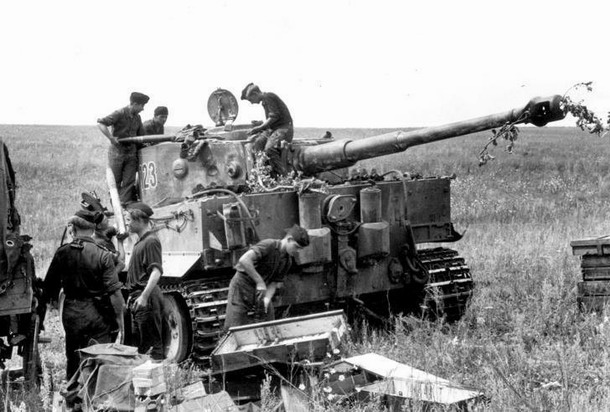
A supply lorry has delivered ammunition for a Tiger tank, source: Bundesarchiv_Bild_101I-022-2948-23, Wikimedia, Creative Commons, edited
The Soviet high command, however, grasped the danger and began moving reserves — primarily the 5th Guards Tank Army of Lieutenant General Rotmistrov and other units — toward Prokhorovka. For reasons that remain unclear, German aerial reconnaissance completely missed the movement of these enormous forces toward Prokhorovka, leaving the Germans convinced that capturing the town would pose no great difficulty.
Army Detachment Kempf also fought in its sector on 9 July without achieving any decisive breakthrough. The Germans did capture the town of Dalnaya Igumenka but suffered considerable losses in men and equipment. The units of Hoth's 4th Panzer Army (which Kempf was supposed to be supporting) had by now advanced so far that the Detachment was essentially conducting its own independent campaign, with almost no bearing on the German 4th Panzer Army. It was clear that Kempf had failed. The Luftwaffe flew 1,621 sorties that day, shooting down 46 Russian aircraft and losing 11 of its own.
Southern Wing, 10 July 1943
Both tank regiments under Colonel Strachwitz (Panzer-Regiment von Lauchert and Panzer-Regiment Grossdeutschland) turned south as ordered by General von Knobelsdorf to help encircle and finally capture Syrtsewo and Verkhopenye. Verkhopenye did fall into German hands that day; Syrtsewo continued to hold out. At the northern tip of the 48th Panzer Corps (XXXXVIII Panzerkorps) now remained only the 11th Panzer Division, tasked with continuing the advance toward Oboyan — which proved beyond its strength, and the division barely moved all day.
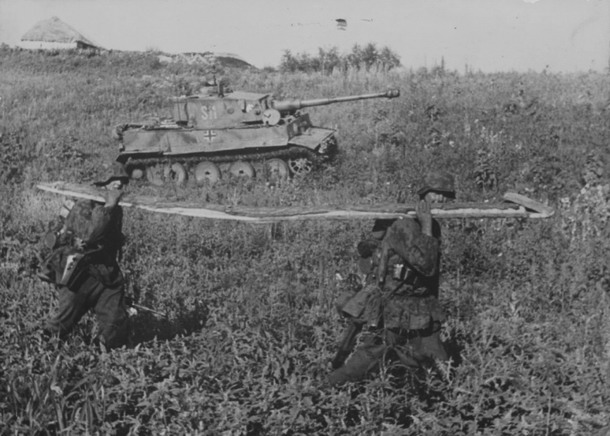
German engineers had no rest at Kursk. When they were not clearing minefields, they were helping tanks across anti-tank ditches, source: Waralbum.ru with permission of the operator, edited
The 2nd SS Panzer Corps turned its full attention toward Prokhorovka on this day. During the morning the LSSAH and Totenkopf divisions set off in that direction. LSSAH was to advance directly toward Prokhorovka along the main road and railway. Totenkopf was assigned to swing north, cross the Psel river and then attack Prokhorovka from the west. Around noon the LSSAH soldiers ran into the Soviet 11th Motorised Rifle Brigade, dug in on a hill near the large Komsomolels collective farm. At around 2:25 p.m. the Germans managed to drive the Russian soldiers back and occupy the collective farm. The Totenkopf engineers had to cross the Psel river under fire, which cost them 374 killed and wounded, and by the end of the day had still not managed to put a bridge across the river for heavy vehicles. Units of Army Detachment Kempf made no significant progress on this day either, and both Germans and Russians had essentially written them off as a combat formation. The Luftwaffe claimed 25 Russians shot down for the loss of 3 of its own aircraft.
The Soviet high command looked at the battle map on 10 July with growing concern. Despite all Russian expectations, the Waffen-SS soldiers in the south had managed to slowly but surely fight their way through all three defensive lines, and it was a real prospect that they might capture Prokhorovka. The Russians therefore decided that the time for their own counterattack had come and began preparing it.
Southern Wing, 11 July 1943
The morning was rainy and the Germans could not count on their air force. At 6:00 sharp the LSSAH division again advanced across open country along the road toward Prokhorovka, but when it approached the hill at elevation 252.2 it was hit by heavy fire from Russian guns and tanks. The German Tigers bravely knocked out Soviet T-34s, but the division's advance stopped and the whole attack threatened to collapse. Fortunately for the Germans, the rain stopped around 9 a.m. and the Luftwaffe could join the action. Around fifty Stuka dive-bombers pounced on the entrenched Soviets. After 10 a.m. LSSAH got moving again, outflanked and captured the hill at 252.2. By evening the forward elements of the LSSAH division were only 3 kilometres from Prokhorovka, but that day the division had suffered 337 killed and wounded and lost 10 StuG III assault guns.
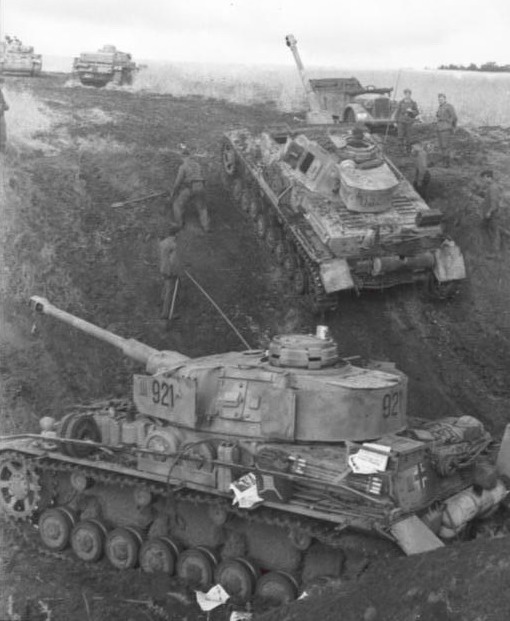
Panzer IV tanks crossing an anti-tank ditch, source: Bundesarchiv_Bild_101I-219-0596-08, Wikimedia, Creative Commons, edited
For the Totenkopf division, 11 July was an unhappy day, as the construction of bridges over the Psel river took longer than the command had expected. Two bridges were not ready until 2:50 p.m., and the movement of tanks and other vehicles across to the far bank continued for the rest of the day and throughout the night. All the while the soldiers also had to continuously repel persistent Soviet attacks. Totenkopf essentially did not move from the spot all day and suffered 450 killed and wounded.
The main surprise of the day came from Army Detachment Kempf, which everyone had already written off. The Soviets, who had concluded that Kempf's units were incapable of a breakthrough, had begun pulling their troops away from his sector to reinforce the defence of Prokhorovka. The Germans seized the opportunity and made a supreme effort with their remaining forces. At 5 a.m. the German 3rd Panzer Corps (III Panzerkorps) opened artillery fire against the weakened Russian defences, followed by an air strike and then a ground assault. After six endless days of failures, Kempf's tanks were rolling forward on two axes simultaneously. The 6th Panzer Division set out from Melikhovo, captured the village of Verkhniy Olshanets in the afternoon and by 10 p.m. had taken the village of Kazachye — advancing some 10 to 11 kilometres in total. The 19th Panzer Division set out from Dalnaya Igumenka, took Khokhlovo and Kiselevo and drove the Russians back across the Northern Donets. Kempf was suddenly back in the game and was sending his 3rd Panzer Corps by the shortest route northward to assist the Waffen-SS in its drive on Prokhorovka.
The 48th Panzer Corps (XXXXVIII Panzerkorps) completed the clearance of its sector on 11 July when it finally drove the stubborn Russian defenders from Syrtsewo, and took the town of Berezovka in the late afternoon. Corps commander General von Knobelsdorf now at last had free hands for a full attack northward toward the city of Oboyan. The situation was becoming critical for the Soviets. Preparations for their own counterattack were in full swing. The 5th Guards Tank Army of Lieutenant General Rotmistrov — which was to be the main force of the Russian counterattack — was already moving from the reserve Steppe Front toward Prokhorovka. The German Luftwaffe had a poor day, shooting down only 19 Russian aircraft and losing 14 of its own.
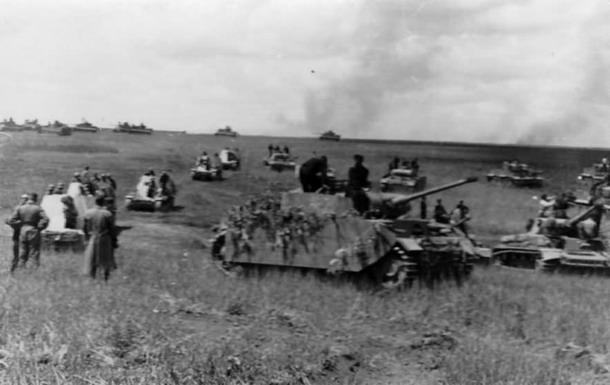
Again a high concentration of armour — Panzer III, Panzer IV, Tiger and Wespe self-propelled guns, source: Worldwarphotos.info with permission of the operator, edited
Southern Wing, 12 July 1943
On this day Operation Zitadelle reached its climax with the famous battle at the village of Prokhorovka. This is traditionally regarded as the largest single-day, single-sector tank battle of the entire war. Many historians disagree, however, and attribute the title to a different battle. Let us leave this topic for the conclusion of the article.
During the night of 11 to 12 July the Russians continued moving reserves to the front. The counterattack was to begin the following day. The Soviets were preparing to strike simultaneously against the German 48th Panzer Corps (XXXXVIII Panzerkorps), to prevent it from continuing toward Oboyan, and against the 2nd SS Panzer Corps (composed of the Totenkopf, Das Reich and LSSAH divisions), to prevent it from taking Prokhorovka. The attack against the 48th Panzer Corps was to be carried out by the 1st Tank Army (Lieutenant General Katukov) and the 6th Guards Army (Lieutenant General Chistyakov). The attack against the Waffen-SS was the responsibility of the already-mentioned 5th Guards Tank Army of Lieutenant General Rotmistrov. Rotmistrov, however, had received substantial reinforcements for the task: the 33rd Guards Rifle Corps, the 2nd Guards Tank Corps and the 2nd Tank Corps.
The Prokhorovka counterattack was planned as follows. The 2nd Guards Tank Corps and the 2nd Tank Corps, with a combined strength of around 190 tanks, would attack the Das Reich division. The 33rd Guards Rifle Corps and the 5th Guards Mechanised Corps would attack the Totenkopf division. The largest force was to be thrown against the LSSAH division: the 18th Tank Corps and the 29th Tank Corps, which together had 6 tank brigades with 339 tanks.
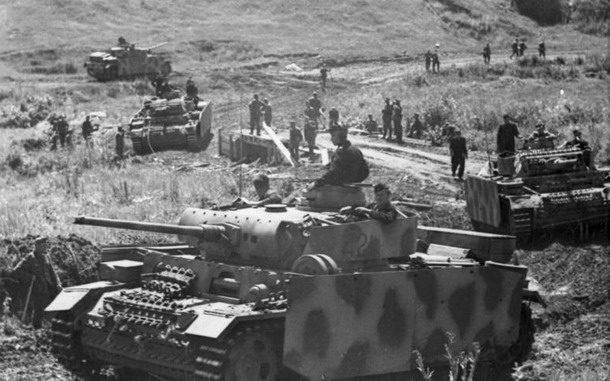
By the summer of 1943 the Panzer III had already passed its prime, but the Germans could still not do without it, source: Bundesarchiv_Bild_101I-219-0595-32, Wikimedia, Creative Commons, edited
The Germans were not idle during the night of 11 to 12 July either. The 6th Panzer Division, part of Army Detachment Kempf, took a risk and sent twenty tanks in the middle of the night from Kazachye into the town of Rzhavets to try to seize a bridge over the Northern Donets. To deceive the enemy, Major Franz Bäke placed two captured T-34 tanks at the head of the column — and the ruse worked. The Germans surprised a group of Soviet tanks at the bridge and destroyed them at point-blank range. They then moved panzergrenadiers and several heavy Tiger tanks across the bridge to hold the bridgehead against any counterattack. Crossing the Northern Donets was an essential precondition for Kempf's units to be able to move north toward Prokhorovka and link up with the Waffen-SS divisions there. From Rzhavets to Prokhorovka was just over 20 kilometres.
News that the Germans had crossed the Northern Donets quickly reached the Soviet command. This unexpected German success naturally disrupted the plan for the Russian counterattack. Rotmistrov had to release some of his units and send them against the new German bridgehead at Rzhavets — a task assigned to Major General Trufanov. This of course weakened the forces assigned to the counterattack against the Waffen-SS at Prokhorovka.
On 12 July the Russians launched their counterattack. Let us look first at how the main thrust against the LSSAH division at Prokhorovka fared. The furthest German position was the hill at elevation 252.2, held that morning by just seven German Panzer IV tanks and a battalion of grenadiers under SS-Obersturmbannführer Joachim Peiper. At 8:30 Russian artillery shells began falling around them and moments later the German soldiers heard a deafening roar and spotted an enormous formation of Soviet tanks rolling toward them from Prokhorovka. Six Soviet tank brigades attacked simultaneously (the 31st, 32nd, 170th, 180th, 25th and 169th Tank Brigades). Two of them — the 31st and 32nd — threw themselves directly at hill 252.2. Peiper quickly fired a flare to signal the Russian attack to the rest of his division, and then a melee broke out on the hill. Soviet T-34s and German Panzer IVs engaged each other at ranges of less than 200 metres. Grenadiers fought Soviet tank riders who had jumped off the tanks. The Germans lost 4 Panzer IVs and twenty Sd.Kfz. 251 half-track transports in the short engagement, but destroyed twenty T-34s and managed to fall back from the hill to their comrades.
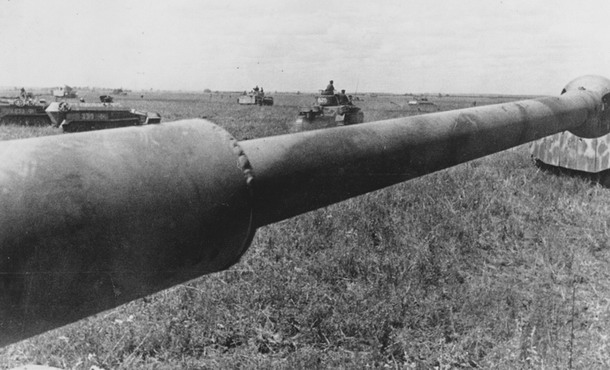
The flat plains of the Kursk battlefield were tailor-made for Tiger tanks with their long-range 88 mm guns, source: Flickr.com with permission of the publishing user, edited
The rest of the Soviet steel torrent flowed around the hill and split into two streams. The 170th and 180th Tank Brigades swept toward the Komsomolels collective farm, where the main body of LSSAH troops was located. The 25th and 169th Tank Brigades then threw themselves against the forest near the village of Storozhevoye. In front of the Komsomolels farm, the first Russian tanks raced at full speed into an anti-tank ditch (I have not been able to determine whether this was dug by the Germans during the preceding night or earlier by the Russians themselves). The remaining tanks halted and stood around for a moment, their commanders uncertain what to do. LSSAH meanwhile rallied and moved out to meet the Russians. At the anti-tank ditch the Germans destroyed nearly 60 hesitating Soviet tanks within minutes. Four German Tigers engaged further Soviet vehicles from a range of 1,800 metres and after a short engagement had destroyed twenty T-34s. The forest near the village of Storozhevoye was held by German grenadiers armed with anti-tank guns. When they spotted the Russian tanks approaching across open ground, they opened fire and destroyed a large number before they reached the tree line.
LSSAH had reasonably good artillery and air support in its area and ultimately managed to repel the enormous Russian attack. In doing so it lost only 17 tanks and 374 men. Rotmistrov lost an astonishing 299 tanks and self-propelled guns.
A little further south, the Soviets were not faring much better. The 2nd Guards Tank Corps and the 2nd Tank Corps attacked the Das Reich division there. Since Das Reich had for some time been focused on covering the left flank of its comrades, it was well prepared for defensive fighting and managed to repel the Soviets, losing 211 men but destroying 69 Russian tanks. The new German bridgehead at Rzhavets, held by Detachment Kempf's forces, also held against the Russian counterattack. The best the Soviets managed was in the sector of the Totenkopf division, which as we know was positioned on the far bank of the Psel river. Here the Russians managed to destroy 28 German tanks (including 5 Tigers) — a very painful loss for the already exhausted Totenkopf.
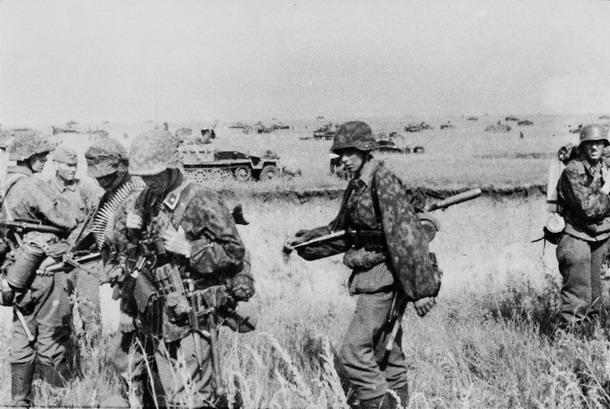
Waffen-SS grenadiers preparing to board their half-track transports and move forward, source: Flickr.com with permission of the publishing user, edited
So how many tanks actually clashed in the famous battle of Prokhorovka? Apparently just under a thousand, of which roughly three hundred were German and just under seven hundred were Russian. This engagement took place across a front 20 to 25 kilometres wide. The Soviets lost approximately four hundred tanks in their counterattack. German armoured vehicle losses at Prokhorovka amounted to roughly eighty machines. Measured purely by the ratio of losses, the Soviet counterattack of 12 July would have to be considered a catastrophe. Yet it served its purpose. The Waffen-SS soldiers, exhausted by eight days of continuous fighting, could no longer muster the strength to resume their advance after this assault.
12 July, however, saw fighting not only at Prokhorovka. The Russian counterattack was proceeding, as we know, also in the sector of the German 48th Panzer Corps (XXXXVIII Panzerkorps). This corps was just preparing to push north toward Oboyan, and the Soviet attack on its left flank caught the Germans by surprise. This allowed the Russians to tear a roughly 4-kilometre gap in the German flank. Corps commander General Knobelsdorf had to immediately change priorities and, instead of attacking north toward Oboyan, go on the defensive. The Soviets thus managed to draw the 48th Panzer Corps into defensive fighting in the forests northwest of Berezovka, which ultimately lasted for several days. The air battle that day brought the destruction of 31 Russian and 11 German aircraft.
Southern Wing, 13 July 1943
This day the weakened Soviets kept the even more weakened Germans under further pressure. The Totenkopf division was running out of ammunition and had to fall back 6 kilometres to the Psel river. Damaged equipment could not be taken along, costing the division 29 tanks and assault guns. LSSAH continued trying to hold its position below the hill at elevation 252.2, succeeding but losing 330 men. Das Reich also repelled further Russian pressure and held its positions tooth and nail. The 48th Panzer Corps (XXXXVIII Panzerkorps) continued its defensive fighting in the forests near Berezovka. Units of Army Detachment Kempf holding the bridgehead at Rzhavets repelled a Russian attack and, with their last 25 tanks, actually advanced 3 kilometres toward the small town of Shakhovo. Kempf was hoping he might be able to encircle the Soviets in the triangle between his left wing and the right wing of the Das Reich division. In the air the Germans scored 28 victories that day and lost 5 aircraft.
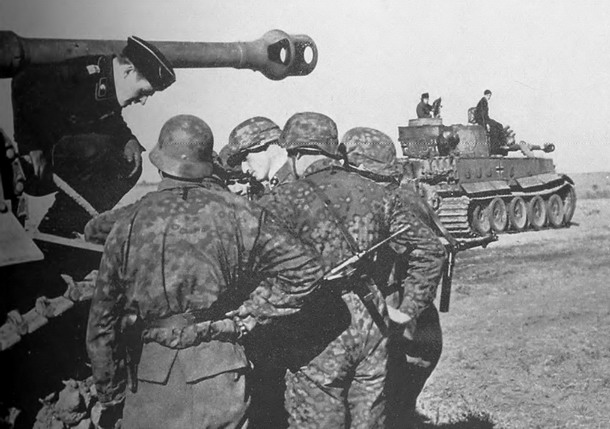
Tiger tanks and their accompanying infantry — a last look at the map and then forward into the attack, source: Bundesarchiv_Bild_101III-Merz-025-18, Wikimedia, Creative Commons, edited
The commander of Army Group South, Field Marshal von Manstein, was summoned to Germany on 13 July for a conference with the Führer. Hitler, disappointed with the progress of the offensive and nervous about the Allied invasion of Sicily, ordered Manstein to end Operation Zitadelle. Manstein persuaded Hitler to give him a few more days, during which the Germans would weaken the enemy as much as possible to prevent an easy Soviet transition to an overall counteroffensive. Things were also getting uncomfortable on the other side of the front: Stalin wanted Rotmistrov court-martialled for the enormous losses the Russians had suffered in the previous day's counterattack — though this ultimately did not happen.
Southern Wing, 14 July 1943
On 14 July the 48th Panzer Corps (XXXXVIII Panzerkorps) continued its mopping-up operations in the forests near Berezovka. The Totenkopf and LSSAH divisions were ordered to hold the defensive. Totenkopf in particular became the target of strong counterattacks and rocket artillery bombardment. Das Reich, by contrast, was to make one final attempt to break through to Prokhorovka from the south. It managed to advance only minimally, however, at the cost of 16 tanks and assault guns lost. The 3rd Panzer Corps (III Panzerkorps) of Army Detachment Kempf continued its slow advance to the northeast and was indeed tightening a noose around the Soviet 48th Rifle Corps. The Russian command recognised the danger and ordered the corps to withdraw from the threatened sector under cover of darkness. The Luftwaffe shot down 30 Russian aircraft that day for the loss of 9 of its own.
Southern Wing, 15 July 1943
The German 48th Panzer Corps (XXXXVIII Panzerkorps) completed its clean-up of the forests near Berezovka. It now at last had free hands for the attack on Oboyan, but was no longer capable of it. It therefore held its positions and awaited further orders. The 3rd Panzer Corps (III Panzerkorps) of Army Detachment Kempf completed the encirclement of the area on its left wing when it linked up around noon with forward patrols of the Das Reich division in the village of Leski — only to find the encircled area already empty, the Russians having withdrawn northward during the night. The Totenkopf division began that day to evacuate its bridgehead on the northern bank of the Psel river and pull slowly back to the south. The Luftwaffe claimed 11 Russians shot down and lost 5 of its own.
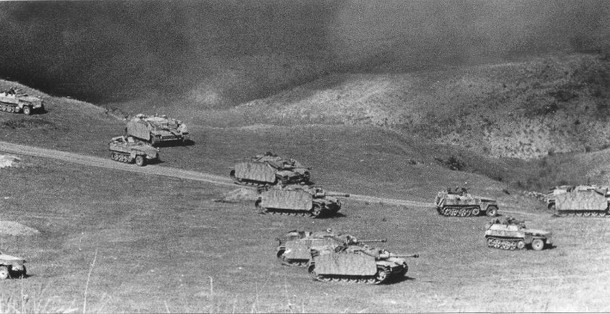
StuG III assault guns and Sd.Kfz. 250 half-track transports, source: Flickr.com with permission of the publishing user, edited
Southern Wing, 17 July 1943
On 17 July all remaining German units at the southern base of the Kursk salient received orders to withdraw to their starting positions. Operation Zitadelle was definitively over in the south as well. The Germans began a slow and careful withdrawal.
Total Losses
As the above account makes clear, the Germans fared significantly better during the offensive at the southern base of the Kursk salient. There they made substantially greater territorial gains than in the north and also managed to inflict considerably higher losses on the Soviets. During the 12 days of Operation Zitadelle, von Manstein's units in the south sustained the following losses: 6,643 killed and missing and 27,065 wounded. A total of 226 tanks, assault guns and tank destroyers were completely lost. A further 1,249 armoured fighting vehicles were knocked out in combat (indicating that many vehicles were damaged more than once). After the end of Operation Zitadelle von Manstein had only 459 serviceable tanks, 118 assault guns and 30 tank destroyers remaining — meaning he had lost 60 to 65 per cent of his armoured strength. The Luftwaffe flew a total of 14,398 combat sorties in the south, losing 99 aircraft in the process.
The Russian Voronezh Front in the south, by contrast, had 53,328 killed or missing and 63,643 wounded. A total of 1,293 Soviet tanks were completely destroyed (of which 854 were T-34) along with 57 self-propelled guns. The Soviet air force lost an astonishing 604 aircraft during the fighting at the southern base of the salient. At the end of Operation Zitadelle Vatutin in the south had only 607 serviceable tanks and self-propelled guns remaining. The loss ratio between the two sides was therefore approximately 1:3.5 in manpower (counting killed, missing and wounded), approximately 1:6 in armoured fighting vehicles and approximately 1:6.1 in aircraft — in all cases in favour of the Germans. Unlike the Germans, however, the Russians were already sending fresh units and new tanks to the front directly from the factories. (As an illustration: T-34 production in 1943 averaged around 40 vehicles per day, meaning that during the 12 days of German Operation Zitadelle, Russian factories could produce around 480 new T-34 tanks alone — to say nothing of other types of armoured fighting vehicles.)
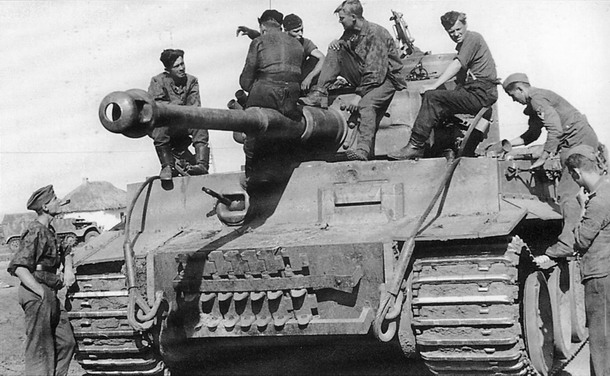
A Tiger tank during a break somewhere in the Kursk salient, source: Flickr.com with permission of the publishing user, edited
At the northern base of the Kursk salient, losses on both sides were considerably lower — after all, Operation Zitadelle in the north effectively lasted only 7 days, from 5 to 11 July. In that time the German 9th Army suffered 4,691 killed and missing and a further 17,510 wounded. Only 71 German armoured fighting vehicles (tanks, tank destroyers, self-propelled guns and assault guns combined) were completely destroyed. The Luftwaffe lost 117 aircraft in the north. Rokossovsky's Central Front had 15,336 killed or missing and 18,561 wounded. Approximately 220 Russian tanks and 439 aircraft were destroyed. The total losses of both sides in Operation Zitadelle were therefore as follows:
LOSSES |
NORTH |
SOUTH |
TOTAL |
||||
Germans |
Russians |
Germans |
Russians |
Germans |
Russians |
Ratio |
|
Killed and missing |
4691 |
15336 |
6643 |
53328 |
11334 |
68664 |
1 : 6.06 |
Wounded |
17510 |
18561 |
27065 |
63643 |
44575 |
82204 |
1 : 1.84 |
Armoured vehicles destroyed |
71 |
220 |
226 |
1350 |
297 |
1570 |
1 : 5.29 |
Aircraft destroyed |
117 |
439 |
99 |
604 |
216 |
1043 |
1 : 4.83 |
Conclusion and Assessment
Operation Zitadelle unfolded not according to the German plan, but according to the Soviet one — though even the Russians themselves apparently had not expected that repelling the German assault would cost them so much blood and steel. The German supreme command did not trouble itself with introducing any element of ingenuity or surprise into its offensive plan. They simply decided to throw everything they had at the Russians and crush them by sheer force in a large encirclement operation of the kind that had served them so well in 1941 and 1942 — completely ignoring the fact that the enemy had a substantial numerical advantage, knew essentially the exact location of the attack and even its approximate date (partly through British intelligence). What the supreme commanders failed to do was at least partly made up for by the brave German soldiers in the field. It is almost incredible that they managed to inflict several times greater losses on such a thoroughly prepared enemy. It was not enough for the operation to succeed, however.
Many readers may be struck by the relatively low losses the Germans inflicted on the Russians at the northern base of the Kursk salient. The truth is that Generaloberst Walther Model, who commanded the German forces in the north, evidently did not drive the attack with the aggression he might have. From the outset he was sceptical about Operation Zitadelle. He was fairly clear-eyed about the fact that this offensive held little hope of success and that his 9th Army would sooner or later have to fight for its own survival in the Orel salient. In effect he was preparing for defensive fighting from the very beginning. It is also true that when Model did transition to the defensive against Soviet Operation Kutuzov, he managed to inflict approximately ten times higher losses on the Soviets during the following five weeks of fighting than he had during Operation Zitadelle itself.
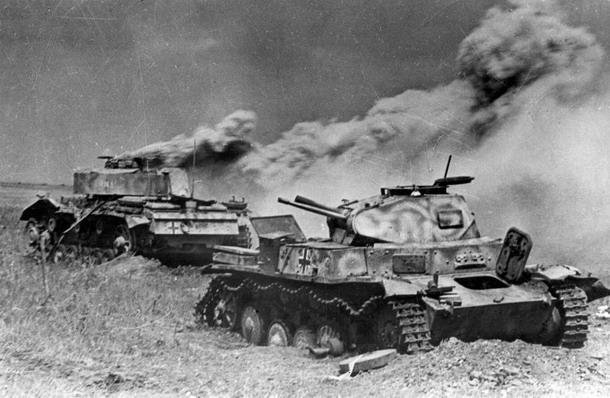
Operation Zitadelle had negligible chances of success from the very beginning — here burning Panzer II (yes, even these ancient machines were deployed at Kursk) and Panzer III tanks, source: Flickr.com with permission of the publishing user, edited
Reading accounts of Operation Zitadelle in various books, one can easily come away with the impression that Tiger tanks played the central role in this battle. Yes, wherever they appeared the Tigers were truly the uncrowned kings of the battlefield and could destroy Russian opponents at enormous range. It must be understood, however, that the Germans managed to deploy only 120 of them in Operation Zitadelle (31 in the north and 89 in the south). The main tank type that carried the German attack was, as usual, the Panzer IV, of which somewhere between 700 and 900 were committed and which thus made up nearly half of Germany's armoured strength in Operation Zitadelle. Zitadelle cannot be regarded as a purely armoured engagement either. The dominant factor in most of the fighting was mines and artillery. The nearly one million Russian mines laid in the salient perfectly prevented the German armoured formations from doing what they did best and what they were counting on at Kursk — forming a tank wedge, driving forward and steamrollering everything in their path. The mines immobilised Hitler's tanks in their dozens, leaving the crews to sit and wait while the minefields were cleared and their vehicles repaired. The Germans grossly underestimated the thoroughness of the Russian preparations and the role that minefields played in them.
The Largest Battle?
Operation Zitadelle is traditionally regarded as the largest tank battle of the entire war and thus of all history up to that point. Many historians disagree, however, attributing this distinction to a different battle — one that took place in late June 1941 around the Ukrainian city of Dubno, when four Soviet mechanised corps attempted to halt the advance of the German Army Group South. So how do we determine which of the two battles deserves the title? Presumably by the number of tanks — but should we count how many tanks were engaged in the fighting, or how many were destroyed?
If we apply the first criterion, then the gold medal does indeed go to Operation Zitadelle, in which more than six thousand Russian and German tanks, tank destroyers and assault and self-propelled guns were engaged. By contrast, on the Ukraine in June 1941, in the area between the towns of Lutsk, Rivne, Dubno, Brody and Radekhiv, "only" some 4,050 to 4,150 tanks, assault guns and tank destroyers were involved (or could have been). And how many tanks were destroyed in each of the two battles compared? Operation Zitadelle cost both sides together around 1,867 destroyed armoured fighting vehicles. In the Ukraine battle, approximately 2,600 tanks and other armoured vehicles are believed to have been destroyed. By this measure the 1941 battle clearly surpasses Operation Zitadelle.
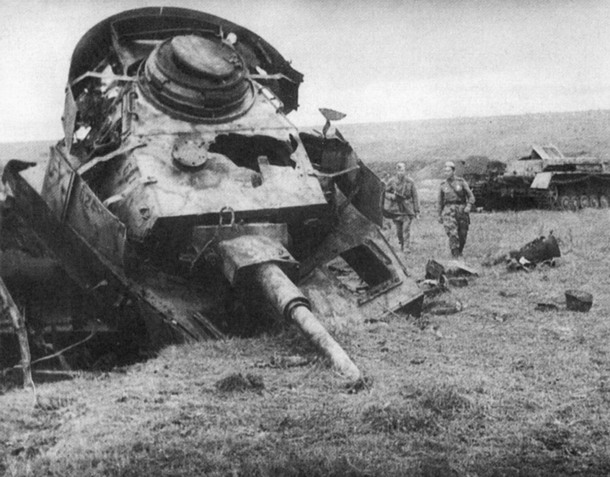
The end..., source: Waralbum.ru with permission of the operator, edited
Both battles are also comparable in duration. The fighting in northwestern Ukraine lasted from 23 June to 1 July 1941 — nine days. Operation Zitadelle ran for essentially 11 days, from 5 to 15 July 1943. (Note: one might argue that the subsequent fighting at Kursk after the German offensive ended — most notably the Soviet Operation Kutuzov — should also be counted as part of the largest tank battle. However, there is no point dragging that into this comparison, since it lasted more than 5 weeks, an incomparably longer period.)
Within Operation Zitadelle, special prominence is given to its climactic battle at the village of Prokhorovka on 12 July 1943, in which around a thousand tanks took part. A comparable peak day in the Ukrainian engagement would be 26 June 1941, when the Soviet counterattack began with four mechanised corps. The exact number of tanks that went into action that day is not known, but it can be estimated fairly realistically at around 1,300 on both sides combined — which, by this measure too, makes the 1941 battle in Ukraine surpass Operation Zitadelle.
Why then has the Battle of Kursk been so consistently and one-sidedly celebrated for all these years? Let us think about it together. Both engagements were fought between Nazi Germany and the Soviet Union. Only these two parties therefore had reasonably accurate information about both battles. But while in 1943 at Kursk the Soviets won, two years earlier in Ukraine the Wehrmacht rolled right over them. History, it is said, is written by the victors, and the victors would certainly not have been pleased for the world to know that they had lost the largest tank battle of all time. The information that filtered out of the USSR for many years after the war therefore spoke clearly: yes, the fighting in the summer of 1941 was bloody, but the greatest tank battle was undoubtedly Kursk — the battle won by Stalin's USSR. The conclusion, however, the reader may draw for themselves.
ARTICLE
CONTENTS:
Reproducing text from the Panzernet website without the written consent of the operator is prohibited.