OSTWIND
anti-aircraft tank on the Panzer IV chassis
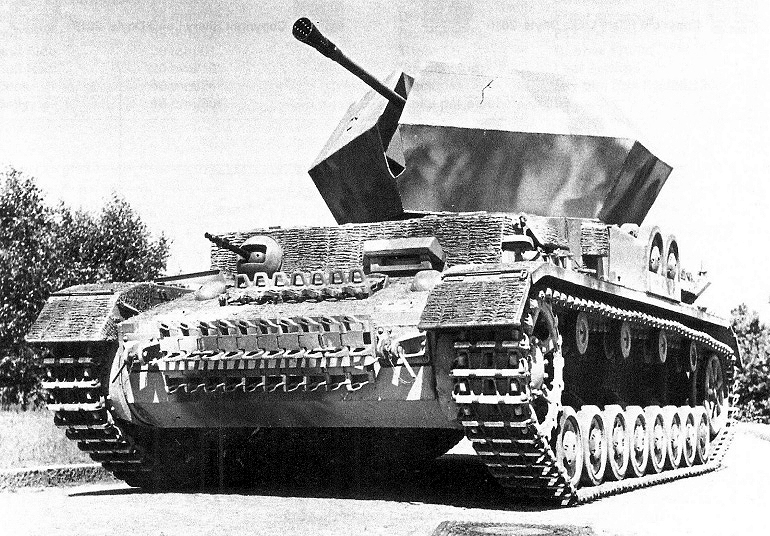
the Ostwind anti-aircraft tank, source: Flickr.com with permission of the publishing user, edited
Origins of the Flakpanzer
By 1944, the Luftwaffe had long since ceased to be capable of providing German ground forces with adequate protection against direct enemy air attack. The Germans were therefore desperately in need of self-propelled anti-aircraft weapons to protect troops and vehicles both on the move and in combat. Armoured units in particular lacked anti-aircraft means capable of keeping pace with them across the most demanding terrain. What was needed were vehicles with a fully tracked chassis and, ideally, a reasonable degree of armour protection. The answer was the so-called Flakpanzer — tank chassis fitted with anti-aircraft weapons. Of the available chassis, the one from the Panzer IV appeared the most suitable for this purpose.
Following the experience gained with the Möbelwagen anti-aircraft tank, the newly developed vehicles were to have a rotating fighting turret to protect the gun crew even during firing. For reasons that are not entirely clear, the ordnance office decided not to commission the new Flakpanzer from a commercial firm, but instead assigned the task to the repair and training unit Panzer Ersatz und Ausbildungs Abteilung 15, based in the town of Sagan (present-day Żagań in Poland). Within this unit, the so-called Kommando Ostbau Sagan was formed, which produced two design proposals for converting used tank chassis into modern anti-aircraft tanks. One was the Ostwind described below; the other, named Wirbelwind, is covered in a separate article.
The first prototype of the new vehicle was tested in July 1944, using as its basis an older, previously used chassis from a PzKpfw IV Ausf. G. The prototype's turret was fabricated from non-armoured steel only, and as the photographs suggest, some of its panels were even welded together from multiple pieces — evidently from whatever material happened to be available to the unit at the time. Following the completion of trials, the Army placed an order in September 1944 for 100 of the new anti-aircraft tanks. The vehicle received the official designation Flakpanzerkampfwagen IV (3,7 cm Flak 43), but became far better known under its battle name Ostwind — meaning "east wind".
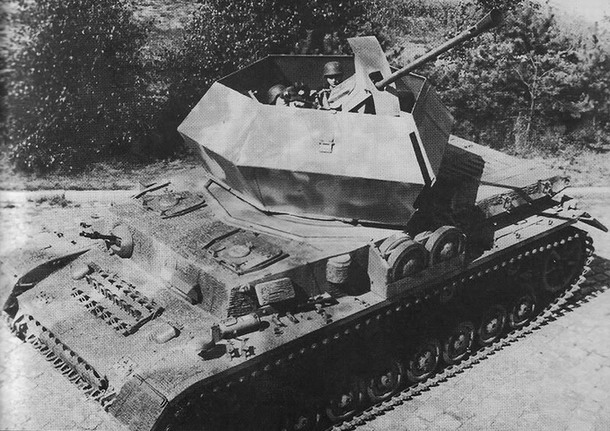
the Ostwind anti-aircraft tank, source: Flickr.com with permission of the publishing user, edited
Description of the Design
Production of these vehicles could take place directly within the unit rather than in a factory, since it was less a matter of manufacturing from scratch and more one of assembly — putting together already finished components. The basis was provided by older, previously used Panzer IV tanks of the Ausf. J variant. The tanks were simply stripped of their original combat turrets and a new turret fitted in their place. This turret was manufactured and supplied to Ostbau Sagan by the firm Deutsche Rohrenwerk. It was six-sided in plan, elongated at the front, and constructed from armour plate only 16 mm thick, which was angled for greater ballistic protection. The turret was open at the top so that the crew had a clear view of the sky and could easily spot — or even hear — an approaching enemy aircraft.
According to some authors, the new turrets were not mounted in the original turret ring but in a newly installed ring taken from the Tiger tank. It has even been suggested that this necessitated relocating the radio operator's roof hatch in front of the turret. Fitting a new turret ring and moving the hatch would, however, have represented quite a laborious modification to the original tank hull — entirely at odds with the philosophy of the whole project, which was to build a new fighting vehicle quickly and cheaply using existing components. No such hull modification is visible in the photographs either (as was the case, for example, with the older Möbelwagen), and I would therefore venture to challenge this theory.
Inside the new turret was mounted the 37 mm anti-aircraft gun 3,7 cm Flak 43. The weapon could rotate together with the entire turret through a full 360 degrees. Vertical elevation ranged from -10° to +90°, meaning the gun could be used against ground targets just as easily. The gun itself had a theoretical rate of fire of up to 250 rounds per minute and a practical rate of up to 150 rounds per minute. Secondary armament consisted of an MG 34 machine gun in the front hull plate, retained from the original tank. As for the onboard ammunition supply for the gun, sources differ — some cite 400 rounds, others 1,000.
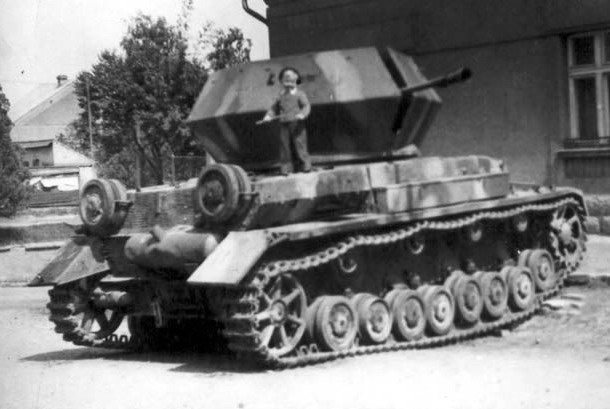
an Ostwind anti-aircraft tank abandoned at the end of the war on Czech territory, source: Flickr.com with permission of the publishing user, edited
The Ostwind's crew consisted of five men. The driver and radio operator were seated in the hull front, just as in a standard Panzer IV. The remaining three crewmen had their stations in the turret. To the right of the gun sat the gunner, who apparently also served as the vehicle commander. To the left of the weapon were the two loaders. The Flak 43 was fed using metal strips of eight rounds. At a practical rate of fire of 150 rounds per minute, those eight rounds were consumed in roughly three and a half seconds — which is presumably why the crew included two loaders rather than one.
The Ostwind's powerplant was inherited along with the tank chassis — a Maybach HL 120 TRM twelve-cylinder petrol engine with a displacement of 11.9 litres and a maximum output of 300 horsepower. The six-speed Zahnradfabrik SSG 76 Aphon gearbox was likewise carried over from the original battle tank. The Ostwind weighed approximately 25 tonnes and was capable of reaching 38 km/h. Its operational range was around 200 km on roads and 130 km cross-country.
As noted, the Army ordered 100 of the new anti-aircraft tanks in September 1944. Historians disagree quite fundamentally, however, on how many were actually completed. Some put the figure at 75 vehicles delivered, others at 44. There is also a version according to which Allied bombing raids and the advance of Soviet forces slowed production so severely that only 7 examples were finished. The Ostwind was deployed primarily on the Western Front, though photographic evidence confirms the presence of at least one vehicle on Czech territory.
Technical Specifications
|
weight: |
25 t |
|
length: |
5.92 m |
|
width: |
2.95 m |
|
height: |
2.96 m |
|
engine: |
Maybach HL 120 TRM |
|
engine output: |
300 hp |
|
max. speed: |
38 km/h |
|
range – road: |
200 km |
|
range – cross-country: |
130 km |
|
crew: |
5 men |
|
armament: |
37 mm Flak 43 gun |
ARTICLE
CONTENTS:
Reproducing text from the Panzernet website without the written consent of the operator is prohibited.