STURMTIGER
a self-propelled rocket launcher for demolishing urban structures
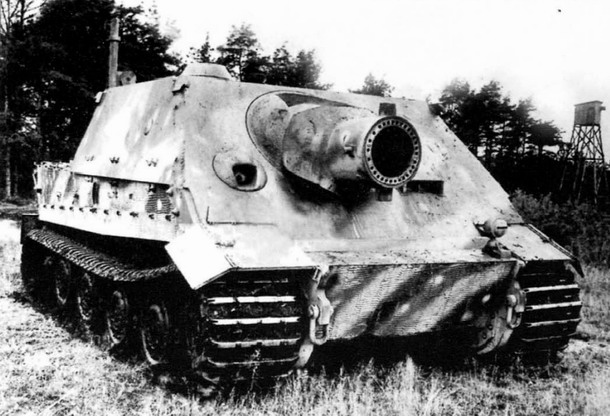
one of the first production Sturmtigers at the Kummersdorf proving ground; source: Flickr.com, published with the permission of the original contributor, edited
Origins of the vehicle
When the German 6th Army reached the outskirts of Stalingrad in late August 1942, weeks and months of brutal fighting in the city's streets, factories, apartment buildings, and cellars lay ahead. This was a form of warfare for which German troops were neither accustomed nor prepared — one that brought very specific challenges, such as the need to eliminate defenders who had barricaded themselves inside multi-storey residential buildings or large factory halls. Driving them out in man-to-man fighting within the building itself was a slow process that also inflicted enormous casualties. The most effective way to overcome this kind of resistance was simply to destroy the entire building along with its defenders. But how to accomplish this in practice? Sending engineers forward with demolition charges was tantamount to sacrificing them. German tanks could approach a building with relative safety, but their guns were quite incapable of bringing such structures down. Heavy artillery, which would certainly have sufficed for the task, operated from long range and lacked the precision to take out a specific building without destroying everything around it. Aircraft were of course an option too — a dive bomber could hit a designated building with reasonable accuracy — but this was a costly and time-consuming solution, and low-level attacks over the city carried a considerable risk of being shot down by ground-based anti-aircraft fire.
What the German soldiers fighting in Stalingrad simply lacked was a self-propelled weapon capable of safely closing to within range of a specific building and destroying it entirely with just a handful of shots. At the same time, the vehicle would of course need to withstand fire coming from all directions — as is the nature of urban combat — and not just small arms and machine guns. Threats also came from anti-tank rifles, anti-tank guns, and most likely hand grenades and mortar rounds as well. The primary characteristics of such a fighting vehicle would therefore have to be heavy all-round armour protection and a weapon of the greatest possible destructive power. Speed and range, on the other hand, were secondary concerns.
The soldiers' requirement for the development and production of such a weapon was put before the supreme army command at Hitler's conference on 20 September 1942. The request was evidently considered sound and was passed on for implementation to the Berlin-based firm Alkett (Altmärkische Kettenwerk). The company promptly prepared two new armoured vehicles, each designed specifically for the purpose described. The first, completed as early as October 1942, was the Sturminfanteriegeschütz 33 — a rapid interim solution built in only 24 examples. The second, considerably more refined vehicle was completed in April 1943 and entered history under the unofficial combat name Brummbär. A distinct category of self-propelled guns had thus come into being, commonly referred to by the unofficial collective term Sturmpanzers.
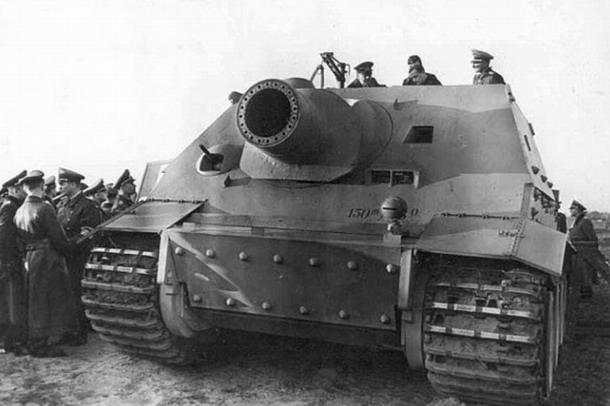
the first prototype of the Tiger assault mortar, differing from later production vehicles in several details including the gun shield and the additional armour plate bolted to the hull front; source: Flickr.com, published with the permission of the original contributor, edited
Both of these vehicles were armed with a 150 mm gun. While the destructive power of this weapon was quite respectable, it still took several shots to demolish a multi-storey residential building. This led soldiers to soon consider whether an even more powerful Sturmpanzer could be built — one capable of doing the job in a single shot. The requirement was therefore essentially very simple: maximum possible firepower, ideally combined with heavy armour protection. Representatives of the ordnance office began searching across Germany for a suitable weapon.
The search for a suitable weapon
Initially, the idea of using a 210 mm howitzer was reportedly considered — possibly a modified version of the Mörser 18 — but this avenue turned out to be a dead end. In the end, the choice fell on something entirely different: a highly specialised weapon that had originally been developed for naval use.
This specialised weapon had been designed in 1942 by Rheinmetall-Borsig. It was a launcher for depth charges intended to destroy submarines approaching coastal military installations such as harbours — a weapon firing from a fixed shore emplacement. As for its designation, the literature offers two variants: either Raketen-Tauchgranatewerfer (RTgW), meaning literally "rocket depth-charge launcher", or Raketen Tauch Geschoss 38 (RTG38), meaning "rocket depth charge". The device was reportedly tested on the Norwegian coast, but apparently with less than impressive results. The weapon nevertheless caught the attention of army representatives thanks to its enormous destructive power, which could clearly be put to good use against land targets as well. When in 1943 demand arose for a weapon for the new Sturmpanzer, the pieces fell neatly into place. The modified version of the weapon, adapted for use in an armoured fighting vehicle, received the designation RW61 (RW = Raketten Werfer). As for the chassis for the new fighting vehicle, the soldiers had a fairly clear idea from the outset. Only the chassis of a heavy tank could carry such a heavy weapon, and the logical choice was the chassis of the Tiger.
The first mention of the new Sturmpanzer armed with a 38 cm weapon on a Tiger chassis appeared in the minutes of a weapons committee meeting dated 27 May 1943. Development of the fighting vehicle was entrusted to Alkett, which had also developed the two preceding Sturmpanzer types. At that time Alkett apparently considered a fundamental redesign of the tank chassis, with the engine relocated to the centre and the fighting compartment at the rear. This idea was soon abandoned, however, as such extensive modifications to the chassis would have delayed and increased the cost of both development and production — and more importantly, it turned out they were not necessary at all. Since Tiger tanks were being produced in relatively small numbers and every one was needed at the front, the ordnance office decided that the basis for producing the new Sturmpanzer would be used chassis from older tanks returning from the front to Germany for major repairs.
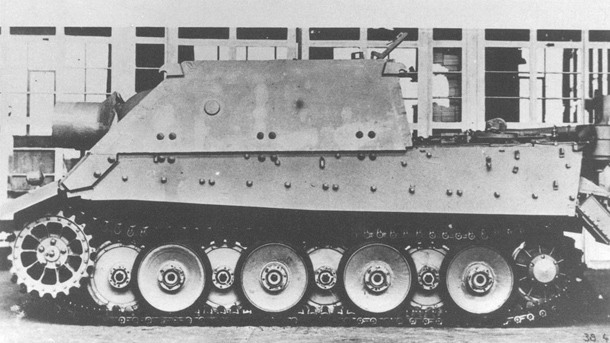
the Sturmmörser Tiger prototype was based on a chassis with the older type of road wheels; in this photograph the vehicle is fitted with the narrower transport tracks; source: Flickr.com, published with the permission of the original contributor, edited
The first prototype
During a conference held on 5 August 1943, the design of the new Sturmpanzer was presented to Hitler. The Führer approved of the vehicle and authorised the construction of a verification prototype followed by series production at a rate of 10 units per month. The first prototype was completed in record time and was already demonstrated to Hitler on 20 October 1943. The demonstration took place at the base near the town of Arys (Polish: Orzysz) in what was then East Prussia (now in Poland). The first prototype differed from the later production vehicles in a number of details. The chassis used as the prototype's basis came from an early-production Tiger with the serial number 250043 (250174 according to some sources), fitted with the older-type road wheels with rubber tyres around their circumference. Later production vehicles exclusively used the newer wheels with a thin rubber tyre concealed beneath a steel rim.
Carried over from the older tank chassis, the prototype also retained the original Feifel air filters and the shrapnel dischargers at both rear corners of the hull — none of which appeared on later production vehicles. The armoured superstructure of the prototype was reportedly fabricated from ordinary mild (unhardened) steel. The hull front received an additional 50 mm armour plate bolted on with 13 heavy bolts. This additional plate was not standard on production vehicles, though exceptions existed — on those, however, considerably more slender bolts were used to secure the extra plate (see photo HERE). Another feature specific to the prototype was the shape of the gun shield: in the area below the barrel, the shield on the prototype was noticeably larger than on later production vehicles (comparison HERE).
The Führer was satisfied with the prototype as demonstrated, and thorough troop trials could begin. These continued until April 1944, when series production was formally approved. As for the official designation of the new fighting vehicle, a whole range of names can be found in the literature, such as 38 cm RW61 auf Sturmmörser Tiger, Panzermörser 38 auf Tiger, or 38 cm Mörserträger auf PzKpfw VI. In the minds of most military history enthusiasts, however, it has been remembered simply as the Sturmtiger. Interestingly, none of the sources available to us cite an ordnance designation (Sd.Kfz.) for this vehicle. German documents most commonly referred to the vehicle as Sturmmörser Tiger — not an assault rocket launcher, but an assault mortar (Mörser).
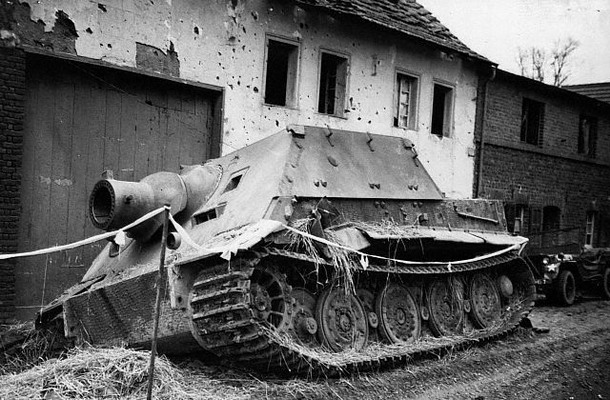
a damaged and abandoned Sturmtiger that fell into the hands of American troops; source: Flickr.com, Public domain, edited
"Series" production
The term "series production" is somewhat generous in the case of the Sturmtiger, given that only 18 units were built in total. Some authors put the figure at 18 plus the prototype; others include the prototype in the 18. Since the prototype was later substantially modernised and committed to combat, it is quite possible that it was ultimately counted among the series vehicles as well. We will, however, stick with the figure of 18+1. There is also disagreement in the literature regarding the delivery dates of the production vehicles. We follow the version given by Thomas L. Jentz in the Panzer Tracts series, according to which the first 3 production vehicles were delivered in August 1944, a further 10 in September 1944, and the last 5 in December 1944 (the distribution of production was evidently determined by the availability of suitable tank chassis).
Description of construction
As already mentioned several times, the Sturmtiger was based on the chassis of the heavy Tiger I tank, and therefore had eight axles for road wheels on each side. On the prototype, which used the older rubber-tyred road wheels, each axle carried three discs, giving the chassis 24 road wheels per side. On later production vehicles with all-steel road wheels, only two discs per axle were needed, resulting in 16 wheels per side. For the sake of simplicity, let us focus from here on exclusively on the production Sturmtigers. On these, the wheels on odd-numbered axles were mounted in the inner row, closer to the hull, while those on even-numbered axles formed the outer row, further from the hull. This interleaved arrangement allowed more wheels to fit on each axle, resulting in better weight distribution. Along with the tank chassis, the Sturmtiger also inherited the tracks. As with the standard Tiger tank, the new Sturmpanzer used two types of tracks: combat tracks 725 mm wide and transport tracks 520 mm wide. The narrower tracks were fitted for rail transport, as the wider combat tracks caused the vehicle to exceed the maximum load gauge.
The powerplant was naturally carried over along with the chassis: a Maybach HL230 P45 petrol twelve-cylinder engine. With a displacement of 23 litres, it produced a maximum output of 700 horsepower at 3,000 rpm. The fuel tanks held a total of 534 litres of petrol, sufficient for approximately 100 km on roads and around 60 km cross-country. The engine was housed in the rear of the hull, with powerful radiators on either side. It was coupled to a Maybach OLVAR OG 40 12 16 A gearbox with eight forward and four reverse ratios.
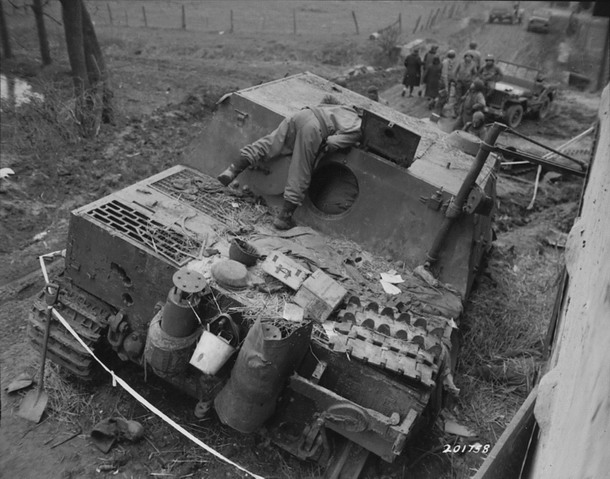
an American soldier peers into the interior of a Sturmtiger; note the missing right track and several penetrations on the left side of the rear hull armour — the ammunition loading crane remains assembled in its position; source: Flickr.com, Public domain, edited
During the conversion to a Sturmpanzer, the entire roof of the original tank's crew compartment was cut away, along with part of its front wall. This created an enormous open space stretching from the front wall all the way to the engine section (this is clearly visible in the photograph HERE, source: Flickr.com, Public domain). Across this open space was placed a new fighting superstructure, welded from flat steel plates (the superstructure on its own is clearly visible in the photograph HERE, source: Flickr.com, Public domain). The superstructure was joined to the hull by means of massive clamps secured with bolts — three on each side of the superstructure and two more on the rear wall. At the front of the superstructure, where its side walls extended further downward, two additional connecting bolts were fitted. All of these bolts had conically shaped external heads, which offered better resistance to a potential hit from a smaller-calibre enemy projectile (the connecting bolts can be examined in the photograph HERE). The armour plates for the new superstructures were supplied by Brandenburgische Eisenwerke of Kirchmöser.
The front wall of the new fighting superstructure contained several openings. First was the driver's vision port, located at the lower left. Directly above it was the aperture for the rocket launcher's sight. At the lower right was a hemispherical ball mount for a machine gun. And of course there was the enormous opening for the RW61 rocket launcher itself — but we will come to that later. The only openings in the side walls were small pistol ports for the crew's personal weapons, closed with armoured plugs. The rear wall of the superstructure similarly had just a single circular opening, which served as the crew's entry and exit hatch. In the roof of the superstructure was a large rectangular opening for loading rockets. Installed in one of the two hatches covering this opening was the so-called Nahverteidigungswaffe — a weapon for close-range defence against enemy infantry. It was essentially a simple launcher from which anti-personnel shrapnel rounds, smoke grenades, and even signal pistol rounds could be fired through its barrel. The roof also featured a circular crew hatch with an observation periscope in its cover, and a large ventilation fan for extracting fumes from the fighting compartment. The front wall of the fighting superstructure was 150 mm thick, the sides and rear 80 mm, and the roof 40 mm.
The RW61 rocket launcher
As already noted, the front wall of the Sturmtiger's fighting superstructure was dominated by the enormous barrel of the RW61 rocket launcher. The weapon was mounted in a hemispherical cradle with a massive external shield (detailed photo HERE). The mounting allowed 10 degrees of horizontal traverse to each side, and vertical elevation from 0 to +85 degrees. The weapon was not fitted with any recoil mechanism. This meant that all the pressure generated at rocket ignition had to be contained by the barrel's internal breech. However, this pressure was equivalent to approximately 40 tonnes — more than the breech could withstand on its own — so part of the pressure had to be redirected elsewhere. For this reason, the barrel was designed with a double-wall construction. It had an inner tube through which the rocket itself flew, surrounded by a second outer tube. The space between the inner and outer tubes contained channels that vented a portion of the flames produced by the igniting rocket's nozzles. These channels are clearly visible as small circular openings arranged around the muzzle of the barrel. Photographs reveal that the number of these channels was not the same on all vehicles, suggesting that the correct number — and with it the pressure balance in the barrel — was gradually fine-tuned over time.
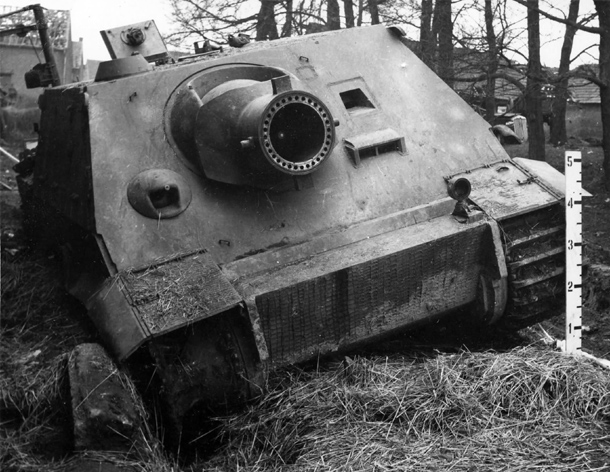
the same Sturmtiger wreck again; on the underside of the open roof hatch the Nahverteidigungswaffe launcher can be seen; source: Flickr.com, Public domain, edited
Once inserted into the barrel, locking catches held the rocket approximately 12 cm from the breech. This created a free space around the rocket's nozzles through which the combustion gases from the rocket motor could enter the side venting channels, then continue to flow through them until they erupted around the muzzle of the barrel (which further intensified the enormous muzzle flash already produced by the launching rocket on its own). The barrel's inner breech was opened by sliding it to the right, a movement performed manually using a handle located to the right below the barrel. The traverse control handle was directly above the barrel, and the elevation control handle was to the left of it.
Types of rockets used
Two types of rockets were used with the launcher. The first was the Raketen Sprenggranate 4581, with a total weight of 351 kg, of which a full 125 kg comprised the explosive charge — Amatol 50/50 (i.e. 50% ammonium nitrate and 50% TNT). This rocket was intended for destroying ordinary structures. The second type was the 345 kg Raketen Hohladungsgranate 4582 (numbered 4592 according to some sources), fitted with a shaped-charge warhead and designed for destroying hardened structures such as fortifications and bunkers. This rocket was capable of penetrating up to 2.5 metres of reinforced concrete. The basic construction of both rocket types for the RW61 was the same. The front section comprised the warhead — either shaped-charge (4582) or high-explosive (4581) — and the rear section contained the propellant for the rocket motor. The two sections were screwed together via threads on their casings and then additionally secured with locking screws (photo HERE).
Solid propellant was used in the rockets, pressed into cylindrical segments of several different sizes. At the centre of the assembly were two nested hollow cylinders approximately 40 cm in length. The inner cylinder had a diameter of roughly 10 cm with a narrow internal cavity, and weighed about 4.5 kg. Around it sat a second cylinder with an outer diameter of approximately 18 cm, weighing about 9 kg. Around these central cylinders were arranged ten further cylinders, each approximately 7.5 cm in diameter and 31 cm in length, each weighing about 2.5 kg. The total weight of propellant in the rocket therefore came to just under 40 kg. The cavity in the inner central cylinder was filled with three cloth bags of gunpowder, with a further bag placed in front of the central cylinder assembly (see photo HERE). These bags served to initiate ignition of the propellant itself — but more on that below.
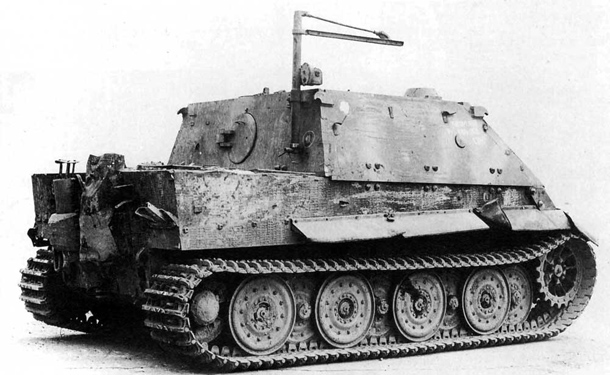
rear view of a damaged Sturmtiger — this photograph clearly shows the bolt heads securing the superstructure to the hull; source: Flickr.com, Public domain, edited
The base of the rocket consisted of a plate fitted with 32 small nozzles, through which the combustion gases from the burning propellant escaped to propel the rocket forward. In flight, the rocket was stabilised by rotation. This rotation was imparted partly by rifling in the barrel, and partly by the nozzles themselves — which were not aligned parallel to the rocket's axis but bored at an angle of 14 degrees. Thanks to this angling, the nozzles continued to spin the rocket even after it left the barrel. Around the lower circumference of the rocket were 9 removable lugs that engaged with the rifling grooves in the barrel (the lugs around the rocket's body are clearly visible in the photograph HERE).
Loading was an art in itself
Loading the 1.5-metre-long, 350 kg rockets into the barrel was no simple matter. Getting them aboard in the first place was complicated enough. For this purpose, the Sturmtiger was equipped with a small hand-operated crane that attached at the right rear corner of the fighting superstructure. The supply vehicle would unload the rockets onto the ground in their wooden safety packaging. The crew would then roll the rocket along the ground to the right side of the Sturmtiger, remove the safety casing, and attach a hook — connected to the crane cable — to the rocket. Each rocket had a white stripe painted around it at its centre of gravity: this was the point where the hook was to be attached, to prevent the rocket from tilting and slipping out.
The crane would then lift the rocket up above the roof of the fighting superstructure and lower it inside through the roof opening. There another crew member would place it on the loading tray and detach the cable, then attach it to the internal crane — suspended from the ceiling of the fighting superstructure — which would hoist it into one of the storage racks. Each side of the superstructure held racks for six rockets. One additional rocket could be left on the loading tray. In theory, a fourteenth rocket could also be loaded directly into the barrel of the launcher for transport, which then had to be fixed at an elevation of +16 degrees. Some sources indicate that only a specially modified and clearly marked rocket — fitted with additional moisture protection, since rain could easily get into the short barrel — could be carried in this way. Loading the full complement of 14 rockets aboard was a job for the entire crew that might take several hours.
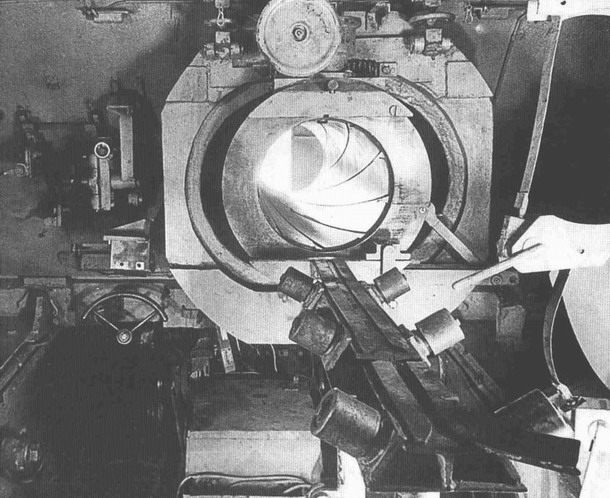
view through the barrel of the RW61 rocket launcher, including the rocket loading tray; to the left of the weapon the driver's position with its "steering wheel" can be seen; source: Wikipedia, Public domain, edited
Chambering a rocket into the barrel was again performed with the help of the internal crane. The rocket was first lifted from its side rack and placed on the loading tray. The loader would then screw an impact fuze into the opening at the rocket's nose (during transport, rockets were logically kept without fuzes). For the shaped-charge Raketen Hohladungsgranate 4582 the fuze type AZKM 10 was used; for the high-explosive Raketen Sprenggranate 4581 the fuze was type AZKM 8, which allowed a delay to be set (up to 0.12 seconds according to some sources, up to 12 seconds after impact according to others). The prepared rocket was then pushed by hand from the loading tray into the barrel. The barrel had to be at an elevation of between 0 and no more than +3 degrees at this point. During insertion, the rocket also had to be rotated to align its lugs with the rifling grooves in the barrel. Rotating a 350 kg rocket was no trivial matter, and the crew had a special tool for this purpose — describing it in words is not particularly helpful, so take a look at its photograph HERE. To further ease the process, the grooves in the barrel were slightly widened at their entry end so that the rocket's lugs would engage more smoothly (this is clearly visible in the photograph HERE).
Once the rocket was safely seated in the barrel, the loader fitted an igniter plug into the opening in its base — needed to ignite the gunpowder bags. As a further step, the loader also had to insert a primary pyrotechnic cartridge into the opening in the barrel breech, after which the breech was closed and the weapon was finally ready to fire. The gunner then pulled the firing lanyard, igniting the pyrotechnic cartridge in the breech. This in turn ignited the initiator at the base of the rocket, which lit the gunpowder bags described above, which then ignited the propellant cylinders in the correct sequence (the entire loading procedure was illustrated in detail in the crew manual — see HERE).
The maximum range of the rocket launcher varied considerably depending on outdoor temperature, as temperature affected the burning rate of the rocket propellant. At -40 °C the rocket would travel only 4,200 to 4,600 metres; at +50 °C the range extended to 6,000 to 6,650 metres. A reasonable mid-point figure at +15 °C is generally cited as 5,650 metres. When aiming, the gunner therefore had to account not only for the distance to the target and the barrel elevation angle, but also for the current temperature — and potentially wind speed and direction as well. The Pak ZF 3x8 sight was used for aiming, providing three-times magnification and an eight-degree field of view. An additional counterweight was sometimes hung on the muzzle end of the rocket launcher barrel to improve the weapon's balance and stability during aiming and firing.
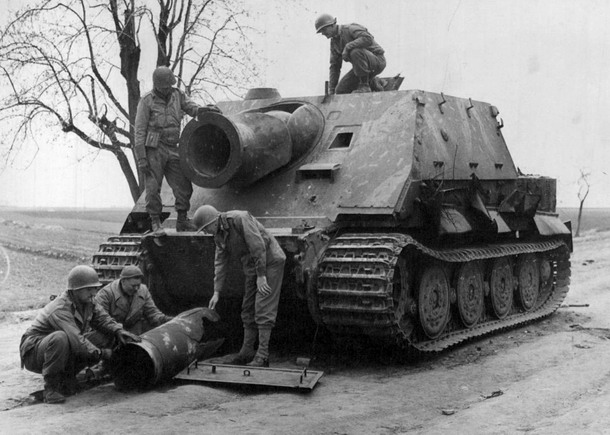
another Sturmtiger captured by American forces; source: Flickr.com, Public domain, edited
The Sturmtiger's crew consisted of five men. The driver sat on the left in the front section of the hull, while the commander, gunner, loader, and radio operator/machine gunner were stationed in the fighting superstructure. Although the superstructure looks quite spacious at first glance, once a full load of rockets had been stowed there was little room left for the crew. Particularly cramped was the radio operator/machine gunner's position. The rocket launcher was not mounted on the vehicle's centre line but slightly to the right of it, meaning the space between the weapon and the right side wall of the superstructure was quite limited. This is in fact evident from the placement of the machine gun ball mount, which was positioned effectively above the right track. The machine gunner therefore had to sit on the track guard — and the radio set was installed there too. The radio was a Fu5 type with a simple rod antenna routed out through the rear wall of the superstructure. The crew also had a second, stowed machine gun aboard, along with two MP38 or MP40 submachine guns. The ammunition supply for the machine guns totalled 2,550 rounds (600 according to some sources), and 384 rounds were available for the submachine guns.
The Sturmtiger weighed 65 tonnes, measured 6.28 metres in length, 3.57 metres in width, and 2.85 metres in height. On roads it could, at least in theory, reach a top speed of 37.5 km/h — in practice it was more like 30 km/h on roads and 20–25 km/h cross-country.
Organisation
Sturmtigers were organised into independent companies called Sturmmörser-Kompanie, in accordance with the organisational directive KstN 1161. Such a company was to have a command section equipped with an armoured half-track Sd.Kfz. 251/18, two cross-country vehicles, and one motorcycle. The company also had its own supply section with ten or eleven trucks, and finally two combat platoons (Zug), each with two Sturmtigers. The total strength of the company was 78 or 79 men. The first such company was formed on 13 August 1944 and designated Sturmmörser-Kompanie 1000. In August 1944 (as noted above) the first three production Sturmtigers were delivered. Together with the prototype, that was exactly enough to equip the two combat platoons of Sturmmörser-Kompanie 1000.
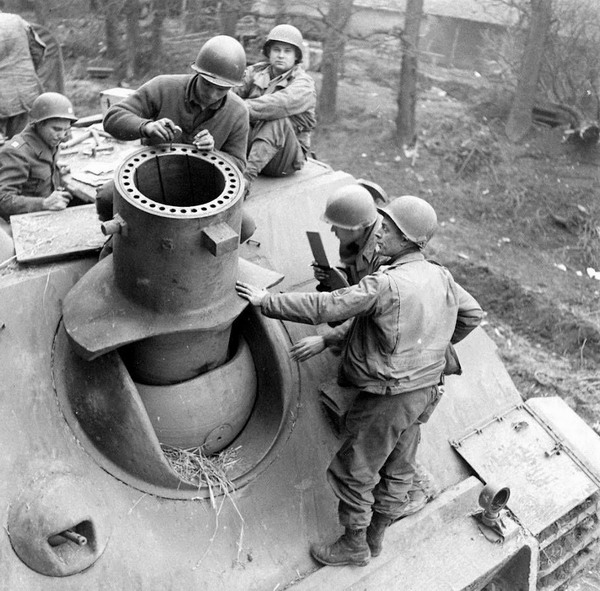
American intelligence officers thoroughly examining a captured Sturmtiger; source: Flickr.com, Public domain, edited
Combat deployment
On 1 August 1944 the Warsaw Uprising broke out in the occupied city. An enraged SS chief Heinrich Himmler personally ordered that Warsaw be razed to the ground. The German units deployed against the insurgents thus faced exactly the kind of fighting for which the Sturmtiger had been developed. It is therefore no surprise that the first two available Sturmmörsers were dispatched to Warsaw as quickly as possible. The first was the prototype itself, built back in October 1943, which arrived in Poland on 15 August 1944. Just three days later, a second Sturmtiger arrived by rail — this time a production vehicle (hull serial number 250237). Together, these two machines formed the first platoon of Sturmmörser-Kompanie 1000. For the following four weeks, the two vehicles took part in demolishing buildings in which the insurgents were sheltering. Since there were not yet enough trained crews for the new fighting vehicle, the prototype's crew had to be assembled from Alkett factory workers. The commander of the 9th Army, General von Vormann, complained in one of his reports that these men knew how to look after the new vehicle but could not shoot straight. After returning from Poland, the Sturmtiger prototype was further modernised: it received a proper fighting superstructure of hardened armour steel (in place of the original mild steel), and its rubber-tyred road wheels were replaced with the newer all-steel type.
From the other two available production Sturmtigers, a second platoon was formed within Sturmmörser-Kompanie 1000 and dispatched to France at the end of August 1944. In December 1944, the entire Sturmmörser-Kompanie 1000 was committed to the Western Front as part of Operation Wacht am Rhein. Little detail is known about its actions in the west. In January 1945 the unit was redesignated Sturmmörser-Batterie 1000 and placed under artillery command. At that time the company was also probably expanded from four to six Sturmtigers, with each of the two platoons receiving a third vehicle instead of the original two. Where exactly this unit fought during 1945 is not known, but at least the modernised prototype of the first Sturmtiger was committed to combat in the east once again towards the end of the war — it was captured by the Red Army and today forms part of the collection of the museum at Kubinka.
The second Sturmtiger company was Sturmmörser-Kompanie 1001, formed on 23 September 1944. It too originally had two platoons of two fighting vehicles each (the vehicles were to have been on chassis with serial numbers 250471, 250051, 250103, and 250043). This company was deployed on the Western Front, again as part of Operation Wacht am Rhein, in the area between the towns of Euskirchen and Düren. In January 1945 it was likewise redesignated Sturmmörser-Batterie 1001 and expanded from 4 to 6 Sturmtigers (two platoons of three vehicles each). From January 1945 there is also a record of one Sturmtiger from this unit destroying three American Sherman tanks — parked close together in the middle of a village — with a single shot. In February and March 1945 the unit withdrew to the east bank of the Rhine, suffering from shortages of fuel and especially spare parts. As a result, during the retreat the crews were forced to destroy three of their Sturmtigers themselves. One of these was the vehicle with hull number 250043, which subsequently fell into the hands of the American 8th Infantry Division.
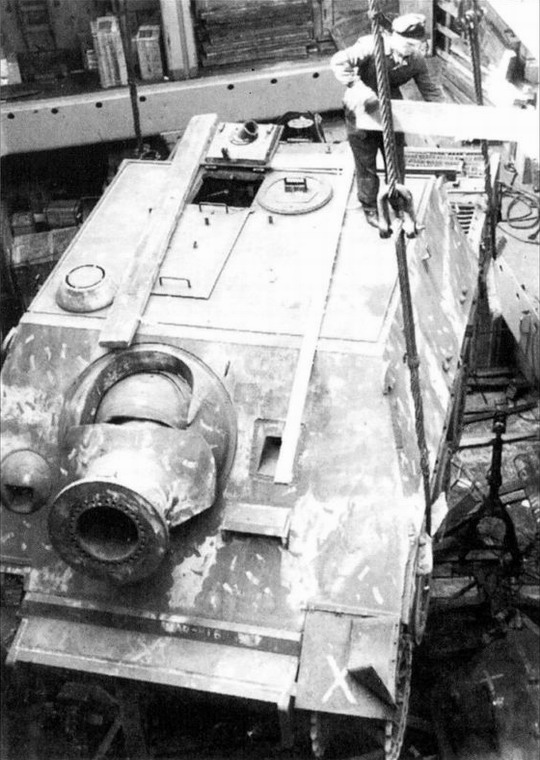
a fine overhead view of a Sturmtiger being loaded onto a ship for transport to the United States; source: Flickr.com, Public domain, edited
The last company, Sturmmörser-Kompanie 1002, was formed on 14 November 1944. In December the unit, with its four Sturmtigers, was sent to the area of the Klever Reichswald. This company too was redesignated as a battery in January, numerically expanded, and placed under artillery command. In March 1945 the unit withdrew to the east bank of the Rhine; in April 1945 it was fighting in the area around the town of Dorsten and retreating steadily eastward before the American advance. Sturmmörser-Batterie 1002 reportedly lost all its Sturmtigers not in combat, but as a result of fuel shortages and mechanical breakdowns.
Technical data
|
weight: |
65 t |
|
length: |
6.28 m |
|
width: |
3.57 m |
|
height: |
2.85 m |
|
engine: |
Maybach HL230 P45 |
|
engine output: |
700 hp |
|
max. speed: |
37.5 km/h |
|
hull armour: |
|
|
- front: |
100 mm |
|
- sides: |
80 mm |
|
- rear: |
80 mm |
|
superstructure armour: |
|
|
- front: |
150 mm |
|
- sides: |
80 mm |
|
- rear: |
80 mm |
|
crew: |
5 men |
|
armament: |
RW61 rocket launcher, 380 mm calibre 2x MG 34 machine gun, 7.92 mm calibre |
ARTICLE
CONTENTS:
Reproducing text from the Panzernet website without the written consent of the operator is prohibited.