MINENRÄUMWAGEN BORGWARD
remote-controlled mine-clearing vehicle
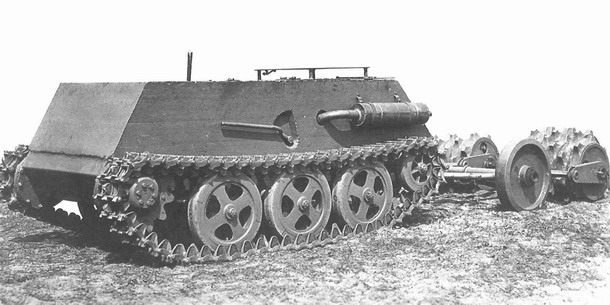
Minenräumwagen B I with detonation rollers attached. The metal rod on the side of the vehicle is the gear lever, which had three positions: neutral, slow forward, and fast forward. Source: Flickr.com, with permission of the publishing user, edited
Origins
As early as the beginning of the Common Era, Roman armies systematically deployed passive obstacles to slow or halt the advance of enemy infantry. At that time these were nothing more than cold-steel devices — metal caltrops with sharp spikes — but their effectiveness in strengthening defensive positions was undeniable. Many centuries passed, a wide range of explosives were invented, and the once-primitive foot trap evolved into the land mine, first in anti-personnel form and later as the anti-tank mine. In the First World War their use was not particularly intensive, since tanks were in their infancy and a combination of barbed-wire entanglements and machine-gun nests was quite sufficient to halt an infantry assault. The Second World War, however, gave land mines enormous scope. Tens of millions of land mines of all types were used during the war, above all in Africa and Russia, but also along the coastal areas of western Europe.
Clearing minefields has always been the domain of combat engineers, and the Second World War was no different. It is an inherently dangerous task, made more so by frequently having to be carried out under enemy fire. It is unsurprising, therefore, that engineers — not just German ones — sought technical means to make the job as safe as possible. As part of this effort, the German army turned to the Weapons Office in October 1939 with a requirement for a remote-controlled vehicle to serve as a minefield clearance device. The Weapons Office translated the army's requirements into a specification and on 21 November 1939 passed it to Borgward along with a contract for the development and delivery of 50 such vehicles.
The vehicle was simply to drive through a minefield while towing a set of steel rollers that would detonate any mines. There was, of course, a considerable chance that the vehicle itself would strike a mine and be destroyed — which was precisely why it was to be remote-controlled and therefore crewless. This method of employment also implied a short operational lifespan, and the Weapons Office therefore required the simplest possible design from Borgward, and consequently the lowest possible unit cost.
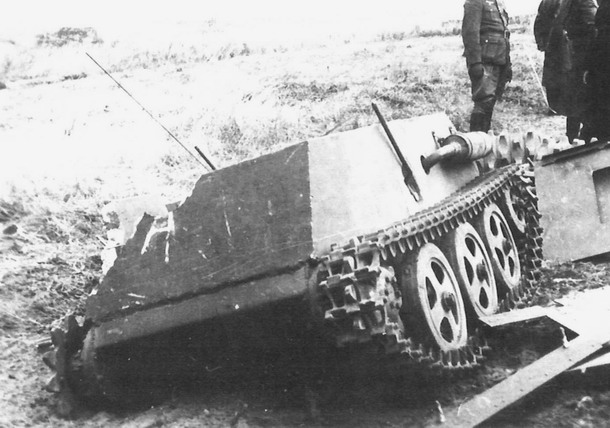
A destroyed Minenräumwagen B I — the vehicle apparently struck a mine. Source: Flickr.com, with permission of the publishing user, edited
Minenräumwagen B I
In response to the army specification, Borgward built a small, compact vehicle weighing 1.5 tonnes, designated the Minenräumwagen B I. The vehicle had a fully tracked running gear with three road wheels on each side. In keeping with the cost-reduction requirement, the road wheels were fitted not with rubber but with wooden tyres — more precisely, four separate wooden blocks attached around the wheel's circumference, somewhat like an old spoked cartwheel. The running gear was completed by a toothed drive sprocket at the front and a small idler wheel at the rear. On the steel running gear pan sat a simple hull made of reinforced concrete. Yes, you read that correctly — the vehicle's hull was indeed concrete. The reason for this choice of material was again cost reduction.
In the rear of the hull was a four-cylinder Borgward 4M 1.5 R II engine of 1.498 litres displacement, producing 28 horsepower at 2,500 rpm. A simple reduction gearbox was connected to the engine, providing two forward gears. Gear selection was performed using a long lever mounted externally on the left side of the vehicle. The lever had three positions: raised upward for neutral, folded halfway forward for first gear, and fully folded forward for second gear. Once a gear was selected, the vehicle drove at a constant speed — 2 km/h in first and 5 km/h in second. Varying the throttle to slow down or speed up was apparently not possible via remote control. If a vehicle running in first gear needed to be accelerated, a soldier would likely have to run up to it and change the lever to second gear while it was moving — catching up to something travelling at 2 km/h was not particularly difficult. Similarly, stopping the vehicle required someone to walk up to it and shift the lever to neutral. Remote control was therefore limited to changing the direction of travel, achieved most probably by electromagnetic brakes on the final drives of the drive sprockets. The fuel supply was sufficient for just 18 km of travel, which given the vehicle's purpose was more than enough.
In the central section of the hull, ahead of the engine, was the control unit, which received radio signals from the remote controller and switched the electromagnetic brakes on the drive wheel final drives accordingly. A short but stout radio aerial protruded from the hull roof in this section. The forward section of the hull had a partially free space that could be used for an explosive charge — more on this later. On the left side of the hull, just behind the gear lever, a large exhaust silencer was mounted on the concrete side panel. The hull roof over the engine section was sheet metal and featured a raised portion with open sides, serving as cooling air vents for the engine. The exact form of the roof over the forward hull section is not entirely clear from the sources; it is generally described as sheet metal, though it is possible that at least some vehicles had a wooden roof panel.
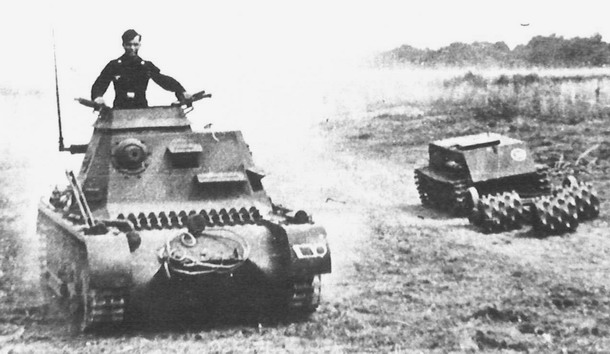
Minenräumwagen B I with detonation rollers and its controlling vehicle, a kleiner Panzerbefehlswagen Ausf. B. The badge of Minenräum Kompanie 1 is visible on the tank's mudguard. Source: Flickr.com, with permission of the publishing user, edited
On the right side of the roof, close to the short radio aerial, a long metal rod protruded upward. Its purpose was very simple: a piece of coloured cloth was tied to its end so that the operator would not lose track of the vehicle's position even in uneven terrain where a ridge might obscure the vehicle itself from view. The remote control equipment for the mine-clearer was far from pocket-sized. It also had to be mobile and protected not only from the weather but from enemy fire. A dedicated guidance vehicle was therefore developed, based on the command tank kleiner Panzerbefehlswagen Ausf. B.
Organisation and Deployment
The Minenräumwagen B I received the ordnance code Sd.Kfz. 300 (Sd.Kfz. = Sonderkraftfahrzeug = special-purpose vehicle). Delivery of the 50 ordered vehicles took place between January and May 1940, though the radio equipment was not installed in them until the end of June 1940. On 1 June 1940, the first unit to begin testing the new vehicles was formally established. Its actual name was Minenräum Kompanie 1 — 1st Mine-Clearing Company — but for security reasons it was long listed under the cover designation Kompanie Glienicke, since the new remote-controlled vehicles were considered a high-technology weapon subject to strict secrecy. The company consisted of three platoons and a command staff. Each platoon had 9 mine-clearing vehicles and 3 guidance tanks. The whole company therefore fielded 27 Minenräumwagen B I. The 50 vehicles delivered thus represented nearly double the company's establishment strength — no problem at all given the "self-destructive" nature of their employment.
Since it was not formed until June 1940, Minenräum Kompanie 1 did not take part in the attack on France. After that campaign ended, however, the unit moved to France to conduct thorough testing of its mine-clearing vehicles on the minefields in front of the Maginot Line. The unit's base for some time became the town of Wissembourg, located right on the Franco-German border in northern Alsace. The Minenräumwagen B I offered two possible methods of employment. The first was the already-described passage through a minefield with detonation rollers in tow. The second was use as a remote-controlled bomb: an explosive charge was placed in the free space at the front of the hull, the vehicle was guided through the minefield, and when it struck a mine, that explosion detonated the carried charge as well. The blast wave from such an explosion would then initiate further mines over a fairly wide area around the vehicle, clearing the ground.
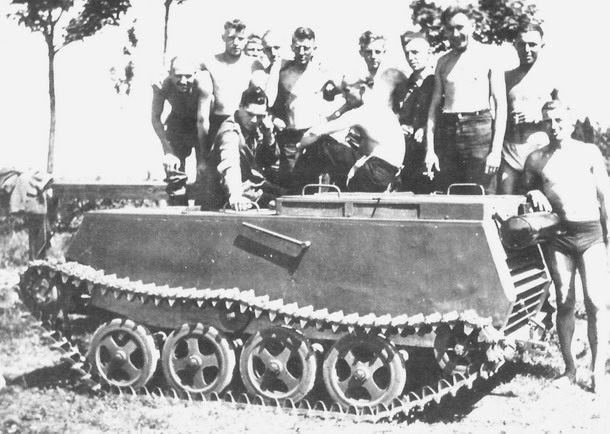
The Minenräumwagen B II was of more robust construction; towing detonation rollers was no longer envisaged for this version. Source: Flickr.com, with permission of the publishing user, edited
Sources disagree on exactly how the carried charge could be detonated. Some authors state it could be triggered actively by the remote controller; others argue the remote control did not allow this and the charge detonated without the operator's control, when the vehicle struck a mine. Either way, German soldiers in France spent several months thoroughly testing both methods of minefield clearance, in the process destroying all fifty mine-clearing vehicles. The Minenräumwagen B I therefore never saw frontline combat and served only for trials — albeit very live ones.
The trials showed that deployment with towed detonation rollers was less effective than deployment with a carried charge. At the same time, it became clear that the Minenräumwagen B I was not a particularly successful vehicle overall. Its cross-country mobility was very limited and the remote-control system unreliable.
Minenräumwagen B II
As early as April 1940, the Weapons Office ordered Borgward to develop a second-generation mine-clearing vehicle, designated the Minenräumwagen B II. The new vehicle was noticeably more robust than the first version, its weight rising to approximately 2.3 tonnes. A larger and heavier vehicle also needed a more powerful engine — specifically a six-cylinder Borgward 6M 2.3 RTBV producing 49 horsepower at 3,300 rpm. Due to the greater length of the vehicle, a fourth road wheel was added. The front drive sprocket was positioned higher than on the first-generation vehicle, increasing the approach angle and therefore improving cross-country mobility. As a consequence, one return roller had to be added to the running gear to guide the upper run of the track onto the high-mounted drive sprocket.
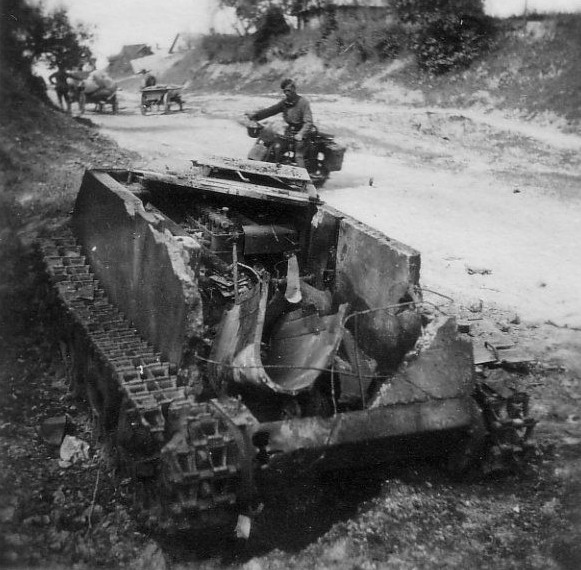
In this shattered wreck of a Minenräumwagen B I, the concrete construction of the hull is clearly visible, including the reinforcing wire. Source: Flickr.com, with permission of the publishing user, edited
The hull was again made of concrete, with an additional steel plate attached to the front face to improve the vehicle's resistance to enemy fire. The Minenräumwagen B II retained the two-speed gearbox and the gear-change system using the large externally mounted lever on the left side of the hull. Speeds remained at 2 km/h in first gear and 5 km/h in second. The operational range grew on the B II to 30 km. The engine was again located in the rear of the hull. The exhaust silencer moved to the rear wall, which was now open — protected only by horizontal steel grilles.
The primary method of employment for the second-generation Minenräumwagen was no longer towing detonation rollers but detonating a carried charge. Three hundred kilograms of explosive carried inside the hull could produce a crater 5 metres in diameter and initiate mines within a radius of 40 metres. The Weapons Office ordered exactly 100 vehicles from Borgward, the first of which were delivered in July 1940. During trials of the new Minenräumwagen B II, soldiers also considered possibilities for using it against targets other than mines. Given the size of the carried charge, the vehicle could at least theoretically destroy bunkers or even enemy armour. An unspecified number of vehicles were therefore modified and a new charge-detonation mechanism was tested on them. A mechanically operated firing device was connected to the charge. A moveable arm was brought out above the left drive sprocket and connected to a long metal rod projecting in front of the vehicle. When the vehicle drove into an obstacle with this rod, the firing device was triggered and the charge detonated. In practice, however, this improvised initiation method proved unsatisfactory. The very fact that such an experiment was conducted suggests that it was indeed not possible to detonate the charge at any chosen moment using the remote controller.
Organisation and Deployment
In December 1940, a second mine-clearing company was formed and merged with the first into the 1st Mine-Clearing Battalion (Minenräum Abteilung 1). The battalion thus consisted of two companies of three platoons each, plus a battalion command staff, and fielded 54 B II mine-clearers and 20 guidance tanks based on the kleiner Panzerbefehlswagen Ausf. B in total. At the turn of May and June 1941, the battalion moved to East Prussia as part of the concentration of forces for the attack on the Soviet Union. It was split up there, its components assigned to various units within VIII and XXXIX Corps under Army Group Centre. After three weeks of fighting on the Eastern Front the battalion was withdrawn to Germany. During August and September it was re-equipped and reorganised, and on 15 September 1941 renamed Panzer Abteilung 300. In February 1942 a third company was added, and the unit was redesignated Panzer Abteilung 300 (FL) — the letters FL standing for Funklenk (radio-controlled). In May 1942 the unit returned to the Eastern Front to take part in the fighting around Sevastopol. By that time, however, the unit was gradually transitioning away from the Borgward B I and B II to different equipment, and its further history is described elsewhere.
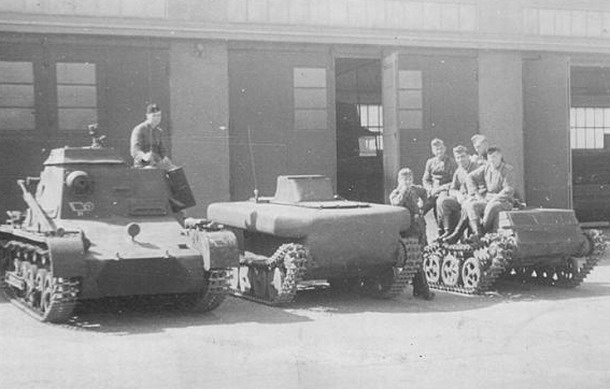
In 1941 the army tested a floating version of the Minenräumwagen B II (centre of photograph), but it did not enter series production. Source: Flickr.com, with permission of the publishing user, edited
Trials and combat deployment on the Eastern Front confirmed in the Minenräumwagen B II the same shortcomings that had already afflicted the first-generation B I. It was slow, could not cope with uneven terrain, and occasionally detonated spontaneously on striking an obstacle. The wireless control system was also reportedly quite prone to failure. Many of these faults stemmed directly from the deliberate drive to minimise the production cost of a vehicle intended for single use. Based on these experiences, the Germans decided that future remote-controlled mine destroyers would be designed for repeated use, making it worthwhile to build them more robustly and reliably.
Floating Version
A special amphibious variant of the mine-clearing vehicle was derived from the Minenräumwagen B II. Where the standard B II had a concrete hull, the amphibious version had a hollow metal float extending outward over the tracks on both sides. A propeller and two small rudders were fitted at the stern. The propeller was connected to the rear track idler sprockets. Roughly in the centre of the hull, a raised tube sat above the float through which air passed for both engine combustion and cooling. Exhaust gases were routed separately through an exhaust pipe emerging above the float at the right rear of the hull. The floating version of the B II received new road wheels that were apparently hollow, to further reduce the vehicle's weight.
The amphibious Minenräumwagen was of course not intended for neutralising naval mines. Its role was exactly the same as that of the standard land-based B II, with the added advantage of being able to clear minefields and destroy bunkers on shorelines — which was otherwise extremely difficult. Crossing a river or lake under enemy fire is hazardous enough in itself, and more so when the far bank is covered in mines. The amphibious Borgward offered the prospect of sending it ahead across a water obstacle to destroy not only mines buried in the sand on the far bank, but potentially also machine-gun nests positioned there.
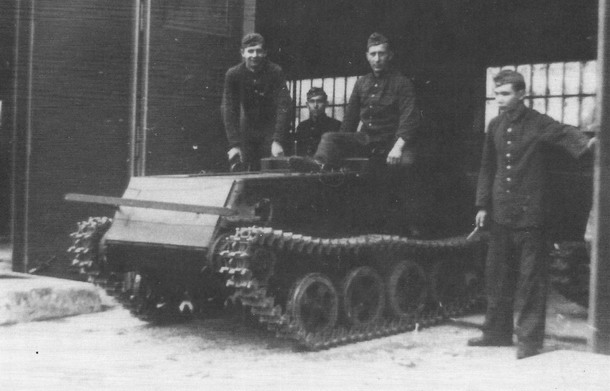
On several Minenräumwagen B II, the "contact" detonation mechanism was tested -- a rod projecting in front of the vehicle. Source: Flickr.com, with permission of the publishing user, edited
Soldiers from the second company of the 1st Mine-Clearing Battalion tested the amphibious vehicle in spring 1941 on a tributary of the Rhine — reportedly under conditions of maximum secrecy. The vehicle apparently earned the nickname Ente — duck — among the troops. Some sources suggest only three examples of the floating mine-clearer were built, which would be consistent with the rarity of photographs showing it. Markus Jaugitz, in his publication on the subject, states that these vehicles saw operational use on the Russian Front — specifically during the crossing of the Daugava (Western Dvina) river in July 1941. In any case, the amphibious mine-clearer never entered series production.

ARTICLE
CONTENTS:
Reproducing text from the Panzernet website without the written consent of the operator is prohibited.