PANZER I
Germany's first tank built for mass production
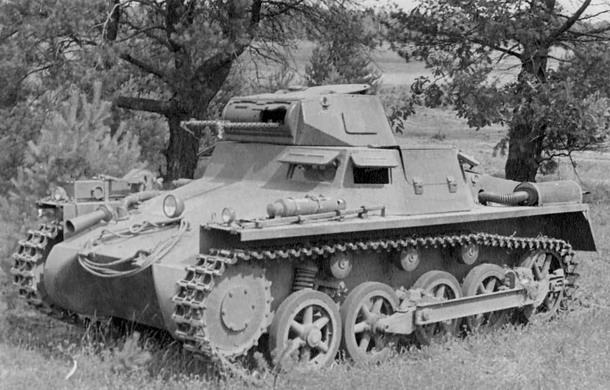
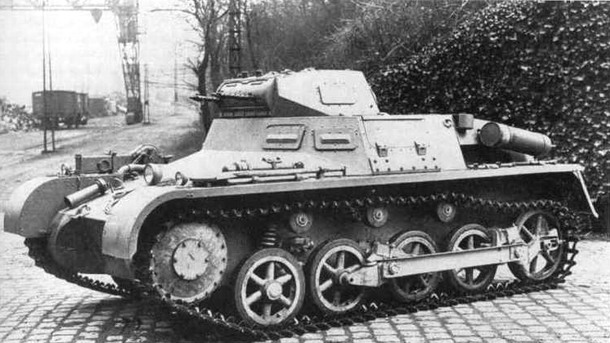
light tank PzKpfw I Ausf. A, source: worldwarphotos.info with permission, edited
Origins of the Tank
Despite what the Roman numeral in its name might suggest, the Panzerkampfwagen I was not the first German tank ever built. It was not even the first German tank of the interwar period. It was, however, the first of a family of modern German tanks whose development and production were not merely an exercise in experimentation and exploration, but a genuine concept intended to lead — and which did lead — to the creation of a new modern armoured force: the Panzerwaffe.
The Panzer I began to take shape at a time when tank development in Germany was not merely discouraged but actively suppressed. Tanks had been placed on the list of weapons banned by the Treaty of Versailles. The more forward-thinking section of the German military leadership, however, understood what a fundamental handicap this embargo could represent for the future of their armed forces. There was a real risk of losing the priceless experience gained by the first tank crews in the closing stages of the First World War, as well as cutting German industry off from the experience of developing and producing this type of equipment. It was entirely conceivable that in the next war, Germany would find itself one step behind its adversaries. It is therefore no surprise that covert violations of the Versailles restrictions began to occur relatively soon.
The first illegally developed tanks were disguised under the innocent label of "tractors" and tested far to the east, in the Soviet Union, with which Germany was cooperating quite intensively at the time. As early as 1925, this approach produced the medium tank project Grosstraktor, followed three years later by the development of the light tank Leichttraktor. These first German designs shared a common shortcoming: they were developed without any clear idea of what role they were actually meant to fulfil. German tank development received clear direction only from 1931, with the appointment of General Oswald Lutz to head the Inspectorate of Transport Units. Although this was a department whose official remit covered transport rather than combat vehicles (let alone the banned tanks), it was precisely within this department that the intellectual foundations of the future German Panzerwaffe were laid.
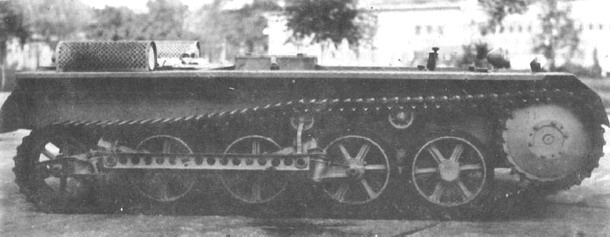
Fahrgestell Nr. 8000, the first chassis prototype for the new tank from 1932. Note only two return rollers and the lightening holes in the profile separating the road wheels. The rear idler wheel is the same size as the road wheels. Source: Wikimedia, Public domain, edited
The chief architect of the armoured force concept was Lutz's chief of staff, Lieutenant Colonel Heinz Guderian. Guderian saw the future of the tank not as a supporting arm for the traditional branches of the army (infantry or cavalry), but as the primary striking force of the modern battlefield. In his vision, the armoured force would be built around two types of tank: a lighter vehicle designed primarily to destroy other tanks (later realised as the Panzer III), and a heavier type intended to destroy bunkers and obstacles (the later Panzer IV).
Guderian and Lutz recognised, however, that Germany could not simply wait passively for the Versailles ban to lapse, as that would mean starting from scratch. Both also agreed that German industry first needed to master the development and production of tanks, and the army itself needed to test in practice the methods of armoured deployment that had until then only been theorised. From all of this, the Germans were to extract experience that would ensure that when the time came for mass production of those two core types, the resulting vehicles would be capable of doing what was required of them. That was precisely why the Germans needed something like a proving-ground type — a tank on which to test whether their vision for the future Panzerwaffe was feasible at all, and on which to begin training the new tank crews who would one day man the full-fledged combat tanks.
Combat capability was not to be a priority for this type. The tank was to be simple, light and cheap. Its weight was not to exceed 5 tonnes, the crew was to consist of two men and armament was to be machine guns only. On the basis of this specification, the German ordnance office (specifically its department Waffenamt Prüfwesen 6) approached Krupp in September 1931 with a requirement to build a prototype chassis for the new tank under the codename Kleintraktor. This requirement covered only the chassis with its armoured hull tray (Kleintraktor Fahrgestell) — no superstructure, turret or armament. The armoured superstructure and turret were the subject of a separate requirement issued not only to Krupp but also to Daimler-Benz and Deutsche Edelstahlwerke. (Note: why the ordnance office chose to award the chassis to a single manufacturer while commissioning the superstructure and turret from three separate firms is beyond me.)
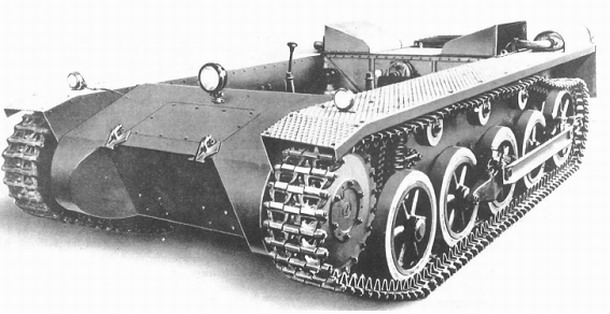
One of the five chassis from the pre-production series delivered in 1933. Note that the rear idler wheel here is still the same diameter as the road wheels, and the typical ventilation hose for the steering brakes has not yet been routed out through the upper nose plate. Source: Flickr.com, public domain, edited
Drawing on experience from the Leichttraktor project, the Waffenamt did not want the new tank to be developed entirely from a blank sheet, as such development was time-consuming and might ultimately fail to deliver the desired result. Krupp therefore received clear instructions from the ordnance office to base the new tank's design on the successful British Vickers-Carden-Lloyd tracked carrier. In November 1931, the Waffenamt, through the trading company Aug. Nowack A.G., ordered the first of a total of three such carriers from the British manufacturer — officially for agricultural purposes, but in reality as a template for building Germany's own tank. The vehicle bearing production number VAE393 arrived in Germany in January 1932. In March of that year, the Waffenamt and Krupp signed a contract for the construction of a single evaluation Kleintraktor chassis. The chassis was not to weigh more than 2,650 kg and was to be powered by a 60-horsepower engine. It was required to reach a speed of up to 45 km/h.
The armoured superstructure was to be welded and the armour was to resist armour-piercing rounds from a Gewehr 98 rifle fired at point-blank range. As for the turret and armament, fitting the tank with a 20 mm cannon was also initially considered. It was only at the end of 1932 that the definitive decision was made that the new tank would carry only two machine guns — apparently to simplify and accelerate the development work.
The First Prototype
The completed prototype of the new tank chassis (Fahrgestell Nr. 8000 = chassis number 8000) was presented to representatives of the ordnance office for the first time in July 1932, initially only within the grounds of the Krupp factory. Army trials of the vehicle then took place in August, after which the Waffenamt issued its first requests for minor design modifications. Although the prototype chassis already closely resembled the future Panzer I, differences were still clearly visible at first glance.
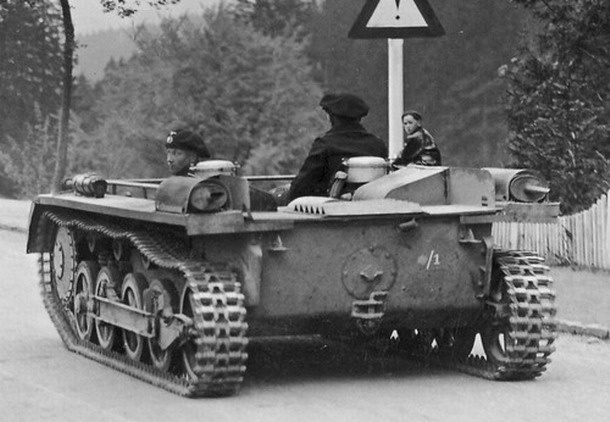
Chassis from the 1st production series were still delivered without superstructures and turrets. Note the new rear idler wheel of larger diameter. The chassis in the photograph has a low handrail fitted around the open cab, which was added retrospectively. Source: fotki.yandex.ru, edited
The chassis had five road wheels on each side, the last of which also served as the idler wheel. All were of the same diameter and spoked design with a rubber tyre around the rim. The first road wheel, which was subjected to the greatest stress during travel, was sprung independently by a coil spring. The remaining four wheels were sprung in pairs by a shared leaf spring. The axles of the two leaf springs were connected on the outer side by a steel profile which, on the prototype, was fitted with lightening holes (later omitted). At the very front was a toothed drive sprocket, and the upper run of the track was supported by two small return rollers (originally the prototype apparently had only one return roller, with a second — and later even a third — added at the Waffenamt's request following the August trials).
As specified in the contract, Krupp delivered only the chassis tray. In its front section sat the Zahnradfabrik gearbox connected to the front drive sprockets. Behind it was the crew compartment, which remained fully open on the prototype. The driver's position with its controls — pedals, steering levers, instrument panel and so on — was on the left at the front. The second crew member's station had not yet been resolved, as it depended on the design of the armoured cab and turret, which were not yet available. A drive shaft ran from the rear-mounted engine through the centre of the crew compartment to the gearbox. The prototype was powered by a Krupp M301 engine producing 51 horsepower and weighed 2,950 kg.
As already mentioned, the prototype underwent its first trials in August 1932. Representatives of the ordnance office were satisfied with the running gear, the steering system and the gearbox. They were not happy, however, with the engine's performance. The unit fitted was less powerful than specified (51 horsepower versus the required 60), while at the same time the final chassis weight had exceeded the original requirement by some 300 kg. As a result, the prototype did not achieve the driving performance the army had envisaged. Among the many requests for changes, the Waffenamt therefore also called for an increase in engine power.
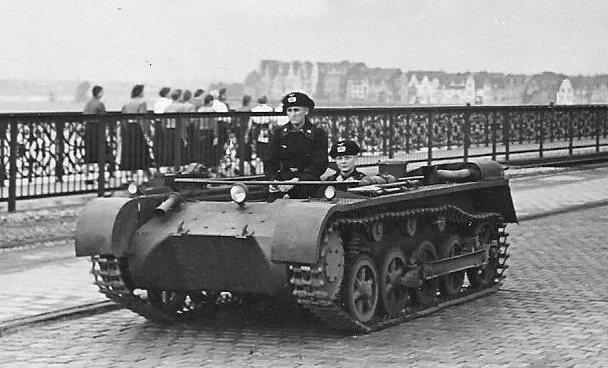
Chassis from the 1st production series were still delivered without superstructures and turrets. Note the new rear idler wheel of larger diameter. The chassis shown has a low handrail around the open cab, fitted retrospectively. Source: Flickr.com with permission, edited
Despite this, the chassis prototype was accepted by the ordnance office in September 1932 and subsequently sent for comparative trials against the British Vickers-Carden-Lloyd on which it was based — trials in which it performed very well, particularly in terms of the running gear itself. Testing of the vehicle continued over the following months until January 1933 (during the lengthy trials it naturally required numerous repairs, including having its engine replaced twice).
Pre-Production Series
The ordnance office then ordered a further five tank chassis from Krupp, incorporating various design modifications identified during the evaluation trials. Again, these were to be chassis only, without armoured cabs or turrets.
The first of these five modified chassis was delivered in July 1933, with the remaining four following a month later. These chassis, numbered 8001 to 8005, became known as the Kleintraktor "pre-production series" or zero series. They are also sometimes referred to as Erprobungsfahrgestelle — evaluation chassis. In their design, these chassis already closely matched those of the later production tanks. Again there were five spoked road wheels on each side, the last of which also served as the idler, but the design of the steel profile separating the last three wheels was changed, and three return rollers now supported the track at the top. The engine was also new: a Krupp M302 of 3.3 litre displacement producing 55 horsepower at 2,500 rpm. The gearbox was a five-speed Zahnradfabrik F.G.35.
Alongside the chassis development, work on the armoured superstructure was of course also progressing. During 1932, all the approached manufacturers produced wooden mockups of their proposals, and the following year moved on to first physical evaluation structures. None of these satisfied the Waffenamt representatives, however, so development continued and the ordnance office had to accept that the five Kleintraktors of the pre-production series would remain as bare chassis. In response, the Waffenamt asked Krupp to produce ballast weights (Balastungsgewichte) that could be attached to the chassis during testing to simulate the weight of the hull and turret. At least some of the five evaluation chassis were therefore probably tested with this ballast fitted.
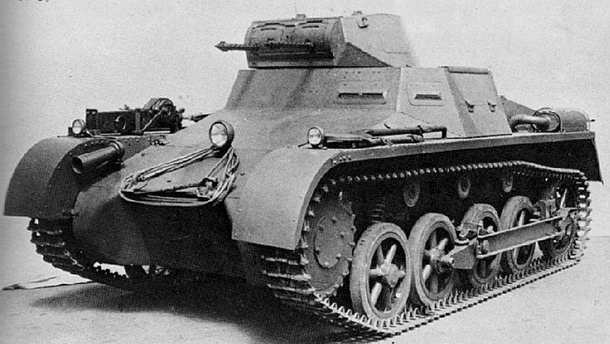
A chassis from the first production series fitted with the Daimler-Benz evaluation superstructure (Versuchaufbau). This superstructure was already practically identical to the later production version — note, however, that the typical ventilation hose for the steering brakes is not yet present. Source: Flickr.com with permission, edited
First Production Series
As early as July 1933 — before the army could even test the five pre-production chassis and before the final design of the armoured superstructure and turret was complete — the ordnance office decided to begin series production of the Kleintraktor chassis, with superstructures and turrets to be fitted retrospectively. From this 1st production series onwards, the Waffenamt began referring to the vehicle as Landwirtschaftliche Schlepper, abbreviated La.S. (Landwirtschaftliche Schlepper = agricultural tractor), as a cover for its true purpose. Krupp itself listed the vehicles under the designation Krupp-Traktor. The first production series comprised a total of 150 chassis. The Waffenamt also wanted to use this order to verify whether other manufacturers could join the production effort if Krupp's own factories proved insufficient for potential mass production. The order for 150 tank chassis was therefore divided among six firms. Krupp was to deliver 135 vehicles; the other five manufacturers (Daimler-Benz, MAN, Henschel, Rheinmetall and Grusonwerk) were each to assemble three, using parts supplied by Krupp.
The first vehicles from this series were handed over to the army in January 1934 and immediately distributed to the training tank battalion at Zossen. Although these were chassis rather than complete tanks, they could already be used to train drivers and mechanics. The armoured superstructures and turrets were to be delivered and fitted later. The production chassis used a new engine type, the Krupp M305 with a displacement of 3.45 litres, which already achieved the army's required output of 60 horsepower at 2,500 rpm. Another change clearly visible from the outside was the new track idler wheels. Again spoked with rubber tyres, they were significantly larger in diameter than the road wheels. While the road wheels measured 530 mm in diameter, the new idler wheels were 630 mm. Doubtless other minor modifications were also introduced (the attentive observer of photographs may notice, for example, two oil filters protruding from the open cab section of the production chassis).
Second Production Series
In April 1934 — roughly three months after gaining experience with the first production chassis — the army placed an order for a 2nd production series of Landwirtschaftliche Schlepper. Design improvements identified during practical operation of the first series vehicles were to be incorporated. This second production series was to number 200 vehicles, with Daimler-Benz, MAN, Henschel, Rheinmetall and Grusonwerk again joining Krupp in the production effort. Since no satisfactory armoured superstructure and turret were yet available, it appears that again only chassis were ordered in this series, with completion into full tanks to take place at a later date.
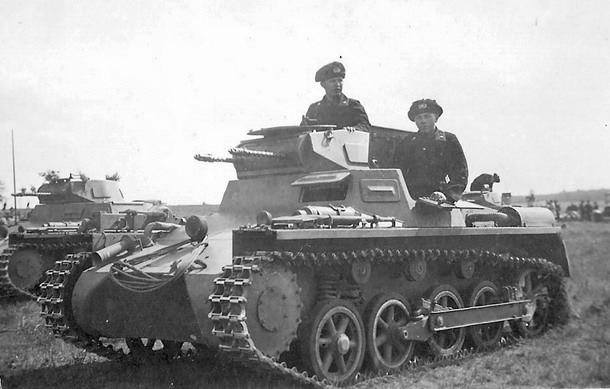
PzKpfw I Ausf. A, source: Flickr.com with permission, edited
Around mid-1934, however, the situation changed fundamentally. By this time the NSDAP under Adolf Hitler had come to power in Germany, and the construction of the new German tank had suddenly become a politically driven priority. Under orders from the Ministry of Defence, the army was to have 1,000 complete La.S. tanks available by July 1935. The Waffenamt immediately changed the second series order from 200 to 850 vehicles (which, together with the 150 tanks from the first series, gave the required total of one thousand). The main problem, however, was that the Waffenamt still had no satisfactory armoured superstructure and turret design available.
When even Krupp's superstructure failed to pass its evaluation trials, the Waffenamt ordered at least 20 of these superstructures and turrets made from unarmoured steel. These were to be fitted to the first series chassis solely so that the Waffenamt could finally present some complete-looking tanks rather than bare chassis. The military authorities knew they were ordering essentially non-functional armour imitations, but for presentation and manoeuvre purposes this was perfectly adequate. As a result, 20 provisional tanks came into being, very different in appearance from what we know as the later standard Panzer I. These rare vehicles have even survived in several precious photographs (e.g. HERE or HERE, source: Flickr.com).
The most successful superstructure and turret design ultimately proved to be the one from Daimler-Benz, which was apparently first presented to ordnance office representatives as early as May 1933. Daimler-Benz subsequently received an order to build five evaluation examples of their superstructure and turret, to be fitted to first series chassis. These chassis, fitted with the so-called Versuchaufbau (evaluation superstructure), were then tested under various conditions including resistance to nearby bomb blasts. In July 1934, given the political situation described above, it was urgently decided that the Daimler-Benz superstructure and turret would be adopted as standard after minor refinements and used both for the second production series then being prepared and for all future production of the new tank. Tanks in the second production series could therefore leave the factories as complete vehicles, superstructures and turrets included. The army began taking delivery of the first of them, apparently from the start of 1935.
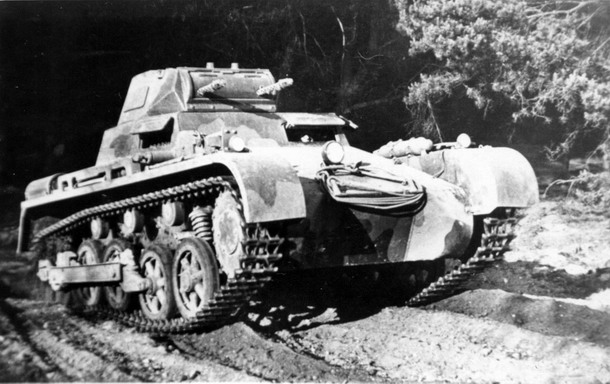
PzKpfw I Ausf. A in an interesting camouflage scheme, apparently during a pre-war exercise, source: worldwarphotos.info with permission, edited
The chassis of the second series were in overall design virtually identical to the first series. There was again a front drive sprocket, four spoked road wheels and a rear idler wheel, with three small return rollers supporting the upper run of the track. A range of minor improvements was incorporated in the chassis, most of which are practically imperceptible in photographs (for example, a strengthened construction of the most heavily stressed first road wheel).
The Armoured Hull
The Daimler-Benz armoured hull was welded from armour plates of varying thickness. The front, side and rear walls were 13 mm thick, the roof panels 8 mm and the floor of the hull tray a mere 5 mm. At the front, the superstructure joined the upper section of the hull tray armour (where a large service opening was cut for access to the gearbox and steering gear). From there the superstructure gradually rose until, roughly level with the second road wheel, it transitioned into the raised crew cab. The cab armour had a hexagonal floor plan with its sides extending outward over the track mudguards. In the front wall of the fighting compartment there was a single vision port for the driver, protected on the inside by a block of bulletproof glass. In dangerous areas the driver could close the vision port cover for added security and observe only through the narrow slits in that cover.
On his side of the cab, the driver also had three further vision ports — two in the angled side walls and one in the rear wall. One port each was also present in the front and rear angled wall on the right side of the cab. In the left side of the cab, a large entry hatch was cut for the driver, extending into both the side wall and the roof of the cab and closed by a two-piece cover. The side section of the cover folded outward and the upper section folded upward. In the right portion of the cab roof sat the fully rotating combat turret.
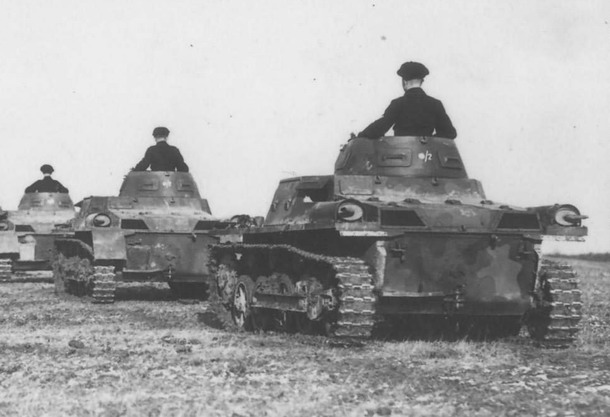
rear view of the PzKpfw I Ausf. A during pre-war manoeuvres, source: worldwarphotos.info with permission, edited
Both crew members had their positions inside the cab. The first — the driver — sat in the left forward section. The second man, who fulfilled the combined roles of commander, loader and gunner, sat to the right and slightly behind the driver. His seat was attached to the turret so that it rotated with it. Strictly speaking, therefore, the commander's station was in the turret rather than the cab. Given the small dimensions of the turret, however, the commander was in practice physically located in the cab below the turret for the vast majority of the time.
At the rear, the cab stepped down into the engine bonnet. Two large openings were cut into it for service access to the powertrain and oil filters. At the rear of the bonnet, centrally, was a large grilled opening through which cooling air was drawn into the engine compartment. On either side of it were two small filler caps — fuel fillers for the two fuel tanks. In the rear wall of the engine compartment, openings on each side allowed the exit of air heated by the engine. Exhaust pipe openings were cut into the sides of the engine bonnet, with the exhaust pipes and silencers laid along the track mudguards. Major engine repairs required the entire bonnet to be removed.
Combat Turret and Armament
All of the tank's armament was concentrated in the small combat turret. The turret had a conical shape with an extended front face. From this front wall protruded a cylindrical gun mantlet (Walzenblende) housing two MG 13 machine guns of 7.92 mm calibre. The machine guns were mounted on either side of the mantlet, with the Turmzielfernrohr 2 optical sight positioned between them. The sight aperture in the mantlet was only 12 mm in diameter. The mantlet allowed the vertical elevation of the machine guns to be adjusted between -10 and +20 degrees. If the optical sight could not be used for any reason, the gunner could open two vision ports in the gun mantlet and aim directly — though in doing so he exposed himself to considerable risk from enemy fire.
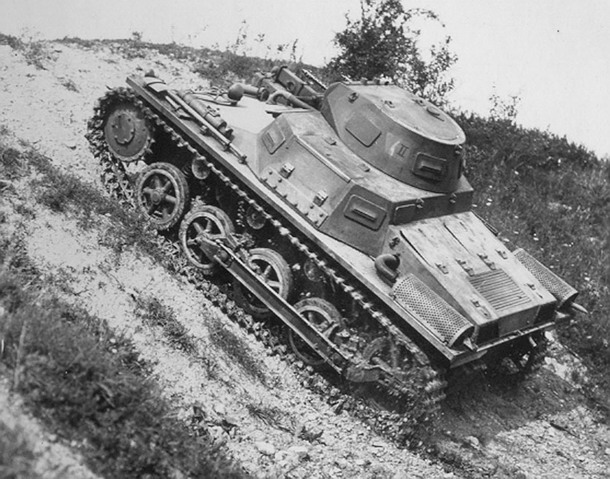
a fine view of the engine bonnet of the PzKpfw I Ausf. A — this appears to be a vehicle from the third production series, source: Flickr.com with permission, edited
Horizontal aiming was achieved by rotating the turret, which could traverse a full 360 degrees. The gunner/commander used the elevation and traverse handwheels, each of which also incorporated a trigger connected by a cable to the firing mechanism on the respective machine gun. The left machine gun was fired by the trigger on the elevation handwheel and the right one by the trigger on the traverse handwheel. If the gunner did not want to use the handwheels for aiming, he could disengage their mechanisms and aim by direct movement — though this was presumably not as straightforward as it might sound, since the machine guns had their stocks removed.
The two machine guns were not identically positioned in the mantlet. The left one was set further forward, so that its barrel protruded further than that of the right gun. They were fed from individual 25-round magazines inserted from the left. Total on-board ammunition supply was 2,250 rounds.
In the rear wall of the turret were two rectangular closable vision ports, their covers fitted with observation slits. Further vision ports were in the side walls of the turret, one on each side; their covers had no observation slits. The front section of the turret roof was slightly sloped, the rear section horizontal. Virtually the entire horizontal portion of the roof was occupied by the large commander's entry hatch, closed by a single-piece cover opening towards the front wall of the turret. In the right section of the hatch cover was a smaller opening used for extending signal flags (and also for ventilating the turret).
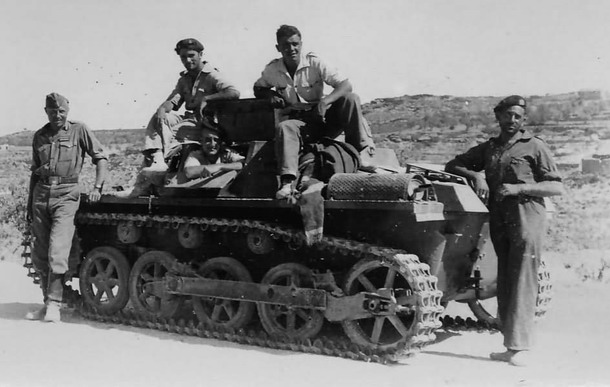
PzKpfw I Ausf. A fitted with covers over the air intake and exhaust louvers (here during the Spanish Civil War), source: worldwarphotos.info with permission, edited
The tank was powered by the already mentioned Krupp M305 engine of 3.45 litres, delivering a maximum output of 60 horsepower at 2,500 rpm. The engine was connected via a shaft to the five-speed Zahnradfabrik F.G.35 gearbox mounted in the front of the hull. Fuel capacity was 140 litres of petrol in two separate tanks. The tank had a combat weight of 5.4 tonnes, measured 4.02 metres in length, 2.06 metres in width and 1.72 metres in height. Its maximum road speed was 37.5 km/h. Operational range was approximately 140 km on road and around 90 km cross-country.
The tank's standard radio equipment was a Fu 2 set, which was a receiver only — not a transmitter. The crew could therefore only receive orders from higher command by radio; communication between tanks themselves relied on flag signals. According to some sources, not all tanks were equipped with a radio at all. The radio set was served by a rod antenna mounted on a hinged bracket at the front of the right side of the cab. The antenna could be folded rearward directly from inside the cab. When fully folded down, it lay in a protective channel on the track mudguard.
The first tanks of the second production series began to be handed over to the army probably at the start of 1935. From that year, the ordnance office began using new designations for the tanks — first M.G.Panzerwagen and later M.G.Panzerkampfwagen, where M.G. stood for Maschinengewehr (machine gun). The final designation Panzerkampfwagen I (abbreviated PzKpfw I) and the equipment code Sd.Kfz. 101 (Sd.Kfz. = Sonderkraftfahrzeug = special-purpose vehicle) were not assigned to the tank until April 1936.
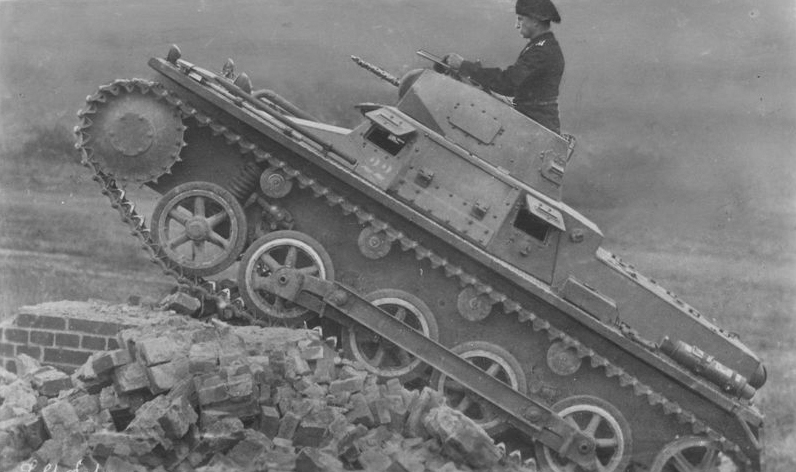
PzKpfw I Ausf. B, source: Flickr.com with permission, edited
Early in 1935, a decision was also made that the 150 chassis of the first production series would not be retroactively fitted with superstructures and turrets as originally planned — the army apparently concluded it would be better to order new complete tanks than to spend money completing chassis that by then had a year of use behind them and were probably quite worn, having been used to train new recruits which certainly put the vehicles through their paces. The army decided to retain the bare chassis as training vehicles. Instead of converting them into tanks, Krupp was ordered merely to fit these chassis with simple handrails around the open cab. In exchange for these 150 chassis that would never become tanks, the ordnance office ordered the same number of new complete tanks (third production series) to maintain the required total of 1,000 vehicles. Since the first 150 vehicles remained as training chassis only, the second production series described here is generally considered the true starting point of Panzer I series production.
By the end of 1935, the army had taken delivery of more than 700 new tanks (the political order for 1,000 tanks by July 1935 was therefore not met), and production continued. A number of minor design changes were introduced during the production run — for example, the vision port in the rear angled wall on the right side of the cab was eliminated entirely (PHOTO, source: Aviarmor.net, edited), the original horn was replaced with a more modern type, riveted reinforcing armour plates appeared on the sides of the cab (PHOTO, source: Flickr.com), and MG 13k machine guns with shorter barrels began to be fitted in the turret.
After completing the 850 tanks ordered in the second production series, production ran seamlessly into the third series of 150 vehicles. In December 1935, a further order was placed for a fourth production series of 175 tanks. Various further minor improvements were again introduced during this additional production run, such as a new type of tail light and strengthened construction not just for the first but for all road wheels. Once all orders were fulfilled, a total of 1,175 Panzer I tanks had been built (850 + 150 + 175). The last of them was accepted by the army apparently in October 1936, though considerably different figures can also be found in the literature.
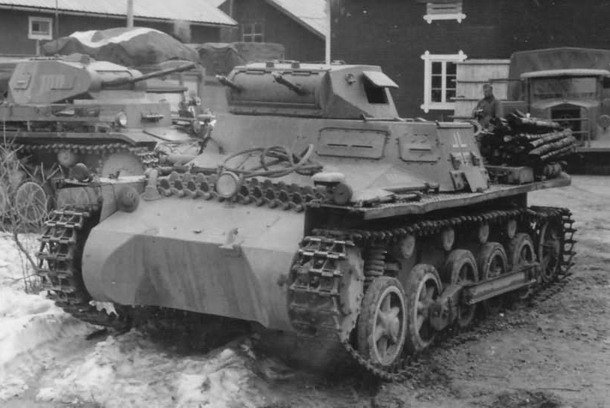
PzKpfw I Ausf. B, source: worldwarphotos.info with permission, edited
Even after production ended, further modifications continued to be introduced at the army's request. In 1937, for example, armoured covers were added over the grilled air intake and exhaust openings. That same year, an order was placed to add a bracket for five smoke grenades that could be discharged directly from inside the tank. From 1939 onwards, tanks began to be fitted with Notek blackout lights and new convoy tail lights for column driving.
Ausführung B
From virtually the very start of the Panzer I's development, its designers struggled to achieve the engine output required by the army. Even though they eventually managed this with the M305 engine, it very soon became apparent that 60 horsepower was not ideal — particularly for operation in more demanding terrain. It is therefore no surprise that the ordnance office called on Krupp to build an improved version of the tank with a more powerful powertrain. The designers evaluated several alternative engines, of which the Maybach NL 38 TR ultimately proved most suitable. This was a water-cooled six-cylinder petrol engine of 3.8 litre displacement, delivering a maximum output of 100 horsepower at 3,000 rpm.
Installing this engine required changes to the tank's design. The engine compartment had to be enlarged, which necessitated lengthening the chassis by 40 cm. The overall length of the tank thus grew from 402 cm on the previous version to 442 cm on the version with the more powerful engine. The running gear was also modified along with the extended chassis. A fifth road wheel was added, and the rear idler wheel was of entirely new design and this time raised above ground level. An additional return roller was also fitted, bringing the total from three to four. The tracks naturally had to be lengthened as well; the number of links on each side increased from the original 89 to 100. The engine itself was mounted in the centre of the engine compartment, with two fuel tanks totalling 146 litres to its right and the radiator with a large fan to its left. The new engine was paired with a new Zahnradfabrik F.G.31 gearbox, again with five forward gears and one reverse.
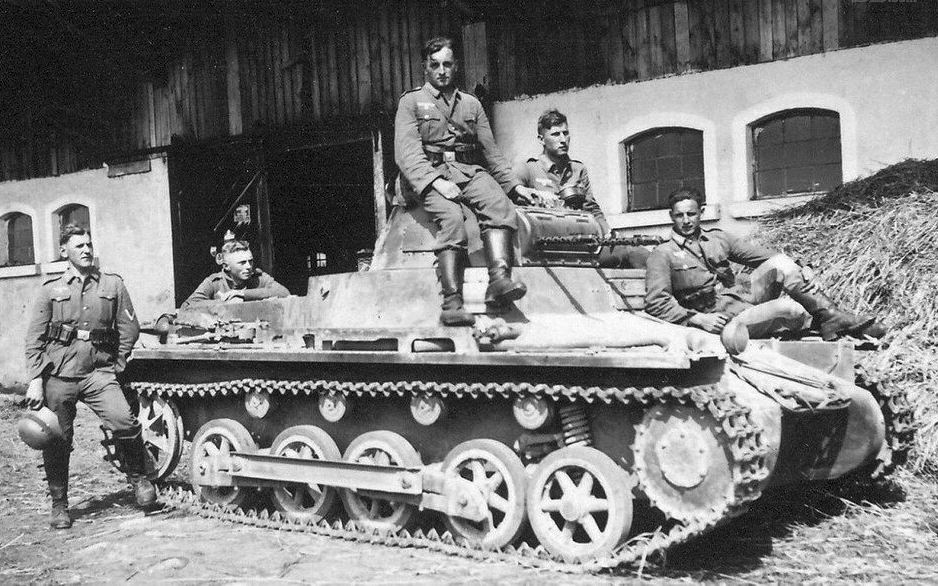
PzKpfw I Ausf. B, source: worldwarphotos.info with permission, edited
The roof armour of the engine compartment and the rear section of the crew cab naturally also changed. Roughly where the rear cab wall with its vision port had previously been, there was now a step with a grilled air intake for the powertrain. The engine bonnet had two service openings: the larger one, closed by a two-piece cover, gave access to the engine itself; the smaller one, with a single-piece hatch, led to the radiator fan. Two small filler openings were also present in the armour — one leading to the fillers of both fuel tanks and another to the radiator filler. In the rear right corner was a grilled opening for the exit of air heated by the radiator. The exhaust silencer was mounted on the right side of the rear wall, its outlet above the right track mudguard. The rest of the hull and the turret remained practically unchanged, aside from details such as the placement of lifting hooks or the type of rivets used (on this version the rivets were conical, for better resistance to being struck by enemy bullets — the flat rivets used on the first version had a tendency, if directly hit, to shear off internally and potentially injure the crew).
To distinguish the original and new variants of the Panzerkampfwagen I, their names were supplemented with a version designation. The original tank with the Krupp engine was designated Ausführung A (Ausführung = version or variant) and the new tank with the Maybach engine Ausführung B — abbreviated PzKpfw I Ausf. A and Ausf. B respectively. According to some historians, the Ausf. B was fitted with a Fu 5 radio set combining both receiver and transmitter, enabling two-way communication. Other sources, however, state that the same Fu 2 receiver-only set was used as on the Ausf. A. The weight of the PzKpfw I Ausf. B increased by approximately 400 kg over the first version, to 5.8 tonnes, but thanks to the substantially more powerful engine its maximum speed rose to 40 km/h.
As for when production of the Ausf. B began, various dates can be found in the literature. The first tanks of this version apparently rolled off the production line sometime in the first half of 1936. Significant disagreements also exist over the number produced. Figures quoted range from 1,100 through 840 down to 399. Several factors contribute to this confusion — sometimes the figure is quoted for both versions combined, or it refers to the number of chassis produced, which is not the same as the number of tanks (training vehicles, command tanks and so on are not included in all counts).
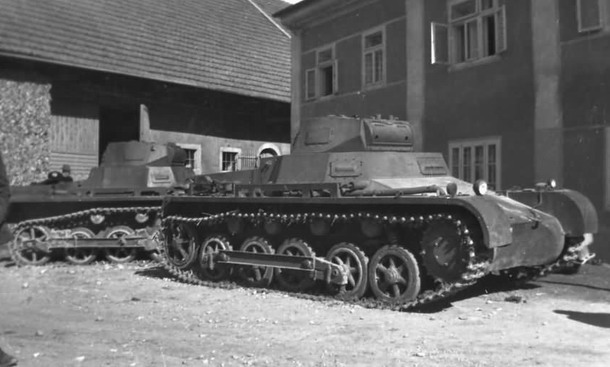
an excellent comparison of the rear running gear of the PzKpfw I Ausf. B (front) and Ausf. A (rear), source: worldwarphotos.info with permission, edited
The Panzer I Ausf. B also received certain modifications during and after production. The construction of the rear idler wheels was strengthened by fitting an "axle" connecting both wheels together. A smoke grenade bracket with a mechanism for firing them from inside the cab was fitted to the rear wall and partially over the exhaust silencer (PHOTO, source: Flickr.com).
Training Chassis
As already mentioned, in 1935 the army decided that the 150 chassis of the first production series would not be retroactively fitted with superstructures and turrets; the bare chassis would continue to serve as training vehicles for drivers and mechanics. Instead of converting them into tanks, Krupp was ordered merely to fit these chassis with simple handrails around the open cab. Similar training vehicles without superstructures and turrets were also produced on the Panzer I Ausf. B basis. Later, armoured units were additionally permitted to convert already worn-out tanks into training vehicles (so-called Schulfahrzeuge). In these retrospective conversions, unit mechanics had to devise their own solutions for covering part of the engine compartment after the superstructure was removed, as well as for installing the handrail around the open cab. This resulted in a wide variety of handrail designs and bonnet modifications being visible in photographs (compare, for example, images HERE, HERE or HERE, source: 3x worldwarphotos.info). Sometimes mechanics left the cab entirely without handrails; at other times they went to the considerable trouble of adding a front wall or even glazing (e.g. HERE, source: Flickr.com).
To conserve scarce petrol, an unknown number of training tanks were later converted to run on wood gas. Some training chassis were also rebuilt to resemble other tank types, serving as training aids. A well-known example is a hybrid combining a wood-gas powered PzKpfw I chassis with the cab and turret of an early-version Panzer III (PHOTO, source: Aviarmor.net). The vehicle's driving qualities can hardly have been impressive given the additional weight and low engine output, but for crew training purposes it was apparently adequate. Photographs also confirm the existence of the same "mutant" using the cab and turret of a PzKpfw II (photo HERE, Public domain). Probably for the same purpose, a mock-up was also built, again on a wood-gas powered Panzer I chassis, as seen in the photograph HERE, source: aviarmor.net.
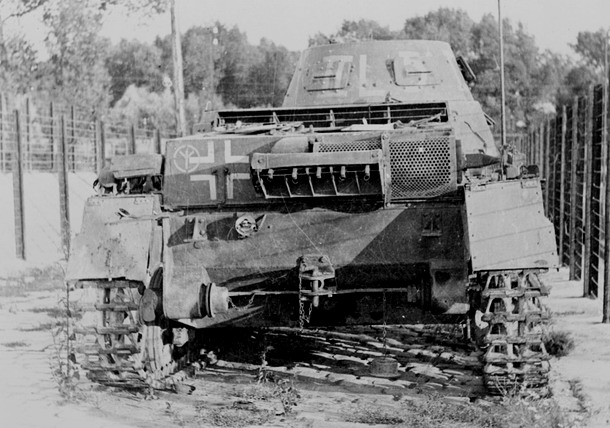
PzKpfw I Ausf. B differed from the Ausf. A not only in its chassis but also in the design of the engine section and rear, source: Flickr.com with permission, edited
By the start of the Second World War, the combat value of the Panzer I was already very low. For a time they continued to serve in the front line (because the Wehrmacht simply did not have enough of the newer types), but alongside this the army began increasingly to convert them for non-combat roles. Several hundred tanks were modified into various specialised vehicles. The same applied to the oldest chassis that had been used as training vehicles from the outset — new tank crews now needed to train on more modern tanks, above all the Panzer III and Panzer IV, and training Panzer Is were therefore no longer needed in such numbers.
Instandsetzungkraftwagen
Considerable numbers of training chassis were converted — mostly directly in field workshops — into various service, support and supply vehicles, collectively referred to as Instandsetzungkraftwagen I (roughly "repair vehicle"). Since they were primarily built in field workshops, they took on a wide variety of forms. They were often fitted with a frame over the open cab from which a waterproof canvas could be hung. Sometimes the mechanics took the trouble to build a front wall or even a complete enclosed cab with a roof. Inside, these vehicles typically carried spare parts for other equipment, fuel, lubricants, batteries, tools and so on.
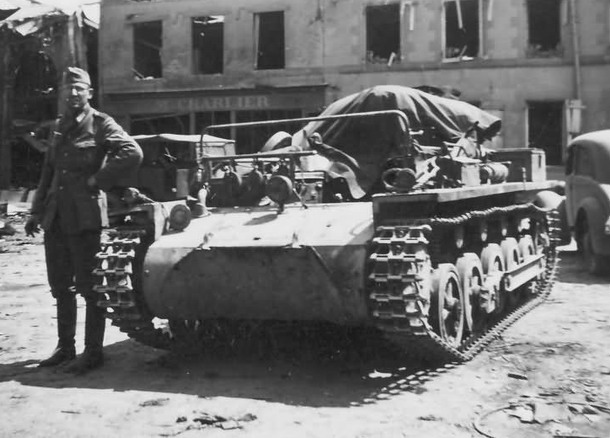
Withdrawn Panzer I tanks were often converted directly in field workshops into various support and service vehicles, collectively known as Instandsetzungkraftwagen I, source: worldwarphotos.info with permission, edited
Ammunition Carrier Variant
At the end of 1939, 51 PzKpfw I Ausf. A tanks were converted into ammunition carriers. The combat turret was removed and the opening covered by a large two-piece hatch. The interior of the cab was then used to store ammunition for other tanks and self-propelled guns. These ammunition carriers are most often referred to as either Munitionsschlepper I Ausf. A or Munitionspanzer I.
How much ammunition could fit into the relatively small interior is not known, but it was apparently not a vast quantity — which is why the ammunition tanks sometimes towed a trailer carrying additional rounds. As the Panzer IV tanks and Stug III assault guns were progressively rearmed with more powerful guns, the dimensions of the ammunition grew and more storage space was needed. The designers were therefore forced to modify the ammunition carriers. A large open-topped sheet metal box was placed on the roof of the cab to hold additional rounds, covered from above by a canvas when required. The installation of this additional ammunition box sealed the original turret opening, so entry and exit from the ammunition tank was henceforth possible only through the driver's hatch.
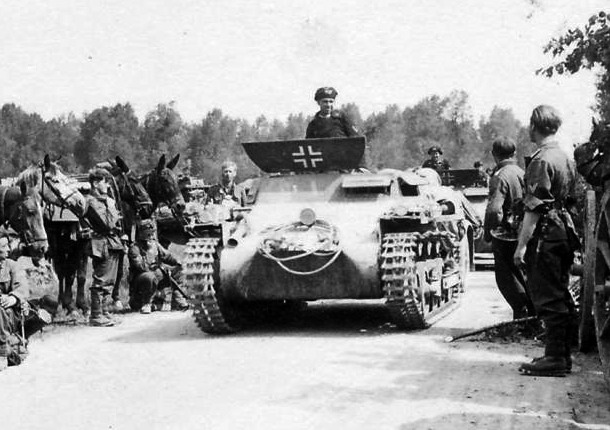
the Munitionspanzer I ammunition carrier, source: Flickr.com with permission, edited
A special version of the ammunition carrier was produced for the needs of Flakpanzer I anti-aircraft tanks. These were not purely ammunition carriers but rather general support vehicles. The Flakpanzers I themselves offered insufficient space for storing a larger ammunition supply, and frankly also insufficient comfort for the crew during longer moves. The support vehicles therefore carried not only ammunition and other supplies, but often part of the Flakpanzer crew as well.
On these vehicles, the turret and the superstructure beneath it were completely removed, and the open cab was enclosed by a relatively tall sheet metal surround. On the left side of the front wall, a large opening filled with Plexiglas provided the driver with a view forward. The interior remained unprotected from above. The tall angular metal surround around the open cab earned these vehicles the nickname Laube — meaning "summer house" or "gazebo".
Combat Engineer Ladungsleger
In 1940, another highly interesting vehicle was developed on the basis of the Panzer I Ausf. B — a demolition tank for combat engineer units. Its official designation was PzKpfw I mit Abwurfvorrichtung, but it became far better known under the name Ladungsleger I. The vehicle's purpose was straightforward: to carry an explosive charge to the vicinity of an enemy fortification, lay it and withdraw before detonation. Thanks to its armour, the tank could do this far more safely than combat engineers on foot.
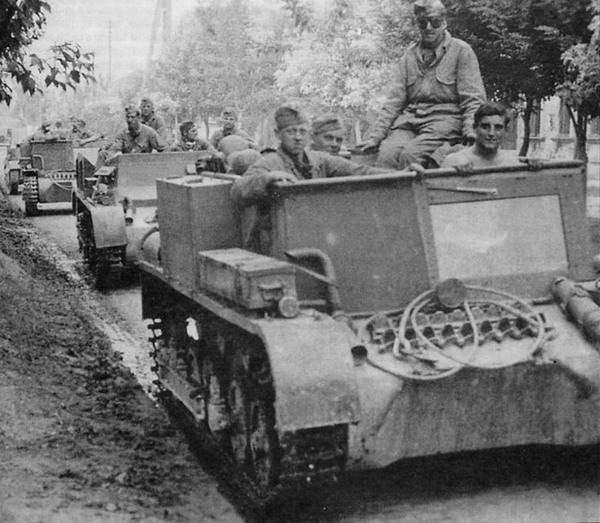
the special "Laube" ammunition and support tank, source: Flickr.com with permission, edited
The Ladungsleger I existed in two variants. In the first, a ramp was erected over the engine compartment, sloping downward towards the rear of the vehicle. A small container holding a charge of up to 50 kg was placed on this ramp. After driving up to the target, the crew released the container from inside the cab using a steel cable; it slid down the ramp to the end, where a cover opened and the timed explosive charge fell out. The tank therefore had to reverse up to the target, which was not simple — though it could then drive forward quickly, away from the placed charge.
The second version of the Ladungsleger I was somewhat more refined. Over the engine compartment an extended arm made of steel tubes was constructed. At its end, approximately 1.5 metres behind the tank itself, a metal container for the explosive was suspended. In the container's floor was a trapdoor secured by a split pin. The pin was pulled from inside the cab using a steel cable; when pulled, the trapdoor opened and the charge simply fell out under its own weight. This version could reportedly take a charge of up to 70 kg. Many authors have stated that the arm with the explosive container could be swivelled forward over the tank, eliminating the need to reverse. However, examining the constructional details of the arm makes it clear that this is an error — reversing was necessary on the second version as well.
Only a very small number of Ladungsleger I were built — approximately 30 examples of the first version and around 10 of the second are typically quoted. This is unsurprising, as the practical combat use of these vehicles was very problematic and demolition tanks saw little service in the war.
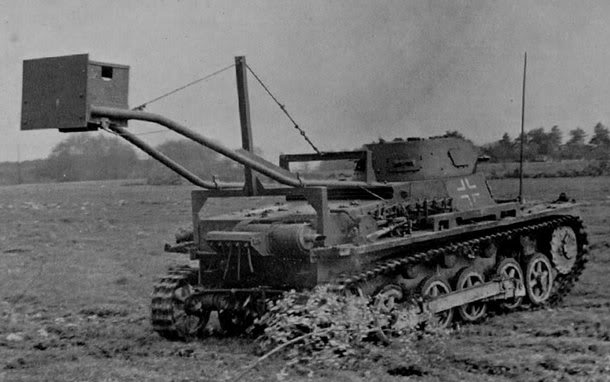
Ladungsleger I second version, source: Flickr.com with permission, edited
Bridgelayer Tank
Both versions of the Panzer I also served as the basis for experimental bridgelayer tanks designated Brückenleger auf PzKpfw I. On both versions, the bridge deck was rigidly attached to the tank hull. The tanks themselves thus functioned as bridge beams — for example, when crossing an anti-tank ditch, the Brückenleger would drive into the ditch and other vehicles would drive across it. Given the structural strength of the Panzer I, it is clear that such a bridge could only support lighter loads.
On the version based on the Panzer I Ausf. A, the bridge deck was roughly the same length as the tank itself. For crossing larger obstacles, multiple bridgelayer tanks positioned end-to-end were therefore envisaged. On the version based on the Panzer I Ausf. B, the bridge deck could be deployed to extend both in front of and behind the tank. The careers of both bridgelayer variants ended after the construction and testing of prototypes — neither entered series production. The reason was naturally their very limited load capacity. When exactly these prototypes were built is uncertain, but it was probably before the outbreak of war.
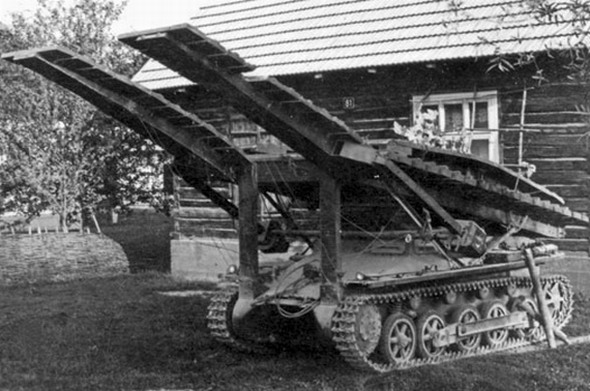
the second improved bridgelayer tank based on the Panzer I Ausf. B, source: Flickr.com with permission, edited
The Breda Cannon
During the fighting of the Spanish Civil War, Panzer I tanks encountered Soviet light tanks T-26 and armoured cars BA-6. These Soviet vehicles were armed with 45 mm guns which made short work of the thin armour on the German vehicles. The Panzer I, with its machine-gun-only armament, was practically helpless against enemy armour. The Spanish Nationalists therefore attempted to increase the combat value of the German tank by fitting a more powerful weapon.
Of the available weapons, the Italian Breda Modello 1935 anti-aircraft cannon of 20 mm calibre appeared most suitable. The cannon was relatively light and had a relatively short recoil stroke — a necessary condition for installation in the very small tank turret. With armour-piercing ammunition, this gun could penetrate up to 40 mm of vertical armour at a range of 250 metres. The first trial conversion was carried out in August 1937 at the Fábrica de Armas factory in Seville. Despite the cannon's relatively compact dimensions, the Spanish engineers had to substantially modify the existing turret — it was raised and a new gun mantlet was fitted along with the weapon.
The Spaniards also demonstrated the rearmed tank to their German allies. The reaction this provoked was closer to alarm than admiration. An open slot had been left in the gun mantlet through which the gunner aimed the weapon. The German tank crews reportedly declared that going into battle in a tank with a "hole" in the front armour was the stupidest possible way to get killed, and they even renamed the conversion the "death tank".
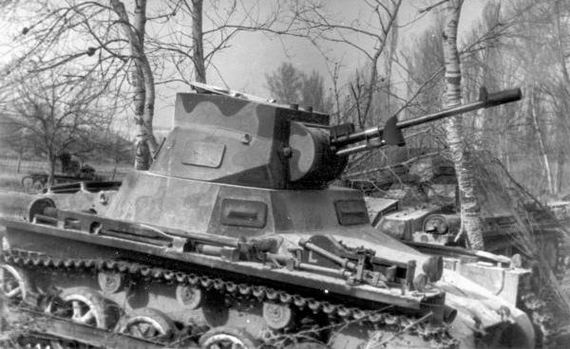
Spanish PzKpfw I Ausf. A rearmed with the 20 mm Breda cannon, source: Flickr.com with permission, edited
Originally at least ten Panzer I tanks were planned for conversion, but in the end only four were completed. The programme was abandoned partly because the resulting vehicle suffered from certain shortcomings, but mainly because in the meantime the Nationalists had managed to capture a sufficient number of Soviet T-26s, which they were able to operate in combat themselves.
Command Versions
One of the many shortcomings of the Panzer I was its radio equipment, consisting only of a receiver. Unit commanders complained that using signal flags alone they could not effectively command their tanks. It is therefore no surprise that as early as 1935 the army ordered Daimler-Benz to build a radio version of the Panzerkampfwagen I Ausf. A. The vehicle was designated leichter (Funk) Panzerwagen — something like "light radio tank". In the literature it also appears as kleiner Panzerbefehlswagen Ausf. A, meaning "small command tank version A". Only a very small number of these vehicles were delivered around mid-1935 — 15 according to some authors, and as few as 6 according to others.
The original tank was modified only very slightly for its new role. The turret was removed and replaced by an approximately equally sized but fixed superstructure. Three vision ports were cut into its walls — one each in the front, rear and left side wall. In the roof of the superstructure was a semicircular entry hatch with a single-piece cover opening toward the right side of the tank. From the right rear of the superstructure emerged a hinged bracket for the rod antenna, which could be folded toward the front of the vehicle. When fully folded, the antenna rested in a protective trough at the front of the right-hand track mudguard. The opening left by the original antenna position in the right front of the cab was sealed.
The new fixed superstructure that replaced the rotating turret incorporated no armament. Removing the weapons, ammunition and turret rotation mechanism freed up interior space for additional radio equipment and a third crew member. As is evident, the modifications carried out were not particularly generous. The interior of the tank therefore remained very cramped, and working conditions for three men inside were quite uncomfortable. For this reason, subsequent efforts to build command tanks focused on the PzKpfw I Ausf. B chassis, which offered greater potential.
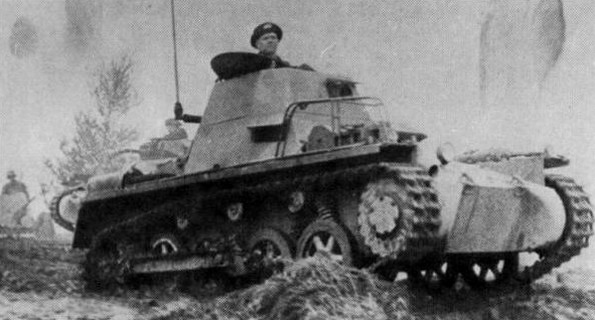
command tank based on the PzKpfw I Ausf. A, source: Flickr.com with permission, edited
In January 1936, the army ordered 72 command tanks based on the PzKpfw I Ausf. B. The Daimler-Benz designers put considerably more effort into this version. Not only the turret but the entire cab beneath it was removed, replaced by a new and substantially taller superstructure. In its front wall were two observation ports, the larger of which served the driver. Further ports were in the side walls and one in the rear wall. In the left side a large entry hatch was cut, closed by double doors. A further entry hatch was provided in the roof of the superstructure on the right side, closed by a two-piece cover (the cover also incorporated a small opening for emergency flag signalling or firing a signal pistol).
In the right section of the cab's front armour plate was a circular aperture for a hemispherical machine gun ball mount. Into this was fitted an MG 34 machine gun of 7.92 mm calibre, with 900 rounds carried on board. At the time these command tanks entered production, however, the hemispherical ball mounts were not yet available, so early command tanks are very often seen in photographs without machine guns, with the aperture in the armour sealed by a steel plate. Photographs from the deployment of these vehicles in the Spanish Civil War show that the Spanish did not wait for the original mounts and instead fitted machine guns into the cut openings using improvised brackets (photo e.g. HERE, source: Flickr.com).
The armour of the new superstructure was 13 mm thick on all walls except the roof, which was 8 mm. The command tank's radio equipment consisted of Fu 2 and Fu 6 sets. The Fu 6 transmitter allowed voice communication over a range of 4 to 6 kilometres. Both sets were served by a two-metre rod antenna mounted on a hinged bracket at the rear of the right side of the superstructure, which could again be folded into a protective trough on the front section of the right-hand track mudguard. Command tanks were frequently retrofitted with other radio types as well, and supplementary antennas were fitted for extended range — sometimes of quite bizarre configurations (as in the photograph HERE, source: Flickr.com).
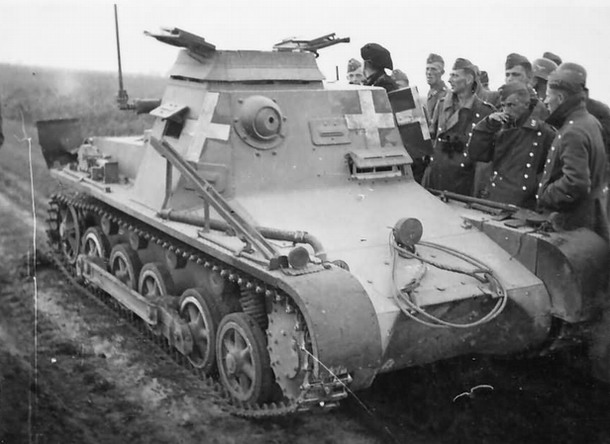
kleiner Panzerbefehlswagen command tank based on the PzKpfw I Ausf. B, source: Worldwarphotos.info with permission, edited
The command tank on the Panzer I Ausf. B chassis was designated kleiner Panzerbefehlswagen Ausf. B with the equipment code Sd.Kfz. 265. Between 1936 and 1938, a total of 184 of these command tanks were produced (some authors quote 200) in three production versions. These versions are sometimes designated 1 Kl B, 2 Kl B and 3 Kl B. They differed from one another in several details, but the most visually obvious difference was certainly the commander's cupola on the roof of the superstructure. The first production version had no commander's cupola at all — only the simple hatch with cover already described. The second version received a rectangular commander's cupola with two observation slits in each wall, again with a two-piece hatch in the roof for crew entry and exit. The third version then featured a redesigned commander's cupola, slightly lower than the previous one.
Photographs also confirm that some standard PzKpfw I tanks were converted into radio vehicles and fitted with frame antennas (photo e.g. HERE, source: Flickr.com). This was most likely an improvisation forced by the shortage of purpose-built command tanks.
Field Ambulance
The kleiner Panzerbefehlswageny served in their primary role for longer than the Panzer I tanks themselves. They too, however, were gradually replaced by more modern command vehicles based on medium tank chassis. Subsequently, many of them found use in other roles. An unknown number were converted into armoured ambulances. These so-called Sanitätswagen I existed in at least two different configurations. In some, the modifications were minimal — the machine gun was simply removed from the standard command tank and the ball mount opening sealed with a steel plate. The vehicle was then equipped with medical supplies and marked with prominent red crosses on white fields.
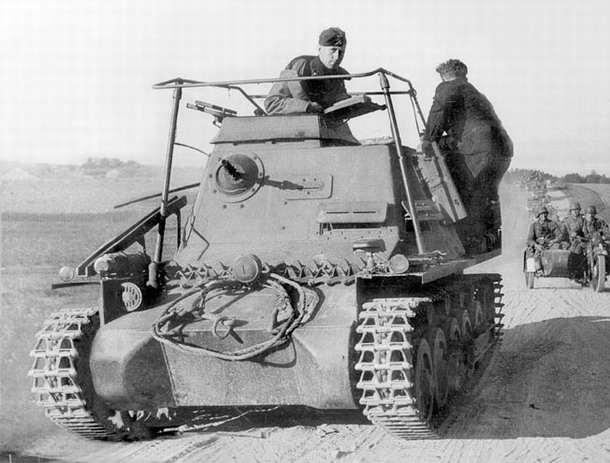
kleiner Panzerbefehlswagen based on the PzKpfw I Ausf. B with supplementary frame antenna, source: Bundesarchiv_Bild_101I-265-0006-16, Wikimedia, Creative Commons, edited
The ambulance tank could bring a medic to the battlefield in relative safety to provide first aid to wounded soldiers. If the wounded man could sit up, he could presumably also be driven out of the combat zone in the tank. A lying patient, however, could not be accommodated inside the crew compartment. The engine bonnet was therefore modified to allow a stretcher with a lying casualty to be carried there — setting aside the fact that the patient would thus be completely unprotected and the journey from the battlefield would hardly have been comfortable.
The second version of the ambulance tank underwent more substantial modifications. The armoured superstructure was removed and the open cab was enclosed by a new, lower armour surround. This new armour protected the interior only from the front and partially from the sides, leaving the top completely open. Its front wall was positioned noticeably further forward than the original cab armour. Moving the front wall forward increased the usable interior space, making it at least theoretically possible that a stretcher with a lying casualty could now be accommodated.
Another secondary role performed by the kleiner Panzerbefehlswageny was directing the remotely controlled mine-clearing vehicles Minenräumwagen Borgward. These unmanned vehicles were controlled by radio from a command vehicle — in this case the kleiner Panzerbefehlswagen. Retired command tanks were also used by propaganda units. A film camera was placed inside the cab, allowing camera crews to film at the front line in relative safety (PHOTO, Bundesarchiv_Bild_146-1974-109-03, Wikimedia, Creative Commons).
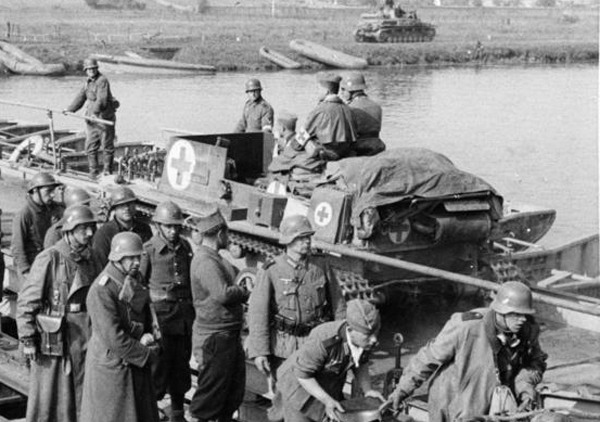
kleiner Panzerbefehlswagen converted into an ambulance tank, source: Bundesarchiv_Bild_146-1978-062-24, Wikimedia, Creative Commons, edited
The Panzer I chassis also served as the basis for the tank destroyer Panzerjäger I, the self-propelled gun Sturmpanzer I and the anti-aircraft tank Flakpanzer I. These vehicles were officially classified as separate types of equipment and are therefore also described separately on this site within the relevant sections (self-propelled guns, tank destroyers and anti-aircraft tanks).
Ausführung C (VK 6.01)
Two further vehicles belonged to the Panzer I family, though they had virtually nothing in common with the original PzKpfw I Ausf. A and Ausf. B (it is personally a mystery to me why the Germans used the Panzer I designation for them at all — perhaps it was the crew size, as both carried only two men, which was the hallmark of the Panzer I within the German tank family).
The first of these successors was the PzKpfw I Ausf. C. The history of this tank apparently began as early as 1937. According to some historians, the project arose on the orders of the airborne forces command, which required a light, fast tank capable of being transported by air to provide reconnaissance for paratroopers. According to other authors, the ordnance office initiated the new tank's development on its own initiative — simply looking to the future and wishing to ensure that the development of light tank designs for the German army did not stall. Even they, however, saw the new tank's primary role as reconnaissance.
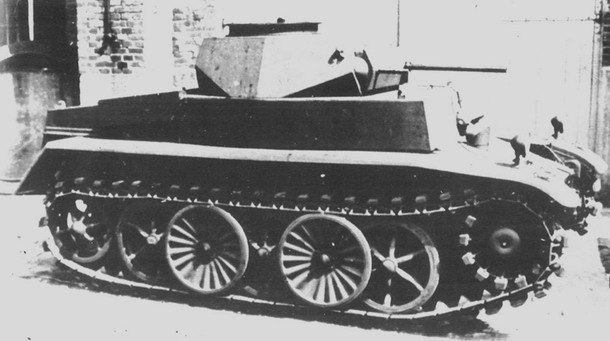
prototype VK 6.01, i.e. the PzKpfw I Ausf. C — note the design of the drive sprocket and the rubber-padded tracks, source: Flickr.com with permission, edited
The design of the running gear for the new tank was entrusted to Engineer Ernst Kniepkamp, an employee of the motorisation department (Wa Prüf 6) and the author of the highly successful chassis concept for German half-track tractors (such as the Sd.Kfz. 6). He received in essence the task of transferring his successful design from a half-track to a fully tracked chassis. The modern chassis was to allow the tank to achieve very high speeds — a considerable advantage when carrying out reconnaissance tasks. Kniepkamp fulfilled the brief and prepared a chassis design with large interleaved road wheels sprung by torsion bars. The detailed engineering and physical development of the chassis was then assigned to Krauss-Maffei, which had experience in the field of the half-track tractors mentioned and had previously worked with Kniepkamp. The armoured superstructure and turret were to be developed by Daimler-Benz.
During 1938 the design documentation for the new vehicle was completed, and in October that year the ordnance office ordered the construction of six evaluation prototypes. The project was run under the designation VK 6.01, where VK stood for Vollketten (fully tracked) and the number 6 indicated the planned weight in tonnes. When exactly the first prototype was built is not entirely clear, but it was probably not until 1941 — which indicates the project was given very low priority (lending weight to the version of events in which the tank was developed not to a specific order but rather "for the drawer"). The tank received the designation PzKpfw I n.A. (n.A. = neuer Art = new type), and after prototype trials a pre-production series of 40 vehicles was ordered.
As already stated, the VK 6.01 was an entirely new design with nothing in common with the two previous Panzer I versions. The running gear on each side of the new tank consisted of five double road wheels of 650 mm diameter. Each wheel was formed by two discs placed at different distances apart on the axle. The odd-numbered wheels fitted into the gaps between the discs of the even-numbered wheels, overlapping them significantly when viewed from the side. The wheels also differed in their design: the odd-numbered wheels were spoked while the even-numbered ones were solid, fitted only with spoked recesses.
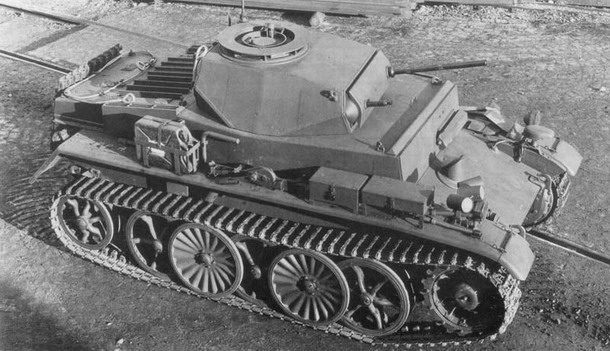
PzKpfw I Ausf. C, source: Flickr.com with permission, edited
Each of the five axles was sprung by an individual torsion bar. The swing arm of the first and last road wheel was additionally fitted with a shock absorber (since the first and last wheels of any running gear assembly are traditionally subjected to the greatest stress). At the very front was the drive sprocket and at the rear the idler wheel. No return rollers were needed as the upper run of the track rested directly on the road wheels. The prototype of the new tank had tracks fitted with rubber pads (as on the half-track tractors), making fast travel on hard road surfaces more comfortable.
The armoured superstructure followed the traditional German layout. From the nose of the hull, an armour plate rose gradually before transitioning into the front wall of the crew cab. In the left section of the cab's front wall was a vision port for the driver that could be closed with a massive flap, after which the driver looked out through an optical device. A further vision port was available to the driver in the left side wall of the cab. Above the driver's station, an entry hatch was cut into the cab roof.
The combat turret was positioned slightly to the right of the vehicle's longitudinal axis rather than centrally. Virtually the entire front wall of the turret was taken up by the weapons mantlet, which housed side by side an MG 34 machine gun (on the right) and the semi-automatic cannon EW 141 (on the left). Both weapons were of the same calibre: 7.92 mm. Their performance, however, was far from equal. The MG 34 used standard machine gun ammunition of 7.92 × 57 mm and was intended for engaging enemy infantry. The EW 141 used armour-piercing ammunition of 7.92 × 94 mm (a significantly larger cartridge case and thus a more powerful propellant charge) and was in essence a semi-automatic anti-tank rifle.
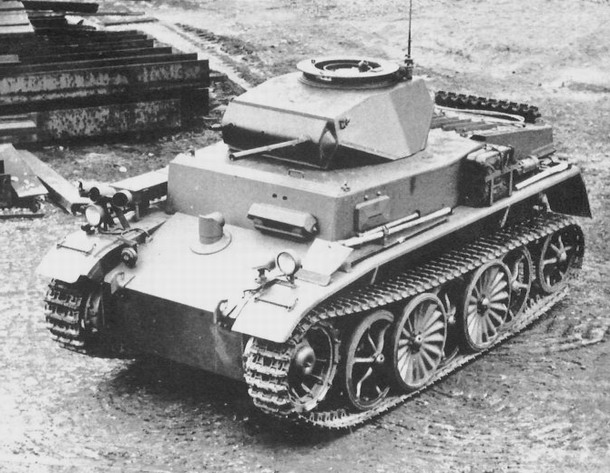
PzKpfw I Ausf. C, source: Aviarmor.net, edited
The barrel of the EW 141 was considerably longer than that of the coaxial machine gun and also substantially thicker, which gave an impression of a larger calibre. The barrel's greater thickness was necessitated purely by the structural requirements of the high pressure generated at firing and the high muzzle velocity. The armour-piercing round fired from this cannon could penetrate up to 25 mm of homogeneous sloped armour at a range of 100 metres. The vehicle's armament must also include a three-barrel smoke grenade launcher mounted on the front of the right-hand track mudguard.
The majority of the turret roof was occupied by a commander's cupola fitted with observation ports around its circumference. In the cupola was the commander's entry hatch, closed by a single-piece cover. The crew consisted of only two men — the driver and the commander, who also had to perform the roles of loader and gunner for both weapons. The tank was fitted with a Funksprechgerät "a" radio with a range of approximately 2 to 3 km when stationary and around 1 km on the move. The radio antenna was mounted in the left rear section of the turret roof.
Behind the cab was the engine compartment, housing a Maybach HL 45 P unit — a six-cylinder petrol engine of 4.678 litre displacement delivering a maximum output of 150 horsepower at 3,800 rpm. The engine was connected via a shaft to the gearbox mounted in the front of the hull. The gearbox was a Maybach VG 15319 type with eight forward gears and two reverse. For steering, the driver used not the conventional brake levers found on most tanks but a steering wheel — similar to, for example, the heavy tank Tiger. On either side of the engine compartment, air intakes for the powertrain were routed upward. The engine bonnet was additionally fitted with ventilation louvres that could be opened and closed by means of steel shutters.
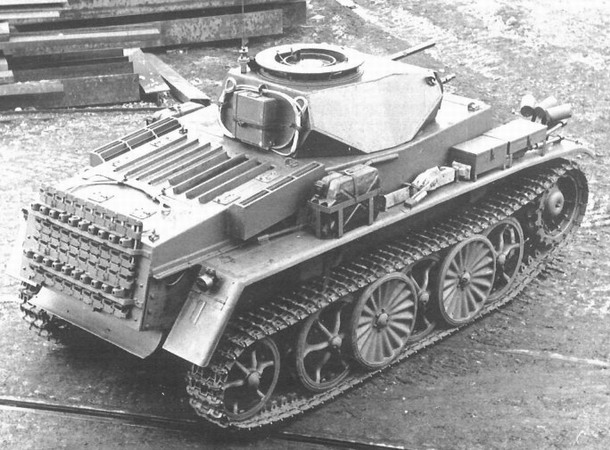
PzKpfw I Ausf. C — note the "louvres" in the engine bonnet, source: Aviarmor.net, edited
The tank's armour was thickest at the front of the cab and turret, at 30 mm — more than twice as thick as on the PzKpfw I Ausf. A and B. The cab sides were 20 mm, the turret sides 14.5 mm, and the rear walls of both hull and turret likewise 14.5 mm. The roof panels were 10 mm and the floor of the hull tray a mere 5 mm. The tank had a combat weight of 8 tonnes and was capable of reaching 79 km/h on road, though the top speed was limited to 65 km/h for safety. The fuel capacity was 170 litres, sufficient for approximately 300 km on road and around 190 km cross-country. The vehicle measured 4.195 metres in length, 1.92 metres in width and 1.945 metres in height.
During prototype trials, the decision was made to abandon the rubber-padded tracks. Production tanks therefore had conventional all-metal tracks. The ordered pre-production series of 40 tanks was delivered in full in 1942. The original designation PzKpfw I n.A. was changed in the same year to the final designation PzKpfw I Ausf. C. Alongside the VK 6.01 described here, a modified model designated VK 6.02 may also have existed, intended to be fitted with the more powerful Maybach HL 51 engine. Sources are not entirely clear on whether this project remained on paper or whether a few examples were actually built.
Production ended with the completion of the pre-production series. From around mid-1942, production of the PzKpfw II Ausf. L, also known by its battle name Luchs, was already under way. The Luchs offered the army essentially the same capabilities as the PzKpfw I Ausf. C and was generally considered a very successful design. The subsequent career of the PzKpfw I Ausf. C was therefore not a glorious one. Two examples were assigned to the 1st Panzer Division at the start of 1943 and sent to the Eastern Front for combat trials. The remaining 38 were allocated to the reserve LVIII Panzer Detachment in France, where they served primarily for training. Whether these tanks saw any fighting after the opening of the Western Front is not known.
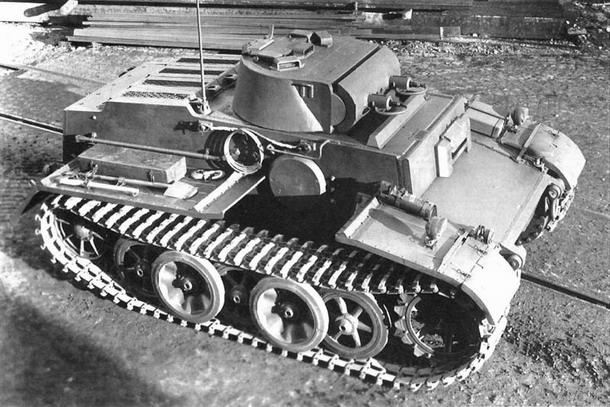
VK 18.01, i.e. the PzKpfw I Ausf. F, source: Flickr.com with permission, edited
Ausführung F (VK 18.01)
The last member of the Panzer I family was the PzKpfw I Ausf. F. Like the Ausf. C described above, it was an entirely new design with nothing in common with the other Panzer I versions. The army requirement on which this tank was based called for a vehicle to provide direct fire support for infantry. The priority was not speed (the vehicle was to accompany foot soldiers) but heavy armour that would protect the tank from enemy artillery fire. The ordnance office accordingly formulated a requirement for a tank with the heaviest possible armour that could still fit within an 18-tonne weight limit. The new vehicle was developed under the designation VK 18.01.
The VK 18.01 project was therefore from the very outset something of a transgression against the entire German armoured force doctrine. The Germans had cast tanks in the role of the new primary combat arm. Slow, heavily armoured infantry support tanks were, in the German concept, a relic of the past. Despite this, the VK 18.01 project was given the green light for some reason.
As with the preceding Ausf. C, the chassis of the new tank was to be developed by Krauss-Maffei and the superstructure and turret by Daimler-Benz. At roughly the same time, another tank of similar purpose was being developed — the VK 16.01 project, being worked on by MAN. In the interest of saving development costs, the ordnance office invited MAN and Krauss-Maffei to collaborate. The chassis of the VK 18.01 and VK 16.01 were to share the maximum possible number of components. Representatives of both firms duly reached an agreement and cooperated on the chassis (as a result of which both finished tanks had virtually identical running gear).
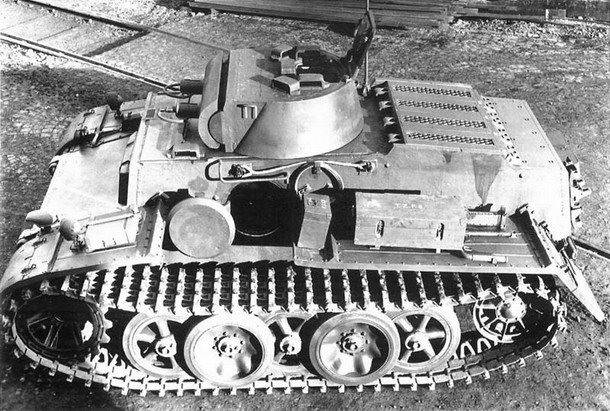
despite its machine-gun-only armament, the PzKpfw I Ausf. F was literally a small fortress on tracks — note the open entry hatch in the side of the hull just above the tracks, source: Flickr.com with permission, edited
Development of the new tank proceeded from drawings through a full-size wooden model to the first evaluation chassis (Versuchsfahrgestell) completed in June 1940. Krauss-Maffei again used running gear with large interleaved road wheels. Given the small dimensions and large weight of the tank, this was the ideal solution, allowing the load to be distributed across the greatest possible number of road wheels. Each wheel consisted of two separate discs: the discs on the even-numbered axles were spaced further apart, with the closely set discs of the odd-numbered axles fitting into the gaps between them. The wheel axles were sprung individually by torsion bars, with the first and last axle additionally fitted with shock absorbers, since these two axles are traditionally subjected to the greatest stresses in travel (the front wheel is first to mount an obstacle, the rear wheel last to clear it).
On each side of the chassis there were five of these double road wheels (each with two discs, making ten discs in total per side). The road wheels were 650 mm in diameter and fitted with rubber tyres for smoother travel. At the front was the toothed drive sprocket and at the rear the track idler wheel.
The first complete tank prototype was apparently not finished until 1941. The armoured superstructure followed the traditional layout: from the extended nose of the hull, the front wall of the crew cab rose with a driver's vision port on the left, followed by the cab with the combat turret on the roof, and behind it the engine compartment. What was anything but traditional, however, was the armour thickness. Both the front wall of the hull tray and the cab front wall were 80 mm thick — a value unheard of even on far larger medium tanks (the famous heavy tank Tiger had 100 mm of frontal armour — barely 20 mm more than this small vehicle!). The side walls were also 80 mm, the rear of the hull 60 mm, the roof panels 20 mm and the hull floor likewise 20 mm. The turret armour was 80 mm on all faces except the roof. This level of protection made the VK 18.01 a genuine small fortress on tracks.
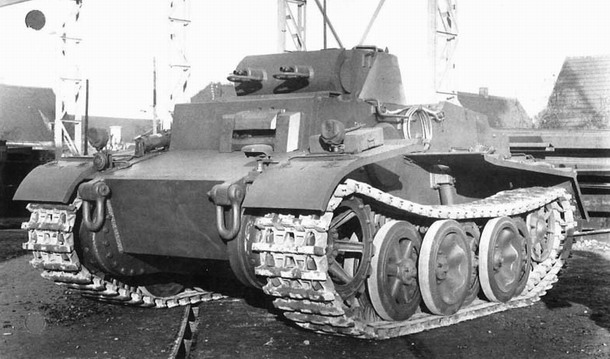
PzKpfw I Ausf. F — the substantial size of the road wheels and the towing hooks give some indication of how heavy this vehicle was, source: Flickr.com with permission, edited
The armament, however, stood in stark contrast to the enormous armour protection. It consisted of only two MG 34 machine guns of 7.92 mm calibre. The VK 18.01 was thus capable of withstanding fire from most enemy weapons, but could itself do nothing against enemy armour or fortified positions — it was effective only against infantry and unarmoured vehicles. The machine guns were set in a cylindrical mantlet on the front face of the turret, with their barrels protected by armoured sleeves from which only their muzzles protruded. For aiming, the gunner used the Turmzielfernrohr 8 sight. The turret itself was circular with slightly conical walls.
Cutting vision ports into armour as thick as the VK 18.01's was no simple task, and it is therefore unsurprising that the tank had only one direct-vision port — the driver's port in the left section of the cab's front wall, already mentioned. It could be closed by a massive flap very similar to that used on the Tiger. All other observation was periscopic, routed through the roof panels. The driver had one such periscope above his position on the left. Five fixed periscopes were on the turret roof for the commander's use, covering the area ahead and to both sides of the tank. To observe to the rear, the turret had to be rotated.
The turret roof also incorporated the commander's entry hatch, closed by a single-piece cover. There was no room on the cab roof for a driver's entry hatch due to the turret. A very unconventional solution was therefore devised: the driver was given two hatches, one in each side wall of the cab, just above the tracks. These were circular and closed by armoured covers on heavy hinges. Gaps had to be created in the track mudguards to accommodate these hatches.
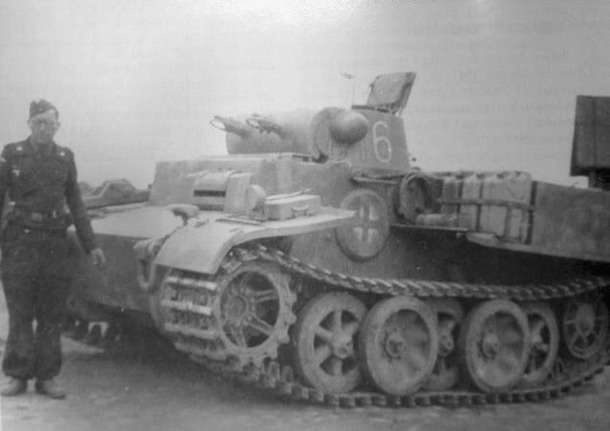
PzKpfw I Ausf. F deployed experimentally at the front by the 1st Panzer Division, source: Flickr.com with permission, edited
In the rear section of the hull was the engine compartment, housing a six-cylinder Maybach HL 45 P of 4.678 litre displacement producing 150 horsepower at 3,800 rpm. The gearbox was a Zahnradfabrik SSG 47 with six forward gears and one reverse. In the roof of the engine compartment were four elongated blocks with grilled air intake vents for the powertrain. These blocks could be hinged open to provide service access to the engine beneath. The tank's weight ultimately even exceeded the originally specified limit, reaching a full 21 tonnes. The maximum road speed is quoted as 25 km/h, though the average speed was only 19 km/h on road and 14 km/h cross-country. With 180 litres of petrol, the tank could cover approximately 150 km on road and around 110 km off it.
The crew consisted of only two men: the driver and the commander, who also had to serve as loader and gunner. The tank was fitted with a Fu 2 radio receiver (some sources say Fu 5). After prototype trials, a number of detail modifications were made (the track mudguards were redesigned, for example) and production of a pre-production series of 30 vehicles began. Production proceeded at a modest pace and the last of the ordered examples was not delivered to the army until December 1942. That same year, the new tank received its official designation PzKpfw I Ausf. F (why the letter F was used rather than D, which was next in alphabetical order, I do not know). Until then, the Waffenamt had apparently listed the tank under the designation PzKpfw I n.A. verstärkt (n.A. = neuer Art = new type, verstärkt = reinforced).
After the pre-production series was completed, production did not continue. Some sources indicate that an order for a further 100 vehicles was placed but subsequently cancelled. The army apparently rightly concluded that this type of tank offered limited combat value and that production capacity needed to be concentrated on other types. Eight of the thirty Panzer I Ausf. F built were assigned to the 1st Panzer Division at the start of 1943 and sent for combat trials on the Eastern Front. The remainder most likely ended up with various training units as exercise tanks.
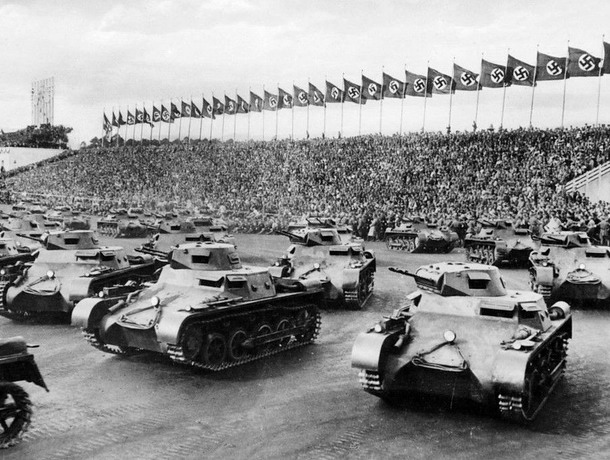
Panzer I tanks enjoyed their greatest fame during pre-war military parades and manoeuvres, source: Flickr.com with permission, edited
Combat Deployment
Let us now return to the classic Panzer I — the Ausf. A and Ausf. B vehicles. The first "battlefield" for the Panzer I consisted of military manoeuvres only, during which it helped the Germans refine the use of tanks as the primary offensive arm. The tank also enjoyed considerable fame during military parades, where it was greeted with enthusiasm as something of a symbol of the resurgence of the German army. Although the Panzer I was created primarily as a proving-ground and training tank (though many authors dispute this), it ultimately saw very intensive combat use.
Its combat baptism came very soon after entering service — as early as 1936, in the Spanish Civil War. The first Panzer I tanks arrived in Spain along with their crews in October 1936. The task of the German tank crews was not to participate directly in the fighting but merely to train the Spanish and provide the necessary support. The Germans used Spain as a kind of test laboratory to evaluate their tanks in action, and required the Spanish to provide reports on their combat experiences with the equipment. The overall message of these reports was not particularly surprising. Despite undeniable qualities (the Spaniards, for example, could not speak highly enough of the MG 13 machine guns), it was evident that machine-gun-armed tanks simply could not hold their own against cannon-armed tanks such as the Soviet T-26.
Germany began the Second World War regardless of the fact that its Panzerwaffe was still far from the state its commanders had planned. In September 1939, the Wehrmacht did not have enough of the medium Panzer III and Panzer IV tanks and was therefore forced to commit the light Panzer Is to combat as well. Of the approximately two and a half thousand tanks committed to the attack on Poland, nearly a thousand were Panzer Is — more than a third of the total. During the fighting, 320 of them were damaged, of which roughly a hundred were total losses.
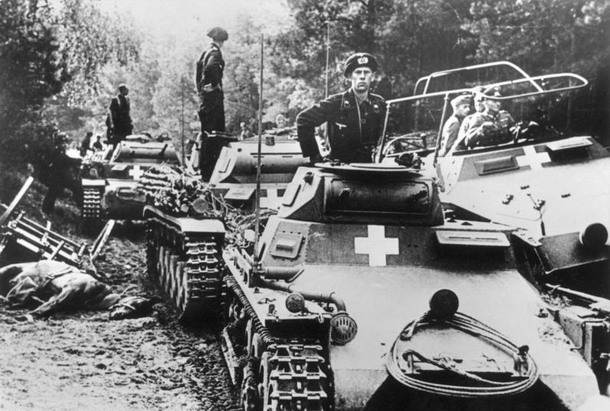
they also saw real combat — here during the attack on Poland in September 1939, source: Bundesarchiv_Bild_146-1976-071-36, Wikimedia, Creative Commons, edited
When the Wehrmacht turned westward in 1940, it still had to rely on some five hundred Panzer I tanks. Panzer I vehicles also saw action in North Africa and in the Soviet Union. The Germans took roughly three hundred of them eastward in 1941, but more than half were lost before the end of that year, and the remainder were soon allocated to roles other than front-line combat. The version that longest retained its primary purpose was apparently the command version, which remained in service in that role until around 1943.
Further Modifications
The Panzer I was produced in a relatively large number of examples and became obsolete fairly quickly, making it, bluntly speaking, "surplus to requirements". This made it an ideal candidate for all manner of field adaptations and conversions. Beyond all those already described, a whole range of other entirely unofficial individual modifications were carried out, at least some of which have survived recorded in photographs.
Photographs document the existence of at least one training Panzer I Ausf. A chassis into whose open cab a twin-coupled MG 42 machine gun assembly was installed. This was the standard anti-aircraft mounting for these weapons, used both in fixed positions and fitted to various vehicles. The assembly consisted of a rotating pedestal with a gunner's seat, a mount for two machine guns fed from drum magazines, and an aircraft ring sight for tracking fast-moving targets. The machine guns were mounted to allow a high positive elevation, enabling them to engage steeply angled targets. The modified Panzer I chassis served as a kind of improvised anti-aircraft tank.
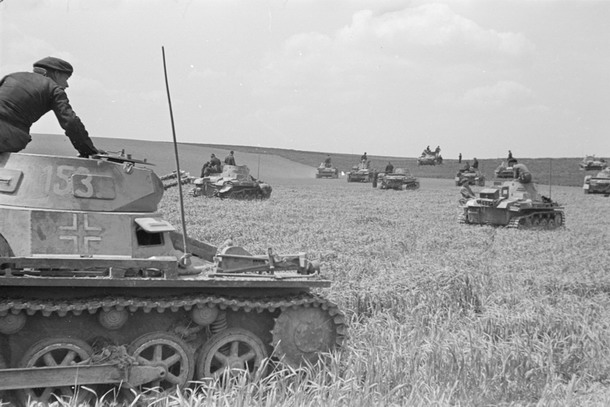
Panzer I tanks in France, 1940, source: Flickr.com with permission, edited
Another photograph demonstrates just how desperately the Germans were trying to obtain self-propelled anti-tank weapons in the final stages of the war. The image shows a Panzer I chassis onto which a StuK 40 gun of 75 mm calibre was installed. Whether this vehicle was ever actually committed to combat is not known, but frankly it is difficult to imagine. The chassis must have been severely overloaded simply by carrying the weapon, let alone absorbing the recoil of its shots.
A similarly desperate attempt to obtain a self-propelled weapon was the installation of a three-barrel assembly of automatic MG 151/15 cannons of 15 mm calibre. A PzKpfw I Ausf. B chassis without its superstructure was used as the base. The cannon mount was evidently taken from the so-called Flakdrilling Sockellafette — a mount on a rotating pedestal. The only surviving photograph of this modified Panzer I clearly shows, however, that the entire mount and pedestal assembly was not used — only the upper section, namely the cannon bracket itself. One can only speculate as to whether the installation was traversable and to what extent.
Photographs also exist of Panzer I Ausf. B tanks fitted with launch frames for rockets of 280 mm or 320 mm calibre. A tubular frame was placed over the engine section, with plates on its sides carrying adjustable brackets onto which the rocket launching crates were hung.
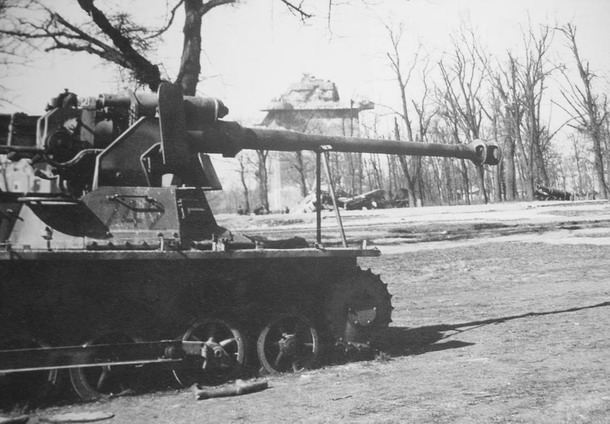
one of the desperate conversions — a PzKpfw I fitted with a StuK 40 gun of 75 mm calibre, source: Flickr.com with permission, edited
The crates were either steel or wooden. The system was the same as that mounted on Sd.Kfz. 251 half-tracks, though on the tank only one rocket could be carried on each side. Many more improvised conversions of this kind must certainly have existed.
Despite the generous orders placed by the German army, Krupp also attempted to find additional export markets for its product. In 1936, a project for a modified version of the Panzer I intended for the Bulgarian army was drawn up. The project was designated L.K.B. 1 (most likely an abbreviation of Leichter Kampfwagen Bulgarien). The L.K.B. 1 was to be based on the standard PzKpfw I Ausf. A but powered by a Krupp M311 engine producing 85 horsepower. At the end of 1936, Krupp asked the ordnance office for permission to build this export tank. In the course of subsequent negotiations, the ordnance office requested the opportunity to test the new vehicle so that it could assess its qualities and consider whether the M311 engine might also be of interest for domestic use. The prototype was completed in March 1937. It differed from the standard PzKpfw I Ausf. A only in the design of the rear engine section, and can be identified in photographs primarily by the placement of its exhaust.
prototype of the export tank L.K.B. 1 with PzKpfw I Ausf. A chassis and Krupp M311 engine — note the distinctive exhaust positioning, source: Flickr.com with permission, edited
After the L.K.B. 1 prototype trials, Krupp decided to continue development and build a further version designated L.K.B. 2, using the Panzer I Ausf. B chassis and again powered by the M311 engine. It appears that an L.K.B. 3 prototype was subsequently also built, though frankly its history is not entirely clear to me. Photographs survive of both a complete tank with a PzKpfw I Ausf. B chassis and M311 engine (identified by the exhaust) and a test-only PzKpfw I Ausf. B chassis with an M311 engine (also identified by the exhaust), the latter with an open cab surrounded by handrails and fitted with ballast to simulate the weight of the superstructure and turret. In the end, however, the deal with the Bulgarians apparently came to nothing and the L.K.B. project faded into history.
For completeness, it should be noted that in 1938 Krupp built the prototype of a light tank L.K.A. 1, which drew heavily on the Panzer I in many respects. Krupp also hoped to break into export markets with this vehicle, but again it appears that only a single prototype was built. The existence of the L.K.A. 1 prototype has, however, confused many historians who incorrectly place it in 1932 and consider it the first stage in the development of the Panzer I itself — an erroneous interpretation of history.
Technical Data
|
|
Ausf. A |
Ausf. B |
Ausf. C |
Ausf. F |
|
weight: |
5.4 t |
5.8 t |
8.0 t |
21.0 t |
|
length: |
4.02 m |
4.42 m |
4.195 m |
4.37 m |
|
width: |
2.06 m |
2.06 m |
1.92 m |
2.64 m |
|
height: |
1.72 m |
1.72 m |
1.945 m |
2.05 m |
|
engine: |
M305 |
NL 38 TR |
HL 45 P |
HL 45 P |
|
engine output: |
60 hp |
100 hp |
150 hp |
150 hp |
|
max. speed: |
37 km/h |
40 km/h |
79 km/h |
25 km/h |
|
hull armour: |
|
|
|
|
|
- front: |
13 mm |
13 mm |
30 mm |
80 mm |
|
- sides: |
13 mm |
13 mm |
20 mm |
80 mm |
|
- rear: |
13 mm |
13 mm |
14.5 mm |
60 mm |
|
turret armour: |
|
|
|
|
|
- front: |
13 mm |
13 mm |
30 mm |
80 mm |
|
- sides: |
13 mm |
13 mm |
14.5 mm |
80 mm |
|
- rear: |
13 mm |
13 mm |
14.5 mm |
80 mm |
|
crew: |
2 men |
2 men |
2 men |
2 men |
|
armament: |
2 × MG 13 machine guns, 7.92 mm |
2 × MG 13 machine guns, 7.92 mm |
EW 141 cannon, 7.92 mm 1× MG 34 machine gun, 7.92 mm |
2 × MG 34 machine guns, 7.92 mm |
Related Vehicles
|
Tank destroyers: |
Panzerjäger I (4.7 cm Pak 38(t) gun) |
|
Self-propelled guns: |
Sturmpanzer I (15 cm sIG 33 gun) |
|
Anti-aircraft tanks: |
Flakpanzer I (2 cm Flak 38 cannon) |
|
Flame-thrower tanks: |
Flammpanzer I (improvised conversions) |

ARTICLE
CONTENTS:
Reproducing text from the Panzernet website without the written consent of the operator is prohibited.