LEICHTTRAKTOR
not quite your ordinary tractor
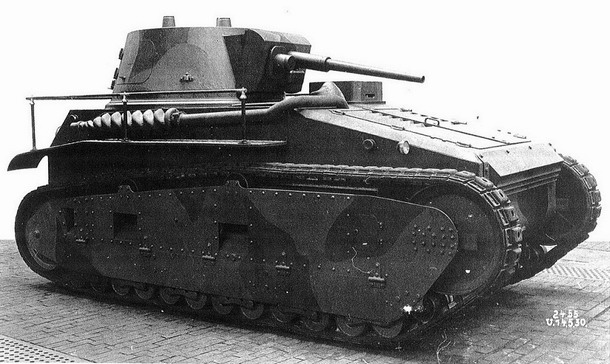
Leichttraktor by Rheinmetall, source: Flickr.com with permission of the publishing user, edited
Among the many categories of weapons prohibited to Germany by the Treaty of Versailles, the development and manufacture of tanks was explicitly banned. The more forward-thinking elements of the German military leadership were well aware of just how serious a handicap this embargo could prove for the future of their armed forces. There was the risk of losing the invaluable experience gained by the first tank crews in the closing stages of the Great War, and of cutting the industrial base off from emerging development trends and modern technologies. It is therefore hardly surprising that covert violations of the Versailles provisions began relatively early. As far back as the mid-1920s, a secret programme for the development of medium and light tanks was underway, camouflaged under the innocent designation of "Traktor."
Army Requirements
The decision to develop a light tank designated Kleintraktor – literally "small tractor" – was made in March 1928 (the designation was later changed to the final form Leichttraktor, meaning "light tractor"). The specification for the new vehicle was drawn up roughly between April and June 1928, and the requirements were demanding by any measure. The tank was to have a rotating turret armed with a 37 mm gun and a coaxial 7.92 mm machine gun. It was to have a fully tracked chassis powered by an engine producing at least 60 horsepower. Road speed was to be between 25 and 30 km/h, with a cross-country capability of 20 km/h. The fuel supply had to be sufficient for a minimum range of 150 kilometres or six continuous hours of operation. The armour was required to withstand armour-piercing steel rifle bullets. The vehicle's weight was not to exceed 7.5 tonnes, and ground pressure was not to exceed 0.5 kg per square centimetre.
A radio set with a range of at least 3 kilometres when stationary and 2 kilometres on the move was also required. The crew was to number four men: a driver, a gunner, a commander, and a radio operator. The interior was to be protected against gas attack. The specification contained many further details – covering, for instance, the ability to climb gradients, surmount vertical obstacles and cross ditches, as well as defining ground clearance, on-board ammunition stowage, and the fitment of a smoke-laying device – but the price of a single tank was not to exceed 50,000 Marks. What is more, the Army was not simply asking for a tank; it wanted a tracked chassis on which, in addition to the light tank itself, a munitions or supply vehicle could also be built – one suitable for civilian use as well. The preliminary specification was issued in April 1928 and finalised during May and June. It was during this finalisation process that the project's designation was changed from Kleintraktor to Leichttraktor.
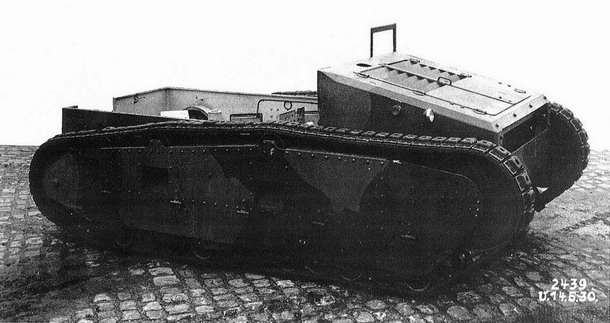
The bare Rheinmetall base platform intended for various vehicle types including the light tank, source: Flickr.com with permission of the publishing user, edited
The specification was then sent out (apparently in June 1928) to Daimler-Benz, Krupp, and Rheinmetall-Borsig. Each firm was to design, build, and deliver two prototypes for testing. Daimler-Benz, however, chose not to participate – apparently for internal reasons that can only be speculated about today. It was evidently not out of fear of punishment for working on a prohibited weapon (substantial fines and imprisonment were the potential penalties), since Daimler-Benz was simultaneously and quite openly involved in the Grosstraktor project. In response to Daimler's withdrawal, the Ordnance Office reportedly amended the specification for the two remaining competitors. One firm was to build, in addition to its two tank prototypes, a supply vehicle (Nachschubfahrzeug) on the same chassis; the other was to produce a tank destroyer prototype. In total, six development vehicles were to be built.
The two remaining manufacturers – Krupp and Rheinmetall-Borsig – then agreed to collaborate. Each worked on its own chassis and hull, but both designs were intended to share the same turret. As a result, the basic layout of both firms' prototypes was virtually identical, and in fact followed on from the pre-war light tank prototypes LK-I and LK-II. The engine was located in the front of the hull, with the crew compartment and fighting turret at the rear. Krupp submitted preliminary drawings of its vehicle as early as July 1928, with Rheinmetall following somewhat later. Ordnance Office staff reviewed the drawings and contracts for the construction of actual prototypes were signed with both firms, most likely in October 1928. The vehicles were completed in May 1930.
Rheinmetall-Borsig Design
Rheinmetall worked precisely in accordance with the Army's specification and developed a universal base platform from which various vehicles could be built. This base consisted of a tracked chassis and an engine section. The entire rear section was left open and could be fitted with a variety of superstructures – either an armoured hull with a fighting turret, producing a light tank, or a flatbed, turning the whole machine into a cargo vehicle. Rheinmetall built and submitted both of these variants for trials. Later, a tank destroyer was also constructed on the same base. The track assembly and entire engine section were naturally identical across all variants, apart from minor details.
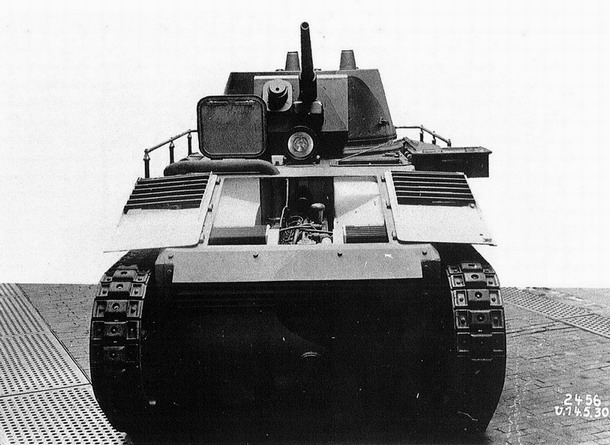
The cargo vehicle variant on the Rheinmetall base platform, source: Flickr.com with permission of the publishing user, edited
In designing the tracked chassis itself, the Rheinmetall engineers drew inspiration from the running gear of an agricultural tractor – possibly a Cletrac (Cleveland Tractor Company) model. The chassis featured twelve small double road wheels on each side, arranged in pairs to form a kind of bogie, giving six bogies per side. The remainder of the suspension was concealed behind the side armour and its layout can only be determined from surviving drawings. The bogies were most likely grouped in pairs and suspended on a shared leaf-spring unit.
The track assembly was bounded at front and rear by a drive sprocket and an idler wheel, both of large diameter and similar design. The drive sprocket was at the rear, the idler at the front. Two return rollers supported the upper run of the track. Between the idler and the first road wheel, an additional small roller was mounted above ground level to support the track when mounting an obstacle and help the tank to clear it. The side of the track assembly was covered by riveted armour plate. The lower portion of this plate was hinged and could be raised to give access to the suspension and wheel assemblies. A notable feature was the use of rubber tracks.
The engine compartment occupied the front of the hull. An air intake opening for the powerplant was situated in the upper part of the front plate. On the tank variant this opening was covered by steel louvres; on the cargo variant it was left open. The engine cover was angular, with a flat upper deck that rose gently from the nose towards the rear. Almost the entire top of the engine compartment was taken up by a large two-part service hatch, partly solid and partly louvred, with its halves opening outward to either side. Small headlights – one on each side – were mounted on the flanks of the engine cover. Beneath the cover sat the Daimler-Benz M36 engine, borrowed from a truck. The 7.8-litre unit produced a maximum output of 100 hp at 2,000 rpm. The Krupp gearbox, also originally designed for automotive use, offered four double forward speeds and one double reverse.
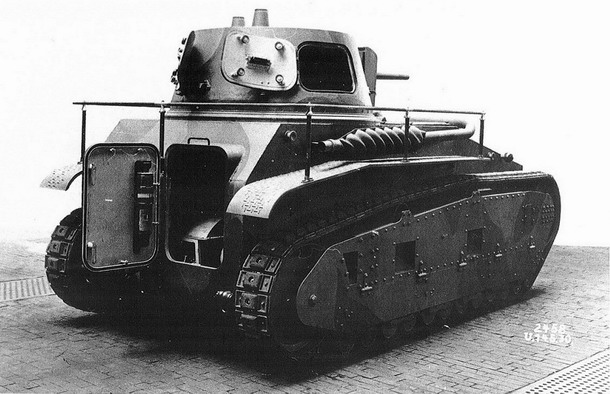
Leichttraktor by Rheinmetall, source: Flickr.com with permission of the publishing user, edited
Up to this point the cargo and tank variants were identical, sharing the common base platform described above. The differences began immediately behind the engine compartment. On the cargo prototype, the driver's cab was partly open – he had only a small glass-filled frame in front of him, a wooden partition behind, and a simple roof overhead. The rear section was given over to an open flatbed, enclosed by a plank siding much like a conventional truck. In this configuration the vehicle could carry both cargo and troops.
More significant, however, was the fighting variant – the light tank proper. Here the engine cover transitioned smoothly into the flat roof of a fully enclosed crew compartment. The driver and radio operator occupied the forward part of this compartment, the driver on the left and the radio operator alongside him on the right. The crew compartment had no front wall in which vision ports could have been fitted. For the driver to see ahead at all, he had to sit on a raised seat with his head permanently protruding through the roof hatch. He was protected by a raised armoured housing over this hatch, which looked essentially like a square metal box. Slit-shaped vision ports were cut into its front face and both sides, giving the driver his view. In a safe area the driver could fold the entire housing open – it hinged to the left – to gain a much clearer direct view. This boxed hatch effectively served as an extension of the driver's cab and fulfilled a role similar to the commander's cupola found on later tanks, providing a field of view while protecting the soldier beneath. The original German designation for this arrangement was Kopfgehäuse, which can be translated as "head housing."
The radio operator also had his own roof hatch, but his cover was entirely conventional – flat, one-piece, and hinged to open rearward. As a result, there was nowhere to fit vision ports, and the radio operator was effectively blind when his hatch was closed. Between the two hatches a large spotlight was mounted, which could be folded down flat. Just before the transition to the crew compartment roof, the exhaust pipe emerged from the top of the engine cover, turned towards the right side, and ran rearward above the track guard. A notable feature of the exhaust pipe was its helical silencer.
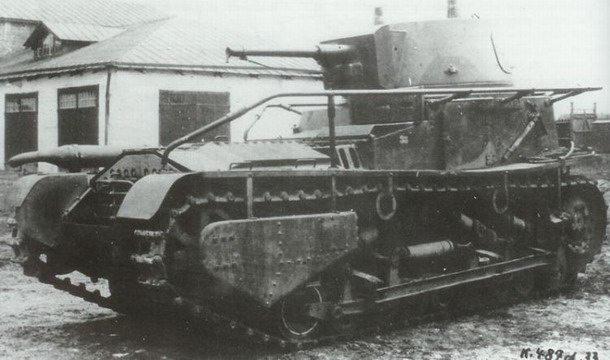
Leichttraktor by Krupp, source: Flickr.com with permission of the publishing user, edited
Virtually the entire remaining roof of the crew compartment was occupied by the fighting turret. As already noted, the turret was shared between the Rheinmetall and Krupp prototypes under their collaborative agreement. Some sources attribute the turret's design to Swedish firms Landsverk and Bofors, but this version of events is unconvincing on several counts. While it is true that Sweden enjoyed very close relations with Germany in the interwar period, one must ask: why would the Germans risk exposure of their Versailles violations by bringing in a foreign partner? Furthermore, Bofors was a gun manufacturer, so its contribution to the project would presumably have been the main armament. Yet the prototypes were armed with a gun of German, not Swedish, manufacture. The more plausible explanation is therefore that the turret was developed for both companies by Rheinmetall, which also supplied the armament.
Whatever its origin, the shared turret had a circular floor plan with walls that tapered conically upward. Projecting from this circular form was a frontal mantlet housing the armament, which consisted of a 3.7cm KwK 36 L/45 gun and a coaxial machine gun, most likely of 7.92 mm calibre. The gun was positioned slightly left of centre in the mantlet, with the machine gun to its right. Sources unfortunately disagree on the exact type of machine gun used, though photographs suggest it was changed at some point during the prototypes' development. Whereas the early version of the Rheinmetall prototype clearly carried a water-cooled machine gun (identifiable by the distinctive thick jacket around its barrel), the later modified tank shows a long, slender barrel consistent with something like the MG34. Vertical elevation of the mantlet ranged from –7 to +25 degrees. Ammunition stowage was 150 rounds for the gun and 3,000 for the machine gun, as required by the Army specification.
The remaining two crew members – the commander and the gunner – were stationed in the turret. Some authors mention a fifth man serving as a loader, but this is probably incorrect, as the overwhelming majority of sources agree on a four-man crew. The loading role was therefore presumably carried out by either the gunner or the tank commander. Access to the turret was via two hatches at the rear of the turret's side walls, each fitted with a single-piece door incorporating a vision slit. A pair of periscopes protruding from the turret roof provided the forward view and aiming capability. Whether a hatch was also fitted in the roof is unclear, as no high-quality overhead photographs have been found.
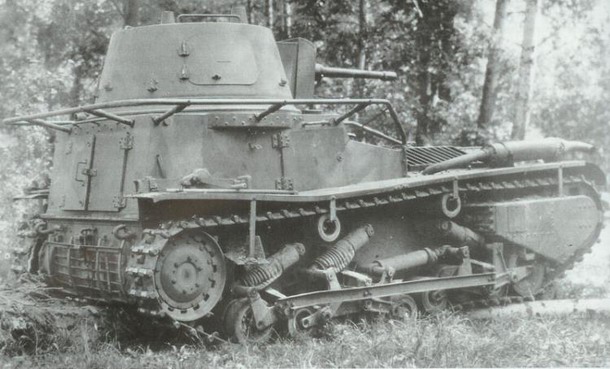
Leichttraktor by Krupp, source: Flickr.com with permission of the publishing user, edited
Another large access hatch with a single-piece door was located in the right half of the hull's rear wall. The side walls of the crew compartment featured track guards on both sides, with the radio aerial frame mounts fitted above them. The aerial itself surrounded the compartment on both sides and across the rear. The armour thickness of the Rheinmetall Leichttraktor is given variously as 4 to 10 mm or 5 to 14 mm depending on the source. Total weight was around 9 tonnes and maximum road speed is generally quoted as 30 to 35 km/h. Fuel capacity was reportedly 220 litres.
Some sources mention an interesting feature of the prototype: an artificially maintained overpressure inside the crew compartment. This was intended to prevent outside air – and with it any poisonous gas – from entering the vehicle uncontrolled. Whether this is accurate remains uncertain, though it is worth noting that protection against gas attack was indeed part of the original Army specification.
In addition to the tank and cargo vehicle described above, Rheinmetall later built a tank destroyer prototype on the same chassis. This vehicle had a smaller turret (reportedly non-rotating in some accounts) mounting a 3.7cm PaK 36 L/45 anti-tank gun, again paired with a machine gun. The crew of the tank destroyer was to be reduced from four to three men. No further details about this vehicle have come to light.
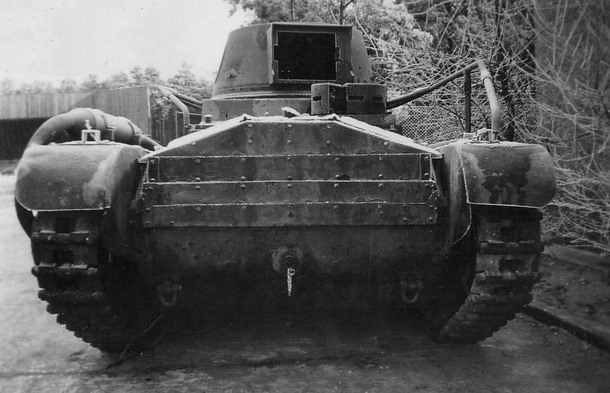
Leichttraktor by Krupp, source: Flickr.com with permission of the publishing user, edited
Krupp Design
Unlike Rheinmetall, the engineers at Krupp chose to develop an entirely new running gear for their Leichttraktor. On each side it consisted of six small and two larger road wheels – the first and last – linked together in an elaborate arrangement of bogies, which were in turn connected to a total of four coil springs distributed unevenly and at varying angles. At the rear was a large-diameter drive sprocket; at the front, a spoked idler. Part of the idler and the hull side immediately behind it were shielded by an armour plate. The tracks were covered along their full length by mudguards. At the front, the mudguards projected considerably beyond the nose of the hull, with a single headlight mounted on each one.
The engine cover was highly articulated. Its front face consisted of several horizontal sheet-metal louvres allowing cooling air to flow to the powerplant. The roof of the engine compartment had a raised centre section with cooling air outlets on either side. Particularly unconventional was the exhaust arrangement. The exhaust pipe ran along the right mudguard from the rear of the engine compartment towards the front of the tank. Some photographs show what appears to be a rubber hose fitted over the end of the exhaust pipe, effectively extending it and directing the gases downward and outward – almost down to the level of the road wheels. The reason for this addition was presumably that the original arrangement had caused exhaust fumes to obscure the view ahead of the vehicle.
Behind the engine section, the raised crew compartment began. The driver's position was on the left-hand side. As on the competing prototype, he too had a kind of armoured housing above his head. In Krupp's version, however, it was not angular but cylindrical, with slit-shaped vision ports around its circumference – though it did not form a complete cylinder. The way this housing opened was particularly interesting: its two halves swung apart to either side.
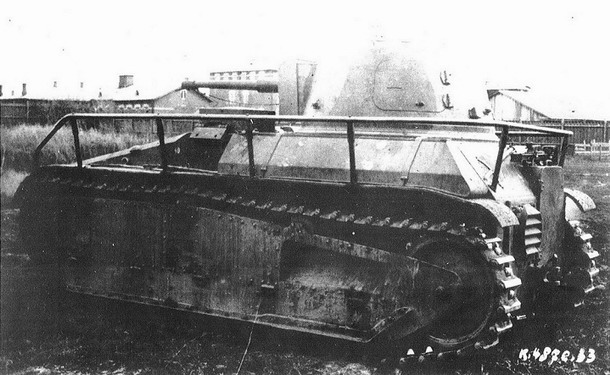
Modified variant of the Rheinmetall Leichttraktor – note the ventilation opening in the rear wall, the extended frame aerial, and other detail changes, source: Flickr.com with permission of the publishing user, edited
As for crew numbers, some sources give three men and others four. Given the original Army specification, the higher figure seems more likely to be correct. Several hatches served for entry and exit. One was in each side wall, with a single-piece cover hinged to open towards the rear of the vehicle. A large hatch with double doors was fitted in the rear wall of the crew compartment as well. A large frame aerial for the radio set surrounded the compartment, and on the left side it extended all the way forward to the hull nose. Above the crew compartment sat the fighting turret, which was identical to that of the Rheinmetall-Borsig prototype.
The Krupp vehicle's powerplant was also identical to the competition, using the Daimler-Benz M36 engine producing 100 hp. The Soden gearbox offered four forward speeds and one reverse. Armour thickness was the same as on the Rheinmetall, as was the fuel capacity and maximum road speed. The weight of the Krupp VK31 was 8.7 tonnes.
Testing in the USSR
As already noted, the four light tank prototypes were completed in April and May 1930. The new tank's code designation was VK31 (Versuchskonstruktion), applied equally to both competing designs. The vehicles were subsequently shipped for testing to the Kama proving ground in the Soviet Union. The Kama training and testing centre had been established as part of Soviet-German cooperation in armoured vehicle development, and it operated until Hitler came to power in 1933.
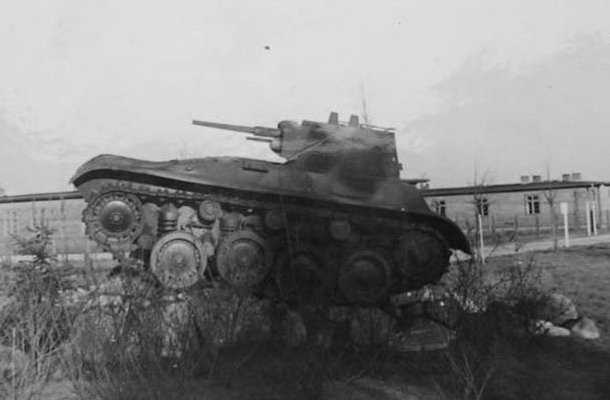
Rheinmetall Leichttraktor with the new type of running gear, preserved as a monument, source: Flickr.com with permission of the publishing user, edited
The trials produced mixed results. While the Leichttraktors represented reasonably modern and mobile vehicles, experts judged their actual combat value to be very limited. The most heavily criticised shortcomings were the very thin armour and frequent engine overheating. Despite this, the Army intended in 1931 to order 34 Rheinmetall tanks for production (some sources even suggest the order was to have been as large as 289 vehicles). The order was subsequently cancelled in favour of another project known as the Landwirtschaftlicher Schlepper, which ultimately resulted in the Panzer I in 1934.
Krupp and Rheinmetall continued working on their respective prototypes in the years that followed, producing modified versions of both designs. In the case of Rheinmetall, the running gear was revised in 1931 or 1932. Externally, this modification was visible in a change to the appearance of the cover over the track assembly. It was on this revised chassis that the aforementioned tank destroyer prototype was built.
Later, further changes were made to the Rheinmetall vehicle. The track mudguards were extended forward to the front of the hull, and the frame aerial was lengthened accordingly. A sheet-metal "box" – presumably a tool stowage bin – appeared above the rear half of the left mudguard. A new louvred opening was added to the rear wall of the hull, to the left of the access hatch, apparently to ventilate the crew compartment. The air intake opening in the front hull plate for engine cooling was noticeably enlarged. Among changes not visible from the outside, the gearbox is said to have been replaced with a different type.
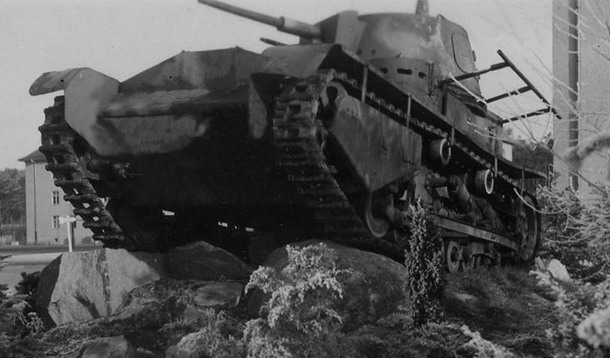
Leichttraktor by Krupp, preserved as a monument, source: Flickr.com with permission of the publishing user, edited
Modifications and End of the Line
In 1932 or 1933, one of the Rheinmetall prototypes received a completely new running gear. It consisted of four large road wheels, each independently sprung by its own substantial coil spring. The drive sprocket and idler were also of a new design. The upper run of the track was supported by three evenly spaced return rollers. The new suspension arrangement allowed the overall height of the tank to be reduced, which necessitated corresponding changes to the hull structure. A number of cosmetic modifications were made as well. For instance, the radio operator's roof hatch was fitted with a raised, square-profiled Kopfgehäuse identical to that of the driver, giving the radio operator a view out of the tank when the hatch was closed.
In 1933 the Kama testing facility was closed and all Leichttraktor prototypes were returned to Germany. Their subsequent fate is not entirely clear. According to some sources, they may have participated in military manoeuvres in 1935. They were then transferred to the gunnery school at Putlos, where they were used for some time as training vehicles for new crews. At least one Krupp prototype and one Rheinmetall prototype with the new running gear (the four large road wheels) ended up as static displays – presumably at Putlos. One of the Krupp tanks was probably converted into an observation or command vehicle, with the turret removed and replaced by a new, larger cab fitted with a large frame aerial.
ARTICLE
CONTENTS:
Reproducing text from the Panzernet website without the written consent of the operator is prohibited.