STURMPANZER I
self-propelled gun on the Panzer I chassis
Author's note: the official designation of this vehicle was "15cm sIG 33 auf Panzerkampfwagen I Ausf. B", but the simpler name "Sturmpanzer I" has also become established for it. Although not an official designation, I will use it throughout the following text (and on these pages generally) for simplicity.
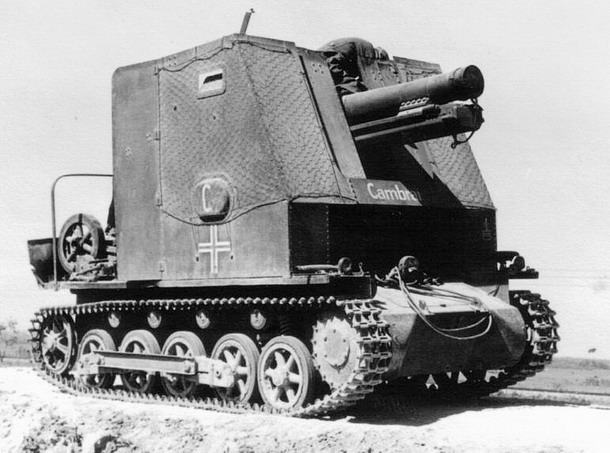
Sturmpanzer I, source: Flickr.com, with permission of the publishing user, edited
Origins of the Vehicle
Even the experience of the Polish campaign had already demonstrated the need for a self-propelled fighting vehicle armed with a large-calibre gun for destroying hardened enemy positions. Previously this task had belonged to conventional artillery with towed guns — but towed guns were no longer an ideal solution under the conditions of Blitzkrieg warfare. They were road-dependent and could not cross terrain the way tanks could. Changing position also meant a very lengthy process for towed guns. Tanks, by contrast, moved across the battlefield at speed and could not afford to wait for slow-moving artillery.
Development of the new self-propelled gun was entrusted to the firm Alkett (Altmärkische Kettenfabrik), with the requirement that the main armament be a 150 mm calibre gun. The design was to incorporate as many components as possible from an already-produced vehicle, in order to save time and money. The designers' choice fell on the chassis of the PzKpfw I Ausf. B tank. This tank had been conceived from the outset as a training vehicle and was completely unsuitable for combat against enemy armour. Using its chassis for a different purpose was therefore a fairly rational decision.
Design Description
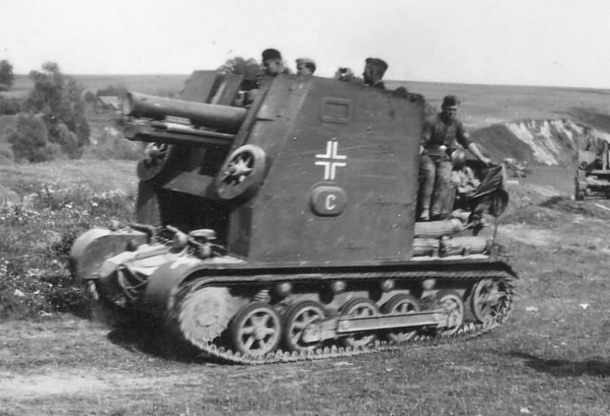
The running gear on each side consisted of five spoked road wheels, supplemented by a drive sprocket at the front and an idler wheel at the rear. The first road wheel was sprung by an independent coil spring; the remaining four were sprung in pairs by leaf springs and separated on the outside by a flat longitudinal beam. The track rested on four return rollers above. Track width was 280 mm. The powerplant of the original tank was also carried over — the six-cylinder Maybach HL 38 TR engine producing 100 horsepower at 3,000 rpm — as was the gearbox with five forward gears and one reverse.
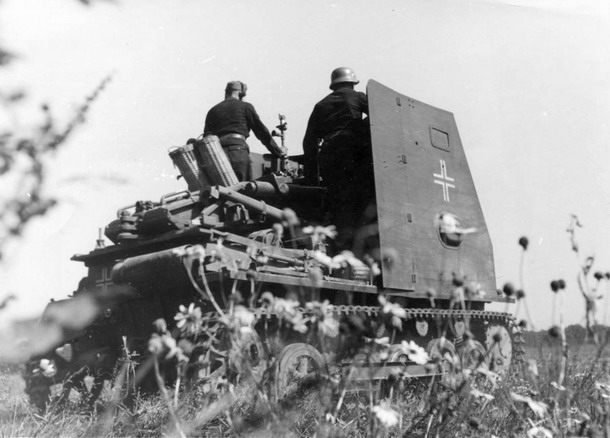
Sturmpanzer I, source: Flickr.com, with permission of the publishing user, edited
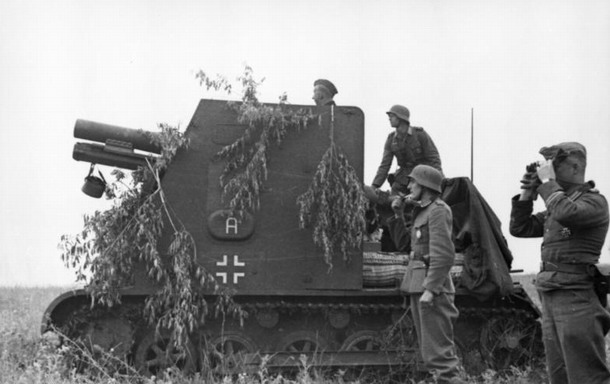
The original rotating turret was removed from the chassis and in its place a large armoured fighting compartment was welded from 10 mm plates (13 mm is also sometimes cited). The compartment was disproportionately large relative to the modest chassis, since it had to house the bulky heavy infantry gun sIG 33 (schweres Infanterie Geschütz) in 150 mm calibre with its 11.4-calibre barrel. The compartment was open at the top, at the rear and partly at the sides — necessary to keep the overall weight within reasonable limits. The front wall of the compartment had a large opening filled by the gun's own shield, since the weapon was installed on the chassis with minimal modification, complete with its original shield and field-carriage wheels — from which only the rubber tyres had been removed.
The designers had in effect simply bolted a towed gun onto a tank chassis (though it has been noted that later vehicles had the guns mounted differently, without the field-carriage wheels). In the left section of the front wall, a panel of armour could be swung open on hinges to provide a clear field of view for aiming. The gun's shield was similarly fitted with a hinged armour flap. With both of these panels closed, the front wall of the compartment was completely sealed — except, of course, for the opening in the gun shield through which the barrel itself projected. On most vehicles the upper section of each side wall had a closable rectangular vision slit in a clearly visible frame surround, though on some vehicles these slits are entirely absent. The rear sections of the side walls were hinged and could be swung outward to the sides, presumably to create more working space behind the gun and thus ease its operation — particularly the loading, which required two men working simultaneously.
The gun retained a traverse of 12.5° to each side and a vertical elevation range from -4° to +75°. The weapon used both high-explosive fragmentation and armour-piercing ammunition. The high-explosive shell weighed 38 kg and left the barrel at 240 m/s, with an effective range of approximately 4.7 km. The on-board ammunition supply of the Sturmpanzer was absolutely minimal, simply because there was no room for more — eight rounds is the figure most commonly cited. Photographs confirm at least five: two on the rear section of the left track guard, one on the right, and two stowed vertically in the gun cradle. The ammunition was carried in wicker crates. The remaining three shells may have been stored somewhere beneath the gun. All additional ammunition had to be carried by an accompanying half-tracked vehicle. The self-propelled gun had no secondary armament whatsoever.
Sturmpanzer I, source: Bundesarchiv Bild 101I-216-0406-37, Wikimedia, Creative Commons
The weight of the Sturmpanzer reached a full 8.5 tonnes — the newly installed weapon alone weighed around 1.8 tonnes. Yet the chassis had been designed for the original PzKpfw I Ausf. B, which weighed approximately 5.8 tonnes. The increase in chassis loading was therefore more than 40%. On top of this, the enormous forces generated by firing a heavy gun acted on the chassis with every shot. (Footage from the fighting in France in 1940 captures a Sturmpanzer I at the moment of firing — the entire vehicle shudders so violently that it looks as though it might fall apart on the spot.) For all these reasons the chassis was subjected to severe stress and breakdowns were more frequent than desirable.
The Sturmpanzer's crew consisted of four men: the driver, stationed at the front of the hull; the commander, who also served as gunner; and two loaders. As already mentioned, the fighting compartment was completely open at the top, open at the rear, and partly open at the sides, leaving the crew fully exposed to the elements. Their only protection against bad weather was a waterproof tarpaulin stretched over the fighting space. Moreover, there was simply not enough room on the hull for all three gun crew members, so during longer movements one or even two of the men rode on the accompanying ammunition vehicle.
Overall Assessment
It is obvious at first glance that the Sturmpanzer I was nothing more than a stopgap solution to an acute shortage of large-calibre combat vehicles. The entire design was provisional and suffered from a number of shortcomings. The height of the fighting compartment alone made the vehicle a conspicuous target for enemy fire, which combined with the very thin armour was a significant disadvantage — though it must be said that the vehicle was intended for fire support at relatively long range and was not supposed to come into direct contact with the enemy. The height of the compartment and the manner in which the gun was installed also shifted the vehicle's centre of gravity uncomfortably high, making it prone to overturning on broken terrain. A further major disadvantage was the already-mentioned fact that the gun and compartment were simply too heavy for the chassis, which limited the vehicle's mobility and shortened its service life. Drawing on this experience, subsequent self-propelled guns carrying the sIG 33 weapon were built on the stronger chassis of the Panzer II, Panzer III and Panzer 38(t).
Sturmpanzer I, source: worldwarphotos.info, with permission of the operator
On the other hand, the vehicle's strengths were its powerful armament and the simple fact that it was the only vehicle of its kind in the German army. In the end, therefore, the troops were glad to have at least some self-propelled gun of that firepower, because the alternative was having nothing at all :-)
The Sturmpanzer I prototype was completed and tested in January 1940. Series production ran for only a few months in 1940 (February is the date most commonly cited) and totalled just 38 vehicles. These were organised into 6 companies (701st through 706th schwere Infanteriegeschütz Kompanie), which then served during the campaigns in Western Europe and the Balkans, and finally in the Soviet Union — where they generally also came to the end of their service lives. The last known example was still in service in mid-1943 as part of the 704th Company, assigned to the 5th Panzer Division.
Technical Data
|
weight: |
8.5 t |
|
length: |
4.42 m |
|
width: |
2.68 m |
|
height: |
3.35 m |
|
engine: |
Maybach NL 38 TR |
|
engine power: |
100 hp |
|
max. speed: |
38 km/h |
|
fuel capacity: |
146 l |
|
hull armour: |
13 mm |
|
superstructure armour: |
10 mm |
|
crew: |
4 men |
|
armament: |
1 x sIG 33 howitzer, 150 mm |
ARTICLE
CONTENTS:
Reproducing text from the Panzernet website without the written consent of the operator is prohibited.