PANZER II
the German army's second light tank
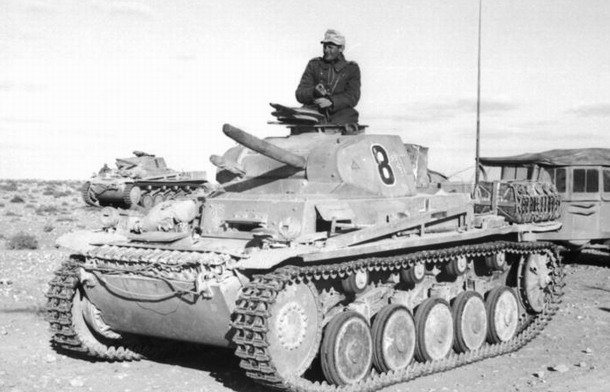
Panzerkampfwagen II in Africa. Source: Bundesarchiv_Bild_101I-783-0110-12, Wikimedia, Creative Commons, edited
Origins
The first half of the 1930s was a truly revolutionary period for the German army. Despite the strict ban on tank development imposed by the Treaty of Versailles, progressive officers were feverishly planning the future shape of Germany's armoured forces. One of them, Lieutenant Colonel Heinz Guderian, chief of staff at the Inspectorate of Transport Troops, proposed a concept under which the future Panzerwaffe would be built around two backbone tank types. The lighter of the two (which later materialised as the Panzer III) was to be designed primarily for destroying enemy armour. The heavier type (which later materialised as the Panzer IV) was to deal with artillery positions, bunkers, and other obstacles to the advance. The two types were to work closely together on the battlefield.
It was, however, 1931, and Guderian and his superior, General Lutz, were well aware that the road to realising their vision would still be very long. They also recognised that tanks intended to be produced in hundreds or thousands and to form the backbone of a modern German army could not simply be built from scratch overnight without the necessary manufacturing experience or operational experience with their employment. This led them to the idea that German industry and the German army first needed something like a trials or evaluation tank — a vehicle that would not excel in combat value, but would be fully tracked, fully armoured, and armed. German industry could use such a vehicle to learn and refine production methods, while the army could test the best ways of employing it tactically and operationally. Both manufacturers and users would then be better prepared for the arrival of the future backbone tanks. And so, in 1931, development began of a light and inexpensive "evaluation" tank designated Kleintraktor, which later entered history as the PzKpfw I. The army was already considering arming this tank with a 20 mm gun, but in the end two machine guns had to suffice, as the gun simply would not fit in the small vehicle's turret. It was decided that a tank with gun armament would be built later if needed.
January 1934 could be regarded as something of a milestone in the further development of German armoured forces. That month the army received its first incomplete PzKpfw I vehicles — without armoured superstructures or turrets, but available at last for initial service use. In that same month, the German Weapons Office completed its specification of requirements for both intended backbone tank types for the future Panzerwaffe and was preparing to assign their development to selected industrial firms. And as if that were not enough, January 1934 also saw the Weapons Office launch yet another project — the development of a new light tank armed with a 20 mm gun.
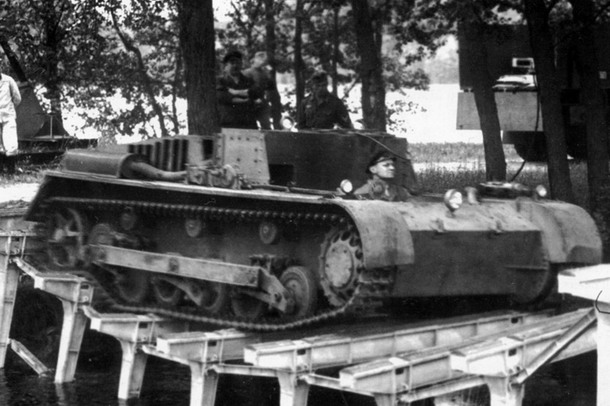
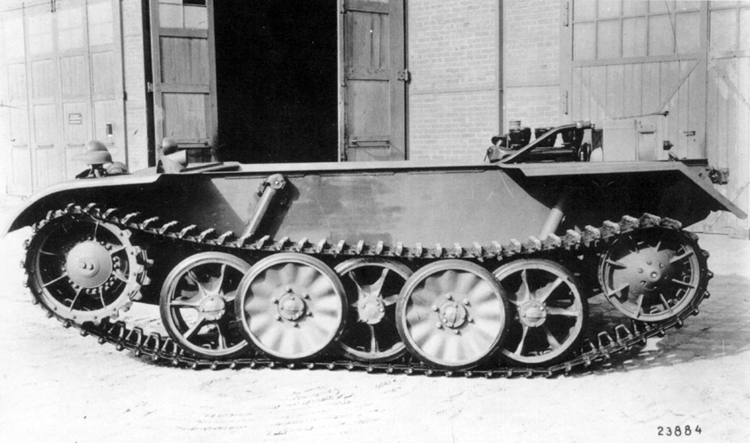
The Krupp running gear prototype for the La.S. 100 during trials. Source: Flickr.com, with permission of the publishing user, edited
Why Another Light Tank?
Given the situation at the time and the plans for the future, one cannot help asking: why did the Germans want to develop yet another light tank? Both manufacturers and the army already had their "school" light tank in the form of the PzKpfw I. And for the future, two backbone types of medium weight were planned. What need was there for another light tank? The correct answer is not entirely straightforward, as it involves several aspects.
It must be remembered that development of the full-value backbone types — the future PzKpfw III and PzKpfw IV — was then only just beginning. It was therefore clear that these vehicles would not be available for at least another two or three years at best. Production of the evaluation PzKpfw I, on the other hand, was already getting underway — and not as a small-batch production but as true series production, so that German firms could practice manufacturing tanks "in quantity".
The leaders of the armoured units were asking themselves: what will our factories and our army do for the next two or three years? If industry keeps producing PzKpfw I tanks throughout this period, we will have far more than we need. But if we stop production after a while, the industry's readiness for mass production of the future medium tanks will start to fade — after all, these are commercial firms that need to earn money, and if they have no tank contracts they will be forced to dismantle production lines, dissolve their trained workforce, and redirect their capacity elsewhere. And what about the army? Will it spend the next three years training endlessly with a single light tank type armed only with machine guns, unable to properly practise combat against other armoured vehicles?
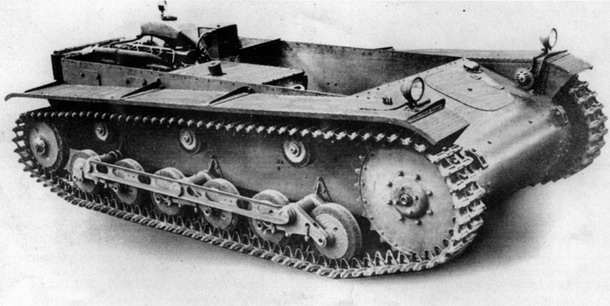
The MAN running gear prototype for the La.S. 100. Source: Flickr.com, with permission of the publishing user, edited
The conclusion the commanders reached was clear: neither German industry nor the German army could afford to stand still for three years. That time had to be put to better use — to try something new that would move them one step closer to the dream backbone tanks. What was needed was a tank that would still be simpler and cheaper than the "target" Panzer III and Panzer IV, but at the same time more advanced, more robust, and more capable than the existing Panzer I. Its development would have to be fast enough to be available before the future backbone types, and it would have to carry gun armament — even if of a small calibre. Such a vehicle would undoubtedly advance the capabilities of both manufacturers and the army. New technical ideas could be developed and tested, and combat against armoured targets could be practised more effectively. One final question remained: what would the army do with such a tank once it eventually received its backbone medium tanks a few years later? Even here the leadership agreed that a light tank with a 20 mm gun would certainly find a role alongside the backbone tanks, performing various secondary duties. The decision was made: the German army would order another light tank.
The army specification referred to the new vehicle as the verstärkter Kleintraktor 6 — a "reinforced" Kleintraktor 6. The name made clear the connection to the PzKpfw I, which the army designated Kleintraktor. The number 6 represented the expected weight of the new tank in tonnes. For security purposes the vehicle was also given a cover designation: La.S. 100 (La.S. = Landwirtschaftliche Schlepper = agricultural tractor, 100 = expected engine output in horsepower). The connection to the PzKpfw I was also reflected in the choice of firms approached. Krupp was to design the running gear of the new tank, while Daimler-Benz was to design and supply the armoured superstructure and turret. The armament was to consist of a rapid-fire 20 mm gun and one 7.92 mm machine gun.
The first meeting between Weapons Office representatives and Krupp took place as early as 24 February 1934. Krupp's chief engineer Hagelloch presented the first conceptual design of the new vehicle and promised to deliver detailed drawings by the end of March. He pressed the Weapons Office officers to place an order immediately, claiming Krupp could deliver the first complete tank before the end of 1934. The Weapons Office gentlemen were apparently not entirely satisfied and were not persuaded — quite the contrary. In May or June, the Waffenamt invited two further firms into the competition: MAN and Henschel, both of which were just then joining Krupp in producing the PzKpfw I. This was surely no coincidence.
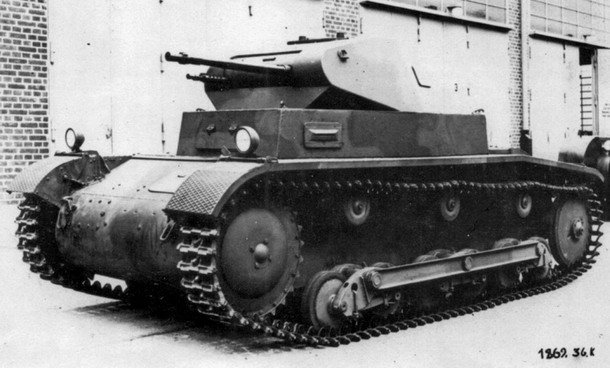
The first complete La.S. 100 prototype from MAN. Source: Flickr.com, with permission of the publishing user, edited
In July 1934, based on ongoing discussions with the firms, the Weapons Office further refined its requirements. The La.S. 100 was to weigh no more than 6,500 kg, achieve a maximum speed of 40 km/h, be powered by a Maybach HL 52 engine producing 120 horsepower, and use a Zahnradfabrik SSG 45 gearbox with six forward gears and one reverse. Sometime between July and September 1934 the firms submitted their proposals in the form of drawings and wooden models.
First Prototypes
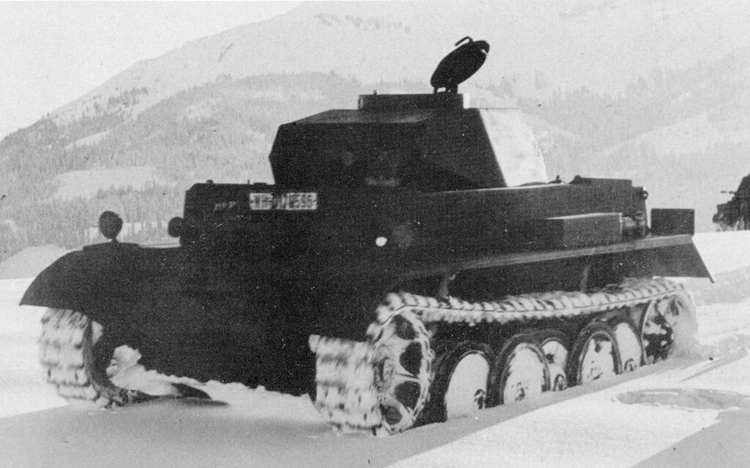
The first evaluation prototype was delivered to the army in February 1935, with the remaining prototypes following in the spring. Krupp and MAN each delivered two test vehicles — running gear only, with the powertrain, gearbox, and ancillary equipment, but without armoured superstructures or turrets. Henschel apparently also delivered a prototype, though no details or photographs of it have survived, so only the Krupp and MAN proposals can be briefly compared. The running gear of these two manufacturers' prototypes was broadly similar: a front drive sprocket with a single row of teeth, a rear idler, three return rollers supporting the upper run of the track, and most importantly six small road wheels paired on bogie arms and sprung by quarter-elliptic leaf springs. Except on the first Krupp prototype, all road wheels had an outer guide rib formed from a metal profile.
In the subsequent army trials, the MAN prototypes performed best. After the successful completion of driving trials, the second MAN prototype was fitted with an evaluation armoured superstructure and turret supplied by Daimler-Benz, and further tests followed. The now-complete tank passed these trials and was confirmed for series production.
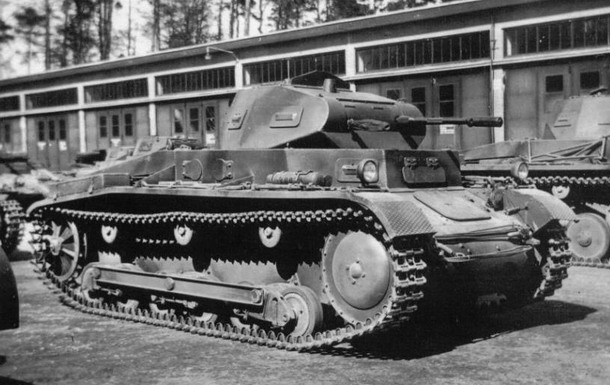
Panzerkampfwagen II Ausf. a/1, a/2, or a/3. Source: Flickr.com, with permission of the publishing user, edited
Ausführung a/1, a/2, a/3
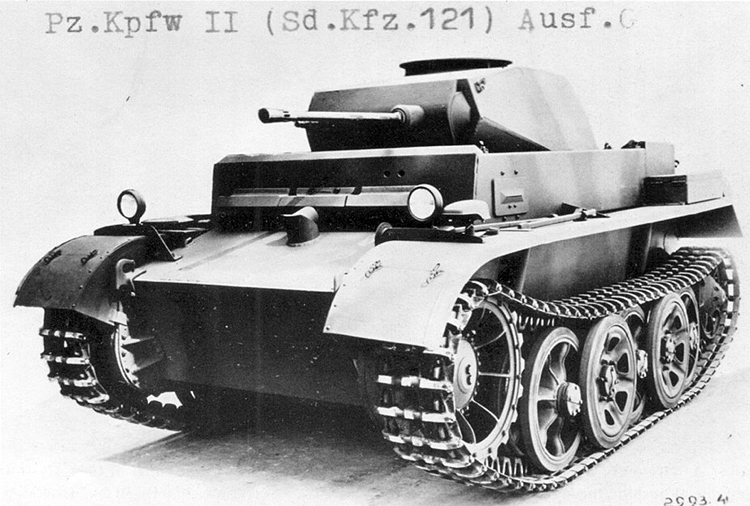
The first production batch of 75 vehicles was ordered in October 1935, originally designated as the zeroth series but later renamed the 1st production series. Tanks from this batch were to be delivered to the army between April and September 1936. In April 1936 the tank received its official name Panzerkampfwagen II (also abbreviated PzKpfw II) and the ordnance code Sd.Kfz. 121 (Sd.Kfz. = Sonderkraftfahrzeug = special-purpose vehicle). Within the first production series, three separate "sub-series" of 25 vehicles each were ultimately produced. The army designated these PzKpfw II Ausf. a/1, Ausf. a/2, and Ausf. a/3 (Ausf. = Ausführung = variant, version). Setting aside the unusual use of a slash and digit after the letter, the lower-case letter itself was also an exception — it signalled that the tanks of the first production series were still regarded as something of an evaluation batch.
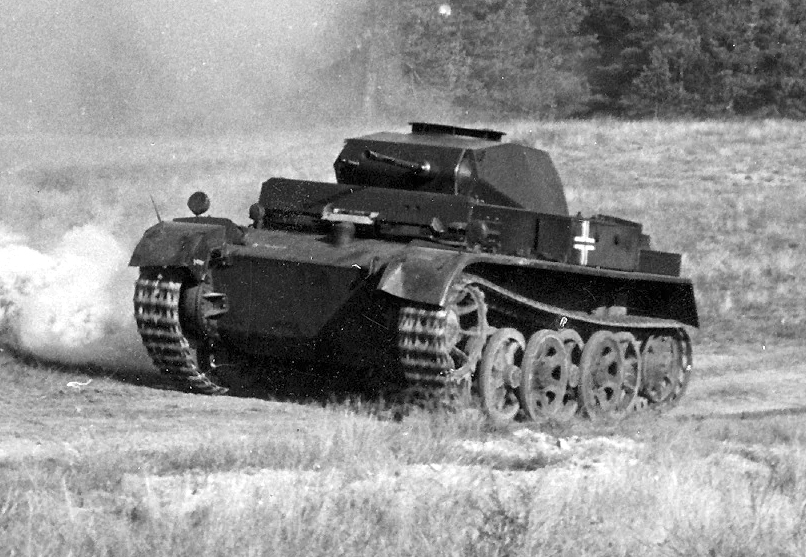
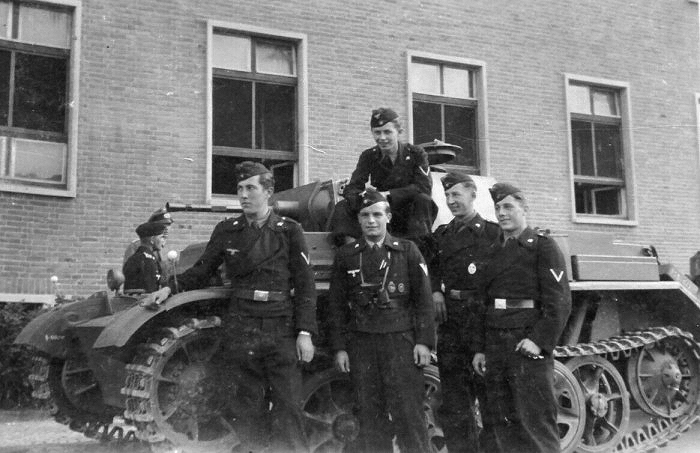
The PzKpfw II Ausf. a/1 was essentially identical in appearance to the second MAN prototype, with only minor differences — for instance the location of lifting ring attachments on the turret, the design of certain vision ports in the turret and superstructure, and the installation of accessories on the track mudguards. One significant difference lay beneath the engine cover: instead of the Maybach HL 52 used in the prototypes, the series vehicle was powered by the more powerful Maybach HL 57, discussed in more detail below.
The running gear consisted of six rubber-tyred road wheels for a smoother ride. The wheels were paired on common bogies. Each bogie consisted of a swinging arm with one road wheel at its end and a horizontally mounted leaf spring with the second road wheel at its opposite end. The bogie was attached to the hull side by a pivot pin. The six road wheels were therefore suspended on three bogies in total. The first two bogies were oriented with their swinging arms facing forward, while the last bogie was reversed with its arm facing aft. The front drive sprocket had only a single toothed ring, whose teeth engaged holes running along the centre of each track link. The tracks were also fitted with two guide horns to prevent them from slipping off the road wheels. The tracks were nominally 280 mm wide — in reality the individual links were 260 mm and the connecting pins 275 mm. Each track consisted of 108 links. The first 10 PzKpfw II Ausf. a/1 vehicles had the same rear idler design as the prototype — a solid metal disc with a rubber tyre around its circumference. From the eleventh vehicle onwards (hull number 20011), the tank received a new all-steel spoked idler wheel.
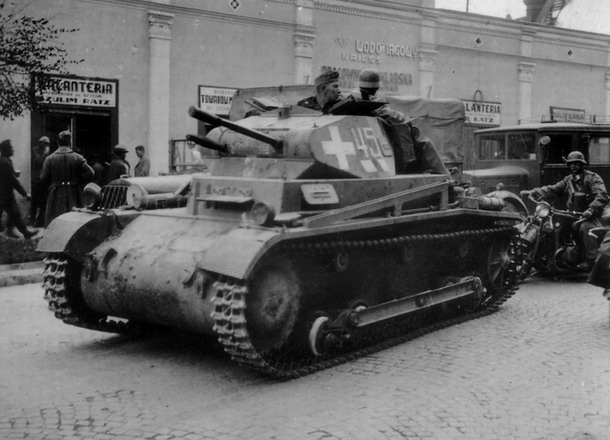
Panzerkampfwagen II Ausf. a/1, a/2, or a/3 during operations in Poland. Source: Worldwarphotos.info, with permission of the site operator, edited
The hull nose did not have the typical pointed shape formed by two angled plates, but instead used a single 13 mm plate curved into an arc, to which a further flat plate angled at 65 degrees was joined. This too was 13 mm thick, and in its left portion was the driver's entry hatch with a single-piece cover. Behind these plates the front wall of the crew superstructure rose from the hull. The superstructure had an irregular shape and was offset to the left of the hull's longitudinal axis. The left portion of the superstructure extended forward, housing the driver's station. The driver had a primary vision port in the front wall of the superstructure directly in front of him, filled with a block of bulletproof glass and closeable with an armoured cover in danger. In that case the driver observed through a binocular periscope KFF I with 1.15× magnification and a 50-degree field of view, whose lenses looked forward through two 15 mm apertures drilled in the front armour directly above the primary vision port. The driver also had vision ports on both sides of his station, likewise filled with protective glass and fitted with armoured covers incorporating narrow observation slits.
On the superstructure roof sat the turret, with a ring 120 cm in diameter. Like the superstructure itself, the turret was positioned to the left of the hull's longitudinal axis. The turret had a twelve-sided plan. Its side and rear walls were 13 mm thick and angled at 22 degrees. The curved front wall was also 13 mm thick and contained a large opening filled by a cylindrical gun mantlet (the so-called Walzenblende). The mantlet was made from 15 mm armour plate and permitted vertical movement of both the gun and the machine gun over a range of –10 to +20 degrees. Both weapons' barrels passed through the mantlet: the rapid-fire 2 cm KwK 30 L/55 on the left and the 7.92 mm MG 34 machine gun on the right. Both weapons were aimed together with the common TZF 4 sight (TZF = Turmzielfernrohr) offering 2.5× magnification and a 25-degree field of view. The sight was monocular and its lens looked forward through a small aperture drilled in the gun mantlet. Two vision ports were also built into the mantlet, fitted with armoured covers but no bulletproof glass — they could only be opened in a safe area or for emergency aiming if the primary sight was destroyed.
The tank's main weapon was thus the KwK 30 gun in 20 mm calibre with a barrel 55 calibres long (110 cm). The weapon was derived from the Flak 30 anti-aircraft gun, adapted for installation in the confined interior of a light tank. Modifications included shortening the barrel (the Flak 30 had a barrel 65 calibres long, i.e. 130 cm) and introducing new magazines holding only 10 rounds. The original Flak 30 used 20-round magazines, which could not be used in the PzKpfw II. As noted, the gun was mounted on the left side of the turret, and loading was also from the left — leaving insufficient room to handle the longer 20-round magazine. Photographs of the cramped turret interior suggest that even inserting the shorter 10-round magazine was far from easy. The gun's ammunition supply totalled 180 rounds — 18 magazines in all — stored in racks along virtually every wall of the superstructure. The machine gun was supplied with a total of 1,425 rounds in drum magazines.
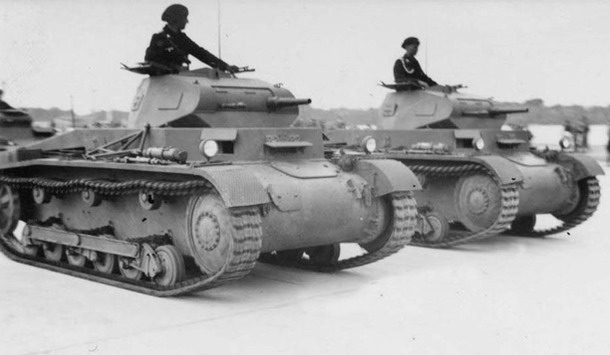
Two PzKpfw II Ausf. b with training ammunition adapters installed. Source: Flickr.com, with permission of the publishing user, edited
The KwK 30 could fire in fully automatic mode at a theoretical rate of 280 rounds per minute. At that rate the gun would empty a full magazine in just over two seconds. In practice, however, the gunner would likely have fired single rounds rather than bursts. Initially only two types of ammunition were available. The anti-armour round was the Panzergranate, with a projectile weighing 148 grams that left the muzzle at 780 m/s. At 100 metres it could penetrate 20 mm of sloped homogeneous armour (some sources give 23 mm), at 500 metres it managed 14 mm, and at one kilometre only 8 mm. The second type was the anti-personnel Sprenggranate fragmentation round. Both used the same 138 mm brass cartridge case with a percussion primer. A third type was later added, designated PzGr 40 — an armour-piercing round with a tungsten core. The projectile weighed only 100 grams and achieved a muzzle velocity of 1,050 m/s. At 100 metres it could penetrate 40 mm of sloped armour, at 500 metres 20 mm.
Both the gun and the machine gun were operated by the tank commander. Horizontal traverse was achieved by rotating the entire turret using a control wheel to the commander's right — one full turn of the wheel traversed the turret 4 degrees. The trigger for the machine gun was mounted on the grip of this wheel. Vertical elevation of the weapons was adjusted using a second control wheel to the commander's left — one turn changed the elevation by 2.8 degrees. The gun trigger was mounted on the grip of this wheel. The commander could fix the turret in a particular position or disengage the traverse mechanism entirely, allowing him to rotate the turret at any speed by hand alone using two handles on the turret ring.
Four vision ports were located on the sides and rear of the turret. On the turret roof were the commander's elevated rotating periscope and a hatch closed by a two-part cover. The right half of the cover had a small opening, apparently intended for firing a signal pistol (and possibly for emergency flag signalling). Rubber pads on both halves of the cover cushioned them when fully opened.
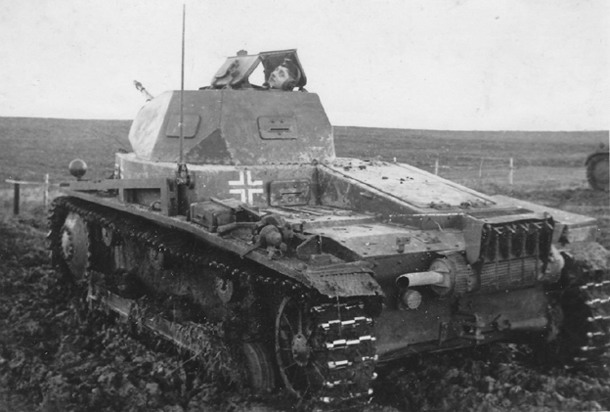
PzKpfw II Ausf. b, with a smoke canister bracket installed above the exhaust. Source: Worldwarphotos.info, with permission of the site operator, edited
The engine compartment occupied the rear of the hull. The engine itself was located on the right side, beneath a raised cover that joined the crew superstructure. On the left side the hull roof was lower, allowing a vision port for the radio operator in the rear wall of the superstructure. The radio operator also had an entry hatch on the left, and behind it the radiator with a large circular cooling fan above it. The fan's housing required a bulge in the rear hull wall to accommodate its tube. Cooling air for the engine was drawn in through an elongated duct on the right side of the engine compartment and expelled through the large circular fan mounted at the left rear. A large exhaust silencer was attached to the rear hull wall.
Versions a/1, a/2, and a/3 were all powered by the already-mentioned Maybach HL 57 TR — a liquid-cooled petrol six-cylinder of just under 5.7 litres displacement, producing a maximum output of 130 horsepower at 2,600 rpm. As noted, the engine was mounted in the hull rear along its right side wall. A driveshaft ran along the right side of the crew superstructure, connecting the engine to the gearbox. The gearbox was located in the front of the hull, also along the right side, beside the driver's seat. From there power was transmitted through steering clutches and brakes to the front drive sprockets. The right side of the crew superstructure was occupied not only by the driveshaft but also by two 12V batteries and — most importantly — two fuel tanks of 102 and 68 litres respectively. Finally, the air filter and intake pipe through which the engine drew air from the fighting compartment for combustion were also located here.
Each of the two fuel tanks had its own filler cap, both emerging side by side on the right wall of the superstructure. With full tanks (170 litres total) the tank could travel 190 to 210 km on roads and between 126 and 160 km cross-country. Maximum road speed was 40 km/h. The engine was started primarily by an electric starter, with a backup flywheel inertia starter cranked by hand, the socket for which was in the rear hull wall below the exhaust silencer. The PzKpfw II version a (i.e. a/1, a/2, and a/3) was 438 cm long, 214 cm wide, and 194.5 cm tall, with a weight of 7,600 kg.
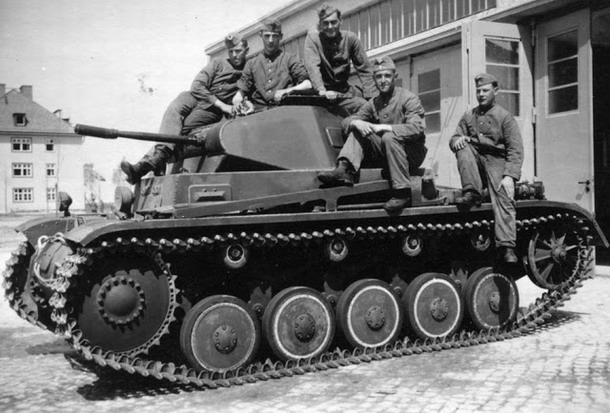
The Panzerkampfwagen II Ausf. c received a new running gear arrangement. Source: Flickr.com, with permission of the publishing user, edited
The light tank's armour was dimensioned to withstand armour-piercing rifle ammunition of 7.92 mm calibre fired from a range of 30 metres or more at all exposed locations. The armour plates were made from high-alloy nickel steel. The most heavily protected component was the gun mantlet at 15 mm. The front, side, and rear walls of both the hull and the turret were 13 mm thick. The hull and turret roofs were both 8 mm, and the hull floor only 5 mm. From the outset, no attempt was made to provide protection against artillery fire — not even of 20 mm calibre.
The crew of the PzKpfw II consisted of three men: driver, radio operator, and commander — who also served as gunner and loader for both weapons. The driver sat in the left forward part of the hull; the radio operator in the left rear of the superstructure, facing rearward as his primary orientation. If needed, the seat backrest could be repositioned so the radio operator faced forward — though he then had no vision port available. When seated in the standard rearward-facing position, the radio operator had the set he operated to his right.
Most sources agree that PzKpfw II tanks were equipped from the first generation with the Fu 5 radio set, a combination of the 10 W.S.c transmitter and the Ukw.E.e receiver, though some sources indicate that standard combat PzKpfw II carried only the Fu 2 receiver. A two-metre rod aerial was fitted to the left side of the superstructure and could be folded forward, lying in a wooden protective channel on the left track mudguard when not in use. An intercom allowed communication between the radio operator and commander only — the driver had neither headphones nor a throat microphone, but had a speaking tube beside his head through which the commander could issue instructions.
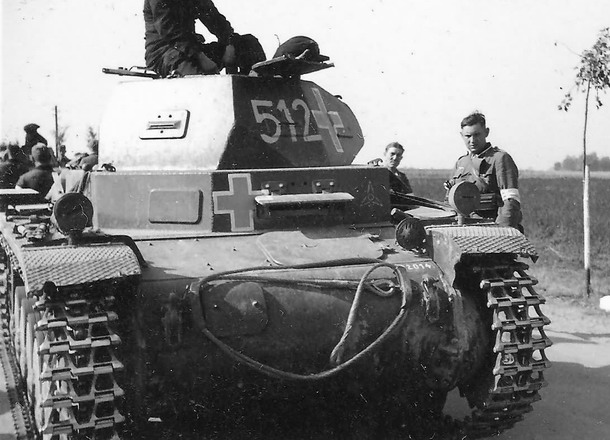
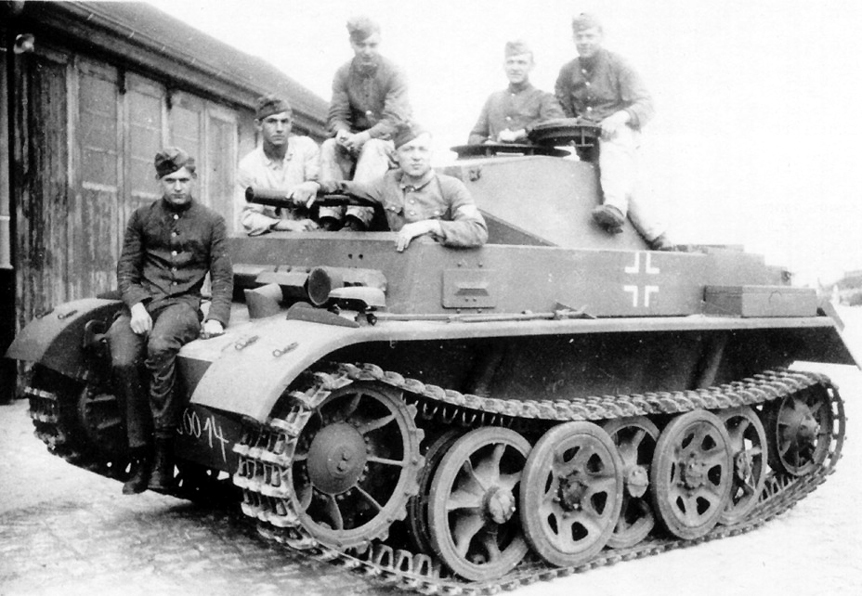
Panzer II Ausf. c of the 4th Panzer Division during the Polish campaign. Part of the hull serial number 22014 is visible on the hull front. Source: Flickr.com, with permission of the publishing user, edited
According to the Weapons Office order, the first series PzKpfw II tanks were to be delivered in April 1936. This deadline was not met, and the first five new tanks were not accepted by the army until 1 October 1936. As already noted, 25 each of the Ausf. a/1, a/2, and a/3 were built. Several mostly minor changes were introduced during production. The change in idler design from the eleventh vehicle has already been mentioned. The Ausf. a/2 received a new service access panel in the hull floor for easier access to the fuel pump and oil filters. The Ausf. a/3 got a larger, more effective radiator and slightly revised leaf spring geometry for the road wheel bogies. At some point during production, towing cable attachment hooks were added to the curved front hull plate. Several further minor internal changes were made that are probably not worth listing individually.
The first 75 series tanks of Ausf. a/1 through a/3 received hull numbers 20001 to 20075. A large number of firms were involved in production. The armoured hulls, superstructures, and turret shells were welded at Deutsche-Edelstahlwerk A.G. in Hanover. Gearboxes were supplied by Zahnradfabrik of Friedrichshafen and engines by Maybach-Motorenbau GmbH. Further subcontractors supplied guns, machine guns, sights, radios, electrical components, and a host of other parts. Assembly of the superstructures and turrets was carried out at the Daimler-Benz works, with final assembly of complete tanks performed at MAN.
Ausführung b
Around the middle of 1936 the Weapons Office placed an order for a second production series of 131 PzKpfw II tanks. Within this order, two sub-series were again ultimately produced: the first 100 vehicles designated PzKpfw II Ausf. b, and the remaining 31 as PzKpfw II Ausf. c. The lower-case letters again indicated that the army still did not consider these vehicles to be a mature, standardised production version.
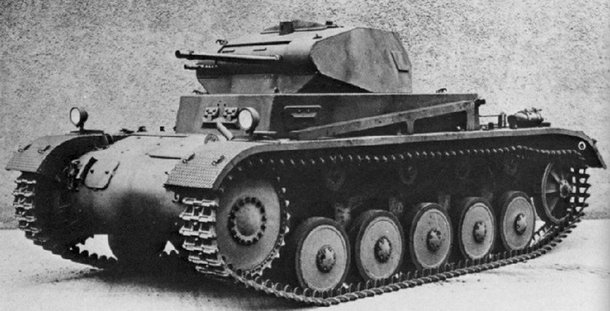
One of the first PzKpfw II Ausf. A vehicles built. Source: Flickr.com, with permission of the publishing user, edited
Compared with the preceding Ausf. a/1 through a/3, the PzKpfw II Ausf. b incorporated several dozen changes ranging from minor to fairly significant. The Ausf. b received new steering brakes and final drives (the assembly transmitting torque from the gearbox to the drive sprockets), along with a new drive sprocket design that necessitated minor modifications to the front hull plate (comparison photo HERE). The rear of the hull was also significantly revised. The large circular exhaust fan visible at the rear on the three previous versions was no longer exposed but housed beneath armour; heated air was now expelled from the engine compartment through a louvred duct newly formed at the end of an extended engine deck. As a result the engine section — and indeed the entire hull — was somewhat longer than on earlier versions. While the Ausf. a/1 through a/3 measured 438 cm in length, the Ausf. b measured 477.5 cm (comparison photo HERE).
The rear ends of the track mudguards and the exhaust silencer were also new. The vision port covers in the hull and turret walls (except the driver's) were revised. For the Ausf. b, the armour plates began to be manufactured from homogeneous steel without a nickel alloy addition, which slightly reduced their resistance. To maintain the army requirement of withstanding 7.92 mm armour-piercing rifle fire from 30 metres or more, the plate thickness had to be increased: where armour had previously been 13 mm, plates were now 14.5 mm. The gun mantlet was increased from 15 to 16 mm and the hull and turret roofs from 8 to 10 mm.
The Ausf. b received wider tracks of 300 mm (285 mm links and 300 mm connecting pins). The wider tracks required wider road wheels and wider return rollers. The longer hull, thicker armour, and wider tracks naturally increased the vehicle's weight from 7.6 to 7.9 tonnes, though without any effect on speed or fuel consumption. The ground pressure remained unchanged at 0.54 kg per cm² thanks to the wider tracks. PzKpfw II Ausf. b vehicles carried hull numbers from 21001 to 21100 and were apparently delivered from spring 1937 onwards.
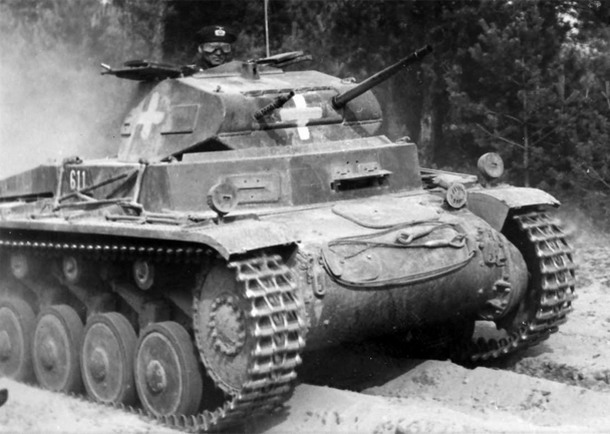
PzKpfw II Ausf. A or B in Poland, this vehicle already has the additional turret ring protection. Source: Waralbum.ru, with permission of the site operator, edited
Ausführung c
As already noted, the last 31 vehicles of the second production series received their own designation, Ausf. c, reflecting a fairly significant modernisation they underwent. The main driver behind this modernisation was poor experience with the original running gear — the small road wheels wore out quickly and required frequent servicing. On the new version the running gear was completely redesigned. Instead of six small road wheels there were now only five, but considerably larger. The new road wheels had a diameter of 550 mm and were solid with a massive rubber tyre around the circumference. Each wheel was mounted on its own individual swinging arm, sprung by its own quarter-elliptic leaf spring. A stop on the hull side limited the maximum upward travel of each arm and thus the maximum compression of each spring. The number of return rollers supporting the upper run of the track increased from three to four.
Another significant change came under the engine cover — a new Maybach HL 62 TR of 6.191 litres displacement, producing a maximum of 140 horsepower at 2,600 rpm. The remaining changes to the Ausf. c were relatively minor: wider track mudguards, relocation of the fuel filler caps from the right side wall of the superstructure to its roof to the right of the turret, a new more comfortable driver's seat, and reinforced armour around the fuel tanks.
The PzKpfw II Ausf. c grew slightly in overall length to 4.81 metres. This, combined with the more robust running gear, also added weight, bringing the vehicle up to 8.9 tonnes. The more powerful engine nevertheless kept the maximum speed at 40 km/h. Ground pressure, however, rose to 0.62 kg per square centimetre. Armament, armour thickness, ammunition load, and fuel capacity remained the same as on the preceding version. The army's representatives were clearly pleased with the Ausf. c, and the Weapons Office promptly placed an order for a further 44 vehicles of this version. These came from the third production series and carried hull numbers 22001 to 22044. A total of 75 Ausf. c vehicles were thus produced (31 from the second plus 44 from the third production series), delivered apparently during autumn 1937.
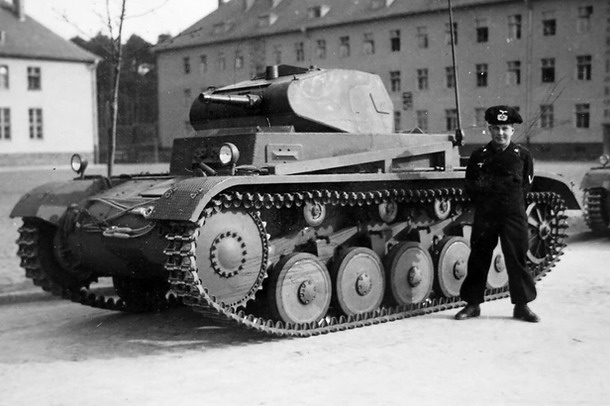
PzKpfw II Ausf. A or B with a training ammunition adapter installed. Source: Worldwarphotos.info, with permission of the site operator, edited
Ausführung A
The new running gear introduced with the Ausf. c had proved itself, and the army concluded that the design of the PzKpfw II had now matured sufficiently to enter standard series production. An order was placed for the fourth production series of 210 vehicles, designated PzKpfw II Ausf. A. The use of a capital letter at last confirmed that the searching phase was over and the series production phase had begun. It was also decided that additional firms should join the assembly process to gain the necessary expertise. Assembly of armoured superstructures and turrets was now shared between Daimler-Benz and Wegmann & Co. of Kassel, while Henschel & Sohn A.G. (also of Kassel) and probably one further unnamed manufacturer joined the final assembly of complete tanks. Of the 210 Ausf. A vehicles, 160 were assembled at MAN, 28 at Henschel, and 22 by the unidentified third firm. Several further firms joined armour plate production, and similarly for other subcontracted components.
The PzKpfw II Ausf. A differed only moderately from the preceding Ausf. c. Among the most visible differences was a new driver's vision port cover — shaped not flat but in a V-profile. Most other changes were internal: a new, more robust Zahnradfabrik SSG 46 gearbox, revised locations of service access panels on the hull floor and in the bulkhead between the fighting compartment and engine bay, a new fuel pump and fuel lines, relocation of the oil cooler, and simplified lubrication of the final drives. The electrical wiring was better shielded to reduce radio interference. A swivel bracket for a machine gun for close-range anti-aircraft defence appeared on the right side of the superstructure (though this was retroactively fitted to many Ausf. c vehicles as well, so it cannot be used as a distinguishing feature). During Ausf. A production, additional protection for the turret ring was introduced: raised steel profiles bolted to the superstructure roof in front of and to the left behind the turret.
Ausführung B
In December 1937 the next version, Ausf. B, entered production. The 5th production series comprised 326 vehicles. In practice, however, this was not a new version at all but simply a continuation of production. The Ausf. B was virtually identical to the Ausf. A. The Alkett works (Altmärkische Kettenwerk) of Berlin joined the assembly alongside MAN, Henschel, and the third unnamed firm, contributing 32 tanks. A further 102 came from Henschel, 169 from MAN, and 23 from the unknown manufacturer. During Ausf. B production several minor changes were introduced, including the addition of protective armour profiles in front of the driver's side vision ports to prevent hits to these ports from frontal fire.
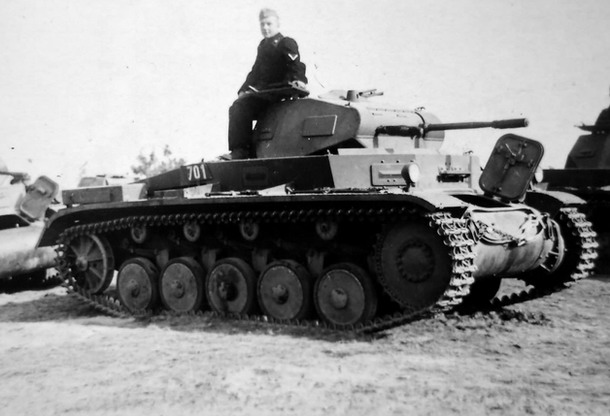
PzKpfw II, probably Ausf. C. Source: Flickr.com, with permission of the publishing user, edited
The next — sixth — production series comprised 58 tanks and continued from the preceding series without any modifications, retaining the PzKpfw II Ausf. B designation. In total, 384 Ausf. B vehicles were built: 326 in the 5th and 58 in the 6th production series.
Ausführung C
1938 arrived. Four years had passed since January 1934, yet neither of the backbone tanks — Panzer III or Panzer IV — was ready for mass production (at the start of 1938 the army had around twenty trial Panzer III tanks and only a handful of the first Panzer IV Ausf. A examples). Under these circumstances, continued production of the light PzKpfw II made sense, and an order was placed for the 7th production series of 364 vehicles, designated PzKpfw II Ausf. C.
MIAG (Mühlenbau und Industrie Aktiengesellschaft) of Braunschweig and FAMO (Fahrzeug- und Motoren-Werke GmbH) of Breslau (now Wrocław, Poland) were earmarked for the future production of the medium PzKpfw III. Since the start of that vehicle's production was being delayed, it was decided that both firms would in the meantime join the production of the light PzKpfw II Ausf. C. Of the total 364 vehicles, MAN delivered 160, Henschel 115, Alkett 15, MIAG 39, and FAMO 35 (these figures should be treated as approximate). The first Ausf. C tanks were completed apparently in June 1938, with production continuing until April 1940.
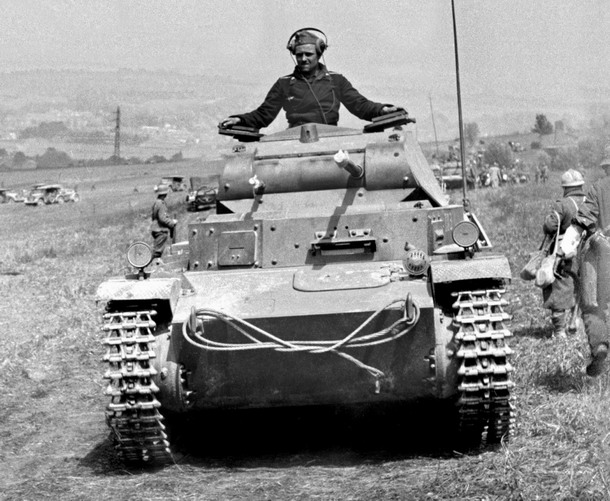
PzKpfw II Ausf. B or C after fitting of additional armour to the hull nose, superstructure front, and turret. Source: Flickr.com, with permission of the publishing user, edited
The Ausf. C differed from the preceding version in just a single detail: newly designed driver's side vision ports in the superstructure side walls. These were now filled with a stronger 50 mm block of bulletproof glass. In photographs they are identifiable by the conically shaped screw heads that appeared in pairs above and below the vision port cover (photo HERE).
Retrospective Modernisation
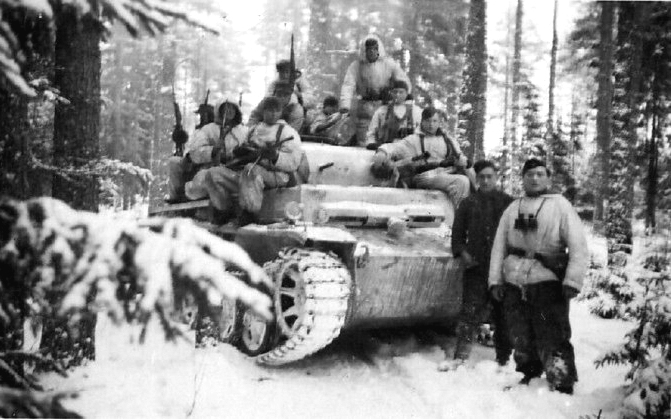
As the above makes clear, the PzKpfw II Ausf. c, A, B, and C were structurally near-identical. It is unsurprising, therefore, that their combat use in Poland in September 1939 revealed the same weaknesses in all of them. Equally logical was that these tanks subsequently underwent the same retrospective modernisation. At the turn of 1939–40, a programme was launched to reinforce the frontal armour of these vehicles. Additional 20 mm armour plates were bolted to the front face of the turret and superstructure. Additional armour of the same thickness was also installed on the hull nose — not curved to follow the original front plate but flat, forming together a new sharply pointed hull nose. Fitting of the additional frontal armour took place in February and March 1940, though photographs from the French campaign of May 1940 show that far from all Panzer II Ausf. c through C tanks received this upgrade.
From October 1940, tanks of these versions were fitted with a new commander's cupola fitted with observation periscopes around its circumference, giving the commander a vastly improved view of the surroundings. Around the same time, convoy lights began to be installed — a shielded Notek headlamp at the front and a rear light indicating distance to the following vehicle. Finally, a modification intended for all previous Panzer II versions (Ausf. a/1 through Ausf. C) changed the machine gun mounting in the fighting turret to accept belt-fed ammunition instead of the previous drum magazines, with the carried machine gun ammunition supply simultaneously increased from 1,425 to 2,100 rounds. From February 1941, selected Panzer II tanks of Ausf. A, B, and C were modified for service in Africa, with enlarged cooling air intakes and more powerful radiator fans.
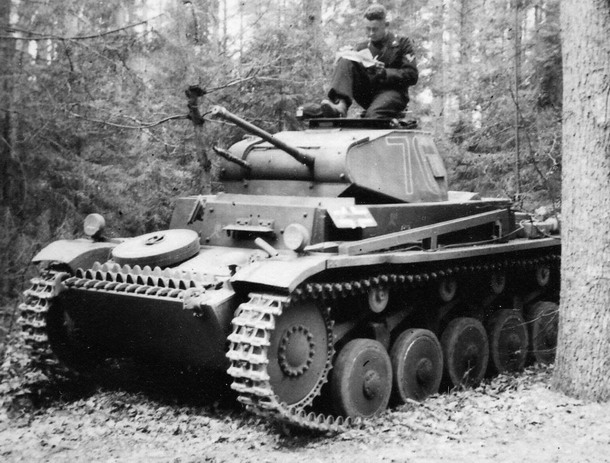
PzKpfw II Ausf. A, B, or C after full modernisation including additional frontal armour and circular commander's cupola. Source: Flickr.com, with permission of the publishing user, edited
Ausführung F
We will now break alphabetical and chronological order and skip the Panzer II Ausf. D and E to look directly at the Ausf. F, since the D and E can be considered a separate developmental branch, while the Ausf. F was the direct continuation of the preceding Ausf. c, A, B, and C. The Ausf. F was the 9th production series of the PzKpfw II, ordered as early as 1939 in an impressive quantity of 404 vehicles. The Ausf. F introduced two main design novelties: a commander's cupola with observation periscopes around its circumference, and — more significantly — a widened superstructure front spanning the full width of the hull. The superstructure front was now formed by a single flat 30 mm plate in which two vision port covers appeared side by side. However, only the left one was a real functioning vision port for the driver; the right one was a false cover for a non-existent port, whose sole reported purpose was to confuse the enemy when aiming — distracting attention from the real vision port. The false cover apparently did not even serve as additional armour, seemingly being made of aluminium.
The hull front on the Ausf. F was thickened to 35 mm, the turret front to 30 mm, and the gun mantlet likewise to 30 mm. The tank received a new exhaust silencer and various other detail changes. Engine, gearbox, armament, and crew composition all remained the same. Weight increased slightly to 9.5 tonnes (up from 8.9 tonnes for the Ausf. C), though maximum speed remained 40 km/h.
Production of the new version was contracted not to MAN but to Alkett (200 tanks) and FAMO (204 tanks). The army order called for delivery of the first Ausf. F tanks in May 1940. One delay followed another and the start of production had to be postponed repeatedly. September 1940 came and not a single new tank had been completed. That month the Weapons Office agreed with Alkett to transfer their portion of the contract to Ursus, based in Warsaw. The first 7 Ausf. F tanks were eventually produced in March 1941 — by Ursus. FAMO joined production in August of the same year.
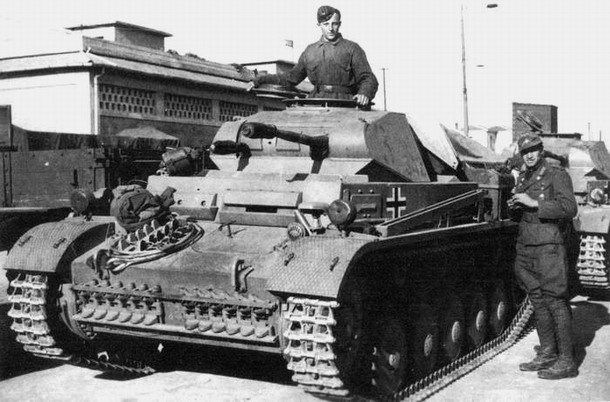
PzKpfw II Ausf. F with the flat superstructure front and its pair of vision port covers — one of which was false. Source: Flickr.com, with permission of the publishing user, edited
The original order for 404 tanks was fulfilled sometime in May 1942. However, a further order had evidently been placed in the meantime, as production did not stop but continued until July. The total number of Ausf. F tanks built was 509. The end of production was preceded by several important decisions at the highest level. At a conference with Adolf Hitler in May 1942, Armaments Minister Albert Speer reported that monthly production of the Panzer II was running at around 50 vehicles. He also informed Hitler that initial studies suggested the tank's chassis might be adapted to carry the powerful 75 mm Pak 40 anti-tank gun, and proposed considering a switch from tank production to production of these gun carriers. Hitler recommended first checking with frontline units whether such a vehicle would be of greater value to them than the standard PzKpfw II.
At a further Führer conference on 4 June 1942 it was decided that tank production would be scaled back, with half of new chassis used for the more heavily armed tank destroyer. Further orders followed in quick succession: on 29 June it was decided that three-quarters of new chassis would go to tank destroyer production, and on 11 July the order came to terminate light Panzer II tank production entirely and dedicate all newly produced chassis to tank destroyers from August 1942 onwards.
During production and retrospectively after its end, the PzKpfw II Ausf. F received several mostly minor modifications. Worth mentioning is the personal equipment stowage box that from May 1941 was hung on the rear wall of the fighting turret.
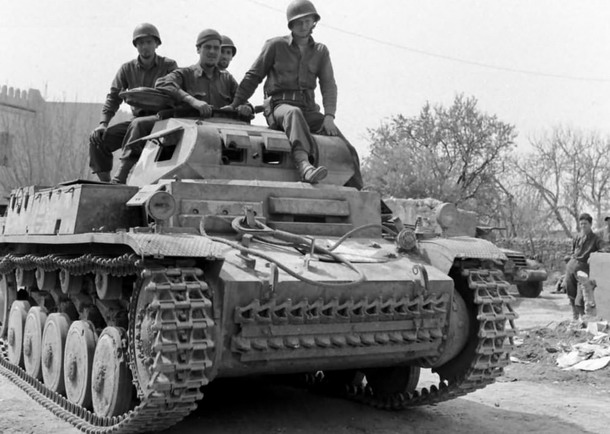
PzKpfw II Ausf. F captured by the Americans. Source: internet, Public domain, edited
Ausführung D
Let us now go back before the Ausf. F and look at the two versions that preceded it: the Ausf. D and Ausf. E. These represented something of a sidestep in the Panzer II's development — an attempt to push the vehicle into a somewhat different role. The impetus was the creation of the so-called leichte Divisionen (light divisions). The concept of light divisions had arisen around mid-1936, championed primarily by the cavalry arm, which was growing anxious about its own future. Cavalry had traditionally been assigned tasks requiring speed — reconnaissance, pursuit, rapid seizure of key sectors of the front. As motorised vehicles and tanks grew in importance in the German army, cavalry commanders feared having their traditional role taken over by others. To survive, they too needed to modernise, to have motor vehicles and ideally their own tanks. This was the thinking behind their proposal for light divisions — a kind of new cavalry for modern warfare. Speed was to be the light divisions' primary characteristic, and that applied to their equipment — including their tanks.
The tank arm's leadership gnashed its teeth at the idea. They neither needed nor wanted light divisions. Their own tank divisions were being built as self-contained combined-arms formations that included all the supporting arms tanks would require — including reconnaissance. Tank commanders were also unhappy at the prospect of sharing their already limited new tank production with the cavalry. The cavalry had its way, however, and asked the Weapons Office to develop a special fast tank for its light divisions.
At the Weapons Office, the project was taken up by engineer Heinrich Ernst Kniepkamp, who had a personal interest in the design of tracked and half-tracked vehicles and was particularly drawn to running gear using large-diameter wheels sprung by torsion bars — a configuration capable of achieving relatively high speeds. Kniepkamp had once worked as a designer at MAN and had long followed the firm's work on the Panzer II. He approved of the running gear modernisation MAN had introduced from the Ausf. c onwards, but was convinced a better solution was possible using large wheels and torsion bars — and he pushed MAN in that direction.
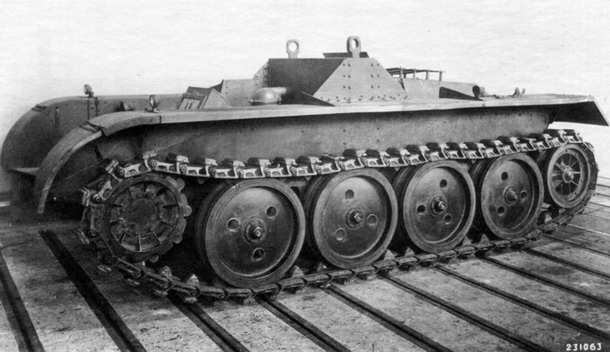
The MAN running gear prototype for the new fast Panzer II version, designated La.S. 138. Source: Flickr.com, with permission of the publishing user, edited
MAN was therefore tasked at the start of 1937 with designing a new version of the La.S. 100 (i.e. PzKpfw II) for the light divisions. The vehicle was to have a more powerful engine, a multi-speed gearbox, and (naturally) large road wheels sprung by torsion bars. The tracks were to have rubber pads to smooth high-speed travel on hard surfaces. There were also further requirements aimed at eliminating the known shortcomings of the standard PzKpfw II: both engine and gearbox were to be located on the vehicle's centreline rather than offset to the side (the right-side positioning of the engine on the standard PzKpfw II greatly complicated maintenance access). The radio operator was to sit beside the driver facing forward (on the standard PzKpfw II, the radio operator sat in the fighting compartment space facing rearward, which proved unfortunate — he had no view ahead and got in the commander's way).
Krupp, which had lost the original La.S. 100 competition, saw in the fast tank project a second chance. Krupp representatives met with Kniepkamp and managed to insert themselves into the project with their own proposal. Both MAN and Krupp delivered running gear prototypes (without superstructures or turrets) for trials at some point during 1938 (some sources say 1937). Given the fairly clear specification both firms had received, their prototypes' running gear was quite similar — both featured four large rubber-tyred road wheels, a front drive sprocket, rear idler, and no need for return rollers. Little information survives about the Krupp prototype, and apparently only a single photograph exists (without any guarantee it is the correct vehicle). What is certain is that the Krupp prototype did not hold up against the MAN one.
In all likelihood, however, even the MAN prototype did not fully meet expectations — as can be inferred from the large number of differences between it and the subsequent production PzKpfw II Ausf. D (tracks, road wheels, drive and idler sprockets all modified in some way). By September 1938 MAN had in hand an order for 85 units of the new fast tank, which had by then acquired its own code designation La.S. 138. The armoured crew superstructure and engine cover for the new tank were apparently designed by Daimler-Benz, seemingly drawing inspiration from those of the medium PzKpfw III Ausf. A. The fighting turret was taken directly from the standard Panzer II.
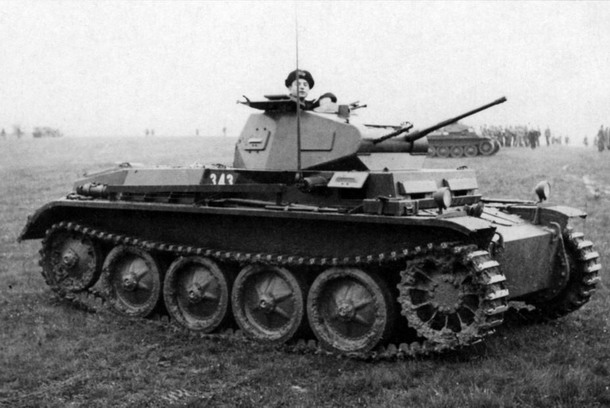
The series production PzKpfw II Ausf. D with torsion bar suspension. Source: Flickr.com, with permission of the publishing user, edited
The first series PzKpfw II Ausf. D vehicles left the production lines probably in October 1938. The tank had four large road wheels with massive rubber tyres. The superstructure front was formed by a single flat plate with the driver's and radio operator's vision ports side by side. The radio aerial moved to the right side and folded rearward. The hull nose was no longer curved but angular. Hull nose and superstructure front armour was 30 mm thick. The vehicle weighed 11 tonnes.
The Panzer II Ausf. D received a new engine and gearbox. The engine was the petrol-fuelled six-cylinder Maybach HL 62 TRM of 6.19 litres and 140 horsepower maximum output — the same nominal power as the Maybach HL 62 TR used on several preceding versions. The gearbox type is disputed in the literature: some sources (Grove, Ledwoch) give the Maybach Variorex VG 102 128 H with seven forward and three reverse speeds, while most sources cite the Maybach SRG 14 479 with seven forward and one reverse. The vehicle's weight had grown relative to earlier versions without a corresponding increase in engine power, yet maximum speed actually rose to 55 km/h — apparently largely due to the new gearbox.
Crew composition remained the same as on predecessors, but the radio operator's station moved forward to the right of the driver. Both driver and radio operator had their own entry hatches in the upper nose plate. The commander remained the sole man in the fighting turret and again served as gunner and loader for both weapons. Armament and radio equipment were unchanged from other Panzer II versions. Fuel capacity increased to 200 litres, giving a slightly improved range of approximately 200 km on roads and 130 km cross-country.
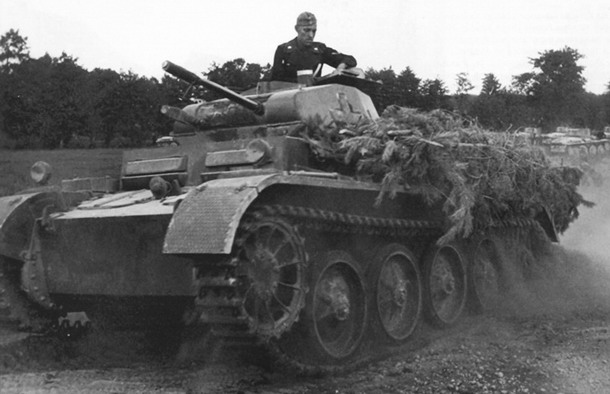
PzKpfw II Ausf. D vehicles served only briefly, in the so-called light divisions. Source: Flickr.com, with permission of the publishing user, edited
Although the army ordered 85 of the new fast tank, only 43 were ultimately completed. In January 1939 the Weapons Office decided to terminate PzKpfw II Ausf. D production early, though production of the Ausf. D chassis itself was to continue for use as the basis of new Flammpanzer II flame-thrower tanks. This decision suggests the PzKpfw II Ausf. D had rather badly disappointed the army's expectations. The last Ausf. D fighting tanks were completed in March or April 1939. The 43 combat vehicles completed by that point were handed over to the army and entered service with the 2nd and 3rd leichte Divisionen. From April 1939 only hulls with superstructures but without fighting turrets left the production line — 39 in total by August 1939, stored as semi-finished components awaiting completion as flame-thrower tanks.
Ausführung E
Parallel with the ongoing series production of the PzKpfw II Ausf. D, MAN's designers experimented with various track types to further improve the ride characteristics of the "fast" tank. They apparently considered their results significant enough to warrant introducing them into production as a new version, designated PzKpfw II Ausf. E. The sole difference from the Ausf. D was the new tracks with lubricated pins and metal cleats — not a return to the rubber-padded tracks of the La.S. 138 prototype. Whether this improvement genuinely justified creating a new version is debatable, but MAN was preparing to introduce the Ausf. E into production even alongside the still-running Ausf. D line. Everything changed with the army's decision to convert the Ausf. D chassis to flame-thrower carriers. The halt to Ausf. D fighting tank production automatically applied to the planned Ausf. E as well. By that point MAN already had seven Ausf. E chassis in an advanced state of completion. These were simply finished without turrets and stored alongside the 39 Ausf. D chassis, awaiting use as the basis for flame-thrower tanks. In total, 46 chassis awaited completion in storage: 39 Ausf. D and 7 Ausf. E. Their conversion into flame-thrower tanks is covered in a separate article in the Flammpanzers section.
Ausführung G (VK 9.01)
In June 1938 the Weapons Office launched an ambitious project designated VK 9.01 (VK = Vollkettenkraftfahrzeug = fully tracked vehicle, 9 = weight class of 9 tonnes, 01 = first development variant). This was not merely another version of the Panzer II but rather an entirely new generation of the type. The VK 9.01 was to become a new standard, produced in very large series, and replace all previous Panzer II versions in service. It therefore also carried the designation PzKpfw II n.A. — "neuer Art" (new type). One of the principal architects of the vehicle was Heinrich Ernst Kniepkamp, the Weapons Office engineer and former MAN employee with extensive experience in the design of half-tracked vehicles.
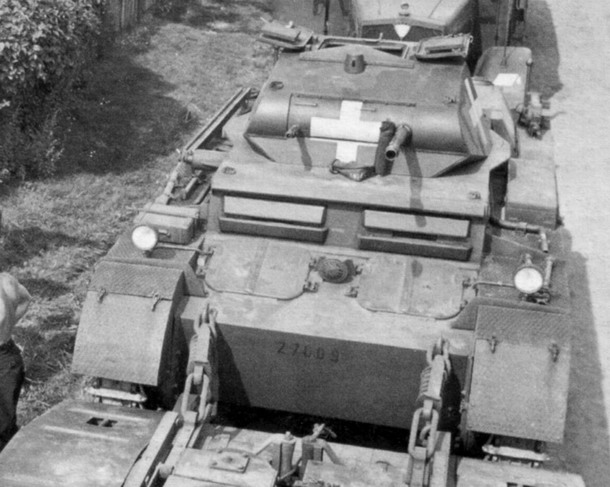
PzKpfw II Ausf. D loaded on a truck. Source: Flickr.com, with permission of the publishing user, edited
Through the VK 9.01, the Weapons Office sought to secure the Panzer II light tank a permanent place in the German armoured forces. By that time, the army was already receiving its first medium Panzer III and Panzer IV tanks, which were to form the backbone of the tank divisions. Deliveries were only just beginning, so the Panzer II need not fear for its existence yet — but for how long? In the longer term, a light Panzer II could justify its place alongside the backbone types only if it offered something they could not. Kniepkamp was clear about what that unique quality would be: speed, making the Panzer II indispensable above all for reconnaissance. Beyond the tank divisions, it was envisioned for service in many other motorised units.
Kniepkamp had already been a central figure in the development of the preceding Ausf. D and E, on which speed was likewise heavily emphasised. The Ausf. D and E, however, were marginal versions — something of a detour from the Panzer II's main development path, designed for the needs of the light divisions. The VK 9.01 was intended to be a far more consequential undertaking. The requirement for high speed and the person of Kniepkamp were nonetheless clear common threads.
In the VK 9.01 project, maximum emphasis was placed on the speed of the resulting vehicle. Immediately after speed came the requirement that the tank be so easy to drive that "anyone" could handle it (similar to half-tracks). These requirements were progressive but demanded the development of numerous entirely new components — particularly the gearbox and steering unit. Regrettably, the Weapons Office consulted the actual users — the tank crews themselves — far too little. They might have learned that all this effort and expense was not really worth it for a new fast tank. The highly ambitious requirements and uncompromising pressure to meet them ultimately had a fatal impact on the project: technical complexity, high costs, numerous complications, and time delays. The VK 9.01 project's rather inglorious end came as no surprise. But we are getting ahead of ourselves.
The VK 9.01 running gear prototype. The outer-row road wheels are solid; they would later be of a different design. Source: Flickr.com, with permission of the publishing user, edited
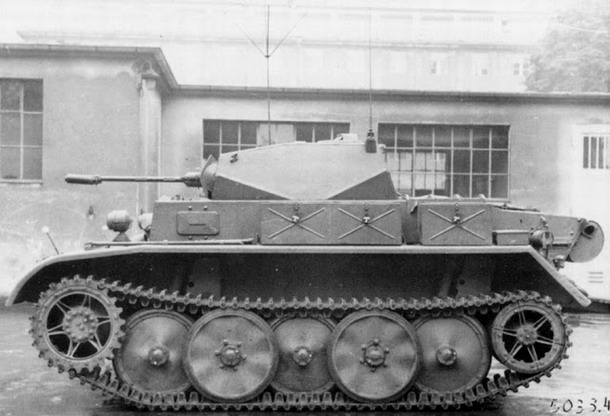
MAN was tasked with developing the running gear and all internal components for the VK 9.01, while Daimler-Benz received responsibility for the armoured hull with fighting superstructure and rotating turret. The tank's armour was to be 30 mm on the frontal areas and 14.5 mm on sides and rear. Total weight was to be approximately 9.2 tonnes. The three-man crew and the armament — a 20 mm gun and machine gun, both in a common mantlet in the rotating turret — remained the same as on earlier Panzer II versions. One novelty was planned, however: weapon stabilisation for the VK 9.01, allowing aimed fire on the move. This fitted perfectly with the overall emphasis on vehicle speed — what use would be a remarkable top speed if the tank had to stop for every shot?
The running gear and drivetrain were of course critical elements for meeting the Weapons Office requirements. Unlike all previous Panzer II versions, the VK 9.01 received an overlapping large-diameter road wheel suspension, intended to allow the smooth high-speed ride so desired. Power was to come from a new Maybach HL 45 engine — a petrol six-cylinder of 4.678 litres producing 150 horsepower at 3,800 rpm.
The engine was to drive an eight-speed semi-automatic Maybach VG 15319 gearbox linked to a newly developed track steering unit, the LGR 15319 (originally designated LG 45 R). In this configuration the tank was projected to reach 67 km/h. Steering used not the usual brake levers but a steering wheel: depending on the angle of steering wheel deflection and the gear engaged, the steering unit varied the braking intensity on the inner track, determining the radius of the turn. Gear selection was also very simple — the driver had the gear selector essentially on the steering wheel itself, moving a small lever up and down with the right hand while the semi-automatic gearbox handled the rest.
VK 9.01 also known as PzKpfw II Ausf. G. Source: Flickr.com, with permission of the publishing user, edited
A wooden model of the new tank was presented to Weapons Office representatives in October 1938. The army first ordered five evaluation running gear prototypes (Versuchs-Fahrgestell) followed by a pre-production series of 30 vehicles — expanded in July 1939 to 75 vehicles. Development of the complex new components proceeded very slowly. For some time it was apparently unclear whether the new LGR 15319 track steering unit would be sufficiently effective, and in August/September 1939 MAN was tasked with preparing an alternative variant with the newer LGL 15319 unit (originally designated LG 45 L). This alternative received the designation VK 9.02, though it need not detain us long as events soon took a completely different turn.
The first running gear prototype for the VK 9.01 — without superstructure or turret — was completed sometime before the end of 1939. The first prototype of a complete tank, however, did not appear until April 1941 — after nearly three years of work. The running gear consisted of five paired road wheels 650 mm in diameter on each side, five axles per side with two wheel discs per axle. The discs on even and odd axles were positioned at different distances from each other, causing the wheels to interleave and overlap. This type of overlapping running gear, called Schachtellaufwerk, was widely used by the Germans on half-tracked vehicles and later on medium and heavy tanks.
In the original VK 9.01 design, the outer-row discs on even axles were solid; later, lightened wheels with cut-outs were used. The inner-row wheels were spoked. All wheels had rubber tyres for smooth running. Torsion bar suspension was used, with the first and last road wheel arms additionally fitted with shock absorbers as these are traditionally the most heavily stressed. A toothed drive sprocket was at the front and an idler at the rear. The tracks were 300 mm wide and each consisted of 77 links joined by "dry" pins. The designers managed to reduce the track contact length with the ground to a remarkably short 1.8 metres (compared to 2.4 metres on the PzKpfw II Ausf. F). This was actually less than the track gauge width, giving a ratio below one — guaranteeing excellent manoeuvrability.
VK 9.01 also known as PzKpfw II Ausf. G. Source: Flickr.com, with permission of the publishing user, edited
Sadly, the results after three years of work and a great deal of expenditure did not live up to expectations. The new VG 15319 gearbox and LGR 15319 steering unit suffered from serious deficiencies, and in April 1941 the decision was taken that further VK 9.01 prototypes would receive different internal components. Specifically, five test running gear prototypes (without superstructure or turret) were ordered with the new Maybach OG 20417 gearbox and LGL 15319 steering unit, and a further five with the new Zahnradfabrik SMG 50 gearbox and LGL 15319 steering unit.
In July 1941, thorough driving trials of the ten delivered test running gear prototypes were conducted. The Zahnradfabrik SMG 50 gearboxes failed in all five vehicles. The Maybach OG 20417 gearboxes fared somewhat better, failing in only two vehicles — though the evaluators had not spared the vehicles, driving some of them more than seven thousand kilometres. After the trials it was clear that the Weapons Office's ambitious requirements had not been met and plans for future mass production were rapidly unravelling.
Beside the very first prototype from April 1941, two further complete VK 9.01 tanks were delivered in August 1941, six in January 1942, and three in February 1942. All had the LGL 15319 steering unit, though the gearbox type fitted is not recorded anywhere. In July 1942 the Weapons Office reduced its pre-production series order from 75 to 55 vehicles, some to have the Maybach OG 20417 gearbox and others the Zahnradfabrik SMG 50. By the end of 1942, MAN had produced 45 running gear prototypes for the VK 9.01 and Daimler-Benz had produced as many as 60 armoured hulls and turrets. How many complete tanks were assembled is unknown. The project was soon quietly terminated so the firms involved could concentrate on other types of fighting vehicle.
VK 9.01 also known as PzKpfw II Ausf. G. Source: Flickr.com, with permission of the publishing user, edited
The army undoubtedly accepted a number of complete tanks and operated them under the designation PzKpfw II Ausf. G. Surviving photographs confirm that vehicles of this type did reach the front. No details of their combat employment are available, however. Two VK 9.01 running gear prototypes also served as the basis for evaluation prototypes of the tank destroyer with the unwieldy designation 5 cm Pak 38 auf PzKpfw II Sonderfahrgestell 901.
Ausführung H (VK 9.03)
In June 1940, with the VK 9.01 project still in development and only a turretless running gear prototype in existence, the Weapons Office already asked MAN's designers to propose a modified version with heavier armour and an even higher speed than the VK 9.01. This derived variant received the designation VK 9.03, and the army assigned it the name PzKpfw II Ausf. H.
One might expect the Weapons Office to have focused primarily on thickening the most exposed frontal armour, but the resulting design surprisingly called for heavier armour only on the hull sides and rear. The front face retained its original 30 mm, while sides and rear were increased from 14.5 mm to 20 mm. The vehicle was to use a new six-cylinder Maybach HL 66 P engine of 6.754 litres and 180 horsepower at 3,200 rpm, paired with a Maybach VG 20417 gearbox and LGL 15319 track steering unit (originally designated LG 45 L).
VK 9.01 also known as PzKpfw II Ausf. G. Source: Flickr.com, with permission of the publishing user, edited
In this configuration MAN's designers calculated the tank would weigh 10.5 tonnes and achieve a maximum speed of 54.5 km/h — meaning the speed requirement was not met, as the original VK 9.01 had a projected top speed of 67 km/h. The Weapons Office nonetheless ordered six test running gear prototypes of the VK 9.03 with the above internal components. Daimler-Benz was tasked with developing the armoured hull and turret. Armament was to remain the same as on the VK 9.01: 20 mm KwK 38 gun and MG 34 machine gun.
According to the original plan, the VK 9.03 was to share the same running gear as the VK 9.01. It was later decided, however, that the vehicle would receive wider tracks of 360 mm (60 mm wider than the VK 9.01), which also increased the track gauge — measured between track centrelines — and the overall vehicle width.
Since the VK 9.03 was derived directly from the VK 9.01, it inherited the same technical complexity and therefore the same propensity for problems and delays. That complexity was strikingly demonstrated by a MAN report from August 1941, which noted that producing the VK 9.03 would require three times as many gears as the PzKpfw III.
VK 9.01 also known as PzKpfw II Ausf. G. Source: Flickr.com, with permission of the publishing user, edited
As if to add still more complexity to an already difficult development, Adolf Hitler himself intervened in September 1941 with the idea of arming the VK 9.03 with the newly developing anti-tank weapon designated Geschütz 8202 — later known as the 2.8 cm schwere Panzerbüchse 41. This was a tapered-bore anti-tank gun with a calibre that changed from 28 mm at the breech to just 20 mm at the muzzle. It fired special ammunition with a hard core and soft driving bands that deformed as the round passed through the bore, accommodating the smaller muzzle diameter. The tapering bore caused extreme projectile acceleration, reaching up to 1,400 m/s. For all its modest size, this weapon could penetrate 52 mm of sloped armour at 500 metres. A version adapted for tank installation was designated 2.8 cm KwK 42. No documents or photographs, however, confirm that this weapon was ever actually installed in a VK 9.03.
Despite its complexity, the Weapons Office had ambitious plans for the new tank — just as it had for the VK 9.01. In January 1941 the Waffenamt signed a preliminary contract with MAN for 500 running gear units. Yet this was nothing compared to what the office was planning for the following four years: a programme document from May 1941 projected delivery of no fewer than 13,980 tanks of this type by 1 April 1945.
VK 9.01 also known as PzKpfw II Ausf. G. Source: Flickr.com, with permission of the publishing user, edited
In practice, however, the VK 9.03's development proceeded in exactly the same way as the VK 9.01 — very slowly and very painfully. The first running gear prototype (without superstructure or turret) was probably completed in December 1941, with two further chassis in an advanced stage. The first complete tank (with superstructure and turret) was promised for May 1942. Trials of the delivered evaluation prototype apparently took place in January 1942 and evidently did not go well. This set off intensive discussions between the Weapons Office and MAN on how to simplify the complex vehicle, with proposals including fitting a standard Zahnradfabrik SSG 48 manual gearbox and a simpler steering unit from BMM (formerly ČKD). All these efforts proved fruitless, and on 27 March 1942 the VK 9.03 project was officially terminated. Priority was given to the far more promising VK 1303.
Finally, it should be noted that plans existed for at least two specialised versions of the VK 9.03: a reconnaissance vehicle designated Panzerspähwagen II Ausf. M (VK 9.03), and an artillery observation vehicle designated Panzerbeobachtungswagen (VK 9.03).
The reconnaissance tank PzKpfw II Ausf. L, also known as the Luchs. Source: Flickr.com, with permission of the publishing user, edited
Ausführung L (Luchs)
Development of a further specialised Panzer II variant under the provisional designation VK 1301 began in mid-September 1939, prompted by fresh experience from the fighting in Poland. Troops had complained that wheeled armoured cars struggled in anything but flat terrain and were essentially confined to roads and tracks. Wheeled vehicles were thus unable to carry out reconnaissance effectively for armoured formations. The Weapons Office therefore tasked MAN and Daimler-Benz with developing a new reconnaissance tank that, thanks to its fully tracked running gear, would have no difficulty crossing broken terrain. The two firms were not to compete against each other with separate designs but were to cooperate on a joint proposal — MAN providing the running gear and hull as usual, and Daimler-Benz the superstructure and turret.
The first prototype, designated VK 1301, was completed in July 1941. Virtually no records of it survive, but there is every reason to believe it disappointed the army's representatives — as evidenced by two facts: MAN immediately began work on a second variant designated VK 1302, and in July 1941 the Weapons Office invited two further firms into the project to provide competition. BMM (the Prague-based ČKD) and Škoda-Werke (Škoda of Plzeň) were both asked to submit proposals for a fast reconnaissance tank.
Almost nothing is known about MAN's second variant, the VK 1302, other than that it was very quickly superseded by a third variant, the VK 1303. In this third and final version, the new tank was to be powered by a Maybach HL 66 P engine producing 200 horsepower at 3,800 rpm, connected to a six-speed Zahnradfabrik SSG 48 gearbox. Steering was provided by a steering gearbox that, depending on the angle of the steering wheel, engaged one of three turning modes for sharp, gentle, or very gradual turns.
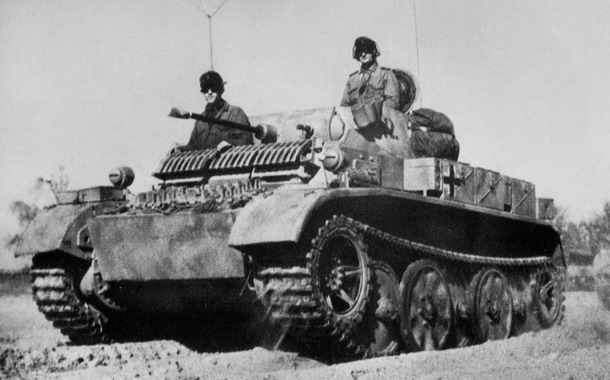
Panzerkampfwagen II Ausf. L, the Luchs. Source: Flickr.com, with permission of the publishing user, edited
Prototypes from all three firms (BMM, Škoda-Werke, and MAN in collaboration with Daimler-Benz) competed in comparative trials at Kummersdorf, apparently running from March to June 1942. The VK 1303 faced the BMM prototype designated Praga TNH n.A. and the Škoda-Werke vehicle simply called the T-15. During the trials the VK 1303 covered 2,484 km without serious problems and was declared the competition winner.
The German Weapons Office and the army itself used several different names for the new MAN tank over time: in 1941 documents referred to it as PzKpfw II n.A. (VK 1301), later as PzKpfw II n.A. (VK 1303), later still as PzKpfw II Ausf. L, and from 1944 as Panzerspähwagen II. The vehicle is best remembered in Second World War history, however, by its simple combat name: Luchs — the lynx. In truth the VK 1301 had little in common with the standard PzKpfw II from the outset; it was probably grouped into the Panzer II family mainly because the same proven partnership of MAN and Daimler-Benz was again involved.
The VK 1303 also stood apart from the Panzer II family in having a four-man crew: driver and radio operator seated side by side in the hull, commander and gunner in the fighting turret. The commander could finally concentrate on observing the battlefield and leave the loading and firing of the weapons to someone else — an enormous advantage for a reconnaissance tank. Armament consisted of an MG 34 machine gun and a 20 mm KwK 38 gun, but unlike the standard PzKpfw II the VK 1303 received a longer-barrelled version. The arrangement of the two weapons also changed — the gun was mounted centrally in the mantlet with the machine gun to its left. Entirely non-standard for German tanks was the gunner's position to the right of the weapons. The gun was again loaded with 10-round magazines; 32 or 33 magazines were carried (320 or 330 rounds). The machine gun was supplied with 2,250 rounds in 15 belts.
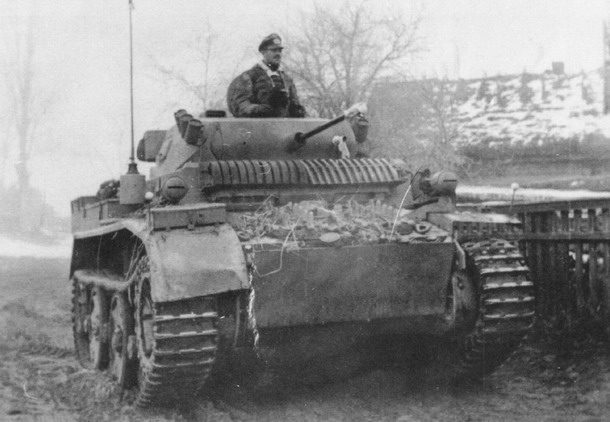
Panzerkampfwagen II Ausf. L, the Luchs. Source: Flickr.com, with permission of the publishing user, edited
The VK 1303 — or PzKpfw II Ausf. L, or Luchs — weighed 11,800 kg and reached a maximum speed of 60 km/h. Its fuel tanks held 235 litres, giving a range of approximately 260 km on roads and 155 km cross-country. Frontal armour was 30 mm; sides and rear 20 mm. The running gear consisted of five axles per side carrying overlapping solid rubber-tyred road wheels 735 mm in diameter for smooth running. Torsion bar suspension was used, with the first and last road wheel arms additionally fitted with shock absorbers. The tracks were 360 mm wide. With a little imagination, the Luchs resembled a scaled-down Tiger. Communications equipment was of great importance on a reconnaissance tank: the Luchs carried a Fu.Spr.Ger. "f" set and the more powerful Fu 12 with a range of up to 25 km. The Fu.Spr.Ger. "f" was housed in the fighting turret connected to a simple rod aerial on the left turret side; the Fu 12 was in the hull with a star-branched rod aerial on the right side of the superstructure.
The army ordered 500 Luchs tanks from MAN, with the first to be delivered as early as August 1942, later expanded by a further 300 vehicles. The army also requested development of a Luchs variant with a 50 mm gun — the first hundred series vehicles were to be delivered with the 20 mm KwK 38, the rest with the 50 mm weapon. This plan was abandoned, and exactly 100 Luchs tanks were built in total, all with the 20 mm gun. The first series tank was completed in September 1942 and production continued at a slow pace until January 1944, when the last seven were delivered. The low production rate was due to MAN having to concentrate with much higher priority on the development and production of the medium Panther tank.
Several modifications were introduced during Luchs production. In December 1942 the fighting turret was revised — the entry hatch in the rear wall was enlarged to span almost the full width of the rear panel, and the commander's cupola was raised to provide better visibility. From February 1943, the driver's auxiliary observation periscope was no longer fitted. From May 1943, three-barrelled smoke discharger sets were no longer mounted on the turret sides. The most significant change came at the turn of June and July 1943, when the complex and troublesome track steering unit was replaced by a conventional steering brake lever system. Approximately 40 vehicles built up to that point were probably also retrospectively converted to this simpler steering system.
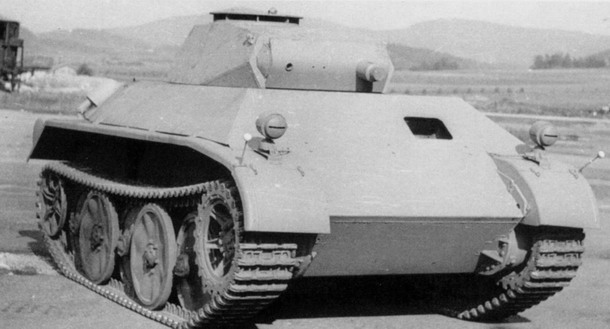
A proposed Luchs modernisation with a Tatra diesel engine. Source: Flickr.com, with permission of the publishing user, edited
Luchs tanks were to be organised into so-called tank reconnaissance companies (Panzerspähkompanie b), each consisting of four platoons of seven tanks plus one tank for the company commander — 29 Luchs in total. Given the limited numbers produced, only two full-strength Panzerspähkompanien b were ultimately formed: one with the 9th Panzer Division and one with the 4th Panzer Division. Luchs vehicles were also distributed in limited numbers to other units. As late as 1 July 1944, the 9th Panzer Division still had 26 Luchs on strength — barely two months later it had none, most having been lost during the encirclement in the Falaise Pocket.
A complete series of photographs documents an evaluation prototype of a modified Luchs that was tested in March 1944. The running gear remained essentially the same, but the hull was substantially redesigned with sloped frontal and side armour. An air-cooled Tatra diesel engine was installed in the redesigned rear. The prototype in the photographs appears to be fitted with a turret taken from the Panzer II Ausf. G (VK 9.01), without armament.
Ausführung J (VK 16.01)
The last member of the Panzer II family to be discussed here was designated PzKpfw II Ausf. J. Its development probably began in autumn 1939 under the designation VK 16.01, with MAN responsible for the running gear and hull and Daimler-Benz for the superstructure and turret. The army specification called for a vehicle for direct support of infantry. Speed was therefore not the priority — since the tank was to accompany infantry on foot — but rather heavy armour. The vehicle was to withstand frontal fire from a 50 mm anti-tank gun. This project was from the outset something of a departure from the entire German concept of armoured warfare, in which tanks were cast as the primary combat arm whose tempo other arms had to match. Having tanks adapt their pace to that of the infantry was, in German doctrine, a complete anachronism. Yet the VK 16.01 project somehow received approval — and not just one such project but two simultaneously.
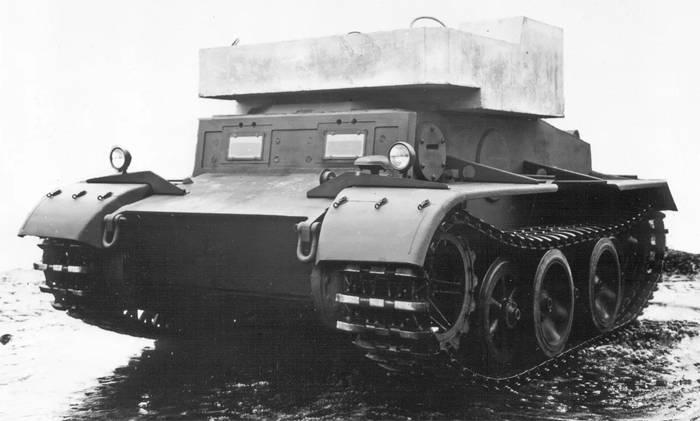
The running gear prototype for the VK 16.01 (PzKpfw II Ausf. J) with a ballast weight in place of the turret. Source: Flickr.com, with permission of the publishing user, edited
Krauss-Maffei was simultaneously developing a tank of identical purpose under the designation VK 18.01 (again in collaboration with Daimler-Benz). This vehicle later entered history, however marginally, as the Panzer I Ausf. F. Why the army needed two such similar tanks is entirely unclear. The Weapons Office representatives at least showed some common sense by urging MAN and Krauss-Maffei to cooperate to reduce development costs, with the VK 16.01 and VK 18.01 sharing the maximum possible number of components. Both vehicles consequently ended up with virtually identical running gear.
According to some sources the first VK 16.01 prototype was completed as early as June 1940, followed by two further prototypes and an order for a pre-production series of 30 tanks. The VK 16.01 weighed 17.4 tonnes. Its running gear used robust overlapping multi-row wheels. For a small and very heavy vehicle this was the ideal solution, ensuring reasonable weight distribution. Each wheel consisted of two separate discs: the discs on even axles were spaced further apart, with the closely spaced discs of the odd axles fitting into the gap between them. Each axle was individually sprung by torsion bars, with the first and last axle arms additionally fitted with shock absorbers as these are traditionally the most heavily loaded. The road wheels were 650 mm in diameter with rubber tyres. Track width was 500 mm.
The front walls of the hull and superstructure were 80 mm thick — a figure unheard of even on much larger medium tanks (the legendary heavy Tiger had 100 mm of frontal armour — only 20 mm more than this "little one"!). Sides and rear were 50 mm. This armour made the VK 16.01 a genuine small fortress on tracks. The little heavyweight was powered by a Maybach HL 45 engine producing 150 horsepower, connected to a six-speed Zahnradfabrik SSG 47 gearbox.
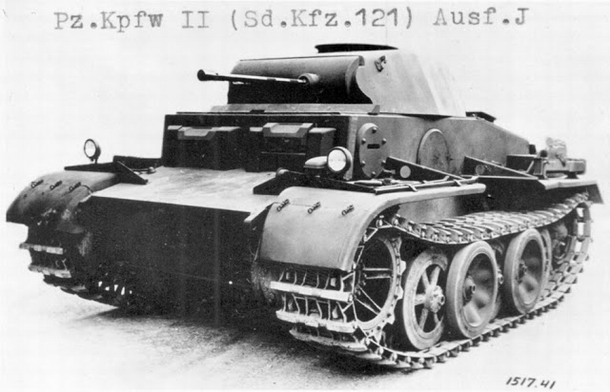
VK 16.01, also known as PzKpfw II Ausf. J. Source: Flickr.com, with permission of the publishing user, edited
Besides VK 16.01, the new tank was known during development as PzKpfw II n.A. verst. (verstärkt = reinforced). It entered service as PzKpfw II Ausf. J. Production of the pre-production series began at some point in 1941, and by year's end only 8 vehicles had been built — the type having been assigned very low production priority, which was a sensible decision. The remaining 22 vehicles of the pre-production series were completed between April and December 1942, at which point production ended — another sensible decision. In total, 30 series vehicles and 3 prototypes were built.
The Panzer II Ausf. J did see combat. In May 1942, five vehicles were assigned to the 1st Company of the special tank battalion Pz.Abt.z.b.V 66 (Panzer Abteilung zur besonderer Verwendung = tank battalion for special purposes). The unit was to be transported to Italy in preparation for Operation Herkules — the planned invasion of British-held Malta. That operation never took place, and the 1st Company of the special battalion was instead assigned to the 12th Panzer Division and sent to northern Russia to participate in attacks on fortifications south of Leningrad. Additional Panzer II Ausf. J vehicles evidently joined the original five, as by 13 August 1942 the unit reported 7 operational vehicles of this type. By year's end, however, all of them had been lost in combat. In January 1943 the unit received 10 new Panzer II Ausf. J. The 12th Panzer Division's reports show various numbers of operational vehicles of this type until July 1943, when the last of them were withdrawn from service and transferred to reserve.
The 12th Panzer Division was the only unit to use these tanks in the front line. All other units operating the Panzer II Ausf. J were assigned to rear security duties. In April 1943 the 13th Reinforced Police Tank Company (verstärkte Polizei Panzer Kompanie) received six of the vehicles, which were deployed in Yugoslavia against partisans from July to November 1943. The independent Panzer Kompanie 221 also used its Panzer II Ausf. J for the same purpose, participating among other things in an anti-partisan operation in Soviet territory in May and June 1943 — carried out under the rather unusual name Zigeunerbaron (Gypsy Baron).
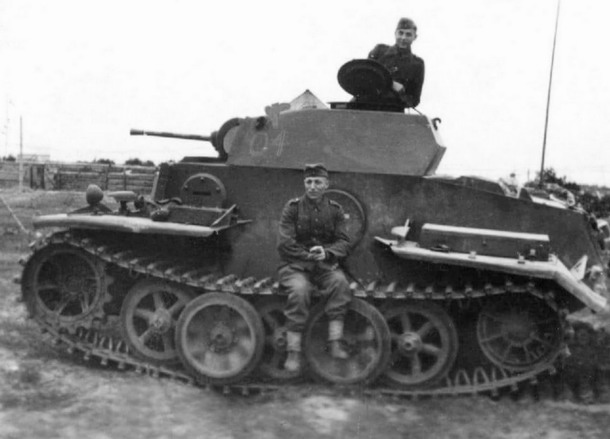
VK 16.01, also known as PzKpfw II Ausf. J. Source: Flickr.com, with permission of the publishing user, edited
Photographs confirm that one PzKpfw II Ausf. J received a very interesting conversion: the turret was removed and a crane arm was installed on the superstructure roof. This was undoubtedly an unofficial field modification about which very few details are known. Given the relatively weak engine, the vehicle was probably not used for recovering other tracked vehicles (perhaps light ones only). It more likely functioned as a mobile crane for field repairs — lifting engines or gearboxes from tanks under maintenance, for which the hull's weight provided a sufficiently stable crane base.
Schwimmpanzer II
When German generals in the second half of the 1930s were considering how best to prepare for the next war — whenever it might begin — they thought among other things about the possibility of attacking Great Britain. They understood that any invasion across the English Channel would require a range of specialised equipment, including tanks capable of crossing at least the final stretch of the Channel under their own power, driving ashore, and ideally engaging immediately in combat. As early as 1938 the Weapons Office therefore tasked Krupp with designing an amphibious variant of the Panzer II. Given the tank's relatively low weight, it was possible to design it not as a submersible but as a floating vehicle — and so was born the interesting vehicle unofficially designated the Schwimmpanzer II.
In 1939 technical drawings were produced for two hollow metal floats and the modifications to the tank itself to allow the floats to be attached. Attachment brackets were placed on the track mudguards and on the hull sides above the road wheels. The drive sprockets, idlers, and return rollers also required modification. Two large floats were attached on either side of the tank. A special metal framework was also fitted over the engine cover to protect the engine compartment from water that might wash over the floats. Before entering the water, the hull vision ports had to be covered with watertight covers. No propellers are visible in the photographs and literature does not mention them, though some form of propulsion was evidently provided. It appears from photographs that the modified drive sprocket's central section engaged an opening in the float, presumably driving some mechanism that transmitted the motion to a form of propulsion (photo HERE).
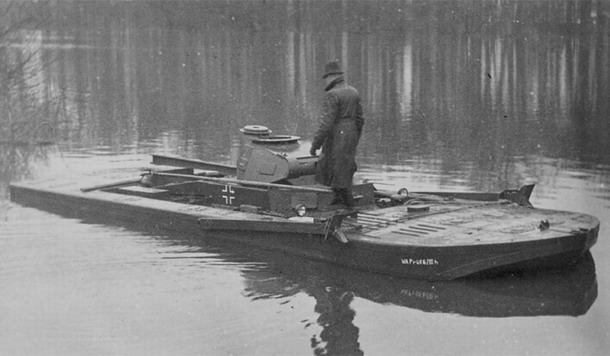
A second-generation Schwimmpanzer II afloat. Source: Worldwarphotos.info, with permission of the site operator, edited
The first evaluation prototype of the floating tank was probably completed in early 1940. By August 1940 the army had 52 of these fighting vehicles, and a further 48 float assemblies were produced by year's end. Sometime around the turn of 1940–41 the army ordered Alkett to develop a new version of the floating Panzer II — one soldiers would find simpler to use, with fewer modifications to the tank itself and a faster, simpler preparation procedure before entering the water. To distinguish it from the new version, the existing one began to be called the "alter Ausführung" (older pattern). A report from July 1941 states that the army had 2 evaluation floats of the new version and a further 52 in production.
The second-generation float was a considerably more modern solution. It was essentially a pontoon with a large opening in the centre. For transport, the pontoon was loaded onto a simple two-wheeled trailer, hitched behind the tank, and towed to the required location. The front of the pontoon was then raised (again using the tank and a steel cable), folding support legs on the pontoon sides were lowered, and the pontoon stood with its bow raised. The tank could then simply reverse under the raised bow into the central opening. The pontoon bow was then lowered again and locked into fittings at the front and rear of the tank; the support legs were raised and secured along the pontoon sides. Detachment worked in reverse. At the rear of the pontoon were toothed wheels that, once the tank was inside, engaged the rear of its tracks. These were connected to propellers at the very stern. Each track drove one propeller. The tank driver with the pontoon attached simply drove into the water and continued using exactly the same steering inputs during water travel as on land. In addition to steering via the propellers, the pontoon apparently also had a rudder operated by the driver via steel cables. The maximum speed of the second-generation Schwimmpanzer was approximately 12 km/h. The pontoon was 9.6 metres long and 3.4 metres wide, weighing 1,300 kg. Modifications to the tank itself were fairly simple: two pontoon attachment points at the hull front and rear, plus relocation of the exhaust silencer to a much higher position than on the standard tank. Operation Sea Lion (the invasion of Britain) never took place, and the floating Panzer IIs were ultimately deployed as standard combat tanks.
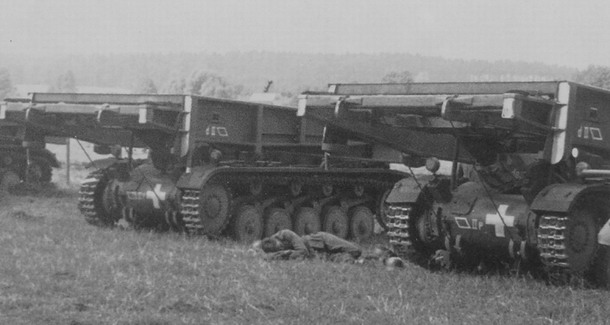
Two Brückenleger II bridge-laying tanks built by Magirus. Source: Worldwarphotos.info, with permission of the site operator, edited
Brückenleger II
As early as 1939 the Weapons Office was exploring the possibility of building specialised bridgelaying tanks — essentially carriers of bridge sections based on modified tank chassis. The Panzer II light tank chassis was selected as suitable for mounting a bridge section with an 8-tonne load capacity, intended for crossing trenches or narrow waterways. The modifications were designed and carried out by Magirus, and the vehicle was named Brückenleger II (literally "bridge-layer"). The first experimental prototype was based on an Ausf. a/3 chassis. A further three vehicles were ordered, based on Ausf. A chassis, all completed in time to participate in the Polish campaign of September 1939. How intensively and how successfully they were employed there is not recorded. Production of this version's bridgelayer did not continue, though other variants were produced based on standard Ausf. C and Ausf. D fighting tanks, retaining their turrets and armament but fitted with a frame — sometimes wooden, sometimes iron — carrying a simple wooden bridge deck.
Pionierpanzer II
Photographs of a Panzer II with its turret and engine cover hidden beneath a large tarpaulin have long been the subject of disagreement among historians. Most authors identify the vehicle in these images as the Pionier-Panzerwagen II — a specialised tank for engineer units — arguing that the tarpaulin covers an open superstructure roof from which the fighting turret has been removed. Thomas L. Jentz, however, in his Panzer Tracts series, maintains this is a deeply entrenched error and that the vehicle in the photograph is simply a standard PzKpfw II Ausf. B being used to test a sun canopy — a so-called Sonnensegel. The tarpaulin-equipped tank was reportedly tested in summer 1941 in Greece and was intended to be used only during movements away from the front and when parking tanks in the sun.
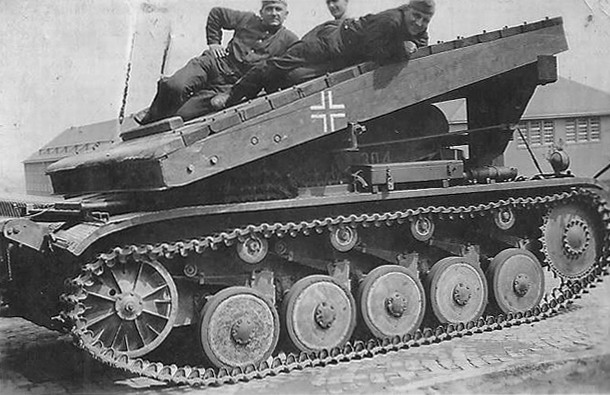
Brückenleger II with a wooden bridge deck based on an Ausf. C fighting tank. Source: Flickr.com, with permission of the publishing user, edited
Jentz makes a persuasive case, yet several details in the photographs in question do not quite support his version. The erected tarpaulin clearly does not follow the shape of a fighting turret — even one rotated 180 degrees to the rear. The frontal view gives the distinct impression that the vehicle has no turret at all. The tarpaulin's profile suggests it is supported by something resembling two struts. A metal frame is visible on the hull nose, with a horizontal wooden board — something that looks at first glance like a step for standing on. No standard fighting Panzer II had any such feature, and no obvious connection between this element and the installation of a sun canopy is apparent; it would seem extremely impractical to require tanks to receive this additional component merely for occasional use of a sun shade. Mildly suspicious, too, is the fact that in both available photographs of the tarpaulin-covered vehicle there is clearly snow on the ground around the tank.
What conclusion to draw? In the author's view, the vehicle under the tarpaulin in these photographs is not a standard tank with a sun canopy, but something specialised — possibly a genuine prototype of an engineer or ammunition carrier tank.
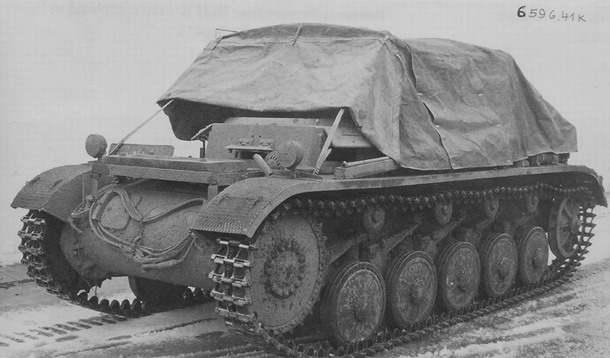
The mysterious tarpaulin-covered vehicle: a Pionier-Panzerwagen II according to some, a standard PzKpfw II with a sun canopy according to others. Source: Flickr.com, with permission of the publishing user, edited
Ladungsleger II
Virtually no information survives about the Panzer II variant semi-officially known as the Ladungsleger II, though its existence is confirmed by numerous photographs. It was a demolition tank for engineer units: its purpose was straightforward — drive an explosive charge close to enemy fortifications, place it, and withdraw before detonation. The tank's armour allowed it to do this more safely than infantry sappers could on foot.
A steel tube arm was mounted over the engine compartment, with a metal container at its end holding a 70 kg explosive charge. In the bottom of the container was a hinged panel secured by a pin. The pin was pulled by a steel cable from inside the crew compartment. Once pulled, the panel opened and the charge simply fell out under its own weight. The arm itself was fixed, so the tank had to reverse up to its target. The charge apparently had a delay fuze activated by the fall from the container. At least three slightly different arm configurations for carrying the charge can be distinguished in available photographs.
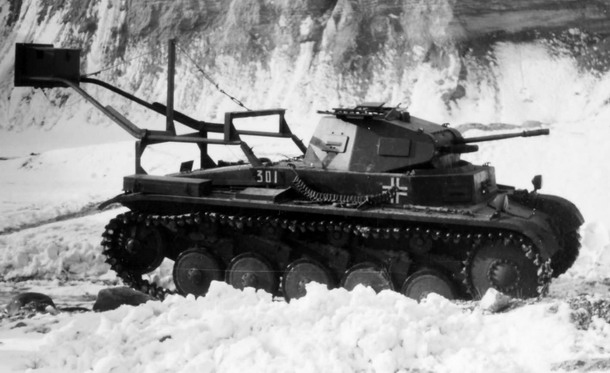
A Panzer II-based demolition charge layer, the Ladungsleger II. Source: Worldwarphotos.info, with permission of the site operator, edited
Beobachtungspanzer II
Unlike most other German tank types, no official command tank was developed on the Panzer II chassis. A specialised artillery observation variant was produced, however — the Panzerbeobachtungswagen II (beobachten = to observe). The vehicle functioned as a mobile forward observation post for directing friendly artillery fire, equipped with enhanced communications: in addition to the standard Fu 5 set, a Fu 8 station capable of voice communication at ranges up to 20 km was installed. The observation tank therefore also had two aerials — the usual rod aerial and a new large frame aerial above the engine compartment. The Panzerbeobachtungswagen II apparently served with units operating the Wespe and Hummel self-propelled howitzers. It is not clear from the literature whether this was an official conversion or a field modification, nor how many such vehicles were produced — though the rarity of their photographs suggests the number was very small.
Mine-Clearing Adaptation
Extensively documented by photographs is a very interesting adaptation of a Panzer II Ausf. A or B from the African theatre. The modification was intended to allow the tank to safely cross minefields. A steel profile framework was attached to the hull nose, with large rollers mounted at its ends approximately 3.5 metres in front of the tank. Above each roller was a concrete pyramidal counterweight to increase downward pressure. These rollers matched the width and gauge of the tracks and were intended to detonate mines ahead of the tank. Travelling in a straight line this apparently worked well, as the tank followed precisely in the safe path created by the rollers — though cornering was more problematic, as the paths of rollers and tracks briefly diverged.
The entire structure was very well-made, suggesting it may have been an official factory product. It is also true that from October 1939 the Wegmann firm of Kassel had been developing mine-clearing devices on a similar principle for the German army, with several variants tested on Panzer II tanks. It is theoretically possible that what was trialled in Africa was a further Wegmann variant. On the other hand, Rommel's Afrika Korps was well known for its creativity and improvisation, so the construction may equally have been the work of skilled mechanics in a field workshop — perhaps using parts from a field crane.
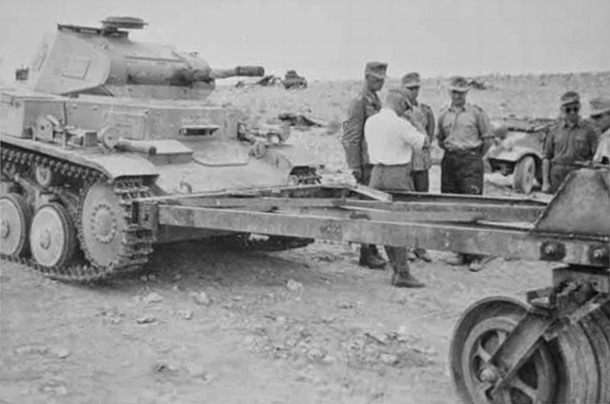
North Africa: a PzKpfw II fitted with a device for clearing lanes through minefields. Source: Worldwarphotos.info, with permission of the site operator, edited
Organisational Structure
PzKpfw II tanks were organised primarily into Panzer Divisionen. The organisational structure of these divisions changed repeatedly both before and during the war, and there is little point in going through every variation in detail. Let us instead look at the organisation of a Panzer Division as it stood on 1 September 1939 — the day the Second World War began. According to the model then in use, the core of a Panzer Division was one Panzer Brigade, consisting of two Panzer Regiments, each comprising two Panzer Abteilungen (tank battalions). Each battalion consisted of three Panzer Kompanien: two designated leichte (light) and one mittlere (medium).
According to the establishment tables, each light company was to have four tank platoons (Panzer Zug) of five tanks each. Not all platoons were alike, however. The first platoon was a leichte (light) Zug of five Panzer II tanks. The remaining three platoons in the light company were armed with Panzer III. The medium company had exactly the same structure as the light company but substituted Panzer IV for the Panzer III. Five PzKpfw II were also in the battalion headquarters and two more in the battalion reserve section. Adding it all up, a full-strength tank battalion contained 22 Panzer II tanks. With two battalions in a regiment, each regiment had 2 × 22 Panzer IIs plus five more in the regimental headquarters. A complete tank division with two regiments was therefore theoretically to have 2 × (44 + 5) = 98 combat Panzer II tanks.
Establishment figures and reality are, however, two very different things. In September 1939 the Wehrmacht did not have nearly as many backbone Panzer III and Panzer IV tanks as it would have wished, and tank divisions had to rely on light tanks far more than the organisation chart envisaged. For example, the 3rd Panzer Division entered the attack on Poland with 176 Panzer II tanks, the 2nd with 155, and the 5th with 144. Overall, somewhere between 1,062 and 1,151 Panzer II tanks were committed to the Polish campaign — more than 40 percent of all German tanks in the operation.
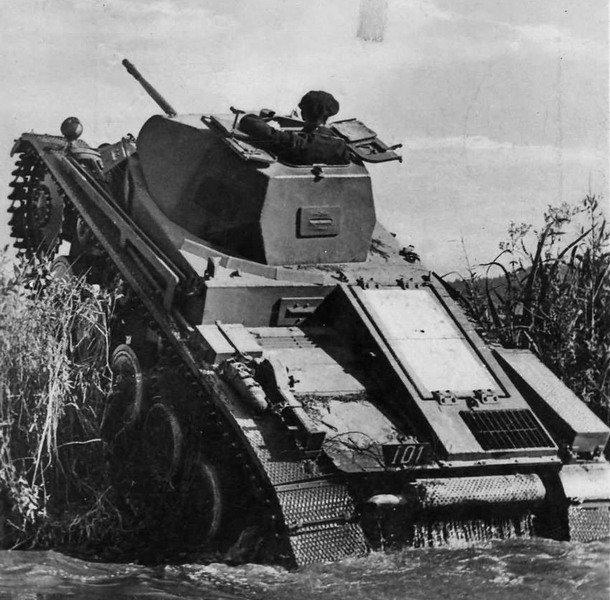
An unusual view of the PzKpfw II, clearly showing the rear turret ring protection and the radio operator's vision port in the superstructure rear wall. Source: Flickr.com, with permission of the publishing user, edited
Over time this situation naturally changed as the light Panzer II was increasingly displaced by medium types both in practice and in the organisational tables. A Panzer Division built to the November 1941 establishment was to have 55 Panzer II tanks: 30 directly in the combat platoons of light and medium companies, 4 in the reserve section, 6 in two engineer platoons, 10 in the two battalion headquarters, and 5 in the regimental headquarters. By the January 1943 organisational scheme, the Panzer II no longer featured at all — not in combat or in support roles.
Combat Deployment
The Panzer II made its combat debut in September 1939 during the attack on Poland (note: this type did not fight in Spain). The Polish army — and certainly its armoured forces — could not match the Wehrmacht, yet the PzKpfw II encountered a more than worthy opponent in the form of the 7TP tank in its 37 mm gun variant, which could theoretically penetrate the Panzer II's frontal armour at ranges up to two kilometres. The Poles had only very limited numbers of these tanks, however — around one hundred. A significant share of German tank losses was also attributable to conventional anti-tank artillery and infantry anti-tank rifles. The total loss count for PzKpfw II by 10 October 1939 stood at 259 vehicles, of which only 83 were written off completely — the rest were repaired. Even at this early stage it was clear that the light tank's armour was too thin, and crews were already calling for reinforcement.
Norway in April 1940 was the next theatre for the Panzer II. A total of 18 vehicles were committed as part of Operation Weserübung, of which 2 were lost. For the attack on France in May 1940, the Germans committed 920 Panzer II tanks — nearly 37 percent of their tank strength in the operation (counting combat tanks only, not command vehicles). The French army possessed not only large numbers of tanks but also heavily armoured types such as the Renault R35, Hotchkiss H35, Somua S35, and Char B1. The frontal armour of these vehicles was impenetrable to the 20 mm German gun at any range. Against such opponents, Panzer II crews could only hope to disable the enemy's tracks, optics, or gun barrel with intensive fire — effectively knocking them out without penetrating the armour. Cases are recorded of French crews abandoning fully operational tanks in panic from the sheer volume of rounds striking their vehicle in rapid succession — even though 20 mm rounds were harmless to the tank itself, sitting inside a shaking tin can listening to one round after another hammer on the armour must have been extremely nerve-racking. Total PzKpfw II losses in the western campaign were 241 vehicles, representing 26 percent losses.
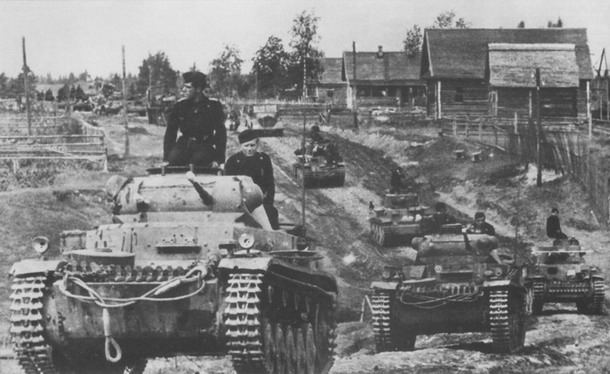
PzKpfw II tanks at the head of an armoured column passing through a Russian village. Source: Worldwarphotos.info, with permission of the site operator, edited
In 1941 the Wehrmacht entered the war in North Africa. During March, April, and May 1941, the Germans sent two divisions: the 15th Panzer Division and the newly formed 5th leichte Division. On arrival, both units together counted 297 combat and 17 command tanks, of which 90 were PzKpfw II. In Africa, German tanks faced primarily British armour — and ubiquitous sand.
Yugoslavia and Greece were the next theatres the Panzer II visited. The attack on both countries was launched simultaneously on 6 April 1941. The conquest of Yugoslavia was assigned to the German 2nd Army, which included among others the 8th and 14th Panzer Divisions, together fielding 94 PzKpfw II tanks. The main force for the attack on Greece was the 12th Army, under which the 2nd, 5th, 9th, and 11th Panzer Divisions operated with a combined total of 166 Panzer IIs. German losses in Yugoslavia and Greece totalled 56 tanks, of which 13 were Panzer II. Despite relatively modest combat losses, the Balkans campaign placed enormous strain on all the equipment involved — movement through difficult mountain terrain left most tanks ready for engine, gearbox, and steering overhauls by the time fighting ended, further delaying preparations for Operation Barbarossa.
The next destination for most German tanks was the Soviet Union, attacked on 22 June 1941. At that time the German army had a total of 1,074 PzKpfw II available. The 17 tank divisions committed to Operation Barbarossa contained 743 PzKpfw II in total (plus dozens more with other units). The Panzer II was no longer the most numerous type — that distinction now belonged to the Panzer III — but it still represented more than twenty percent of committed German tank strength. The Soviet Union at that time had more tanks in service than the rest of the world combined. The vast majority were light and lightly armoured types, primarily the T-26 and BT series. The German PzKpfw II still had a meaningful role to play in destroying these opponents. As the proportion of medium and heavy tanks in Red Army ranks grew, however, this changed, and the light Panzer II began to be withdrawn from front-line units to other duties.
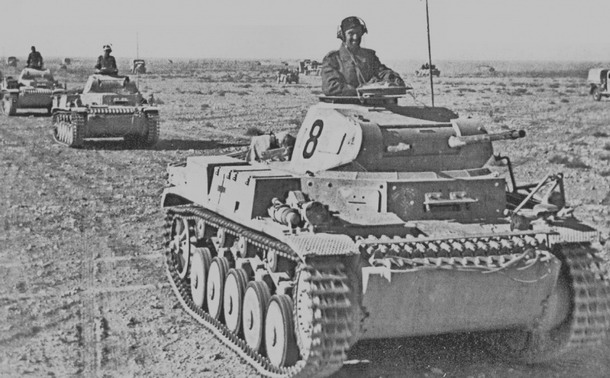
PzKpfw II tanks in Africa. Source: Waralbum.ru, with permission of the site operator, edited
From 22 June to 31 August 1941, an extraordinary 239 Panzer II tanks were lost in fierce fighting, of which only 24 were repaired and returned to service. Over the same period the army received 41 new vehicles, so the total PzKpfw II strength declined by 174 to exactly 900 vehicles. By the end of 1941 this figure had fallen further to 837. Although production ended in July 1942, it had been sufficient to make 1942's net balance positive — production exceeded losses and the total available Panzer II count rose to 997 by year's end. From that point onwards the number could only decline. By the end of 1943 only 399 remained. The last available total figure is from 1 October 1944, when 386 PzKpfw II were still on hand — by which time monthly losses were in single figures, as combat employment of the type had become minimal. In the final months of the war, however, these obsolete light tanks were presumably thrown back into battle in the general shortage of everything, and their losses likely rose again.
As noted at the beginning of this article, the Panzer II came into existence somewhat unplanned — to fill the gap between the evaluation Panzer I and the two full-value backbone tanks, Panzer III and Panzer IV. The German army therefore had no great ambitions for it when it was created. What the army had not counted on was entering another war before the decade was out. Hitler's pressure to start the war placed the armoured arm in the uncomfortable position of having to rely, whether it liked it or not, on the light tanks it had never planned to rely on. Thus it came to pass that the light Panzer II made up approximately 40 percent of all German tank strength committed to the attack on Poland in September 1939.
The PzKpfw II was only a light tank and, in the view of many historians, not a particularly distinguished one — yet it acquitted itself solidly in a role for which it was never designed. It fought with the Wehrmacht and Waffen-SS throughout the first half of the war. It coped with the African heat as well as with Norwegian and Russian snow. It passed through the Ardennes, across the rocky hills of Greece and Yugoslavia, and over the vast Russian plains. When its career as a front-line tank was over, it served as the basis for other fighting vehicles — above all the tank destroyer Marder II.
Technical Data
|
|
Ausf. a/1–a/3 |
Ausf. b |
Ausf. c |
Ausf. A–C |
Ausf. D, E |
Ausf. F |
Ausf. G |
Ausf. J |
Ausf. L |
|
weight: |
7.6 t |
7.9 t |
8.9 t |
8.9 t |
11 t |
9.5 t |
10.5 t |
17.4 t |
11.8 t |
|
length: |
4.38 m |
4.76 m |
4.81 m |
4.81 m |
4.75 m |
4.81 m |
4.24 m |
? |
4.63 m |
|
width: |
2.14 m |
2.14 m |
2.22 m |
2.22 m |
2.14 m |
2.28 m |
2.38 m |
? |
2.48 m |
|
height: |
1.95 m |
1.96 m |
1.99 m |
1.99 m |
2.02 m |
2.15 m |
2.05 m |
? |
2.21 m |
|
engine: |
HL 57 TR |
HL 57 TR |
HL 62 TR |
HL 62 TR |
HL 62 TRM |
HL 62 TR |
HL 45 |
HL 45 |
HL 66 |
|
engine output: |
130 hp |
130 hp |
140 hp |
140 hp |
140 hp |
140 hp |
150 hp |
150 hp |
200 hp |
|
max. speed: |
40 km/h |
40 km/h |
40 km/h |
40 km/h |
55 km/h |
40 km/h |
65 km/h |
31 km/h |
60 km/h |
|
hull armour: |
|||||||||
|
- front: |
13 mm |
14.5 mm |
14.5 mm |
14.5 mm |
30 mm |
35 mm |
30 mm |
80 mm |
30 mm |
|
- sides: |
13 mm |
14.5 mm |
14.5 mm |
14.5 mm |
14.5 mm |
14.5 mm |
14.5 mm |
50 mm |
20 mm |
|
- rear: |
13 mm |
14.5 mm |
14.5 mm |
14.5 mm |
14.5 mm |
14.5 mm |
14.5 mm |
50 mm |
20 mm |
|
turret armour: |
|||||||||
|
- gun mantlet: |
15 mm |
16 mm |
16 mm |
16 mm |
15 mm |
30 mm |
30 mm |
80 mm |
30 mm |
|
- sides: |
13 mm |
14.5 mm |
14.5 mm |
14.5 mm |
14.5 mm |
14.5 mm |
14.5 mm |
50 mm |
20 mm |
|
- rear: |
13 mm |
14.5 mm |
14.5 mm |
14.5 mm |
14.5 mm |
14.5 mm |
14.5 mm |
50 mm |
20 mm |
|
crew: |
3 men |
3 men |
3 men |
3 men |
3 men |
3 men |
3 men |
3 men |
4 men |
|
armament: |
KwK 30 gun, 20 mm MG 34, 7.92 mm |
KwK 30 gun, 20 mm MG 34, 7.92 mm |
KwK 30 gun, 20 mm MG 34, 7.92 mm |
KwK 30 gun, 20 mm MG 34, 7.92 mm |
KwK 30 gun, 20 mm MG 34, 7.92 mm |
KwK 30 gun, 20 mm MG 34, 7.92 mm |
KwK 38 gun, 20 mm MG 34, 7.92 mm |
KwK 38 gun, 20 mm MG 34, 7.92 mm |
KwK 38 gun, 20 mm MG 34, 7.92 mm |
Related Vehicles
|
Tank destroyers: |
Marder II (76.2 mm / 75 mm gun) Pz.Sfl. Ic (50 mm Pak 38 gun) |
|
Self-propelled guns: |
Bison (15 cm sIG 33 infantry gun) Wespe (10.5 cm leFH 18/2 howitzer) |
|
Anti-aircraft tanks: |
leichter Versuchsflakwagen (37 mm gun) |
|
Flame-thrower tanks: |
Flammpanzer II (on Ausf. D and E chassis) |
ARTICLE
CONTENTS:
Reproducing text from the Panzernet website without the written consent of the operator is prohibited.