HUMMEL
a heavily armed bumblebee
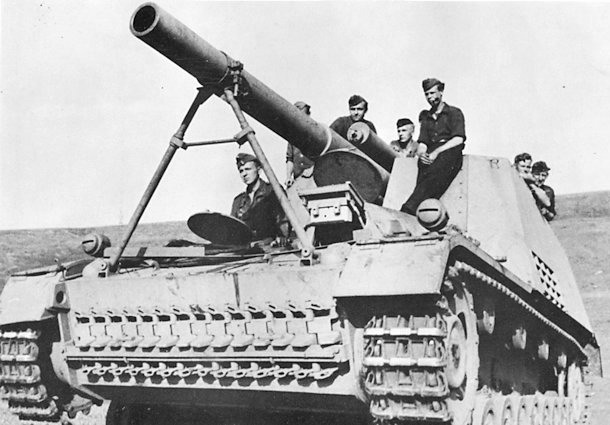
the Hummel self-propelled howitzer — the "bumblebee"; source: Flickr.com, published with the permission of the original contributor, edited
Origins of the vehicle
In early 1942, the German ordnance office (Waffenamt) launched an extensive programme to develop several types of self-propelled guns. The programme was intended to provide the German army with advanced vehicles that would form the backbone of artillery not only in armoured divisions. The self-propelled guns under development were designated Grille (cricket) and Heuschrecke (grasshopper), with several specific types being developed under each designation. Among them were the Grille 15 and Heuschrecke 15, intended to carry a heavy 150 mm howitzer. These vehicles were to use the chassis of the Panther tank, which was itself still in development at the time. Moreover, the requirements set by the ordnance office — specifically its 4th Department (WaPrüf 4) — for the new self-propelled guns were very demanding, making it clear that development would take considerable time. The army could not remain without equipment in the interim, however, and so a decision was made to build a kind of "interim" type: a self-propelled gun with adequate armament that could be made available quickly and meet the army's needs until deliveries of the new Grille 15 and Heuschrecke 15 began.
To speed up and reduce the cost of production, an already-manufactured tank chassis was to serve as the basis for this interim vehicle. The main weapon was to be the heavy sFH 18 howitzer of 150 mm calibre, which ruled out the use of light tank chassis such as those of the Panzer I, Panzer II, or Panzer 38(t). The most suitable option appeared to be the chassis of the medium Panzer IV. Since the weapon itself was to be mounted in the rear of the vehicle, the engine compartment had to be relocated to the centre of the chassis. The Berlin-based firm Alkett (Altmärkische Kettenwerk) was tasked with preparing the suitably modified base for the heavy howitzer, assisted by Rheinmetall-Borsig, which was to make the necessary adaptations to the sFH 18 howitzer (sFH = schwere Feldhaubitze = heavy field howitzer).
The first prototype
The first prototype of the new self-propelled gun was apparently built as early as October 1942, on a modified Panzer IV chassis (at this stage still without components from the Panzer III). The chassis received a new fighting superstructure — fabricated from unarmoured steel on the prototype — housing a modified version of the howitzer designated sFH 18/1. Since there were concerns about how the chassis would handle the enormous stresses generated when firing such a heavy weapon, the howitzer barrel was fitted with a massive muzzle brake to absorb recoil. Firing trials of the prototype showed these concerns to have been unfounded, however, and when it was demonstrated to the Führer in February 1943 it no longer carried a muzzle brake (photo HERE).
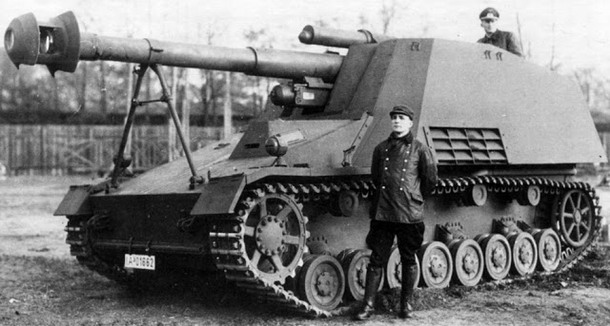
the first Hummel self-propelled howitzer prototype, built on a Panzer IV chassis and still fitted with a muzzle brake on its weapon; source: Worldwarphotos.info, published with the permission of the site operator, edited
Geschützwagen III/IV
Driving trials of the first prototype showed that the base assembled from Panzer IV components alone was not quite the ideal solution. Before the end of 1942 it was therefore decided that production vehicles would use a hybrid base combining the best elements of the Panzer III and Panzer IV tanks. The resulting chassis was designated Geschützwagen III/IV (Geschützwagen = literally "gun carriage"). The gearbox, drive sprockets, final drives, and steering mechanism were taken from the Panzer III, while the engine, cooling system, road wheels, tracks, idler wheels, and return rollers came from the Panzer IV. The Geschützwagen III/IV therefore had eight road wheels of 470 mm diameter on each side, paired and sprung by quarter-elliptic leaf springs. The wheels were of solid construction with a rubber dampening tyre for a smoother ride, and were of double-disc design with a small gap between the two discs through which the track guide tooth ran. The upper run of the track was supported by four return rollers of 250 mm diameter, also fitted with rubber tyres. At the front was the drive sprocket; at the rear the idler. The tracks were 400 mm wide.
Although the hull tub appeared at first glance to have been taken directly from the Panzer IV, it was in fact purpose-built for the new vehicle. It was therefore somewhat longer than on the Panzer IV and also had thinner armour. The lengthening of the hull tub was visible at the front as a larger gap between the drive sprocket and the first road wheel, and at the rear as a larger gap between the last road wheel and the idler (comparative photo HERE). This also naturally required the tracks to be lengthened from the 99 links of each Panzer IV track to 104 links on each Geschützwagen III/IV track. While the front hull armour of the Panzer IV Ausf. F was 50 mm thick, on the new Geschützwagen III/IV it was only 30 mm. The side and rear armour was also thinner — the aim, of course, being to save weight.
From the front wall of the hull tub rose a steeply sloped upper glacis plate. On the left side of this rose a raised compartment for the driver. Its front wall featured the driver's main vision port with an upward-opening cover, in which a vision slit was fitted from the inside with a block of bulletproof glass. Two further vision slits were located on either side of the driver's compartment. Directly above the driver's head was his circular entry hatch with a single-piece cover. To the right of the raised driver's cabin was a further circular hatch serving the radio operator. Between the two men was the Zahnradfabrik SSG 77 gearbox, offering six forward and one reverse ratio.
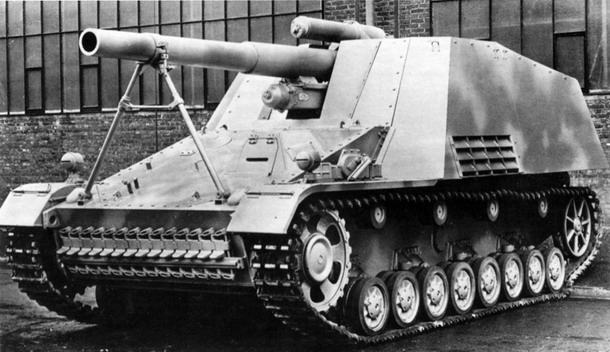
production Hummels were based on the Geschützwagen III/IV chassis, which combined elements of the Panzer III and Panzer IV; source: Flickr.com, published with the permission of the original contributor, edited
In the centre of the hull, immediately behind the driver and radio operator's compartment, sat the engine bay housing a Maybach HL 120 TRM twelve-cylinder petrol engine of 11.867 litres displacement, producing 300 horsepower at 3,000 rpm. In the side walls of the engine section were air intake openings, protected on the outside by steel louvres. To the left of the engine was mounted the large radiator; on the opposite side a pair of fans drew air in through the left side and expelled it out through the right. Behind the engine section came the vehicle's main fighting superstructure. Thanks to the relocation of the powerplant to the centre, the superstructure floor could be positioned very low. Even so, two fuel tanks and one coolant tank still fitted beneath it. The fuel filler necks opened through the floor on the left side of the fighting compartment. Regarding total fuel capacity, the original technical specification sheet for this type states 470 litres — though some otherwise very reliable sources give only 400 litres. Just above the tracks, exhaust pipes exited the engine section side walls and ran along the hull sides to the rear, where the two pipes joined into a single large silencer.
On the upper deck of the engine compartment sat the low mount for the sFH 18/1 howitzer of 150 mm calibre. The mount allowed the weapon to traverse 13 degrees to the left and 15 degrees to the right (15 degrees each side according to some sources). Vertical elevation ranged from -3 to +42 degrees. The weapon was connected to a Rblf 36 periscopic sight. Separate-loading ammunition was used, with individual shell weighing 43.5 kg(!) and a separate propellant cartridge. The strength of the propellant charge could be varied to adjust range. With the maximum charge No. 8, the shell left the barrel at 520 m/s and reached a range of around 12,250 metres. Shells and propellant cartridges were stowed along both side walls and the rear wall of the fighting compartment — only 18 rounds in total. The limiting factor was reportedly not so much the internal space of the superstructure but the load-bearing capacity of the chassis, which was pushed to its limits with each shot.
The fighting superstructure was enclosed by a fixed armoured shield welded from flat steel plates just 10 mm thick — too thin to stop even an armour-piercing infantry rifle bullet. The self-propelled gun was not intended for direct combat, however, but to provide fire support to tanks from a relatively safe distance behind them. The rear wall of the fighting superstructure had large access doors. The roof of the superstructure was left open, which not only saved weight but also improved ventilation and gave the crew better visibility. In bad weather the crew could close the roof using a waterproof tarpaulin — and warm the interior by opening the hot air ducts from the engine.
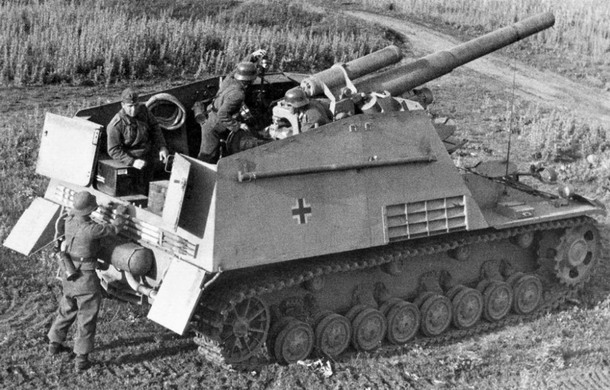
a Hummel in firing position — an early production vehicle, still with the original rear-mounted exhaust silencer and even the mudguard splash guards; source: Flickr.com, published with the permission of the original contributor, edited
The technical specification sheet states the vehicle's total weight as 24 tonnes, though figures of 23.46 tonnes and even "merely" 22 tonnes can be found in the literature. On roads the vehicle could (at least in theory) reach an impressive 42 km/h, and up to 25 km/h cross-country. Range on a full tank was approximately 215 km on roads and 130 km cross-country. The self-propelled howitzer measured 717 cm in length, 297 cm in width, and 281 cm in height. The firing height of the howitzer was 230 cm above the ground. During development and production the new self-propelled gun carried several names — mostly the traditionally cumbersome official designations such as Geschützwagen III/IV für sFH 18/1 (Sf.). The vehicle entered history, however, under the simple combat name Hummel (bumblebee), which first appeared in August 1943. This name never became official — indeed, according to some sources it was formally banned in February 1944.
The vehicle's crew consisted of six men. First was the driver, seated in the already-described compartment at the left front of the hull. The second crew member was the commander, stationed in the right front section of the hull, where he also operated the FuSprG f radio set (Funksprechgerät f), used for communication between the vehicle and the battery commander. An internal intercom, the Bordsprechgerät, with a loudspeaker was fitted for communication within the crew. While the commander rode in his position inside the hull during travel, once the vehicle reached its firing position he moved into the fighting superstructure to direct fire. The remaining four crew members made up the howitzer crew and were therefore also stationed in the fighting superstructure. The gunner sat to the left of the weapon, using the Rblf 36 periscopic sight (Rundblickfernrohr 36) for aiming. The other three men served as loaders — and if you wonder why so many were needed, bear in mind that a single 150 mm shell weighed 43.5 kg. Loading such heavy shells and separate propellant cartridges simply required multiple people working together, just as with a conventional towed howitzer, a wooden ramrod was used (the gun crew in action can be seen in photographs HERE and HERE).
The gunner could select from 8 different propellant charge sizes, giving a range spanning from around 4,000 up to 12,250 metres (13,250 metres according to some authors). Firing with the two heaviest charges, Nos. 7 and 8, placed considerable strain not only on the weapon itself but on the entire vehicle. For this reason, use of these charges reportedly required the unit commander's approval. It was also said to be strictly prohibited to fire more than 10 consecutive rounds with these charges, and every use of the heavy propellant loads was to be recorded in the vehicle's service log without exception — so that repair workshops would be informed of the increased wear on such vehicles. In practice, the ranges offered by the lighter charges were almost certainly more than adequate: charge No. 5 gave a range of 8,200 metres, and charge No. 6 a solid 9,725 metres. The Hummel had no integrated anti-personnel armament. For this purpose, an MG 34 machine gun and two MP 38 submachine guns were carried on board.
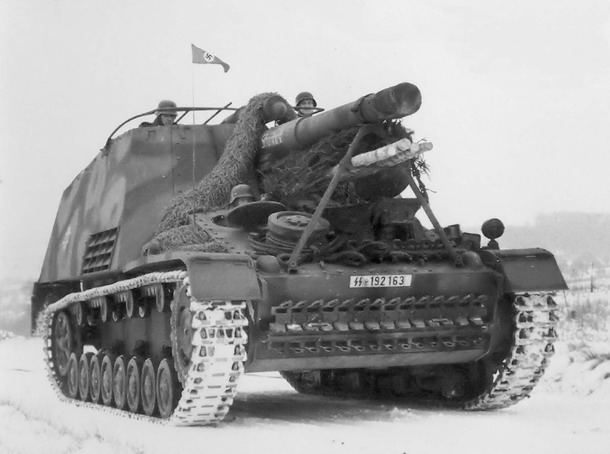
the Hummel self-propelled howitzer — the "bumblebee"; source: Flickr.com, published with the permission of the original contributor, edited
Series production
Following inspection and trials of the prototype, series production was approved. At least 100 vehicles were needed by May 1943, so they could take part in the planned summer offensive on the Eastern Front. Armour plates for the new vehicles were originally to be supplied by Deutsche Edelstahlwerke, but this was soon transferred to Deutsche Röhrenwerke. Final assembly was handled by Deutsche Eisenwerke, specifically its Werk Stahlindustrie plant in Duisburg. The first 5 production vehicles were completed as early as February 1943, followed by 26 in March, 49 in April, and 35 in May. The army's requirement was therefore met: by the end of May 1943 a total of 115 Hummel self-propelled guns were available. By the end of 1943, a total of 368 vehicles had been produced.
Although the Hummel had originally been conceived only as an interim solution until the more advanced Grille 15 or Heuschrecke 15 self-propelled howitzers became available, its production ultimately continued until the end of the war — because the Grille/Heuschrecke programme ended in failure. A further 289 Hummels were thus built in 1944. The last example was assembled in March 1945, closing the total production run at 705 vehicles. All were built at the Werk Stahlindustrie plant in Duisburg, with the exception of twenty vehicles completed before the end of the war at a subsidiary plant of Deutsche Eisenwerke in Teplice (in German: Werk Teplitz-Schönau). The shift of production to Bohemia was a desperate attempt to protect manufacturing from Allied bombing raids on industrial facilities in the Reich.
Ongoing improvements
A number of mostly minor modifications and improvements were introduced during the production run. The first series Hummels still used road wheels from the Panzer IV Ausf. D variant. This version had already been out of production for over two years, so these idler wheels were apparently drawn from older service stocks. The front drive sprockets on early vehicles also came from the long-discontinued Panzer III Ausf. E (easily identifiable in photographs by their circular lightening holes). From May 1943, however, newer idler wheels from the Panzer IV Ausf. F and drive sprockets from the Panzer III Ausf. J began to be used. A comparative photograph can be viewed (photo HERE).
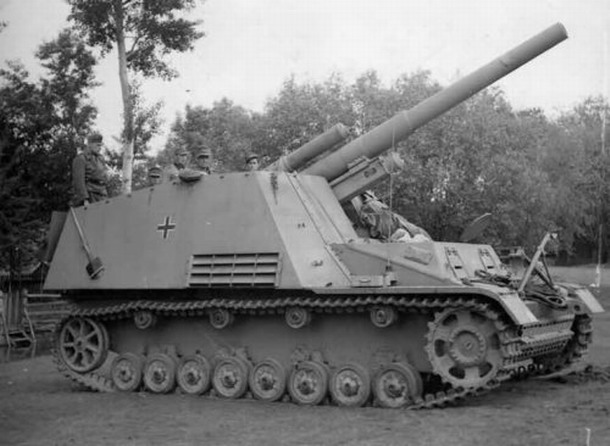
a late-production Hummel self-propelled howitzer with the wider driver and commander's cabin; source: worldwarphotos.info, published with the permission of the site operator, edited
In August 1943 the right-hand headlight was eliminated as a cost-saving measure. From that point on, Hummels carried only a single Bosch blackout headlight, mounted at the front on the left track guard. On early vehicles, the left and right exhaust pipes merged into a shared silencer mounted on the rear wall of the hull. The silencer was positioned directly below the crew's entry doors, however, and the soldiers naturally used it as a step. It was not designed for this purpose, and deformation or other damage was the predictable result. From August 1943 the exhaust silencer was therefore eliminated entirely, replaced by a solid step. The space on either side of this step was used to hang two spare road wheels. Both exhaust pipes now terminated just behind the idler wheels (photo HERE). A welcome side effect was that the flow of exhaust gases blew away the dust thrown up by the tracks during travel, preventing it from entering the fighting superstructure.
In February 1944, from vehicle serial number 320501 onwards, a new wider cab for the driver and commander was introduced. This configuration offered more comfort and better visibility for the vehicle commander, while also providing easier service access to the front steering brakes. When driving on the dusty Russian "roads", Hummels drew in large quantities of dust that clogged the radiators. Photographs show that crews sometimes covered the air intakes with a piece of cloth to combat this (photo HERE). From August 1944 the vehicle therefore received new covers for the side air intakes, open only at the top, which substantially reduced the amount of dust ingested. Other ongoing changes worth noting include the elimination of the splash guards at the rear ends of the track mudguards and the introduction of all-steel return rollers (photo HERE).
Some vehicles also received unofficial field modifications. Worth mentioning is a simple frame on the nose of the hull in front of the driver's vision port, intended to help the driver align the vehicle when traversing for aiming. Another common addition was a wire mesh over the open roof of the fighting superstructure, which prevented grenades from being thrown in and also provided better support for the waterproof tarpaulin.
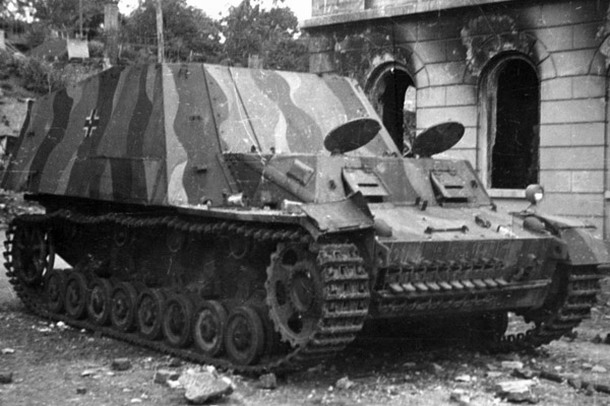
the unarmed ammunition-carrying version of the Hummel; source: Worldwarphotos.info, published with the permission of the site operator, edited
The ammunition carrier version
The eighteen rounds carried aboard the Hummel were not a great many. From the outset, the Germans therefore planned the production of dedicated ammunition carriers (Munitionsfahrzeuge), which would resupply the self-propelled guns with additional ammunition directly on the battlefield. These were essentially standard Hummels but without armament: the howitzer aperture in the front wall of the fighting superstructure was closed with a 10 mm armour plate, and the internal space of the superstructure was used to stow crates and baskets containing shells, propellant cartridges, and powder charges. In an emergency, the ammunition carrier could be fitted with a howitzer and put into action as a fighting vehicle. From May 1943 until the end of the war, a total of 157 Hummel ammunition carriers were built.
Organisation and deployment
Hummel self-propelled howitzers were organised into artillery batteries in accordance with the organisational directive K.St.N. 461b. A battery consisted of six self-propelled howitzers and two ammunition carriers. One Hummel battery together with two further batteries of the lighter self-propelled gun Wespe formed an artillery battalion (Artillerie Abteilung). The artillery regiment (Artillerie Regiment) within an armoured division (Panzer Division) initially had two and later three battalions, but only one of them was self-propelled; the other two were equipped with conventional towed guns with half-tracked prime movers. An entire armoured division therefore had only 6 Hummels (and 12 Wespes). In addition to armoured divisions, Hummels were also assigned to Panzergrenadier divisions and to independent army-level battalions. An independent army artillery battalion was equipped with 14 combat and 9 ammunition-carrier Hummels.
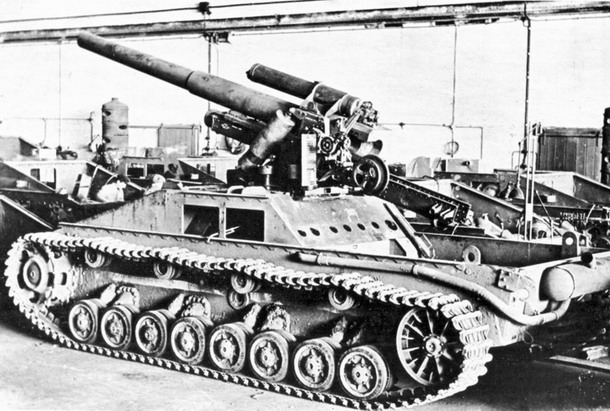
a fine view into the interior of an incomplete Hummel on the assembly floor; source: Flickr.com, published with the permission of the original contributor, edited
The Hummel made its combat debut in the summer of 1943 at the Battle of Kursk, where 60 of them were committed. From that point on they fought until the end of the war on both the Eastern and Western Fronts. Early combat reports mentioned failures of the running gear — tracks, drive sprockets, idler wheels, and final drives — caused by frequent pivot-turning of the vehicles when traversing to aim. While the Hummel proved its worth fully on the Eastern Front, reports from units deployed in Italy were more critical. The narrow, steeply graded, sharp-cornered mountain roads of central Italy were absolute hell for tracked vehicles. Hummels (and others) suffered frequent breakdowns there, and some units reportedly preferred to request their replacement with "ordinary" guns and half-tracked prime movers. As of 31 December 1943, a total of 268 Hummel self-propelled howitzers were with front-line units (out of 368 built by that date).
Technical data
|
weight: |
24 t |
|
length: |
7.17 m |
|
width: |
2.97 m |
|
height: |
2.81 m |
|
engine: |
Maybach HL 120 TRM |
|
engine output: |
300 hp |
|
max. speed - road: |
42 km/h |
|
max. speed - cross-country: |
25 km/h |
|
fuel capacity: |
470 l |
|
range - road: |
215 km |
|
range - cross-country: |
130 km |
|
hull armour: |
20-30 mm |
|
superstructure armour: |
10 mm |
|
crew: |
6 men |
|
armament: |
sFH 18/1 howitzer, 150 mm calibre |
ARTICLE
CONTENTS:
Reproducing text from the Panzernet website without the written consent of the operator is prohibited.