MARDER II
two tank destroyer variants on the Panzer II chassis
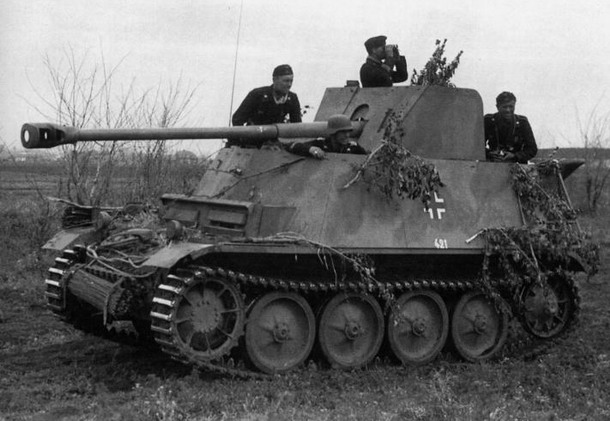
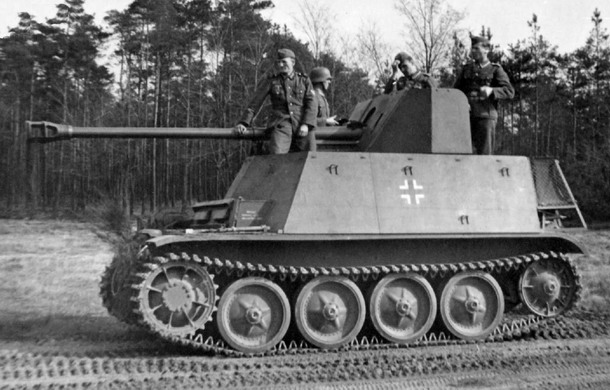
Sd.Kfz. 132, the Marder II on the PzKpfw II Ausf. D chassis armed with the 7.62 cm Pak 36(r) gun. Source: Flickr.com, with the permission of the publishing user, edited.
Two quite different tank destroyers went down in history under the combat name Marder II (Marder = marten). Both used the chassis of the PzKpfw II light tank, but the chassis came from entirely different variants. In practically every other respect the two vehicles differed as well: in running gear, superstructure design, armament, transmission and crew composition. Yet both carried the name Marder II, and in the following article we will describe them both in chronological order of their development.
The 7.62 cm Pak 36(r) Gun
In the years before the Second World War, the anti-tank units of the German Army relied almost exclusively on the light 3.7 cm Pak 36 (Pak = Panzerabwehrkanone = anti-tank gun). It was a light weapon of modest calibre, but in its day it was considered reasonably effective. The Germans had admittedly been working on the development of more powerful anti-tank guns in the 50 mm and 75 mm calibres before the war, but without any great urgency. Both in Poland in 1939 and in France a year later, the Wehrmacht had managed well enough with 37 mm guns (and various captured types). Lulled by its successes, the German high command was not planning any revolution in its anti-tank arsenal. All that was about to change on 22 June 1941.
The Germans were of course well aware that the Russians had very large numbers of tanks, even if precise figures were unknown. They therefore brought approximately 15,000 towed anti-tank guns with them into the Soviet Union. Around 14,000 of these, however, were again the old 37 mm Pak 36, with only roughly a thousand of the newer 50 mm Pak 38. The saving grace for the Germans was that the vast majority of Soviet armour at that time consisted of light tanks, which the older guns could handle. Exact figures are unavailable, but it is generally stated that from 22 June 1941 to the end of that year, the Germans destroyed around twenty thousand Soviet tanks – out of a total of approximately 25,000 that the Soviets possessed. Beyond the shocking quantity of tanks, however, the Wehrmacht encountered something else in Russia: formidable opponents in the form of the capable medium T-34 and the heavy KV-1 and KV-2. Against these vehicles, the German 3.7 cm Pak 36 truly earned its unflattering nickname of "door knocker" – politely rapping on the armour of these machines was about all it could manage.
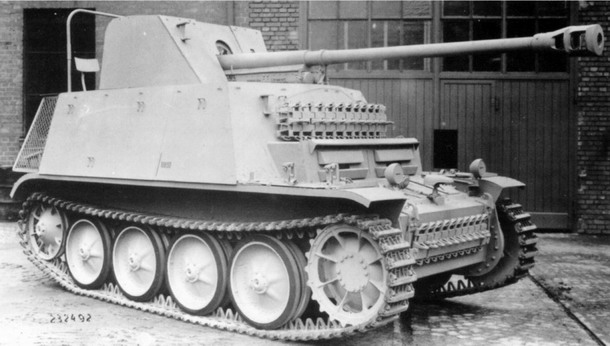
A brand-new Marder II with the 7.62 cm Pak 36(r) gun in the factory yard. Source: Flickr.com, with the permission of the publishing user, edited.
In 1941, the Russians had only limited numbers of T-34s and KVs, but the Germans understood that production would continue at pace. They now simply had to act – and act fast. Completing the development and ramping up mass production of a new 75 mm gun became the highest priority, and almost simultaneously work began on adapting this gun for installation in tanks (PzKpfw IV) and assault guns (StuG III). New and more effective sub-calibre rounds were developed for the existing 3.7 cm Pak 36 and 5 cm Pak 38, and the development of entirely new medium (Panther) and heavy (Tiger) tanks was accelerated. Even this was not enough, and the Germans looked for additional ways to deliver maximum anti-tank firepower to the front in the shortest possible time. Their attention fell on one particular weapon that had the necessary performance and was available immediately and in reasonable quantity: the 76.2 mm F-22 divisional gun, which the Germans had captured from the Soviets themselves.
In the opening months of the Eastern campaign, the Germans seized enormous numbers of these guns – figures of 1,300 to 2,000 are commonly cited – along with full ammunition dumps. The Wehrmacht incorporated the captured weapon into its inventory under the designation FK296(r) (FK = Feld Kanone = field gun, (r) = russisch = Russian). Although this gun had not originally been designed as an anti-tank weapon, the Germans concluded that it could be adapted for that purpose with relatively little effort. Two different types of modification were designed and carried out, each producing a distinct "new" weapon. The first involved replacing the original sight with a new German one, moving the traverse handwheel from the right to the left side of the gun, and modifying the gun shield. This modified weapon received the new designation FK36(r) and continued to use the original Russian ammunition with a case length of 385 mm.
Of far greater interest to us is the second modification, which was designated the 7.62 cm Pak 36(r) (many authors omit the (r) suffix from this weapon's designation; we will retain it here for clarity). The Germans recognised that if they intended to rely on the Russian gun in earnest, they could not depend on limited stocks of captured ammunition – they needed to produce their own. They also discovered that the gun barrel could comfortably handle substantially more powerful ammunition than the original Russian round, which used a 385 mm case with a 90 mm base diameter. This was hardly surprising, as the F-22 had actually been designed from the outset for more powerful ammunition, but the Soviet Army had ultimately decided to adapt it for the older and weaker Model 1900 round that was already in established production in the USSR.
Marder II with the 7.62 cm Pak 36(r) gun on the Eastern Front – camouflage with branches and grass of this kind was very useful for setting up surprise ambushes. Source: Worldwarphotos.info, with the permission of the site operator, edited.
The Germans therefore developed entirely new ammunition for the Russian gun, combining a 76.2 mm projectile with a cartridge case borrowed from the 75 mm Panzergranate 39 round used in the Pak 40 anti-tank gun. This case was 716 mm long with a base diameter of 100 mm – roughly 2.4 times the volume of the original Russian ammunition, and therefore a proportionally larger propellant charge. Introducing the new ammunition naturally required replacing the entire chamber of the gun, as the original had been dimensioned for the short Soviet cartridge. A more powerful recoil mechanism was also fitted to control the movement of the barrel after firing, as was a muzzle brake – a completely new addition.
This modification of the Russian gun killed two birds with one stone: it significantly increased the weapon's performance through the more powerful cartridge, while making use of cartridge cases already in production, which kept manufacturing costs down considerably. The standard anti-tank round for the "new" 7.62 cm Pak 36(r) was designated the 7.62 cm Panzergranate 39 (more precisely 7.62 cm Pzgr. Patr. 39 rot) – an armour-piercing shell, as the name suggests. Two additional new types of ammunition were also developed: the Panzergranate 40 with a tungsten core for use against armour, and the Sprenggranate 39 high-explosive round for use against personnel.
The complete 76.2 mm Panzergranate 39 round weighed 12.7 kg, of which the projectile itself accounted for 7.6 kg. The shell left the muzzle at 740 m/s. At 500 metres it could penetrate 90 mm of homogeneous armour sloped at 60 degrees (some sources give 98 mm). At one kilometre it dealt with 82 mm of sloped armour (other sources quote 88 mm), and at 1,500 metres the projectile could still defeat 73 mm of armour plate.
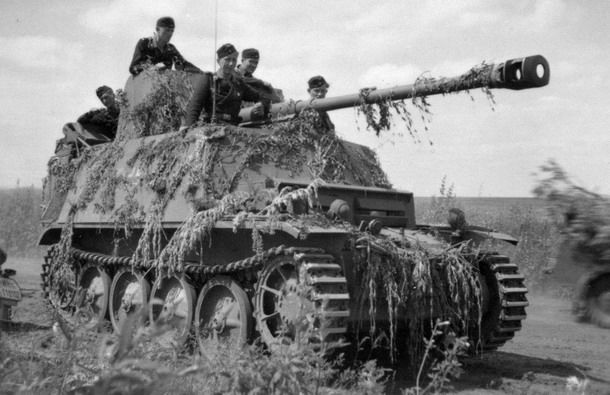
Marder II with the 7.62 cm Pak 36(r) gun on the Eastern Front – camouflage of this kind was very useful for surprise fire ambushes. Source: Worldwarphotos.info, with the permission of the site operator, edited.
The Sd.Kfz. 132 Version
The new gun, together with its ammunition, was now ready and began to be delivered to the troops in its towed form. The Germans, however, were looking for a way to give the gun mobility so that it could keep pace with the rapid advance of their tanks. What was needed was a carrier with a fully tracked chassis and an armoured hull, and it had to be available quickly. In the first two years of the war, the Wehrmacht had been forced to rely heavily on light tanks. By 1941 it was abundantly clear that these vehicles had little left to offer in the front line, yet simply scrapping them would have been a senseless waste. It was entirely logical, therefore, that the Germans began to explore using light tank chassis to carry heavier weapons – such as the aforementioned 7.62 cm Pak 36(r). In pursuit of this idea, German planners settled on the chassis of the Panzer II, specifically the Ausf. D variant (also known by its production designation LaS 138).
The PzKpfw II Ausf. D had originally been developed as a fast tank for the so-called light divisions. Only 43 were built in total, between October 1938 and April 1939, before production was cut short when the vehicles proved not to fully meet the Army's expectations. In 1940 these tanks were converted into the specialised Flammpanzer II flamethrower tanks. At the time the Germans apparently saw a reasonable future for these vehicles, and in March 1941 the Waffenamt ordered MAN to produce a further 150 Ausf. D chassis – designated Ausf. D2, as they differed from the earlier ones in their drive sprocket and idler wheel – for use in building additional flamethrower vehicles. Production began in August 1941.
The war moved on, however, and the German forces were coming to grips with the full difficulty of fighting on the Eastern Front. Priorities shifted; what the Germans needed was not more flamethrower tanks but above all vehicles capable of destroying the heavily armoured Soviet T-34s and KV-1s. In December 1941 the remnants of two flamethrower battalions equipped with Flammpanzer IIs returned from Russia; both were immediately disbanded and their personnel redistributed to regular tank units. Production of the Flammpanzer II was ordered to cease, and in December 1941 the Waffenamt commissioned Alkett to design a conversion of the PzKpfw II Ausf. D2 chassis into a tank destroyer armed with the 7.62 cm Pak 36(r). Of the 150 Flammpanzer IIs on the Ausf. D2 chassis ordered from MAN in March 1941, only 62 had been completed by the time production was halted. These already-finished flamethrower vehicles were apparently recalled urgently from their combat units and sent back to the factory to be converted into tank destroyers as well.
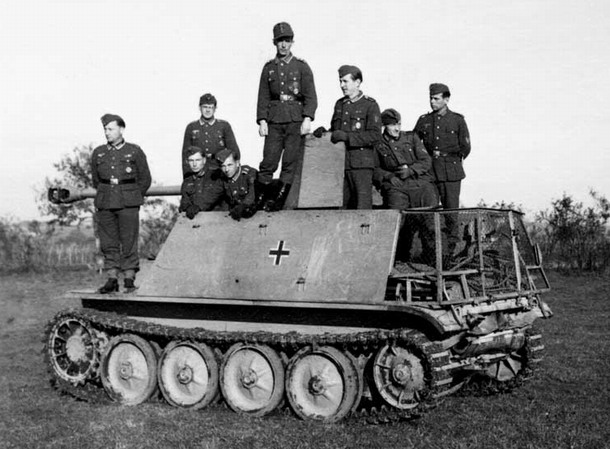
Most Marder IIs with the 7.62 cm Pak 36(r) gun had only a wire mesh rear wall on the fighting compartment. Source: Flickr.com, with the permission of the publishing user, edited.
The tank destroyer that Alkett produced was based on the PzKpfw II Ausf. D2 chassis, with four large road wheels on each side. The wheels were sprung by torsion bars and fitted with solid rubber tyres for a smoother ride. The drive sprocket was at the front and the idler at the rear; no return rollers were needed. In addition to the chassis itself, the tank destroyer retained the original hull and the forward section of the crew compartment, in particular its front wall with the driver's and radio operator's paired observation visors. Both the hull front and the driver/radio operator's compartment front wall were 30 mm thick.
A short distance behind the original compartment's front wall, a tall fixed superstructure rose up, welded from flat armour plate. The front plates of this superstructure were 14.5 mm thick, the sides only 10 mm – sufficient protection against small arms fire and light shell fragments, but not against armour-piercing rifle-calibre bullets. The superstructure was open at the top and rear; the rear wall initially consisted of nothing more than a frame filled with wire mesh. During production this mesh was replaced by steel armour plate, and photographs suggest that on some older vehicles the mesh was also replaced retrospectively in field workshops.
The partly traversable gun shield projected above the open top of the superstructure, with the long barrel of the Pak 36(r) pointing forward from it like an outstretched arm. The gun was mounted on a T-shaped pedestal that allowed horizontal traverse of 25 degrees either side of centre and vertical elevation from -5 to +16 degrees. The shield, which moved with the gun as it was aimed, was 14.5 mm thick at the front and 10 mm on the sides – exactly the same as the superstructure beneath it. The gun used a Z.F. 3x8 sight (Z.F. = Ziel Fernrohr, telescopic sight) with 3× magnification and an 8-degree field of view. The sight was mounted on the left side of the gun, and a small cutout in the gun shield accommodated it, closed by a sliding cover.
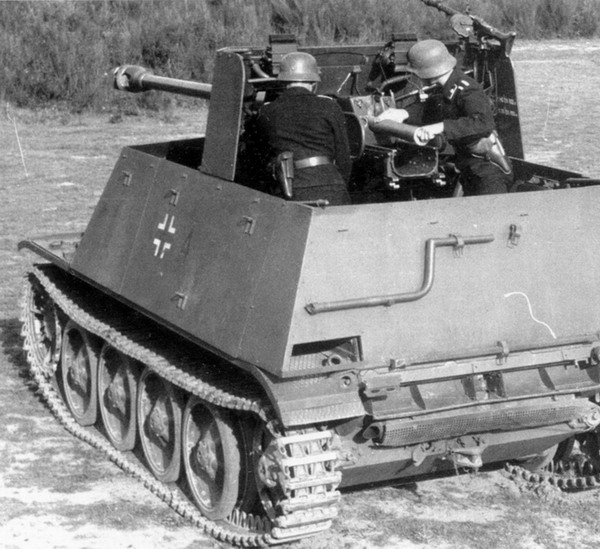
On later vehicles the wire mesh rear wall was replaced by an armour plate. Source: Flickr.com, with the permission of the publishing user, edited.
The floor of the fighting compartment around the gun was lowered, allowing the crew to stand while operating the weapon without their heads projecting above the armour shield. For safe observation of the battlefield, two retractable periscopes were mounted on the gun shield (photo HERE). The four-man crew consisted of the driver and radio operator, seated side by side in the hull, and the loader and gunner in the upper fighting compartment. The gunner, who also served as vehicle commander, stood to the left of the gun, with the loader to the right. As already noted, both men stood while operating the gun; for road marches and rest periods, each had a small folding seat. The fighting compartment, like the superstructure above the driver and radio operator's positions, had an open roof. A waterproof tarpaulin was therefore provided, which could be stretched over the entire space and secured to the sides of the superstructure. At the rear of the fighting compartment, a tubular frame first had to be erected to support the tarpaulin (photo HERE). The vehicle's communications equipment consisted of a FuSprGer "d" radio set and an intercom.
The new tank destroyer appeared under a variety of very long and cumbersome designations in various documents and records. The combat name Marder II was apparently not assigned until November 1943, at Hitler's own suggestion. Its ordnance code was Sd.Kfz. 132. The Marder II with the ex-Soviet Pak 36(r) gun weighed 11.5 tonnes, measured 5.65 metres in length, 2.3 metres in width and 2.6 metres in height. The Maybach HL 62 TR engine producing 140 horsepower was inherited from the tank chassis, as was the seven-speed Maybach SRG 14 479 gearbox. The tank destroyer could reach a top speed of around 55 km/h. On a full tank of fuel it had a road range of approximately 200 km and a cross-country range of around 130 km. Apart from the gun, the Marder II had no built-in secondary armament. For defence against infantry, however, the crew carried an MG 34 machine gun and an MP 40 submachine gun. The machine gun was hung from a mount on the right side wall of the gun shield and operated by the loader. The submachine gun was fired simply over the top of the fighting compartment walls. The ammunition supply consisted of 30 rounds for the gun, 900 rounds for the machine gun and 192 rounds for the submachine gun.
The prototype of the new tank destroyer apparently passed its approval trials without difficulty and series production was launched. The first 60 vehicles were delivered by Alkett in April 1942 and a further 90 in May, consuming all 150 available chassis – confirming that the already-completed flamethrower tanks had indeed been converted as well. The Waffenamt subsequently ordered a further batch of 60 tank destroyers, to be converted from surviving older flamethrower tanks. This work was entrusted to Wegmann & Co of Kassel. Conversions proceeded slowly as older flamethrower tanks trickled into the factory: 13 were completed in June 1942, 9 in July, 15 in September and 7 in October. A further 8 were built in May and June 1943. What caused the gap of more than half a year is not clear from the available literature. In total, 52 tank destroyers were converted from older Flammpanzers.
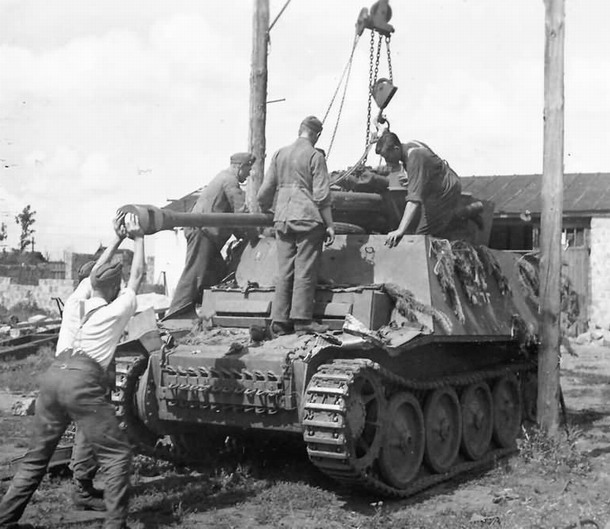
Marder II during a gun change in a field workshop. Source: Worldwarphotos.info, with the permission of the site operator, edited.
Virtually all sources agree on the conversion of older Flammpanzers into tank destroyers. This fact, however, raises a question. The older Flammpanzer II vehicles were built on the PzKpfw II Ausf. D1 chassis, manufactured in 1938 and 1939, and these original chassis had eleven-spoke drive sprockets. Yet I have not seen a single photograph of a Marder II with this type of sprocket. Every vehicle without exception has eight-spoke sprockets, characteristic of the Ausf. D2 chassis produced in 1941 and 1942. One possible explanation is that during the conversion of the older chassis, Wegmann also replaced other worn components including the drive sprockets, fitting the old chassis with new unworn wheels. The literature, however, passes over this detail in silence.
The first Marder IIs with the Pak 36(r) gun began to reach combat units at the end of May 1942, and before long the first reports of practical combat experience were coming back. The new tank destroyer's principal asset was undoubtedly its gun, which could destroy Soviet T-34s and KV-1s at ranges of over one kilometre without difficulty. At the same time, the front-line reports listed far more negatives. The vehicle was too tall, making it easy for the enemy to spot in a firing position. After each shot, the vehicle rocked so violently that the gunner was often unable to observe the trajectory of the round just fired. The forward barrel support was too weak and frequently bent or broke. Coolant leaks were also reported as a recurring problem. The maximum gun depression of -5 degrees was insufficient for firing from a hull-down position behind the crest of a rise. The onboard ammunition supply was very low and there was not enough space for the crew's personal belongings – the latter problem the crews often solved themselves by bolting on various boxes and crates, as can be seen in photographs HERE and HERE.
Overall statistics are not available, but partial reports show that when deployed correctly the Marder IIs were, for all their shortcomings, a lethal weapon. A report from the 559th Anti-Tank Battalion (Panzerjäger Abteilung 559), for example, records that between 5 and 18 July 1942 the unit destroyed 22 Soviet tanks for the loss of just one Marder II. The majority of this type, however, were lost before the end of 1942. The order of battle compiled ahead of the Kursk offensive showed that by 30 June 1943 only 28 serviceable tank destroyers of this type remained in the entire German Army, with a further 3 in repair workshops.
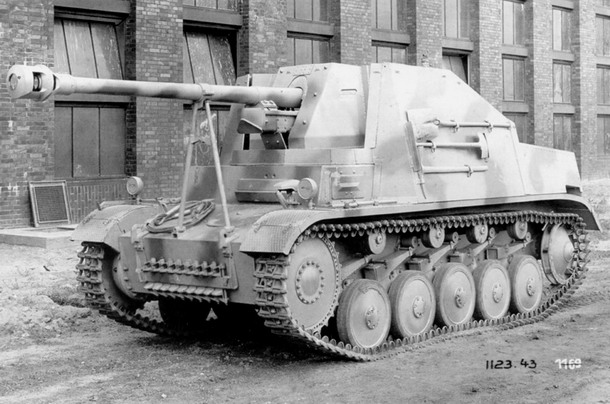
The verification prototype of the Marder II with the 7.5 cm Pak 40 gun, the Sd.Kfz. 131. Source: Flickr.com, with the permission of the publishing user, edited.
The Sd.Kfz. 131 Version
The modified captured 7.62 cm Pak 36(r) was undoubtedly an excellent weapon and helped the Germans through the worst of their difficulties at the turn of 1941–42. At the same time it was perfectly clear that it could only ever be a stopgap solution. The Wehrmacht could not rely long-term on an adapted captured weapon, because the availability of further examples of the original Soviet F-22 gun could neither be meaningfully influenced nor reliably predicted. When planning the next generation of the Marder II tank destroyer, designers therefore focused entirely on the domestically produced 7.5 cm Pak 40. The first design studies appeared as early as April and May 1942, essentially simultaneous with the start of production of the first Marder II version. On 13 May of that year, Armaments Minister Albert Speer announced at a conference with Hitler that a tank destroyer combining the Panzer II chassis and the Pak 40 appeared to be feasible. Speer proposed considering a switch from light tank production to this type of tank destroyer. Hitler ordered that combat units first be consulted on whether such a vehicle would be more valuable to them than the standard PzKpfw II, but simultaneously approved development of the new tank destroyer.
Apparently before the end of May 1942, the Waffenamt entered into discussions with three firms to share the development work. Rheinmetall-Borsig was to adapt the Pak 40 gun for installation on a tank chassis, Alkett was tasked with designing the superstructure, and MAN was to carry out the necessary modifications to the Panzer II Ausf. F chassis. The first prototype was expected by 15 June 1942 – a deadline that was apparently more or less met, since a report dated 20 June from Alkett states that driving trials of the prototype were already under way on their premises.
In the meantime, a series of key decisions was made that definitively settled the fate of both the Panzer II tank and the Marder II tank destroyer. First, at a Führer conference on 4 June 1942, it was decided that light tank production would be wound down and half of all new chassis would be used to build the new tank destroyer. On 29 June came an order to allocate three-quarters of new chassis to the tank destroyer, and finally on 11 July the order came to terminate production of standard Panzer II tanks altogether and to use all newly produced chassis exclusively for the construction of Marder IIs from August 1942 onwards.
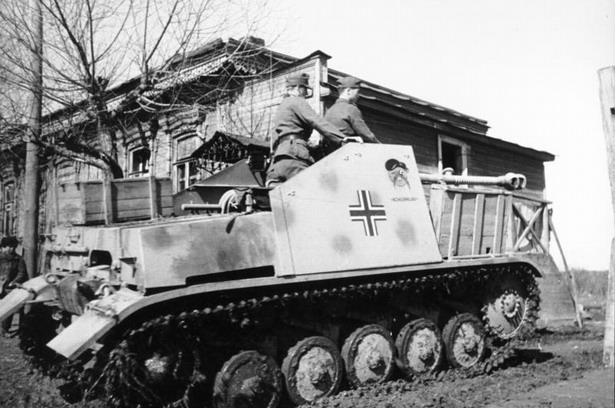
Marder II with the Pak 40 gun, nicknamed Kohlenklau (coal thief). The crew of this vehicle from the 561st Tank Destroyer Battalion had 19 destroyed Russian tanks to their credit by spring 1943 and became the subject of German propaganda interest. Source: Bundesarchiv_Bild_101I-197-1235-04, Wikimedia, Creative Commons, edited.
As usual, the new vehicle accumulated a bewildering array of official designations before finally receiving the simple combat name Marder II in November 1943. Its ordnance code was Sd.Kfz. 131. From the original tank the tank destroyer retained the complete chassis and the forward section of the original crew compartment. The false visor cover was removed from the front wall of the compartment, leaving only the driver's actual visor. The walls of the new superstructure rose high above the front wall of the original compartment, and its base occupied the full width of the vehicle out to the edges of the track mudguards. To keep the vehicle's weight within reasonable limits, the superstructure walls were only 10 mm thick and protected the fighting compartment from the front and sides only. Strictly speaking, however, the superstructure had no front wall as such – what protected the fighting compartment from the front was the gun shield. This was attached to the gun barrel and moved with it when the weapon was aimed. It consisted of two layers of armour, each plate being 4 mm thick.
Ammunition stowage boxes were located at the rear of the hull. On early vehicles these were riveted; later ones were welded. The stowage boxes on the right side, above the engine compartment, could be folded rearward to provide access to the powerplant beneath them. In the forward section of the fighting compartment, the Pak 40 75 mm gun was mounted on a special pedestal – more precisely, it was the Pak 40/2, the designation given to the gun adapted specifically for installation in the Marder II.
The pedestal (and likewise the gun shield) permitted a generous traverse of 57 degrees: 25 degrees to the right and 32 degrees to the left. The rightward traverse was smaller because the gun was positioned slightly to the left of the vehicle's centreline, meaning that when traversing right the breech end of the barrel reached the left side wall of the superstructure sooner. Vertical elevation ranged from -8 to +10 degrees. The gun used a Z.F. 3x8 sight (Z.F. = Ziel Fernrohr) with 3× magnification and an 8-degree field of view. The sight was mounted on the left side of the weapon, with a separate opening in the gun shield to accommodate it, closed by a sliding cover. To prevent the long gun barrel from vibrating during faster movement, the vehicle was fitted with two barrel supports: one on the floor of the fighting compartment that fixed the gun's recoil trough, and another on the edge of the hull's front armour plate in which the barrel itself could rest.
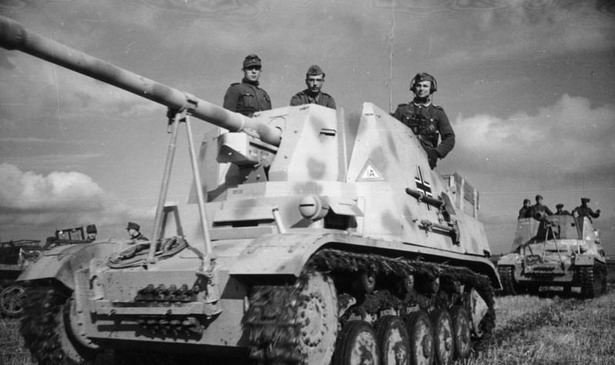
Marder II with the Pak 40 gun – a later-production vehicle that no longer has the driver's periscope apertures in the front wall of the superstructure. Source: Bundesarchiv_Bild_101I-197-1238-16, Wikimedia, Creative Commons, edited.
The Pak 40/2 had a barrel 345 cm long, equating to 46 calibres. Its standard anti-tank round was the Panzergranate 39, with a projectile weighing 6.8 kg. This round left the muzzle at 790 m/s and at 500 metres could penetrate 96 mm of sloped homogeneous armour. At one kilometre it defeated 85 mm of armour, and at 1,500 metres it could still defeat a plate 74 mm thick (though, as usual, other figures can be found in the sources). A second anti-tank round, the Panzergranate 40, was a sub-calibre projectile weighing 4.1 kg with a tungsten core. At the muzzle it reached 990 m/s and at 500 metres penetrated 120 mm of armour. At one kilometre it could defeat 97 mm of sloped armour, and at 1,500 metres still 77 mm.
The tank destroyer had no integral anti-personnel armament, but it was far from defenceless. The crew carried an MG 34 machine gun and an MP 40 submachine gun in the fighting compartment. The machine gun was mounted in a bracket in the right front corner of the superstructure and operated by the loader. The submachine gun was simply fired over the top of the fighting compartment armour. The ammunition supply was 37 rounds for the gun, 600 for the machine gun and 192 for the submachine gun.
The second-generation Marder II had a crew of only three. The driver sat alone in the left-hand forward section of the hull and was responsible for operating the radio in addition to driving. The loader and gunner – the latter also serving as commander – had their positions in the fighting compartment. Three retractable periscopes allowed the crew to observe safely over the armoured walls: one faced directly forward and was mounted on the gun shield to the right of the barrel, with one more on each side wall. Communications equipment consisted of a Fu.Spr.Gr. "d" radio set and an intercom. The Marder II with the Pak 40 measured 6.36 metres in length, 2.28 metres in width and 2.2 metres in height. Powered by the Maybach HL 62 TR engine producing 140 horsepower, this 11-tonne vehicle could reach a top speed of 40 km/h. The gearbox offered six forward speeds and one reverse.
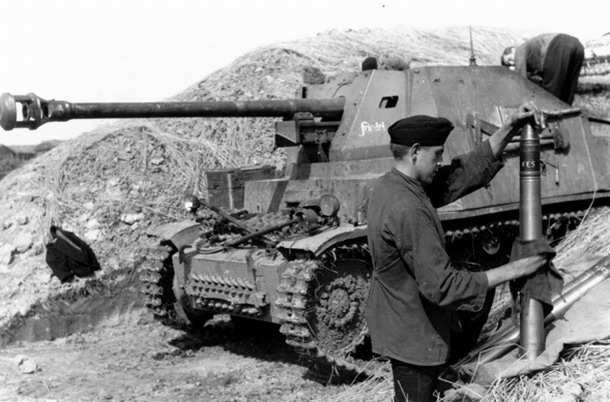
A round for the Pak 40 that armed this version of the Marder II was certainly no trifle. Source: Flickr.com, with the permission of the publishing user, edited.
We stated that the tank destroyer adopted the complete Panzer II Ausf. F chassis, but to be precise, a word of qualification is needed. The first prototype revealed that the Marder II's 11 tonnes placed a considerable burden on the tank chassis. The standard Panzer II Ausf. F weighed 9.5 tonnes, so the Marder II was roughly 16 percent heavier – and the firing loads added yet another dimension. While firing the Panzer II's 20 mm cannon had a negligible effect on the chassis, things were very different with a 75 mm gun. Each shot from such a heavy weapon transmitted a substantial amount of energy to the chassis. Series-production Marder IIs therefore received stronger leaf springs for the road wheels, and the first, second and fifth wheel on each side was given a heavier bump stop limiting maximum spring deflection.
Once the new-generation Marder prototype had been more or less successfully tested, preparations for series production began. The first 18 new Marder IIs were delivered in July 1942, and production continued until February 1943 when it was temporarily suspended in favour of building the Wespe self-propelled howitzer. It resumed in May 1943, only to be definitively terminated the following month in June. Over those 10 months of production, a total of 531 Marder IIs of this version were built. Production took place on the territory of present-day Poland, at the FAMO factory in Wrocław and the Ursus factory in Warsaw.
Several relatively minor modifications were introduced during production. From January 1943, the driver's observation periscope was no longer fitted, and the two small lens apertures for it in the front wall of the superstructure were no longer drilled (photo HERE). Apparently from April 1944, the original Fu.Spr.Gr. "d" radio sets began to be replaced by the more powerful Fu 5. The Fu 5 set was evidently too large to fit in the cramped space beside the driver, so it was relocated to the right side wall of the fighting compartment, with the loader now responsible for operating it. At the same time, the radio antenna was moved from the left side wall to the right side of the vehicle.
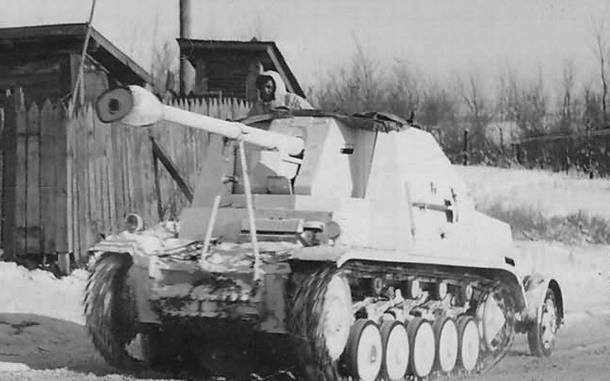
Marder II with the Pak 40 gun in winter camouflage, with an ammunition trailer attached. Source: Worldwarphotos.info, with the permission of the site operator, edited.
The combat value of the Marder II tank destroyer was so much greater than that of the original light tank that the Germans decided to convert older, already-used Panzer IIs into tank destroyers as well. These conversions were ordered from MAN, FAMO and Škoda, and reportedly involved not only Ausf. F tanks but also Ausf. c, Ausf. A, Ausf. B and Ausf. C variants. We have, however, only been able to find photographs of Marders converted from Ausf. F tanks. These retroconversions retained the second false visor cover in the driver's superstructure front wall, making them easy to identify in photographs – at least from the front (comparison photo HERE).
Organisational Structure
Marder IIs were organised into tank destroyer battalions (Panzerjäger Abteilung), which existed both as integral elements of armoured (and infantry) divisions and as independent units directly subordinate to Army command (Heeres Panzerjäger Abteilung). For simplicity, the following description focuses on divisional battalions. German Panzer divisions had had their own integral anti-tank battalions for some time, originally designated Panzerabwehr Abteilung and equipped only with towed guns, mostly of 37 mm calibre. With the arrival of the new Marder II (and Marder III) tank destroyers, individual companies within these battalions began to be transformed into self-propelled tank destroyer companies in accordance with the revised organisational table KStN 1148a issued in February 1942.
Under this table, a tank destroyer company was to have three platoons of three Marders each, giving a complete company nine tank destroyers. A battalion of three companies therefore had 27 in total. Initially, however, only individual companies were re-equipped with the new tank destroyers, not entire battalions. In December 1942, organisational table KStN 1148a was revised: a self-propelled anti-tank company within a divisional battalion was now to have three combat platoons of three Marders each plus one command Marder at company headquarters – ten Marders per company and thirty in a complete battalion. A further update came in June 1943: each company was now to have three platoons of four tank destroyers each plus two more at company headquarters, totalling 14 Marders per company. Three companies in a battalion thus gave 42 tank destroyers, to which were added three further command tank destroyers newly allocated to battalion headquarters as well, bringing the full Panzerjäger Abteilung establishment to 45 Marder tank destroyers in total – often a mix of Marder IIs and Marder IIIs. For completeness, the tank destroyer battalion had a total strength of 650 men and, alongside the tank destroyers themselves, included 22 reconnaissance motorcycles, 45 cars, 85 trucks, 13 half-tracked prime movers and one Sd.Kfz. 251 armoured personnel carrier.
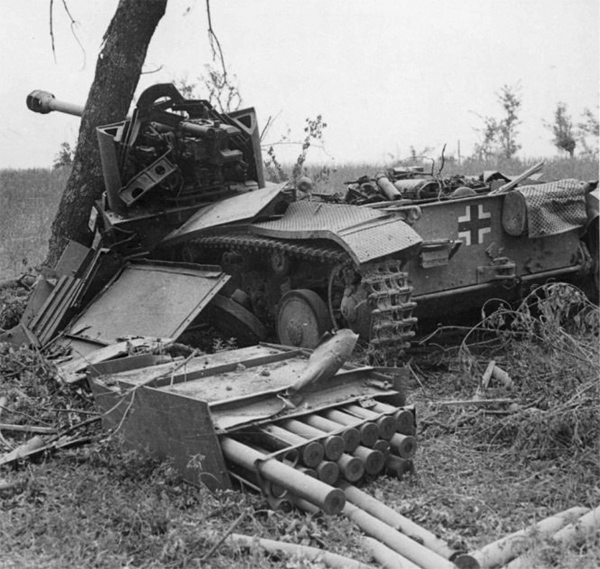
A completely destroyed Marder II with the Pak 40 gun – it is interesting to note that the gun ammunition did not explode but simply spilled out of the scattered ammunition boxes. Source: Waralbum.ru, with the permission of the site operator, edited.
A modified variant of the Pak 40-armed Marder II was produced for company commanders and battalion headquarters. Instead of the standard Fu.Spr.Gr. "d" (or Fu 5) radio, the command tank destroyer received the more powerful Fu 8 set, and later models apparently carried a combination of the Fu 5 and Fu 8. Exactly how this equipment was fitted into such a confined space is not entirely clear to me, and I have not seen a single photograph of a Marder II with two radio antennas.
Tactics and Deployment
The combat tactics of the Panzerjäger – tank destroyers – were straightforward in principle. During an armoured division's attack, the tank destroyers followed behind the German tanks, ready to intervene if the enemy launched a tank counter-attack, for example into the flank of the German formation. Tank destroyers were not a breakthrough weapon intended to lead the assault – they would have been far too vulnerable in that role, being only very lightly armoured (unlike tanks) and unable to engage targets in all directions (unlike tanks). Tank destroyers were meant to wait for an enemy armoured counter-attack and then shatter it with accurate, powerful fire. They fulfilled the same function as classical towed anti-tank guns, with the advantage of being better able to keep pace with the rapid advance of tanks. The tank destroyers would find a suitable position behind the German tanks, wait, and if no counter-attack materialised, move up to the next position behind the advancing tanks and wait again – shadowing their own tanks step by step.
The same tactics applied when supporting infantry units, and unfortunately this frequently led to serious misunderstandings with infantry officers. Infantry commanders often failed to grasp the difference between a lightly armoured tank destroyer, an assault gun and an actual tank. They would try to send the Marders forward at the tip of the attack, ahead of their own infantry – which was completely contrary to the vehicles' intended role. No commander would think of sending a towed anti-tank gun charging at the head of an assault, but once that weapon was given a tracked chassis, everyone wanted to see it as far forward as possible, breaking through the enemy's defences. Here too, the Marders were supposed to stay back and only move forward to support the infantry when an enemy tank counter-attack appeared.
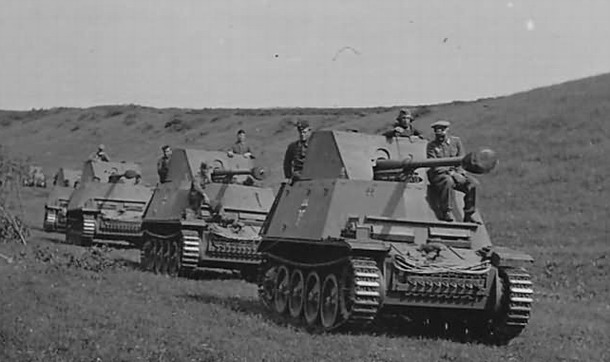
A platoon of Marder II tank destroyers with the 7.62 cm Pak 36(r) gun. Source: Flickr.com, with the permission of the publishing user, edited.
Further friction with the infantry arose from the limited onboard ammunition supply. Consider the following scenario. German infantry launches an attack; in a pre-selected position behind them stands a company of nine Marder IIs, whose commander is watching the battlefield and waiting for the agreed signal indicating the presence of Russian tanks – typically the firing of a flare. And then it happens: the soldiers at the tip of the attack spot a group of Russian T-34s. A coloured flare arcs through the air, the German infantry goes to ground and takes cover, and the Marders move forward to engage from suitable firing positions before the T-34s close to within dangerous range. But since each Marder carries only 37 rounds – of which perhaps only 20 are armour-piercing – some vehicles soon have to pull back to rearm. This moment was sometimes interpreted by the infantry as a retreat, with a tendency to follow suit – which naturally did not endear the Marder crews to their commanders.
A picture of how the Marders generally fared in the field can be gained from an extensive report written by the commander of the 49th Tank Destroyer Battalion attached to the 4th Panzer Division. This unit received its first three Marder IIs in September 1942 and was completely re-equipped with the type in February 1943. The report was written in April 1943, after approximately eight weeks of combat deployment on the Eastern Front.
Starting with the shortcomings: the 10 mm armour is wholly inadequate and does not even stop armour-piercing infantry rifle rounds. The same applies to the 2×4 mm gun shield; at minimum, the shield should be thickened to provide better crew protection. The vehicle's greater weight compared to the standard Panzer II causes the tracks to wear rapidly and break frequently. The waterproof tarpaulin cannot prevent water entering the fighting compartment, causing not only crew discomfort but also threatening the weapon, the ammunition and especially the radio.
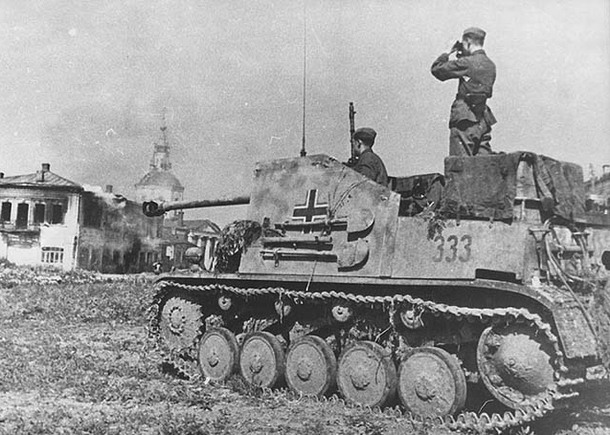
Marder II with the Pak 40 in a firing position on the edge of a town – note the ammunition crates stored at the rear (when firing, crates stowed this way would likely obstruct the automatic ejection of spent cases from the gun). Source: Worldwarphotos.info, with the permission of the site operator, edited.
The Fu.Spr.Gr. "d" radio has a range of only 1 to 2 km, which is too little for practical combat use (this report was of course written before the upgrade to the more capable Fu 5 sets). The vehicle vibrations when the gun fires are so violent that tools attached to the side armour fall off, and the retractable observation periscopes in the fighting compartment are frequently damaged. Marder II drivers complain that the speedometer needle shakes so badly when driving over rough ground that reading the current speed from the instrument is practically impossible.
The standard ammunition supply of 37 rounds is too low. Crews routinely load additional ammunition on board, storing it in wooden transport crates placed directly on top of the official armoured ammunition boxes at the rear of the vehicle. This can increase the onboard ammunition supply to as many as 60 rounds, but at the cost of crew comfort and safety (before firing, these crates presumably had to be moved aside, since the Pak 40 automatically ejected spent cases after each shot, requiring clear space behind the gun). What is needed is either more ammunition stowage space or more ammunition vehicles with each unit. The list of positive points was noticeably shorter, essentially concentrating solely on the gun itself: the Pak 40 could reliably penetrate the armour of medium and heavy Russian tanks at adequate engagement ranges.
The order of battle ahead of Operation Zitadelle on 30 June 1943 showed 384 serviceable Marder IIs with the 75 mm gun at unit level. Six months later, by the end of 1943, units reported only 178 serviceable vehicles of this type remaining.
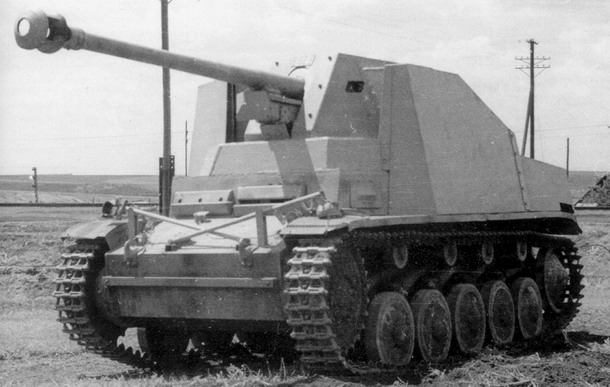
Some Marder II tank destroyers were not newly built but converted from used Panzer II tanks – here is one of them, identifiable by the false visor cover on the front wall of the superstructure. Source: Flickr.com, with the permission of the publishing user, edited.
The Marder II tank destroyer was a product of its time. Its designers' ambition was to quickly deliver a vehicle with a powerful weapon to the troops, making use of existing surplus chassis. Everyone understood that it was essentially a solution to an immediate crisis, and that once time allowed, more mature and better-armoured tank destroyers would be developed – such as the Jagdpanzer IV or the Jagdpanther. The Marder IIs nonetheless fulfilled their role with distinction.
Technical Data
|
|
Sd.Kfz. 132 |
Sd.Kfz. 131 |
|
weight: |
11.5 t |
11.0 t |
|
length: |
5.65 m |
6.36 m |
|
width: |
2.30 m |
2.28 m |
|
height: |
2.60 m |
2.20 m |
|
engine: |
Maybach HL 62 TR |
Maybach HL 62 TR |
|
engine output: |
140 hp |
140 hp |
|
max. speed: |
55 km/h |
40 km/h |
|
crew: |
4 men |
3 men |
|
armament: |
PaK 36(r) gun, 76.2 mm 1× MG 34 machine gun, 7.92 mm |
PaK 40 gun, 75 mm 1× MG 34 machine gun, 7.92 mm |
ARTICLE
CONTENTS:
Reproducing text from the Panzernet website without the written consent of the operator is prohibited.