MARDER III
three tank destroyer variants on the Panzer 38(t) chassis
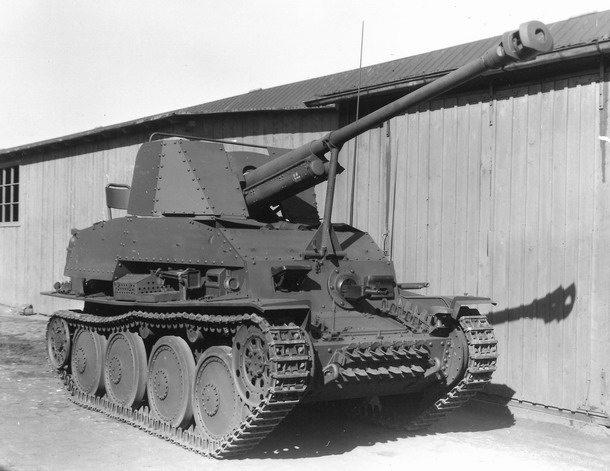
Sd.Kfz. 139, the Marder III with the originally Soviet 7.62 cm PaK 36(r) gun, photographed here in the factory yard. Source: private collection, with the owner's permission, edited.
Note: the Marder III family produced a total of three generations of tank destroyers, which differed substantially from one another but shared the same tank chassis. All three are described below in chronological order of their development.
In the years before the Second World War, the anti-tank units of the German Army relied almost exclusively on the light 3.7 cm Pak 36 (Pak = Panzerabwehrkanone = anti-tank gun). It was a light weapon of modest calibre, but in its day it was considered reasonably effective. The Germans had been working on the development of more powerful anti-tank guns in the 50 mm and 75 mm calibres before the war, but without any great urgency. Both in Poland in 1939 and in France a year later, the Wehrmacht had managed well enough with 37 mm guns (and various captured types). Lulled by its successes, the German high command was not planning any revolution in its anti-tank arsenal. All that was about to change on 22 June 1941.
The Germans were of course well aware that the Russians had very large numbers of tanks, even if precise figures were unknown. They therefore brought approximately 15,000 towed anti-tank guns with them into the Soviet Union. Around 14,000 of these, however, were again the old 37 mm Pak 36, with only roughly a thousand of the newer 50 mm Pak 38. The saving grace for the Germans was that the vast majority of Soviet armour at that time consisted of light tanks, which the older guns could handle. Exact figures are unavailable, but it is generally stated that from 22 June 1941 to the end of that year the Germans destroyed around twenty thousand Soviet tanks – out of a total of approximately 25,000 that the Soviets possessed. Beyond the sheer quantity of tanks, however, the Wehrmacht also encountered something else in Russia: formidable opponents in the form of the capable medium T-34 and the heavy KV-1 and KV-2. Against these vehicles, the German 3.7 cm Pak 36 truly earned its unflattering nickname of "door knocker" – politely rapping on the armour of these machines was about all it could manage.
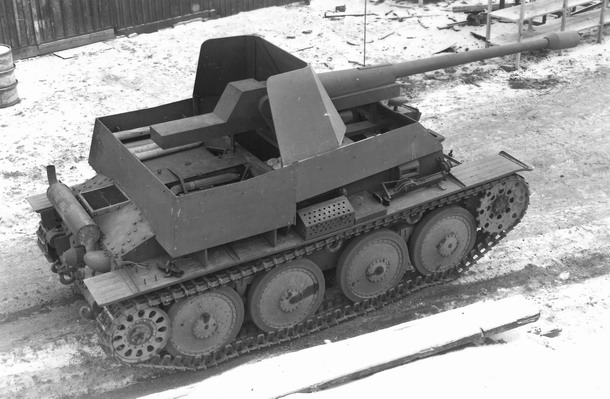
In January 1942, BMM built a technology demonstrator of the new tank destroyer, with wooden mock-ups of both the gun and the superstructure. Source: private collection, with the owner's permission, edited.
The 7.62 cm Pak 36(r) Gun
In 1941, the Russians had only limited numbers of T-34s and KVs, but the Germans understood that production would continue at pace. They now simply had to act – and act fast. Completing the development and ramping up mass production of a new 75 mm gun became the highest priority, and almost simultaneously work began on adapting this gun for installation in tanks (PzKpfw IV) and assault guns (StuG III). New and more effective sub-calibre rounds were developed for the existing 3.7 cm Pak 36 and 5 cm Pak 38, and the development of entirely new medium (Panther) and heavy (Tiger) tanks was accelerated. Even this was not enough, and the Germans looked for additional ways to deliver maximum anti-tank firepower to the front in the shortest possible time. Their attention fell on one particular weapon that had the necessary performance and was available immediately and in reasonable quantity: the 76.2 mm F-22 divisional gun, captured from the Soviets themselves.
In the opening months of the Eastern campaign the Germans seized enormous numbers of these guns – figures of 1,300 to 2,000 are commonly cited – along with full ammunition dumps. The Wehrmacht incorporated the captured weapon into its inventory under the designation FK296(r) (FK = Feld Kanone = field gun, (r) = russisch = Russian). Although the gun had not originally been designed as an anti-tank weapon, the Germans concluded that it could be adapted for that purpose with relatively little effort. Two different types of modification were designed and carried out, each producing a distinct "new" weapon. The first involved replacing the original sight with a new German one, moving the traverse handwheel from the right to the left side of the gun, and modifying the gun shield. This modified weapon received the new designation FK36(r) and continued to use the original Russian ammunition with a case length of 385 mm.
Of far greater interest to us is the second modification, designated the 7.62 cm Pak 36(r) (many authors omit the (r) suffix; we retain it here for clarity). The Germans recognised that if they intended to rely on the Russian gun in earnest, they could not depend on limited stocks of captured ammunition – they needed to be able to produce their own. They also found that the gun barrel could comfortably handle substantially more powerful ammunition than the original Russian round, which used a 385 mm case with a 90 mm base diameter. This was hardly surprising, as the F-22 had been designed from the outset for more powerful ammunition, but the Soviet Army had ultimately decided to adapt it for the older, weaker Model 1900 round that was already in established production in the USSR.
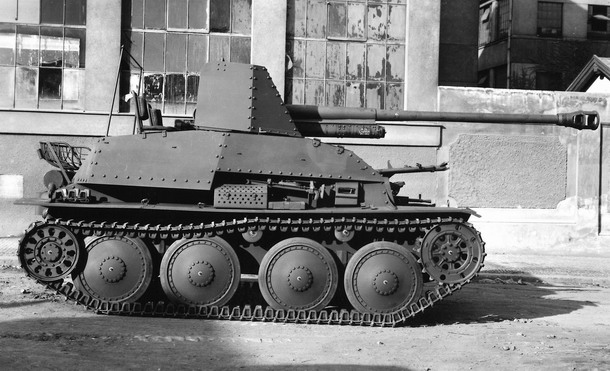
One of the first series-production Sd.Kfz. 139 vehicles, again photographed in the factory yard of BMM in Prague. Source: private collection, with the owner's permission, edited.
The Germans therefore developed entirely new ammunition for the Russian gun, combining a 76.2 mm projectile with a cartridge case borrowed from the 75 mm Panzergranate 39 round used in the Pak 40 anti-tank gun. This case was 716 mm long with a base diameter of 100 mm – roughly 2.4 times the volume of the original Russian ammunition, and therefore a proportionally larger propellant charge. Introducing the new ammunition required replacing the entire chamber of the gun, as the original had been dimensioned for the short Soviet cartridge. A more powerful recoil mechanism was also fitted to control the movement of the barrel after firing, as was a muzzle brake – a completely new addition.
This modification killed two birds with one stone: it significantly increased the weapon's performance through the more powerful cartridge, while making use of cartridge cases already in production, which reduced manufacturing costs considerably. The standard anti-tank round for the "new" 7.62 cm Pak 36(r) was designated the 7.62 cm Panzergranate 39 (more precisely 7.62 cm Pzgr. Patr. 39 rot) – an armour-piercing shell, as the name indicates. Two further new ammunition types were also developed: the Panzergranate 40 with a tungsten core for use against armour, and the Sprenggranate 39 high-explosive round for use against personnel.
The complete 76.2 mm Panzergranate 39 cartridge weighed 12.7 kg, of which the projectile itself accounted for 7.6 kg. The shell left the muzzle at 740 m/s. At 500 metres it could penetrate 90 mm of homogeneous armour sloped at 60 degrees (some sources give 98 mm). At one kilometre it defeated 82 mm of sloped armour (other sources quote 88 mm), and at 1,500 metres the projectile could still defeat 73 mm of armour plate.
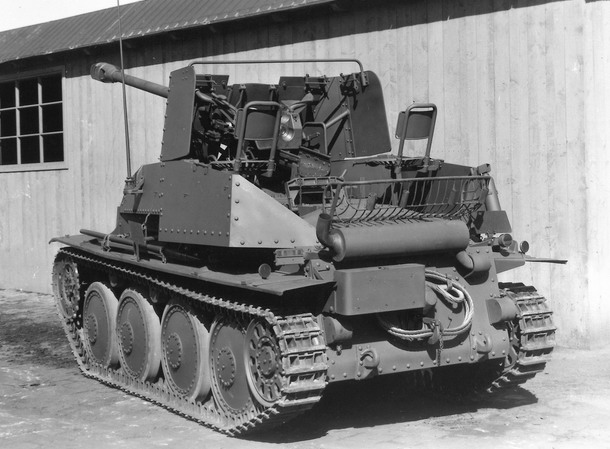
A view into the fighting compartment of the Sd.Kfz. 139: the seats are in the travelling position and the gun's recoil trough is secured in the floor bracket. Source: private collection, with the owner's permission, edited.
Origins of the Vehicle
The new gun and its ammunition were now ready and the weapon began to be delivered to the troops in its towed form. At the same time, combat experience in the Soviet Union had brought about another major change. Light tanks of the PzKpfw 38(t) type had been definitively judged unfit for front-line service and were officially withdrawn from that role. Yet at that moment production of this tank was running at full capacity: between 50 and 60 new vehicles were leaving the gates of the Prague ČKD (later BMM) factory every month. These were the seventh production series, designated Ausf. G, and the factory was also steadily preparing to begin production of the eighth series, the Ausf. H, planned in a run of 500 tanks through to April 1943. The PzKpfw 38(t) was moreover a proven and reliable machine, with which both crews and maintenance workshops were thoroughly familiar. Discarding such a well-established production programme would have been a significant waste. German planners therefore put two and two together and began exploring the possibility of converting the PzKpfw 38(t) chassis to carry the new 7.62 cm Pak 36(r) gun.
The design of the new vehicle, combining chassis and gun, was most likely entrusted to the firm of Alkett, though some sources credit BMM directly with the development. Either way, on 22 December 1941 BMM received an order to build a prototype of the newly designed vehicle, and apparently simultaneously to begin the first production series of 120 vehicles. The first series vehicles were to be delivered as early as March 1942. Time was therefore the priority. The new tank destroyer was to be designed in such a way that the chassis and hull of the original light tank required no major modifications, allowing series production to begin immediately – and even to run in parallel with continued production of standard PzKpfw 38(t) tanks. The task of adapting the gun for installation on the chassis was assigned to Rheinmetall.
On 12 January 1942 a major design conference was held at ČKD, and by 22 January a demonstration mock-up was ready. The basis was a PzKpfw 38(t) Ausf. E chassis that happened to be undergoing repairs in the Prague workshops. A mock-up superstructure made from wooden boards was mounted on the tank chassis, along with a wooden dummy gun barrel (photographs of the demonstrator can be seen above and also HERE, source: Flickr.com). This was followed by the construction of the first working prototype. Rheinmetall designed a new massive cross-shaped gun mount for it, with the longer arm running through virtually the entire length of the fighting compartment and the shorter arm lying transversely across it. On 29 January 1942, ČKD received the order to initiate all steps necessary to launch series production – even though the prototype's firing trials were not scheduled until 11 February (they went very well, as expected).
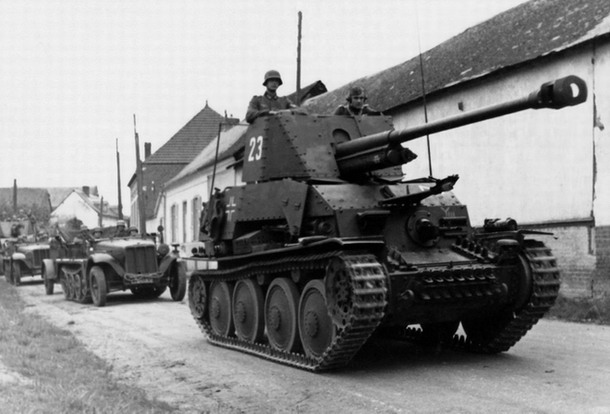
Sd.Kfz. 139 in a column of vehicles – the divisional insignia on the armour identifies this Marder III as belonging to the 10th Panzer Division of the Wehrmacht, making it most likely a vehicle of Panzerjäger Abteilung 90. Source: Flickr.com, with the permission of the publishing user, edited.
The new self-propelled anti-tank gun received the official designation 7.62 cm Pak 36(r) auf Fgst. Pz.Kpfw. 38(t) (Sfl.) and the ordnance code Sd.Kfz. 139. In various official documents, however, the vehicle appeared under a wide range of other, mostly cumbersome designations. The form Panzerjäger 38 für 7.62 cm Pak 36 is encountered relatively frequently. By far the most widely known name, however, was Marder III (Marder = marten), which Adolf Hitler personally approved for use in November 1943 (other sources place this in February or even March 1944).
The first 120 vehicles ordered were to be built on chassis already in progress for PzKpfw 38(t) Ausf. G tanks. The new vehicle thus rode on a chassis with four road wheels on each side. The wheels had a diameter of 775 mm and were fitted with rubber tyres around their circumference for a smoother ride; their discs were made from 6 mm armour plate. The two front and two rear road wheels were paired on a shared suspension arm and sprung by a shared semi-elliptic leaf spring. The track assembly also comprised a front toothed drive sprocket of 637 mm diameter, a rear idler of 535 mm diameter and two return rollers of 220 mm diameter. The tracks themselves were 293 mm wide, each consisting of 93 links, fitted with a double guide tooth to prevent them from slipping off the road wheels. Along their full length the tracks were protected from above by mudguards made from 2 mm shaped sheet steel.
The Sd.Kfz. 139 Version
The chassis was adopted for its new purpose together with the armoured hull and part of the original crew compartment. The turret was of course removed. The 7.62 cm Pak 36(r) was a fairly bulky weapon, so sufficient space had to be created for both it and its crew – and the space above the original tank crew compartment (where the turret had once been) was simply not enough. It was also necessary to make use of the space above the engine at the rear of the hull.
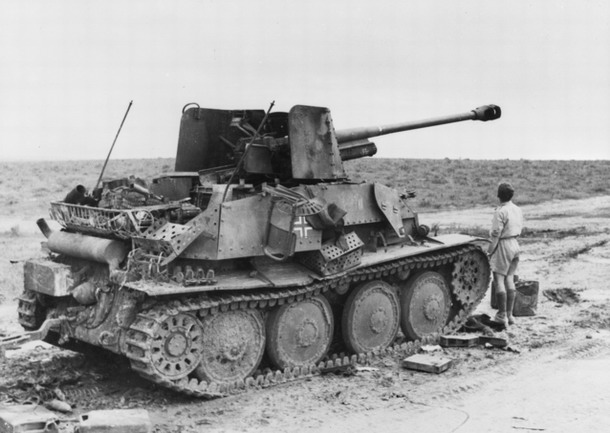
A knocked-out and abandoned Sd.Kfz. 139 in Africa – the loader's seat has been tipped over the side armour, complete with its backrest. Source: Flickr.com, with the permission of the publishing user, edited.
The roof plate of the original tank crew compartment, with its large circular opening for the rotating turret, was therefore removed and replaced with a new one. Similarly, the engine section received a new roof plate with flat surfaces on either side of a raised centre section. This created the floor of the new, adequately sized fighting compartment. The front wall of the original tank crew compartment – with its hull machine gun and two observation visors – was retained, as were both side walls of the original compartment. Above them rose a completely new fixed superstructure, riveted from 15 mm sheet armour plate. These plates were relatively low, however, and the elevated fighting compartment above them offered only token protection rather than genuine cover.
The gun was mounted roughly in the middle of the vehicle's length on the cross-shaped pedestal already described. The pedestal was bolted to the hull using five bolts at the end of each arm, with the exception of the longest rear arm. The mount allowed only limited movement of the weapon, both vertically and horizontally. Vertical elevation could be adjusted from -6 to +16 degrees. Maximum horizontal traverse was 25 degrees either side of centre (some sources give only 21 degrees either side). The gun shield, riveted from armour plates only 10 mm thick, was connected to the gun and moved laterally with it as the weapon was traversed. In the centre of the shield was a cutout through which the barrel passed. The remaining space in the cutout was filled by a separate armour piece that could move up and down with the barrel. To the left of the barrel, the shield had a cutout for the gun sight. The shield was extended slightly sideways, but only modestly, offering no serious level of crew protection in that direction either. For greater clarity, we include an annotated diagram of the armour layout HERE.
The floor of the new fighting compartment was therefore at the level of the former crew compartment roof and the engine deck top – in other words, very high above the ground (just how high the men in the fighting compartment were can clearly be seen in the photograph HERE). And correspondingly high was the gun itself – its breech sat a full 2 metres above the ground. Ammunition stowage boxes were located in the floor beneath the gun and along the sides of the fighting compartment. The total onboard ammunition supply was only 30 rounds of 76.2 mm calibre. Additionally, 1,200 rounds were carried for the hull machine gun. Thirty rounds for the main gun was decidedly inadequate, and the Marder III was therefore intended to tow an ammunition trailer behind it. This was not a particularly practical solution. The long gun barrel (measuring 389 cm) vibrated badly during movement, which was of course undesirable. Two barrel supports were therefore fitted: the first on the floor of the fighting compartment, securing the gun's recoil trough, and the second on the superstructure armour, in which the barrel itself could be rested.
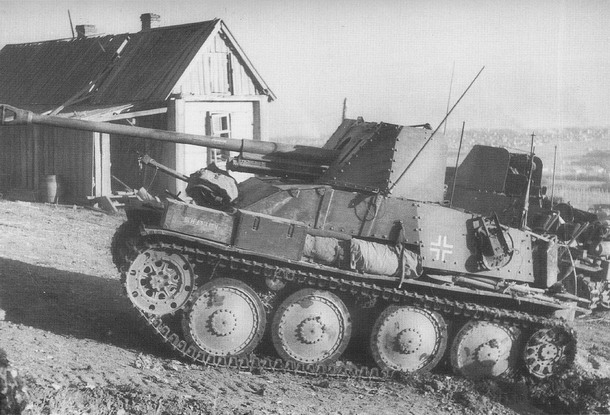
Two Sd.Kfz. 139 vehicles in a Russian village. Source: Flickr.com, with the permission of the publishing user, edited.
The complete drivetrain was taken over unchanged from the original tank. At the rear of the hull therefore sat a water-cooled, six-cylinder Praga TNHPS/II petrol engine of 7.75 litres displacement, producing a maximum output of 125 horsepower at 2,200 rpm. Air for the engine was drawn in through intakes tucked under the overhanging sides of the superstructure, just above the track mudguards. The heated air was then expelled through a trapezoidal outlet at the rear of the engine deck. Two hatches in the floor of the fighting compartment provided maintenance access to the engine. The engine was started primarily by an electric starter, though hand-cranking was also possible. Fuel was stored in two tanks with a combined capacity of 210 litres. A driveshaft ran from the engine forward to the gearbox at the front of the crew compartment. The gearbox was of the Praga Wilson type, with five forward speeds and one reverse.
The Marder III's crew numbered four men. The driver and radio operator sat in the forward section of the hull in positions corresponding to those in the original tank crew compartment. The driver sat on the right (in keeping with pre-war Czechoslovak traffic regulations, which governed the design of the PzKpfw 38(t)). Directly in front of him, in the hull front wall, was his main observation visor, filled with 50 mm hardened glass and fitted with an external armoured cover. When the cover was closed, the driver could see only through a narrow slit in it; in safe areas he could open the cover for a better view. A second visor was provided in the right-hand side wall of the hull. Immediately below it was a ventilation slit. Both the visor and the slit were protected externally by a common armoured cover. The vehicle was steered using two horizontally mounted control levers, three pedals and a gear selector.
To the left of the driver, separated from him by the gearbox, sat the radio operator, who was also responsible for operating the hull machine gun. He too had his own armoured visor in the front wall. The left side wall had no visor, but did have a ventilation slit protected by an external armoured cover. The hull machine gun was located to the radio operator's right, partially above the gearbox. The ball mount allowed horizontal movement of 14 degrees either side of centre and vertical elevation from -10 to +10 degrees. Aiming was done through a monocular ZDK 2105 sight (ZDK = záměrný dalekohled kulometný, or machine-gun telescopic sight) with 2.6× magnification and a 25-degree field of view, manufactured by the firm Optikotechna of Přerov. The 7.92 mm machine gun itself was a product of the Brno armaments factory; its original Czechoslovak designation was ZB vz. 37, but the Germans assigned it their own designation of MG 37(t).
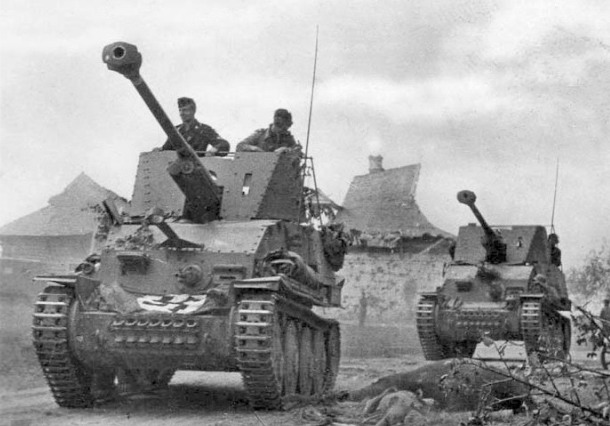
Sd.Kfz. 139 on the march – it is interesting to note that not one of the vehicles has its barrel support raised. Source: Worldwarphotos.info, with the permission of the site operator, edited.
In an emergency, the hull machine gun could also be operated by the driver, who had a button on one of his control levers linked by a Bowden cable to the gun's trigger. Before such "emergency" use, however, the gun had to be locked in the neutral position. The driver could only aim by turning the entire vehicle (for which purpose he had simple iron sights in front of his visor), and once the loaded rounds had been expended he naturally could not reload the weapon. For emergency close defence against enemy infantry, the crew also had an MP 38 submachine gun of 9 mm calibre carried on board.
The remaining two crew members – the loader and the gunner – had their positions in the main fighting compartment. The gunner also served as the vehicle commander. Each had a simple sheet-metal folding seat attached to the side armour and supported by a tubular leg. These seats were used only in the travelling mode; during combat readiness they were removed from the fighting compartment to avoid obstructing the crew while operating the gun. First the backrests were detached and pushed into holders on the wire mesh at the rear of the fighting compartment. The seats themselves, still with their tubular legs, were then folded over the side armour and left hanging on its outside (the various seat positions can be seen in photographs HERE and HERE). The men in the gun compartment normally observed from the vehicle simply by looking over the edge of the armour shield. When this was too dangerous, each man also had two observation periscopes available – one on the front wall of the shield and one on the side wall – which were normally folded down and raised upward above the armour edge before use.
As already noted, the gun fighting compartment was largely open. Even the roof of the fixed superstructure forward of the gun shield was not completely closed, so the crew in the hull were also not fully sheltered from the weather. A large waterproof tarpaulin was therefore provided, which could be erected over the entire fighting compartment and part of the superstructure forward of it, also protecting the gun's recoil mechanism. At the rear of the fighting compartment, two metal rods supported the tarpaulin. To provide at least a minimum of visibility, the tarpaulin was fitted with celluloid windows on the sides and rear, and one small window was even provided in the front wall above the gun sight.
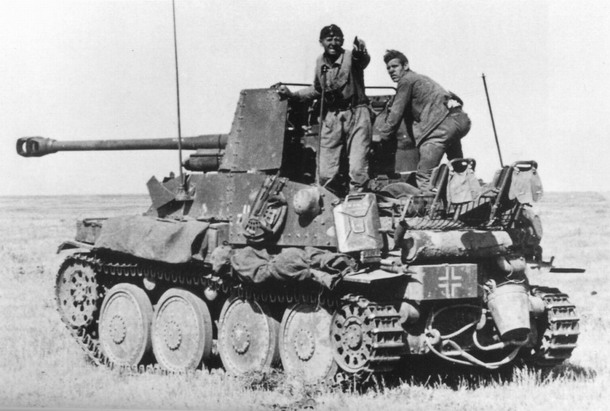
Sd.Kfz. 139 on the Russian steppe. This photograph makes very clear just how high above the ground the fighting compartment was and how exposed the gun crew were to enemy fire. Source: Waralbum.ru, with the permission of the site operator, edited.
The crew communicated with each other via headsets and throat microphones connected to an internal communications circuit. For external communication there was a Fu5 radio set, combining both receiver and transmitter, with a voice range of 2 to 3 km on the move. The radio was served by a simple rod antenna mounted on the left side of the armoured superstructure. The Sd.Kfz. 139 apparently did not give rise to a specialised command version with an expanded radio fit (though some sources mention one). Company and battalion commanders of tank destroyer units used command vehicles of other types, such as those based on the PzKpfw I light tank.
The Marder III with the 76.2 mm gun weighed either 10.8 or 10.67 tonnes, depending on which author one believes. The vehicle measured 585 cm in length including the barrel overhang, 215 or 216 cm in width and 250 cm in height. Its top speed was around 42 km/h. A full fuel load gave a road range of approximately 185 km. The onboard ammunition supply was 30 rounds for the gun, 1,200 for the machine gun and 192 for the submachine gun. The purchase price of one vehicle was 54,785 Reichsmarks (55,100 in tropical configuration).
As already noted, in December 1941 the German Army ordered ČKD to produce the first series of 120 new tank destroyers. The specific production schedule was set out in a contract from early March 1942: 33 vehicles were to be delivered in March, 70 in April and the remaining 17 in May 1942, all while the factory continued producing standard PzKpfw 38(t) tanks in parallel. The production ramp-up did not go entirely to plan. In March not a single new tank destroyer was completed, and tank production also fell to just 28 vehicles due to assembly line modifications. In April 1942, however, the first 38 completed Marders left the factory, and the remaining 82 followed in May. ČKD had thus caught up with the first-series production plan after all.
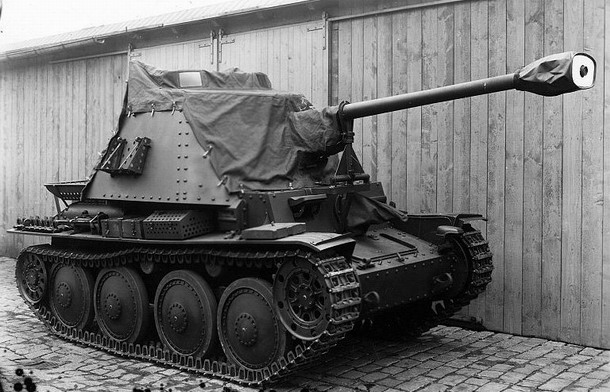
The second-generation tank destroyer was designated Sd.Kfz. 138 or Marder III Ausf. H – here a fine factory photograph with the waterproof tarpaulin over the fighting compartment. Source: Praga archive, with the permission of the company's representative, edited.
At his conference with Armaments Minister Albert Speer on 13 May 1942, Hitler had still agreed to a mixed production schedule under which the ČKD (BMM) factory would deliver 30 PzKpfw 38(t) tanks and 20 Marder III tank destroyers per month. By 4 June, however, he had reversed this decision and ordered that light tank production be wound down as quickly as possible so that the factory could concentrate entirely on assembling Marders. Simultaneously, an order was placed for a second production series of exactly 100 tank destroyers. June 1942 thus became the last month of mixed production, in which the Prague factory delivered 23 tank destroyers and 26 light tanks. In July the factory delivered Marders exclusively, with 50 vehicles. The remaining 27 of the hundred ordered were completed in August.
The second production series introduced only a few minor engineering changes. The gun shield was revised, as was the armour arrangement below the barrel. This increased the maximum gun depression from the original -6 to -8 degrees. The forward barrel travel lock was also redesigned to be more robust and remotely retractable from inside the vehicle (comparison photo HERE). One considerably more significant change, however, came partway through second-series production.
To recap: when the Marder III tank destroyer entered production in March 1942, BMM was in the middle of the seventh production series of the PzKpfw 38(t) light tank, the Ausf. G, while also steadily preparing for the transition to the eighth series, the Ausf. H. For the planned Ausf. H tanks, an upgraded, more powerful engine had been developed under the designation Praga AC. The first 194 Marder IIIs (120 from the first series and 74 from the second) were built on PzKpfw 38(t) Ausf. G chassis. In July 1942, however, the stock of these chassis was exhausted, and Marder production transitioned smoothly to Ausf. H chassis already fitted with the new Praga AC engines. The final 26 Marders from the second series therefore received the new chassis with the new engine.
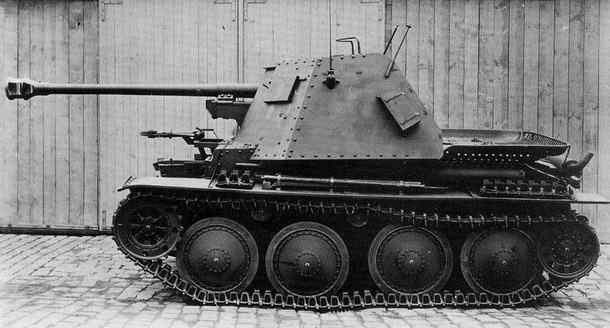
Another factory photograph of a brand-new Marder III Ausf. H. Source: Praga archive, with the permission of the company's representative, edited.
The Praga AC was essentially a modified variant of the original Praga TNHPS/II engine. By adding a second carburettor and increasing the compression ratio, its output was raised from 125 horsepower at 2,200 rpm to 150 horsepower at 2,600 rpm. This improvement increased the Marder's theoretical top speed from 42 km/h to 49.5 km/h (with a slight reduction in fuel consumption as a bonus). Unfortunately, this remained a theoretical maximum. In practice, the benefit of the new engine was partially offset by a limitation on the gearbox side: the Marder III continued to use the Praga Wilson gearbox, which was not designed to operate above 2,500 rpm. The maximum achievable speed therefore increased only to around 47.25 km/h. A very positive aspect was that both engines were interchangeable without the need for further modifications, meaning that operating Marders with both engine types in parallel caused no difficulties for maintenance mechanics or spare parts supply.
In August 1942, the Waffenamt secured a further 124 Pak 36 guns, enabling a third production series of Marder IIIs to be ordered. The first 24 vehicles of this series were completed in August, followed by 50 more in September and 50 in October 1942, at which point series production of this version ended. Across the three series described, a total of 344 were produced: 194 on the Ausf. G tank chassis with the Praga TNHPS/II engine, and 150 on the Ausf. H chassis with the Praga AC engine.
Although series production of the Sd.Kfz. 139 ended in October 1942, further vehicles of this type continued to be produced in smaller numbers by converting older PzKpfw 38(t) tanks returning to the factory for general overhaul. The exact number of such conversions is not known, but it was in the lower tens of vehicles (reports for February, March and April 1943, for example, record a combined total of 19 such conversions). The limiting factor for further Marder production was above all the shortage of Pak 36(r) guns. As noted, these were originally Russian weapons that the Germans did not manufacture themselves but only modified; availability therefore depended on how many could be captured from the enemy, and those numbers were steadily falling.
The second-generation tank destroyer was designated Sd.Kfz. 138 or Marder III Ausf. H. Source: Praga archive, with the permission of the company's representative, edited.
Within the very first production series of the new tank destroyer, a modification of some vehicles for operation in tropical conditions was also requested. The tropical version received more powerful cooling fans for the radiator air supply, more effective air and oil filters, and forced ventilation of the driver's compartment. Two water jerricans and a broad shovel for working in sand were added to the standard equipment. Vehicles intended for the tropics also received a different paint scheme: instead of grey, a yellowish-brown sand colour was used. The first tropicalised Marders were delivered as early as May 1942, and over the entire production run somewhere between 60 and 70 of them appear to have been built.
Marder IIIs were organised into tank destroyer battalions (Panzerjäger Abteilung). German Panzer divisions had had their own integral anti-tank battalions for some time, originally designated Panzerabwehr Abteilung and armed only with towed guns, mostly 37 mm calibre. With the arrival of the new Marder III (and Marder II) tank destroyers, individual companies within these battalions began to be converted into self-propelled tank destroyer companies in accordance with the revised organisational table KStN 1148a, issued in February 1942. Given the limited numbers of new combat vehicles available, however, only one or two of a battalion's three companies were converted at any given time; the remainder continued with towed guns for the time being. The self-propelled companies were denoted by the abbreviation Sfl. (Selbstfahrlafette = self-propelled), and the towed companies by mot. (motorisiert = motorised). A self-propelled anti-tank company could, under the new organisational table, have either two or three combat platoons of three tank destroyers each, giving either 6 or 9 tank destroyers per company.
On 9 March 1942, an order was issued for the distribution of Marder IIIs from the first production series among the Panzer divisions. The tank destroyer battalions of the 1st, 4th, 9th, 11th, 12th and 17th Panzer Divisions were each to receive six vehicles – enough to form one self-propelled company of two platoons. The battalions of the 8th, 19th, 20th and 22nd Panzer Divisions were each to receive twelve vehicles – enough for two self-propelled companies of two platoons each. A total of 90 Marders were thus distributed among these ten Panzer divisions, with the vehicles actually delivered to their units during May, June and July 1942. The remaining 30 vehicles from the first series went partly into reserve stocks and partly to independent army-level battalions.
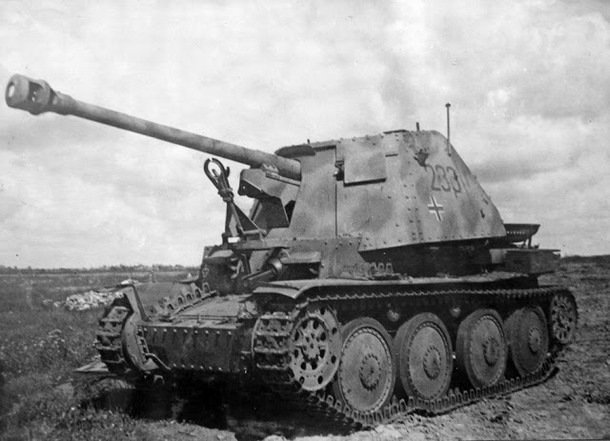
Marder III Ausf. H in the field. Source: Flickr.com, with the permission of the publishing user, edited.
Tank destroyer combat tactics were essentially straightforward. During a Panzer division's offensive, the tank destroyers followed behind the German tanks, ready to intervene if the enemy launched an armoured counter-attack and broke through the flanks of the advancing German formation, for example. Tank destroyers were not a breakthrough weapon meant to lead the assault – they would have been far too vulnerable in that role, being neither fully armoured on all sides nor capable of engaging targets in every direction (unlike tanks). Tank destroyers really did "wait" for the enemy's tank counter-attack, and then shattered it with accurate, powerful fire. They fulfilled the same function as classical towed anti-tank guns, with the advantage of being better able to keep pace with the rapid advance of the tanks.
As with every new weapon, army commanders closely monitored reports from front-line units on their first practical experience of deploying the Marders. Several reports appeared during June and July, summarising initial findings, and they were broadly similar in their conclusions. The performance of the 76.2 mm Pak 36 gun was assessed unambiguously positively. The 5th Panzer Division's report of 28 July 1942 states that the gun cleanly penetrated the 100 mm frontal armour of a Soviet KV-1 at 350 metres. A second hit at only 100 metres passed through the frontal armour into the crew compartment, then through the engine compartment bulkhead and through the entire engine before coming to rest against the rear armour. Similarly, the 8th Panzer Division's report of 23 November 1942 praised the gun's range and performance, noting that in combat it was generally unnecessary to resort to the special Panzergranate 40 sub-calibre round, as the standard Panzergranate 39 was more than adequate against all enemy tanks encountered.
The reports more frequently mentioned the vehicle's shortcomings, however. The fighting compartment armour was inadequate both in thickness and in extent, leaving the crew largely exposed to enemy fire and shell fragments while operating the gun. The ammunition supply was too low, and some of the ammunition stowage boxes were moreover difficult to access. The ammunition trailer was not an ideal solution: it was too flimsy and broke down frequently in the field (the 5th Panzer Division's report bluntly stated that the trailer was completely useless). The forward barrel support proved insufficiently robust and reportedly broke during cross-country movement. Driving without the barrel support was impossible, since even a few hundred metres of movement was enough to disturb the sights, requiring them to be readjusted and the weapon re-zeroed before firing. The troops also requested that the forward barrel support be remotely retractable from inside the vehicle, without anyone having to climb outside.
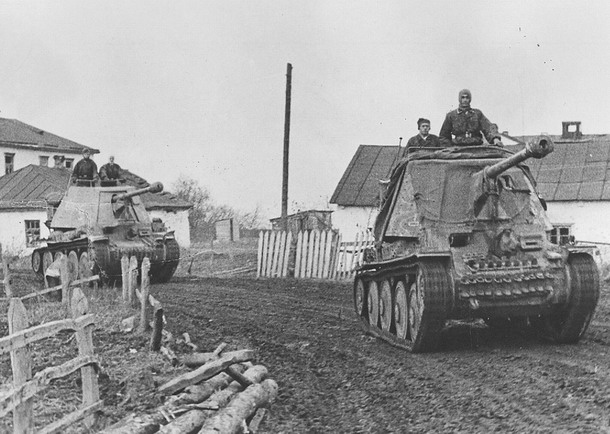
A pair of Marder III Ausf. H vehicles driving through a Russian village. Source: Flickr.com, with the permission of the publishing user, edited.
Another drawback of the Marder III frequently cited was its considerable height. Not only did this make the vehicle easy for the enemy to spot, but the men operating the guns in the almost completely open fighting compartment were also more exposed to enemy fire. The Panzerarmee Afrika headquarters complained emphatically in August 1942 that the vehicle was not fast enough, that its tracks were too narrow for its weight causing it to bog down easily, and that the engine frequently overheated and broke down. The 8th Panzer Division, fighting on the Eastern Front, praised in its November report the Marder's speed and cross-country performance and ease of handling. It went on to note, however, that in soft ground the vehicle had a strong tendency to get stuck, and that leaf spring failures on the road wheels were very common (a consequence of the overloaded chassis). Gearbox failures were also reported as annoyingly frequent. During longer road marches the engine deck apparently heated up to the point where the soldiers in the fighting compartment above it literally burned the soles of their boots.
In April 1943, the 5th Panzer Division reported that one of its anti-tank companies, comprising six Marder IIIs with the 76.2 mm gun, had destroyed a total of 71 Russian tanks between August 1942 and March 1943, for the loss of just one of its own vehicles.
Most Marder IIIs of the Sd.Kfz. 139 version were lost during the hard fighting in the winter of 1942–43. By the end of 1943, combat unit reports indicated that around seventy vehicles of this type survived. A January 1945 report listing equipment numbers at the end of the previous year recorded 19 serviceable Sd.Kfz. 139 Marders with a further 4 under repair. How many survived to the war's end is not known.
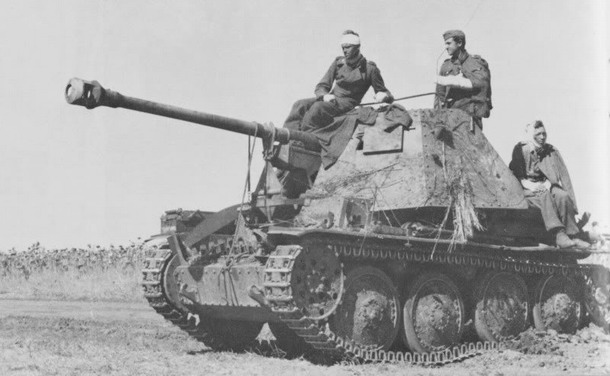
Marder III Ausf. H evacuating wounded soldiers. Source: Flickr.com, with the permission of the publishing user, edited.
The criticism of the early Marders from combat units evidently reached the designers at BMM in Prague. Some shortcomings were beyond easy remedy, but others were addressed relatively simply. Among the easy fixes was designing a new, more robust forward barrel support with remote retraction by the driver – an improvement introduced on the second production series. The Prague manufacturer apparently also attempted to improve the fighting compartment armour. Photographs show that a test vehicle was produced with side armour raised to the same height as the gun shield, the sides then tapering sharply down toward the engine deck at the rear. The rear and roof remained open even in this version. It was a genuine effort, though the result was not particularly successful in practice. Moreover, by the time this modified prototype appeared, it was already clear that the next generation of the PzKpfw 38(t)-based tank destroyer would look completely different from the Sd.Kfz. 139. The prototype with the raised side armour never entered production. Its appearance can be seen in photographs HERE and HERE (source: Flickr.com).
The Sd.Kfz. 138 Ausf. H Version
As early as the beginning of May 1942, during his discussions with Armaments Minister Speer, Hitler had made clear that he did not regard the PzKpfw 38(t) as a vehicle with a future and strongly preferred to use the available tank chassis for better-armed tank destroyers. Even at that stage Hitler had ordered that if sufficient converted ex-Soviet 76.2 mm guns for the Sd.Kfz. 139 were not available – which sooner or later was inevitable – a different tank destroyer on the same chassis should be developed, adapted to carry the German 75 mm Pak 40 anti-tank gun. On 18 May 1942, Speer's ministry accordingly tasked the Waffenamt with opening discussions with ČKD (BMM) on this subject. ČKD soon received an order to prepare by July 1942 a design for a new tank destroyer on the PzKpfw 38(t) chassis armed with the Pak 40. The Berlin firm of Alkett apparently assisted with the development once again.
In record time, the designers drew up plans and the workers built the first prototype. It was based on the chassis of an older Ausf. E, F or G tank (sources disagree) that happened to be undergoing repairs at ČKD. The prototype underwent successful firing trials at the Milovice proving ground as early as 30 June 1942 – a remarkable achievement. The designers had pulled off a genuine coup: not only did the new vehicle address most of the problems that had plagued the first Marder, but its construction also required far fewer modifications to the original tank chassis and hull. This promised the possibility of relatively straightforward conversion of older tanks returning to the factory for overhaul.
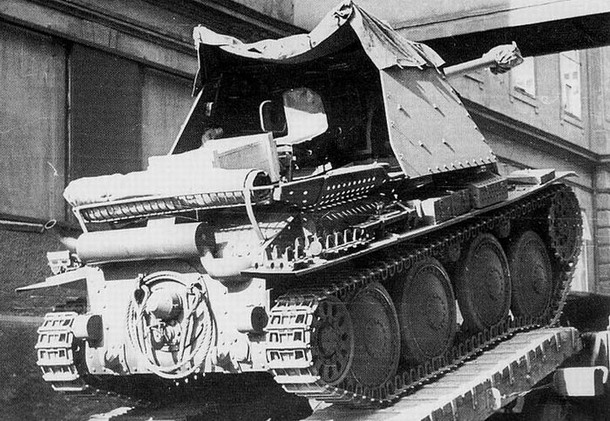
A new Marder III Ausf. H being driven up a ramp onto a railway wagon. Source: Flickr.com, with the permission of the publishing user, edited.
This second tank destroyer on the PzKpfw 38(t) chassis also appeared in various official documents under many different designations – among them the early designation 7.5 cm Pak 40 auf Pz.Kpfw. 38(t) and the later Panzerjäger 38 für 7.5 cm Pak 40/3. Its ordnance code was unambiguous: Sd.Kfz. 138. Like its predecessor, this vehicle ultimately went down in history under the simple combat name Marder III, assigned by Hitler himself in November 1943. To distinguish it from the older Marder III (the Sd.Kfz. 139), the newer one is commonly referred to as the Marder III Ausf. H (since it was built on chassis originally intended for Ausf. H tanks). We will use this designation throughout the remainder of the text.
The roof plate of the crew compartment that had originally carried the turret was again removed and replaced. The new plate extended beyond the side walls of the original crew compartment, projecting over the track mudguards on both sides. This new plate formed both the roof of the hull and the floor of the new fighting compartment above it. Around this compartment rose a fixed superstructure riveted from 15 mm armour plate. The front section of the superstructure consisted of two fixed plates on either side and the rounded movable gun shield in the centre, which linked to both plates and filled the space between them. As the gun was traversed, the shield moved laterally with it.
Both the gun and the entire armoured superstructure were positioned further forward on the Marder III Ausf. H than on its predecessor. The armoured fighting compartment thus began immediately behind the front wall of the driver and radio operator's compartment. This meant that neither man could have an entry hatch directly above his seat, and both had to squeeze through two openings in the floor of the fighting compartment behind them. These two crew members were therefore the best-protected members of the crew, but in the event of an emergency exit from the vehicle – especially if wounded – their situation was considerably more difficult.
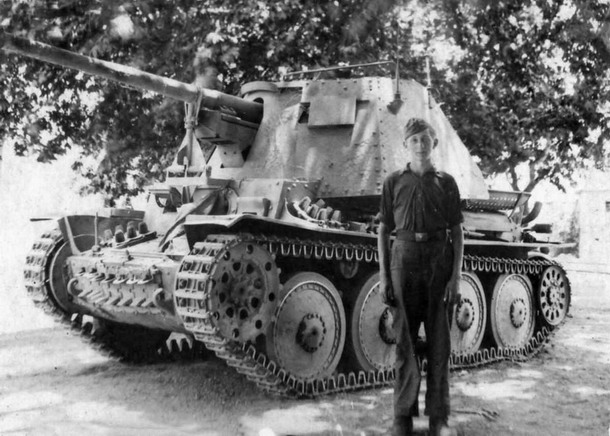
A young soldier (probably a mechanic rather than a crew member) poses for a souvenir photograph with a Marder III Ausf. H. Source: Worldwarphotos.info, with the permission of the site operator, edited.
The fighting compartment housed the Pak 40 anti-tank gun, mentioned many times already. Rheinmetall adapted it for installation in the new Marder with a horizontal T-shaped pedestal mount; so modified, the gun received its own designation of Pak 40/3. The pedestal (and likewise the gun shield) allowed a generous horizontal traverse of 56 degrees – 28 degrees either side of centre (though some sources give only 50 degrees total). Vertical elevation ranged from -9 to +9 degrees. The gun used a Z.F. 3x8 sight (Z.F. = Ziel Fernrohr) with 3× magnification and an 8-degree field of view. The sight was mounted on the left side of the gun, and a separate aperture in the fighting compartment front armour accommodated it, closed by a sliding cover. To prevent the long barrel from vibrating during faster movement, the vehicle again had two barrel supports: one on the fighting compartment floor securing the recoil trough, and another on the edge of the driver and radio operator's front armour in which the barrel itself could be rested.
The Pak 40 had a barrel 345 cm long, equating to 46 calibres. The standard anti-tank round was the Panzergranate 39, with a 6.8 kg projectile leaving the muzzle at 790 m/s. At 500 metres it could penetrate 96 mm of sloped homogeneous armour; at one kilometre, 85 mm; and at 1,500 metres, 74 mm (though, as usual, other figures can also be found). A second anti-tank round, the Panzergranate 40, was a 4.1 kg sub-calibre projectile with a tungsten core, reaching 990 m/s at the muzzle and penetrating 120 mm at 500 m, 97 mm at 1 km and 77 mm at 1.5 km. The Marder III Ausf. H carried 38 rounds for the gun. Secondary armament remained the MG 37(t) hull machine gun and an MP 38 submachine gun carried loose inside the vehicle. 600 rounds were stowed for the machine gun and 192 for the submachine gun.
The overall height of the Marder III Ausf. H remained the same as on the earlier tank destroyer (according to some sources it even increased by 1 cm), yet the problem of the dangerously elevated gun crew position was nonetheless successfully resolved – by a very simple means. As already noted, the floor of the fighting compartment had large crew entry openings on either side of the gun, for the driver and radio operator. These openings had no covers and were permanently open. Small padded seats were positioned at the edge of the floor behind these openings. The two gun crew members – loader and gunner – therefore sat on these seats with their legs hanging down through the entry openings into the hull interior, essentially at floor level, from which position they could fully operate the weapon without needing to stand up (photo HERE). Both men thus remained effectively "inside" the armoured superstructure, protected from the front and sides. Compared to the older Sd.Kfz. 139, where the crew stood almost unprotected high above the ground, this was a major improvement. The seats apparently had no backrests, making longer road marches rather uncomfortable – but that was an acceptable trade-off for greater safety.
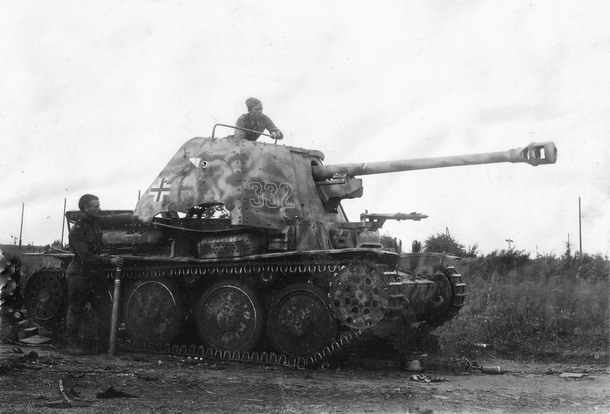
A knocked-out and abandoned Marder III version H, captured by Red Army soldiers. Source: Waralbum.ru, with the permission of the site operator, edited.
The engine deck remained in essentially the same form as on the original PzKpfw 38(t) tank. Above it, however, a new shallow "tray" was constructed, formed on the sides from perforated upward-bent sheet metal and at the rear from wire mesh of the same profile. The space above the engine section was completely unprotected by armour, and the tray served primarily to catch the empty cartridge cases automatically ejected from the gun after each shot. The crew of course also used this space to store personal belongings, food and anything else they needed to bring with them.
The crew of the Marder III Ausf. H again numbered four. The driver sat on the right of the hull and the radio operator on the left; the radio operator was also responsible for operating the hull machine gun. The other two crew members had their positions in the gun fighting compartment: the loader to the right of the gun and the gunner to the left, the latter also serving as vehicle commander. The fighting compartment armour protected these two men from the front and sides, but was completely open at the rear and only partially covered above. Both men could observe from the fighting compartment simply by looking over the armour edge, or more safely through upward-extending retractable periscopes – two for each man, one facing to the side and one forward. A waterproof tarpaulin fitted with celluloid windows could once again be erected over the fighting compartment in bad weather.
The Marder III Ausf. H was equipped with a Fu.Spr.Ger. "d" radio and an internal intercom. The radio was served by a simple rod antenna attached to the left side armour of the fighting compartment (though I have come across one photograph showing the antenna bracket on the right side). According to most sources, no specialised command vehicle with an expanded radio fit was developed on the basis of the Marder III Ausf. H.
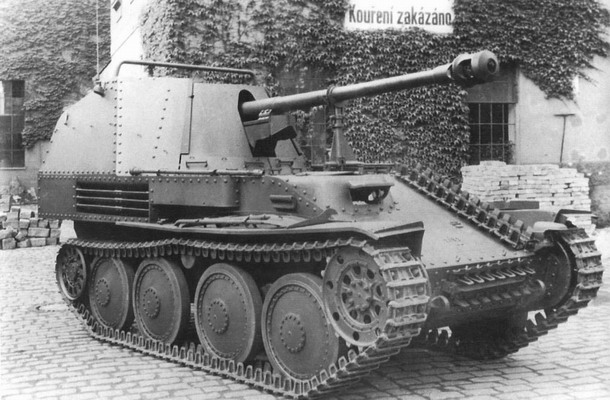
The third generation of the Marder III was designated Ausf. M. Source: Praga archive, with the permission of the company's representative, edited.
The Ausf. H weighed 10,800 kg, measured 5.77 metres in length, 2.16 metres in width and 2.51 metres in height (though, again, slightly different figures can be found). Power came from the liquid-cooled six-cylinder Praga AC petrol engine producing 150 horsepower. The gearbox was again of the Praga Wilson type with five forward speeds and one reverse. The vehicle's maximum road speed was approximately 47 km/h.
As already noted, the first Marder III prototype with the Pak 40 gun underwent successful firing trials at the Milovice proving ground on 30 June 1942. This prototype differed from later production vehicles in only a few details, identifiable in surviving photographs: a different design of the gun sight sliding cover on the front armour, and wire mesh side panels in the tray above the engine compartment (comparison photo HERE).
Series production of the Marder III Ausf. H began seamlessly as production of the previous version (Sd.Kfz. 139) came to an end. The first 42 tank destroyers with the Pak 40 gun left the production halls in November 1942, followed by 68 more in December and 60 in January 1943. In February, production fell to 35 vehicles as some capacity was diverted to the manufacture of the Grille self-propelled howitzer. March 1943 saw 30 Marders, April 34, and finally in May 1943 the last 6 vehicles were completed. In total, 275 Marder III Ausf. H were produced between November 1942 and May 1943.
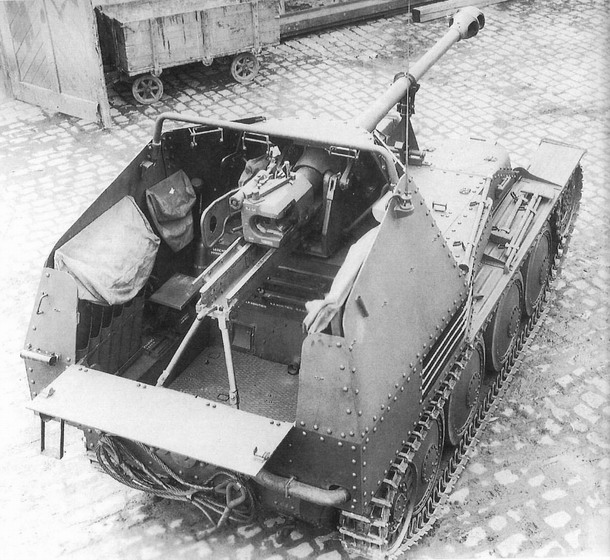
A view into the fighting compartment of the Marder III Ausf. M – the gun is secured in both front and rear barrel supports. Source: Praga archive, with the permission of the company's representative, edited.
Series production was now complete, but further vehicles continued to be built by converting older, already-used PzKpfw 38(t) tanks returning from the field. These conversions, however, did not take place at BMM in Prague but at its associated repair facility in Přelouč (Heeres Kraftfahrzeug Werkstatt Pschelautsch). Tanks of all variants, including the oldest Ausf. A, were converted there. According to Panzer Tracts, the first 18 were completed in May 1943, followed by 60 in June, 28 in July, 27 in August, 34 in September and the last 8 in October, for a total of 175 converted vehicles. Vladimír Francev, however, in his book states that conversions began as early as November 1942 and that the total was not 175 but at least 336, including conversions from earlier Marder III tank destroyers with the ex-Soviet 76.2 mm Pak 36 gun. Adding this to the new-build production, the total number of Marder III Ausf. H completed was either 450 (Panzer Tracts) or over 611 (V. Francev), depending on which author one believes.
Most new Ausf. H Marders were sent to combat units on the Eastern Front as replacements for tank destroyers lost in action. Some were also used to rearm units that had been decimated and withdrawn westward for reconstitution. When German units tallied their strength at the end of June 1943 ahead of the forthcoming Operation Zitadelle, they counted a total of 183 serviceable Marder IIIs with the 75 mm gun in their inventories – unfortunately without distinguishing between the Ausf. H and Ausf. M (which we will discuss shortly).
Although the Marder III Ausf. H was a more considered design than the older Sd.Kfz. 139, front-line unit reports still criticised similar shortcomings to those of its predecessor. The tank destroyer was under-armoured, too tall and too slow cross-country. The 6th Panzer Division's report of February 1943 includes a particularly interesting observation. Soviet tank attack tactics had changed compared to previous years, according to the division's commanders: rather than throwing tanks directly against German formations (which, despite the qualitative advantage of Soviet armour, ultimately only resulted in their destruction), the main mass of tanks now held back while only a few vehicles were sent forward on reconnaissance. In such a situation, the 6th Panzer Division argued, German units needed a vehicle capable of moving forward from safe positions to find and destroy the main enemy tank group. For this offensive style of combat, however, a heavily armoured vehicle was far more suitable than the Marder III. The StuG III assault gun (naturally in the late-production version with the long gun) was far better suited to this task. The 6th Panzer Division's representatives backed their views with statistics comparing the victories and losses of the divisional tank destroyer battalion and the divisional assault gun battalion. The report's conclusion made clear that if the 6th Panzer currently had any unit capable of countering enemy tank attacks, it was the Sturmgeschütz III assault gun battalion.
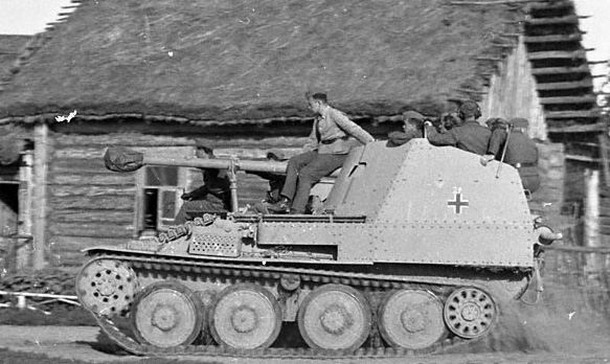
Marder III Ausf. M passing through a Russian village at speed. Source: Flickr.com, with the permission of the publishing user, edited.
The Sd.Kfz. 138 Ausf. M Version
From early 1943, the designers at BMM in Prague (again most likely with substantial input from colleagues at Alkett) were working on a new generation of the Marder III tank destroyer. Their aim was not only to eliminate the known faults of the earlier Marders but also to simplify the manufacturing process as much as possible – and no wonder, since for the second half of 1943 the Prague factory had received from the German authorities the highly ambitious production quota of 150 vehicles per month. On 7 February 1943, Armaments Minister Speer reported to the Führer that work was under way on a new version of the tank destroyer in which the engine would be moved from the rear of the hull to its centre. The first prototype of the new Marder III was apparently completed before the end of February 1943. After brief testing, approval was given for series production to begin in May 1943.
The fundamental innovation of the third-generation Marder III was precisely this repositioning of the engine further forward. With the engine no longer at the rear, space was freed up at the back of the vehicle for the main crew fighting compartment, which could have a considerably lower floor. A lower floor meant that, for the same height of surrounding armour, the internal protected space was greater. The gun crew could therefore work standing upright without their heads projecting above the surrounding armour. In this respect the new Marder combined the best features of both previous generations: the Sd.Kfz. 139 had allowed the gun crew to stand while operating the weapon, but with almost no armour protection; the Marder III Sd.Kfz. 138 Ausf. H had sheltered the crew behind armour, but they had to sit on the floor to work the gun, which was far from ideal. The new Marder offered both.
Let us take things in order. The running gear itself changed little compared to previous generations – essentially just one of the two return rollers supporting the upper run of the tracks was eliminated. The original tank hull, however, was substantially redesigned for the new generation. The radio operator's position in the left-hand forward section of the hull was completely eliminated. From the nose of the hull, a single flat plate now rose up, 15 mm thick and inclined at 67 degrees. On the right side, a raised space had to be created for the driver's head, achieved by riveting on an armoured housing that stepped up from the sloped roof plate. The cast housing had rounded edges and 15 mm thick walls. Its front face contained a closable visor for the driver, and above his head was a circular entry hatch with a two-part cover. An additional driver's visor was provided in the right-hand side wall of the hull. Immediately behind the driver was an armoured bulkhead, beyond which lay the engine section – housing the engine itself, both fuel tanks and the radiator. The engine was again of the Praga AC type, producing 150 horsepower at 2,600 rpm.
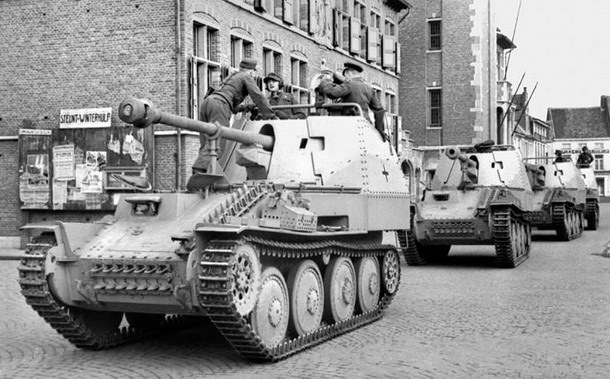
A column of late-version Marder III Ausf. M vehicles in Eeklo, Belgium. Source: Wikimedia, Bundesarchiv Bild 101I-297-1729-23, Creative Commons, edited.
Cooling air was drawn in through concealed intakes on both sides of the engine compartment and expelled through a large grilled opening further back on the right side of the fighting compartment (as shown in the photograph HERE). The engine exhaust was routed through a long exhaust pipe that ran, concealed beneath the armour, along the right side of the fighting compartment. Only at the rear wall did the pipe exit from beneath the armour, terminating in a large cylindrical silencer mounted on the rear wall of the superstructure.
Behind the engine, separated from it by an armoured bulkhead, was the main fighting compartment. It was protected on essentially all sides by 10 mm armour (though the rear wall was rather low). The side armour was permanently riveted to the hull; the front armour, by contrast, moved laterally together with the gun barrel. The upper section of the rear wall of the compartment above the exhaust silencer could be folded down flat, facilitating crew access and ammunition loading. Given the open roof of the fighting compartment, the Ausf. M was also equipped with a waterproof tarpaulin that could be stretched over the compartment and secured externally to the armour.
Like its predecessors, this generation of the Marder III received several official designations. To distinguish it from the previous version, the newer vehicle took the designation Ausf. M, where the M stands for Mitte, meaning centre – a reference to the mid-mounted engine position (though this is not entirely certain, as the Germans themselves often referred to the engine position as "engine forward" – Motor vorn or vorversetzter Motor).
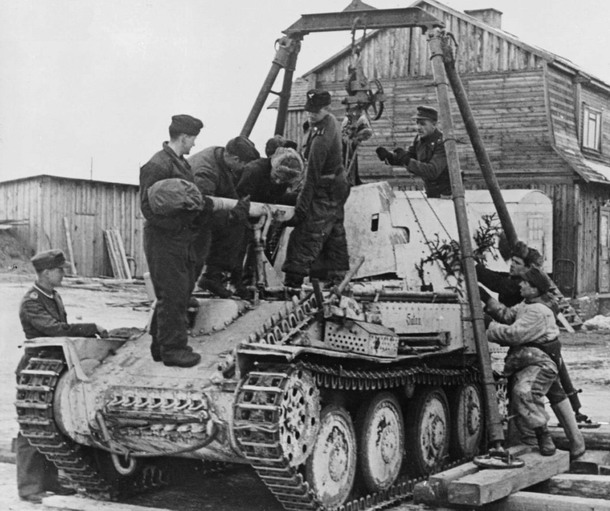
Marder III Ausf. M during a field gun change. Source: Flickr.com, with the permission of the publishing user, edited.
The main armament of the new Marder III was, as on the previous generation, the 75 mm Pak 40/3. The gun barrel measured 345 cm – 46 calibres. To prevent the long weapon from vibrating during movement, it was secured in two supports: a folding front support beneath the barrel and a rear support fixing the recoil trough. The standard anti-tank round was the Panzergranate 39 with a 6.8 kg projectile leaving the muzzle at 790 m/s, penetrating 96 mm of sloped homogeneous armour at 500 m, 85 mm at 1 km and 74 mm at 1.5 km (though, as always, other figures can be found). The Panzergranate 40 sub-calibre round with a 4.1 kg tungsten-core projectile achieved 990 m/s at the muzzle, penetrating 120 mm at 500 m, 97 mm at 1 km and 77 mm at 1.5 km.
The onboard ammunition supply for the gun was 38 rounds – 12 along each side wall of the compartment and the remainder apparently below the fighting compartment floor. With the radio operator's position eliminated, the hull machine gun also disappeared from the new Marder. The vehicle thus had no integral anti-personnel weapon. However, the crew carried an MG 42 machine gun on board, hung over the edge of the front armour. For close-in defence the crew also had an MP 40 submachine gun and their personal sidearms.
The crew of the Marder III Ausf. M numbered four. The driver was the only one seated in the hull, completely separated from his colleagues by the engine compartment. The remaining three – commander, gunner and loader, the last of whom also operated the radio – had their positions in the rear fighting compartment. The gunner's seat was to the left of the gun, where the gun sight and controls were also located; the sight lens protruded through a small cutout in the front armour. The loader sat to the right of the gun. On the rear wall of the compartment two further seats were mounted, available for the vehicle commander as he saw fit. For safe observation of the battlefield, four retractable periscopes were provided in the fighting compartment, extending above the armour: two pointing directly forward and two angled to the sides.
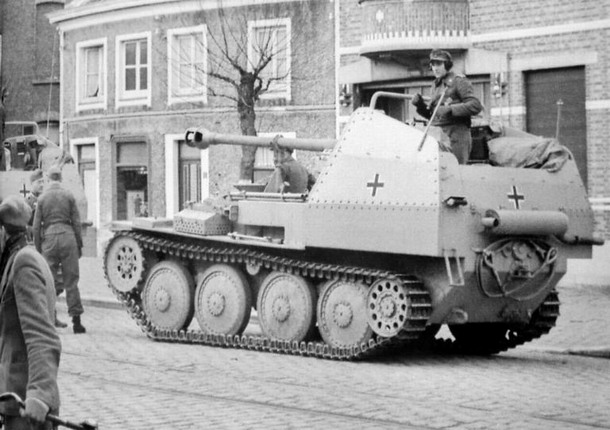
Late-version Marder III Ausf. M with welded hull construction. Source: Flickr.com, with the permission of the publishing user, edited.
The first series-production Marder III Ausf. M vehicles had rear track mudguards with cutouts serving as crew boarding steps. Very shortly after production began, however, these mudguards were eliminated (apparently to simplify manufacture) and boarding steps were instead fitted to the left side of the rear fighting compartment wall (photo HERE). Further engineering changes were also introduced during production. Apparently as early as July 1943, the routing of the exhaust pipe was revised: the pipe now exited the hull on the side and ran rearward alongside but outside the armour (photo HERE). The reason for the change was apparently that when the pipe ran under the armour, it passed directly beneath the ammunition stowage boxes along the right side wall of the compartment, causing unintentional and potentially dangerous heating of the rounds. In December 1943 a significant structural innovation was introduced: instead of the previous assembly method using rivets and bolts, electric welding now became the primary joining method for the hull.
The driver's raised housing was now also welded rather than cast. In contrast to the original rounded cast version, the welded housing was angular. Similarly angular were now the air intake covers on the sides of the engine compartment. At the same time, the front hull plate was thickened from 15 to 20 mm – not to improve passive protection, but to increase structural rigidity. Finally, the hull side plates were extended forward at the front near the drive sprockets and provided with drilled holes for attaching tow cables (a comparison can be seen HERE).
Standard combat Marder III Ausf. M vehicles were equipped with a Fu.Spr.Ger. "f" radio set (a later switch to the Fu5 set was apparently planned). The radio was suspended on the right side wall of the fighting compartment and operated by the loader. The rod antenna was attached to the right side armour of the compartment. The Ausf. M was the first of the Marder III family for which a documented purpose-built command version was produced. Designated Befehlsjäger 38 Ausf. M, it carried the standard Fu.Spr.Ger. "f" set plus a second, more powerful Fu8 transmitter. The second radio replaced the ammunition stowage rack for 12 gun rounds on the right side of the compartment. The command Marder remained fully armed and combat-capable, though its onboard ammunition supply was reduced from the standard 38 to 26 rounds. The second transmitter was accompanied by a second antenna, of the Sternantenne d type with a star-shaped branched tip.
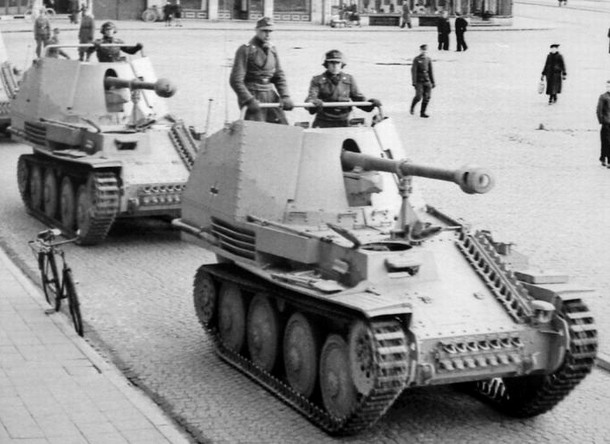
A column of late-version Marder III Ausf. M vehicles in Eeklo, Belgium. Source: Flickr.com, with the permission of the publishing user, edited.
The new vehicle layout, with the engine in the middle and the fighting compartment at the rear, produced a substantially better weight distribution. The long gun barrel, moreover, no longer projected at all beyond the vehicle's footprint, greatly simplifying driving in both cross-country terrain and urban environments. Moving the gun further rearward did, however, bring one unexpected complication: the muzzle was now uncomfortably close to the driver's entry hatch. If the driver forgot or failed to close his hatch before the gunner fired, the experience was rather unpleasant. The Marder III Ausf. M weighed 10.15 tonnes, making it the lightest of all three generations. At 5,020 mm in length it was also the shortest (with zero barrel overhang) and, at 2,350 mm, the lowest of all three variants, thanks to the lowered fighting compartment floor and armour.
The first 20 Marder III Ausf. M vehicles were completed on schedule in May 1943. From that point, production grew steadily, peaking at 141 vehicles in October 1943. It then declined again, primarily because part of the Prague factory's capacity had to be devoted to work on new fighting vehicles (the Grille self-propelled howitzer, the Flakpanzer 38(t) anti-aircraft tank and others). Production of the final Marder III generation continued until May 1944, when the 942nd vehicle was completed. Adding up the combined production totals of all three Marder III generations is unfortunately not straightforward, due to contradictions in the literature and the uncertain number of non-series conversions. What can be said with reasonable confidence is that at least 1,736 Marder IIIs were built in total – an impressive figure that underscores the significance that the originally Czechoslovak PzKpfw 38(t) design, and the Prague ČKD factory as a whole, held for the German war machine.
Organisational Structure
As already noted above, Marder IIIs were organised into tank destroyer battalions (Panzerjäger Abteilung), which existed both as integral elements of armoured (and infantry) divisions and as independent units directly subordinate to Army command (Heeres Panzerjäger Abteilung). For simplicity, the following description focuses on divisional battalions. German Panzer divisions had had their own integral anti-tank battalions for some time, originally designated Panzerabwehr Abteilung and armed only with towed guns, mostly 37 mm calibre. With the arrival of the new Marder III (and Marder II) tank destroyers, individual companies within these battalions began to be converted into self-propelled tank destroyer companies in accordance with the revised organisational table KStN 1148a issued in February 1942.
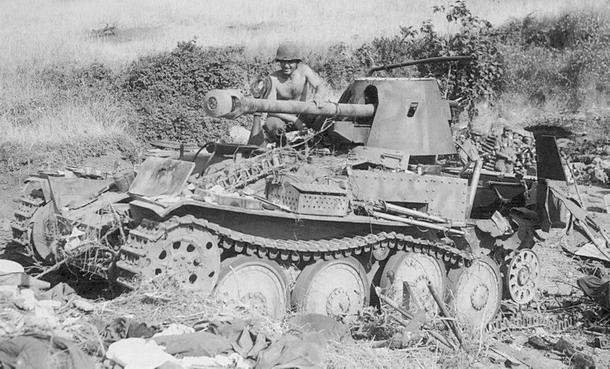
An American soldier beside the shattered wreck of a Marder III Ausf. M. Source: internet, public domain, edited.
Under this table, a tank destroyer company was to have three platoons of three Marders each, giving a complete company nine tank destroyers. A battalion of three companies therefore had 27 in total. Initially, however, only individual companies within a battalion were re-equipped with the new vehicles, not the entire battalion. In December 1942, organisational table KStN 1148a was revised: a self-propelled anti-tank company within a divisional battalion was now to have three combat platoons of three Marders each plus one command Marder at company headquarters – ten Marders per company and thirty in a complete battalion. A further update came in June 1943: each company was to have three platoons of four tank destroyers each plus two more at company headquarters, giving 14 Marders per company. Three companies thus gave 42 tank destroyers, to which a further three command tank destroyers – newly allocated to battalion headquarters – were added, bringing the full Panzerjäger Abteilung establishment to 45 Marder tank destroyers in total. These were generally a mix of various Marder III versions and also Marder IIs. For completeness: a tank destroyer battalion had a total strength of 650 men and included, alongside the tank destroyers themselves, 22 reconnaissance motorcycles, 45 cars, 85 trucks, 13 half-tracked prime movers and one Sd.Kfz. 251 armoured personnel carrier.
As already noted, German units recorded counts of Marder IIIs with the Pak 40/3 gun without distinguishing between the Ausf. H and Ausf. M versions. Only combined figures for both variants are therefore available, and these show that the number of serviceable Marder IIIs with the 75 mm gun as of 31 December 1943 was 352 vehicles.
Special Conversions
In closing, a few unusual variants deserve mention. It is fairly well known that a prototype Marder III Ausf. M was built, converted to run on producer gas (wood gas). The reason was of course to conserve the increasingly scarce supply of petrol. A vehicle running on producer gas naturally could not match the performance of a petrol-powered one, but as it was intended only as a training machine, the reduced power was no great concern. The prototype was apparently built in the autumn of 1943. Two pressurised cylinders filled with compressed producer gas were fitted on the left side above the engine compartment, and the engine presumably also received a new carburettor. No more than one prototype is believed to have been built, as documented in factory photographs. Rather less well known is the fact that at least one example of the Marder III Ausf. H was similarly modified. This is confirmed by a surviving photograph of a vehicle with two pressurised cylinders stowed above the engine deck at the rear of the hull. This too was certainly a training machine, and was most likely also a one-off.
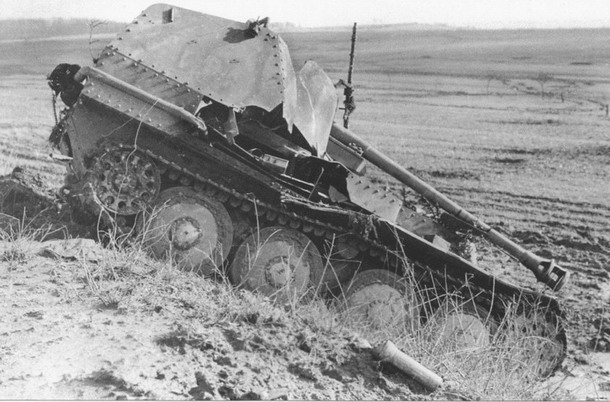
A destroyed Marder III Ausf. M wreck. Source: Flickr.com, with the permission of the publishing user, edited.
The Ausf. M chassis also gave rise to a prototype armoured personnel carrier capable of transporting both infantry and ammunition for other fighting vehicles. The proposed vehicle was designated Mannschafttransportwagen und Munitionstransporter auf Fahrgestell 38(t) Motor Mitte. It had no gun; the opening in the front armour where the gun had been was plated over with a steel panel. The armour of the fighting compartment was raised and extended on the sides and rear to create more interior space for the people being transported. Benches were fitted all around the compartment to accommodate approximately eight soldiers. Twin-leaf entry doors were fitted in the rear armour, with a folding step hanging beneath them. This too ultimately remained a single prototype.
Technical Data
|
|
Sd.Kfz. 139 |
Sd.Kfz. 138 H |
Sd.Kfz. 138 M |
|
weight: |
10.67 t |
10.80 t |
10.15 t |
|
length: |
5.85 m |
5.77 m |
5.02 m |
|
width: |
2.16 m |
2.16 m |
2.15 m |
|
height: |
2.50 m |
2.51 m |
2.35 m |
|
engine: |
Praga TNHPS/II / Praga AC |
Praga AC |
Praga AC |
|
engine output: |
125 hp / 150 hp |
150 hp |
150 hp |
|
max. speed: |
42 / 47 km/h |
47 km/h |
47 km/h |
|
range – road: |
185 km |
240 km |
200 km |
|
crew: |
4 men |
4 men |
4 men |
|
armament: |
PaK 36(r) gun, 76.2 mm 1× MG 37(t) machine gun, 7.92 mm |
PaK 40 gun, 75 mm 1× MG 37(t) machine gun, 7.92 mm |
PaK 40 gun, 75 mm 1× MG 42 machine gun, 7.92 mm |

ARTICLE
CONTENTS:
Reproducing text from the Panzernet website without the written consent of the operator is prohibited.