FLAKPANZER 38(t)
anti-aircraft gun on a proven chassis
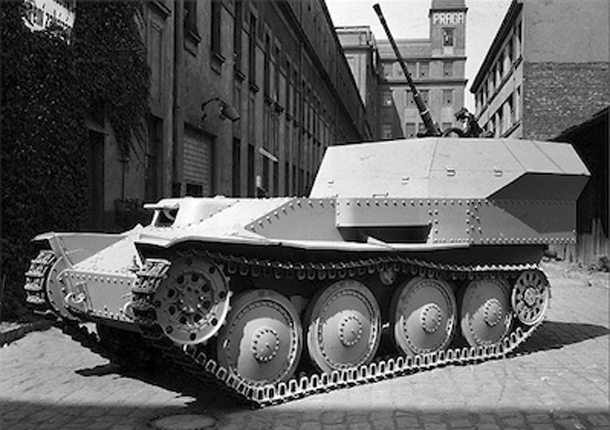
Flakpanzer 38(t) in the factory yard, source: Praga archive with permission of the company representative, edited
Origins of the Flakpanzer
From roughly mid-1943, problems with the anti-aircraft defence of German ground forces intensified sharply and had to be addressed with real urgency. The Luftwaffe could no longer extend its increasingly feeble protective cover over German units dispersed across a vast area. The only ground-based defensive means available at the time were towed anti-aircraft guns and self-propelled guns mounted on half-track prime movers.
Armoured units in particular lacked a self-propelled anti-aircraft vehicle capable of keeping pace with them across the most demanding terrain. The answer was the anti-aircraft tank (German: Flakpanzer) — an anti-aircraft weapon on a tank chassis. The primary platform for such vehicles became the medium tank Panzer IV, on whose chassis several Flakpanzer types were built during 1943 and 1944 — the Möbelwagen, the Wirbelwind, and the Ostwind.
Beyond this, the Germans also decided to use the proven chassis of the light tank Panzer 38(t) for the same purpose. To be precise, it was not actually the Panzer 38(t) chassis as such, since that tank had ceased production in 1943. Its chassis, however, continued to be manufactured — for the Marder III tank destroyer (and later also for the self-propelled gun Grille). Strictly speaking, therefore, it was the chassis of the Marder III tank destroyer that was used, specifically the Ausf. M variant.
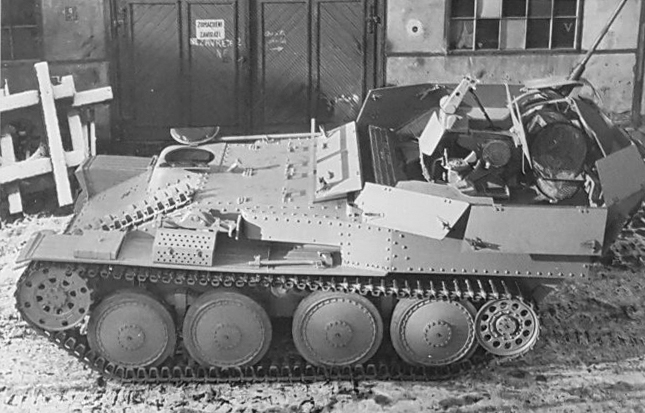
Flakpanzer 38(t) with the fighting compartment walls folded down, Praga archive with permission of the company representative, edited
Description of the Design
The letter M in the variant designation derived from the word Mitte (German for "middle"), as this version of the chassis had its engine mounted amidships. This arrangement left ample space at the rear for a fighting compartment, whose floor could moreover be positioned relatively low. The front section of the hull featured a very steeply angled roof plate. On its right side rose a small "box" protecting the driver's position, topped by a circular hatch closed by a two-piece lid. Behind the driver's station followed the engine compartment with a flat roof, and at the rear the fighting compartment, which extended well beyond the tracked running gear.
The fighting compartment was enclosed on all sides by armour plate but had no roof. The thickness of this armour was only 10 mm. The walls were angled, which increased their resistance to fire. Not only did the compartment lack a roof, but its walls were also relatively low and certainly did not provide the crew with complete protection. This was partly intentional, as the men aboard needed an unobstructed view of the sky. The upper portion of the compartment's armour was also foldable, allowing the weapon to traverse even at low elevation angles — for example when engaging ground targets.
Armament
Inside the fighting compartment was installed the automatic 20 mm anti-aircraft gun 2cm Flak 38. The mount allowed a full 360-degree traverse. Elevation could be adjusted from -10° to +90°, meaning engagement of ground targets was equally straightforward. Critics of the chosen weapon pointed to its relatively small calibre and limited effective ceiling. However, the new Flakpanzer was intended primarily to escort armoured columns, which were most commonly attacked by fighter-bombers making low-level diving runs. The range of the Flak 38 allowed it to engage aircraft flying at approximately 500 metres altitude at a distance of around two kilometres — entirely adequate for this purpose. Regardless of any pros and cons, the designers had little choice in the matter, since the Flak 38 was practically the only anti-aircraft weapon that could realistically be fitted to a light tank chassis. The gun did, however, have one significant advantage: a high rate of fire — in practice up to around 200 rounds per minute. A high rate of fire naturally increases the probability of hitting a fast-moving target such as an aircraft. The ammunition supply carried for the gun amounted to 1,040 rounds.
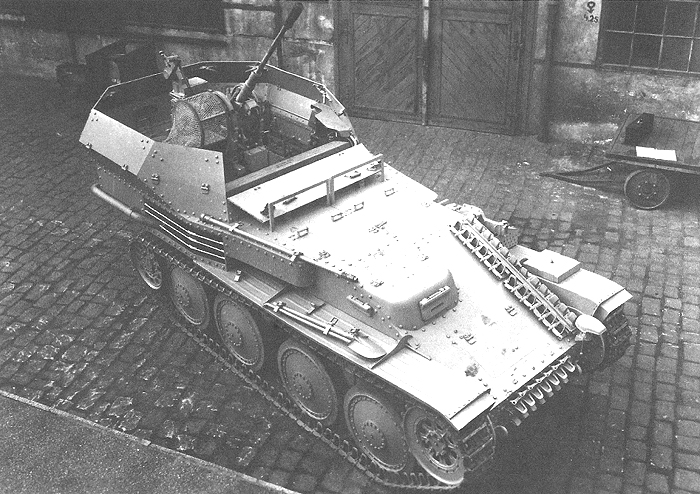
Flakpanzer 38(t) in the factory yard, side view, Praga archive with permission of the company representative, edited
The new anti-aircraft tank received the official designation 2cm Flak 38 auf Fahrgestell PzKpfw 38(t), though it is generally referred to simply as the Flakpanzer 38(t). From the outset of its development, this vehicle was regarded as a more or less temporary stopgap until other types of greater combat value could be made available. Series production began at BMM (formerly ČKD) in Prague in November 1943 and continued until February 1944, with a total of 141 vehicles completed. The Flakpanzer 38(t) weighed 9.8 tonnes and was capable of road speeds of up to 42 km/h. Its powerplant was inherited along with the chassis — a Praga AC petrol engine with a maximum output of 160 horsepower.
Flakpanzer 38(t)s were organised into anti-aircraft platoons and assigned to armoured units of both the Wehrmacht and the Waffen-SS. The majority were deployed on the Western Front. Only a handful survived to the end of the war; the rest were lost in combat.
Technical Specifications
|
weight: |
9.8 t |
|
length: |
4.61 m |
|
width: |
2.14 m |
|
height: |
2.25 m |
|
engine: |
Praga AC |
|
engine output: |
160 hp |
|
max. speed: |
42 km/h |
|
fuel capacity: |
218 l |
|
range – road: |
185 km |
|
range – cross-country: |
140 km |
|
crew: |
4 men |
|
armament: |
20 mm Flak 38 gun |

ARTICLE
CONTENTS:
Reproducing text from the Panzernet website without the written consent of the operator is prohibited.