JAGDPANZER IV
the tank destroyer that nearly replaced the Panzer IV tank
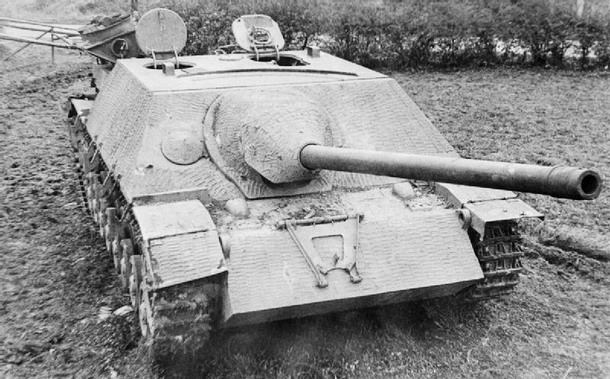
Panzer IV/70 (V) abandoned by its crew on the Western Front, source: Flickr.com with permission of the publishing user, edited
Origins
The story of the Jagdpanzer IV can, with some simplification, begin with the success of the StuG III assault guns in destroying Soviet tanks. To understand how we got there, we need to go back to 1941. Following the invasion of the Soviet Union in June of that year, the Wehrmacht was caught off guard not only by the sheer numbers of Red Army tanks but also by the quality of some of their types — particularly the modern T-34 and KV. The Germans were forced to fundamentally rethink their arsenal and boost their anti-tank capability. They pursued two parallel approaches. The first was to develop self-propelled anti-tank guns that, for the sake of speed, combined existing light tank chassis with available German and captured guns. The resulting vehicles — most notably the Marder I, Marder II, and Marder III series — packed powerful guns but lacked reasonable armour protection and were essentially regarded as stopgap solutions until proper next-generation tank destroyers could be made available. The second approach was the rapid rearming of existing combat vehicles with more powerful guns, primarily the Panzer IV tanks and StuG III assault guns.
Let us focus on the latter — the StuG III. This vehicle had originally been developed for general infantry fire support, but the overwhelming number of Soviet tanks gradually forced it to take on an increasingly prominent anti-tank role. In March 1942, the StuG was therefore rearmed from the original short StuK L/24 gun to the more effective StuK 40 L/43, better suited to its new purpose. In June 1942, an even more powerful gun with a barrel length of 48 calibres (L/48) followed. The StuG III was now a low-profile, mobile, solidly armoured, and heavily armed fighting vehicle, and its combat successes against Soviet tanks came swiftly. By mid-1942, the long-barrelled StuG III was the most well-rounded anti-tank weapon in the German arsenal, and it was only natural that the Germans decided to build on this success and develop a next-generation vehicle.
The requirements for the new assault gun — referred to as the Sturmgeschütz neuer Art — were drawn up by the German Ordnance Office (Waffenamt) in September 1942. It was clear from the outset that the vehicle's primary mission would be the destruction of enemy armour. The specifications called for a low-profile vehicle with 100 mm of sloped frontal armour, carrying a 75 mm gun with a barrel length of 70 calibres (L/70). This was to be an adapted version of the latest German tank gun, the KwK 42, developed for the newly introduced Panther tank. It is worth noting that at this stage the Germans still referred to the future vehicle simply as an assault gun, and no one had yet bothered to distinguish it as a tank destroyer — that distinction would come later.
the first mock-up of the future Jagdpanzer IV, featuring a wooden superstructure and gun model on a Panzer IV Ausf. F chassis, source: Flickr.com with permission of the publishing user, edited
Development of the new vehicle was entrusted to the firm Vomag (Vogtländische Maschinenfabrik AG). The original plan called for an entirely new chassis with wider tracks and greater ground clearance, but pragmatism ultimately prevailed and it was decided to base the vehicle on the existing Panzer IV chassis. It soon became apparent that the desired L/70 gun would not be available in the near future — production was only just getting underway and priority had been given to arming the Panther tanks. Waiting for the gun before proceeding with development was a luxury Germany could not afford in the middle of a war, so it was decided that the new assault gun would be fitted for the time being with the somewhat less powerful PaK 39 L/48 in 75 mm, with the intention of upgrading to the L/70 as soon as possible.
In May 1943, Vomag presented the first mock-up of the new vehicle. Mounted on a Panzer IV Ausf. F chassis was a wooden model of a low, fixed superstructure with a sharply sloped front plate. A dummy gun was fitted as well. The entire vehicle stood just 170 cm tall, which was considered the minimum acceptable height for operation and firing in the field. The mock-up was generally well received, but several changes were proposed. The most significant was a complete redesign of the hull nose. The presented model retained the standard Panzer IV hull with only a moderately sloped lower front plate — a design that was already considered outdated by mid-1943 (and one the Germans would have gladly changed on the tanks themselves, had mass production allowed for it). The army therefore demanded that the new assault gun feature a sharply angled nose made up of steeply sloped plates, which offered significantly better protection. Another proposed change was the addition of machine guns for close defence against enemy infantry (according to some authors this suggestion came only in July, following the negative combat experience with the Ferdinand tank destroyers, which lacked machine guns and suffered heavily at the hands of Soviet infantry).
First Prototype
Vomag revised the design accordingly, and the new vehicle received a hull with a sharp nose. The upper plate was 60 mm thick and angled at 45 degrees, the lower plate 50 mm thick at 55 degrees. The first full prototype, built from mild steel, was presented to the military in October 1943. It differed from future production vehicles only in a few details. The front face of the superstructure had rounded side edges, the gun carried a distinctive muzzle brake and a specially shaped mantlet, and on either side of the gun in the front plate were machine gun ports that could be closed with conical covers. The side walls of the fighting compartment also appear to have featured closeable circular ports for crew small arms fire.
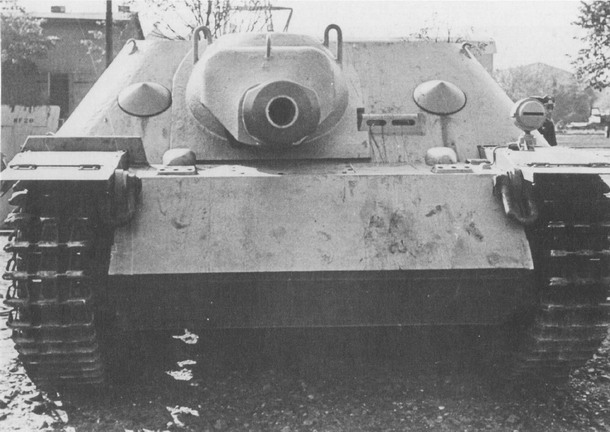
the first Jagdpanzer IV prototype, built from unarmoured mild steel, source: Flickr.com with permission of the publishing user, edited
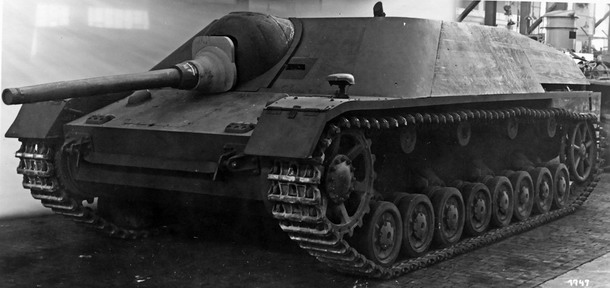
In December 1943, apparently two or three more prototypes were completed, this time with full armour. These were also based on the Panzer IV Ausf. F chassis. Their gun mantlet already matched the later production standard, but the rounded side edges of the front plate and the side-wall firing ports were still present. These vehicles are commonly referred to in the literature as the pre-production or "zero series." The prototypes apparently later served as training vehicles with instructional units, and at least one of them survived the war as a result — it is now held in the collection of the tank museum in Munster. (The observant visitor may notice that this particular vehicle has a small-arms port only in the left side wall of the fighting compartment, not in the right — a detail that, curiously, no published source seems to mention.)
The final pre-production change was a redesign of the superstructure's front face, replacing the rounded side edges with sharp right-angle corners. This was simpler to manufacture and also left room for easier armour reinforcement in the future. The army was now fully satisfied, and Vomag began series production in January 1944. In addition to the design designation Sturmgeschütz neuer Art, the vehicle had also been referred to during development as the Panzerjäger Vomag. Once production began, the official designation became Jagdpanzer IV Ausf. F — derived from the Ausf. F chassis used for the prototypes. Somewhat paradoxically, production vehicles were actually built on the Panzer IV Ausf. H chassis. Of all the names given to this vehicle, however, none spread more widely than Jagdpanzer IV L/48, taken from the gun designation. The vehicle's ordnance inventory code was Sd.Kfz. 162.
Jagdpanzer IV Ausf. F
As already mentioned, the production Jagdpanzer IV Ausf. F was built on the Panzer IV Ausf. H chassis (and later the Ausf. J). The original chassis naturally required a number of modifications. The service hatches for access to the steering brakes were reduced in size, the fuel tank and ammunition stowage arrangements were changed, the auxiliary engine and the generator for rotating the turret were removed, the escape hatch in the floor was repositioned, and the ducting that fed warm air from the engine compartment into the crew space was redesigned. The most significant change, however, was the sharp-nosed hull already mentioned. This proved a considerable engineering challenge, since the original hull had never been designed with such a feature in mind. The engineers managed it, but the result was not perfect. The pointed nose protruded well forward of the tracks, which meant the vehicle risked becoming grounded when crossing rough terrain. The overhang is clearly visible in a comparison photograph with the Panther (which had been designed with a sharp nose from the start), available HERE (source: Flickr.com).
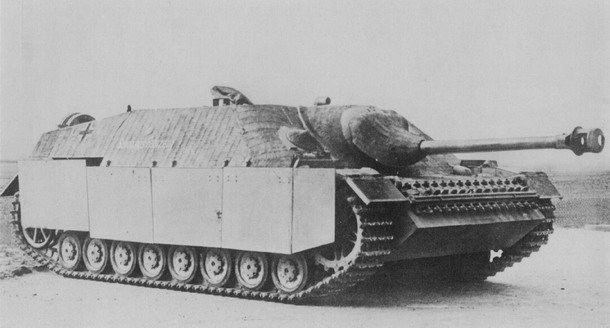
one of the pre-production "zero series" Jagdpanzer IV prototypes, still featuring rounded side edges on the superstructure front plate, source: Flickr.com with permission of the publishing user, edited
The Jagdpanzer IV Ausf. F had eight road wheels on each side, 470 mm in diameter, of solid construction with rubber cushion rims for a smoother ride. The wheels were paired, with the track guide teeth running through the gap between each pair. Road wheels were mounted in pairs on bogies: four brackets were bolted to the hull sides, each carrying two swing arms, one road wheel per arm. The two swing arms of each bogie were connected by a quarter-elliptic leaf spring. Four return rollers of 250 mm diameter with rubber rims supported the upper run of the track. At the front were the drive sprockets and at the rear the idler wheels. The vehicle ran on 400 mm wide tracks, each consisting of 99 links.
The fixed fighting superstructure was welded from flat armour plates. The front plate of the superstructure was 60 mm thick and sloped at 50 degrees. It was dominated by the gun, which was offset approximately 20 cm to the right of the vehicle's centreline. The gun was mounted in a large collar bolted rigidly to the front plate, with an opening cut to allow the barrel to traverse and elevate. This opening was covered by a cast mantlet slid directly onto the barrel — essentially the same arrangement as used on the light tank destroyer Hetzer. The distinctive shape of this mantlet earned it the nickname Saukopf, or "pig's head." The collar behind the mantlet can be clearly seen in photographs available HERE (source: Flickr.com) and HERE (source: Flickr.com).
The main armament was the 75 mm PaK 39 L/48 anti-tank gun. Firing the Pzgr. 39 armour-piercing round — weighing 6.8 kg with a muzzle velocity of 750 m/s — it could penetrate 96 mm of sloped homogeneous armour at 500 metres. Using the Pzgr. 40 sub-calibre round with a tungsten core (4.1 kg, 930 m/s), penetration rose to 120 mm. Ammunition stowage was 79 rounds for the gun and 1,200 rounds for the machine guns. Early production vehicles had the gun fitted with a muzzle brake. The gunner used a Sfl.Z.F.1a periscopic sight with five-times magnification. The gun could traverse 12 degrees to each side (some sources say only 10), and elevate from -8 to +15 degrees (figures of -7 and -5 degrees also appear in the literature). Any further adjustment required moving the entire vehicle. Given the gun's long effective range, even this limited traverse was generally more than sufficient.
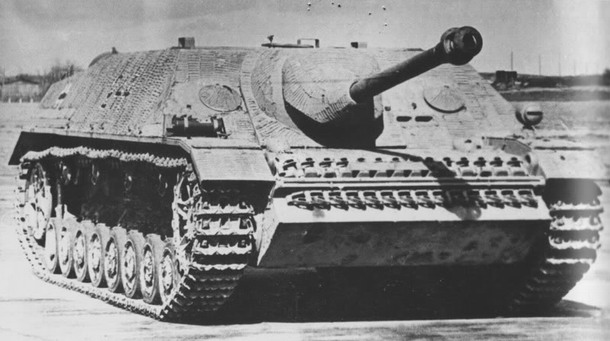
an early production Jagdpanzer IV Ausf. F with the early-pattern gun collar and spare track links on the hull nose, source: Flickr.com with permission of the publishing user, edited
To the left of the gun, in the lower portion of the front plate, were two vision ports for the driver. Slightly to the left and above these was a machine gun port closed by a low conical cover. An identical machine gun port with a conical cover was located to the right of the gun. In the forward part of the roof was a movable armour plate through which the periscopic gun sight was raised. In the left rear portion of the roof was the commander's entry hatch with a rotating periscope in the cover, and just ahead of it a smaller aperture for a binocular observation periscope. The right portion of the roof carried a second entry hatch with a round cover. Two fixed periscopes pointing to the sides were also mounted in the roof.
At the rear of the roof was the Nahverteidigungswaffe — a close-defence weapon designed primarily to deter enemy infantry. It was essentially a grenade launcher whose firing mechanism was housed inside the vehicle, with the barrel emerging through the roof. In addition to anti-personnel fragmentation rounds, it could fire smoke grenades, and a signal pistol could even be fired through its barrel. Deliveries of the Nahverteidigungswaffe were delayed from the very start, however, so a number of vehicles had to be completed without them, the prepared roof opening simply being covered by an armour plate. The fighting compartment's ventilator fan was positioned in an unusual location: at the very bottom right of the rear wall. The front plate of the superstructure was 60 mm thick at 50 degrees of slope. The side walls were angled at 30 degrees and were 40 mm thick (some authors give only 30 mm). The roof was 20 mm and the rear wall 30 mm thick.
Behind the fighting compartment was the engine compartment, its deck sitting only slightly lower than the superstructure roof. The rear wall of the fighting compartment was therefore very shallow — only about 25–30 cm — and the designers made use of it to stow the gun cleaning rods. The engine deck carried the usual tools: an axe, shovel, bolt cutters, starting crank, jack, and fire extinguisher. Large louvred grilles ran along the sides of the engine compartment. Cooling air was drawn in through the port on the left side, passed through the radiator, then around the engine block, and was expelled on the right side of the vehicle by two large fans. The exhaust system with its bulky silencer was located on the rear hull plate, alongside a wooden block used as a jack pad, and two spare road wheels.
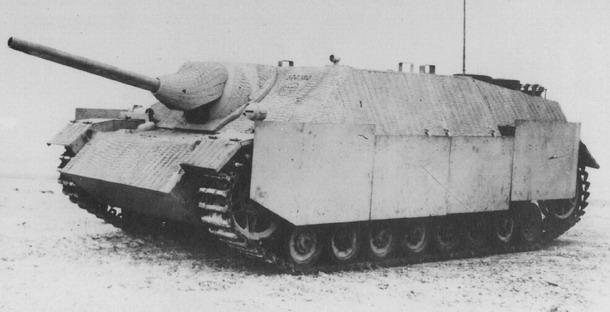
Jagdpanzer IV Ausf. F with the late-pattern gun collar, only the right machine gun port, spare track links on the hull rear, Zimmerit coating, and side skirts (Schürzen), source: Flickr.com with permission of the publishing user, edited
The engine itself was mounted longitudinally, slightly to the right of the vehicle's centreline. A driveshaft ran from it along the floor of the fighting compartment to the gearbox at the front of the hull. Both the engine and gearbox were inherited from the Panzer IV: the engine was the Maybach HL 120 TRM, producing a maximum of 300 hp at 3,000 rpm, and the gearbox was the Zahnradfabrik SSG 76, offering six forward gears and one reverse. Fuel capacity was 470 litres, giving a road range of approximately 210 km and a cross-country range of around 130 km.
The Jagdpanzer IV Ausf. F had a combat weight of approximately 24 tonnes and a top road speed of around 40 km/h. Overall height was just 186 cm, while the gun's firing height above the ground was only 140 cm. The standard vehicle was equipped with a Fu5 radio set, capable of both transmitting and receiving. The set was mounted in a metal frame suspended at the rear of the fighting compartment, against the wall separating the crew space from the engine compartment. A simple rod aerial was attached at the right rear corner of the superstructure. Operation of the radio was the responsibility of the loader.
The standard crew consisted of four men. The driver sat alone at the left front of the hull. To his right was the gearbox, above which the gun collar was mounted. To the right of the gearbox was a rack holding 11 rounds of 75 mm ammunition, and just above it was the right machine gun port in the front plate. The gunner sat on a folding seat to the left of the gun and used the monocular periscopic sight raised through the roof aperture. When required, he also took on the role of machine gunner, firing through the port in the left side of the front plate. Beneath the gunner's seat was the emergency escape hatch in the floor. Behind the gunner sat the commander, and to the right of the gun the loader had his position. The loader's responsibilities extended well beyond loading: if needed, he operated the machine gun on the right side of the front plate, managed the radio, and handled the Nahverteidigungswaffe if one was fitted. A command variant also existed, carrying an additional Fu 8 radio set and a fifth crew member dedicated solely to operating it. Command vehicles gained a second rod aerial — this one with a star-shaped branching tip — mounted at the left rear corner of the fighting compartment.
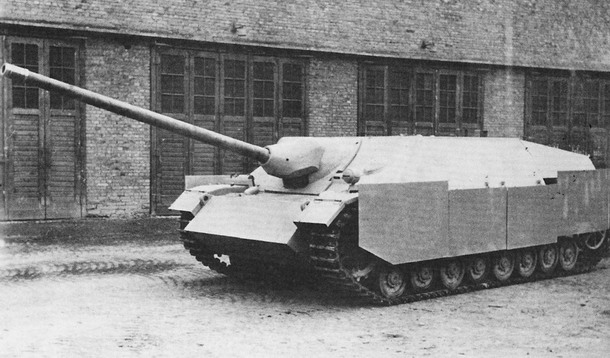
the first Panzer IV/70 (V) prototype, built on a Jagdpanzer IV Ausf. F chassis with hull number 320162 — already fitted with the new L/70 gun but still with the early-pattern gun collar; the barrel support has not yet been installed, source: Flickr.com with permission of the publishing user, edited
Production and Improvements
Series production of the Jagdpanzer IV Ausf. F began in January 1944 at the Vomag factory in Plauen, Saxony (German: Plauen). Initially Vomag assembled the new tank destroyers alongside the standard Panzer IV tanks. Tank production was gradually wound down and finally ceased altogether in May 1944, allowing the factory to concentrate exclusively on the Jagdpanzer IV. Naturally, a large number of subcontractors were involved, including the Vítkovice ironworks (operating at the time under the German name Witkowitzer Bergbau und Eisenhütten Gewerkschaft). Production of the Jagdpanzer IV Ausf. F continued until November 1944, with a total of 784 units delivered (some sources give 769). Production vehicles were routinely coated with Zimmerit anti-magnetic paste and fitted with 5 mm side skirts (Schürzen).
As was typical, a number of running improvements were introduced during the production run. As early as March 1944, the machine gun port on the left side of the front plate was eliminated. It had proven extremely awkward to use, as the gunner had to lean across the driver while also contending with the gun sight mount in his way. The right front port and the Nahverteidigungswaffe in the roof would have to suffice for anti-infantry defence. Vomag had already stockpiled a quantity of front plates with the left port cut out, so until these were used up, the opening in new vehicles was simply welded shut with a solid armour plug.
Perhaps the most significant improvement came in May 1944: the upper front hull plate and the superstructure front plate were both increased in thickness from 60 to 80 mm. This substantially improved the vehicle's protection, but at the cost of shifting the centre of gravity noticeably forward. The Jagdpanzer IV Ausf. F had already been fairly nose-heavy, putting strain on the steering brakes, final drives, and front road wheels. With the additional frontal armour the problem became unacceptable, and engineers searched for every kilogram they could remove from the front of the vehicle. The lower portion of the gun collar beneath the barrel was narrowed (see the comparison photograph HERE, source: Flickr.com), and the spare track links were moved from the hull nose to the rear engine deck. The two spare road wheels that had previously hung there were consequently relocated to the engine deck lid.
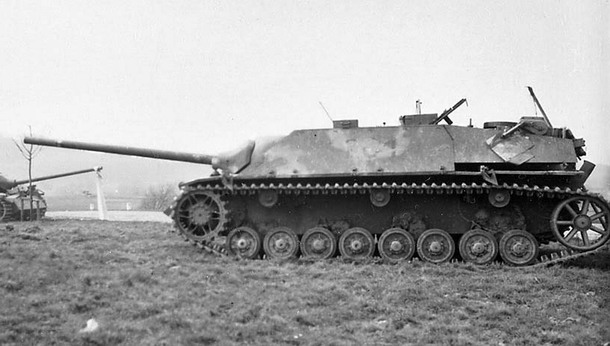
a knocked-out Panzer IV/70 (V) on the Western Front, with all road wheels fitted with rubber rims and only three return rollers, source: Waralbum.ru with permission of the operator, edited
The designers managed to kill several birds with one stone by removing the gun's muzzle brake. This saved the much-needed weight at the front of the vehicle, simplified manufacture, and addressed complaints from frontline units. Given the gun's very low firing height above the ground, firing with a muzzle brake had kicked up a large cloud of dust that completely obscured the gunner's view, preventing him from observing the round's trajectory and correcting his aim. Test firing confirmed that the recoil mechanism handled the gun's recoil perfectly well without a muzzle brake, so its removal was straightforward — besides, many crews in the field had already removed theirs without waiting for official authorisation. The threads left on the barrel after removal of the muzzle brake are clearly visible in the photograph available HERE (source: Flickr.com).
From September 1944, the large exhaust silencer on the hull rear was replaced by two much simpler pipes — the so-called Flammentöter — connected directly to the exhaust manifold and pointing upward. The vehicle was noisier as a result, and more prone to visible exhaust flame at night (which gave away its position), but this was an acceptable trade-off for the savings in production cost. Also in September 1944, the number of track return rollers was reduced from four to three.
The Jagdpanzer IV Ausf. F was a remarkably well-conceived fighting vehicle. Its frontal armour was, thanks to both thickness and slope, almost incredibly resilient — its effective protection actually exceeded that of the legendary heavy tank Tiger. Its low silhouette made it a very difficult target to hit, and greatly simplified camouflage, allowing it to take enemies by surprise — qualities that made it particularly well suited to defensive fighting. Critics, however, rightly pointed out its relatively weak armament. Equipped only with the PaK 39 L/48, it was in combat terms no more powerful than a StuG III assault gun — which was cheaper to produce and did not consume chassis that could otherwise be used to build tanks (since the StuG III was built on the Panzer III chassis, which was no longer being produced as a tank in its own right).
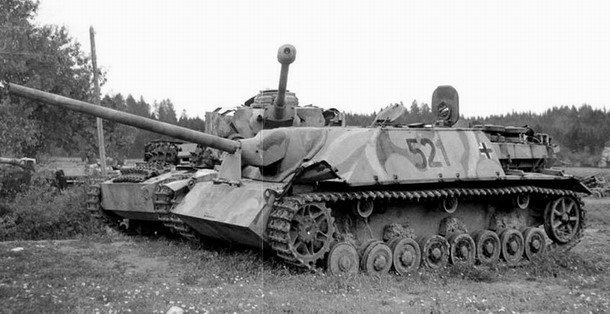
Panzer IV/70 (V) at a German vehicle collection point, source: internet, Public domain, edited
Panzer IV/70 (V)
It was therefore no surprise that right at the start of Jagdpanzer IV Ausf. F series production in January 1944, Hitler again pressed his demand that the vehicle be rearmed as soon as possible with the more powerful gun with a 70-calibre barrel. Rheinmetall was by then already working intensively on adapting the 7.5 cm KwK 42 L/70 tank gun for this new role. The resulting weapon was designated by some sources as the 7.5 cm StuK 42 L/70 (StuK = Sturmkanone = assault gun), and by others as the 7.5 cm PaK 42 L/70 (PaK = Panzerabwehrkanone = anti-tank gun). Apparently as early as March 1944, the new weapon was experimentally fitted into a Jagdpanzer IV Ausf. F with hull number 320162, and on 6 April, photographs of the newly armed vehicle were presented to the Führer. Hitler was enthusiastic, calling it the most significant new German armoured vehicle. The prototype was formally shown to him at his traditional birthday weapons presentation on 20 April 1944. Hitler demanded that mass production begin immediately — he was so taken with it that he even proposed halting Panzer IV production entirely and redirecting all freed-up capacity to the new tank destroyer (more on that later).
Photographs show that the first prototype was also tested with a roof-mounted machine gun operated from inside the fighting compartment. Unfortunately it turned out that there was insufficient interior space for the crew to operate this weapon effectively, and it was not adopted. During development, the vehicle went by the name Panzerjäger Vomag L/70; Hitler's preferred designation was Panzer IV lang (V), but the official name that ultimately stuck was Panzer IV/70 (V) — the letter V standing, of course, for Vomag. Vomag began production of the rearmed tank destroyer apparently in August 1944 (some sources say as early as May of that year). Vehicles with the L/70 gun were thus produced in parallel with the older L/48 version, with the proportion of the more powerfully armed machines gradually increasing until they accounted for 100% of output in November 1944 — a month in which 178 units were completed.
The new gun had similar traverse and elevation figures to the original: 12 degrees to each side horizontally (some sources say 10), and from -7 to +15 degrees vertically (again, -5 degrees also appears in the literature). The Sfl.Z.F.1a periscopic sight with five-times magnification was retained. The barrel length was an impressive 525 cm. To balance such a long barrel, a hydro-pneumatic equilibrator was installed to the right of the gun mount inside the fighting compartment, and a small iron counterweight was welded to the rear of the recoil guard.
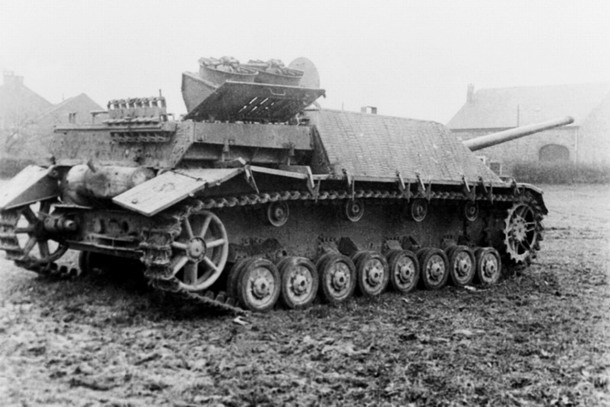
an abandoned Panzer IV/70 (V) — an early vehicle still fitted with the original exhaust silencer and rubber-rimmed road wheels; the open engine deck reveals the twin large cooling fans, source: Flickr.com with permission of the publishing user, edited
Armed with the StuK 42 L/70 (or PaK 42 L/70), the vehicle became a genuine tank killer. The gun used three types of ammunition: the high-explosive Sprgr. 42, and two types of armour-piercing rounds — PzGr. 39/42 and PzGr. 40/42. The Panzergranate 39/42 was a conventional armour-piercing shell with a small bursting charge that detonated after penetrating the enemy tank's armour. It weighed 6.8 kg and left the muzzle at approximately 925–935 m/s. At one kilometre it could penetrate around 111 mm of sloped homogeneous armour. The PzGr. 40/42 was a sub-calibre round with a tungsten carbide core, weighing 4.75 kg and achieving a muzzle velocity of around 1,120 m/s. From a kilometre it could defeat sloped armour up to 149 mm thick (it should be noted that figures vary considerably across the literature).
Beyond the armament, the original Jagdpanzer IV Ausf. F and the new Panzer IV/70 (V) differed only in minor respects. The ammunition stowage had to be redesigned, since the rounds for the StuK 42 (PaK 42) were considerably longer; only 55 could be carried as a result. The long barrel tended to vibrate during travel, so a support had to be fitted. It was mounted on the hull nose (see photograph HERE (source: Flickr.com)). The support was spring-loaded: when stowing the gun for travel, one crew member had to dismount, manually lift the support arm, and hold it while the gunner lowered the barrel into it. Releasing it was quicker — the barrel was simply raised slightly and the spring snapped the support clear automatically, allowing the vehicle to go from march to action without stopping.
It quickly became apparent that the new long-barrelled gun significantly worsened the already problematic front-heaviness of the vehicle. This made the vehicle harder to steer and rapidly wore out the rubber tyres on the front road wheels. From September 1944, the solution was to fit the first two wheel positions on each side with steel-rimmed road wheels. Otherwise the Panzer IV/70 (V) went through essentially the same running improvements as its predecessor: the simplified Flammentöter exhaust pipes and the reduction of track return rollers from four to three in September 1944. A new feature was the welding of three mounting brackets to the superstructure roof for a tubular crane with a 2-tonne lifting capacity, capable of lifting out virtually the entire engine. The last change recorded was the elimination of the apertures in the steering brake access covers, apparently in February or March 1945.
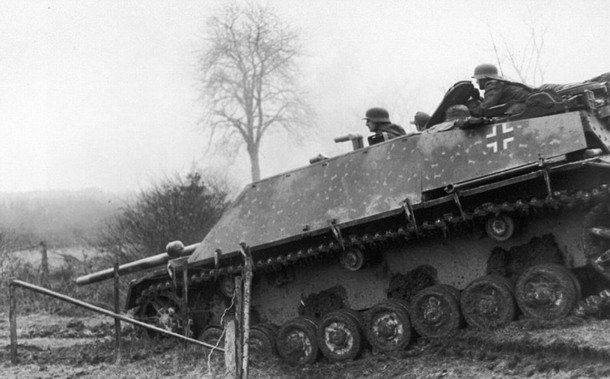
Panzer IV/70 (V) in action on the Western Front — manoeuvres like this put considerable strain on the already overloaded front suspension, source: Waralbum.ru with permission of the operator, edited
At some point in 1945, a small number of vehicles were apparently fitted with an unusual weapon for close defence against enemy infantry: a curved-barrel rotating port fitted in the loader's roof hatch, into which a Sturmgewehr 44 assault rifle could be inserted from inside and fired in any direction around the vehicle. Only a fraction of vehicles received this modification, and details of its practical effectiveness in combat are not known.
The Panzer IV/70 (V) weighed 25.5 tonnes (some sources give 25.8 tonnes), roughly 1.5 tonnes more than the earlier Jagdpanzer IV Ausf. F. The increased weight reduced the vehicle's top speed to just 35 km/h. Production of the Panzer IV/70 (V) at Vomag continued right to the end of the war. The most productive month was January 1945, when 185 vehicles left the factory. Total production came to somewhere between 930 and 940 Panzer IV/70 (V).
Panzer IV/70 (A)
Let us return briefly to Hitler's decision to end Panzer IV production and redirect capacity to the Panzer IV/70 (V) tank destroyer. His doubts about the combat value of the Panzer IV had been building since August 1943, when he reviewed the results of an analysis of the fighting at Kursk. Among other things, that analysis showed that StuG III assault guns had outperformed Panzer IV tanks in action. In June 1944, Hitler received an Ordnance Office report comparing the combat capabilities of the Panzer IV with the Soviet T-34/85 and IS-2. The German vehicle came off poorly — which was an objective conclusion. In July 1944, Hitler therefore ordered that Panzer IV production be phased out entirely and replaced by mass production of the new Panzer IV/70 (V). The firms earmarked for the transition were Alkett and MIAG (both then producing StuG III assault guns), Krupp-Grusonwerk (producing the StuG IV), and Nibelungenwerke (producing the Panzer IV itself). From May 1945, these four factories were expected to deliver a combined total of 800 tank destroyers per month.
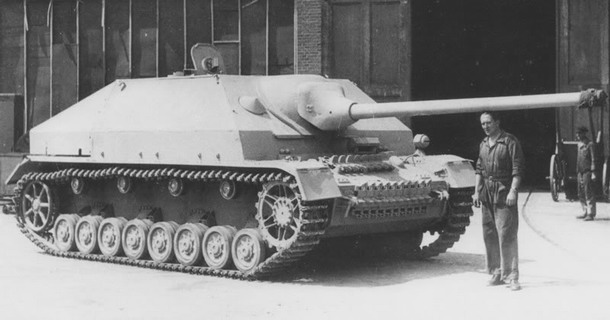
the first Panzer IV/70 (A) prototype had stepped side walls on the fighting compartment, source: Flickr.com with permission of the publishing user, edited
Factory representatives and senior military figures — including Guderian — had to explain to Hitler that rapidly switching mass production from existing types to a new tank destroyer was far from straightforward. Doing it all at once rather than gradually would mean a significant production gap, which was the last thing Germany needed in mid-1944. Hitler eventually accepted the argument, but insisted that the troops must receive as many vehicles with the powerful L/70 gun as quickly as possible. To satisfy this demand, representatives of Alkett came up with a proposal for what they called a Zwischenlösung — literally a "transitional solution."
Alkett adapted the armoured superstructure of the Panzer IV/70 (V) so that it could be fitted to a standard Panzer IV tank chassis. Nibelungenwerke could then continue producing chassis in large numbers, completing some as tanks and fitting others with the new superstructure carrying the StuK 42 (PaK 42) gun. This way there would be no major drop in tank output, while the army would receive at least a limited number of the tank destroyers Hitler so urgently wanted. The transitional version was designated Panzer IV/70 (A), the letter A representing Alkett. Hitler approved the proposal, and a hastily assembled first prototype was shown to him in July 1944.
Mounting the superstructure from the Panzer IV/70 (V) directly onto a standard Panzer IV chassis without modification was of course impossible. Some adaptation was unavoidable. Not only did the superstructure have to be shortened somewhat, but due to the internal layout of the tank chassis — particularly the fuel tanks — it also had to sit higher than on the production tank destroyer. On the first prototype this was solved by retaining the front wall of the original tank's hull superstructure (widened outward but with the machine gun port eliminated), moving the original hull's side walls out over the tracks, and then mounting the Panzer IV/70 (V) fighting compartment on top of these.
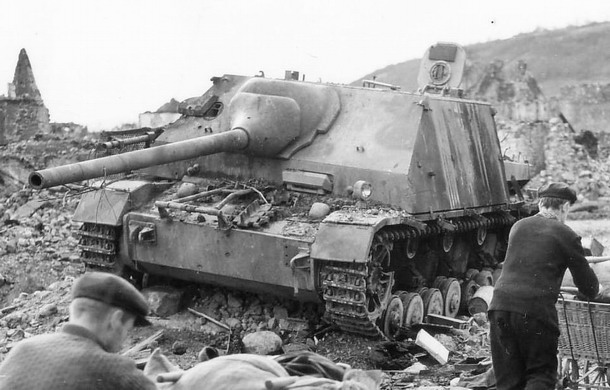
a wrecked Panzer IV/70 (A) in the middle of a destroyed town — the first four road wheels have steel rims, source: Waralbum.ru with permission of the operator, edited
On production vehicles the arrangement was somewhat different. The widened front plate from the original tank was retained (again without the machine gun port), but the sides of the new fighting compartment were extended downward (for a clear illustration of the difference between the prototype and production vehicle, the interested reader is referred to the comparison photograph HERE (source: Flickr.com)). All of these adaptations undermined the simplicity that was supposed to be the point of the transitional design, but it apparently still made sense to proceed. The Panzer IV/70 (A) ended up approximately 38 cm taller than the standard Panzer IV/70 (V). The taller rear wall of the fighting compartment was put to use housing the ventilator fan and a pair of spare road wheels.
For reasons that are not entirely clear, the machine gun port in the front plate to the right of the gun received a newly designed cover on the Panzer IV/70 (A). The barrel support also had to be taller to suit the raised superstructure. Due to its greater height, the Panzer IV/70 (A) was also heavier than its cousin, weighing in at a full 27 tonnes (some authors give 28 tonnes).
An order for 300 of these transitional tank destroyers was placed immediately after the prototype presentation, with the first 50 to be delivered by August 1944 (some sources give only 200 units ordered, while others mention as many as 350). Since this was intended as a temporary solution, Nibelungenwerke was expected to prepare in the meantime for production of the standard Panzer IV/70 (V). During its production run, the Panzer IV/70 (A) went through similar improvements to those of the regular Panzer IV/70 (V). Foremost among these was the introduction of steel-rimmed road wheels on the first four positions on each side. The number of return rollers was also reduced from four to three. A curved-barrel port for the Sturmgewehr 44 was installed in the right roof hatch cover (photographs available HERE and HERE (source: Flickr.com)).
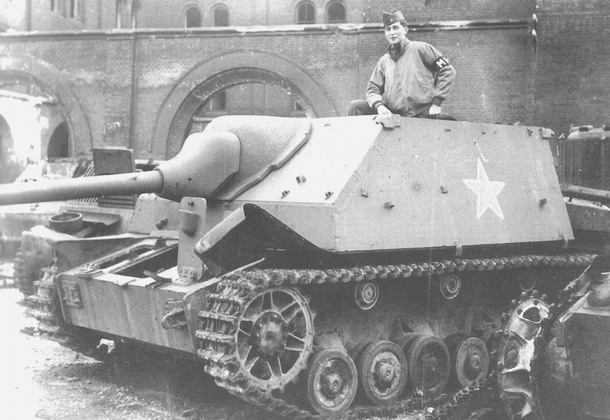
a wrecked Panzer IV/70 (A) at a vehicle collection point — clearly an early vehicle, still fitted with the original rubber-rimmed road wheels on all positions, source: Flickr.com, Public domain, edited
As is so often the case with temporary solutions, the transition of Nibelungenwerke and the other factories to series Panzer IV/70 (V) production kept being postponed, and the transitional Panzer IV/70 (A) ended up remaining in production until the end of the war. A total of 278 were built. The failure to complete the planned transition was not so much a matter of factory incompetence as it was a deliberate effort — a quiet boycott of Hitler's decision that enjoyed the full backing of senior military figures, particularly Heinz Guderian. Guderian had from the outset actively opposed plans to build assault guns on the Panzer IV chassis. He understood that, despite its age, the Panzer IV remained absolutely indispensable to the German army. Its production line was mature and running at volumes that were simply unattainable with the new Panther and Tiger tanks. Guderian repeatedly tried to make Hitler see this, but without success. His views on the matter were so well known that soldiers had given the Jagdpanzer IV a nickname: Guderian Ente — "Guderian's duck" — a reference to the vehicle's sluggish, overloaded handling.
Panzer IV lang (E)
According to German planners, a new version designated Panzer IV lang (E) was to enter production in November 1944. This vehicle was to be based on a newly developed chassis called the Einheitsfahrgestell III/IV (hence the letter E). This chassis had been under development since early 1944 as a combination of the best elements of the Panzer III and Panzer IV chassis. The Maybach HL 120 TRM engine with its radiator and fans, as well as the hull tub itself, were to be taken from the Panzer IV. The SSG 77 gearbox, final drives, steering brakes, and drive sprockets were to come from the Panzer III. The vehicle was to receive a new running gear consisting of six 660 mm diameter road wheels on each side and new 540 mm wide tracks. The Panzer IV lang (E) was intended to become the new standard, progressively replacing in production all variants of the Jagdpanzer IV, as well as the StuG IV, and possibly the Panzer IV tank itself. None of this came to pass: in October 1944 the entire project was cancelled.
Organisational Structure
The main organisational unit for all three variants of the Jagdpanzer IV — the Ausf. F, L/70 (V), and L/70 (A) — was the tank destroyer company (Panzerjäger Kompanie). Under the 1944 table of organisation, each company had a headquarters element and three combat platoons. Two authorised strength variants existed. In the first, each platoon had four tank destroyers plus one command vehicle at company headquarters, giving a total of 13 vehicles per company. In the second variant, each platoon had only three tank destroyers, giving a company total of 10. These companies were assigned to both infantry regiments and to armoured and Panzergrenadier divisions. Within armoured and Panzergrenadier divisions, companies were grouped into battalions (Panzerjäger Abteilung), each battalion consisting of two companies and a headquarters element.
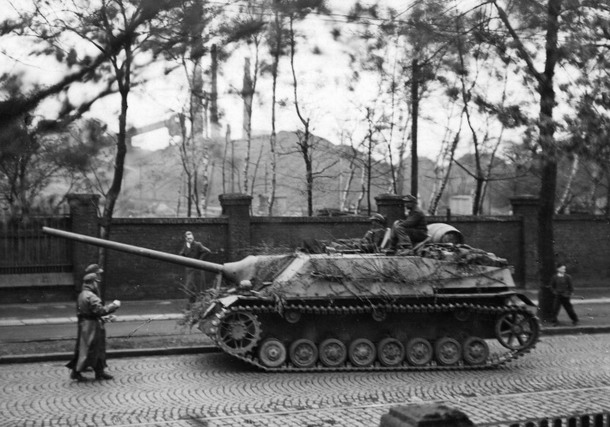
Panzer IV/70 (V) — this photograph beautifully illustrates the enormous overhang of the gun barrel, source: Flickr.com, with permission of the publishing user, edited
The Jagdpanzer IV is generally regarded as a reasonably successful fighting vehicle. Its principal weakness was the overloading of the chassis, particularly at the front, which made the vehicle sluggish and put considerable strain on its mechanical components. On the other hand, the standard of both armament and armour was very high. Very few opponents could penetrate its frontal plate, while the long-barrelled gun could destroy virtually any Allied armoured vehicle at around 1,500 metres — and the same applied to most Soviet vehicles, with the exception of the heavy IS-2 tank. The Jagdpanzer IV was ideally suited for defensive fighting. Ambushing an enemy from a concealed position was where this low-profile, inconspicuous vehicle excelled. Given the period in which it entered service, it was rarely able to participate in anything other than defensive operations. The one significant offensive action it took part in was the famous Ardennes attack against the Allies at the end of 1944. Otherwise, it fought on both the Western and Eastern Fronts until the final days of the war.
Technical Specifications
|
|
Jagdpanzer IV/48 |
Panzer IV/70 (V) |
Panzer IV/70 (A) |
|
weight: |
24 t |
25.5 t |
27 t |
|
length: |
6.85 m |
8.50 m |
8.87 m |
|
width: |
3.17 m |
3.17 m |
3.30 m |
|
height: |
1.86 m |
1.86 m |
2.23 m |
|
engine: |
Maybach HL 120 TRM |
Maybach HL 120 TRM |
Maybach HL 120 TRM |
|
engine power: |
300 hp |
300 hp |
300 hp |
|
max. speed: |
40 km/h |
35 km/h |
38 km/h |
|
fuel capacity: |
470 l |
470 l |
470 l |
|
road range: |
210 km |
210 km |
200 km |
|
cross-country range: |
130 km |
130 km |
130 km |
|
hull armour: |
|
|
|
|
- front: |
60 / 80 mm |
80 mm |
80 mm |
|
- sides: |
30 mm |
30 mm |
30 mm |
|
- rear: |
20 mm |
20 mm |
20 mm |
|
superstructure armour: |
|
|
|
|
- front: |
80 mm |
80 mm |
80 mm |
|
- sides: |
40 mm |
40 mm |
40 mm |
|
- rear: |
30 mm |
30 mm |
30 mm |
|
crew: |
4 men |
4 men |
4 men |
|
armament: |
75 mm PaK 39 L/48 gun 1x MG 42 machine gun, 7.92 mm |
75 mm StuK 42 (PaK 42) L/70 gun 1x MG 42 machine gun, 7.92 mm |
75 mm StuK 42 (PaK 42) L/70 gun 1x MG 42 machine gun, 7.92 mm |
ARTICLE
CONTENTS:
Reproducing text from the Panzernet website without the written consent of the operator is prohibited.