STURMGESCHÜTZ IV
assault gun on a Panzer IV chassis
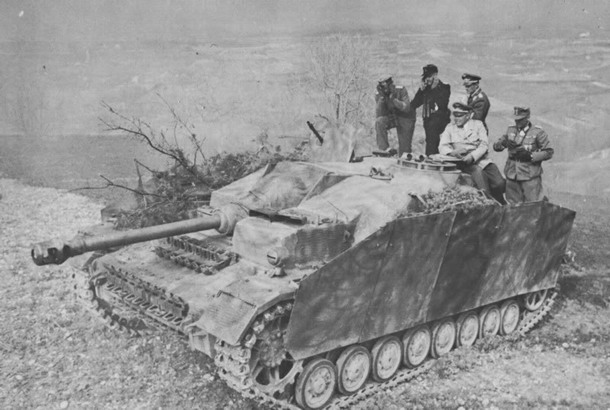
Sturmgeschütz IV with side skirt armour (Schürzen); source: Waralbum.ru with permission of the site operator, edited
Origins of the Vehicle
The assault gun — a literal translation of the German word Sturmgeschütz — was a distinctive category of German armoured vehicle in the Second World War. The first and most famous representative of this category was the Sturmgeschütz III (or StuG III). Its original role was to provide direct fire support for attacking infantry. However, following the invasion of the Soviet Union in June 1941, the StuGs were forced to take on the role of tank destroyers, as the Germans in Russia faced the enormous armoured superiority of the Red Army. In March 1942 the StuG III was therefore re-armed, replacing the original short StuK L/24 gun with the more effective StuK 40 L/43, which was far more capable against armoured targets. In June 1942 an even more powerful version followed, with a barrel 48 calibres long (L/48). The StuG III was a low-profile, mobile, well-armoured, and now heavily armed fighting machine, and its combat successes against Russian tanks were not long in coming. By mid-1942 the long-gunned StuG III represented the most well-rounded anti-tank weapon available to the German Army, so it is no surprise that the Germans decided to build on this success and develop a next-generation vehicle.
The requirements for a new assault gun (the so-called Sturmgeschütz neuer Art) were drawn up by the German Waffenamt as early as September 1942. The original plan envisaged an entirely new vehicle with sloped frontal armour, wide tracks, a generally low profile, and generous ground clearance. The Germans soon realised, however, that developing a completely new vehicle from scratch would be too time-consuming and costly, and a pragmatic decision was made: the new assault gun could perfectly well be built on the chassis of the already-produced Panzer IV tank, which would need to be "merely" modified to meet the army's requirements.
The Ministry of Armaments therefore asked Krupp — as the designer of the Panzer IV — to investigate the feasibility of building such an assault gun on that tank's chassis. Krupp fulfilled its assignment and in February 1943 submitted a technical drawing of the new vehicle to the ministry. In their proposal, Krupp's engineers worked with a modified chassis featuring sloped frontal armour, tracks 560 mm wide (compared to 400 mm on standard production tanks), and thicker side armour. On top of this chassis, the designers placed a fighting compartment derived from the StuG III Ausf. F. The proposed superstructure, however, featured a new, sharply angled frontal plate 50 mm thick. The vehicle's armament was to consist of the Sturmkanone 40 L/48 in 75 mm calibre — the same weapon carried by the later production variants of the standard StuG III.
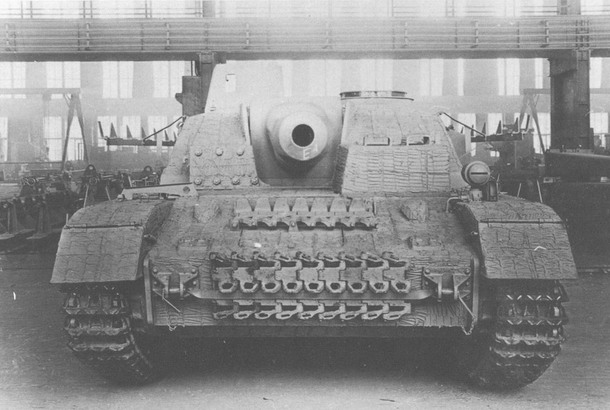
one of the first series-production StuG IVs in the factory hall of Krupp Grusonwerk, the vehicle is fully coated in Zimmerit anti-magnetic paste; source: Flickr.com with permission of the publishing user, edited
Krupp's calculations showed, however, that a vehicle configured in this way would weigh around 28.26 tonnes — nearly 5 tonnes more than a standard Panzer IV Ausf. G. This was likely to place excessive strain on the tank chassis, and Krupp therefore informed the Ministry of Armaments that it did not consider the production of an assault gun to the specified parameters to be reasonably feasible. With that, Krupp's proposal was shelved, and a different vehicle was selected as the successor to the StuG III: the tank destroyer Jagdpanzer IV, whose development was progressing promisingly at the Vomag company.
The situation changed dramatically on 26 November 1943. On that day, Allied bombers targeted the production facilities of the Berlin firm Alkett, the main supplier of StuG III assault guns. The extensive bombing brought production almost to a standstill in December — Alkett delivered just 24 new StuG IIIs that month, compared to 255 just two months earlier! This extremely serious situation was discussed with Hitler at a conference on 6 and 7 December 1943. The question of the day was how to replace both the current and any potential future shortfalls in StuG III deliveries. One option was to bring additional factories into the production programme, but where to find them? Every armaments plant in Germany was already running at full capacity. Switching any of them to StuG III production would take a long time and would necessarily mean sacrificing output of something else.
Expanding StuG III production also made little sense in the context of future plans. By the turn of 1943–44, the StuG III was past its prime, and the Germans knew it. That was precisely why Vomag was working on its generational successor, the Jagdpanzer IV. The problem was that the Jagdpanzer IV was still at the first prototype stage at the time, and mass production was nowhere near ready. In short: the drop in StuG III production at Alkett was not going to be made good by building the same StuG III elsewhere, nor could it yet be replaced by the new Jagdpanzer IV. A quick stopgap solution was needed — one that would not require any fundamental change to the production programme of any existing factory, and that would rapidly deliver to the troops a weapon at least equal in combat value to the StuG III. The realistic options were limited, so a decision came fairly quickly. Essentially, the earlier idea of mounting the StuG III superstructure and gun on a Panzer IV chassis was revived — but this time without any of the additional modifications such as sloped armour, wider tracks, and so on. Speed and simplicity of production were the overriding priorities.
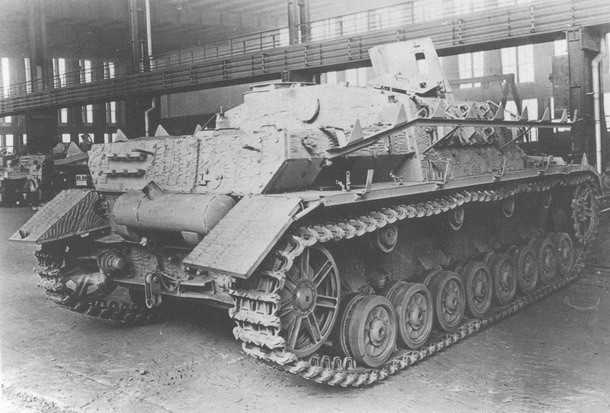
one of the first series-production StuG IVs in the factory hall of Krupp Grusonwerk; note the frame for attaching the side skirt armour (Schürzen); source: Flickr.com with permission of the publishing user, edited
First Prototype
Alkett was ordered to immediately prepare a modified version of the StuG III Ausf. G superstructure that could be installed on a standard series-production Panzer IV chassis. The Krupp Grusonwerk plant in Magdeburg was simultaneously instructed to stop fitting conventional tank hulls and turrets to the chassis it produced there, and instead to begin mounting superstructures to Alkett's design. In this way the new assault gun Sturmgeschütz IV — or StuG IV — was born. The new vehicle was thus to be produced at the expense of Panzer IV tank output. This did not trouble Hitler in the slightest, as he personally considered the planned assault gun a more valuable fighting vehicle than the Panzer IV (Hitler even proposed eventually phasing out Panzer IV production altogether and fully replacing it with the Jagdpanzer IV tank destroyer).
Fitting the StuG III superstructure onto the Panzer IV chassis proved surprisingly straightforward from a technical standpoint. The main design challenge was the length of the chassis and its hull. The StuG III superstructure was simply too short for this tank chassis. When it was placed on the hull and aligned at the rear with the edge of the engine compartment, the driver's position ended up outside the superstructure, in front of its front wall. Moving the driver's position rearward would have been too complex, as it would have required relocating all the steering controls. The easier solution was to extend the fighting compartment forward at that point. A small angular box-like protrusion was added to the left at the front, under which the driver's station was housed. The open space to the right of the driver was simply covered with a flat horizontal armour plate.
The first prototype of the Sturmgeschütz IV was completed on 15 December 1943 — just one week after the decision to build it had been taken. On 16 and 17 December, the prototype was demonstrated to Hitler, who approved it for series production without reservation. And brace yourself — before the year was out, the first 30 series-production vehicles had rolled out of the Krupp Grusonwerk factory! The workers in Magdeburg clearly did not enjoy much Christmas rest that year (the chassis for these first 30 vehicles were apparently supplied, for some reason, by Nibelungenwerke).
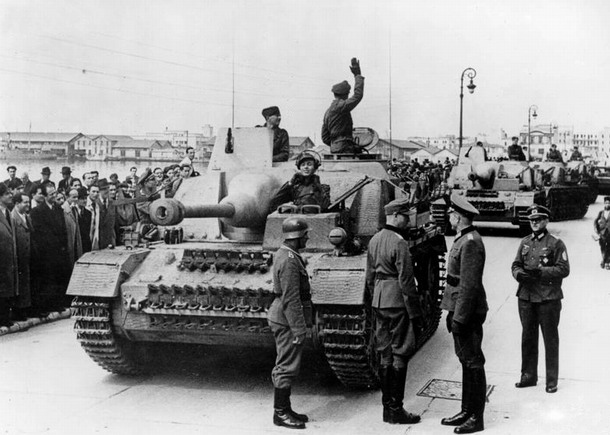
StuG IV assault guns in Greece; source: Worldwarphotos.info with permission of the site operator, edited
Technical Description
The series-production StuG IV was built on the chassis of the Panzer IV Ausf. H. This chassis featured eight road wheels on each side, 470 mm in diameter with rubber tyres for a smoother ride. The wheels were double, with the track's guide teeth passing through the gap between the two discs. The road wheels were suspended in pairs: four mounting brackets were bolted to each side of the hull, and two swing arms were attached to each bracket, with each arm carrying one road wheel. The two swing arms were connected by a quarter-elliptic leaf spring. The upper run of the track was supported by four return rollers, 250 mm in diameter, also fitted with rubber tyres. At the very front was a toothed drive sprocket, and at the rear a spoked idler wheel. The vehicle ran on tracks 400 mm wide (though 400 mm was the measurement of the connecting pins, while the track links themselves were only 380 mm wide). Each track consisted of 99 links and weighed approximately 750 kg.
The front wall of the hull was 80 mm thick. Above it, a sharply angled plate connected to the front wall, which featured a large access hatch for servicing the gearbox and two smaller hatches for access to the final drives and steering brakes. The fighting superstructure described above was mounted on top of the hull. Protruding forward from the left side was the driver's "private cabin" mentioned earlier, with 80 mm of frontal armour, an entry hatch in its roof, and two observation periscopes — one pointing directly forward and one angled slightly to the left. In the standard Panzer IV tank, a radio operator/hull gunner sat to the right of the driver. In the StuG IV, however, this position was eliminated and the space to the right of the driver's compartment was simply covered by a flat horizontal armour plate.
The vehicle's main armament was of course mounted in the front wall of the fighting compartment. This was the StuK 40 L/48 gun with a barrel 3,615 mm long (approximately 48 calibres). The standard anti-tank round was the armour-piercing Pzgr. 39, with a projectile weighing 6.8 kg and a muzzle velocity of 750 m/s. This round could penetrate 96 mm of sloped homogeneous armour at 500 metres. At one kilometre it was still capable of defeating 85 mm of armour. There was also the Pzgr. 40 with a tungsten core, weighing 4.1 kg and leaving the barrel at 930 m/s — capable of penetrating 120 mm of armour at 500 metres and 97 mm at a full kilometre. The StuK 40 was also a highly accurate weapon. In firing trials against a target measuring 2 x 2.5 metres (roughly equivalent to the frontal silhouette of a tank), the probability of a hit was 100% at 500 metres, 99% at 1,000 metres, and a still-respectable 77% at 1,500 metres. In actual combat the results were naturally lower due to human error and stress, but they remained very solid figures.
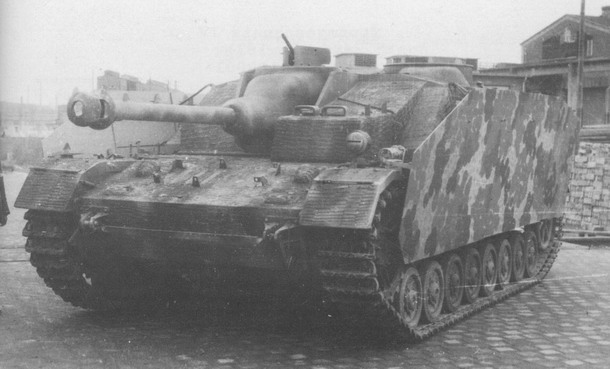
late-production StuG IV with a remotely operated machine gun on the roof; source: Flickr.com with permission of the publishing user, edited
The gun was not mounted along the vehicle's centreline but slightly to the right of centre. The gun cradle and recoil mechanism were protected by a cast mantlet nicknamed Saukopf (though an unknown number of early vehicles received guns with the older boxy mantlet design — one such vehicle can be seen in the not-very-sharp photograph HERE (source: flickr.com)). The mounting allowed a maximum horizontal traverse of 10 degrees to each side, and a vertical range of -6 to +20 degrees. The gun was served by the Sfl.Z.F.1a gun sight, whose periscope extended above the roof of the superstructure. Ammunition stowage on board was apparently 63 rounds (though figures of 61 and even 87 rounds are also cited).
The side and rear walls of the fighting compartment were 30 mm thick, while the roof was a mere 10 mm. In the roof was an opening for the gun sight periscope, a loader's entry hatch, and a commander's cupola with observation ports — also used as the entry hatch for the commander and gunner. On the rear wall of the superstructure was a ventilator fan to extract propellant gases produced when the gun was fired. In front of the loader's hatch was a folding sheet-metal shield on which an MG 34 machine gun could be mounted for close-range defence against enemy infantry (the early StuG IV therefore had no anti-infantry weapon built in under armour). The machine gun was operated by the loader — and it must be said this was a rather hazardous job, as he had to expose his entire upper body outside the superstructure to do so, making him a fairly easy target for enemy fire.
Behind the fighting compartment was the engine bay. The engine itself was mounted longitudinally, slightly to the right of the vehicle's centreline. It was connected via a driveshaft that ran along the floor of the fighting compartment to the gearbox, located at the front of the hull (immediately to the right of the driver). The powerplant was the proven liquid-cooled twelve-cylinder Maybach HL 120 TRM with a displacement of 11.9 litres, producing 300 horsepower at 3,000 rpm. The StuG IV also inherited the gearbox from the Panzer IV chassis: the Zahnradfabrik SSG 76 with six forward gears and one reverse. Since the StuG IV had no rotating turret, it did not require — unlike the Panzer IV — the auxiliary two-cylinder DKW engine that on the original tank powered the turret traverse mechanism. The StuG IV weighed 23 tonnes (though 25.9 tonnes is also cited) and had a top road speed of around 38 km/h. Average cross-country speed was approximately 15 km/h.
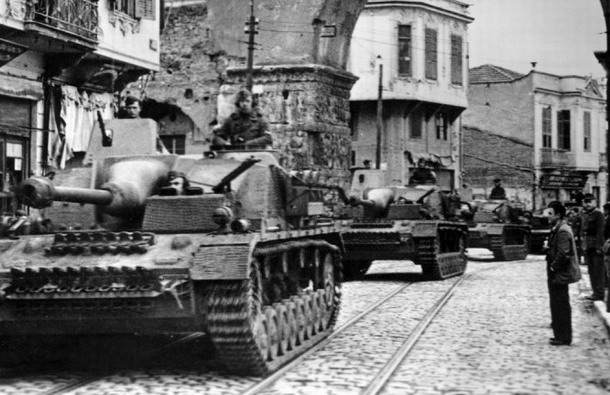
StuG IV assault guns; source: Flickr.com with permission of the publishing user, edited
Fuel was stored in three interconnected tanks, giving a total capacity of probably 470 litres (though other figures are also encountered). Full tanks gave the assault gun a road range of around 220 km and approximately 130 km cross-country. The crew consisted of four men: the driver, seated on the left in the forward extension of the superstructure; the gunner behind him; the vehicle commander further behind; and the loader on the opposite side of the gun. Standard StuG IVs were equipped with the Fu 15 radio set, which was a receiver only. Platoon commanders' vehicles were also fitted with a second set, the Fu 16, which allowed active transmission as well. These command vehicles can be identified by their two whip antennas. An intercom system for communication between crew members was also provided. From virtually the beginning of production, StuG IVs were fitted with frames for the attachment of side skirt armour (Schürzen).
As already noted, production of the StuG IV began in December 1943 at Krupp Grusonwerk in Magdeburg. Since Krupp Grusonwerk had previously been building Panzer IV tanks, only partial changes to the production programme were required. A large proportion of components were naturally supplied by various subcontractors. The most significant among them are worth mentioning: armoured hulls came from Böhler of Kapfenberg, Eisenwerke Oberdonau of Linz, Krupp of Essen, and Eisen und Hüttenwerk of Bochum. The fighting superstructures were provided by Brandenburger Eisenwerke of Brandenburg. Guns were supplied by the Berlin firm Wimag (Wittenauer Maschinenfabrik) and by Škoda of Pilsen. Gun sights were manufactured by Carl Zeiss of Jena and under licence by Optische und Feinmechanische Werke of Görlitz and Ernst Leitz of Wetzlar. Gearboxes arrived in Magdeburg from two Zahnradfabrik plants — Werk I in Friedrichshafen and Werk III in Schwäbisch Gmünd — and from September 1944 also from Carl Hammel of Chemnitz. Maybach HL 120 TRM engines were supplied by the parent Maybach-Motorenbau factory in Friedrichshafen, as well as by Nordbau (Norddeutsche Motorenbau) of Berlin and MAN of Nuremberg.
Production and Modifications
Following the initial 30 vehicles delivered in December 1943, output rose to 108 in January 1944, 106 in February, and then settled at roughly ninety vehicles per month. In August and September 1944, the Krupp Grusonwerk plant was targeted by Allied bombing raids, which caused output to fall to 70 vehicles in August and just 56 in September. Production was stabilised again in October and November, but from December 1944 it began to collapse for good. Supplies from subcontractors were failing, rail transport and electricity deliveries were disrupted, and so on. Completed vehicle numbers fell steadily until production finally came to a halt in April 1945. The total number of StuG IVs built throughout the entire production run reached 1,141 vehicles.
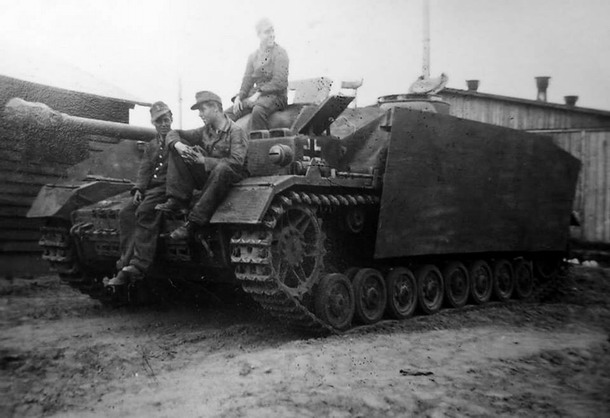
Sturmgeschütz IV with three members of its crew; source: Worldwarphotos.info with permission of the site operator, edited
During the production run, a number of more or less significant design modifications were introduced. Very few of these were developed specifically for this vehicle, however. The reason was simple: the StuG IV was essentially a combination of a chassis and a superstructure, both produced primarily for other fighting vehicles. Most of the changes were simply adopted as they were introduced on the Panzer IV chassis or the StuG III superstructure. For example, when in February 1944 the current production version of the Panzer IV — the Ausf. H — was replaced by the new Ausf. J, the StuGs had to gradually transition to the new-version chassis as well. Likewise when the chassis saw the number of track return rollers reduced from four to three on each side, and the original exhaust with a horizontally positioned silencer replaced by simple vertically oriented pipes (the so-called Flammtöter). All of this the StuG IV was obliged to adopt too.
A few modifications that came over with the fighting superstructure are also worth mentioning. In June 1944, attachment brackets for a lightweight folding crane were added to the superstructure roof. These took the form of small metal cylinders welded to the roof — five in total, one in each corner and one in the centre. The tubes forming the crane were inserted into the cavities of these cylinders. The crane had a maximum lifting capacity of 2 tonnes and was used primarily for field repairs to the engine and gun.
Another noteworthy innovation was a roof-mounted machine gun that could be operated safely from inside the superstructure. The weapon was fixed just ahead of the loader's hatch in a low, fully rotating mount. Operation was again the loader's responsibility. For aiming, he used a periscope built directly into the rotating mount. The machine gun was fitted with a low arrow-shaped shield. Only once the drum magazine was empty did the loader have to open his hatch to reload — but even then only his hands and head needed to be exposed, making it a considerably safer arrangement than the previous method of mounting the machine gun on the large folding shield (a comparison of both roof machine gun mounting methods can be seen in the photograph HERE (source: flickr.com)). The introduction of the remotely operated machine gun also necessitated a modification to the loader's hatch, which now opened in two halves to the sides.
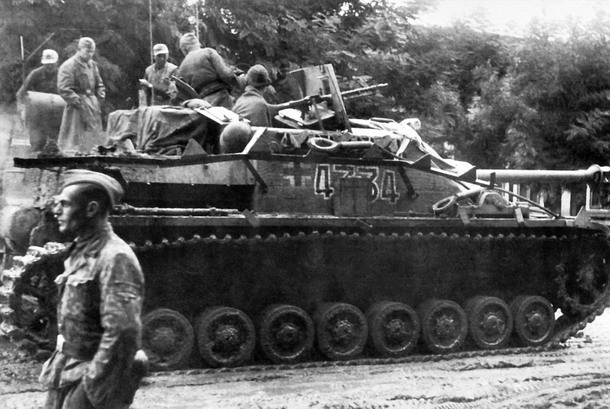
Sturmgeschütz IV "in the field"; source: Flickr.com with permission of the publishing user, edited
Later still, designers managed to fit the machine gun inside the vehicle, directly alongside the gun. In this configuration the machine gun fired through an aperture cut into the upper left portion of the gun mantlet. This was an extremely safe solution, similar to how machine guns were installed in tank turrets. However, the weapon could now only fire directly forward and had a very limited field of aim. This modification was probably introduced only in the final months of production and therefore affected only a very small number of vehicles (one such example can be seen in the photograph HERE (source: flickr.com)).
One more feature was adopted from the StuG III: the Nahverteidigungswaffe (close-defence weapon). This was essentially a grenade launcher, with the firing device mounted inside the superstructure beneath the roof and the barrel opening onto the roof surface. In addition to anti-personnel fragmentation grenades, it could also fire smoke grenades, and even a signal pistol could be discharged through the barrel. Due to limited production capacity, however, only a small proportion of StuG IVs were fitted with this weapon (one example can be seen in the photograph HERE (source: flickr.com)).
There were also several innovations developed specifically for the StuG IV rather than simply inherited from its component vehicles. One was a gun barrel travel lock. Initially the new assault guns were delivered without any such support. The barrel vibrated during travel, however, so a folding support was introduced, mounted at the very tip of the hull nose. The barrel rested in it in the horizontal position (i.e., at zero degrees of elevation). In this position, however, the barrel was at the same level as the driver's periscopes, significantly restricting his field of view to the right. A new support was therefore quickly introduced, positioned closer to the front wall of the superstructure and holding the gun barrel at +12 degrees elevation — more than enough for the driver to see adequately to the right beneath the raised barrel.
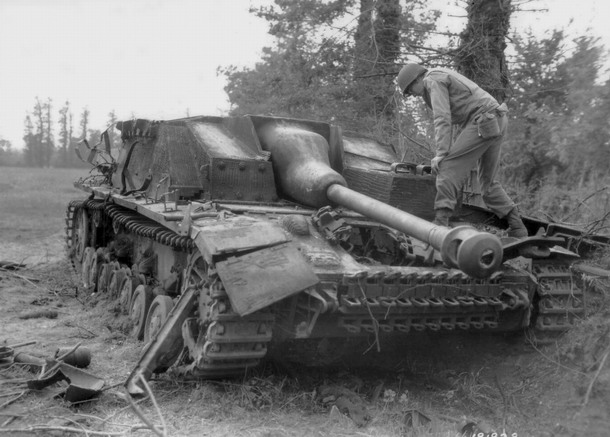
wrecked Sturmgeschütz IV on the Western Front; source: Flickr.com, public domain, edited
At some point during 1944, the driver's periscopes were fitted with covers to better protect them from rain and snow. According to some sources, the left periscope was also rotated slightly closer to the vehicle's centreline. The driver also received a new seat with adjustable height, allowing him to raise it and drive with his head out of the hatch during longer moves away from the combat zone. Crews in the field frequently resorted to various methods of supplementing the frontal armour on their vehicles. Hanging spare track links over every available surface of the superstructure and hull was generally tolerated as relatively harmless, but what military commanders objected to was coating the driver's compartment in a thick layer of concrete. This practice was officially prohibited, yet it can be seen in photographs quite frequently (examples HERE (source: flickr.com), HERE (source: flickr.com), and HERE (source: flickr.com)). Drawing on these experiences, the manufacturer considered bolting an additional 30 mm steel plate to the front of the driver's compartment, but this was apparently never implemented. On a certain number of vehicles, however, the front of the driver's cab was fitted — possibly experimentally — with additional armour angled sharply forward. Judging from photographs of such vehicles (examples visible HERE (source: flickr.com) and HERE (source: flickr.com)), this armour must have restricted service access to the left final drive and steering brake.
The final modifications worth mentioning were the discontinuation of the Zimmerit anti-magnetic paste coating sometime towards the end of 1944, the introduction of wire mesh side skirts (Thomaschürzen) in place of steel plate skirts, and the adoption of wide winter tracks for improved movement on snow and ice. Documents show that other modifications were discussed, but it is unclear whether they were ever implemented. These included eliminating the emergency escape hatch in the hull floor in the position where the Panzer IV's radio operator had sat (a position that did not exist in the StuG IV at all), and installing an additional ammunition storage box in the space freed up by the removal of the DKW auxiliary engine.
Organisation and Deployment
The Sturmgeschütz IV was not intended to form the backbone of independent units equipped exclusively with this type of vehicle. Rather, it was meant to supplement the older StuG IIIs already serving in assault artillery units. The first StuG IVs began reaching front-line formations in February 1944. At that time, the basic organisational unit for assault guns was the battery (Sturmgeschütz Batterie), consisting of three or four platoons of three vehicles each. Three batteries were grouped together into a battalion, later redesignated as a brigade (Sturmgeschütz Brigade). A significant proportion of StuG IVs were also allocated to independent assault gun companies, which were then attached to infantry divisions, armoured divisions, Panzergrenadier divisions, or even to Volkssturm units.
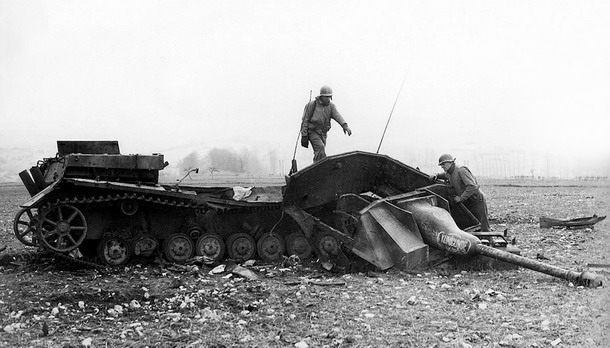
StuG IV completely destroyed by an ammunition explosion on the Western Front; source: Flickr.com, public domain, edited
The StuG IV's combat debut was probably in March 1944 with Sturmgeschütz Brigade 311 on the Ukraine, during fighting in the area between Ternopil and Zhytomyr. At the end of March, the brigade was encircled east of Ternopil and lost all its remaining assault guns in the attempted breakout to friendly lines. Of the entire brigade, only 15 men survived — all others were killed or captured. The majority of StuG IVs saw action in the East, though they also appeared in France and on the Italian front. In July 1944, assault guns of Sturmgeschütz Brigade 394 participated in the counter-attacks following the Allied landings in Normandy, and later also in the fighting in the Ardennes. In Italy, the type served with Sturmgeschütz Brigade 914, which helped resist the Allied advance near Ancona and along the Gothic Line.
The StuG IV never became the legend that its older sibling with the Roman numeral three in its name did. It came about unplanned, essentially as an emergency measure. The Sturmgeschütz IV offered no potential for any significant further development. Its fighting superstructure, inherited from the StuG III, could not accommodate a more powerful gun — even the existing one barely fitted. Upgrading the chassis was equally out of the question, as it too was essentially at its limits. Its designers, however, were well aware of this and had no orders or ambitions beyond delivering a reasonably capable vehicle to the troops as quickly as possible — and in that, they most likely succeeded.
Some senior military figures — including the Inspector of Armoured Troops, Heinz Guderian — were opposed to the creation and production of the Sturmgeschütz IV. They disagreed with Hitler's view that this vehicle offered higher combat value than the standard Panzer IV. They argued in favour of the Panzer "four" as a substantially more versatile weapon and objected to reducing its production in favour of the StuG IV. Their objections fell on deaf ears. Finally, one more curious footnote: there exists a series of photographs dated to March 1944 showing a StuG IV converted into a plough. The gun had been removed and a large metal blade was attached to the front of the hull. This peculiar machine was most likely intended for clearing rubble from the streets of German cities suffering from Allied air raids, and was probably built as a unique one-off (the photographs in question can be viewed HERE (source: flickr.com), HERE (source: flickr.com), and HERE (source: flickr.com)).
Technical Data
|
weight: |
23 t |
|
length: |
6.70 m |
|
width: |
2.95 m |
|
height: |
2.20 m |
|
engine: |
Maybach HL 120 TRM |
|
engine output: |
300 hp |
|
max. speed: |
38 km/h |
|
fuel capacity: |
470 l |
|
range – road: |
220 km |
|
range – cross-country: |
130 km |
|
hull armour: |
|
|
- front: |
80 mm |
|
- sides: |
30 mm |
|
- rear: |
20 mm |
|
superstructure armour: |
|
|
- front: |
80 mm |
|
- sides: |
30 mm |
|
- rear: |
30 mm |
|
crew: |
4 men |
|
armament: |
StuK 40 L/48 gun, 75 mm calibre 1 x MG 34 machine gun, 7.92 mm calibre |

ARTICLE
CONTENTS:
Reproducing text from the Panzernet website without the written consent of the operator is prohibited.