VK 3.01 & VK 3.02
armoured ammunition carrier for infantry
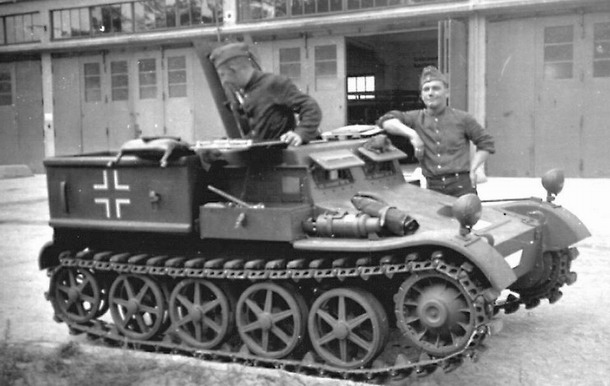
Armoured ammunition carrier VK 3.01, source: flickr.com with permission of the publishing user, edited
Origins
The requirement for a small, light armoured vehicle to deliver ammunition to infantry combat units directly at the front line was issued in September 1937. According to the Ordnance Office specification, the vehicle was to be fully tracked and capable of carrying a load of up to 1,000 kg. It was to deliver ammunition right up to the first line of positions, where it would be exposed to enemy fire, and therefore had to be armoured – with frontal armour thick enough to withstand fire from an infantry rifle of 7.92 mm calibre. The requirements apparently also included the ability to unload the carried ammunition without any crew member having to leave the vehicle. The project received the designation VK 3.01. The letters VK stood for Vollketten Kraftfahrzeug, meaning fully tracked motor vehicle. The numeral before the decimal point indicated the vehicle's expected weight in tonnes, and the digits after it gave the sequential project number.
The informed reader will perhaps recall that at the time in question, development of another ammunition vehicle – the Sd.Kfz. 252 – had already been under way for about three quarters of a year. The obvious question arises: why did the Army not wait for this existing "ammo carrier" to be completed and instead launched a parallel project? The answer most likely lies in the quite different requirements of the artillery and the infantry. The Sd.Kfz. 252 ammunition half-track had been developed on commission from the artillery to supply StuG III assault guns; it was therefore designed to carry 75 mm artillery ammunition and certainly did not have the ability to unload its cargo without the crew dismounting. Moreover, it was clearly over-engineered and unnecessarily expensive for the carriage of light infantry ammunition.
In any case, the Ordnance Office entrusted the development of the infantry ammunition carrier to the firm of Borgward in Bremen, northern Germany. A pre-production evaluation batch of 20 vehicles was ordered. The project was apparently not assigned particularly high priority, and delivery of the first examples was planned only for December 1939. Even this deadline was most likely not met, since the first testing of the new vehicle is recorded in Ordnance Office documents as having taken place only in April 1940.
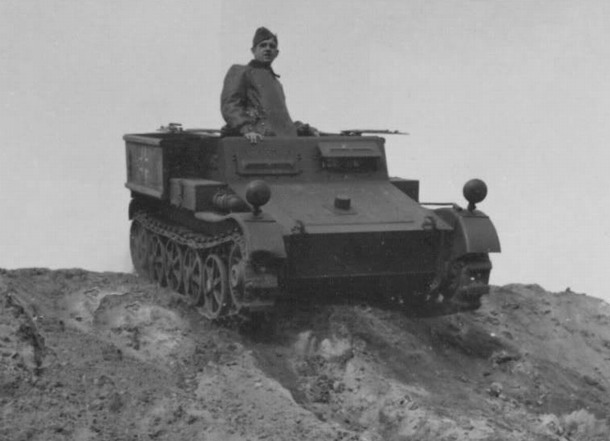
Armoured ammunition carrier VK 3.01, source: flickr.com with permission of the publishing user, edited
Design Description
The Gepanzerter Munitions-Schlepper VK 3.01, as the vehicle was officially designated, had a chassis consisting of four road wheels on each side. These were spoked wheels with solid rubber tyres around their circumference. Each wheel was mounted on its own swinging arm and sprung by a torsion bar. At the very rear was an idler wheel whose design closely resembled the road wheels but was of a smaller diameter. Both the road wheels and the idler were doubled – each consisting of a pair of "discs" – with the track guide tooth passing through the gap between the discs. The drive sprocket was at the front. The tracks were 200 mm wide and fitted with rubber pads for smoother running on hard surfaces.
The vehicle was powered by a Borgward 6M 2.3 RTBV petrol six-cylinder engine of 2.247 litres displacement, producing a maximum output of 49 hp. The 3.5-tonne vehicle could reach a maximum speed of 30 km/h. The 95-litre fuel tank provided a road range of approximately 200 km. The crew of the ammunition vehicle originally consisted of just two men sitting side by side in a fully enclosed cab. Vision was provided by ports in the front and side walls of the cab. Crew entry and exit was through hatches in the cab roof. The frontal armour of the crew compartment was 14.5 mm thick, sufficient to resist armour-piercing rifle and machine-gun fire of 7.92 mm calibre. Most other hull walls were 8 mm thick.
In the centre of the rear section sat the engine, flanked on each side by large cargo boxes capable of holding up to 18,000 rifle and machine-gun cartridges of 7.92 mm calibre in wooden crates. The boxes had a slightly sloped floor and openable side walls. This allowed the crew to "unload" the carried ammunition crates very quickly and without having to dismount. They simply stopped at the designated point, released the side wall latches directly from the cab via a Bowden cable, and the ammunition crates then slid out of the boxes onto the ground beside the vehicle – ideally into grass rather than onto concrete.
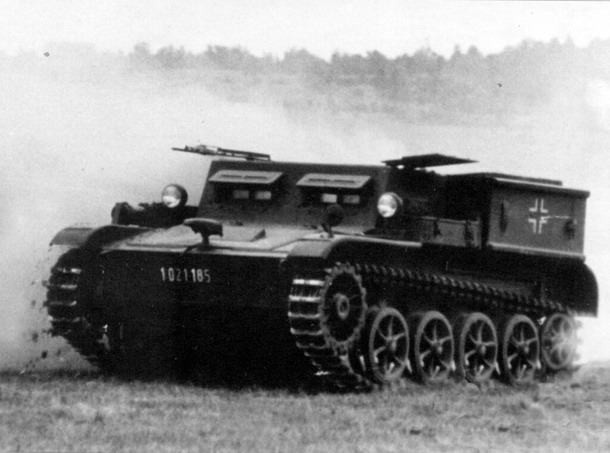
Probably a VK 3.02 – note that the headlights on the track guards have moved noticeably rearward, and the vent in the roof plate ahead of the crew cab is also differently arranged, source: flickr.com with permission of the publishing user, edited
Second Generation
The April 1940 trials of the VK 3.01 were reasonably satisfactory overall. Ordnance Office representatives were generally pleased with the vehicle but called for a number of major and minor design improvements. Production of the VK 3.01 in its existing form therefore did not continue; instead, work began on a new, modified version. The required changes included, for example, increasing the crew space by widening the vehicle by 50 mm and raising it by 50 mm. The cargo box on the right side was to be divided into two independently openable sections, so that each half of the ammunition carried on that side could be dropped separately. The cargo space on the left side remained undivided. The positioning of the headlights was also changed, as was the design of the ventilation opening above the gearbox in the front of the hull, and a Notek convoy light was added.
The modified version of the ammunition carrier received the designation VK 3.02, and 400 examples were ordered from Borgward. Series production began in October 1941 with the completion of the first four vehicles. In November, 14 vehicles left the assembly line; December produced just 4, a further 4 came in January 1942, and the last 2 in February of that year. It is clear, therefore, that production was terminated far earlier than planned – instead of the 400 ordered carriers, just 28 were delivered. The reason? In December 1941 the German Army evaluated its initial experience operating the new vehicle and in its report made clear that the vehicle was not meeting its expectations. The Ordnance Office consequently cancelled the original order and reached an agreement with the manufacturer to use the ammunition carrier's chassis as the basis for a different vehicle: the remote-controlled demolition charge carrier known as the Sprengladungsträger B-IV.
"Combat" Deployment
Twenty-six VK 3.02 vehicles (from the total of 28 completed) and 19 VK 3.01 vehicles (from the 20 completed) were transferred to the Infantry School (Infanterie Schule) at Döberitz. Here they underwent thorough testing around the turn of 1942–43. The trials revealed, among other things, problems with the drive sprocket, which became heavily fouled with dirt and consequently placed excessive strain on the tracks, even causing them to break. On the basis of this experience, Borgward designed a new pattern of drive sprocket and during April and May 1943 replaced the sprockets on all 45 ammunition carriers. From these vehicles a specialist ammunition company was then formed: the Gepanzerter Munitions-Schlepper Kompanie 801. In June 1943 this unit was despatched to the northern sector of the Eastern Front as part of the 1st Infantry Division, where it was committed to active combat. On 20 August 1943 the unit reported 40 serviceable ammunition carriers. The last VK 3.01 and VK 3.02 vehicles were lost during the unit's fighting withdrawal in 1944.
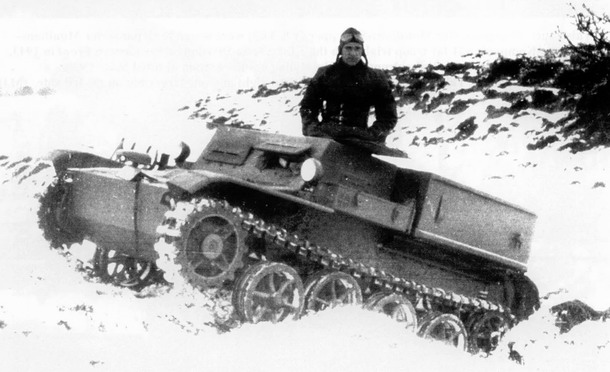
Armoured ammunition carrier VK 3.02 with the new pattern drive sprocket, source: flickr.com with permission of the publishing user, edited
And what became of the one VK 3.01 and two VK 3.02 that were "left over"? The VK 3.01 served as the basis for a self-propelled gun evaluation model: a wooden mock-up of an armoured superstructure and a 105 mm recoilless gun was installed on its chassis. More details about this planned conversion can be found in THIS article. The two VK 3.02 vehicles were used to build a prototype of a light tank destroyer armed with a 50 mm Pak 38 L/60 gun, which is also described separately HERE.
ARTICLE
CONTENTS:
Reproducing text from the Panzernet website without the written consent of the operator is prohibited.