JAGDTIGER
the heaviest series-production armoured vehicle of the Second World War
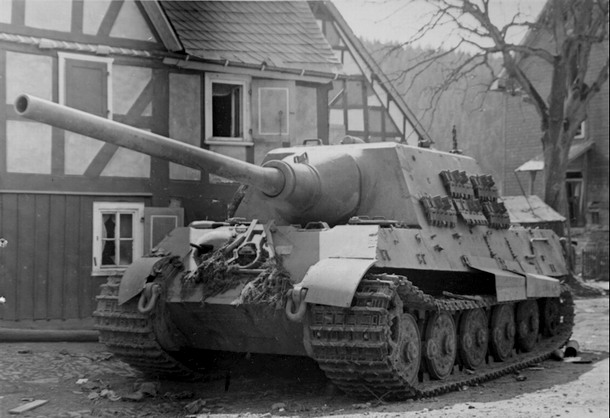
a knocked-out Jagdtiger heavy tank destroyer from the 512th Battalion, captured by the Americans; this is a Henschel-suspension vehicle; source: internet, public domain, edited
Origins of the Vehicle
Given Hitler's obsession with heavy fighting equipment, one might almost expect that the genesis of the heaviest German series-production armoured vehicle was a self-satisfied order from the Führer. That is not the case, however. The impulse for the development of the Jagdtiger tank destroyer reportedly came from the troops themselves, who were calling for a new heavy assault gun capable of supporting infantry and destroying both heavily armoured and soft targets at ranges of up to three kilometres. Such a requirement fitted neatly into the general German approach to dealing with Russian numerical superiority: there are too many enemies, so we need something very powerful that can destroy them at long range before they even reach us. The Waffenamt processed this military requirement and in February 1943 approached Henschel and Krupp with an initial outline specification for a new fighting vehicle. The two firms were not asked to submit rival proposals — they were to collaborate on the vehicle together.
The choice of firms was by no means accidental. The Waffenamt had a fairly clear idea of the new vehicle's basic layout. It was to be based on the chassis of the Tiger II (also known as the Königstiger), which at that time had not yet entered series production but was being worked on intensively... and where else... at Henschel. The armament of the new vehicle was to be a modified version of the 128 mm K 44 gun with a barrel 55 calibres long, also being developed at the time... by whom... yes, by Krupp. So Henschel was tasked with preparing the chassis with a new armoured hull and superstructure, while Krupp was to carry out the necessary modifications to the 128 mm gun.
In March 1943 a meeting was held to discuss further required characteristics of the vehicle under development. The frontal armour was to be at least 150 mm thick — ideally 200 mm! The sides were to be 100 mm. Speed was not a priority, but protection was. The total weight of the vehicle was on no account to exceed 70 tonnes, as this was the maximum load capacity of the Tiger II chassis. The production of the new vehicle was also to require a minimum of scarce raw materials.
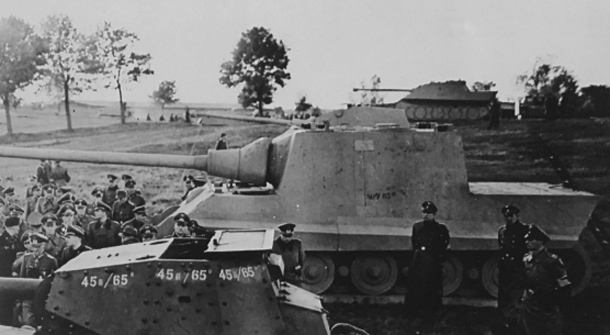
in October 1943 a full-scale wooden mock-up of the new vehicle was presented to the Führer; source: Flickr.com with permission of the publishing user, edited
Two Variants
On 12 April 1943, Henschel presented Waffenamt representatives with drawings of two possible variants of the new vehicle. The first was based on a chassis whose fundamental layout matched that of the Tiger II — engine at the rear, gearbox at the front, fighting compartment in the middle of the hull. The design called for 150 mm of armour on the hull front, 200 mm on the front of the fighting superstructure, and 80 mm on the sides. This variant had two main drawbacks. One was the roughly three-metre overhang of the gun barrel in front of the vehicle's silhouette, which would complicate movement in broken terrain and transport by rail. The second disadvantage was directly related to the first: a shift in the vehicle's centre of gravity towards the front, caused by both the heavy frontal hull armour and the long gun barrel. This placed increased stress on the front section of the running gear — a concern made worse by the fact that the vehicle would have no rotating turret, meaning the entire vehicle would need to be turned sideways fairly frequently. An overloaded running gear subjected to constant stress would be prone to more frequent breakdowns.
The second proposed variant involved moving the engine to the centre of the hull and placing the fighting superstructure at the rear. This solution reduced the barrel overhang to just 1.3 metres and provided a much more favourable weight distribution. On the other hand, it also brought numerous disadvantages. Moving the engine to the middle required significant departures from the tank's basic design, generating additional labour and cost. The proposed design did not yet address how the engine's cooling air intake and exhaust would be handled. And finally, removing an engine located in the middle of the hull would require dismantling not only the gun but the entire armoured superstructure as well — wholly impractical under field conditions. The first variant, with the engine at the rear, was therefore selected for further development.
In May 1943, further parameters of the new vehicle — now referred to as the Tigerjäger — were approved. To simplify production, the hull armour was to be identical to that of the series-production Tiger II: 150 mm on the upper front hull plate, 100 mm on the lower plate, 80 mm on the sides and rear, and 40 mm on the roof. The entire hull, however, had to be extended by 300 mm compared to the Tiger II hull (some sources say 410 mm), which manifested as a larger gap between the last road wheel and the rear idler (comparison photo HERE). The new fighting superstructure, mounted in the centre of the hull, was to receive 200 mm of frontal armour, 80 mm on the sides and rear, and a 30 mm roof. The Maybach HL230 engine was also to be taken over from the Tiger II — a petrol-powered twelve-cylinder with a 23-litre displacement, producing a maximum output of 700 horsepower at 3,000 rpm. The gearbox was to be the Zahnradfabrik AK 7-200 with seven forward gears and one reverse, as used in the medium tank Panther. The road wheels and 800 mm wide tracks were likewise to be taken from the Tiger II.
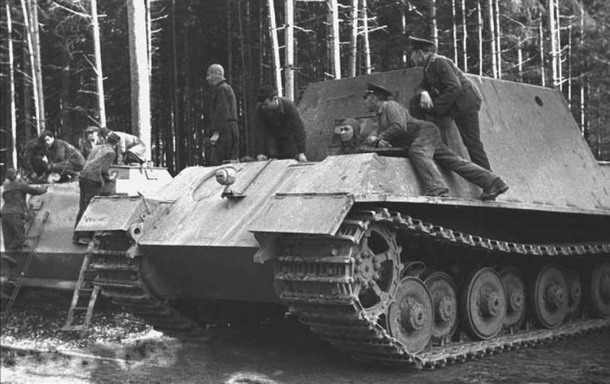
before the first prototype, this incomplete demonstrator was built; source: Worldwarphotos.info with permission of the site operator, edited
A Henschel drawing dated 15 May 1943 (visible HERE) clearly shows one interesting detail that the designers genuinely had to resolve. This was a chamfer cut into the upper edge of the hull's front plate, intended to provide as much clearance as possible for depressing the gun barrel (i.e., to allow the maximum negative elevation). The idea of chamfering the front plate across the full width of the gun's traverse was later abandoned, but two other measures had to be adopted instead. The first was the relocation of the driver's and radio operator's compartment ventilator fan. In the Tiger II tank, this fan was mounted on the hull roof plate between the driver's and radio operator's hatches — directly beneath the gun barrel, meaning its cover restricted the barrel's downward movement. In the Tigerjäger, the fan was therefore moved to the right-hand corner of the driver's and radio operator's compartment. The second measure was recessing the driver's periscope 50 mm deeper into the hull roof plate, so that its armoured cover would not obstruct the gun when depressed.
Henschel originally proposed that the fighting superstructure should be a separate piece that could be lifted off the hull. This proposal was rejected by the Waffenamt on the grounds that the joints between hull and superstructure would be under enormous stress with every shot fired, raising doubts about their structural integrity and water-tightness. Henschel argued that if the entire armoured body — hull and superstructure combined — formed a single piece, it would weigh around 34 tonnes and would be extremely difficult to handle on the production line. The Waffenamt, however, held firm, stating that the production facility would simply have to find a way to manage. The roof of the fighting superstructure, on the other hand, was to be removable, to facilitate the servicing and removal of the gun.
According to the original plans, the gun mounting was to allow horizontal traverse of 18 degrees to each side and vertical movement from -8 to +15 degrees. When Krupp delivered the final drawings of the modified 128 mm gun — which incidentally received the designation 12.8 cm L/55 StuK (StuK = Sturmkanone = assault gun) — it became apparent that both the negative vertical elevation and the lateral traverse would have to be somewhat less than planned.
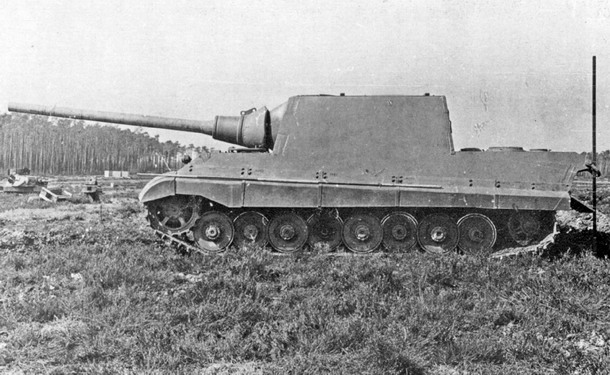
the first prototype built (serial number 305001), from February 1944, was based on Prof. Porsche's suspension system; source: Flickr.com with permission of the publishing user, edited
In September 1943, a full-scale wooden mock-up of the new vehicle was presented to the Waffenamt. Following its review, further change requests were raised. Among the simpler ones were the elimination of loopholes for personal weapons in the side walls of the superstructure, the enlargement of the commander's entry hatch (so it could be more easily passed through while wearing winter clothing), and modifications to the ammunition stowage brackets. But there were also far more significant requirements. For example, a decision was made to replace the gearbox. Instead of the planned Zahnradfabrik AK 7-200, the Maybach Olvar OG 40 12 16 B was to be used. This was unquestionably a rational choice: the original Zahnradfabrik AK 7-200 had been designed for the Panther tank, which weighed a "mere" 44.8 tonnes. The newly chosen Maybach Olvar OG 40 12 16 B was substantially more robust, and was moreover already in use in the series-production Tiger II, which simplified manufacturing (it is actually rather surprising that this gearbox was not chosen in the first place). The Maybach Olvar OG 40 12 16 B provided eight forward gears and four reverse gears. The second major decision was to increase the frontal armour of the fighting superstructure from 200 to 250 mm!
The Waffenamt also asked the manufacturer whether it would be possible to fit a more powerful version of the gun. It would still be in 128 mm calibre, but instead of a barrel 55 calibres long, the weapon would be 70 calibres long (L/70). With otherwise identical properties, a gun with a longer barrel imparts higher velocity to the projectile, and therefore more energy — simply put, as long as the shell is inside the barrel it is accelerating; the moment it leaves, it begins to decelerate. The answer came in October 1944. With the L/70 gun, the barrel overhang beyond the vehicle's footprint would be a full 4.9 metres! This would worsen the already problematic front-end overloading of the running gear and would severely complicate both railway transport and movement in terrain or built-up areas. The idea was (fortunately) dropped, and the vehicle's armament remained the L/55 gun with a barrel 7,020 mm long.
Prof. Porsche Enters the Picture
In January 1944, Professor Ferdinand Porsche entered the project, approaching Hitler with a proposal for a new type of running gear that the heavy vehicle could use. The planned Henschel running gear, carried over from the Tiger II, consisted of 18 wheels on each side mounted on 9 axles and sprung by transversely positioned torsion bars. Porsche, by contrast, proposed a system with only eight road wheels paired into bogies and sprung by longitudinal torsion bars — a similar solution to the one Porsche had proposed for his Tiger I prototype, later used in the construction of the Ferdinand / Elefant tank destroyer.
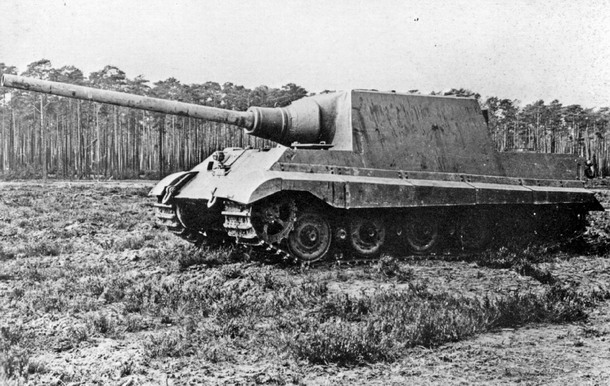
the second prototype, 305002, carried the running gear from the Tiger II tank and ultimately emerged as the winner of the comparative trials; source: Flickr.com with permission of the publishing user, edited
Porsche promised a saving of several hundred man-hours both in the manufacture of the running gear itself and in the production of the armoured hull. He also argued for a weight reduction of 1,200 kg (some authors say as much as 2,680 kg), an increase in ground clearance of 100 mm, and simpler servicing than the Henschel running gear. Such a list of potential advantages could not simply be ignored. Moreover, Porsche was Hitler's personal friend, so it is no surprise that the Führer ordered the construction of comparative prototypes — one with Henschel's running gear from the Tiger II and one with Professor Porsche's system. And not only that. Preparations for the start of series production could not wait for the comparative trials to conclude and a winner to be declared. A decision had to be made now about what the assembly plant should prepare for, so that deliveries could begin as soon as possible (we are talking about the turn of 1943 and 1944 — the Germans could not afford to stop producing fighting equipment). And Porsche was persuasive enough to sway all those responsible: production preparations were aimed at the vehicle with his running gear.
The fact that the Nibelungenwerke plant in St. Valentin, Austria, had been selected for final assembly of the future series-production vehicles certainly played a role as well. Nibelungenwerke fell under the Steyr-Daimler-Puch conglomerate, where Porsche had considerable historical connections (at the turn of the 1920s and 1930s he had held senior positions at both Daimler-Benz and Steyr-Werke). Before the two full prototypes were built, however, at least one unarmed "prototype" on Prof. Porsche's chassis — made of soft, unarmoured steel — was apparently constructed and tested. Photographs of it can be viewed HERE, HERE, and HERE. Note that this vehicle had entirely different track mudguards from the later full prototypes and series vehicles. Whether a similar test vehicle was built on Henschel's chassis is not clear from the available sources.
First Prototypes
In any case, the first complete and armed prototype of the new vehicle was according to plan to be built in December 1943. As usual, various delays intervened, and both ordered prototypes were not assembled until February 1944. The first, fitted of course with Porsche's running gear, carried serial number 305001. The second, number 305002, was built on the Tiger II running gear. After initial factory trials, both vehicles were handed over to the army, which began comparative trials on 5 May 1944. Both prototypes were fitted with the then-standard Gg 24/800/300 tracks from the Tiger II and the associated eighteen-tooth drive sprockets.
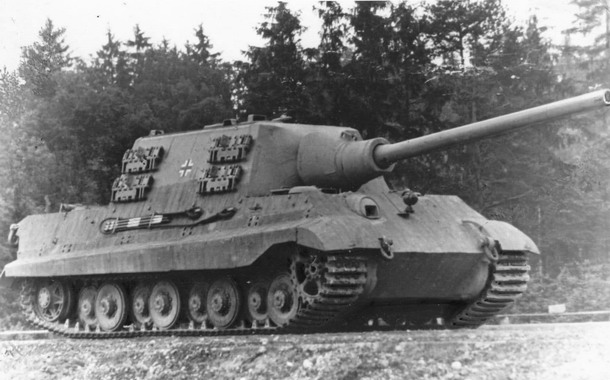
Jagdtiger serial number 305003 was experimentally fitted with tracks from the Ferdinand tank destroyer, but this did not improve its driving characteristics; source: Worldwarphotos.info with permission of the site operator, edited
The Porsche variant prototype, however, began losing points with army representatives even before the driving trials began. As already noted, Porsche's running gear consisted of only eight road wheels on each side, meaning each wheel had to bear a far greater load than the eighteen wheels of Henschel's system. In the Porsche variant, each road wheel therefore exerted a pressure on the track beneath it equivalent to approximately 550 kg per square centimetre. Army representatives were justifiably concerned that this would lead to track bending or cracking far more easily in practice. And there was one further unpleasant detail. The Gg 24/800/300 tracks from the Tiger II were equipped with two guide teeth (projections on the inner surface of the track that prevent it from slipping off the road wheels). In the running gear designed by Prof. Porsche, however, the teeth of the inner guide horn were in the way and had to be removed from the track (simply cut off with an oxyacetylene torch) — unnecessary extra work from the soldiers' point of view.
As if that were not enough, the driving trials reportedly revealed yet another unpleasant characteristic of Porsche's running gear. At low speeds it exhibited severe vibrations, which only subsided after reaching approximately 15 km/h. Porsche tried to attribute this behaviour to the fact that the Tiger II tracks in use, 800 mm wide, were not suitable for his running gear. In July 1944, Jagdtiger serial number 305003 (with the Porsche chassis) was therefore experimentally re-tracked with 640 mm wide tracks from the Ferdinand tank destroyer. The problem recurred. Further trials were abandoned, the Henschel prototype was declared the winner of the comparative tests, and series production was to be switched immediately from the Porsche version to the winning design.
Series Production
As already mentioned, series production was to follow very closely on the heels of the two comparative prototypes, using Prof. Porsche's running gear. Getting production underway proved rather less straightforward than the planners had imagined, and the first three series vehicles did not leave the factory in St. Valentin, Austria until July 1944, followed by three more in August. In September the Nibelungenwerke plant completed three or four vehicles with Porsche's running gear that were still in progress, and then switched fully to the Henschel running gear as ordered. According to some authors, only 10 vehicles in total were built on Prof. Porsche's running gear, including the prototype. Other sources say it was the prototype plus 10 series vehicles — 11 examples in all. In this context, we must return once more to the tracks. While the later series-production Jagdtigers on the Henschel chassis received the newer Gg 26/800/300 tracks and nine-tooth drive sprockets, those first 10 or 11 vehicles built with the Porsche chassis retained the older Gg 24/800/300 tracks and eighteen-tooth drive sprockets. And of course — the teeth of the inner guide horn had been removed from these tracks (as described above).
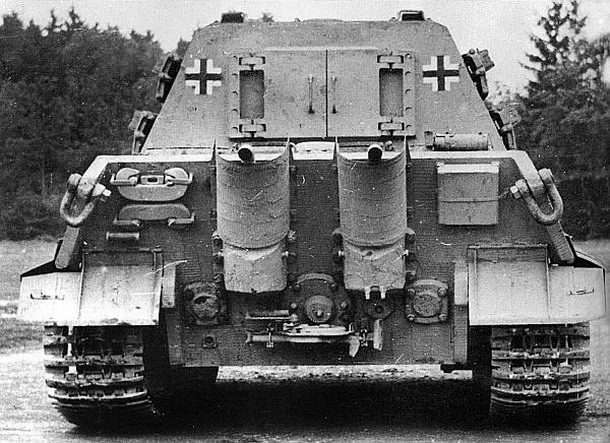
fine view of the rear of Jagdtiger serial number 305003, fitted with Ferdinand tank destroyer tracks; the photograph also clearly shows the earlier style of exhaust pipe covers; source: Flickr.com with permission of the publishing user, edited
In September 1944, a total of 8 Jagdtigers left the production line (3 or 4 with Porsche running gear, the rest Henschel). October saw 9 Jagdtigers built, despite the factory being bombed by the Allies on the 16th. November produced a further 6 vehicles and December an even 20. By the end of 1944, a total of 51 Jagdtigers had been completed (2 prototypes plus 49 series vehicles).
The start of production was accompanied by the usual teething troubles. Vehicle number 305005, for example, had defective welds on the frontal armour. Repair was not practicable, so the Waffenamt accepted the vehicle but restricted it to rear-area service only — probably for crew and mechanic training. On other early vehicles, inaccurately cast areas on the front wall of the fighting superstructure and on the gun mantlet had to be ground down considerably (the front wall of the superstructure, with its elongated gun aperture, was indeed a casting). Despite all efforts to eliminate the inaccuracies, these vehicles ended up with a smaller negative gun elevation than perfectly manufactured Jagdtigers.
A large number of suppliers were of course involved in Jagdtiger production. Engines were provided both by Maybach-Motorenbau GmbH of Friedrichshafen and by Auto-Union AG of Chemnitz; guns were supplied by Friedrich Krupp AG of Essen; gun mountings came from the Krupp Bertawerk AG factory in Breslau; and gearboxes from the Zahnradfabrik plants in Passau and from Adlerwerke in Frankfurt. Armour plate production was handled by Eisenwerke Oberdonau in Linz, and final assembly of the vehicles took place at the already-mentioned Nibelungenwerke plant in Austria.
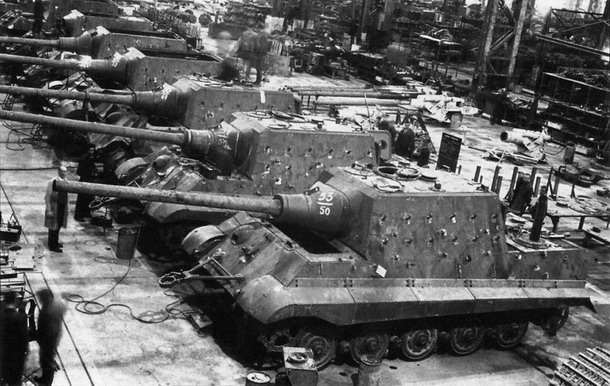
Jagdtiger production took place at the Nibelungenwerke factory in St. Valentin, Austria; source: Flickr.com with permission of the publishing user, edited
January 1945 arrived, and the Waffenamt announced a production plan for Jagdtigers for the coming months. Nibelungenwerke was to deliver 10 vehicles in January, 40 in February, 25 in March, and a final 25 in April. From May 1945, the factory was then to switch to Tiger II production. From the same month, Jagdtiger production was to be taken over by the firm Jungenthal, continuing at the planned rate of 25 vehicles per month. It was, however, 1945, and the lifespan of any German plan was extremely short. Delays from subcontractors, rail transport disruptions, and power supply failures were the order of the day.
In January 1945 the workers still managed to complete the required 10 vehicles; February delivered only 13. In March, not a single Jagdtiger was probably completed, for two reasons. The first was the air raid of 23 March, during which 258 tonnes of bombs were dropped on the factory. The second was a critical shortage of 128 mm guns. At the end of February Hitler had already ordered that Jagdtiger production must not be halted, so if standard guns were unavailable, the vehicles were to be fitted with 88 mm guns from Tiger II tanks (the Führer presumably did not concern himself with how extensive the engineering changes would be). What is certain is that some number of Jagdtigers were completed in April and even in early May 1945. The literature, however, is contradictory. Total production figures of 74, 76, and even 88 vehicles are cited. It is possible that some authors include unfinished vehicles that remained in the factory when it was occupied by the Red Army on 9 May 1945.
Assault Gun or Tank Destroyer?
Let us briefly consider the various designations the new fighting vehicle acquired over time. As the attentive reader may have noticed at the start of this article, the original military requirement spoke of an assault gun. And so the vehicle was indeed initially designated — for example as 12.8 cm StuK auf Tiger H3 (February 1943) or Tiger II – Sturmgeschütz (March 1943). In May 1943, the designations 12.8 cm Panzerjäger and Tigerjäger appeared for the first time, both clearly indicating that the new vehicle was intended not as an assault gun but as a tank destroyer. Behind this change lay long-running disagreements between the armoured troops and the artillery. By reclassifying the vehicle, the tank arm was attempting to bring work on it under its own control, since while the development of tank destroyers fell under them (department WaPrüf 6 of the German Waffenamt), the development of assault guns was the domain of the artillery (department WaPrüf 4 of the German Waffenamt).
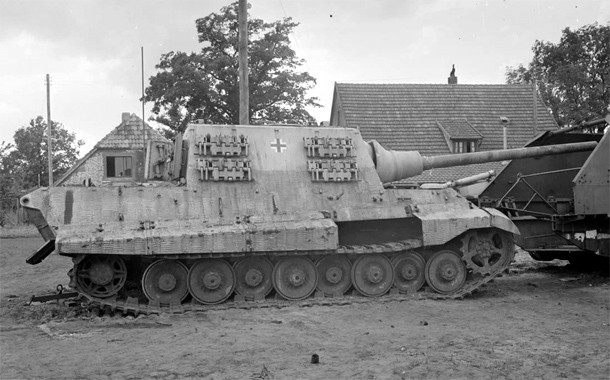
Jagdtiger with Porsche running gear; source: Flickr.com, public domain, edited
From that point on, the vehicle was referred to exclusively as a tank destroyer under designations such as 12.8 cm Pz.Jäg.44 (L/55) Tiger B (September 1943), Panzerjäger Tiger für 12.8 cm Pak 44 (Sfl.) (October 1943), or s.Pz.Jg. auf Fgst. Tiger (February 1944). The now universally known name Jagdtiger — "hunting tiger" — appeared for the first time in February 1944 and caught on both with the units and in various official documents. The described change in the new vehicle's role may not have been purely formal, however. This is suggested by the fact that during subsequent development, the originally required capability for indirect fire — more typical of conventional artillery — was abandoned entirely. For completeness, the vehicle's ordnance code was Sd.Kfz. 186 (Sd.Kfz. = Sonderkraftfahrzeug = special-purpose vehicle).
Vehicle Description
The Jagdtiger tank destroyer became the heaviest German series-production armoured vehicle of the Second World War. Speaking of the series-production Jagdtiger on the Henschel chassis, its weight was 75.2 tonnes (though other figures are also cited), its length was an extraordinary 10.654 metres (including the gun barrel overhang), its width 3.625 metres, and its height 2.945 metres. As already mentioned, the Jagdtiger's hull had to be extended by a full 30 cm relative to the Tiger II (or 41 cm, depending on which source you trust). Alongside this, the track contact length with the ground was increased by 120 mm (4,120 mm on the Tiger II, 4,240 mm on the Jagdtiger).
The running gear of the tank destroyer consisted of 18 wheels on each side, mounted on 9 axles and sprung by torsion bars (to reiterate — we are describing the series-production Jagdtiger with Henschel suspension). The wheels on the first and last axles were additionally fitted with hydraulic shock absorbers, as they had to withstand the greatest load while driving. The road wheels were 800 mm in diameter and rimmed on the outside with only a thin rubber cushioning layer concealed beneath a steel rim. While prototype 305002 still carried the older Gg 24/800/300 tracks and eighteen-tooth drive sprockets, the series vehicles received the newer Gg 26/800/300 tracks with the corresponding nine-tooth drive sprockets (introduced on the Tiger II in May 1944). And like the Tiger II, the Jagdtiger used two sets of tracks — narrower transport tracks and wider combat tracks. The combat tracks were 800 mm wide, the transport tracks only 660 mm. The narrower tracks were necessary for rail travel, as the vehicle simply exceeded loading gauge limits with combat tracks fitted. Before every loading onto flatcars the tracks had to be swapped, and then swapped back again after unloading at the destination. Using the narrow transport tracks for normal self-propelled movement was prohibited.
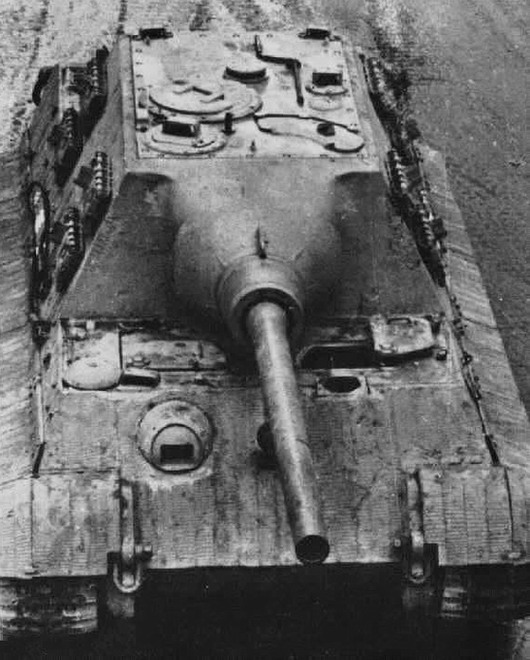
a fine overhead view of the Jagdtiger heavy tank destroyer; source: Worldwarphotos.info with permission of the site operator, edited
Each track consisted of 47 double-link sections, each comprising a main link and a connector link. One such double section of transport track weighed 42.9 kg; a combat track section weighed 62.7 kg. It is easy to calculate therefore that one complete combat track for the Jagdtiger weighed approximately 2,947 kg! Exchanging combat and transport tracks was clearly a very demanding job. With the wider combat tracks, the specific ground pressure was around 1.06 kg/cm², which was high, but still within acceptable limits. Early in 1945, new Kgs 73/800/152 tracks with single-piece links were introduced on Tiger II tanks, but these were apparently not used on Jagdtigers.
The Jagdtiger was theoretically capable of reaching a top speed of 41.5 km/h, but in practice it moved considerably slower, particularly cross-country. The fuel tanks held an impressive 860 litres of petrol, but the vehicle's fuel consumption was truly astronomical. On the road it devoured approximately 800 litres per 100 km; cross-country it could quite readily demand 1,100 litres per 100 km! The gearbox was the already-mentioned Maybach Olvar OG 40 12 16 B with eight forward gears and four reverse. The crew consisted of six men. The driver and radio operator sat in the front section of the hull, accessed through their own hatches in the hull roof plate ahead of the fighting superstructure. The remaining men had their stations in the fighting superstructure. The gunner sat to the left of the gun, the vehicle commander to its right, with two loaders behind them. For entry and exit the crew used two hatches in the superstructure roof and, alternatively, large double doors in its rear wall.
The Jagdtiger's standard communications equipment was probably the Fu 5 radio set, though command vehicles also existed with the more powerful Fu 8 set and a second antenna with a star-shaped spreader (a mounting for this antenna can be seen in photographs HERE). Additionally, a signalling device was fitted on board, allowing the commander to issue simple orders to the driver. This consisted of a mechanical indicator operated by a Bowden cable and a bell that alerted the driver to a new command. The indicator had several basic positions corresponding to: forward, reverse, right, left, and stop.
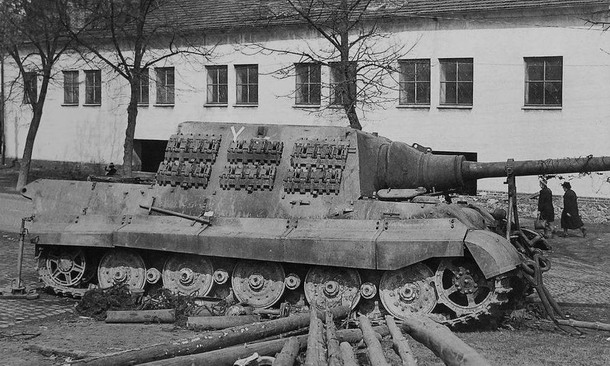
a late-production Jagdtiger with six spare track links on the side of the superstructure and brackets for a tubular crane; source: Flickr.com with permission of the publishing user, edited
The Pak 44 Gun
The Jagdtiger's main armament was the already-mentioned 128 mm K 44 gun. Although originally developed under this designation, it entered service under the name 12.8 cm Pak 44 (Pak = Panzerabwehrkanone = anti-tank gun), and was later redesignated 12.8 cm Panzerjägerkanone 80. It was a truly fearsome weapon, against which practically no target could hold out. The gun weighed approximately seven tonnes, and for ease of handling it used two-piece (separated) ammunition — meaning the shell was loaded into the barrel first, followed by the cartridge case with the propellant charge. Three propellant charge sizes were available, along with two basic types of shell. Against soft targets the high-explosive 12.8 cm SprGr L/50 was used, weighing approximately 28 kg. Against armoured targets the 12.8 cm PzGr 43 was employed.
The PzGr 43 (Panzergranate 43) weighed 28.3 kg and left the gun barrel at up to 920 m/s. At a range of 1,000 metres, this projectile could penetrate homogeneous steel armour sloped at 30 degrees to an extraordinary thickness of 230 mm! But that is not all. At 2,000 metres the PzGr 43 penetrated approximately 200 mm of armour, and at three kilometres it could still defeat armour 173 mm thick. All that was needed was a hit, and the devastating effect was essentially guaranteed. The commanding officer of the 2nd Company of the 512th Heavy Tank Destroyer Battalion, Otto Carius, mentions in his memoirs that he succeeded in destroying an American tank concealed behind a house with fire from a Jagdtiger. It is admittedly not clear from his account whether the building was of wood or brick construction, but the ability of the shell to pass through a house and still defeat the armour of the tank behind it is eloquent enough regardless.
The tables comparing the ability of enemy tanks to penetrate the Jagdtiger's frontal armour with the German vehicle's ability to penetrate the frontal armour of those same enemy tanks made for very one-sided reading. No Allied or Soviet tank — including the IS-2 — could penetrate the Jagdtiger's front even at point-blank range. The Jagdtiger, by contrast, could penetrate the frontal armour of all major enemy vehicles at ranges of 3,500 metres and beyond. Worth briefly mentioning is also the fact that a special type of sub-calibre ammunition with discarding sabot was under development for the Pak 44 gun, designated the 12.8 cm Treibspiegel-Geschoss mit H-Kern. It was precisely because of this planned ammunition type that the gun was not fitted with a muzzle brake. In the end, however, this round never entered service.
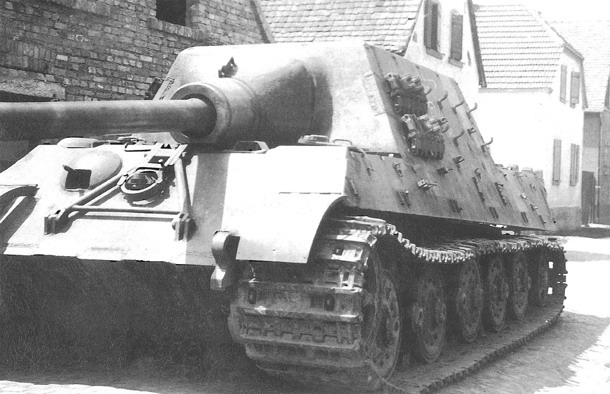
Jagdtiger on Henschel suspension; source: Worldwarphotos.info, public domain, edited
In the Jagdtiger, the Pak 44 gun was mounted at a firing height of 2,150 mm, with a horizontal traverse of 10 degrees to each side and a vertical range of -7 to +15 degrees. For aiming, the ten-power periscopic Winkelzielfernrohr 2/1 (W.Z.F.) gun sight was used, extending through an aperture in the roof. Ammunition stowage on board was 40 rounds (though a US Army technical report on a captured Jagdtiger dated 10 May 1945 states that the vehicle has brackets for only 38 rounds).
In the left section of the fighting superstructure roof was the so-called Nahverteidigungswaffe (close-defence weapon), intended primarily for defence against enemy infantry. This was essentially a grenade launcher, with the firing device mounted inside beneath the roof and the barrel opening onto the roof surface. In addition to anti-personnel fragmentation grenades, smoke grenades could also be fired from this weapon, and a signal pistol could even be discharged through the barrel. The vehicle also carried two machine guns. An MG 34 was installed in a ball mount in the front hull wall; a second machine gun, type MG 42, was carried loose inside the superstructure and could be fired either from the roof or from a mounting above the engine bay (photo HERE).
During Jagdtiger production, several mainly minor design changes were introduced. In July 1944, the sheet-metal covers around the exhaust pipes on the rear hull wall were removed (photo HERE). From August 1944, a folding travel lock for the gun barrel was fitted to the hull front plate. Beginning in September 1944, new vehicles were coated with Zimmerit anti-magnetic paste, though generally only up to the height that an infantryman could reach while standing beside the vehicle. In December 1944, the number of spare track link brackets on the sides of the fighting superstructure was increased from four to six. In February 1945, brackets for erecting a simple tubular crane were welded to the fighting superstructure roof (photo HERE), used for example to lift the engine during field repairs.
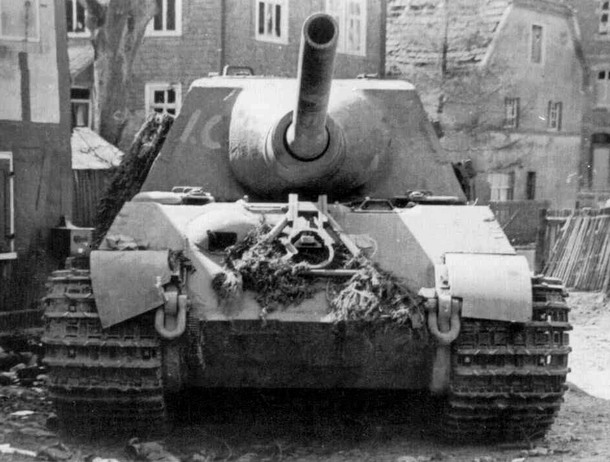
a view into the barrel of the 128 mm gun; source: Flickr.com, public domain, edited
Organisational Structure
Jagdtigers were organised into heavy tank destroyer battalions (schwere Panzerjäger Abteilung, or sPzJgAbt). Such a battalion consisted of three companies (Kompanie). Each company was further divided into three platoons (Zug), each armed with four tank destroyers plus supporting vehicles. Each company also had its own command section with two additional Jagdtigers, meaning a company at full strength fielded 14 tank destroyers (3 x 4 plus 2). The battalion additionally had its own headquarters company (Stabkompanie) with a further three vehicles. The complete battalion therefore disposed of 45 Jagdtigers (three combat companies of 14 plus the battalion headquarters company with 3). Comparing the battalion's organisational structure with the total number of Jagdtigers produced makes it immediately clear that there were not even enough vehicles to equip two complete battalions.
Combat Deployment
The first unit to receive the new vehicles was sPzJgAbt 653. This unit had originally been equipped with Ferdinand (later Elefant) tank destroyers, but after nearly a year and a half of hard fighting on the Eastern Front and in Italy only 10 of these remained. At the end of 1944, all ten Elefants were transferred to a separate company, and the 653rd Battalion began preparing for re-equipment with Jagdtigers. Deliveries of the new vehicles were slow, however, so by the end of November 1944 the battalion had only 16 vehicles available. These were used for intensive crew training at the training ground near Döllersheim in Austria (some 100 km from the Nibelungenwerke factory itself). On 5 December 1944, these 16 Jagdtigers — organisationally divided between the battalion's 1st and 3rd Companies — were loaded onto three freight trains and dispatched from Döllersheim to the Western Front to take part in Operation Wacht am Rhein. Due to logistical problems, however, only one train with six Jagdtigers reached the target railway station at Blankenheim, and even then not until 21 December 1944. The remaining two trains unloaded their cargo at Wittlich station, a full 50 km from the front.
As for the Jagdtigers' actual combat involvement in Operation Wacht am Rhein, the sources are fundamentally at odds. According to some authors, at least some of the six Jagdtigers from Blankenheim followed in the wake of the main German attack and over the following two days travelled the more than 120 km to the Belgian town of Bastogne, where the Germans had been holding a surrounded American garrison for several days. The Americans, however, were not about to abandon their comrades, and dispatched a relief column from the south, led by 32 Sherman tanks of the 8th Battalion of the 4th Armored Division. The area south of Bastogne was at that time held by the German 26th Volksgrenadier Division under the command of — please try not to laugh — Major General Heinz Kokott.
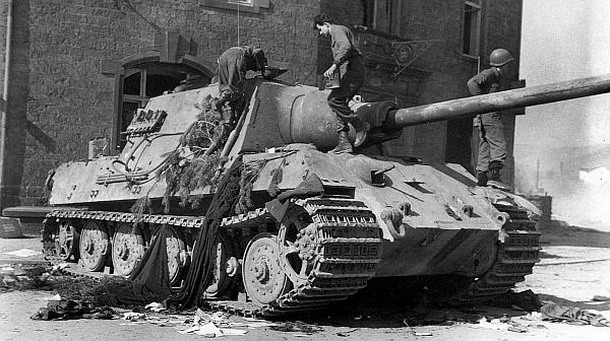
American soldiers examine an abandoned Jagdtiger with interest; source: Flickr.com, public domain, edited
Heinz Kokott had his headquarters in the village of Hompré, just 7 km south of Bastogne, placing him directly in the path of the American relief column. On 23 December, as he was organising all available forces to repel the American attack, four Jagdtigers from sPzJgAbt 653 reportedly appeared at Hompré suddenly and unexpectedly. Major General Kokott was taken aback not only by the arrival of any German armour at all, but above all by what type it was. No one among the German troops at the front had yet had the opportunity to see the monstrous 75-tonne machines. The Major General immediately decided to deploy the vehicles in the planned defence against the Americans and ordered the group commander (whose name is unfortunately not recorded anywhere) to move his vehicles a further 5 km south to the village of Chaumont and prepare to repel the American attack. Whatever the name of that Jagdtiger group's commander, he demonstrated that he knew his trade. He positioned his vehicles in an ideal spot, allowing them to exploit their principal asset — long-range, accurate, and devastating firepower. Concealed at the edge of a wooded ridge, the four Jagdtigers had a perfect view of the approach road to Chaumont. When American Shermans appeared on it, the Germans had them at their mercy. In the engagement that followed, the Americans lost a total of 18 tanks, 11 of which were reportedly destroyed by the Jagdtigers of the 653rd Battalion.
And now back to earth... according to the overwhelming majority of authors (Spielberger, Doyle, Jentz, Devey, Münch), the Jagdtigers took no part in combat at all during the German Ardennes offensive. The six vehicles unloaded from the train at Blankenheim on 21 December reportedly did not advance to Bastogne at all, but instead took up positions between the towns of Gemund, Kall, and Schleiden, some 20 km from Blankenheim itself. They remained there until 23 December, when they received (along with the rest of the 653rd Battalion) new orders to move to the town of Zweibrücken. The battalion was to participate in a new German offensive codenamed Operation Nordwind. One is probably forced to accept that the heroic story from Chaumont is pure fiction, and that the Jagdtigers in fact took no part in the Ardennes offensive at all. It is also difficult to imagine that the "legendary" four Jagdtigers could have covered the more than 120 km from Blankenheim to Bastogne under their own power in two days — as we shall see in a moment when we describe another attempted Jagdtiger march under their own power over a longer distance.
Returning then to 23 December 1944, when the 653rd Battalion received orders to move to the town of Zweibrücken and take part in Operation Nordwind. The six Jagdtigers near Blankenheim assembled at the railway station and on 29 December were travelling by freight train toward their new deployment area. For the other Jagdtigers, positioned in the vicinity of the town of Wittlich, however, no railway flatcars were available, so their crews were ordered to make their own way to Boppard, some 90 km distant. And here is what happened: every single Jagdtiger that took part in the march broke down along the way — every last one. Some of those travelling by train from Blankenheim also experienced mechanical problems. In short, on 31 December 1944 — the day before Operation Nordwind was due to begin — there were just two operational Jagdtigers at the assembly point!
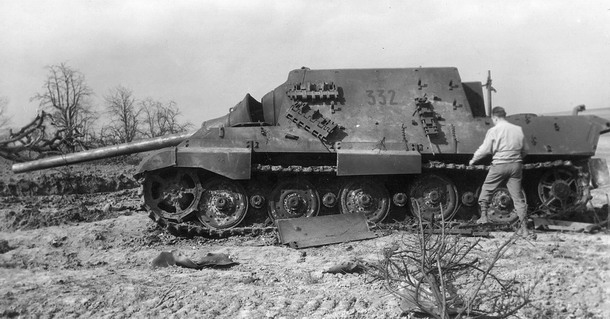
a wrecked Jagdtiger on Henschel suspension; source: Worldwarphotos.info, public domain, edited
Over the following days, one more vehicle was made operational, and on 9 January 1945 three Jagdtigers were finally able to go into action for the first time, alongside the 17th SS Panzergrenadier Division "Götz von Berlichingen". During the day they reportedly managed to destroy one American Sherman, but while advancing across a snow-covered field the Germans missed concealed infantry, and one of the Jagdtigers received a fatal hit to the side of the hull. A shaped-charge round from an American bazooka burned through the 80 mm side armour and triggered an explosion of the stored ammunition, killing the entire crew and completely destroying the vehicle. This was the Jagdtiger with hull number 305024 and tactical number 134. The Germans made no attempt to recover the wreck. They simply left it in place, and only when they later prepared to evacuate the area did they blow it up to hinder Allied inspection. The following days and weeks saw the Jagdtigers operating in the area north of Strasbourg.
On 1 March 1945, a total of 39 Jagdtigers from the 653rd Battalion were standing in the forests around the town of Haguenau, some 25 km north of Strasbourg, preparing to repel an expected Allied attack. Of those 39 vehicles, 29 were combat-ready, 8 required short-term repair, and 2 long-term repair. By 11 March the battalion had 41 Jagdtigers available, of which 38 were operational. Just a few days later the Allies launched an attack in the Haguenau area and the Jagdtigers again went into action — for example on the night of 14 to 15 March, when they destroyed a column of American tanks at the village of Mertzwiller from a range of 4 km. On 16 March, however, the Jagdtigers came under intense enemy fire and a total of 7 vehicles were put out of action, five of which could not safely be recovered and had to be blown up by the Germans.
The 653rd Battalion then began a slow retreat to the north-east through the towns of Wissembourg, Landau in der Pfalz, and onward to Germersheim, where it crossed the Rhine. During this long retreat the number of operational vehicles steadily dwindled, primarily due to breakdowns and Allied air power. By 23 March the battalion reported 31 Jagdtigers, only 3 of them operational; by 31 March only 25 remained, again just 3 of them combat-ready. April and May 1945 were almost entirely dominated by retreat to the east and mounting losses. On 26 April 1945 the battalion reported 14 Jagdtigers: 1 combat-ready, 7 requiring short-term repair, and 6 long-term repair. The last two operational Jagdtigers from the entire 653rd Battalion surrendered to the Americans at 15:00 on 7 May 1945 in Liezen, Austria. These were vehicles with tactical numbers 312 and 324.
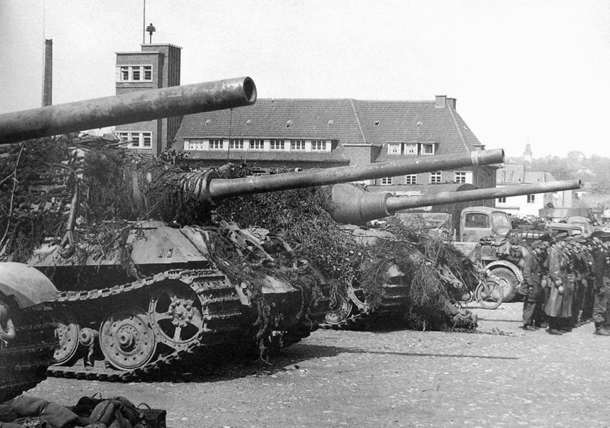
the ceremonial surrender of the remnants of the 1st Company of the 512th Battalion on 16 April 1945 in the town of Iserlohn near Dortmund; source: internet, public domain, edited
The second and last unit to receive Jagdtigers was battalion sPzJgAbt 512, which was effectively not built up until the end of January 1945. According to plan, each of its three companies was to receive only 10 vehicles (instead of the regulation 14). The battalion headquarters was to receive a further three Jagdtigers, meaning the unit was planned to have 33 vehicles in total. Between 12 and 14 February 1945, the battalion took delivery of its first 11 brand-new Jagdtigers and the men began gunnery training at the range near Döllersheim, Austria (the military training area still exists there today). On 16 February, however, orders came through to return all 11 vehicles to the parent factory to have their faulty Henschel L801 steering gearboxes replaced, which delayed the battalion's equipping by two precious weeks. On 3 March 1945, the first 5 fully functional Jagdtigers departed by rail from Linz in Austria to Sennelager near Paderborn in Germany. A further 15 vehicles set out on the same journey on 5 and 10 March.
Getting armoured vehicles from the factory to their assigned location and ensuring their combat readiness was an almost impossibly difficult task in the conditions of February 1945. The Jagdtigers themselves travelled to Sennelager from Linz on transport tracks — naturally, since they were going by train. The combat tracks, however, did not travel with them, presumably because they were not available in Linz and had to be separately dispatched to Sennelager from the supplier's factory in Velbert. At the same time, ammunition had to be sent from Magdeburg to Sennelager. All three trains had to survive the journey unscathed by Allied air power and converge at one station, so that the Jagdtigers could actually be made ready for combat.
While the 512th Battalion was being transported to Sennelager (specifically on 7 March), American forces succeeded in capturing the strategically vital Ludendorff railway bridge over the Rhine at Remagen. On 10 March 1945, the 512th Battalion was accordingly ordered to move to Remagen and participate in the German counter-attack. The unit, however, was nowhere near ready for action — the crews were still essentially familiarising themselves with their new fighting vehicles. The closest to combat-ready was the 2nd Company under First Lieutenant Otto Carius. Carius himself was of a different view, however — he considered the training insufficient and the vehicles immature. But orders are orders, and on 14 March 1945 the 2nd Company loaded its 10 Jagdtigers onto three freight trains and set off for Siegburg railway station. Due to confusion on the railways, however, one train ended up in Duisburg, so only five Jagdtigers and their support and supply vehicles reached Siegburg.
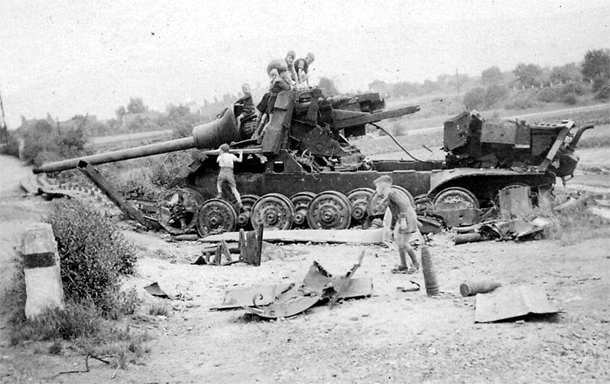
a Jagdtiger blown up by its crew now serves as a climbing frame for children; source: Flickr.com, edited
In the night of 20 to 21 March 1945, five Jagdtigers were unloaded from the train and moved into forests east of Siegburg. Carius's Jagdtigers were assigned to the newly formed Panzergruppe Hudel for the attack on the American bridgehead on the Rhine, and in the early hours of 24 March they went into action. The Americans, however, had been expecting the German attack, were well prepared, repelled it without too much difficulty, and quickly counter-attacked. Carius's 2nd Company with its Jagdtigers (still only 5 in total) received orders on 25 March to withdraw to the town of Siegen and prepare for its defence. Two Jagdtigers suffered breakdowns on the way that prevented them from continuing their march and both had to be blown up. The remaining three reached Siegen, and between 26 and 30 March were joined there by five more vehicles that had gone astray during their move from Sennelager. Carius thus now had 8 Jagdtigers at his disposal. A further 10 Jagdtigers from the 1st Company of the 512th Battalion also arrived in the town.
On 28 March 1945, the 512th Battalion recorded its first destroyed enemy tank, when the commander of the 1st Company, First Lieutenant Albert Ernst, quite literally tore apart an American Sherman with a 128 mm shell. Over the following three days, the 1st Company held defensive positions south-east of Siegen and destroyed more than thirty American vehicles — mostly tanks — firing at ranges of up to three kilometres. Albert Ernst was promoted to Captain for this achievement, but his company was left with only 5 Jagdtigers. On 1 April 1945, the Americans succeeded in closing the so-called Ruhr Pocket, encircling 317,000 German soldiers including the remnants of the 512th Heavy Tank Destroyer Battalion. The men of the 512th Battalion fought on inside the pocket for more than two weeks, but it was merely delaying the inevitable. The unit's fate was sealed.
Film footage has survived of the ceremonial surrender of the remnants of the 1st Company of the 512th Battalion on 16 April 1945 in the town of Iserlohn near Dortmund. Company commander Captain Albert Ernst had his unit fall in on the town square. It was still a long column of various vehicles — trucks and cars, half-track personnel carriers, recovery vehicles including one Bergepanther, and above all three operational Jagdtigers. On the barrel of one of them, five victory rings are clearly visible. The armoured vehicles drove into the square with white flags on their antennas, under American supervision and — somewhat surprisingly — to occasional waves from watching civilians. The soldiers then laid down their weapons and formed up for a final muster before their vehicles.
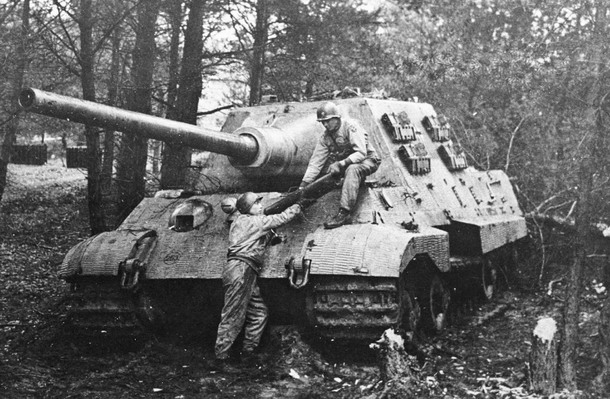
American soldiers examine an abandoned Jagdtiger on Porsche suspension; source: Worldwarphotos.info, public domain, edited
The Jagdtigers left their mark on the history of the Second World War more through their size and weight than through their combat successes. The truth is, however, that they were not given many opportunities to achieve such successes. When a fighting vehicle enters service six months before the end of a war, under conditions of growing shortage and chaos, and is built in quantities of mere dozens, it does not exactly enjoy ideal circumstances to demonstrate what it can do. Jagdtigers also earned a reputation for being very unreliable vehicles. Here too, in their defence, it must be said that they simply never had the chance to go through the initial phase of testing, tuning, and ironing out deficiencies. In January 1945, the Inspectorate of Armoured Forces sent a representative to the 653rd Battalion to look into the causes of the high breakdown rates among the new vehicles. His report identified several problem areas, but a very significant factor was the utterly inadequate training of drivers. The Jagdtigers' worst enemies were often their own inexperienced crews.
Technical Data
|
weight: |
75.2 t |
|
length: |
10.65 m |
|
width: |
3.63 m |
|
height: |
2.95 m |
|
engine: |
Maybach HL230 |
|
engine output: |
700 hp |
|
max. speed: |
41.5 km/h |
|
fuel capacity: |
860 l |
|
fuel consumption – road: |
800 l / 100 km |
|
fuel consumption – cross-country: |
1100 l / 100 km |
|
hull armour: |
|
|
- front: |
150 mm |
|
- sides: |
80 mm |
|
- rear: |
80 mm |
|
superstructure armour: |
|
|
- front: |
250 mm |
|
- sides: |
80 mm |
|
- rear: |
80 mm |
|
crew: |
6 men |
|
armament: |
Pak 44 L/55 gun, 128 mm calibre 2 x machine gun, 7.92 mm calibre |
ARTICLE
CONTENTS:
Reproducing text from the Panzernet website without the written consent of the operator is prohibited.