NASHORN
a rhinoceros with a very sharp "horn"
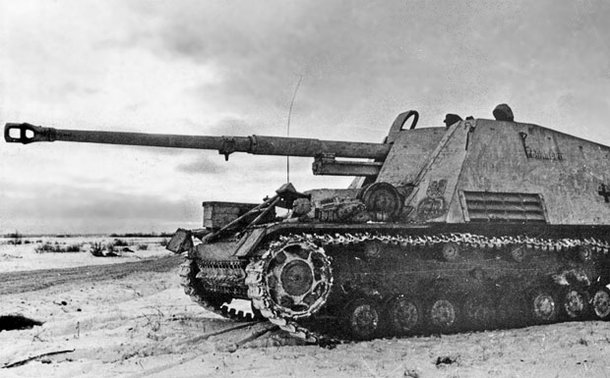
Nashorn tank destroyer in winter camouflage — note the extraordinary length of the gun barrel, source: Flickr.com, with permission of the publishing user, edited
Origins of the Tank Destroyer
The Second World War brought remarkable advances in the development of tanks and other armoured fighting vehicles. On one hand, this drove a constant increase in armour thickness, while on the other, ever more powerful and effective anti-tank weapons were being developed in response. At the outbreak of the war, the main German anti-tank weapon was the PaK 36 with a calibre of just 37 mm. Next in line came the PaK 38 at 50 mm, but that too soon proved inadequate, giving way to the 75 mm PaK 40. The German army command was well aware, however, that even this weapon would sooner or later struggle against the new heavy tanks being developed by their adversaries — above all the Soviet Union. In June 1942, the Ordnance Office therefore ordered the development of a new 88 mm anti-tank gun.
The new weapon was to build on the success of the Flak 41 anti-aircraft guns, which had proved highly effective against armoured vehicles. The new gun was required to be capable of penetrating 160 mm of sloped homogeneous armour at a range of one kilometre. The Ordnance Office approached two competing firms, Krupp and Rheinmetall, with the requirement that the new gun be ready for production by spring 1943. Krupp ultimately won the competition, and the new weapon received the designation PaK 43.
The Germans being the Germans, virtually simultaneously with the development of the new gun they also began searching for a suitable carrier that would combine with it to form a new self-propelled weapon. It soon became clear that no suitable fully-tracked chassis for mounting the future PaK 43 was available, and that developing a purpose-built tank destroyer would take considerable time — certainly longer than until spring 1943. It would, however, be a great waste to have a powerful new gun ready and be forced to simply wait for its carrier to be finished. So as early as the end of July 1942, a decision was made in favour of a so-called Zwischenlösung, or interim solution. This meant developing a carrier that need not meet any exceptional standards, but had to be available as soon as the gun itself was ready and deployable immediately thereafter — while work on the final vehicle, with its far superior specifications, continued in parallel.
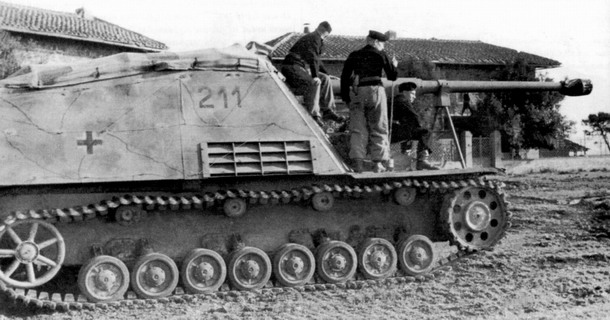
This Nashorn still has the early-pattern drive sprocket with circular lightening holes, but the gun barrel travel support is already the later type that could be folded from inside the fighting compartment, source: Flickr.com, with permission of the publishing user, edited
The Chassis
As it happened, the development of the new Hummel self-propelled howitzer was underway at the same time, and the firm Alkett was developing for it a new chassis that drew on the best features of both the Panzer III and Panzer IV tanks. The Germans decided to use this new combined chassis — designated Geschützwagen III/IV (Geschützwagen = gun carriage) — as the basis for the "interim" tank destroyer armed with the new PaK 43.
From the Panzer III, the Geschützwagen III/IV inherited virtually the entire transmission and steering system — the Zahnradfabrik SSG 77 gearbox, the steering brakes and the drive sprockets. From the Panzer IV came the Maybach HL120 TRM engine, the radiator, fans, exhaust system, road wheels, idler wheels and tracks. The engine was not placed at the rear of the hull as in the original Panzer IV, however — it was shifted to the centre of the hull in order to free up the rear compartment for the fighting cabin.
The front of the hull was formed by a 30 mm armour plate, above which a steeply angled glacis plate ran to the roof, with the driver's hood projecting from its left side. In front of the driver was a vision port: in safe areas it could be opened fully to allow direct observation, while in combat it remained closed and the driver viewed the ground ahead only through a slit protected on the inside by a block of bulletproof glass. The driver had his own circular hatch with a single-piece cover above his head. To his right sat the radio operator, who also had his own circular hatch overhead.
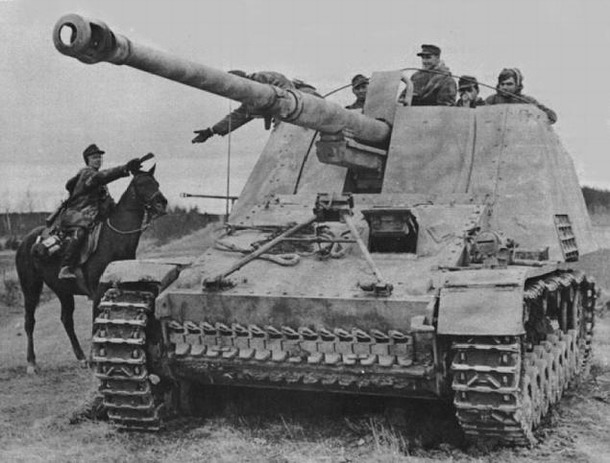
Late-production Nashorn, source: Flickr.com, with permission of the publishing user, edited
Immediately behind the positions of these two men rose the tall armoured superstructure enclosing the main fighting compartment. Its front wall was formed by a gun shield connected directly to the gun. The sides of the superstructure had louvred openings to ensure airflow to the engine — air was drawn in from the left and expelled to the right. The armour of the fighting compartment tapered slightly toward the rear. In the rear wall was a two-leaf door for crew access and ammunition loading.
The armour of the fighting compartment was only 10 mm thick, in an effort to keep the vehicle's weight to a minimum. Plate of this thickness offered protection only against small arms fire and light shell splinters, while the top of the compartment was left completely open. In bad weather the crew could protect themselves by stretching a waterproof tarpaulin secured to loops on the side walls. It is clear from all of this that crew protection was relatively modest. It is important, however, to appreciate the vehicle's intended combat role. The tank destroyer's main asset was its gun, which was highly effective and extremely accurate even at long ranges. The ideal tactic was therefore an unexpected ambush of enemy armour, destroying it with fire from a distance. The Nashorn was not meant to let the enemy close in, and when that prospect loomed, the right move was simply to withdraw.
Relocating the engine to the centre of the chassis allowed the floor of the fighting compartment to be placed relatively low. This meant the armour surrounding the compartment could be tall enough to reasonably protect the crew inside, while still keeping the overall height of the vehicle within just about acceptable limits. The space beneath the floor also accommodated fuel tanks with a capacity of 600 litres (some sources give 470 litres). The filler necks were routed into the fighting compartment itself, so the tanks could be topped up from a jerrycan without anyone having to leave the protection of the vehicle's interior.
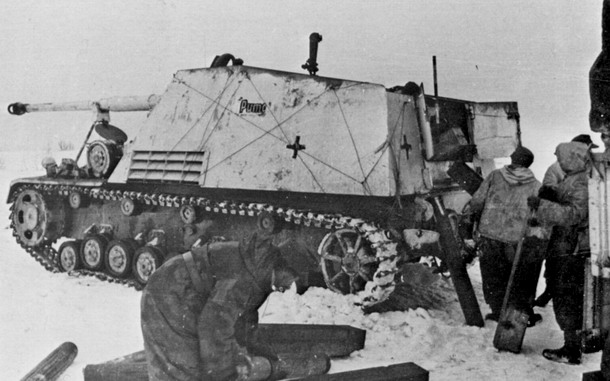
A Nashorn replenishing its ammunition, source: Waralbum.ru, with permission of the operator, edited
The 8.8 cm Pak 43/1 Gun
The PaK 43 gun was mounted in the front of the fighting compartment — more precisely the PaK 43/1, which was the official designation of the variant adapted for installation in a tank destroyer. The gun had a barrel 71 calibres in length, approximately 6.3 metres. While the long barrel contributed to higher muzzle velocity and greater accuracy, it also brought certain complications. It vibrated considerably during travel and therefore had to be supported by a barrel rest mounted at the very front edge of the hull. The gun's vertical elevation ranged from -5° to +20°, and horizontal traverse was 15° to each side (though quite different figures are sometimes cited).
Several types of ammunition were available for the gun. First was the armour-piercing Pzgr. 39/43 with a projectile weighing 10.4 kg. The shell left the barrel at around 1,000 m/s and at a range of one kilometre could penetrate an impressive 165 mm of sloped homogeneous armour. The Pzgr. 39 carried a bursting charge of 59 grams, which detonated after penetrating the armour inside the struck vehicle, helping to finish the job. Then there was the Pzgr. 40/43 with a tungsten carbide core, intended for use against the most heavily armoured enemy vehicles. Tungsten was a very scarce material for the Germans and this ammunition was therefore issued only in very limited quantities. The Pzgr. 40 weighed 7.3 kg and achieved a muzzle velocity of 1,130 m/s; at a range of one kilometre it could penetrate sloped armour 193 mm thick. The third type of anti-tank ammunition was the hollow-charge Gr. 39/3 HL, weighing 7.65 kg with a muzzle velocity of 600 m/s. This round could penetrate 90 mm of armour regardless of the range from which it was fired. Finally there was the high-explosive fragmentation shell Sprgr. 43, used against infantry and other soft targets, weighing 9.4 kg and leaving the barrel at 700 to 750 m/s.
As for the official name of the new tank destroyer, a considerable number of different variants can be encountered in the sources. What the sources do broadly agree on, however, is that until approximately the end of 1943 the vehicle was referred to by the combat name Hornisse — meaning hornet (which fitted neatly into the series of insect names alongside Wespe — wasp — and Hummel — bumblebee). Somewhere around the turn of 1943–44, a new combat name began appearing in documents and reports: Nashorn, meaning rhinoceros. This eventually became the official designation, and it is under this name that the tank destroyer entered the history of the Second World War. The vehicle's ordnance code was Sd.Kfz. 164.
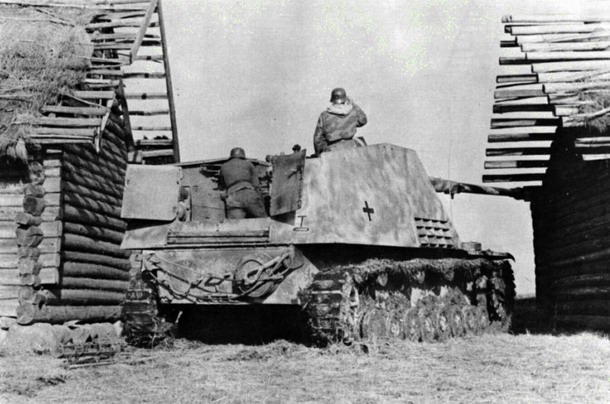
Nashorn in an ideal firing position for an unexpected ambush of the enemy, source: Flickr.com, with permission of the publishing user, edited
The primary manufacturer of the new fighting vehicle was the Berlin-based firm Alkett (Altmärkische Kettenwerke GmbH). Deutsche Eisenwerke plants in Duisburg and in the Protectorate also became involved in production over time. Series production of the Nashorn began in February 1943. Despite having been conceived as an interim solution intended to be replaced by a more advanced vehicle later on (which, incidentally, ultimately materialised as the Jagdpanther tank destroyer), production of the Nashorn ran until March 1945, with a total of 494 units built.
During the production run, a number of minor and more significant modifications were introduced. The first Nashorns used drive sprockets taken from the Panzer III Ausf. E, with circular lightening holes. Later, sprockets from the Ausf. J variant began to be fitted. The configuration of the hull rear also changed: the original arrangement featured a large exhaust silencer, while later vehicles had the exhaust outlets terminating just above the tracks, freeing up the rear deck for stowage of spare road wheels, aiming rods and gun-cleaning equipment.
The original gun barrel travel support consisted of two separate metal rods. When not needed, these were folded crosswise onto the glacis plate. To fold them, a crew member had to leave the protection of the vehicle's interior, which was considered a significant drawback. Probably in May 1943, a new version of this support was therefore introduced that could be lowered by means of a steel cable from inside the fighting compartment. This allowed the vehicle to transition more quickly and safely from the march to the firing position.
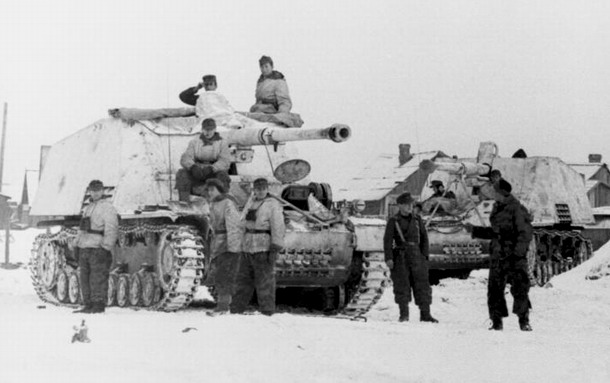
A pair of Nashorns on the Eastern Front, March 1944, source: Bundesarchiv_Bild_101I-279-0950-09, Wikimedia, Creative Commons, edited
The first 50 production vehicles were fitted with two types of sighting equipment. One was the Zieleinrichtung 37/43 SVo with the Sfl. Z. F. 1a sight (Selbstfahrlafetten-Zielfernrohr), used for direct fire — typically anti-tank engagements. For indirect fire — typically against infantry — the Zieleinrichtung 34 with the Rundblickfernrohr 32 or 36 panoramic sight was provided. The dual sighting arrangement quickly drew criticism from crews. For one thing, gunners had to be trained on both systems, which lengthened and increased the cost of training. More importantly, crews complained that the sight mounting was not sufficiently rigid and that vibration from driving and firing constantly knocked the sights out of alignment, requiring repeated re-zeroing — a particular problem with the Zieleinrichtung 34. Crews demanded that only a single sight be fitted and that its mount be properly redesigned to prevent movement under vibration. From April 1943 onwards, new Nashorns were therefore equipped solely with the Sfl. Z. F. 1a sight.
The Nashorn tank destroyer weighed 24 tonnes. The Maybach HL120 TRM engine produced a maximum of 300 horsepower at 3,000 rpm and gave the vehicle a top speed of 40 km/h. The Zahnradfabrik SSG 77 gearbox provided six forward gears and one reverse. A full load of fuel was sufficient for approximately 260 km on roads and around 130 km cross-country. The crew totalled five men: the driver and radio operator sat side by side in the hull, while the commander, gunner and loader were stationed in the fighting compartment. An MG 34 machine gun in 7.92 mm calibre was carried as supplementary armament, with 600 rounds of ammunition. The machine gun could be fired over the top of the fighting compartment's armour, or mounted on a swivel bracket on the inner side of the compartment wall for engaging low-flying enemy aircraft. The main gun ammunition supply consisted of 40 rounds for the PaK 43/1. The standard radio was the Funksprechgerät "f" (Fu.Spr.Ger "f"); command vehicles additionally received a second set of the Fu 8 type, installed in the right rear corner of the fighting compartment.
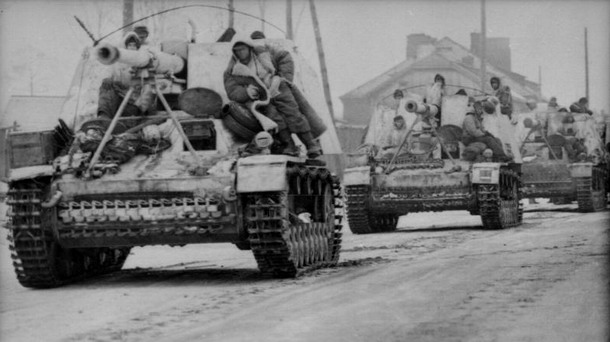
A company of Nashorns on the march, Eastern Front, January or February 1944, source: Bundesarchiv_Bild_101I-278-0888-15, Wikimedia, Creative Commons, edited
Organisation
The primary organisational unit for the Nashorn was the heavy tank destroyer battalion (schwere Panzerjäger Abteilung, or sPzJgAbt). Its official structure was laid down by establishment order KStN 1148b of 1 April 1943. A battalion consisted of three companies (Kompanie), each company of three platoons (Zug), and each platoon of four Nashorns — giving one company 3 × 4, or 12 vehicles. The company headquarters added two command Nashorns (fitted with a second radio set), bringing the paper strength of one company to 14 tank destroyers in total. The full battalion therefore had 42 vehicles (3 × 14) plus a battalion headquarters with three further Nashorns, giving a schwere Panzerjäger Abteilung at full establishment a total of 45 tank destroyers. A unit of this size naturally had a whole range of supporting equipment assigned to it — staff cars, motorcycles, lorries for carrying fuel, ammunition, spare parts and personnel, and even half-tracked prime movers.
The first company of new tank destroyers was formed in February 1943. Two more companies followed in March, and before the end of that month an order was issued forming these three companies into the first official heavy tank destroyer battalion, sPzJgAbt. 560. The following month, April 1943, saw the activation of the second battalion, sPzJgAbt. 655. Further battalions followed, numbered 525, 93, 519 and 88. In addition to the dedicated heavy tank destroyer battalions, Nashorns were also allocated to the establishments of various other units, both larger and smaller.
The operational documentation and crew manuals for the Nashorn left absolutely no doubt as to the vehicle's combat purpose. They stated explicitly that the Nashorn was designed to destroy all types of enemy tanks at ranges of up to 4 kilometres. For engagements up to 2 kilometres, crews could fire directly using the gun sight. At greater distances, it was recommended to first range more carefully onto the target, either using a rangefinder or by firing a spotting round. High-explosive fragmentation shells were recommended for this purpose, being the cheapest of the available ammunition types. And it must be said that the manuals were not exaggerating. A combat report from one company of the 655th battalion in August 1943 records that during fighting near the city of Orel, the crew of one Nashorn managed to hit and destroy a Soviet T-34 tank at the remarkable range of 4,200 metres. The enormous power of the gun is further illustrated by another example from the same report: an 88 mm hit on a T-34's engine compartment from a range of 400 metres tore the engine clean out of the vehicle and threw it 5 metres away — and another hit on the turret caused it to be blown off and hurled a full 15 metres from the tank.
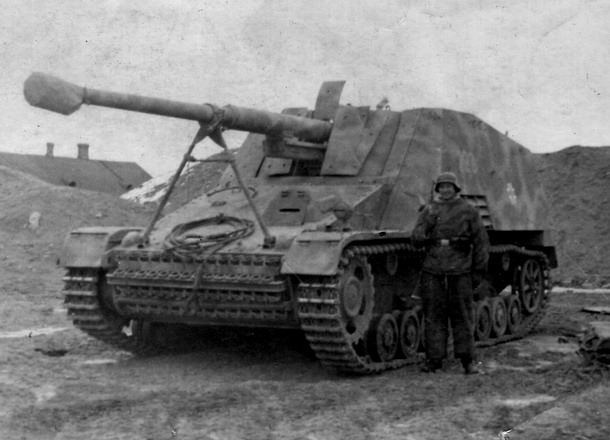
Heavy tank destroyer Nashorn, source: Flickr.com, with permission of the publishing user, edited
Combat Deployment
The qualities of the PaK 43/1 gun were beyond dispute — but what about the rest of the Nashorn? The truth is that the first combat unit reports on experience with these tank destroyers were not particularly flattering. Crews complained above all that vehicles arrived from the factories in a generally unfinished state and that mechanics in field workshops had to adjust the steering brakes, sights and various other components. Despite this, the Nashorns accomplished an enormous amount of work at the front — if one may put it that way. One example says it all. Nashorns of schwere Panzerjäger Abteilung 519 managed to destroy 290 enemy tanks in the period between 19 December 1943 and 24 February 1944 — roughly three months — while losing only 6 of their own vehicles. Even as the heavy tank destroyer battalions were progressively rearmed with the more modern Jagdpanther, the Nashorn remained in service right to the very end of the war. They fought on both the Eastern and Western Fronts, and several dozen operational examples survived to the German surrender.
Technical Data
|
weight: |
24 t |
|
length: |
8.44 m |
|
width: |
2.95 m |
|
height: |
2.94 m |
|
engine: |
Maybach HL 120 TRM |
|
engine power: |
300 hp |
|
max. speed: |
40 km/h |
|
fuel capacity: |
600 l |
|
range – road: |
260 km |
|
range – cross-country: |
130 km |
|
hull armour: |
|
|
- front: |
30 mm |
|
- sides: |
20 mm |
|
- rear: |
20 mm |
|
superstructure armour: |
|
|
- front: |
10 mm |
|
- sides: |
10 mm |
|
- rear: |
10 mm |
|
crew: |
5 men |
|
armament: |
1 x PaK 43/1 L/71 gun, 88 mm |
ARTICLE
CONTENTS:
Reproducing text from the Panzernet website without the written consent of the operator is prohibited.