7,5 cm StuK auf PANZER 38(t)
a project to rearm the light tank
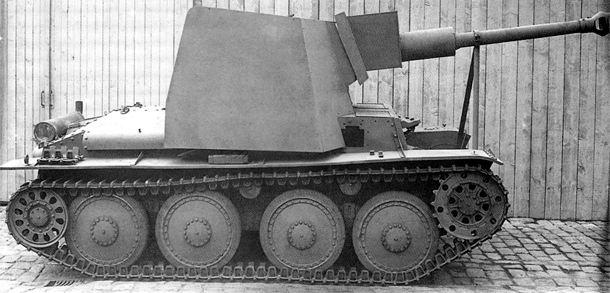
the sole prototype of the 7.5 cm StuK auf PzKpfw 38(t), source: Flickr.com with permission of the publishing user, edited
Origins of the Project
Unfortunately, very little information is available about this fighting vehicle project. From the little that can be found in the literature, the requirement for its construction arose in March 1942. The Prague company BMM — the successor to ČKD in the Protectorate of Bohemia and Moravia — was tasked with designing a conversion of the light tank PzKpfw 38(t), which was produced there, into a carrier for the 75 mm StuK 40 L/43 gun. BMM was to prepare not only the necessary modifications to the tank chassis but also the design of a new armoured superstructure to protect the gun's fighting compartment. The task of adapting the StuK 40 gun for installation on a tank chassis was assigned to Rheinmetall-Borsig.
In terms of its timing, this project fits logically into the broader picture of events. At the turn of 1941 and 1942, the Germans were working feverishly to develop as many weapons as possible capable of effectively countering the masses of Soviet tanks. As part of this effort, it was precisely in March 1942 that the first evaluation examples of the StuG III assault gun armed with the StuK 40 were completed. Testing of these vehicles produced positive results, and it therefore makes sense that the Germans immediately began considering whether the same weapon could be used to rearm other suitable platforms. At the Prague ČKD factory, preparations were already under way at that time for production of the Marder III tank destroyer — but in a version armed with a modified captured Soviet gun (the Pak 36(r) of 76.2 mm calibre). If a conversion could be devised using a gun of domestic origin — one already in production for other vehicles, namely the StuG III — that would certainly have been a step in the right direction.
The Demonstrator Prototype
The designers at both Rheinmetall and BMM set to work. The first and only prototype of the new vehicle was apparently completed as early as May 1942. Rather than a fully developed prototype, however, it was a simplified technology demonstrator in which details such as ammunition stowage boxes, tool brackets, and a gun barrel travel lock had not yet been resolved — the travel lock fitted to the prototype was evidently a simple fixed bolt-on affair, with no thought yet given to how it would fold down.
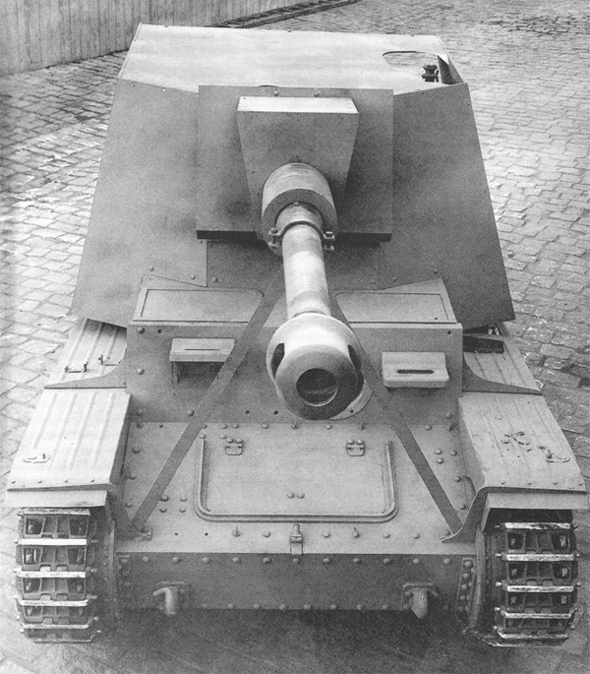
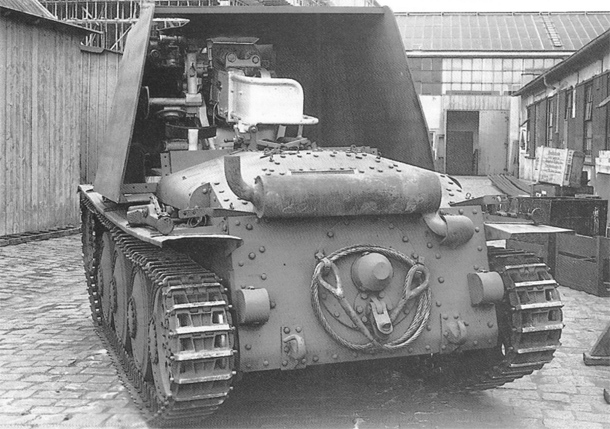
prototype of the 7.5 cm StuK auf PzKpfw 38(t); note the opening in the roof for the gun sight, source: Flickr.com with permission of the publishing user, edited
Description of the Design
The conversion of the tank into a self-propelled gun followed the approach standard at the time. In place of the original tank turret, a fixed superstructure of very simple construction was installed. Its walls, welded from flat armour plate, protected the gun crew from the front, sides, and partially from above. The protection was, however, largely symbolic — the plates used were apparently only 10 mm thick, which was insufficient even to stop armour-piercing rounds from a standard military rifle of 7.92 mm calibre. The rear of the fighting compartment was left entirely open, leaving the crew fully exposed to enemy fire from that direction.
Installed in the fighting compartment was the 75 mm StuK 40 gun (StuK = Sturmkanone = assault cannon) with a barrel approximately 43 calibres long. This weapon could fire the armour-piercing round Pzgr. 39, weighing 6.8 kg, at a muzzle velocity of 740 m/s. At 500 metres this round penetrated 91 mm of angled homogeneous armour, and at one kilometre it could still defeat an impressive 82 mm. The gun was served by a Sfl.Z.F.1a sight, whose periscope extended through a dedicated opening in the left section of the fighting compartment roof. The gun was installed complete with the recoil mechanism protective cover as used on the StuG III assault gun, but received a new square-profiled mantlet protecting the point where the barrel passed through the front wall of the fighting compartment. The gun mount certainly allowed some limited lateral traverse, though how many degrees is not known.
The crew of the new vehicle was apparently to consist of four men. The driver and hull machine gunner sat inside the hull, while the loader and gunner — who would presumably also have served as vehicle commander — had their stations in the fighting superstructure. The prototype as built was not fitted with a hull machine gun according to the photographs, though the opening for it was not blanked off, so it is unclear whether it was to be eliminated on the new vehicle or simply had not been installed at the time the prototype was photographed.
a view into the interior of the 7.5 cm StuK auf PzKpfw 38(t) prototype, source: Flickr.com with permission of the publishing user, edited
The chassis and hull of a Panzer 38(t) Ausf. E or Ausf. F were used for the prototype. Along with the chassis and hull came the vehicle's internal components — most notably the Praga TNHPS/II engine developing 125 horsepower and the Praga Wilson five-speed gearbox. The vehicle's weight was around 11 tonnes (somewhat more than the standard PzKpfw 38(t) tank) and its maximum speed was 35 km/h. As for the project's designation, it is most commonly referred to as the 7.5 cm StuK auf PzKpfw 38(t).
Cancellation of the Project
The vehicle described here never entered production, and here too an explanation that fits neatly into the historical context is easy to find. In June 1942 — just one month after the 7.5 cm StuK auf PzKpfw 38(t) prototype was completed — the prototype of the Marder III Ausf. H tank destroyer was also finished. The two vehicles were strikingly similar: the Marder was also built on the same light tank chassis, had a virtually identical armoured superstructure, but was armed with the more powerful PaK 40 L/46 gun of 75 mm calibre. The two prototypes were clearly direct competitors, and since the Germans at that time were looking above all for an effective anti-tank weapon, it makes sense that of the two proposals, the one carrying the somewhat more capable gun was selected for production.

ARTICLE
CONTENTS:
Reproducing text from the Panzernet website without the written consent of the operator is prohibited.