WANZE
desperate times call for desperate measures
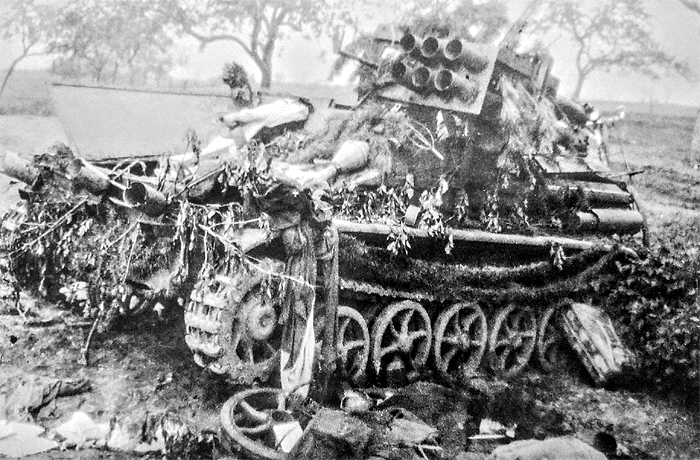
wreck of an 8,8cm Raketenpanzerbüchse 54/1 auf Ladungsträger B-IV, heavily camouflaged with branches, source: Flickr.com, courtesy of the publishing user, edited
Anything Will Do
The rocket tank destroyer 8,8cm Raketenpanzerbüchse 54/1 auf Ladungsträger B-IV was produced only during 1945 and in just a handful of examples. The impetus for its construction was the Germans' desperate effort to strengthen the defence of the capital of the Third Reich itself against the advancing Red Army by whatever means available. The basis for the new vehicle was the remote-controlled demolition charge carrier Borgward, designated Ladungsträger B-IV.
Beyond the sheer lack of any other suitable weapon carriers, there were additional reasons behind this choice. Existing German tank destroyers of the medium and heavy weight classes suffered from severely limited mobility among the ruins of defended cities — picking their way through rubble and debris was no easy matter for them, and they became clumsy, oversized targets.
A small and light vehicle did not suffer from this shortcoming, but it had other disadvantages. First, its limited payload made it impossible to arm with a heavy anti-tank weapon; and second, its thin armour could not provide the crew with adequate protection. The first problem was solved by the existence of the Panzerschreck (Panzerschreck = tank terror) — a highly effective yet lightweight rocket anti-tank weapon. The second problem was resolved by the decision to use a remote-controlled chassis with no crew on board at all.
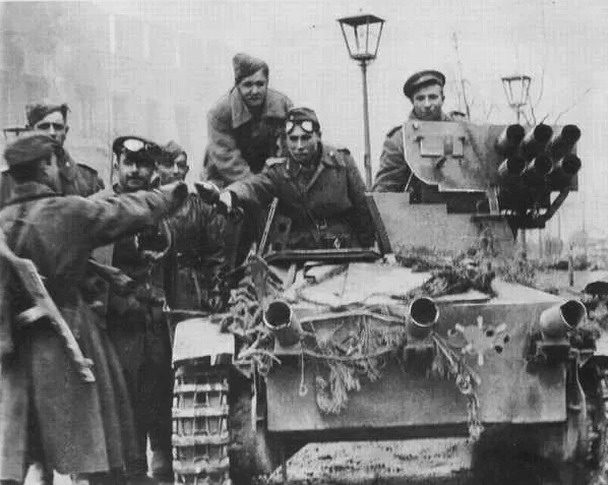
8,8cm Raketenpanzerbüchse 54/1 auf Ladungsträger B-IV in the hands of Red Army soldiers, source: Flickr.com, courtesy of the publishing user, edited
Remote-Controlled Tank Destroyer
A driver operated the vehicle only during longer non-combat movements. In action, however, it was guided by remote control from a safe position. If the operator controlling the vehicle remotely was sheltering inside a hardened bunker, he risked losing sight of the vehicle — let alone being unable to aim its weapons accurately. In practice the vehicle was therefore controlled not from cover but from aboard another, more heavily armoured vehicle such as a tank. The controlling vehicle would advance cautiously at a safe distance behind the rocket launcher, using it as a forward weapon.
The tank destroyer's running gear, taken from the already-mentioned demolition charge carrier, consisted of five road wheels on each side. The wheels were of spoked construction and closely resembled the road wheels of the PzKpfw I tank. At the very rear of the running gear was a spoked idler, while at the opposite end was the drive sprocket. On the roof of the armoured superstructure, a cluster of six launch tubes for the Panzerschreck 88 mm rocket weapon was installed. At the front there were additionally three tubes for firing anti-personnel high-explosive fragmentation grenades.
Combat Deployment
The new tank destroyer was given the nickname Wanze — bedbug. The exact number of vehicles produced is not known, but it was probably only a small handful. They were deployed with the 11th SS Panzergrenadier Division during the defence of the Berlin-Mitte district, and all but one were probably destroyed. The sole confirmed survivor fell intact into the hands of the advancing Soviets near the Brandenburg Gate. After the war, this vehicle too was apparently scrapped.

ARTICLE
CONTENTS:
Reproducing text from the Panzernet website without the written consent of the operator is prohibited.