PANZER 35(t)
from Plzeň to the gates of Moscow
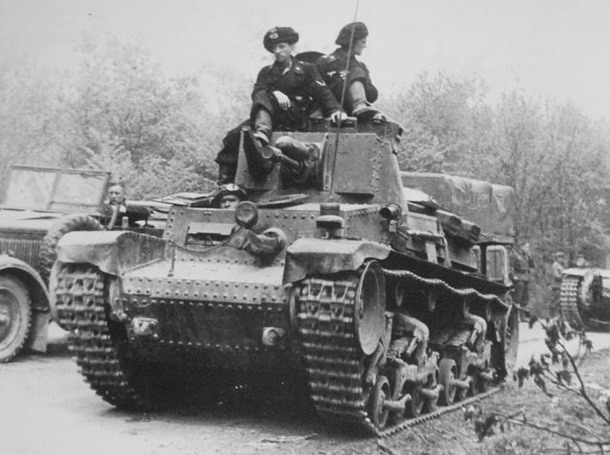
Light tank Panzerkampfwagen 35(t) during the French campaign, source: Flickr.com with permission of the publishing user, edited
PzKpfw 35(t) was the German designation for the originally Czechoslovak light tank LT vz. 35, which the Germans took over into their own inventory after the occupation of the Czech lands – willingly and with minimal modifications. To learn more about the history of this tank, we must therefore take a brief excursion not into pre-war Germany but into pre-war Czechoslovakia.
The Search for a New Tank
In 1933, the year Adolf Hitler was appointed Chancellor in neighbouring Germany, the Czechoslovak Army possessed only a very limited arsenal of armoured fighting vehicles. It was, however, working hard to remedy the situation as quickly as possible. During 1933 the Army ordered 51 armoured cars OA vz. 30, 70 tankettes vz. 33, and 50 light tanks LT vz. 34. The following year the General Staff drew up an ambitious plan to equip the armed forces with large numbers of tanks across three categories. The Czechoslovak Army was to receive 373 cavalry tanks, 336 infantry tanks, and 336 medium tanks – in every case newly developed vehicles of modern design.
At the end of 1934 the Ministry of Defence approached ČKD, Škoda, and Tatra with a requirement to develop prototypes for all three of these categories. The tank LT vz. 35, with which this article is concerned, emerged from the programme to find a new cavalry tank, so we will focus our attention accordingly. In this category, only ČKD and Škoda submitted prototypes, doing so in the spring of 1935. The Škoda vehicle was designated Š-II-a, its rival P-II-a. Thorough Army trials of both machines began in the summer of 1935. The Škoda Plzeň prototype ultimately emerged as the winner. ČKD, however, refused to accept the defeat and contested the Army's decision as biased. The truth is that both prototypes were broadly comparable in their characteristics. Allegations of corruption were even levelled – and according to some historians they were not without foundation. The Ministry of Defence chose to resolve the dispute by means of a mildly non-committal compromise. In October 1935 it placed an order for 160 of the victorious Škoda tanks, but split the contract equally between the two competitors. Škoda Plzeň was therefore to deliver 80 tanks, and the other 80 were to be manufactured under licence by ČKD in Prague. Some sources suggest the contract split was arranged independently by the two firms themselves, but this confuses cause and effect: the agreement between the two companies only came about as a practical necessity, required to implement the Ministry's decision.
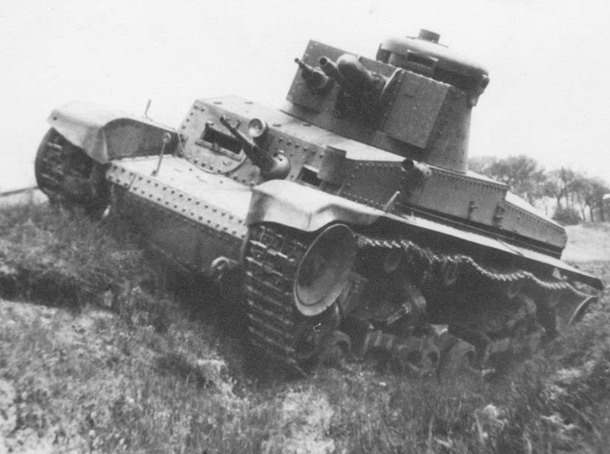
The Škoda prototype designated Š-II-a during trials, source: Flickr.com with permission of the publishing user, edited
The purchase price of a bare new tank under this order was 524,640 Czechoslovak crowns with armour plate from Poldi Kladno, or 527,840 crowns with plate from the Vítkovice steelworks. To this, however, a considerable sum had to be added for further equipment. The gun alone cost more than a hundred thousand crowns, the machine guns accounted for almost sixty thousand, the sights came to over sixteen thousand, and the radio set cost a similar amount. Once further items such as observation periscopes, ammunition, tools, and batteries were added in, the total price of a fully equipped tank climbed to 741,868 crowns – or 745,068 crowns depending on the armour source (though slightly different figures are also quoted). Expressed in terms of the ratio between the average wage then and in 2018, the price of a complete tank was equivalent to roughly 30 million Czech crowns in today's money.
The Š-II-a Prototype
The order had been placed, but Army trials continued nonetheless. The Š-II-a prototype was transferred to the armoured warfare school at Milovice. Further testing produced a long list of requirements for modifications to bring the eventual production vehicle even more closely into line with what the Army wanted. In May 1936 the Ministry of Defence placed a second order for a further 35 tanks, and the very next month requested both suppliers to produce a further 103 vehicles. The total to be delivered thus rose to 298. The first production tanks were to be delivered to the forces in September 1936. This schedule could not be met, however, as the ramp-up to production was accompanied by a host of problems, with many of the first components manufactured showing high rejection rates. Both manufacturers responded by accusing each other of unprofessionalism and sloppiness. It is hardly surprising that this situation bred deep misgivings among Army representatives about the reliability of the new tank, and an order was soon issued for selected production vehicles to undergo another thorough round of trials.
The Army took delivery of the first 15 examples of the new tank as an early Christmas present on 21 December 1936. By that point the new tank had received its official Army designation: LT vz. 35, meaning light tank, pattern 35. All 15 vehicles delivered in December 1936 went directly to the 1st Armoured Regiment at Milovice. Beginning in January 1937, endurance trials on selected vehicles were launched at Milovice. These continued essentially until September 1937, during which time individual tanks covered between four and seven thousand kilometres each. The test vehicles were subsequently stripped down and subjected to detailed inspection. The trials revealed a number of shortcomings – partly design imperfections, partly substandard individual components or poor material quality. Alongside the targeted testing of selected vehicles, the Army also carefully monitored how the other tanks were performing in regular unit service, and from that quarter too it received reports of a rather high breakdown rate.
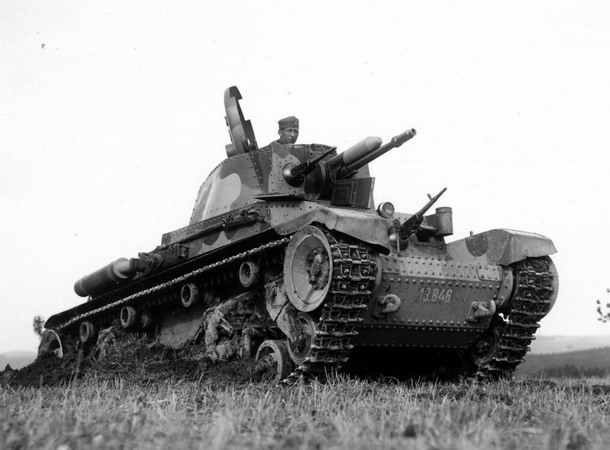
Light tank LT vz. 35 in Czechoslovak Army service, source: Flickr.com with permission of the publishing user, edited
On the basis of these findings the Army began to question whether to continue at all with the production of the third contracted batch of 103 tanks. However, a large proportion of vehicles in this batch were already complete and others well advanced, so the Army ultimately relented and in November 1937 confirmed it would accept all the vehicles it had ordered in 1935. ČKD completed its share of production before the end of 1937. Škoda Plzeň delivered the last three tanks from its half of the contract only in April 1938. In total, all 298 ordered tanks were manufactured and delivered. Of these, 149 were built by ČKD and an equal number by Škoda Plzeň. The tanks were distributed among the three existing armoured regiments. The 1st Regiment at Milovice received 197, the 2nd Regiment at Vyškov 49, and the 3rd Regiment at Turčianský sv. Martin the remaining 52.
The soldiers did not enjoy their full complement of tanks for very long. As early as May 1938, the Army completed a thorough evaluation of the endurance trials results together with the ongoing unit reports, and drew up a list of modifications and upgrades to be carried out on the LT vz. 35. A schedule was simultaneously drawn up under which tanks would be sent back from their units to the two parent factories. Each factory was to modify twenty tanks per month, in addition to carrying out routine repairs on other vehicles that had broken down. Among the modifications was the replacement of the original ZB vz. 35 machine guns with the newer ZB vz. 37.
Design Description
The LT vz. 35 was built on a chassis with eight pairs of road wheels on each side. The 350 mm diameter road wheels were fitted with rubber tyres for a smoother ride. The wheels were doubled – two side by side on each axle – with the track guide tooth passing through the gap between them. Two adjacent pairs of road wheels were combined into a small bogie, and two such neighbouring bogies were then mounted on a shared robust swinging bracket. This bracket was suspended beneath an arm riveted rigidly to the hull side. The movement of the bracket below this arm was sprung by a pair of semi-elliptical leaf springs. Each side of the hull therefore had two arms, with four road wheels grouped under each. At the very front was a toothed idler wheel 575 mm in diameter; at the rear was the drive sprocket, also toothed and also 575 mm in diameter. The upper run of the track was carried by four return rollers 200 mm in diameter. In the space between the first road wheel and the idler, an additional doubled "road wheel" was fitted. Positioned above ground level and attached rigidly without springing, its purpose was to assist the tank in climbing higher obstacles. Above the mounting of this wheel was, incidentally, a small sheet-metal box, which apparently served as a container for wheel lubrication supplies.
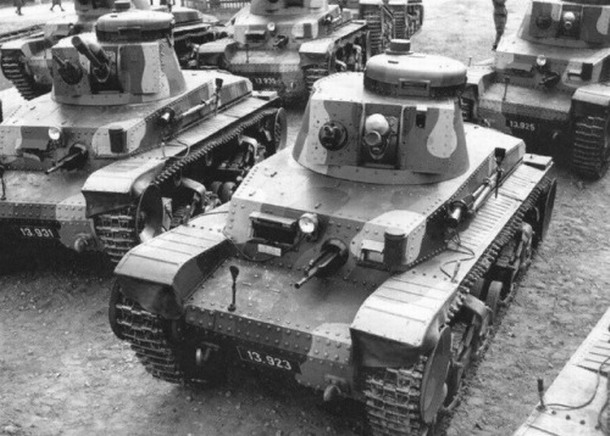
Confiscated LT vz. 35 tanks lined up for acceptance by the German Army, source: Flickr.com with permission of the publishing user, edited
The tracks were 320 mm wide and each consisted of 111 links. The designed service life of the tracks was 6,500 km. The front idler and rear drive sprocket were fitted with prominent outer discs that extended beyond the width of the track. Their purpose was straightforward: since individual track links were connected by moveable pins, if any pin began working loose and sliding outward during travel, these metal discs would push it back into place. Another interesting feature of the rear drive sprocket was a metal scraper mounted on the hull side ahead of it. This scraper cleared heavier accumulations of mud and clay from the drive sprocket and thus protected the running gear from excessive fouling.
The hull, and likewise the turret, was built on a skeleton of steel L-section angle irons to which the individual armour plates were riveted. The front hull plate was 25 mm thick and carried two hooks for attaching tow ropes. Behind the hull nose rose the front wall of the fighting compartment, also 25 mm thick. In its right-hand section was the driver's main vision port, measuring 390 x 90 mm. On the outside this port was protected by a hinged armoured visor 28 mm thick; on the inside by a 50 mm block of bulletproof glass. The outer visor was equipped with a narrow observation slit. In a combat area the driver therefore closed his port with the armoured visor and observed through the slit alone. In less dangerous areas he left the visor open, and in areas free of any risk he drove with his head protruding from the hatch above his seat, as is commonly seen in photographs. A narrow observation slit was also present in the side wall to the driver's right.
To the left of the driver's front vision port was the hull machine gun embrasure. Further to the left was the machine gunner/radio operator's vision port, measuring 150 x 75 mm, which also had an external hinged visor and internal bulletproof glazing. The hull machine gun mounting allowed horizontal traverse of 30 degrees (15 to each side) and vertical elevation from –10 to +25 degrees. The machine gun was initially the ZB vz. 35 type, later replaced by the ZB vz. 37; both were of 7.92 mm calibre.
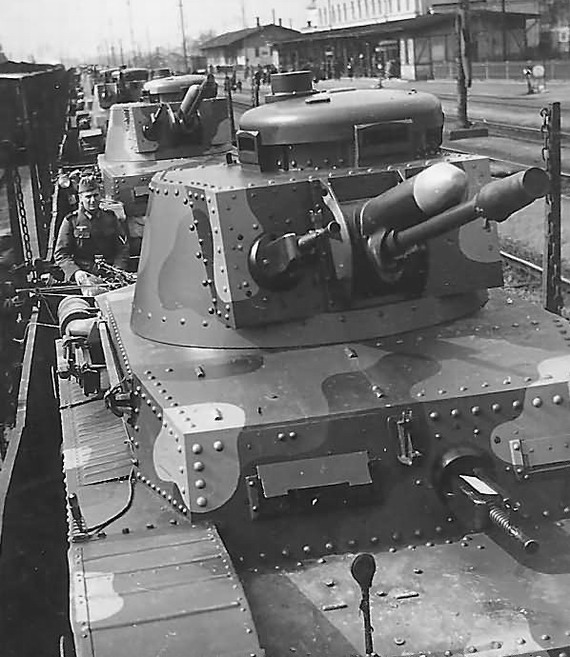
Confiscated LT vz. 35 tanks being transported by rail to Germany, source: Worldwarphotos.info with permission of the site operator, edited
On the compartment roof sat the fighting turret, mounted on a ring 1,267 mm in diameter. The rounded side walls of the turret transitioned at the rear into an extended bustle. At the front, the turret featured a strictly angular and slightly sloped front plate 25 mm thick.
The Škoda A3 Gun
In the centre of the front plate was mounted the tank's main weapon, the Škoda A3 gun of 37 mm calibre. The Army itself recorded this weapon as the 3.7 cm vz.34ÚV (ÚV = útočná vozba, the period designation for Czechoslovakia's tank arm). It was a modified variant of the anti-tank gun KPÚV vz.34. The gun could be elevated vertically from –10 to +25 degrees. Horizontal traverse was achieved by rotating the turret, which could of course be turned without restriction through the full 360 degrees. Turret rotation was manual, via a handwheel with a handle mounted on the turret ring to the left of the commander/gunner. One full turn of the handwheel rotated the turret by 3 degrees. If necessary the handwheel gearing could be disengaged, allowing the gunner to traverse the turret freely and rapidly by bracing his feet on the compartment floor and pushing with his shoulder against the gun's recoil guard – something that would have been unthinkable in a heavy tank, but the low turret weight of the LT vz. 35 made it entirely feasible.
The gun was aimed using a telescopic sight of type ZDD 2151 (ZDD = záměrný dalekohled dělový, literally "aiming telescope for artillery"). It was a monocular sight with 1.25x magnification and a field of view of 55 degrees. The eyepiece allowed individual focusing over a range of ±5 dioptres. The sight was supplied by the Optikotechna company of Přerov, at that time owned by the Zbrojovka of Brno. The sight was positioned to the left of the gun itself, with its objective lens looking out through the front plate via a small opening closed by an armoured cover (photo HERE). The 1,458 mm gun barrel was fitted with a muzzle brake with numerous small perforations. Above the barrel sat a substantial armoured cylinder housing the gun's recoil and recuperator mechanism. The weapon had a semi-automatic breech, meaning that after each shot the breech opened and the spent cartridge case was ejected automatically. This allowed a theoretical rate of fire of up to 15 rounds per minute. Barrel life was around three thousand rounds. The complete gun assembly weighed 235 kg. Below the breech hung a fabric bag to catch the ejected cartridge cases so they would not roll around the floor underfoot. Similar cloth bags were hung at both machine guns as well.
To the right of the gun was installed the turret machine gun – again initially the ZB vz. 35 type and later the ZB vz. 37. The turret machine gun was normally slaved to the gun, so both weapons were aimed together using the gun sight. If necessary, however, the machine gun could be "decoupled" from the gun and then moved independently, aimed using standard mechanical sights. The hull machine gun had its own dedicated sight, the ZDK 2104 (ZDK = záměrný dalekohled kulometný, "aiming telescope for machine gun"), also supplied by Optikotechna of Přerov.
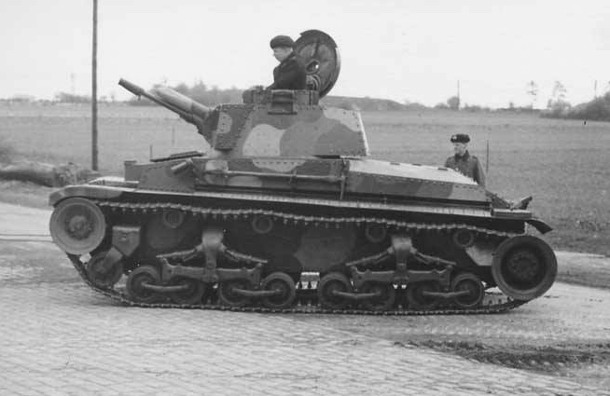
An LT vz. 35 arriving at the barracks of the German 11th Tank Regiment (Panzer Regiment 11) in Paderborn, source: Flickr.com with permission of the publishing user, edited
On-board ammunition stowage comprised 78 rounds for the gun and 2,700 rounds for the machine guns. Most of the gun ammunition was stowed in the extended turret bustle, with the remainder along the sides of the fighting compartment. Of the 78 rounds carried, regulations stipulated 24 armour-piercing and 54 high-explosive fragmentation rounds. The armour-piercing round weighed 850 grams (the projectile alone), of which a mere 8 grams was explosive filler. It left the muzzle at 675 m/s and at 600 metres could penetrate vertical homogeneous armour 42 mm thick. The high-explosive round weighed 825 grams, of which 77 grams was explosive. It left the muzzle at 687 m/s and had an effective range of approximately 4 kilometres.
In the left portion of the turret roof was a raised commander's cupola. Its tube, 570 mm in diameter, was fitted with four evenly spaced observation ports. As the highest point of the tank, the commander's cupola gave the vehicle commander the best possible all-round view. It also served as the entry and exit hatch, closed from above by a substantial cover that projected well beyond the tube's circumference – faintly resembling the cap of a mushroom. The cover incorporated an opening for extending a hand-held observation periscope, along with two small holes for signal flags and a signal lamp. The interior of the cupola tube was extensively padded to prevent the commander from injuring his head during travel.
In the rear of the hull behind the fighting turret was the engine compartment, housing the water-cooled petrol four-cylinder Škoda T-11/0. The 8.62-litre engine produced 120 hp at 1,800 rpm. Fuel was carried in two tanks. The main tank, holding 124 litres of petrol, was located to the left of the engine. The reserve tank, with a capacity of 29 litres, was alongside the side wall of the fighting compartment. If the starter motor failed, the engine could be hand-cranked using a starting handle operable directly from inside the fighting compartment. To the right of the engine was the radiator, supplied with air through elongated louvres on either side of the engine cover above the track guards. Immediately behind the engine sat the gearbox, which offered three forward and three reverse ratios. A two-speed auxiliary reduction gear was fitted behind the main gearbox, doubling the number of available ratios. In practice, therefore, six forward speeds and six reverse speeds were available. Two large closable service access panels were provided in the engine cover, one leading to the engine and one to the gearbox. A large exhaust silencer was stowed above the right track guard.
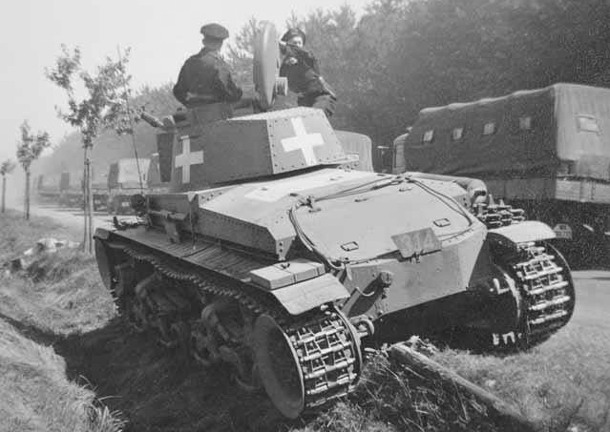
PzKpfw 35(t) in Poland, source: Flickr.com with permission of the publishing user, edited
The LT vz. 35 weighed 10.5 tonnes, was 4.9 metres long, 2.055 metres wide, and 2.37 metres tall. On a road it could achieve up to 34 km/h; cross-country it typically moved at 12 to 16 km/h. With full tanks the vehicle had a road range of roughly 160 km and 120 km cross-country. The crew of the LT vz. 35 consisted of just three men: the driver, the machine gunner/radio operator, and the commander/gunner. The driver sat at the front right of the hull. His position reflected pre-war Czechoslovak traffic regulations, under which driving was on the left – as in England. At his feet he had three pedals: the throttle on the far right and two brake pedals, one for each track.
Pneumatic Steering
When the driver settled into his seat, directly between his legs was a control column bearing the tank's primary controls: a small controller lever for selecting gear ratios, and two slender steering levers. These controls were connected to pneumatic circuits through which compressed air flowed, acting on the controlled elements – the clutches and brakes – by means of its pressure (the tangle of air hoses running to and from the control column can be clearly seen in the photograph HERE (author's collection)). When the driver pulled one of the steering levers towards him, the drive was first disengaged from the sprocket on that side, allowing that track to run free. Pulling the lever further disengaged the clutch and applied air pressure to the brake drum of the drive sprocket, actively slowing that track. Pulling it to the full extent brought the sprocket to a complete stop, whereupon the tank began to pivot on the spot.
The pneumatic system used compressed air as its medium, so its plumbing had to be strictly airtight to prevent pressure loss. Two compressors driven by the main engine provided the compressed air, which was stored in a 18-litre pressure vessel located in the fighting compartment along its left wall. From this vessel, high-pressure hoses ran along the floor to the steering levers and thence rearward to the gearbox, clutches, and drive sprocket brakes. The rationale for pneumatic steering was to ease the physical demands on the driver. Manoeuvring a heavy tracked vehicle at that time required considerable physical effort, and using compressed air as the control medium reduced this effort by roughly two thirds. It did, however, require the installation of additional components – compressors, the pressure vessel, hoses – which increased maintenance requirements. Repairing a leaking pressure hose in field conditions was essentially impossible.
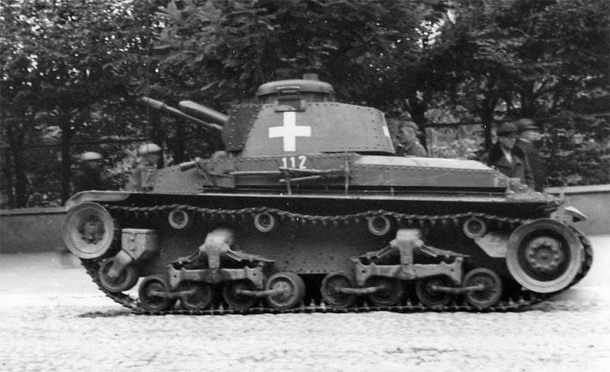
PzKpfw 35(t) during the Polish campaign, source: Flickr.com with permission of the publishing user, edited
For use in the event of a pneumatic system failure, the driver therefore also had emergency controls in the form of the two brake pedals already mentioned, along with a second set of mechanical steering levers positioned on either side of his seat. To the right of his front vision port was a dial showing the pressure in the pneumatic system. To the left of the port was a set of three coloured indicator lights, used by the tank commander to pass instructions to the driver. Directly above his seat the driver had an access hatch, closed by a two-part cover, which also served the radio operator.
The second man on board was the radio operator, who simultaneously served as the hull machine gunner. He sat in the forward part of the hull to the left of the driver. If the radio operator could not operate the hull machine gun – for instance, if he was wounded or killed – the driver could fire it in an emergency. For this purpose, the machine gun was locked in zero elevation and zero traverse, pointing straight ahead at a horizontal angle, and the driver fired it remotely via a Bowden cable. Since the gun itself was locked in a fixed position, the driver had to aim by manoeuvring the whole vehicle. A simple sight in the form of a circle on a short metal rod was positioned before his port for this purpose (see photograph HERE).
To the radio operator's left, hung on the side wall of the compartment, was the radio set vz. 35. It operated in telegraph mode (i.e. Morse code) and had a minimum range of 7 km. Connected to the radio was a rod aerial attached externally to the front left corner of the fighting compartment. The tank had no internal intercom system; communication between crew members took place directly – requiring the men to shout quite loudly at one another – supplemented by the already-mentioned set of three coloured signal lights with which the commander could give instructions to the driver. The final crew member was the commander, who was also obliged to serve simultaneously as gunner for the main gun, gunner for the turret machine gun, and loader for both weapons. The commander was thus the only man in the fighting turret and, it must be said, was considerably overburdened by the demands of all these combined roles.
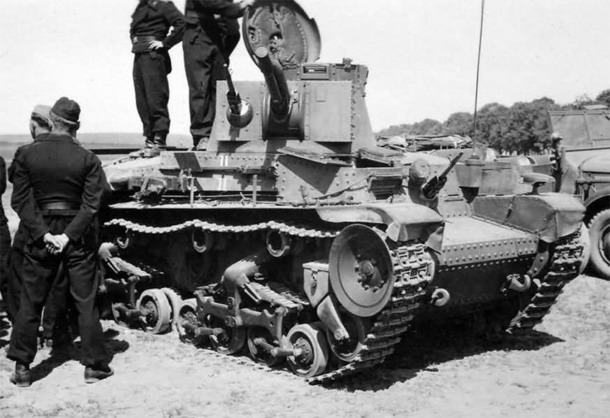
PzKpfw 35(t) – note the padding on the underside of the commander's cupola hatch cover, source: Worldwarphotos.info with permission of the site operator, edited
First Combat Deployment
As already noted, the Army took delivery of the last of the 298 manufactured tanks only in April 1938 – and not a moment too soon. In response to the rapidly deteriorating international situation, the Czechoslovak Army mobilised its tank units on 20 May 1938. The LT vz. 35 tanks left their barracks and took to the field, ready to repel a possible enemy attack. Their opportunity to demonstrate their capabilities in live combat came only in September of that year. On 12 September 1938, Henlein's Freikorps rose in revolt in the Sudetenland. Martial law was declared in the threatened border areas the very next day and the Army despatched tanks to help the gendarmerie and infantry bring the situation under control. In the days and weeks that followed, the Czechoslovak tanks were successfully engaged in several dozen actions of varying scale. Over that summer the LT vz. 35 tanks covered several thousand kilometres in the course of frequent redeployments – and did so, surprisingly, without any serious problems. Credit was certainly due in part to the fact that the crews had spent the previous six months learning to operate and properly maintain their vehicles.
On 23 September 1938 Czechoslovakia declared general mobilisation, and the Ministry of Defence simultaneously placed an urgent order with the Plzeň Škoda works for a further 105 LT vz. 35 tanks (there was no time to wait for the newer LT vz. 38 from ČKD). On 30 September 1938, however, the Munich Agreement was signed and Czechoslovakia's hopes of any military resistance against Germany were extinguished for good. In early October the Army therefore cancelled the above order. In October 1938 some of the tanks were sent to Slovakia and Sub-Carpathian Ruthenia to counter increasingly aggressive Hungarian incursions. Fighting there continued until March 1939, when the remainder of Bohemia and Moravia was occupied by Germany and Slovakia split off as an independent state.
German Confiscation
As part of the occupation of the Czech lands, the Germans confiscated all Czechoslovak military equipment including the LT vz. 35 tanks. German officers are said to have come to Milovice to inspect them on 15 March 1939 itself. The LT vz. 35 came as no surprise to the Germans, who had long been following it through their own intelligence-gathering efforts. Of the 298 tanks in Czechoslovak Army service, the Germans claimed 244 for themselves. The newly formed Slovak Republic retained "its" 52 tanks belonging to the 3rd Armoured Regiment at Turčianský sv. Martin, and the final two went to Hungary – most likely vehicles captured by the Hungarians during the fighting in Slovakia and Sub-Carpathian Ruthenia. The transport of the 244 confiscated tanks to Germany took place in March and April 1939.
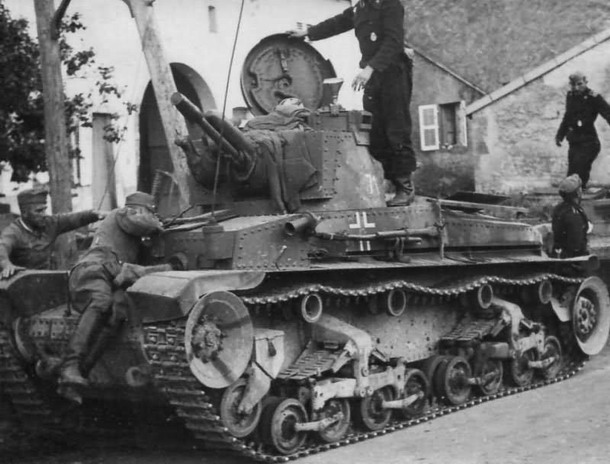
PzKpfw 35(t) – again note the clear padding on the underside of the commander's cupola hatch cover, source: Worldwarphotos.info with permission of the site operator, edited
Such a large number of battle-tested, well-developed tanks armed with 37 mm guns represented a windfall of immense value for the German Army. This is best appreciated by comparing it with what the Germans themselves had available at the time. The LT vz. 35 was in all its key parameters – armour, armament, and speed – broadly comparable to the German medium tank Panzer III. And in March 1939 the Germans had only around a hundred and fifty of their own Panzer III tanks available. By requisitioning 244 LT vz. 35s, the German tank fleet in this category was therefore more than doubled, virtually overnight!
Panzerkampfwagen 35(t)
When the Germans took the captured tank into their inventory, they needed to find a new official designation for it. Their own nomenclature system was clear and simple enough, but had evidently not planned for the adoption of tanks from another country. Finding a suitable designation therefore took some time. The captured Czechoslovak tanks began appearing in various documents under unofficial names such as Skoda-Panzer, Skoda-Pz. III, or PzKpfw 3,7cm. The first official designation was PzKpfw L.T.M. 35, where L.T.M. stood for Leichte Tank Muster (or Leichte Tank Modell). It was only in January 1940 that the definitive official designation PzKpfw 35(t) was introduced (PzKpfw = Panzerkampfwagen = armoured fighting vehicle, (t) = tschechisch = Czech).
Compared to the original Czechoslovak configuration, the Wehrmacht made only a negligible number of modifications. Probably the most important change was the addition of a fourth crew member. Given the commander's already excessive workload, this was a very sensible step towards more effective crew functioning. The fourth soldier was assigned to load the gun and operate the turret machine gun. The commander still had to serve as gun layer in addition to commanding, but this was now at least manageable. New folding seats, suspended on brackets from the turret ring, were installed for both men. To give the two turret crew members a reasonable amount of space, the on-board ammunition load was reduced. The gun stowage was therefore cut from the original 78 to 72 rounds, and the machine gun ammunition from 2,700 to 1,800. Along with the tank, the Wehrmacht also adopted its weapons into service. The tank gun received the new official designation 3.7cm KwK 34(t) L/40, and the Zbrojovka machine guns were now listed as MG 37(t).
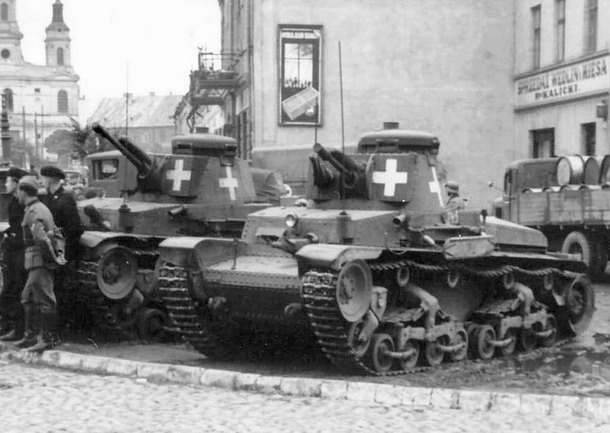
PzKpfw 35(t) in occupied Poland, source: Worldwarphotos.info with permission of the site operator, edited
The Czechoslovak telegraph radio set was replaced by the German Fu5 radio operating in voice mode. An intercom for communication between crew members was simultaneously installed. Various original electrical components were also exchanged for new German ones (Bosch brand). New lights were apparently fitted at some point during 1940. A Notek-type headlight was placed on the left track guard at the front, and a convoy distance light was added at the rear (which indicated to the vehicle following in column whether it was maintaining correct spacing). Trapezoidal sheet-metal plates carrying the tank's number were attached to the sides and rear of the hull. The original three-colour camouflage scheme was repainted in German tank grey, and new national markings – crosses – were of course applied. On some tanks a bracket for five smoke dischargers, remotely triggered from the cab, was fitted to the rear of the hull. This feature was standard on most German tanks of the period, its purpose being to allow a crew that had got into trouble to lay a smoke screen around themselves and withdraw to safety in short order.
Command Versions
As already mentioned, the Germans fitted the PzKpfw 35(t) with their own Fu5 radio sets – stations that combined both a transmitter and receiver in one unit. Tanks so equipped were suitable not only for routine combat use but also for the needs of platoon and possibly company commanders. A specialised command version of the tank was also produced, adapted for higher-level commanders at battalion and regimental level. The Germans routinely built such command vehicles on the basis of various tank types, designating them Panzerbefehlswagen. In the case of the Panzerbefehlswagen 35(t), clear information about their configuration is not easy to find. At least three externally distinct versions of this command tank are documented photographically.
The first had, in addition to the standard rod aerial at the front left corner of the fighting compartment, a second rod aerial on the left side of the engine section. The vehicle carried a combination of two radio sets, though the literature does not make clear whether this was a Fu 5 and Fu 2, or a Fu 5 and Fu 7 combination. When converting combat tanks to command vehicles, the Germans routinely removed the main gun, since this was necessary to fit the additional equipment inside – not only the more powerful radio set itself, but also an electrical generator, a gyrocompass, a map table, and other accessories. The Panzerbefehlswagen 35(t) was apparently no exception (even though most sources do not state this explicitly). To conceal the fact that the tank was unarmed, the armoured cover of the recoil mechanism was retained on the turret front plate, with a wooden dummy gun barrel attached below it. The turret machine gun was also removed, its embrasure blanked off with a steel plate. This command version of the tank thus retained only the hull machine gun.
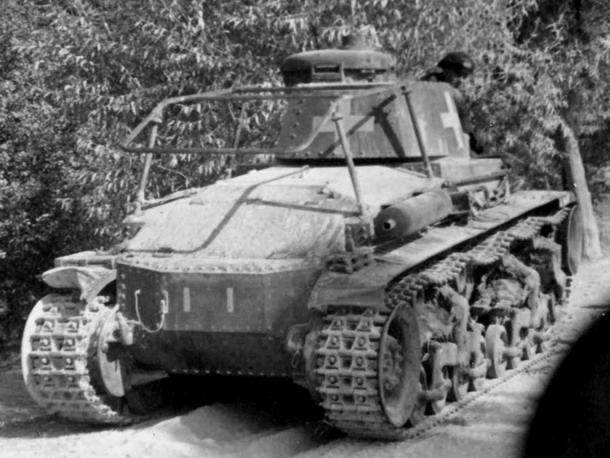
Command version Panzerbefehlswagen 35(t) with frame aerial above the engine compartment, source: Worldwarphotos.info with permission of the site operator, edited
The other two variants of the Panzerbefehlswagen 35(t) were fitted with a conspicuous frame aerial mounted on supports above the engine compartment. Both of these variants apparently carried a combination of Fu 5 and Fu 8 radio sets, and both very likely had the gun removed and replaced with a wooden dummy barrel. How did they differ from each other? In one, the turret machine gun was removed along with the gun, leaving only the hull machine gun. In the other, it was the hull machine gun that was removed while the turret machine gun was retained (all three command tank variants can be viewed HERE). As a side note, during the Polish campaign command tanks were marked with two vertical white stripes on both the front and rear of the hull.
While on the subject of radio sets – some LT vz. 35 tanks, already during their service in the Czechoslovak Army, were equipped with a relatively small frame aerial running along the left side of the fighting compartment and engine section (similar to those fitted to LT vz. 38 tanks). None of the publications consulted mentions this. Photographically, the presence of such an aerial is documented on the tank numbered 13761 at the time of its German confiscation. It may have been a Czechoslovak command tank. Other photographs exist showing already-German PzKpfw 35(t)s on which this aerial was retained but not in use (photographs HERE and HERE).
The Germans took their newly acquired, bloodlessly won tanks away during March and April 1939. All manuals and instructions for crews and mechanics were rapidly translated into German and Wehrmacht tank crews began intensive training on the new type. While the Germans were very willing to adopt the LT vz. 35, they had no interest in resuming its production. They judged the newer light tank from ČKD – the LT vz. 38 – to be the more promising prospect in that regard, and it must be said they were right.
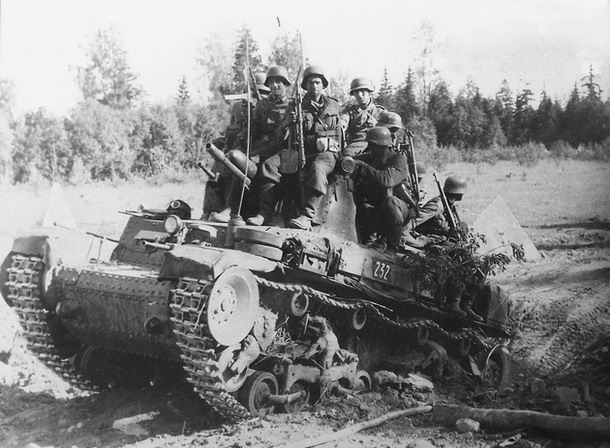
PzKpfw 35(t) loaded with infantry, source: Flickr.com with permission of the publishing user, edited
Organisation
Some PzKpfw 35(t) tanks were allocated to the test and training centre at Kummersdorf, some placed in reserve storage, and the remainder divided between two combat formations: the 11th Tank Regiment (Panzer Regiment 11) at Paderborn, and the 65th Tank Battalion (Panzer Abteilung 65) at Sennelager. At the time of the German attack on Poland on 1 September 1939, both of these formations were subordinate to the 1st Light Division (1. leichte Division). Panzer Regiment 11 consisted of two tank battalions, each with three tank companies (Panzer Kompanie). Each company was further divided into four tank platoons (Panzer Zug) of five tanks apiece. Panzer Abteilung 65 stood in the 1st Light Division's order of battle as an independent battalion (not subordinate to Panzer Regiment 11) and was similarly organised into three tank companies, each divided into four platoons of five tanks. These formations were not equipped exclusively with PzKpfw 35(t) tanks but also with light PzKpfw II and medium PzKpfw IV tanks.
Poland 1939
Going into the Polish campaign, Panzer Abteilung 65 had 39 PzKpfw 35(t) tanks, of which 37 were standard combat vehicles and 2 command tanks. Panzer Regiment 11 had 81 tanks of this type, 75 combat and 6 command. In total, therefore, the Germans sent 112 combat PzKpfw 35(t)s and 8 command Panzerbefehlswagen 35(t)s into Poland. Noteworthy is the fact that the Germans could field only 87 of their own comparable PzKpfw III tanks in Poland (counting combat versions only, not command variants). When we also consider that just 55 of the comparable PzKpfw 38(t) were deployed in Poland, it emerges that the PzKpfw 35(t) was in fact the most numerous German tank of its category – i.e. armed with a 37 mm gun – in that campaign.
For the attack on Poland, the 1st Light Division was subordinated to the German 10th Army, which in turn was part of Army Group South (commanding General Gerd von Rundstedt). The division advanced towards Wieluń and then further northeast. The tanks crossed the Warta river between the villages of Konopnica and Rychłocice; on 5–6 September the division fought near the village of Widawa, then advanced eastward, reaching the area of Radom on 12 September. It then pushed north and from 17–20 September was engaged in fighting between Warsaw and Modlin, where the division remained until the end of the Polish campaign. As for the number of PzKpfw 35(t) tanks lost in Poland, widely varying figures are encountered. According to some sources, 11 vehicles were seriously damaged in combat, but 10 of them were eventually repaired. Other sources state that 77 PzKpfw 35(t) tanks were damaged in combat and 7 had to be written off entirely.
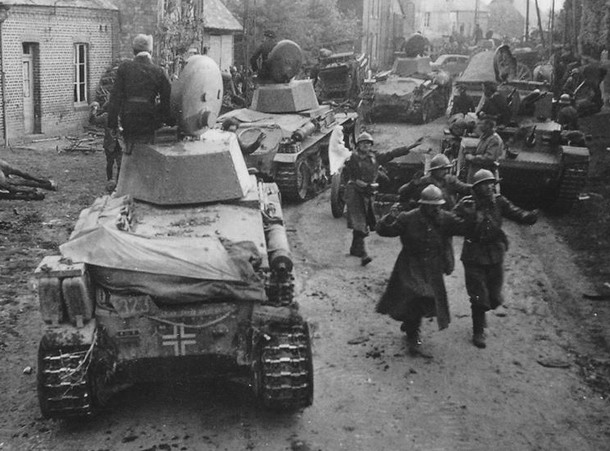
PzKpfw 35(t) tanks during the campaign in France, 1940, source: Flickr.com with permission of the publishing user, edited
France 1940
In October 1939 the 1st Light Division was reorganised as the 6th Panzer Division (Panzer Division), though its structure remained the same: the division continued to have three tank battalions in total (the independent Panzer Abteilung 65 and the two battalions of Panzer Regiment 11). Before the attack on France, the PzKpfw 35(t) tanks underwent thorough technical inspection and minor modifications were carried out. For instance, a bracket for two fuel jerrycans was added to the rear of the left track guard, and a further bracket for three jerrycans was fitted to the engine cover. On some tanks a spare road wheel was hung on the hull side amidships. On the day of the attack on France, 10 May 1940, the division had 118 combat and 14 command PzKpfw 35(t) tanks, along with 60 light PzKpfw II and 31 medium PzKpfw IV tanks.
The 6th Panzer Division entered the French campaign as part of the 41st Motorised Army Corps (XLI Armeekorps (mot.), Lieutenant General Georg-Hans Reinhardt), which was subordinated to General Ewald von Kleist's 12th Army. The division passed through Luxembourg and Belgium, crossed the "impenetrable" Ardennes hills and forests, and then crossed the Franco-Belgian border. Near the town of Monthermé it crossed the Meuse and drove westward through Cambrai and Arras. On 27 May it was fighting near Hazebrouck and then marched through Cassel to the English Channel coast.
At the turn of May and June, the objectives of Operation Fall Gelb (the first phase of the attack on France) had been achieved. German forces regrouped and launched the second phase, codenamed Fall Rot. The 6th Panzer Division now set off with Guderian's panzer group roughly back along its own tracks, to the southwest towards Sedan. On 10 June the division was near Rethel and pressed on through Suippes, Saint-Dizier, Chaumont, Langres, and finally to Épinal, where the division's combat operations ended with the French capitulation. As to how many PzKpfw 35(t) tanks were lost during the western campaign, here again different figures are encountered. Some authors record 45 tanks of this type as combat-damaged, of which only 11 could not be repaired and had to be written off entirely. Other credible sources state that 62 Panzer 35(t) tanks were damaged to such an extent that they either had to be written off completely or sent back to the factory for a full overhaul – though these sources do not state how many were ultimately repaired.
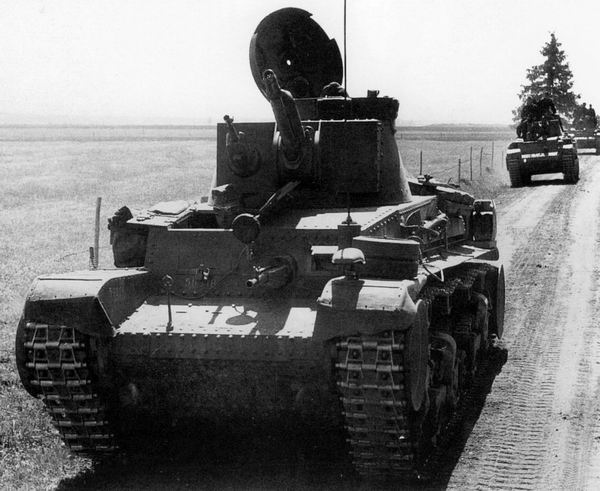
PzKpfw 35(t) tanks also took part in Operation Barbarossa, source: Bundesarchiv_Bild_101I-208-0031-03, Wikimedia, Creative Commons, edited
For completeness it should be noted that PzKpfw 35(t) tanks were allocated to one further combat formation for the French campaign: the reconnaissance battalion of the Waffen SS Totenkopf division. This battalion most likely received 6 of these tanks, owing to a shortage of other available fighting equipment.
Soviet Union 1941
At the beginning of 1941 the PzKpfw 35(t)s were officially withdrawn from the front line, but since the Wehrmacht needed every available tank for the planned eastern campaign, these vehicles remained in the inventory of the 6th Panzer Division. The division therefore entered Operation Barbarossa with a total of 160 PzKpfw 35(t) tanks. Sources differ slightly on the breakdown between combat and command variants: the combat total was either 149 or 155. In addition, the division had 47 PzKpfw II tanks, 30 PzKpfw IV tanks, and 8 command tanks of an unspecified type. Before the attack on the USSR, the Panzer 35(t) tanks were fitted with brackets on the hull rear for five additional fuel jerrycans. Two spare road wheel hubs were now stowed on the left track guard and spare track links on the right. The Germans were trying to prepare their tanks for operations in the vast Russian interior, where fuel and spare parts supply would be more difficult than in central and western Europe. In addition, a variety of boxes for provisions and personal crew kit appeared on the tanks (this can be clearly seen in the photographs HERE and HERE).
The 6th Panzer Division was placed under the 4th Panzer Group (4. Panzergruppe, commanding Colonel-General Erich Höpner) for the attack on the Soviet Union, and within it formed part of Army Group North (Field Marshal Wilhelm von Leeb). The Group's task was to destroy Soviet forces in Lithuania, Latvia, and Estonia and advance towards Leningrad. The 6th Panzer Division launched its attack from the area around Tilsit (today Sovetsk) on the Lithuanian border. By the second day of the operation, the German tanks were already some 80 km inside Soviet territory. From 23 to 27 June 1941 the PzKpfw 35(t) were involved in fierce fighting around the town of Raseiniai, in which the Soviets lost several hundred tanks. The division then pressed on across the Daugava (Western Dvina) river and on 20 August 1941 reached the outskirts of Leningrad.
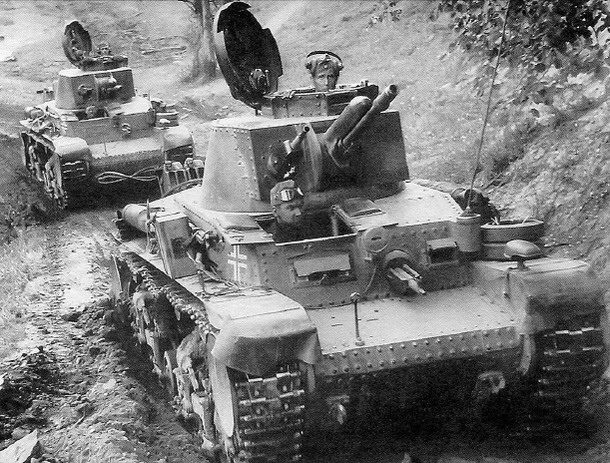
PzKpfw 35(t) in Russia, source: Worldwarphotos.info with permission of the site operator, edited
On 5 September 1941 the Führer ordered the 4th Panzer Group to move south into the operational area of Army Group Centre, in preparation for Operation Typhoon – the drive on Moscow. Höpner's panzer group played a key role in the encirclement operation at Vyazma. In mid-October the so-called rasputitsa began – the rainy season during which the unsurfaced Russian roads turned into impassable mud. The mobility of German armoured formations fell to a minimum, vehicle wear increased sharply, and fuel and ammunition supply broke down. On 15 November the 6th Panzer Division stood on the western bank of the Lama river, roughly 40 km north of Volokolamsk. Moscow was approximately a hundred kilometres away.
The entire 4th Panzer Group resumed its advance around 17 November, when the first overnight frosts had firmed the muddy ground sufficiently. Progress was very slow nonetheless: over 14 days, Höpner's tanks covered just 60 km – roughly 4 km per day. The 6th Panzer Division with its PzKpfw 35(t) tanks advanced north of the Soviet capital, towards Klin. On 5 December 1941 the 6th Panzer Division halted a few kilometres west of the small town of Yakhroma. The division was less than fifty kilometres from the northern edge of Moscow. The Škoda tanks, however, got no further: the German drive on Moscow was called off and the retreat to the west began.
As for losses in Panzer 35(t) tanks, contradictory information is encountered as usual. Vladimír Francev, in his book, gives a very optimistic figure of just seven tanks lost in the first four months of the eastern campaign (roughly from the end of June to the end of October 1941). Thomas Jentz – and Pier P. Battistelli in agreement with him – states on the other hand that by 10 September alone (after some two and a half months of the eastern campaign), the 6th Panzer Division had already lost 47 Panzer 35(t) tanks. It is of course possible that Jentz's figure reflects tanks that could not be repaired in the field but might subsequently have been repairable at the parent factory. Given that the Škoda works in Plzeň were fully occupied with other production for the German Army and the PzKpfw 35(t) was considered an obsolete and unpromising type, it seems likely the Germans were no longer prepared to expend workshop capacity on any demanding repairs. Moreover, by the end of 1941 sufficient spare parts would probably no longer have been available in any case, and repairs were by then mostly carried out by cannibalising parts from other written-off vehicles. In light of the enormous losses suffered by other German tank types, the higher figure of 47 PzKpfw 35(t) total losses seems the more credible one.
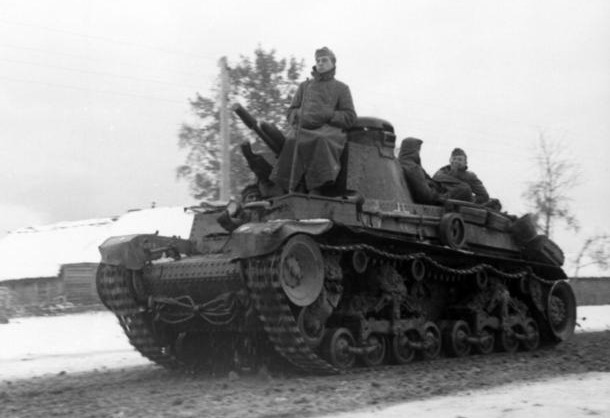
PzKpfw 35(t) in the first Russian winter – in December 1941 the Škoda-built tanks reached to within just 50 km of Moscow, source: Bundesarchiv_Bild_101I-268-0185-06A, Wikimedia, Creative Commons, edited
Operation Typhoon was the last offensive operation of the German Army in which the Škoda-built tanks took part. It marked not only the end of their era, but the end of the era of front-line light tanks in general. Some authors also claim that the pneumatic steering system failed in the Russian frosts. If true, it would have been merely the final nail in the coffin of the PzKpfw 35(t) in any case. The 6th Panzer Division was withdrawn to the homeland and re-equipped. All serviceable "thirty-fives" were concentrated in reserve depots in Vienna, from where they were distributed to various police and anti-partisan units.
Mörserzugmittel 35(t)
The Germans were simultaneously looking for other uses for withdrawn but still serviceable tanks. In March 1942, as part of these efforts, a decision was made to convert 40 tanks into unarmed artillery tractors. The vehicle design and first prototype were apparently prepared by the firm Alkett, and the subsequent conversion of tanks to this pattern was entrusted – naturally enough – to Škoda Plzeň. The fighting turret was removed from each standard PzKpfw 35(t). A simple canvas roof on a tubular frame was erected over the turret opening. A heavy tow frame with a 12-tonne towing hook was fitted at the rear of the hull. The hull machine gun was removed and its embrasure blanked off with a steel plate. A bracket for four fuel jerrycans was added to the left side of the fighting compartment. Three further jerrycans were stowed inside the vehicle. The tractor's crew consisted of just two men. During 1942 and 1943 a total of 49 tanks were converted to this role. The Mörserzugmittel 35(t), as the tractor was designated, is documented in photographs on the Eastern Front (a photograph of a destroyed tractor can be seen for example HERE and HERE, source: Waralbum.ru). The removed fighting turrets were used in static fortifications in Denmark and Corsica. Two Mörserzugmittel 35(t) were later reportedly converted (unofficially, in some field workshop) into a tank destroyer armed with a 4.7cm PaK 36(t) gun.
Bridgelayer Tank
Apparently only a single prototype was built of a conversion of the PzKpfw 35(t) into a bridgelaying tank, or Brückenleger. Beyond an excellent series of photographs, virtually nothing is known about this vehicle. The photographs come from trials of the vehicle, which probably took place in the winter of 1939/40. The experimental tank was fitted with steel sections forming two relatively narrow trackways. The surface of the trackways was covered with short wooden boards. The trackways ran along either side of the fighting turret and angled upward from rear to front. At the rear, each trackway had a hinged ramp section. From the photographs it appears the entire structure was fixed rigidly in place, with no means of adjusting the incline. The purpose of this bridgelayer was evidently to enable other vehicles to surmount tall obstacles. The bridge was connected to the tank and could not be laid on the ground, meaning the tank had to temporarily support the weight of the vehicle crossing it. The photographs show the trials taking place in what appears to be a sand pit or quarry (judging by the background and a transport wagon visible in the scene). The bridgelayer drove beneath a concrete ramp normally used for loading sand onto trucks, and two light tanks – a standard PzKpfw 35(t) and a PzKpfw II (evidently in some modified version) – then attempted to drive up the ramp using it. Photographs of this vehicle can be viewed HERE, HERE, HERE, HERE, and HERE (sources: Waralbum.ru and Worldwarphotos.info).
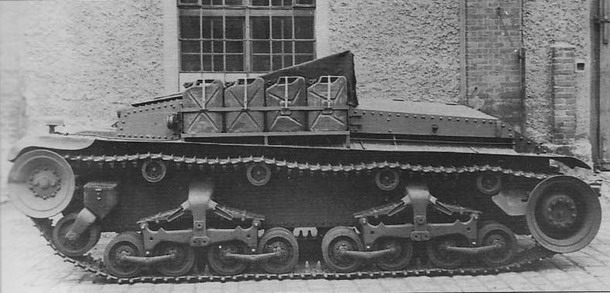
Artillery tractor Mörserzugmittel 35(t), source: Flickr.com with permission of the publishing user, edited
Other Operators
As already noted above, the new Slovak state retained a total of 52 LT vz. 35 tanks after separation from Czechoslovakia. In September 1939 the Slovaks, as German allies, had their tanks ready to deploy in support of the Wehrmacht during the conquest of Poland. Given the relatively smooth progress of the Polish campaign, this proved unnecessary, and the Slovak LT vz. 35s did not see action. Nor were they needed during the conquest of western Europe a year later. Things changed in the summer of 1941, when the Slovak tanks took part in Operation Barbarossa. The apparently only significant engagement in which the Slovaks fought their tanks took place on 22 July 1941 near the Ukrainian town of Lipovets. Three Slovak tanks were lost there. By the end of 1941 all Slovak LT vz. 35s had been withdrawn from combat units and relegated to training duties. The withdrawn tanks saw their last deployment in August 1944 during the Slovak National Uprising. This time, however, they were deployed not alongside the Wehrmacht but against it. Some of the rebel tanks were destroyed by German forces during the fighting; the remainder were seized after the suppression of the uprising and their subsequent fate is unknown.
The Romanian Army was also a significant operator of Czechoslovak tanks. Romania ordered its LT vz. 35s from Škoda Plzeň as early as 1936, in a quantity of 126 vehicles. Deliveries took place between September 1938 and February 1939. The Romanians assigned their tanks the designation R-2. These vehicles – or at least some of them – had a specifically different rear turret wall: instead of being rounded, it was angled, made up of two flat plates. This difference is clearly visible in the comparison photograph HERE. The R-2 tanks, together with older light Renaults, formed the backbone of the 1st Armoured Division, which Romania sent into the attack on the Soviet Union in the summer of 1941. On 5 August 1941 the division crossed the Dniester and advanced on the port city of Odessa. The city was not captured until 16 October and was subsequently occupied by Romania itself. The Romanian 1st Armoured Division was then withdrawn home for rest and replenishment, having only 20 serviceable R-2 tanks remaining.
The division returned to the front only in August 1942, bringing with it 109 R-2 tanks, 11 PzKpfw IVs, and the same number of PzKpfw IIIs. Its new task was to secure the left flank of the German 6th Army at Stalingrad. In November 1942 the Romanian armoured formation was literally swept away by the Soviet counteroffensive. Only a fraction of the unit managed to escape. Of the original 109 R-2 tanks, 81 were left in the snow northwest of Stalingrad. The remainder of these tanks were transferred from combat units to Army reserves. In 1944, twenty of them were converted into the TACAM R-2 tank destroyer, armed with a modified version of the Soviet ZIS-3 gun of 76.2 mm calibre. After the coup of August 1944, when Romania turned away from Germany, the TACAM R-2s were deployed against the Wehrmacht itself. In the fighting against the former ally, fully half of them were gradually lost.
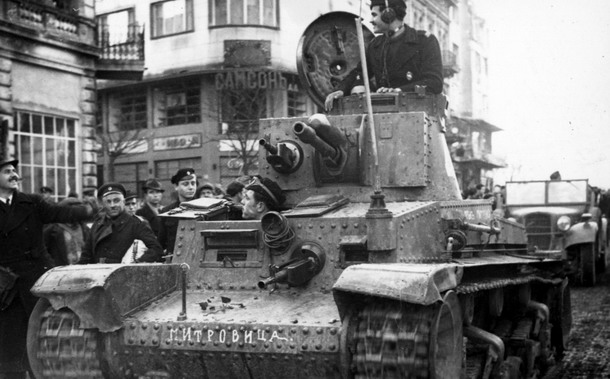
PzKpfw 35(t) in Bulgarian Army service, source: Flickr.com with permission of the publishing user, edited
The last operator of the Škoda-built tanks worth mentioning is Bulgaria. The Bulgarians purchased their first 26 PzKpfw 35(t) tanks from the German Army as early as 1939. Before delivery, these used vehicles were to undergo a complete overhaul at Škoda Plzeň. The firm's production capacity was, however, being intensively used by the Germans themselves, so work on the Bulgarian tanks was not accorded high priority. As a result, the Bulgarians received their refurbished vehicles only between February and April 1940. A further ten tanks were subsequently purchased by Bulgaria directly from the manufacturer. These were vehicles that had originally been ordered by Afghanistan in 1940. The Germans had initially agreed to this sale but later changed their minds, and the ten tanks eventually went to Bulgaria rather than Afghanistan, under the designation T-11. The Bulgarian Army ultimately used these vehicles into the 1950s.
Assessment
The PzKpfw 35(t) – or LT vz. 35 – is often described as an unreliable vehicle, with its pneumatic steering system singled out in this context. This is not a fair assessment. In its day it was a modern vehicle, fully comparable with its contemporaries or even superior to them. The qualities of the Czechoslovak tank were tested in the best possible way – in combat. First in the hands of Czechoslovak soldiers during clashes with various armed factions in the Czech border regions and in Sub-Carpathian Ruthenia, and later in German hands. With the Wehrmacht the PzKpfw 35(t) drove not only through Poland, Luxembourg, Belgium, and France, but all the way to the gates of Moscow! The problems that the extreme Russian winter brought were not a reflection of any inherent unreliability of the vehicle but affected virtually all German equipment. In total, across all designations, 434 of these tanks were built – 298 for the Czechoslovak Army, 126 for Romania, and 10 for Bulgaria/Afghanistan.
Technical Data
|
weight: |
10.5 t |
|
length: |
4.90 m |
|
width: |
2.06 m |
|
height: |
2.37 m |
|
engine: |
Škoda T-11/0 |
|
engine output: |
120 hp |
|
max. speed: |
34 km/h |
|
hull armour: |
|
|
- front: |
25 mm |
|
- sides: |
16 mm |
|
- rear: |
16 mm |
|
turret armour: |
|
|
- front: |
25 mm |
|
- sides: |
16 mm |
|
- rear: |
16 mm |
|
crew: |
4 men |
|
armament: |
KwK 34(t) gun, 37 mm calibre 2 x MG 37(t) machine gun, 7.92 mm calibre |
ARTICLE
CONTENTS:
Reproducing text from the Panzernet website without the written consent of the operator is prohibited.