KATYUSHA
the legendary Stalin's Organ
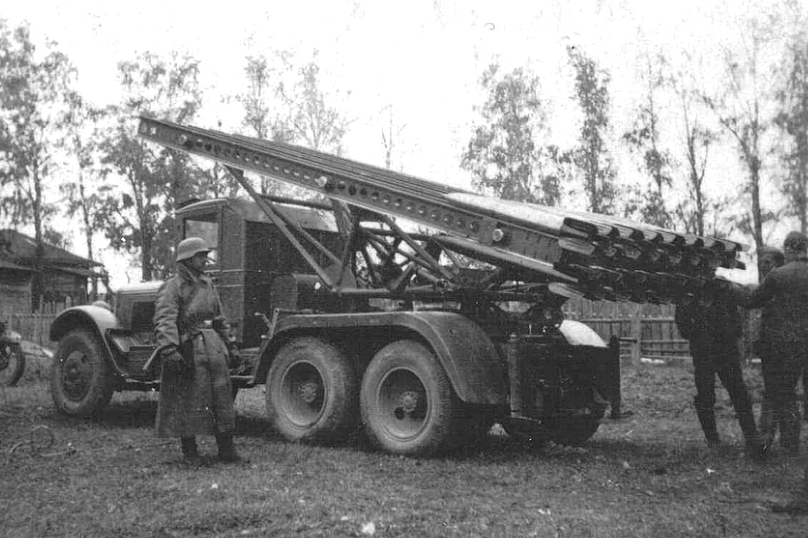
BM-13-16 self-propelled rocket launcher on a ZiS-5 chassis, captured by the Germans, source: Topwar.ru with permission of the operator, edited
Origins
Alongside the T-34 tank, the Red Army fielded at least one other weapon in World War II that became a true legend and symbol: the Katyusha rocket launcher. The Katyusha story began in June 1938, when the Soviet Main Artillery Command (Glavnoye Raketno-Artilleriyskoe Upravleniye) issued a requirement for a ground-based multiple-launch system for the RS-132 aircraft rocket. Working to this specification, a design team led by I. Gvai in Chelyabinsk produced a simple launching frame to be mounted on the rear of ZiS-5 trucks, firing a modified version of the rocket designated M-13 (or M-132). The prototype launcher proved highly unstable during testing, largely because the rockets were fired sideways. This lesson led in August 1939 to a redesigned prototype designated BM-13, in which the launch frame was oriented longitudinally.
During 1940 the prototype underwent firing trials with several types of rockets, and a decision was eventually taken to accept it for series production. The vehicle received the designation BM-13-16, indicating a combat vehicle (Boyevaya Mashina) for M-13 rockets with 16 launch rails. The M-13 rocket had a calibre of 132 mm and weighed 42 kg. It was propelled by a nitrocellulose-based solid fuel (smokeless powder). Stabilisation was provided by four fins. The rocket carried 4.9 kg of explosive and had a range of approximately 5,400 metres.
Development and production of the rocket launchers was kept under the strictest secrecy, with the notorious NKVD overseeing everything. For this reason the vehicles were referred to under various cover names before eventually receiving the official designation "Guards Mortar." They became famous, however, under the name Katyusha — a diminutive of the girl's name Katerina, given to the weapon by the soldiers themselves after the beloved wartime song of the same name by Mikhail Isakovsky. The Katyusha also acquired a nickname from the enemy: German soldiers called them Stalin's Organs, partly because of a vague resemblance between the launch rails and organ pipes, but most likely above all because of the wailing sound they made when fired.
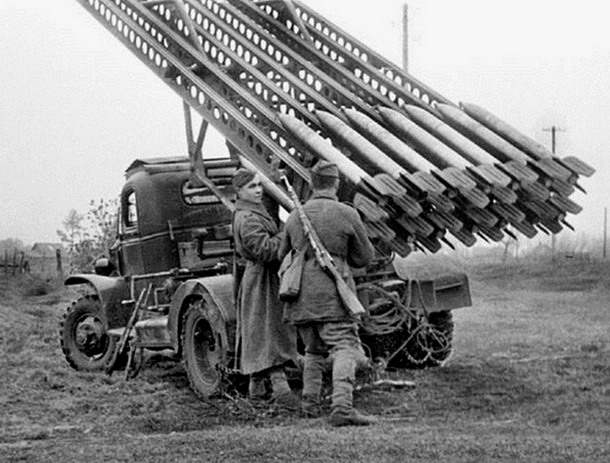
loading a BM-13-16 self-propelled rocket launcher on a Chevrolet G-7117 chassis, source: Topwar.ru with permission of the operator, edited
By the outbreak of war in the east, the Soviets had managed to produce only 40 of these self-propelled rocket launchers. Their first combat use against the Germans took place on 14 July 1941 (some sources give 7 July) near the town of Orsha in present-day Belarus. A group of seven launchers under the command of Captain Ivan A. Flyorov attacked a German-held railway station. The rockets destroyed the station itself, several railway wagons and inflicted significant casualties on the Germans. Impressed by this success, a decision was made to scale up production and continue development of the rocket launchers — a development that over the following years of war brought both new carrier vehicles and new rockets.
Rocket Types Used
In August 1941 a second rocket type for the Katyusha was developed, designated M-8, with a calibre of 82 mm. The new rocket had a shorter range than its predecessor, but its lower weight and smaller dimensions opened up the possibility of fitting launching frames to lighter vehicles — more on that below. In June 1942 a new rocket, the M-30, was developed as a modification of the original M-13, with a range of 2,800 metres and a warhead weighing 28.9 kg. The M-30 had an oversized warhead — of greater diameter than the rest of the rocket — was more powerful than either of the earlier types and was capable of destroying fortified targets such as bunkers. An improved version, the M-31, was developed subsequently. Both the M-30 and M-31 were, however, launched only from static ground frames known as heavy Guards Mortars. It was not until 1944 that the M-31 was also adapted for a truck-mounted launcher, joining the Katyusha family under the designation BM-31. Beyond these main types, improved variants such as the M-13UK and M-13DD were also developed. A further rocket, the M-20, was never officially approved for service.
Carrier Vehicles Used
BM-13 rocket launchers were originally mounted on two-axle ZiS-5 and ZiS-5V trucks and three-axle ZiS-6 trucks, designated BM-13-16 (M-13 rockets, 16 launch rails). As early as 1941, the M-13 launcher was also fitted to the chassis of the STZ-5 tracked artillery tractor, though only a small number of these were produced. The launching frame for M-13 rockets was experimentally fitted to the KV-1 tank chassis as well — the resulting vehicle was designated KV-1K — but it was not put into production, as it was considered wasteful to use a heavily armoured tank chassis for a rocket launcher that operated well behind the front line.
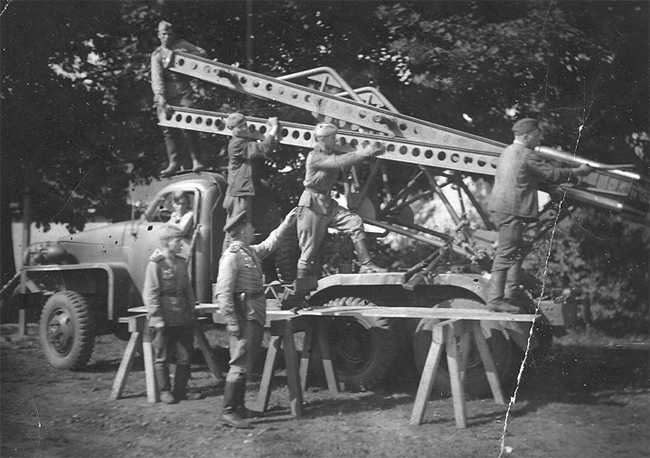
fitting M-13 rocket launch rails to a Studebaker truck, source: Topwar.ru with permission of the operator, edited
The first carriers for BM-8 rocket launchers were likewise the ZiS-5, ZiS-5V and ZiS-6 trucks. The smaller size of the rockets made it possible to fit twice as many launch rails as on a BM-13, giving the designation BM-8-36. On the Studebaker chassis a full 48 rails could be fitted, giving the designation BM-8-48. The light M-8 rockets also enabled launcher installation on vehicles that would otherwise have been unsuitable. This produced the BM-8-24 on the chassis of T-40 and T-60 light tanks, and the BM-8-8 on the GAZ-67 cross-country vehicle. The M-30 rockets were somewhat more demanding to mount since they were not fired from rails but from frames. For these rockets, the BM-31-12 launcher (12 launch frames) was developed on the Studebaker chassis.
The BM-13 remained the most numerous type throughout, however. By the end of 1942, for instance, BM-13s accounted for 56% of all Guards Mortars in the Red Army, with 21% being BM-8s and 23% static M-30 launchers.
From 1942 Allied equipment began arriving in the Soviet Union under the Lend-Lease programme, and Katyushas began to be mounted on American, British and Canadian truck chassis. The American two-and-a-half-ton Studebaker US6 quickly proved the best of all the carriers used so far, and a decision was made to standardise Katyusha production on this chassis under the designation BM-13N (N for normalizovanny — standardised).
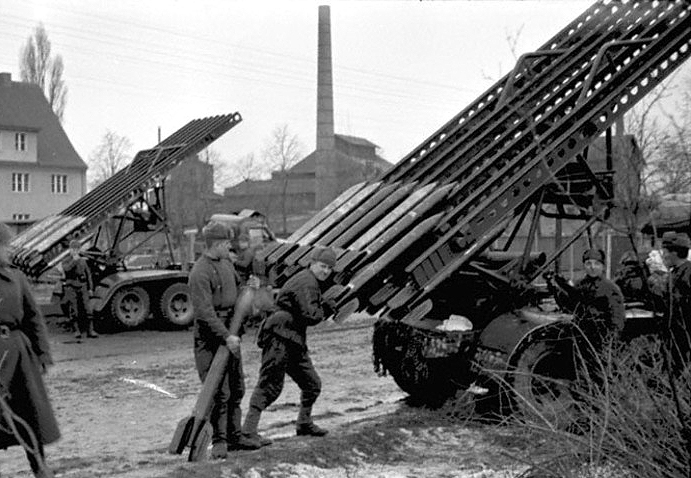
loading a BM-13-16 self-propelled rocket launcher, source: Waralbum.ru with permission of the operator, edited
Katyushas were used intensively in combat against enemy infantry, tanks and fortifications alike. They took part in the defensive battles around Moscow, Leningrad, Stalingrad, Sevastopol and many other cities, and proved equally effective on the offensive, destroying enemy positions and helping to open the way for other units.
Overall Assessment
The Katyusha's main advantage was its ease and cheapness of manufacture — even factories without sophisticated equipment could produce them. The Katyusha was not a particularly precise weapon, but it excelled at area-saturation attacks. A salvo of rockets could cover a large area and deliver a substantial quantity of explosive onto it in a very short time. Its main drawback was the slow and laborious process of reloading. Katyushas were therefore primarily shock weapons — designed to saturate the enemy with rockets and then withdraw, rather than maintain sustained suppressive fire. The vast majority of Katyushas were mounted on truck chassis, which naturally meant poor cross-country mobility and virtually no protection for the crew against incoming fire. Despite all its shortcomings, it was nonetheless an effective and widely respected weapon.
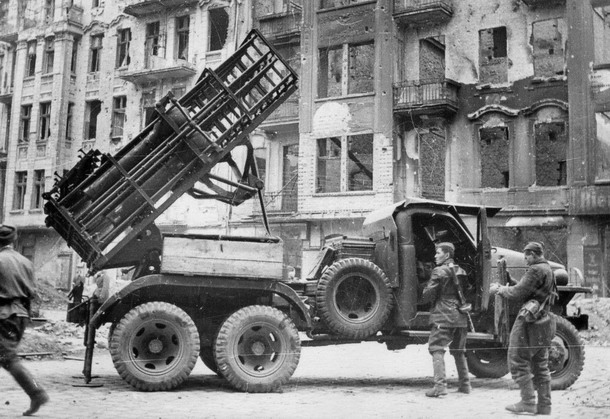
a BM-31-12 self-propelled rocket launcher on a Studebaker US6 chassis preparing to fire in the streets of Berlin, source: Topwar.ru with permission of the operator, edited
The organisational structure for Katyusha deployment was established on 8 August 1941 and defined a battery as four launchers. Three batteries formed a battalion, and three battalions formed a regiment. A regiment at full strength therefore fielded 36 launchers in total. In addition, independent batteries and independent battalions also existed. By the end of 1941 the Red Army had eight regiments, 35 independent battalions and 2 independent batteries, for a total of 554 launchers. By the end of 1942 the number of Katyushas in the Red Army had grown to 3,237. By the end of World War II more than 10,000 of these vehicles had been produced in total, and production continued after the war.

ARTICLE
CONTENTS:
Reproducing text from the Tankist website without the written consent of the operator is prohibited.