SU-122
self-propelled gun on the T-34 tank chassis
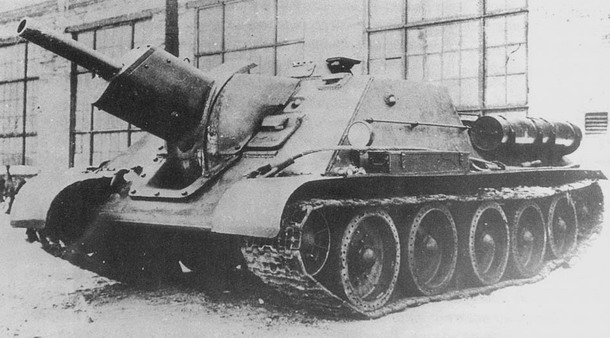
SU-122 self-propelled howitzer, source: Aviarmor.net with permission of the operator, edited
Origins
The combat successes of the German Stug III assault gun did not go unnoticed by Soviet military officials, and it was most likely these German vehicles that inspired the Soviet programme to develop a self-propelled gun of 122 mm calibre or larger. The programme was initiated in April 1942 and several competing design teams were involved. Only two projects progressed as far as hardware, one of them being the design from the Yekaterinburg-based Uralmash factory (Uralsky Mashinostroitelny Zavod), designated U-35, from which the SU-122 ultimately emerged.
One of the project's key priorities was the ability to manufacture the vehicle quickly and cheaply. For this reason, the U-35 — and by extension the SU-122 — was built on the chassis of the already-proven production T-34 tank. The chassis and rear half of the hull, along with the engine and gearbox, were taken from the tank without modification. The front half, however, was changed fundamentally. The turret and upper hull were removed and replaced by a fixed rectangular superstructure. The front wall of the superstructure joined the front plate of the hull tub and rose at a sharp angle without a break all the way to the roof. The front wall was 45 mm thick, as were the side walls. The rear wall and roof were 20 mm.
Design Description
In the front wall, slightly right of centre, was a large opening housing the vehicle's main weapon: the M-30S howitzer, adapted from the towed M-30 Model 1938 howitzer of 121.92 mm calibre. The weapon was set into a massive collar that projected noticeably from the front plate of the superstructure — the collar was so large because it housed the entire recoil mechanism. Vertical elevation ranged from -3° to +26°, with 10° of traverse to each side.
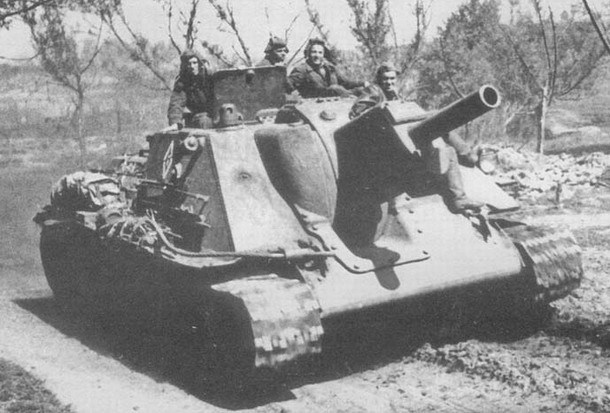
SU-122 self-propelled howitzer, source: Aviarmor.net with permission of the operator, edited
To the left of the howitzer in the front wall was the driver's entry hatch, of the same design as on the original T-34 but narrower. Above the hatch was a pistol port for personal weapons, and higher still, at the very junction of the front wall and the roof, was the gunner's vision port. On the right side of the superstructure roof was a commander's cupola, behind which was the fighting compartment ventilation outlet. To the right of the ventilator was a rectangular entry hatch with a single-piece cover. The roof also featured the aperture for the PTK panoramic periscope, located in its right front section.
The SU-122 had a crew of five. The driver sat on the left in the front of the hull, in the same position as on the T-34. Behind the driver — that is, to the left of the howitzer — sat the gunner. To the right of the howitzer sat the commander, and at the rear of the fighting compartment behind the howitzer were two loaders.
After completing military trials, series production of the vehicle was approved in December 1942 under the official designation SU-122. Before the end of that year, 25 of the new vehicles had been completed and formed into the first mixed regiment. This regiment comprised six batteries in total: four equipped with SU-76 self-propelled guns and two with the SU-122, each battery fielding four vehicles. The combination of these two types in practice proved unsuccessful, however, and thereafter each type was organised into separate regiments. SU-122 regiments of medium self-propelled artillery consisted of four batteries of four vehicles each, plus one T-34 command tank.
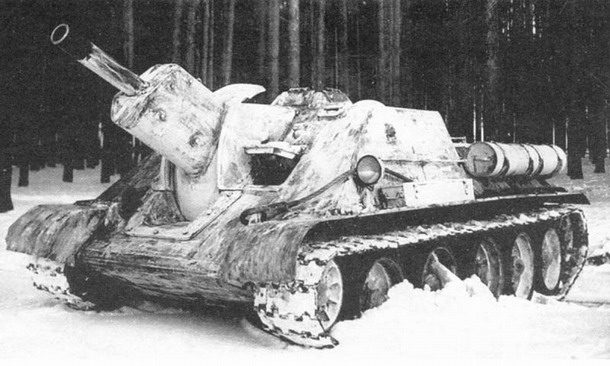
SU-122 self-propelled howitzer, source: Aviarmor.net with permission of the operator, edited
Combat Service
The SU-122 saw its combat debut in January 1943 near Leningrad. Its most concentrated deployment came during the fighting in the Kursk salient in July 1943, where 56 of these vehicles were committed simultaneously. The SU-122 fought through to the end of the war. There is no record of the Soviets supplying these vehicles to any ally, though a number were involuntarily "donated" to the German army through capture, and the Germans did make limited use of them.
Project SU-122M
Several proposals to improve the vehicle were developed during the production period. In March 1943 an attempt was made to rearm the vehicle with the U-11 howitzer of the same calibre as the original M-30S. The new weapon was accompanied by a new ball mount, similar to those used on the later SU-85 and SU-100. This upgraded vehicle was designated SU-122M. Testing revealed a number of shortcomings: reliability was lower than the original, weight had increased — putting greater stress on the chassis — and production costs had risen as well. The SU-122M project was consequently rejected.
Project SU-122-3
In May 1943 a further modernisation proposal appeared, designated SU-122-3. This project aimed to maximise component commonality with the SU-85 production line. The prototype was very similar to the unsuccessful SU-122M, again featuring a ball mount housing a 122 mm howitzer — this time the D-6 type, which was lighter and more compact than the U-11. The SU-122-3 was likewise not approved for series production.
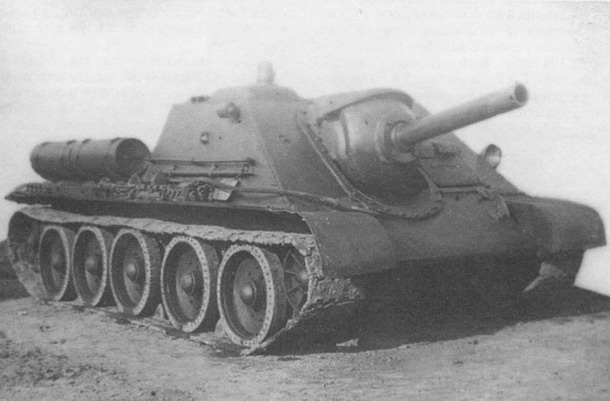
prototype of the SU-122M self-propelled howitzer, source: Aviarmor.net with permission of the operator, edited
Project SU-122P
A further prototype existed under the designation SU-122P, though this was not a vehicle derived from the original SU-122. Instead it was based on the chassis of the SU-100 self-propelled gun and armed with the D-25 tank gun of 122 mm calibre. The SU-122P was tested in the autumn of 1944 but, despite satisfactory trial results, was not accepted for series production.
The SU-122 represented a very successful combination of relatively powerful armament with good armour protection and mobility. It proved most effective against infantry and static fortifications. Against tanks and other armoured vehicles it was less well suited — a 122 mm shell could penetrate the side armour of a German Tiger turret with a well-placed hit, but only at relatively short range and only if the shot connected cleanly. It was only the introduction of the new HEAT round BP-460A in May 1943 that allowed the SU-122 to defeat enemy armour at greater distances.
One fundamental drawback nonetheless remained: a low rate of fire. This was caused by the use of separate-loading (two-piece) ammunition and the gun's screw breech, which took longer to close than a sliding block type. As a result, the practical rate of fire was just two rounds per minute. Production of the SU-122 continued until the end of summer 1944, when the type was replaced by the newer SU-85. A total of 1,148 vehicles were built during the production run.
Technical Specifications
Weight |
30.9 t |
Length |
6.95 m including gun barrel |
Width |
3.0 m |
Height |
2.32 m |
Engine |
V-2 34 |
Maximum power |
500 hp |
Maximum speed |
55 km/h |
Range – road |
300 km |
Range – cross-country |
150 km |
Superstructure armour |
20 – 45 mm |
Gradient |
35° |
Fording depth |
1.3 m |
Trench crossing |
2.5 m |
Armament |
1 × M-30S howitzer, 121.92 mm |
Crew |
4 men |

ARTICLE
CONTENTS:
Reproducing text from the Tankist website without the written consent of the operator is prohibited.