SU-85
tank destroyer self-propelled gun
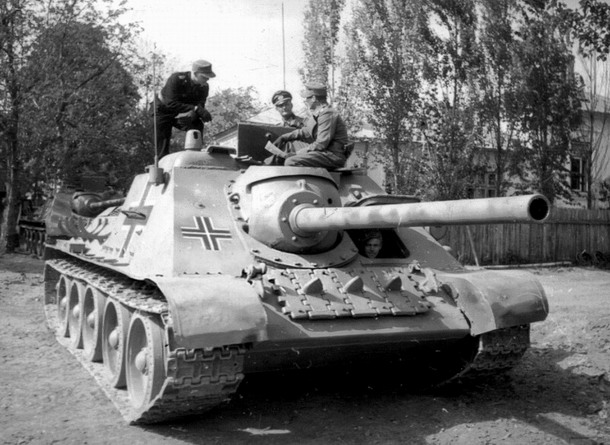
SU-85 self-propelled gun in Wehrmacht service, source: Flickr.com with permission of the publishing user, edited
Origins
The development of the SU-85 was triggered by the capture of a Tiger tank in January 1943. The captured vehicle was sent to Moscow for thorough examination. Firing trials produced results that the Soviet high command found deeply troubling. The most widely used Soviet tank guns of the period — the F-34 and ZiS-5, both in 76.2 mm calibre — could damage the new German tank only at suicidally close range. Far more effective, as the trials demonstrated, was the 85 mm 52-K M1939 anti-aircraft gun.
A decision was immediately taken to develop a modified version of this gun that could be fitted into the hull of the existing SU-122 self-propelled gun, creating a new self-propelled anti-tank weapon. Two design bureaus were tasked with developing the new gun: those of V. Grabin and F. F. Petrov. Grabin's team chose to base their design on the S-18 tank gun, which was at that time being developed as a prototype weapon for future heavy tanks. Grabin modified the S-18 just enough to allow it to be installed in the hull of the SU-122. This allowed two examples of the gun to be made available very quickly, and they were promptly dispatched to the Uralmash factory for installation.
During installation, however, it became clear that the gun was too large for the SU-122 hull. Fitting it without modifying the hull structure took up too much interior space, so the factory proposed an alternative mounting arrangement — one that solved the space problem but required modifications to the front of the superstructure and therefore entailed significant additional production costs. The result was two prototypes built at Uralmash, designated SU-85-I and SU-85-IV, differing precisely in the method of gun installation. (Why the numbers I and IV were chosen for these designations, rather than I and II, is something I have not been able to find explained anywhere.)
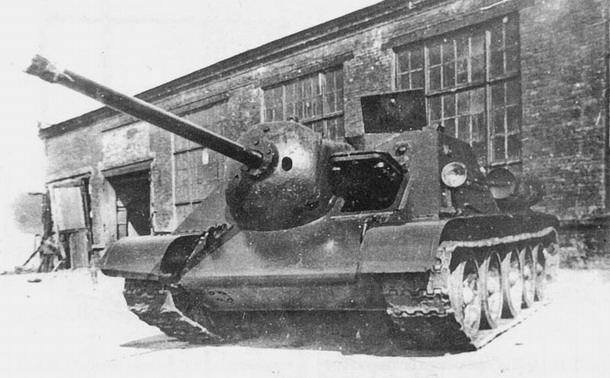
prototype SU-85-IV, source: Aviarmor.net with permission of the operator, edited
First Prototypes
In the SU-85-I the S-18 gun was installed without any modification to the hull. In the SU-85-IV, by contrast, the gun was set into a kind of extended collar projecting from the front plate. When Petrov's rival team also completed their weapon — the D-5S — a third prototype could be built at Uralmash, armed with this new gun and designated SU-85-II. All three vehicles underwent thorough testing. The SU-85-IV was the first to be eliminated, leaving the competition between versions I and II.
Although the design with the S-18 gun had been the favoured option from the outset, testing showed that the new D-5S achieved equivalent ballistic performance while proving more reliable than its competitor. The winner of the competition was therefore the SU-85-II with the D-5S gun. On 7 August 1943 the new vehicle was formally accepted into Red Army service under the official designation SU-85. As a footnote, the unsuccessful S-18 gun never received even its originally intended installation in heavy tanks, and the two SU-85 prototypes described above remained the only vehicles ever to be armed with it.
Design Description
Production of the new self-propelled gun got underway at a remarkable pace — the first hundred vehicles were completed before the end of August. As already noted, the SU-85 was based on the earlier SU-122 self-propelled gun. It therefore sat on the chassis of the production T-34 tank, from which the entire rear section — including the engine and gearbox — was also taken. On the forward half of the chassis sat a fixed superstructure with a sharply sloped front plate 45 mm thick. A large portion of the front plate was occupied by the opening for the gun's ball mount, with the gun offset slightly to the right of centre.
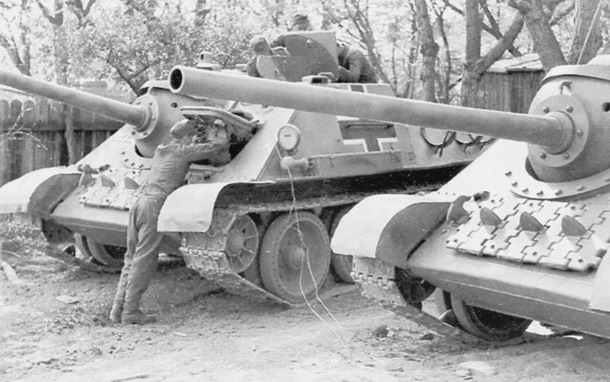
SU-85 self-propelled guns in Wehrmacht service, source: Flickr.com with permission of the publishing user, edited
The D-5S gun used fixed (unitary) ammunition. Its armour-piercing round weighed 9.2 kg and could penetrate 138 mm of armour at 500 metres, and 100 mm at one kilometre. Sub-calibre rounds weighing 4.99 kg were also available, capable of penetrating 145 mm of armour at 500 metres. The gun additionally fired high-explosive fragmentation rounds weighing 9.6 kg. The SU-85 had no integral machine gun armament; for close-in defence against enemy infantry the crew instead carried submachine guns and hand grenades. Ammunition stowage comprised 48 gun rounds, 1,500 rounds for personal weapons, 24 F-1 hand grenades and 5 anti-tank grenades.
To the left of the gun was the driver's hatch, of the same design as on the T-34. Immediately above the driver's hatch, close to the gun, a bulge in the front plate concealed a panoramic artillery sight, which extended above the roof of the vehicle when a two-part hatch cover was opened. In the right front corner of the roof was a commander's cupola. Somewhat unusually, the cupola had no hatch — only a set of periscopes. Additional fixed periscopes were mounted along both side edges of the roof and along the rear edge, giving the crew a complete all-round view. At the junction of the roof and rear wall was the main crew entry/exit hatch and ammunition loading hatch, a two-part design with one section in the roof and the other in the rear wall of the fighting compartment. All walls also featured small pistol ports for firing personal weapons.
Production of the SU-85 ran from August 1943 to July 1944, during which time a total of 2,329 vehicles were completed (though other figures are sometimes cited). Production ended for two reasons: first, the T-34/85 tank was entering series production, armed with the same 85 mm gun — making a self-propelled gun of equal firepower alongside the tank redundant. The more immediate trigger was the arrival of the new SU-100 tank destroyer, whose production was approved on 3 July 1944.
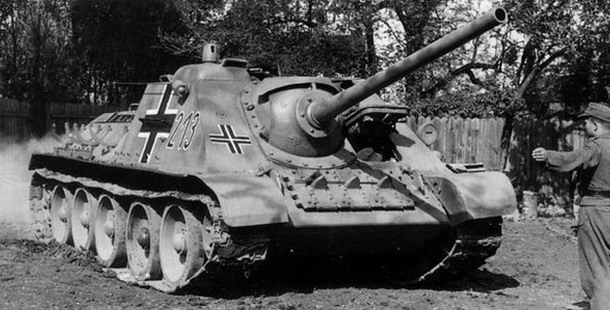
SU-85 self-propelled gun in Wehrmacht service, source: Flickr.com with permission of the publishing user, edited
Variant SU-85M
The transition from SU-85 to SU-100 production, however, produced an awkward situation. Soviet ammunition factories were unable to respond to the approval of the new vehicle as quickly as the Uralmash production plant, and in July 1944 the manufacture of 100 mm ammunition for the SU-100 had not yet reached sufficient volume. At the same time, SU-85 production had already been halted, creating a real risk of a gap in self-propelled gun output. The chief designer of the SU-100, L. I. Gorlitski, responded with a stopgap solution: D-5S guns from existing SU-85 vehicles began to be fitted into the hull of the new SU-100 at the Uralmash factory.
From July to December 1944, what was in effect a new version of the SU-85 was being produced — one based on the more modern SU-100 hull. This version received the official designation SU-85M, and a total of 315 are said to have been built. The SU-85M differed from the standard SU-85 in its front armour thickness, which increased from 45 mm to 75 mm, as well as in its larger fighting compartment and — most visibly — its new commander's cupola. The cupola was of the same type as fitted to T-34/85 tanks and gave the commander a considerably better all-round view. The cupola body intruded noticeably into the right side wall of the fighting compartment.
Prototype SU-85BM
The SU-85 and SU-85M also served as the basis for several experimental vehicles which, while never reaching series production, are certainly worth noting. All of these prototypes shared the common goal of increasing the firepower of the original vehicle. The driving impulse was the appearance of the new German Ferdinand tank destroyers, whose armour was a serious challenge for Soviet weapons and whose guns represented the pinnacle of anti-tank capability at the time. Soviet artillery command therefore tasked designers with developing a gun capable of matching the performance of the German 88 mm PaK 43.
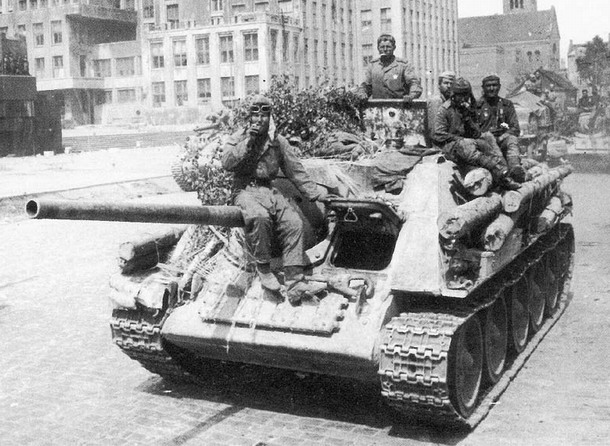
SU-85 self-propelled gun in liberated Minsk in 1944, source: Aviarmor.net with permission of the operator, edited
The first proposal for a new weapon came from F. F. Petrov's design bureau: a modified version of the original D-5S gun, designated D-5S-85BM. The letters BM stood for Bolshaya Moshchnost — literally "high power." The gun retained the 85 mm calibre but featured a lengthened barrel, a modified chamber, and was intended to use ammunition with a boosted propellant charge. As a result, projectiles achieved muzzle velocities of up to 950 m/s. The gun was experimentally installed in an SU-85 hull, creating a prototype designated SU-85BM. Trials ran from January to March 1944, and the vehicle was ultimately not accepted for production.
Prototype SU-S-34-1
Grabin's rival department offered its own experimental weapon in the spring of 1944: the S-34-IB. This gun used composite ammunition — an 85 mm projectile combined with a cartridge case (and therefore propellant charge) designed for 100 mm rounds. Again a prototype self-propelled gun was built around this weapon on the SU-85 hull, designated SU-S-34-1. The vehicle underwent trials in the summer of 1944 but was likewise rejected and faded into obscurity.
Prototype SU-D-10-85
The final attempt to increase the firepower of the SU-85 came in the autumn of 1944, once again from designer F. F. Petrov with his D-10-85PM gun proposal. As with Grabin's gun described above, this weapon combined an 85 mm projectile with a heavy cartridge case for 100 mm rounds. The gun was once more fitted into an SU-85 hull and submitted for trials under the designation SU-D-10-85. Testing continued into the spring of 1945, with the same outcome as the two earlier prototypes: rejection.
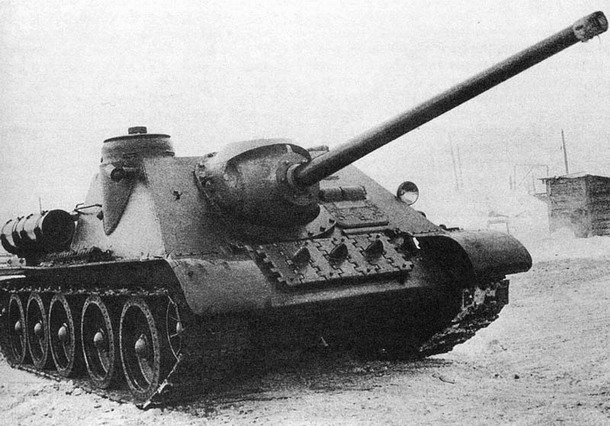
SU-85M — note the commander's cupola, source: Aviarmor.net with permission of the operator, edited
SU-85 self-propelled guns were organised into independent battalions and later regiments. Their combat debut came in September 1943 during the crossing of the Dnieper river, and from that point they fought through to the very end of the war. Units of Polish and Czechoslovak forces fighting alongside the Red Army were also equipped with these vehicles. The Soviets involuntarily supplied a number of SU-85s to the Wehrmacht as well — captured examples were put to operational use by the Germans.
Technical Specifications
Weight |
29.2 t |
Length with gun |
8.3 m |
Length without gun |
6.1 m |
Width |
3.0 m |
Height |
2.45 m |
Engine |
V-2 34 |
Maximum power |
500 hp |
Maximum speed |
55 km/h |
Range |
450 – 550 km |
Superstructure armour |
20 – 45 mm |
Armament |
1 × D-5S gun, 85 mm |
Crew |
4 men |

ARTICLE
CONTENTS:
Reproducing text from the Tankist website without the written consent of the operator is prohibited.