TANK T-34-85
the workhorse of the Red Army
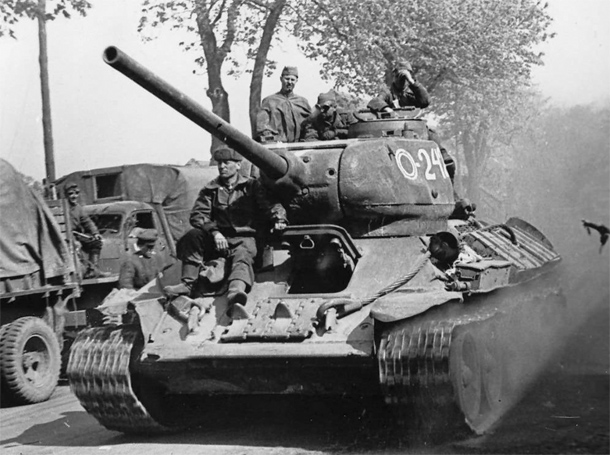
T-34-85 tank, source: Worldwarphotos.info with permission, modified
The Drive to Modernise the T-34
That the T-34 was a very successful design is something no one really needs convincing of — history has demonstrated it plainly enough. That said, it does not mean there was no room for further development and improvement. The first serious attempt at a major upgrade came as early as 1940, under the designation T-34M. That project had truly ambitious goals and would most likely have replaced the original design had Nazi forces not invaded the USSR in June 1941. The Soviet Union found itself at war — and worse, was losing badly — which naturally turned all priorities upside down, not least in tank production. There was no time for development and modernisation; the only thing that mattered was producing fighting vehicles in the largest possible numbers to stop the German advance. The T-34M project was therefore swiftly cancelled, and for the better part of the next two years the T-34 was denied any meaningful development whatsoever. Only incremental improvements that did not slow down mass production were permitted.
The next opportunity to advance the T-34 came in June 1942. The immediate threat of defeat had by then receded, and the Soviet armoured forces high command (GABTU) ordered the development of a new tank that would combine the best qualities of medium and heavy tanks in reasonable measure. The T-34 design team from its "parent" Factory No. 183, led by Alexander Morozov, joined the project with their proposal designated T-43 — a designation that could hardly have been more easily confused with what already existed. Morozov's team conceived the new T-43 largely as the next generation of the T-34, and the two vehicles consequently shared a considerable number of design elements. Development of the new T-43 placed particular emphasis on armour protection. Its turret was an entirely new design, though the armament remained unchanged from the T-34: the F-34 gun of 76.2 mm calibre.
This approach made reasonable sense in the second half of 1942. The performance of the existing F-34 gun was still adequate against the main German tanks, the Panzer III and Panzer IV (to say nothing of the light Panzer II). What was troubling the Soviets were their own heavy tank losses, which they were trying to address by improving armour protection. In January 1943, however, an event occurred that struck the T-43 project a fatal blow. That event was the capture of a new German Tiger tank. It happened in the early hours of 18 January 1943 on the Leningrad Front, the vehicle belonging to the 502nd Heavy Tank Battalion (according to some sources, two Tigers were captured that day).
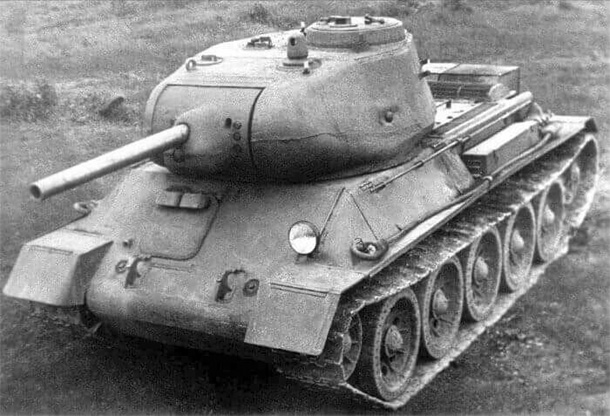
development of a T-34 successor designated T-43 began as early as 1942 (prototype shown); although the project was cancelled, its turret served as the basis for the T-34-85 turret design, source: Flickr.com with permission of the publishing user, modified
New Guns
Firing trials against the captured Tiger demonstrated that the existing Soviet F-34 guns of 76.2 mm calibre had essentially no chance of penetrating the German vehicle's frontal armour. It was abundantly clear that Soviet fighting vehicles would need a far more powerful gun. And that was the nail in the coffin of the T-43 project, since the T-43 had been designed around precisely the F-34 in 76.2 mm calibre. It is little wonder, then, that when the first prototype of this tank was completed in March 1943, it was virtually condemned from the outset. Development did not proceed further, and the T-34 thus lost its potential successor and remained "condemned" to mass production without any meaningful upgrades. The priority now became the development of a new, powerful gun capable of dealing with the German Tigers.
The requirements for the new gun were derived from the results of the firing trials against the captured Tiger. During those tests, the 85 mm anti-aircraft gun 52-K M1939 proved highly effective. It was therefore decided that the new weapon should share the same calibre and achieve comparable ballistic performance. The contract for the development of the new 85 mm weapon was issued by the Soviet artillery high command (GAU) in mid-April 1943, and the specification clearly described a weapon intended not for a tank but for a self-propelled gun. As early as May 1943, a further order was issued calling for a tank version of the same gun — but intended for heavy tanks. There was no mention whatsoever of re-arming the medium T-34. It seemed clear, once again, that the T-34 would be passed over and would miss yet another opportunity for modernisation… at least for now.
The competition to develop the new gun for the self-propelled vehicle came down primarily to two designs. The first, designated D-5S (sometimes referred to simply as D-5), was the work of chief designer Fyodor Fyodorovich Petrov at Artillery Factory No. 9 in Sverdlovsk. The second, designated S-18, came from chief designer Vasily Gavrilovich Grabin at the Moscow Central Artillery Design Bureau (TsAKB). Army trials were held in July 1943, and the D-5S emerged as the winner; it was immediately approved as the main armament of the new self-propelled gun SU-85. In a parallel competition for a derivative gun intended for heavy tanks, Grabin and Petrov again faced off — with the S-31 (Grabin) and D-5T (Petrov) respectively. Again Petrov prevailed, and his D-5T accordingly became the armament of the heavy tanks KV-85 and IS-1.
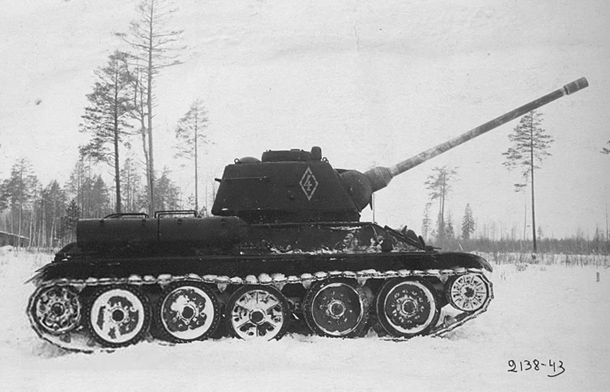
comparative trials of T-34 prototypes with 85 mm guns were held in December 1943; this T-34 with its original turret and Grabin's S-53 gun was among the participants — it is remarkable that this weapon fitted into the small turret at all, source: Flickr.com with permission of the publishing user, modified
Once again, however, wartime events intervened in a decisive way. In July 1943 came the battle of the Kursk salient. There the Soviets had the opportunity to encounter yet another new German tank — the Panther. Suddenly there were simply too many German tanks whose frontal armour the T-34 with its 76.2 mm gun could not penetrate. It was now clear beyond any doubt that the modernisation of the T-34 could no longer be deferred, and that it too would have to be re-armed with the new 85 mm gun if it was to remain effective on the battlefield.
A New Turret
Designers at the "parent" Factory No. 183 (relocated after the Kharkov evacuation to Nizhny Tagil) analysed the options for re-arming the tank and in August 1943 reached a firm conclusion: an 85 mm gun could not be fitted into the existing T-34 turret with its 142 cm turret ring, and a new turret with a 160 cm ring would be required.
In practice this meant not only a new turret, but inevitably also modifications to the tank's hull — and that did not sit well with the State Defence Committee (GKO), since Stalin's official prohibition against making changes to the T-34 that might disrupt its mass production was still formally in force. The engineers from Factory No. 183 held their ground, however, and the command eventually — presumably through gritted teeth — gave its blessing to the development of a new, larger-ring turret. This task was assigned to Factory No. 112 in Gorky, with V. Kerichev as the responsible designer.
Kerichev decided not to develop the new turret from scratch, but instead to adapt the turret from the cancelled T-43 project. Even that, however, required considerable modification. Among other changes, the designers had to add a taller collar around the turret ring, because the T-34's raised engine deck cover meant that a low turret could not rotate over it. The interior layout of the turret also had to be modified to accommodate a much larger gun — 85 mm — than the one for which it had originally been designed — 76.2 mm.
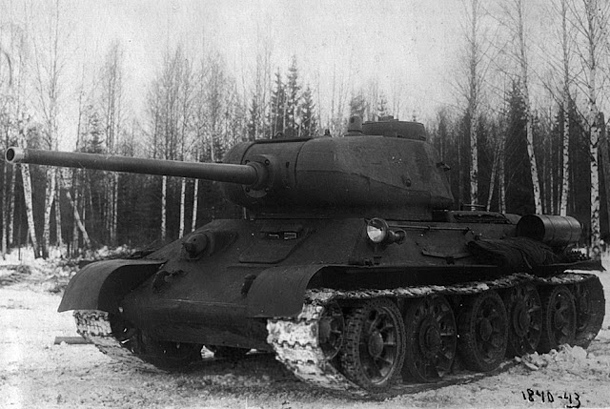
T-34 prototype with the new, larger turret (derived from the T-43 turret) and D-5T gun during comparative trials in December 1943, source: Flickr.com with permission of the publishing user, modified
But which specific gun was actually to go into the new turret? This is a point on which the literature is somewhat confused. The first choice of the Factory No. 112 designers was most likely Petrov's D-5T, which had already won (against Grabin's S-31) the competition for the armament of the new heavy tanks KV-85 and IS-1 and was therefore an already fully approved and officially adopted weapon. When it came to fitting it into the modified T-43 turret, however, it was found to come almost in contact with the turret roof, leaving so little space behind the gun for the loader to work that operation would be essentially impossible. Petrov's D-5T was simply not well suited to the chosen turret. The overall concept of the T-34 chassis with the modified T-43 turret and an 85 mm gun proved viable enough — it was just a matter of finding a different gun. So in late October 1943 a new competition was opened for an 85 mm gun, this time finally designed specifically for the T-34. This reopened the field for Petrov's rival, Vasily Grabin.
Grabin, who had already lost to Petrov twice in 85 mm gun competitions (for the SU-85 and for the heavy tanks KV-85 and IS-1), was determined to even the score — and here was an opportunity he simply could not let slip. Knowing that Soviet high command preferred to keep modifications to the T-34 to a minimum, he tried to accommodate the generals on that point. To maximise his chances of winning, Grabin proposed two weapons simultaneously. The first, designated S-50, was intended for installation in the modified T-43-derived turret being developed by Factory No. 112. The second, designated S-53, was instead designed for the existing production T-34 turret with its 142 cm ring. If his second weapon proved satisfactory, it would allow the T-34 to be re-armed without changing the turret — or therefore the hull. That was precisely what army command had been hoping for.
For the comparative trials held in December 1943, three proposals for re-arming the T-34 were prepared: (1) a T-34 with the standard turret (142 cm ring) and the S-53 gun (Grabin); (2) a T-34 with the modified T-43 turret (160 cm ring) and the S-50 gun (Grabin); (3) a T-34 with the modified T-43 turret (160 cm ring) and the LB-1 gun (designed by Factory No. 92). Concurrently, testing apparently also continued on the T-34 with the modified T-43 turret (160 cm ring) and the D-5T gun (Petrov). Stalin and the entire State Defence Committee expected the trials to run smoothly, a winner to be declared quickly, and series production of the new 85 mm-armed T-34 to begin in January 1944. Reality, unfortunately, looked far less rosy — none of the tested tanks was found fully satisfactory.
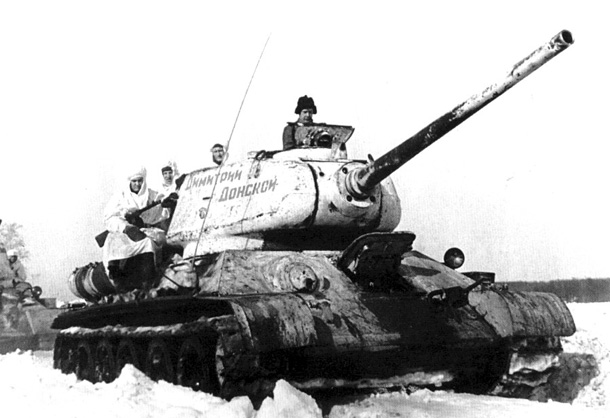
since the winning S-53 gun still needed its teething troubles resolved, the first series T-34-85s had to be temporarily armed with the D-5T gun, source: Flickr.com with permission of the publishing user, modified
Selecting the Best Weapon
As far as the guns themselves were concerned, the soldiers saw the most potential in Grabin's S-53. The gun did exhibit certain problems with its recoil mechanism, but nothing that could not be resolved. More serious was the problem of fitting it into the existing T-34 turret with its 142 cm ring. It was plainly a dead end — a futile attempt by the designer to please the generals and avoid the inevitable. The S-53 was smaller and lighter than Petrov's competing D-5T, but even so there was so little space around it inside the small turret that its crew simply could not have worked effectively. The S-53 thus emerged as the competition's winner and was officially adopted into Red Army service on 1 January 1944, but it was simultaneously decided that it had to be further improved and above all adapted for installation in the larger turret with the 160 cm ring.
This meant a delay — and Stalin was expecting T-34 production with the 85 mm gun to begin in January 1944. Since what the great Generalissimo said was law, the responsible military officials had to find a way to meet his wishes no matter what. The decision was therefore taken to make do temporarily with Petrov's D-5T gun. As we have seen, it barely fitted into the new turret, but it was an officially approved weapon (even if approved for other tanks) and nothing better was available. On 15 December 1943 it was officially decided to begin accelerated series production of the T-34 with the modified T-43 turret and the D-5T gun — a stopgap arrangement to bridge the period until the S-53 could be properly adapted.
Start of Production
Series production was entrusted to Factory No. 112 in Gorky. To clearly distinguish the new vehicle from the older version with the 76.2 mm gun, it received the designation T-34-85 (sometimes also written T-34/85). By the end of January, the first 25 examples of the new tank had rolled off the production line with the "temporary" D-5T gun. Stalin's order had been fulfilled!
Let us now return to the as-yet undeclared winner of the competition for the new "standard" gun for the T-34 — Grabin's S-53. The task of making the desired improvements and adaptations to this weapon was assigned to the design bureau of Factory No. 92, under designer A. Savin. He incorporated a number of sound design elements from the competing 85 mm guns (the D-5T and LB-1) into Grabin's S-53, and named the resulting weapon the ZiS-S-53 (ZiS standing for Zavod imeni Stalina — the Factory Named After Stalin — which was the honorary official designation of Factory No. 92). Further trials followed, and in March 1944 the weapon entered series production. From that month, the ZiS-S-53 began gradually replacing the interim D-5T on T-34-85 tanks, eventually supplanting it entirely. By that point, approximately 800 tanks had been built with the temporary D-5T gun.
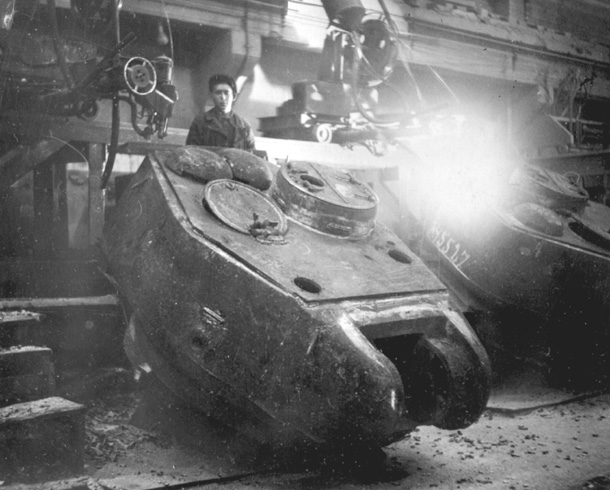
the T-34-85 received a new turret derived from the T-43 project — individual cast sections were welded together and a roof of rolled steel plate was then welded on top, source: Flickr.com with permission of the publishing user, modified
It should be noted here that some authors describe the development and production history of the 85 mm guns for the T-34 rather differently. According to Y. Pasholok or R. Michulec, for instance, the modifications to the S-53 following the December trials had two phases. During the first, the gun was simply adapted for installation in the larger turret and introduced into series production, still under the designation S-53. The upgrade and redesignation to ZiS-S-53 supposedly came much later — specifically in October 1944. According to these authors, the production T-34-85 therefore had three different guns in sequence: the interim D-5T from January 1944, the S-53 gradually introduced from March 1944, and finally the ZiS-S-53, which entered production sometime before the end of 1944.
Description of the Tank
With a degree of simplification, one can say that the T-34-85 differed from the original T-34 only in its turret. Of course, minor changes were also made to the hull (for example, enlarging the turret ring aperture and fitting new ammunition stowage boxes for the larger rounds), but the fundamental hull design remained genuinely unchanged. The same was true of all other components — the running gear, engine, tracks, gearbox, fuel and cooling systems, steering, and so on. Even so, let us briefly describe the construction of the vehicle as a whole. The running gear had five road wheels on each side, of twin construction, 830 mm in diameter with rubber tyres around the rim. Each wheel was independently suspended on a swinging arm connected to a diagonally mounted coil spring. The suspension system was based on the Christie patent, which the Soviets had already used on the older BT tanks. At the front was a smaller idler wheel and at the rear the drive sprocket, both lightened with cut-outs. The tracks were 500 mm wide.
The hull was welded from plates of rolled homogeneous armour. The lower front plate was 45 mm thick and angled at 60° from vertical. The upper front plate was likewise 45 mm, inclined at the same angle of 60° from vertical but in the opposite direction. In the right part of the front plate was the embrasure for the 7.62 mm DT hull machine gun, and to its left the driver's hatch with two vision ports in its lid. The hull side walls were 45 mm thick and angled at 40° from vertical. The hull roof plate was 20 mm thick, as was the floor of the hull. The rear of the hull was formed by upper and lower plates of equal thickness — 45 mm each. The upper plate was angled at 48°, the lower at 45°. Two exhaust pipes emerged from the upper plate, partially concealed under riveted covers, directed downward and rearward. The entire upper rear hull plate was removable to allow easy engine or transmission replacement. For minor repairs and inspections, a service hatch was provided between the exhaust pipes. The hull roof over the engine compartment behind the turret was slightly raised, with hinged covers concealing further service and ventilation openings for the engine and transmission.
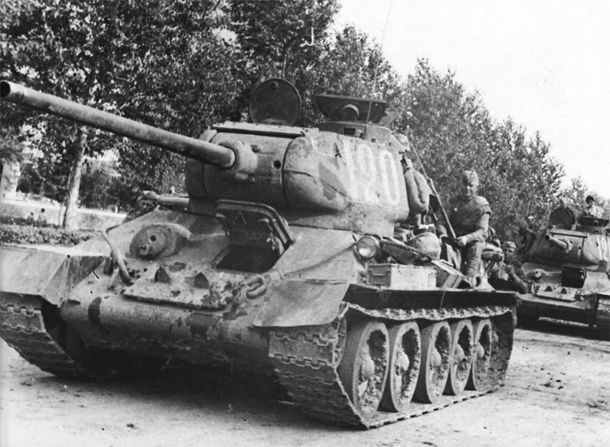
production T-34-85 with S-53 / ZiS-S-53 gun, source: Flickr.com with permission of the publishing user, modified
In the rear of the hull was the V-2 engine, developing a maximum of 500 horsepower at 1,800 rpm. It was a twelve-cylinder liquid-cooled diesel of 38.8 litres displacement. The V-2 design was reasonably sound overall. During wartime production, precision finishing was applied only to critical engine components — cylinder bores and other bearing surfaces — while everything else was manufactured to the minimum acceptable standard. The engine's most glaring Achilles' heel was its air filtration system, which was so poorly designed that it significantly reduced the engine's service life by allowing substantial quantities of dust into the cylinders. Without regular servicing, this inevitably led to seized pistons. Even the improved Tsyklon filters introduced in 1943 failed to cure this problem. The typical service life of a T-34's V-2 engine was around 180 to 200 hours even in 1944 — which corresponded to the fact that the average distance between major engine overhauls was a mere 200 km (!). Large radiators were positioned on either side of the engine, with airflow through the radiator cores maintained by a large radial fan mounted on the engine flywheel.
Behind the engine sat the gearbox, which offered four forward gears and one reverse. The gearbox deserves to be counted as another weakness of the T-34 — not so much because of manufacturing quality, but because of its fundamental design. Gear changes were prone to clashing cogs and broken teeth. The average distance between major gearbox overhauls in 1944 was around 1,200 km. Along both sides of the fighting and engine compartments were a total of eight internal fuel tanks (or six, if two pairs of directly connected tanks are counted as single units), holding 545 litres of diesel. A further 270 litres could be carried in three cylindrical external tanks mounted on the sides of the engine deck (one on the left, two on the right). Sources are unclear as to whether these external tanks were actually plumbed directly into the internal fuel system or were simply jerry cans from which fuel had to be manually transferred to the internal tanks. Either way, the internal fuel supply was sufficient for around 380 km on road or approximately 260 km cross-country. The 32-tonne vehicle had a maximum speed of around 55 km/h on road and 30 km/h off-road, though normal travelling speed was of course considerably lower. Alongside the fuel tanks, two engine oil tanks were also housed on either side of the engine compartment.
The turret, unlike the hull, was cast — or more precisely, welded together from several cast sections. The turret front, at 90 mm, represented the most heavily armoured part of the entire tank. The turret sides and rear were also a very respectable 75 mm. On the turret roof were the commander's cupola on the left side, the loader's circular entry hatch to its right, three MK-4 observation periscopes in total (one each for the commander, gunner, and loader), the radio antenna mount (absent on early tanks), and raised covers over two fans for extracting propellant fumes after firing. On early turrets, both side walls carried slit-type observation ports and pistol ports for crew small arms below them, closed by simple armoured plugs. These slit ports were later eliminated during production.
The Crew
While the original T-34 with the 76.2 mm gun had a four-man crew, the new T-34-85 gained an additional crewmember. The addition of a fifth man was made possible by the new, larger turret, which had room for three soldiers. To the uninitiated this might seem a minor change, but in practice it represented a very significant step forward in combat effectiveness. The commander of the original T-34 had also to serve as the gunner, which divided his attention between engaging a specific target and monitoring the general situation on the battlefield. While aiming the gun, he could hardly simultaneously search for the next target and issue instructions to the driver and loader. In the five-man crew, however, the commander was commander and the gunner was gunner — as had long been standard practice in German tanks. In addition to the commander and gunner, the T-34-85 crew comprised the driver, radio operator/machine gunner, and gun loader.
The driver sat in the left front of the hull and entered through his own hatch in the front hull plate. Placing the entry hatch in one of the most exposed parts of the entire tank is not the most conventional solution. The hatch lid was armoured to the same thickness as the surrounding front plate — and in fact slightly thicker, due to its raised and widened form — but simply cutting such a large opening inevitably reduces the overall strength of the front plate compared to a solid steel sheet. The more usual position for a driver's hatch, in the hull roof directly above his seat, was not feasible on the T-34. The front hull plate extended quite far rearward due to its steep angle, and above all, the fighting turret was positioned well forward. This in turn was dictated by the location of the gearbox in the hull rear — with the engine and gearbox at the back, the turret had to sit further forward.
In the driver's hatch lid were two periscopic vision ports, each externally fitted with its own closeable shutter. The driver had no other means of looking out, so if he had to close the shutters for safety he was completely blind and had to rely on guidance from the commander. The hatch opened upward, which would have been unthinkable given its thickness — and therefore weight — without some form of counterbalancing assistance. This was provided by a large coil-spring piston suspended under the hull roof to the left behind the driver's head and connected to the hatch. The spring's force balanced the hatch's weight, allowing the driver to open and close it relatively easily and smoothly. The closed hatch was locked by two rotary latches at its lower edge. The open hatch was secured by a screw on its lifting piston. Should the securing mechanism fail and the hatch fall while the driver was climbing through the opening, the result would most likely be fatal — or at best, broken bones.
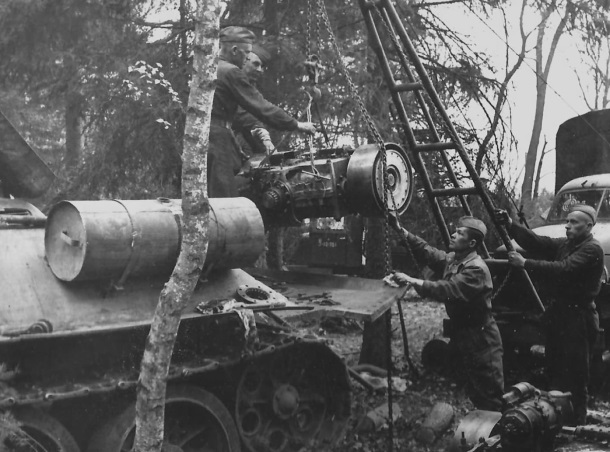
the gearbox was one of the tank's structural weaknesses and its service life was fairly limited — on the other hand, its location in the very rear of the hull meant it could be replaced relatively easily even in field conditions, source: Flickr.com with permission of the publishing user, modified
The driver operated the tank using the classic trio of clutch, brake, and accelerator pedals along with two steering levers. Pushing a lever forward engaged the relevant track drive; moving it further back disengaged the drive and left the track running free; and pulling it all the way back applied the track brake. The gear lever was to the driver's right, connected to the rear-mounted gearbox via a long system of rods — their considerable length doing nothing to make gear changes easy or precise. The lever was fitted with a hand lock to prevent unwanted jumping out of gear, whether spontaneous or caused by an accidental knock from the radio operator. To change gear, the driver had to first press this safety catch on the lever handle and only then shift. Changing gears in the T-34 was certainly no picnic — it required so much physical effort that drivers often needed both hands, and when even that was not enough, a degree of brute force was called for. My grandfather once told me that when he first sat in a T-34 driver's seat during his military service, he noticed a hammer lying on the floor in front of him. When he asked what it was for, he got the sardonic reply: "Just wait till you try to change gear." My grandfather — who had previously driven a British Cromwell and a German Hetzer — was rather taken aback by this. :-)
The primary means of starting the engine was an electric starter powered by four 12V batteries housed in the engine compartment. If this method was not available — due to a starter failure or flat batteries — the backup was starting by compressed air. The air was stored in two cylinders mounted in the very front of the hull ahead of the driver and radio operator. There was no compressor on board to refill the cylinders once emptied, so they simply had to be swapped for new ones. Directly in front of the driver, just below the entry hatch, was a small instrument panel carrying a speedometer, rev counter, and coolant temperature gauge.
To the driver's right sat the radio operator and machine gunner — one man performing both roles. Directly ahead of him was the mount for the 7.62 mm Degtyarev DT-29 machine gun. Unlike the standard infantry version of the Degtyarev, the tank variant had a pistol grip, a shorter telescoping stock, and modified drum magazines of smaller diameter holding 60 rounds each; approximately 22 magazines were carried on board. The gun mount allowed vertical movement of -6° to +20° and horizontal movement of 15° to either side. Externally, the mount was protected by a moving armoured shield. The hull machine gun had no dedicated sight — just a simple small aperture directly above the barrel through which the gunner aimed using ordinary open iron sights.
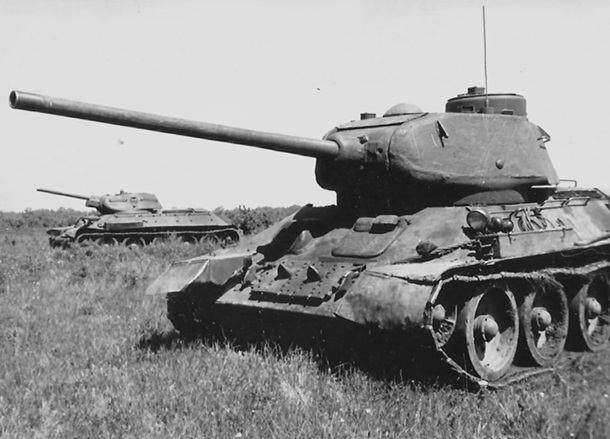
T-34-85 alongside its older brother with the 76.2 mm gun, source: Flickr.com with permission of the publishing user, modified
The machine gunner's station was immediately adjacent to the driver's, and the gear lever was so close to the gunner's left leg that it genuinely risked getting in the driver's way during gear changes. In the floor ahead of the machine gunner was an oval emergency escape hatch — though it was so small that it is difficult to imagine how a soldier dressed in a padded winter jacket would manage to squeeze through it. The machine gunner was also responsible for operating the radio (at least in early T-34-85s). The set was housed in the right front corner of the hull, typically a type R-9 with a range of up to 24 km. The crew also had an intercom for internal communication, with headphones built into the protective helmets the tankers wore.
The remaining three crew members had their positions in the fighting turret. The gunner sat to the left of the gun on a folding seat and traversed the turret using a control handle to his left. On early T-34-85s, turret traverse was manual only, and rotating the turret a full 360° required the gunner to turn the handwheel 390 times. To his right was the elevation handwheel, which also carried the firing trigger. Sometime in the second half of 1944, an electric turret drive was added. With it engaged, a full rotation took approximately 14 seconds. The controls for both traverse mechanisms were elegantly combined into a single handwheel — the faster electric drive was used for coarse movements and the manual for precise laying onto the target. For general observation, the gunner had an MK-4 periscope in the turret roof ahead of the commander's cupola.
Somewhat higher, but essentially right behind the gunner's back, sat the tank commander. With his head in the commander's cupola he had an all-round view, effectively in two ways: he could use the five fixed vision blocks set around the cupola's circumference, or he could look through an MK-4 periscope installed in the rotating cupola roof, which allowed him to sweep the battlefield freely (limited only by the flexibility of his neck). The commander's cupola originally had a two-piece hatch split down the middle, with an MK-4 observation periscope in the forward half. Later the roof was redesigned as a smaller fixed front section and a larger opening rear section with a single-piece lid. In both cases the cupola served as the entry hatch for both the commander and the gunner. The last man in the turret — the loader — had his station to the right of the gun, his own single-piece hatch in the turret roof, and his own MK-4 observation periscope.
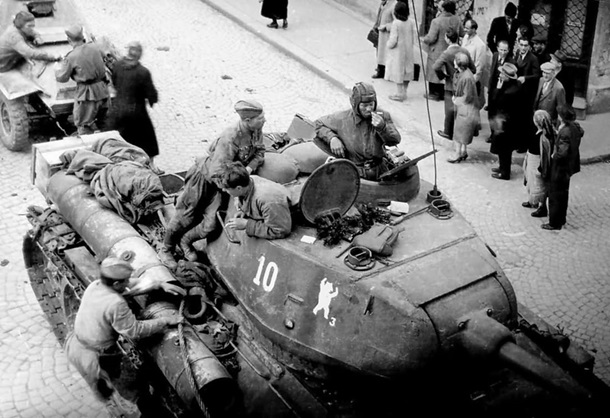
this photograph clearly shows the original type of commander's cupola with the two-piece hatch, source: Flickr.com with permission of the publishing user, modified
As already noted, the main gun of the T-34-85 changed at least once — and possibly twice — during production. What is beyond doubt is that the first gun installed was the D-5T. This was paired with a TSh-15 telescopic sight with a 16° field of view and 4× magnification, and the gunner also had a PTK-5 panoramic periscope in the turret roof ahead of the commander's cupola. The replacement of the D-5T with the S-53 and subsequently the ZiS-S-53 also meant replacing the TSh-15 with the TSh-16 (both sights had the same field of view and magnification). The PTK-5 was at that point replaced by the simpler MK-4 periscope. Changing the gun also required adjustments to the seating positions of the gunner and commander, who had to move rearward — by perhaps as much as 40 cm. The D-5T had a barrel of 51.6 calibres in length and weighed approximately 1,500 kg. The ZiS-S-53 had a barrel of 54.6 calibres but weighed "only" around 1,150 kg. T-34-85s armed with the D-5T versus the S-53 or ZiS-S-53 can therefore be distinguished in photographs by essentially three clear differences: the different form of the gun mantlet, the absence of the PTK-5 panoramic periscope, and the position of the commander's cupola.
Early T-34-85 tanks carried 55 rounds for the gun; later this increased to a full 60 rounds (sources do not specify whether this change coincided with the switch from the D-5T to the ZiS-S-53). The ready supply consisted of four rounds stowed on the right turret wall directly beside the loader. A further 12 rounds were held in racks in the rear of the fighting turret, and the remaining 44 lay in wooden or metal boxes on the hull floor below the turret. The T-34-85 turret had no basket and therefore no floor that rotated with it — not good news for the loader at all. Once he had used up the 16 rounds stowed in the turret, he had to start drawing rounds from the boxes in the hull. In the extremely confined space he had to somehow straddle a box, bend deep down, open it, extract the correct round, and before straightening up make sure the turret had not rotated to a new position in the meantime — because if it had, he risked at best a nasty blow to the head from the gun.
At least three types of ammunition were available for the T-34-85's gun. The most commonly used was the O-365 high-explosive fragmentation shell, intended for engaging soft targets. It weighed 9.6 kg, of which 775 grams was explosive filling. In indirect fire mode, the tank could reach targets at over 13 km with this round. The standard anti-tank round was the BR-365 armour-piercing shell, weighing 9.36 kg and carrying a 50-gram TNT bursting charge. It left the barrel at 792 m/s and could penetrate 102 mm of armour at 1,000 metres. Later in 1944, an additional anti-tank round was introduced — the sub-calibre BR-365P, with a tungsten carbide core weighing just 4.95 kg. At the muzzle it reached 1,200 m/s and could penetrate 138 mm of homogeneous armour at 500 metres. The majority of rounds carried on board were typically high-explosive fragmentation shells. The most advanced BR-365P sub-calibre rounds were usually held in very limited numbers, saved by crews for the most heavily armoured German vehicles. In the post-war years further ammunition types were introduced, including the BR-365K shaped-charge round.
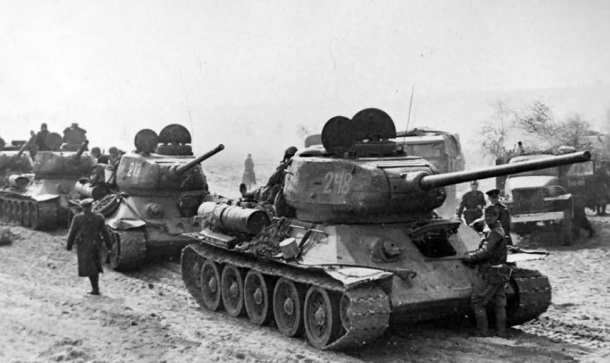
these tanks already have the later type of commander's cupola with the single-piece hatch and fixed front section, source: Flickr.com with permission of the publishing user, modified
Progressive Modifications
During the production run of the T-34-85, a number of modifications — mostly minor ones — were of course introduced. The changes most relevant to the Second World War period are of primary interest here. The first major modification was the already-described replacement of the D-5T gun with the S-53 and then the ZiS-S-53, and the associated adjustments to the turret roof. As noted above, an electric turret traverse drive was added sometime in the second half of 1944, which required a small change to the shape of the armour on the left turret side. Early T-34-85s had a two-piece commander's cupola hatch, split evenly down the middle, with an MK-4 periscope in the forward half. Around the turn of 1944 and 1945 the tank received a new, slightly larger-diameter cupola, with the roof divided into a smaller fixed front section and a larger rear section in roughly a 1:2 ratio. The front section carried the MK-4 periscope and could not be opened; only the larger rear section remained openable. While this might appear at first glance to reduce the size of the entry opening, this was compensated by the increase in the overall diameter of the cupola. The elimination of the original slit-type vision ports in both turret side walls has already been mentioned.
Sometime around the turn of spring and summer 1944, T-34-85s received new front mudguard end-pieces. The original rounded ends were replaced by simpler square-edged ones (a fairly trivial detail in any case, since tanks frequently lost these portions of mudguard). The road wheels also appeared in various configurations — solid or with lightening holes, with full or perforated rubber rims. Towards the end of 1944 tanks began to be fitted with the TDP smoke-generating system. The system was designed to lay a smoke screen that allowed the tank to conceal itself from enemy gunners and disappear to safety under cover of smoke. It consisted of two canisters of smoke compound designated MDSh, which were clamped to the rear hull wall and could be "fired" remotely from inside the vehicle.
Unlike the older T-34s with the 76.2 mm gun, T-34-85s were virtually without exception fitted with a radio, typically the 9-R type with a range of up to 24 km. In the first series tanks, the radio was still located in the hull and operated by the machine gunner/radio operator sitting next to the driver. Before long, however, the set was moved into the fighting turret and its operation was taken over by the tank commander. This also meant relocating the antenna from the right hull side to the turret roof, immediately ahead of the commander's cupola.
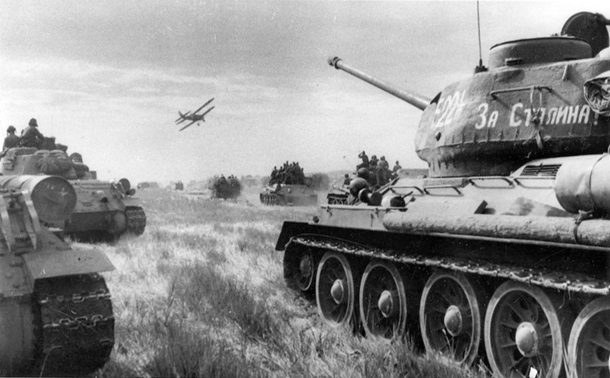
T-34-85 tanks in the attack, source: Flickr.com with permission of the publishing user, modified
Series Production
Series production of the T-34-85 was carried out at three factories: Factory No. 183 (Nizhny Tagil), Factory No. 112 (Gorky), and Factory No. 174 (Omsk). The turrets produced at each factory differed from one another in overall shape, in the number and form of the individual cast sections that were welded together, and in other details such as the crane lifting lugs. By far the largest supplier was the last of the three — Lenin's Factory No. 174 in Omsk. With the end of the Second World War, T-34 production dropped sharply, but it certainly did not stop. In the Soviet Union itself it continued until 1950; in Czechoslovakia and Poland it ran for another six years beyond that. And how many T-34-85s were built in total? The sources cannot quite agree. In 1944 around ten and a half thousand were probably built, and from January to May 1945 roughly another six thousand — totalling something like sixteen and a half thousand by the end of the Second World War. From May to December 1945 approximately another six and a half thousand were produced, and in the post-war years perhaps a further twenty thousand or so (not only in the USSR, but also under licence in Czechoslovakia and Poland). The total production of T-34-85s was therefore most likely somewhere in the region of 42,500 vehicles — a figure that ultimately exceeded even the output of its older sibling with the 76.2 mm gun.
From the standpoint of combat value, the arrival of the T-34 with the 85 mm gun represented an enormous leap forward. The importance of this tank to the Red Army — already immense — grew still further with this change. The figures speak for themselves: in 1942, the T-34 (with the 76.2 mm gun) accounted for around 51% of Soviet tank production. By the turn of 1943 and 1944, the T-34-85 already represented 79% of the USSR's total tank output.
Combat Deployment
The first T-34-85s began reaching combat units in March 1944. Initially they were deployed side by side with the older T-34/76, but as production numbers grew they increasingly replaced their predecessor. Among the first units to receive the new tanks was the 38th Independent Tank Regiment, which used them immediately in what became known as the Uman–Botoşani Offensive in south-western Ukraine. The transition to the new type was not without its difficulties. First of all, the T-34-85 required one more crew member than its predecessor, so it was not simply a matter of putting existing, well-drilled crews into the new vehicle — a fifth man had to be found first, and quickly. In practice, early T-34-85s sometimes went into action with only four men on board, meaning without the radio operator/machine gunner. The other crew members (with the exception of the driver) then had to be trained on the new vehicle. The driver was essentially the only one for whom virtually nothing changed. Time was short — the 38th Independent Tank Regiment, for example, gave its men just two hours to familiarise themselves with the new tank before sending them straight into action.
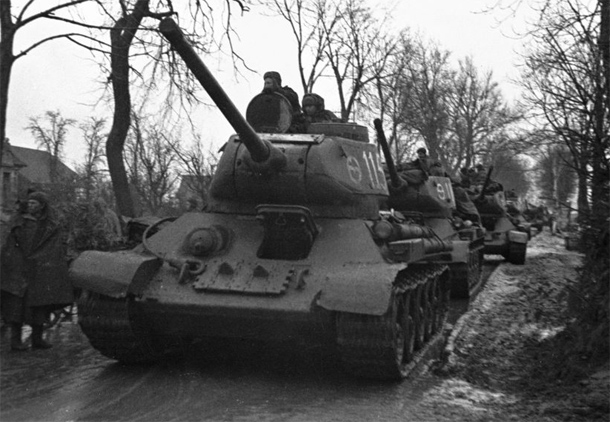
T-34-85 tanks in the streets of a captured German city, source: Flickr.com with permission of the publishing user, modified
Overall Assessment
At the outset we said that history has demonstrated the T-34 to be a very successful design. That is certainly true in general terms, though a closer look reveals plenty of "buts." The success of the T-34 design was definitely not rooted in perfectly refined engineering detail — if anything, it was quite the opposite. Judged by contemporary European or American standards, the technical execution and build quality of the T-34 were very poor. This is the consistent conclusion of virtually all "Western" assessments of the tank, whether conducted on examples obtained by purchase, gift, or battlefield capture. We have already mentioned the ineffective engine air filters and the poorly designed gearbox. Also worth noting is the inadequate watertightness of the hull. According to both British and American evaluation reports, water penetrated the hull through low-quality welds both when crossing watercourses and in rain. Combined with little or no protection for stored ammunition and radio equipment against moisture, this was a fairly serious problem — though the Russians apparently did not see it in quite such a dark light.
The surface finish of the cast turret armour was very rough and the quality of the observation optics was also rated as poor. A further unfortunate shortcoming was the fact that the alloying additions — such as nickel — commonly used in Western countries when casting armour were not used in the T-34's turret armour in the usual quantities. The result was an armour that was very hard and brittle, producing large amounts of spalling when penetrated, which multiplied the destructive effect inside a hit turret. A whole chapter in itself could be written about ergonomics — a concept that the Russian school of tank design seems to have remained largely unacquainted with to this day. Driving the tank was rated as extremely strenuous and exhausting. Interior space in the fighting turret was very cramped. The engine, connected to the hull by rigid metal mounts without rubber anti-vibration bushings, generated intense noise and vibration — which in turn led to crew fatigue and reduced combat effectiveness.
The genuine success of the T-34-85 design, however, lay elsewhere. This tank was a near-perfect match for the needs of the Russian army and the capabilities of Russian industry during the Second World War. It was a vehicle that the factories of the era could produce without great difficulty, even with machinery that was, let us say, not exactly state of the art. Relatively low production costs allowed truly mass output, and the tank's service life was suited to its intended purpose — not overengineered for longevity. Crew comfort received little consideration, because the crew, too, had a defined purpose and a defined service life. Within the constraints of what the Russians were capable of producing and what they needed, the T-34 was a near-perfectly balanced design.
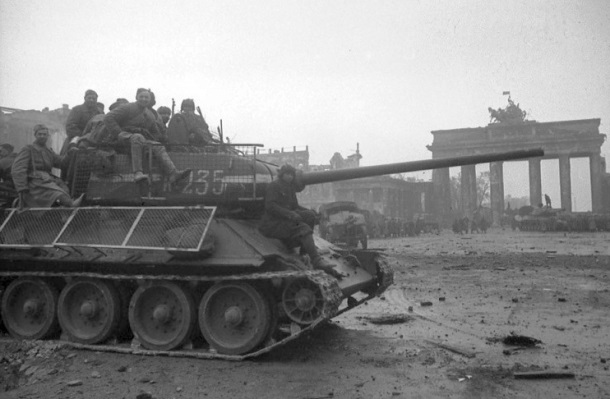
and here, in the heart of Berlin itself — the wire mesh screens are protection against German Panzerfausts, source: Flickr.com with permission of the publishing user, modified
A cheap and simple tank that makes no pretence at high-tech equipment or crew comfort — this is something countless armies around the world continued to search for long after the end of the Second World War, and some still do today. As a result, the T-34-85 was sold to at least 30 different countries and remains in service in several — mainly African — nations to this day. The largest combat deployment of T-34-85s since the end of World War II came during the Korean War, particularly in its opening phase up to around October 1950. North Korean T-34-85s held up well against American M24 Chaffee light tanks and bazookas, but when M26 Pershing and M46 Patton tanks began appearing on the battlefield, losses among the ageing T-34-85s climbed rapidly until these machines were gradually withdrawn from frontline use entirely. T-34-85s also fought in the Arab–Israeli wars, in various conflicts across Africa, and in the civil war in the disintegrating Yugoslavia. According to Wikipedia, as of 2018 the tank was still in active service or held in army reserve stocks in Congo, North Korea, Guinea, Namibia, Laos, Vietnam, Yemen, Cuba, and likely elsewhere besides.

ARTICLE
CONTENTS:
Reproducing text from the Tankist website without the written consent of the operator is prohibited.