8,8 cm FLAKPANTHER
a Flakpanzer project based on the Panther tank chassis
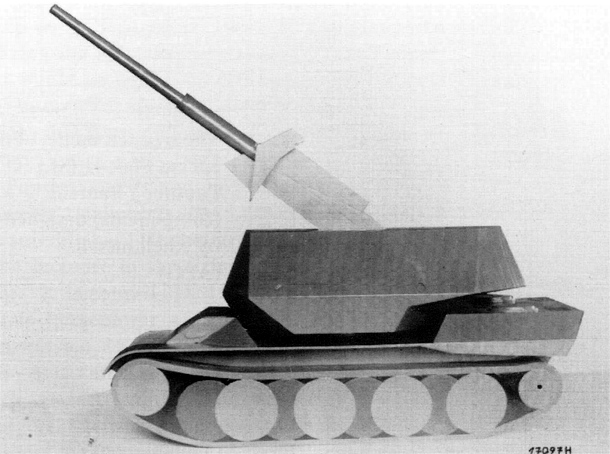
this scale wooden model by Rheinmetall shows the approximate appearance of the intended Flakpanzer, armed with the Flak 41 gun and built on Panther tank components, source: Flickr.com with permission of the publishing user, edited
Origins of the Project
The development of the vehicle described in the following pages was, in a certain sense, bound up with the existence of another machine known as the 8.8 cm L/71 Versuchsflakwagen. That vehicle, on which Krupp had been working since June 1942, was to be based on an entirely new chassis designated Panzerselbstfahrlafette IVc. It was precisely the fact that this was a completely new chassis design that the Army saw as a considerable risk. The ordnance office was concerned that a new vehicle would require a great deal of time and effort before it was technically mature, and they were also unhappy that introducing yet another new chassis type would further fragment production.
The ordnance office therefore asked Krupp to consider a version of the vehicle based on the components of existing or soon-to-be-produced tanks — specifically the Panther, Tiger, Leopard, or Luchs, which were regarded as the most promising types and something of a future standard.
The First Design
In response, Krupp prepared a proposal which was presented on 2 September 1942 to the ordnance office representative, Ing. Klein. The new 88 mm gun carrier was to use the running gear from the Panther tank, with solid road wheels 860 mm in diameter and tracks 660 mm wide. The Maybach HL 157 engine and Maybach OG 55 11 77 gearbox were to be borrowed from the planned light tank Leopard. The vehicle's hull was to be 6.7 metres long and 3.27 metres wide. With the gun in the 12 o'clock position — pointing straight ahead — the barrel overhang would be 3.2 metres. Armour thickness was to range from 30 mm on the front hull faces to 16 mm on the sides and presumably the rear as well. The vehicle's weight was calculated at approximately 31 tonnes. The armament was to be an 88 mm anti-aircraft gun with a barrel length of 71 calibres, which Krupp was developing for the German Luftwaffe under the designation Gerät 42. Krupp's proposal also specified a number of additional parameters for the vehicle: ground clearance of 0.54 metres, track contact length of 3.92 metres, gun firing height of 2.45 metres, fuel capacity of 550 litres, road range of 300 to 350 km, and cross-country range of 200 to 250 km. The 88 mm ammunition load was even specified — 36 rounds. The expected maximum speed, however, was not included in the data provided.
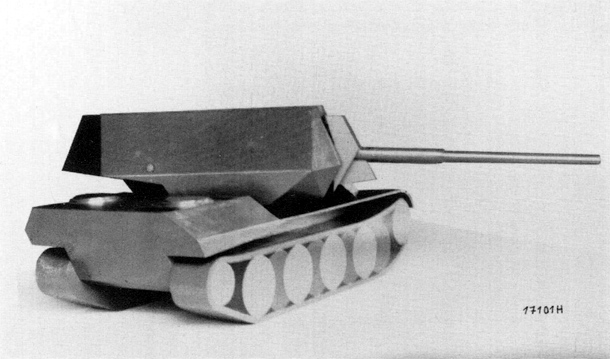
the Flakpanzer was not intended to use the complete Panther chassis, but only certain components such as the engine, road wheels, tracks, and similar items, source: Flickr.com with permission of the publishing user, edited
Nothing but Bad News
Krupp's proposal did not have a very long lifespan. The months that followed brought a whole series of events and decisions that effectively tore it apart. In January 1943, the light tank Leopard project was officially cancelled. The ordnance office had already informed Krupp of this in November 1942 — two months in advance — and ordered that the new vehicle design be revised so as not to rely on any Leopard components. Krupp therefore had to prepare a new variant of the design, now based almost entirely on components from the Panther tank. This revised design was designated gepanzerte Selbstfahrlafette für Gerät 42, also known as Versuchsflakwagen II (abbreviated VFW II). Virtually all internal mechanical components were now to be drawn from the Panther, most notably the Maybach HL230 petrol engine producing 700 horsepower and the Zahnradfabrik AK 7-200 gearbox with seven forward gears and one reverse.
Another unwelcome development for Krupp arrived in early 1943, when the Luftwaffe decided to discontinue development of the Gerät 42 gun in favour of a more capable competing weapon from Rheinmetall, designated the Flak 41. Krupp once again had to revise its Flakpanzer design on the Panther chassis, this time to accommodate the Flak 41. The vehicle's designation was changed accordingly to gepanzerte Selbstfahrlafette für Flak 41 (abbreviated gep. Sfl. für Flak 41). Most likely as a direct consequence of this change of armament, Rheinmetall — as the supplier of the Flak 41 — was also brought into the project. Two competing firms were now working in parallel on the new Flakpanzer: Krupp under the designation gep. Sfl. für Flak 41, and Rheinmetall under the designation 8,8 cm Flak 41 (Sf.) Panther I Bauteile.
A third piece of unwelcome news arrived from the ordnance office in October 1943: the designers were to abandon the use of Panther components and rework their designs to use components from its planned successor, designated Panther II. Krupp received instructions to return the Panther chassis that had previously been provided to them for development work. The two manufacturers had barely had time to come to terms with this news when the decision that would put an end to the entire run of bad tidings landed on their desks. In January 1944, Armaments Minister Albert Speer ordered the cancellation of the entire project.
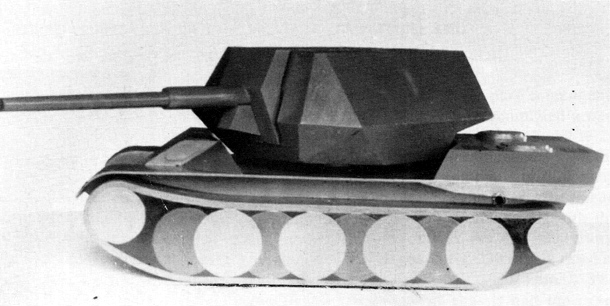
the model shows clearly that the hull was to be lowered in its central section to make room for the enormous rotating turret, source: Flickr.com with permission of the publishing user, edited
Conclusion
The reason for cancelling the project was, in hindsight, fairly straightforward. The Flak 41 had an enormous effective ceiling — 10.7 km effective range, 15 km maximum — making it ideal for destroying high-altitude enemy bombers. For that role, the gun performed perfectly well in a static emplacement, without any need for frequent changes of position. It therefore made little sense to mount a gun with such an extreme range on a tracked chassis and build a self-propelled version of it. Self-propelled anti-aircraft tanks were intended for an entirely different kind of combat — accompanying and protecting other fighting vehicles against close-range attacks by enemy fighters and ground-attack aircraft. For that purpose, a far more modest range was perfectly sufficient, while a higher rate of fire was far more valuable (engaging a relatively close but very fast-moving target).
What such a Flakpanzer on the Panther chassis with an 88 mm gun would have looked like is illustrated very nicely by the surviving photographs of the scale wooden model prepared by Rheinmetall. The running gear — drive sprockets, idler wheels, road wheels including their suspension and shock absorption system, as well as the tracks and internal final drives — would most likely have been carried over without modification. The rear section of the hull housing the engine compartment also appears unchanged, whereas the front section was to differ from the standard Panther in several respects. The glacis above the track mudguards is narrower than on the regular tank, and thinner armour plate would certainly have been used here. The hull roof in the central section was lowered to the level of the track mudguards, creating a base for the enormous rotating turret. The turret appears to have been fully enclosed, save for a large opening in the roof that allowed the gun to elevate up to 90°. The rear section of the fighting compartment was so long that it extended well over the engine deck, meaning that access to the powerplant would presumably only have been possible with the turret rotated to the side (3 or 9 o'clock position). While Krupp's original design, according to the documentation, envisaged folding side panels that could be swung outward, nothing of the sort is visible on the Rheinmetall model. The crew inside the turret would most likely have entered and exited through a door in the rear wall, since climbing in over the roof would have been quite impractical.

ARTICLE
CONTENTS:
Reproducing text from the Panzernet website without the written consent of the operator is prohibited.