SCHULFAHRZEUG MIT MG ZWILLINGSSOCKEL 36
an improvised Flakpanzer with machine gun armament
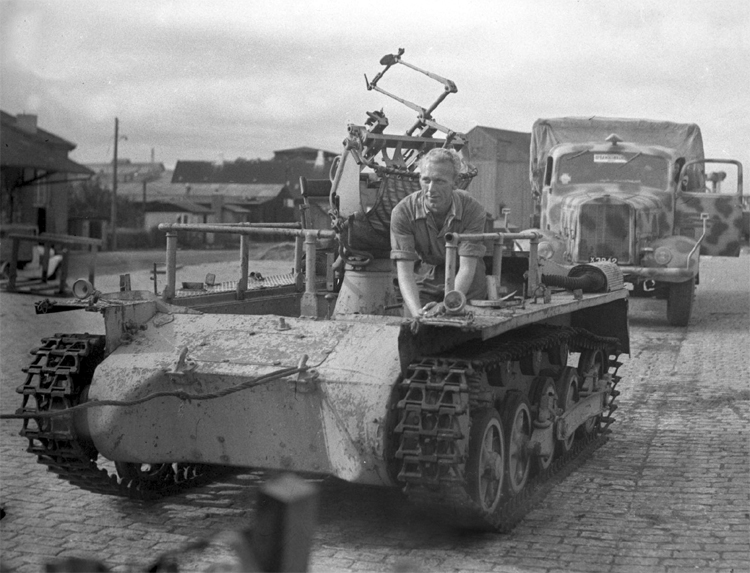
a Panzer I training chassis (Schulfahrzeug) fitted with a twin machine gun mount (MG Zwillingssockel 36), most likely belonging to the Gestapo regional headquarters in the Danish city of Aarhus, source: Flickr.com with permission of the publishing user, edited
Infanteriefahrzeug 5
Even before the First World War, the German infantry used various simple wheeled carts called Infanteriefahrzeuge (If.) to transport heavy weapons such as the MG 08 machine gun, towed either by horses or by the soldiers themselves. When the German army introduced the new universal machine gun MG 34 into service in 1934, it also procured a new type of transport cart for it, designated the Infanteriefahrzeug 5, or alternatively the Maschinengewehrwagen 36. Unlike earlier cart types, however, the Infanteriefahrzeug 5 was not a mere cargo trailer pulled by horses. It incorporated a rotating mount for a pair of MG 34 machine guns, allowing to open fire directly from the cart (photo HERE).
Zwillingssockel 36
This mount received the designation Zwillingssockel 36, though it is also frequently referred to as the Zwillingslafette 36. It consisted of a rotating pedestal to which the gunner's seat was attached, along with a cradle holding two side-by-side machine guns. Empty cartridge cases fell into the cradle beneath the guns and from there tumbled down into the hollow pedestal column, keeping them off the floor of the vehicle and out of the gunner's way. When installed in the mount, the wooden stocks were removed from the machine guns, as they served no purpose there and merely wasted space. While the mount could also be used against ground targets, it was primarily intended for engaging aerial threats, and for this purpose it was equipped with an anti-aircraft ring sight (Kreiskorn Fliegervisier). The Maschinengewehrwagen 36 was therefore no longer merely a cargo trailer but a fighting vehicle capable of providing anti-aircraft cover for a column on the move.
The Zwillingssockel 36 proved such a simple and effective solution that it was very soon also being fitted to various motor vehicles — cross-country cars and light trucks. The Germans introduced a collective designation for such vehicles: Truppenluftschutzwagen, roughly meaning a unit air-defence vehicle (photo HERE). Later, the mount's brackets were even adapted to accept the newer MG 42 machine gun.
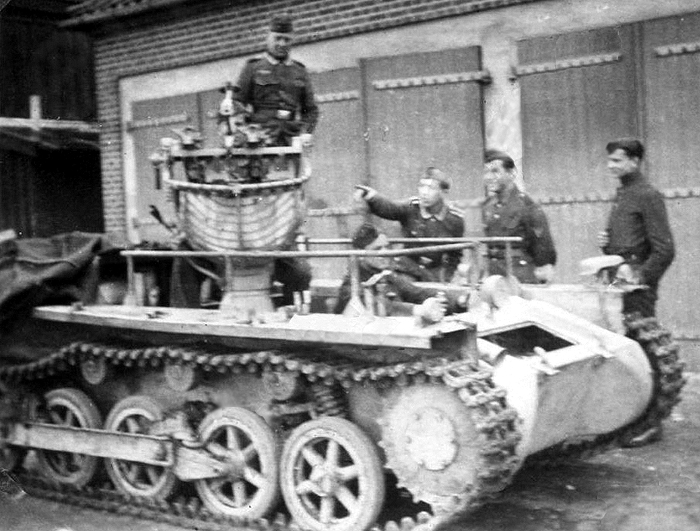
Schulfahrzeug mit MG Zwillingssockel 36 in a barracks yard; no machine guns are fitted in the mount, source: Flickr.com with permission of the publishing user, edited
From fitting the Zwillingssockel 36 to wheeled vehicles it was really only a small step to mounting it on a tracked chassis, which would give the twin machine guns a far greater cross-country capability. And one such suitable tracked chassis was already readily available: the training hulls derived from the light tank Panzer I. These were hulls from the first production series of the Panzer I that the army had taken delivery of in 1934 without armoured superstructures, turrets, or armament. The original plan had been to complete them later as fully equipped combat tanks, but in 1935 the army changed its mind and kept the bare hulls for driver training, where they were known as Schulfahrzeuge. It was precisely because these training hulls had never been fitted with an armoured superstructure that mounting the Zwillingssockel 36 in their open cargo bed was entirely straightforward.
Since this was not an official conversion, the vehicle was never given an official designation. In the literature it is most commonly referred to by the general description Schulfahrzeug mit MG Zwillingssockel 36. No source records how many training hulls were converted in this way. The surviving photographs appear to show at least two distinct examples of the vehicle, judging by differences in the railing around the open cargo bed.
Vehicle Description
As already described, the vehicle was based on the chassis of the light tank Panzer I in a configuration corresponding to the Ausf. A variant. This means that on each side it had four spoked road wheels of 530 mm diameter, a rear idler wheel of 630 mm diameter, a front drive sprocket, and three smaller return rollers supporting the upper run of the track. The first road wheel, which was subjected to the greatest stress during driving, was independently sprung by a coil spring. The remaining three road wheels and the rear idler were sprung in pairs on shared leaf springs.
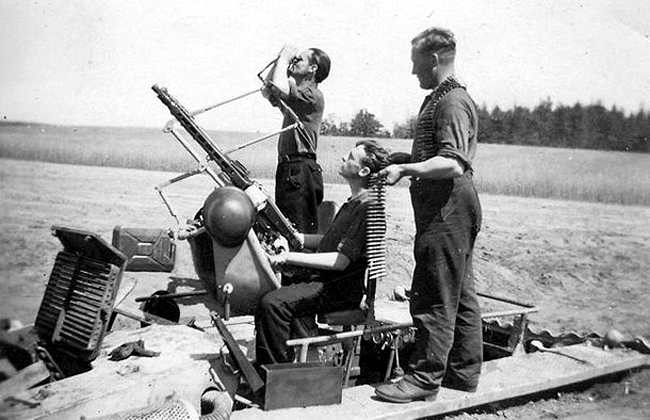
Schulfahrzeug mit MG Zwillingssockel 36 "in action", source: Flickr.com with permission of the publishing user, edited
The vehicle was powered by the four-cylinder petrol engine Krupp M305 of 3.45 litres displacement, producing 60 horsepower at 2,500 rpm. The engine was mounted at the rear of the hull and connected via a driveshaft to the five-speed Zahnradfabrik F.G.35 gearbox positioned at the front of the hull. The driver's seat was in the left front of the open cargo bed. The machine gun mount was bolted to the floor to the right and behind the driver.
The vehicle shown in the photographs has MG 42 machine guns of 7.92 mm calibre installed in the mount, with 50-round drum magazines. As the photographs make clear, the weapon's crew had no protection whatsoever. The concept behind this fighting vehicle, however, was that the vehicle itself was not the primary target of an enemy attack — rather, it existed to provide covering fire for others. A pair of MG 42s offered an impressive theoretical rate of fire of 2 × 1,200 rounds per minute, but as the war progressed the effectiveness of machine guns in the air-defence role declined sharply as the survivability of enemy ground-attack aircraft increased.
One Panzer I training hull fitted with the Zwillingssockel 36 machine gun mount was found after the war in the Danish city of Aarhus. It most likely belonged to the local Gestapo regional headquarters, which had used it as an improvised security vehicle.

ARTICLE
CONTENTS:
Reproducing text from the Panzernet website without the written consent of the operator is prohibited.