STURER EMIL
the lumbering crusher of concrete and tanks
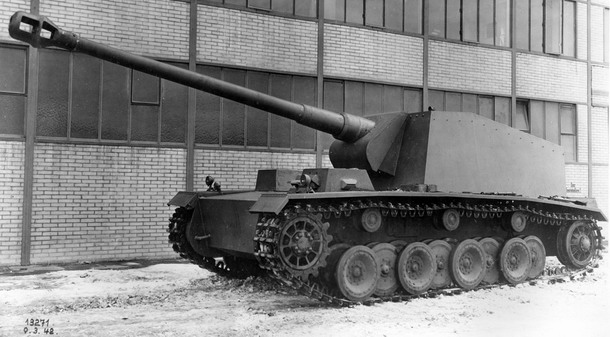
one of the two prototypes of the 12.8 cm Selbstfahrlafette L/61 Pz.Sfl. V (also known as the Sturer Emil) in a factory yard; source: Flickr.com with permission of the publishing user, edited
In Search of a Fortification Destroyer
By 1938, Adolf Hitler — and certainly his generals — had a clear picture: Germany would soon unleash a new aggressive war. Whether it would begin in a year or two, whether the first target would be Czechoslovakia or Poland, one thing was beyond doubt: if the war unfolded according to German plans, France would be next. An attack on France, however, meant dealing with one significant element of its defensive strategy — the system of fortifications known as the Maginot Line. The Germans had no intention of being drawn into a protracted siege. They planned to wage their war differently — in a new, modern way... a lightning war! And for this style of warfare they needed a weapon capable of approaching an enemy fortification very quickly (and preferably undetected), destroying it with accurate fire from as great a distance as possible, and then moving on. The vehicle was to be armoured, providing its crew with at least some degree of protection, and its gun was ideally to have long range and great destructive power.
The need for such a fighting vehicle seemed entirely clear-cut at the time. There was no reason to wait, so the Germans launched the development of several vehicles for this purpose simultaneously. The first was a self-propelled version of the 88 mm Flak 18 gun mounted on the half-track tractor Sd.Kfz. 8. Next in line was a 105 mm self-propelled gun on a fully tracked chassis, later known by the nickname Dicker Max, and then there was a third project led by Krupp, which was to result in an 88 mm gun on a newly developed chassis designated Pz.Sfl. IVc. Both of these weapons were highly capable, but the Germans soon began to worry that even they might not be sufficient against stronger concrete bunkers. In 1939, they therefore began considering the development of yet another vehicle for the same purpose, this time armed with an even more powerful gun. In working parlance it was referred to as the schwere Betonknacker — something along the lines of "heavy concrete crusher".
The 12.8 cm Flak 40 Gun
The military's attention turned to the new 128 mm anti-aircraft gun, the Flak 40. This was a Rheinmetall-Borsig weapon that had not yet entered series production, but had already completed successful prototype testing and promised the required performance. And no wonder — it could fire a shell weighing more than 26 kg to an altitude of up to 14,800 metres! This power, however, came at a price in terms of weight. With its standard Bettung 40 mounting the weapon weighed an astonishing 17 tonnes, and with a static pedestal anchored into concrete it came in at between 12 and 13 tonnes. Where, then, to find a chassis strong enough to carry such a heavy weapon? Nothing suitable was in series production, so some experimentation was necessary.
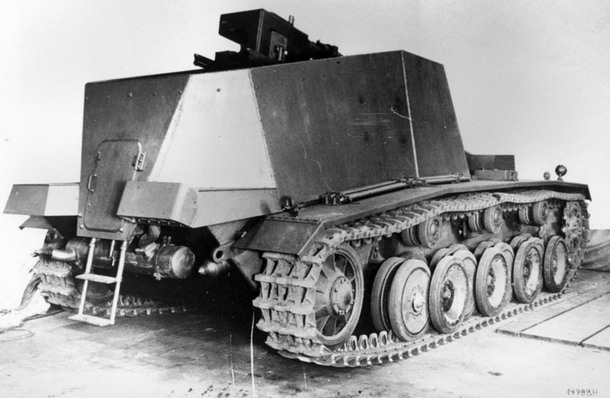
rear view of the "concrete crusher" Sturer Emil with the gun at maximum negative elevation — in this position the weapon allowed access to the engine beneath it; source: Flickr.com with permission of the publishing user, edited
The VK 30.01 (H) Chassis
When Waffenamt representatives considered the options that were at least theoretically available, their attention was drawn to a 30-tonne class tank project that Henschel was working on under the designation VK 30.01 (H). The chassis for this tank existed only as a prototype, but it appeared that it could meet the technical requirements to a considerable degree. The Waffenamt therefore asked both firms to cooperate. Rheinmetall-Borsig was to modify its Flak 40 gun so that it could be installed on the tracked chassis of the VK 30.01 (H), while Henschel was to modify its chassis to carry the resulting weapon.
Vehicle Description
The VK 30.01 (H) chassis had to be substantially modified for its new purpose. Some authors suggest it was more a case of building an entirely new chassis using components from the VK 30.01 (H). The most significant change was apparently the lengthening of the entire hull by around 120 cm (some authors say even 150 cm). The original assembly of seven road wheels on each side therefore had to be supplemented by an eighth wheel, and the gap between the last road wheel and the rear idler was also extended. The road wheels were solid with rubber tyres and 700 mm in diameter. Each axle carried two discs. The discs on even-numbered axles were positioned close together and interleaved with the discs on the odd-numbered axles, meaning the wheels overlapped each other to a large extent.
The road wheels were sprung by torsion bars. On the last two axles, however, the original torsion bars were replaced by heavier ones, as these wheels had to absorb a considerable share of the shocks generated when the gun fired. At the front was a toothed drive sprocket, at the rear an idler wheel, and the upper run of the track was supported by three small return rollers. Between the first and second return rollers, above the level of the road wheels, were small emergency hatches on both sides of the hull, similar to those found on early versions of the Panzer III. The 520 mm wide tracks were also taken from the VK 30.01 (H) prototype, though they were of course longer. The new chassis began to be referred to under the designation Sfl. V (Sfl. = Selbstfahrlafette = self-propelled gun carriage).
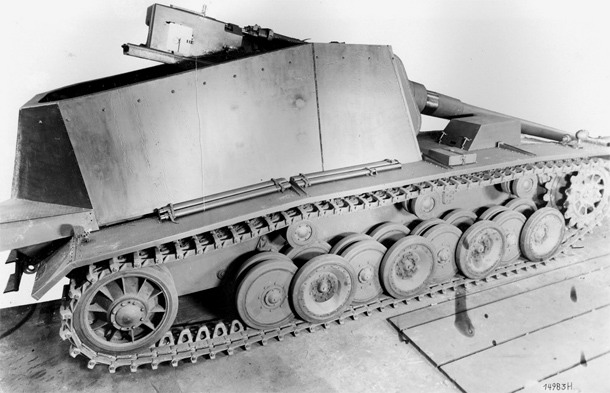
this demonstration photograph clearly shows the road wheel arrangement; also visible are the small "anchors" that secured the false right-hand cupola against inadvertent opening; source: Flickr.com with permission of the publishing user, edited
Almost the entire front half of the hull was very low, with a nearly horizontal roof plate. Rising from this plate were two armoured cupolas. The left-hand cupola served the driver — it protected the area around his head, as the rest of his body sat inside the hull with only his head protruding into the cupola. It was therefore equipped with two vision ports. The main port was in the front wall of the cupola. On the inside it was filled with a block of bullet-resistant glass, and on the outside it could be sealed with an armoured cover. When this cover was closed, the driver looked out indirectly using a binocular periscope, whose lenses peered forward through two small holes drilled into the armour above the main vision port cover. A second, smaller and simpler port was provided in the left side wall of the cupola. The driver's entry hatch passed through the roof of the cupola, closed by a single-piece lid. The right-hand cupola was essentially a decoy, intended primarily to confuse the enemy. It could also be hinged open and most likely concealed the fuel tank filler neck beneath it (and possibly some personal storage space for the crew). According to some sources, this false cupola was fitted only to the first of the two prototypes, but this is probably not accurate (more on this topic later).
In the rear half, the walls of the main fighting superstructure rose from the hull. The superstructure was enclosed on all sides, but had a fixed roof only over its forward section — the remainder of the roof was left open. The frontal armour of both the hull and the fighting superstructure was a full 50 mm thick. The sides were 30 mm and the rear only 15 mm. Immediately behind the front wall of the superstructure, roughly at the midpoint of the hull's length, was the gun mounting. Directly behind the gun sat the engine. The engine naturally did not fit beneath the superstructure floor, so at this point a raised housing projected upward from the floor — in other words, there was a large metal box in the middle of the superstructure floor, under which the engine was hidden. The sides of this "box" were fitted with slots to allow airflow.
Beneath this box — the engine housing — was a petrol-powered, liquid-cooled six-cylinder Maybach HL 116 S engine with a displacement of 11.6 litres, producing 300 horsepower at 3,300 rpm. Behind the engine, now concealed beneath the superstructure floor, was the radiator. The gearbox, by contrast, was located at the front of the hull — specifically the Zahnradfabrik SSG 77 type with six forward gears and one reverse. The original final drives from the VK 30.01 (H) prototype had to be replaced with new units having a lower gear ratio, which better suited the demands of steering the longer and heavier vehicle.
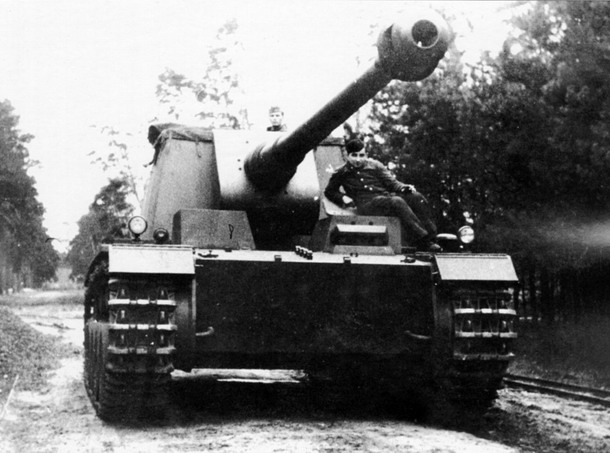
a brand-new Sturer Emil after being taken over by soldiers of the 521st Tank Destroyer Battalion; source: Flickr.com with permission of the publishing user, edited
The 12.8 cm K40 Gun
In the front section of the fighting superstructure, mounted on a robust carriage, was the vehicle's main weapon — designated the 12.8 cm Kanone 40. The superstructure looked spacious at first glance, but the enormous gun actually occupied most of its interior. To recall: the Kanone 40 was a modified version of the anti-aircraft Flak 40. The modified gun alone, without its mounting, weighed — according to some sources — 7.8 tonnes, while others give a figure of "only" 4.3 tonnes (which seems suspiciously low). Either way, the gun's dimensions remained enormous even after modification, particularly its length. Photographs comparing the original Flak 40 next to a human figure give the best sense of just how vast the weapon was — examples can be seen HERE, HERE, and HERE. The barrel of the original Flak 40 was 61 calibres long — approximately 7.8 metres. As part of the modifications for installation in an armoured vehicle, the gun was also fitted with a muzzle brake, which increased its overall length to 8.32 metres! This means that when the gun was removed from the vehicle and placed alongside it, it was around 1.3 metres longer than the vehicle itself!
A muzzle brake was necessary to reduce the recoil stroke when firing. Without it, recoil measured around 100 cm; with it, this was reduced to approximately 80 to 82 cm. The recoil mechanism also had to be modified. The mounting allowed the gun a traverse of 7 degrees to the right and only 5 degrees to the left — a very limited range, though since the vehicle was designed to engage static targets (bunkers), the restricted traverse was not considered a major drawback. The vertical range was from -15 to +10 degrees. The generous negative elevation served two purposes: it allowed the vehicle to fire from a hull-down position behind a terrain feature, and it was also the only way to access the engine for servicing without having to remove the gun.
The original Flak 40 used fixed (unitary) ammunition, meaning the shell and cartridge case formed a single piece. These rounds were an extraordinary 149 cm long. Handling such large and heavy ammunition in the confined interior of the superstructure would have been extremely awkward (the size of the original rounds can be appreciated in the photographs HERE and HERE). The Kanone 40 was therefore given new two-piece (separated) ammunition — projectile and cartridge case separately. The shells themselves were stored vertically in open racks along the side walls in the rear of the superstructure. The cartridge cases were stored horizontally in closed bins on either side of the gun. The bulky ammunition naturally took up a great deal of space, so only a mere 15 rounds could be carried on board. The gun could deliver both direct and indirect fire and was accordingly fitted with two different sights — both periscopic, extending from the roof at the front of the superstructure. For close-range defence against enemy infantry, the crew had two MP40 submachine guns with a supply of 384 rounds.
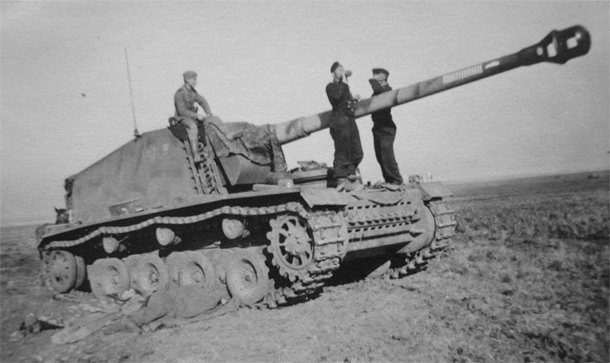
and here already on the Eastern Front — the false cupola on the right front of the hull is gone, and the barrel of the 128 mm gun bears 15 victory notches; source: worldwarphotos.info with permission of the site operator, edited
Both armour-piercing and high-explosive shells were available for the gun. The armour-piercing Panzergranate weighed 26.4 kg (referring to the shell alone, without the cartridge case!) and left the barrel at approximately 880 m/s. At a range of one kilometre, this round could penetrate 150 mm of sloped homogeneous armour, and at two kilometres it was still capable of defeating 130 mm. The crew of the schwere Betonknacker consisted of five men. The driver was the only one to sit inside the hull proper, specifically at the front left. To his right was the gearbox, and further to the right of that, the fuel tank. The remaining four men had their stations in the fighting superstructure. The gunner sat to the left of the gun and the commander to its right. The commander looked out through a binocular periscope. Also on board were a loader and a radio operator. Entry into the superstructure was through a fairly small door in its rear wall. To protect the crew from the elements, a waterproof tarpaulin could be stretched over the open section of the roof. The vehicle's communications equipment consisted of the Fu.Spr.Ger. "a" radio set, supplemented by an intercom for internal communication between crew members (primarily between commander and driver). The whip radio antenna was mounted on the right side armour of the superstructure.
The concrete crusher weighed a full 36.5 tonnes, so with only 300 horsepower it was clearly and severely underpowered. This naturally manifested itself in the vehicle's sluggishness and lumbering behaviour. Its top speed was 25 km/h according to some authors, and only 19.6 km/h according to others. A full tank of 450 litres of petrol gave a road range of approximately 170 km and a mere 80 km cross-country. The vehicle measured an impressive 9.7 metres in length (9.8 metres according to some sources), of which a full 2.7 metres was the gun barrel overhanging the front of the vehicle! Width was 315 cm and height either 267 or 275 cm, depending on which source you choose to believe.
The new armoured vehicle went by several different names, as was customary. In addition to the working designation schwere Betonknacker already mentioned, official documents also use the name 12.8 cm Selbstfahrlafette L/61 Pz.Sfl. V, and later also Pz.Sfl. für 12.8 cm K.40, among others. In the title of this article we have chosen to retain the unofficial nickname that the soldiers themselves reportedly gave the vehicle — Sturer Emil, meaning "stubborn" or "obstinate Emil". The inspiration for this nickname was the vehicle's slowness and cumbersome handling.
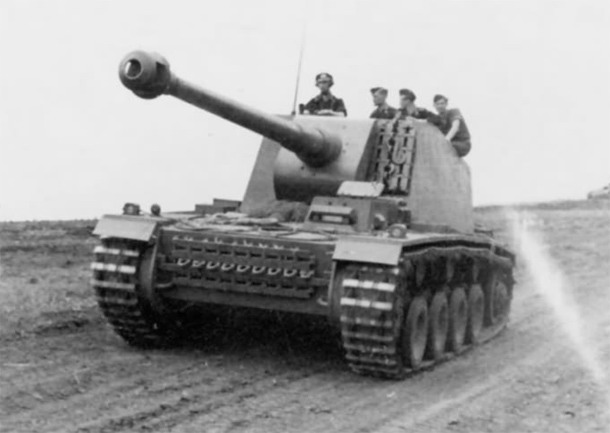
among the modifications made by the crews in the field was the attachment of spare track links to the front of the hull and superstructure; source: worldwarphotos.info with permission of the site operator, edited
As mentioned in the introduction, the new self-propelled gun was developed in cooperation between Henschel and Rheinmetall. The Waffenamt ordered two modified chassis from Henschel and four modified 128 mm guns from Rheinmetall, from which two complete pre-production prototypes were to be assembled. For some reason, a Berlin firm — Alkett — was apparently entrusted with putting the prototypes together. According to a plan from April 1940, the prototypes were to be delivered in December of that year, but this did not happen. In July 1941, delivery was expected in September 1941, but that too fell through, and both ordered prototypes were finally handed over to the army only in March 1942. Given that they had been developed to breach the Maginot Line, this was somewhat overdue. So what to do with them? A decision came very quickly: both prototypes would be reclassified as heavy tank destroyers and tested in this new role on the Eastern Front.
Combat Deployment
In May 1942, both prototypes were therefore assigned to the 521st Tank Destroyer Battalion (Panzerjäger Abteilung 521, or PzJgAbt 521). There they were joined by another fighting vehicle that could be considered a distant relative — the 105 mm self-propelled gun on a Panzer IV chassis known as the Dicker Max, which had likewise originally been designed for bunker-busting but ended up on the Eastern Front as an experimental tank destroyer. These three armoured vehicles were formed into a special heavy platoon within the battalion. The entire battalion was placed under the XVII Army Corps in June 1942 and in July took part in Operation Fall Blau — the German offensive in southern Russia. The battalion was part of Army Group B, advancing on Stalingrad, and fought on the left flank of Paulus's 6th Army.
Photographs from front-line service show that the crews and field workshops carried out a whole series of modifications to the vehicles. Noteworthy examples include new brackets for hanging spare track links on the front of the hull and superstructure. On at least one vehicle, the false armoured cupola on the right side of the hull was also removed (or lost). The nearly horizontal roof plate at the front of the hull served as a convenient stowage surface for all manner of equipment, including spare road wheels. This last detail had a clear logic behind it. The Sturer Emil was a unique vehicle of which only two existed. Road wheels and tracks (along with other components) were therefore a "scarce commodity" at the front, and the crews did their best to always carry spares. The same, unfortunately, applied to ammunition. Two-piece 128 mm rounds had to be supplied exclusively for these vehicles, which was naturally a very expensive affair. The crews therefore conserved their ammunition wherever possible, and if a shot stopped an enemy tank without destroying it, the German crews made no effort to finish it off — which, conversely, suited the Russians, who towed away their knocked-out heavy tanks for repair whenever the situation allowed.
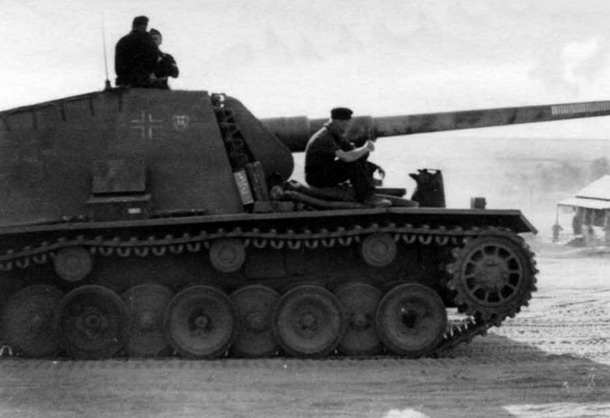
Sturer Emil with the 521st Tank Destroyer Battalion on the Eastern Front; source: worldwarphotos.info with permission of the site operator, edited
Both vehicles were given individual nicknames by their crews at the front (the general nickname was Sturer Emil, but here we are talking about the names given to each specific vehicle), which were subsequently adopted by other soldiers in the battalion. One of the tank destroyers was called Moritz and the other Max (not to be confused with the Dicker Max!). Very little specific information has survived about the combat successes of the two vehicles. Virtually all sources cite the same combat report by First Lieutenant Kurt Hildebrandt, which vividly describes the deployment of the heavy platoon. Hildebrandt notes that while the tank destroyer named Moritz performed well in combat, the second vehicle named Max suffered from repeated mechanical problems that kept putting it out of action.
The report describes how the tank destroyer Moritz destroyed four medium T-34 tanks and one heavy KV-1 in a single morning without any losses on the German side. History, however, decreed that the entire combat career of both experimental tank destroyers would last only six months. On 12 November 1942 the battalion reported both vehicles as still operational. The report from 2 December 1942 mentions only one of them, and after that the trail goes cold — at least in the German records. Both vehicles were subsequently declared lost at Stalingrad. At least one photograph exists showing one of these tank destroyers (probably Moritz) with 31 victory rings painted on the gun barrel!
Given the total loss of both vehicles and their crews, no proper evaluation of their combat experience could ever be carried out. The truth is, however, that any deliberations about possibly putting this type of tank destroyer into series production were already long dead at the turn of 1942 and 1943 in any case. The VK 30.01 (H) project that had provided the prototypes with their chassis had long been cancelled, and as the war dragged on, the Germans needed to consolidate production rather than introduce further entirely unique vehicle types. The two Sturer Emils that were built thus became the first — and last — representatives of their kind.
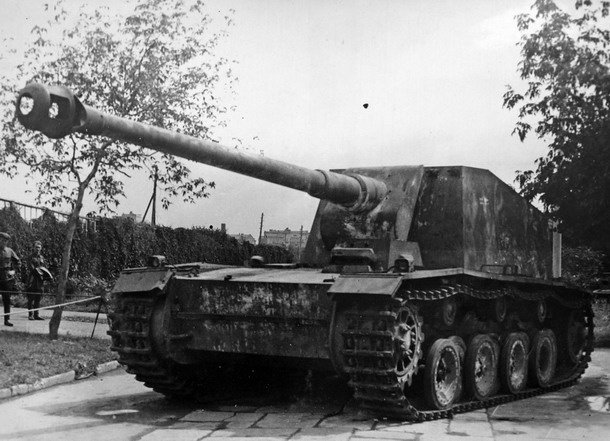
the wreck of a Sturer Emil on display at an exhibition of captured German equipment in Moscow; source: Flickr.com with permission of the publishing user, edited
The subsequent fate of one of these vehicles is recorded only in Soviet reports. In February 1943, Russian soldiers discovered the abandoned and frozen tank destroyer named Moritz near the village of Novoalekseyevka, located some 40 km west to north-west of Stalingrad. The captured vehicle was transported to the testing centre at Kubinka. Given its non-functional condition, no driving trials could be conducted, and firing trials were equally impossible due to a lack of ammunition. After a thorough inspection of the immobile vehicle, it was taken to Moscow, where it was put on public display as part of an exhibition of captured Nazi equipment in Gorky Park. It subsequently returned to Kubinka, where it has remained as an exhibit in the local military technology museum.
Technical Data
|
weight: |
36.5 t |
|
length: |
9.7 m |
|
width: |
3.15 m |
|
height: |
2.67 or 2.75 m |
|
engine: |
Maybach HL 116 S |
|
engine output: |
300 hp |
|
max. speed: |
25 km/h |
|
fuel capacity: |
450 l |
|
range – road: |
170 km |
|
range – cross-country: |
80 km |
|
crew: |
5 men |
|
armament: |
1 x 12.8 cm Kanone 40 gun |
|
ammunition stowage: |
15 rounds |
ARTICLE
CONTENTS:
Reproducing text from the Panzernet website without the written consent of the operator is prohibited.