TANK IS-2
Stalin's Heavy Hitter
IS-2 tank, source: Waralbum.ru with permission of the operator, modified
Origins of the Tank
In August 1943, Soviet military officials carried out a thorough analysis of the results of the victorious battle of Kursk and reached an unambiguous conclusion: even the heavy tank IS-1, whose development had just been completed, would not be the right tool for destroying the most modern German tanks — the Tiger and the Panther — with its 85 mm gun. Based on these findings, the State Defence Committee (Gasudarstvenyj kamitet oborony) ordered in September 1943 that development of a new IS variant with more powerful armament should begin.
IS-100 Prototypes
When considering a new gun, the designers focused on two calibres: 100 mm and 122 mm. Let us first look at the experiments with 100 mm guns. The IS-100, as the tank with that calibre was known, was built in two variants. Both were based on the production IS-1, with only the main gun changed. The first IS-100 prototype carried the D-10T gun and was designated Object 245. The second prototype was armed with the S-34 gun and designated Object 248. These two prototypes are sometimes also referred to in the literature as IS-4 (for Object 245) and IS-5 (for Object 248) — the designations that would have been applied had either vehicle entered series production. Neither did, however, and the IS-4 and IS-5 designations were ultimately used for post-war Soviet tanks instead.
Object 245 and Object 248 were subjected to thorough firing trials, in which the prototype armed with the D-10T gun (Object 245) performed better. That gun variant was therefore recommended for the production tanks. However, since development of an IS tank with the even more powerful 122 mm armament was progressing satisfactorily, Object 245 was ultimately not put into production — even though the 100 mm D-10T gun had a number of advantages over its 122 mm rival. It allowed up to three times the rate of fire (5–8 rounds per minute), more ammunition could be carried, and it was around 600 kg lighter. The armour-penetration performance of the 100 mm rounds was also greater than that of the 122 mm rounds, at least under certain conditions.
The 122 mm gun that was ultimately selected for the new tank was, however, more versatile: it could not only destroy enemy armour, but was also highly effective against fortifications and infantry — something the 100 mm gun could not claim. And the Soviets were not looking for a tank designed primarily for fighting other tanks, but a universal machine for breaking through defensive lines. The production of ammunition for the 100 mm gun was also beset with serious complications. All of this tipped the balance in favour of the 122 mm calibre.
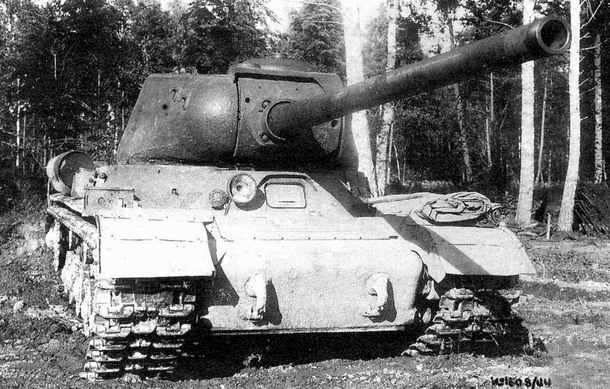
unsuccessful prototype Object 245 with D-10T gun of 100 mm calibre, source: Topwar.ru with permission of the operator, modified
IS-122 Prototype
The designers' primary interest in the 122 mm calibre was sparked by the aforementioned analysis of the Battle of Kursk. During that engagement, the A-19 Model 1931 gun of 122 mm calibre (or more precisely 121.92 mm) had proven highly effective against German Tigers. The designers at Artillery Factory No. 9 therefore decided to use this gun as the basis for a new weapon for the IS tanks. They quickly drew up a proposal for adapting the A-19 so that it could be mounted in a tank turret, and sent the plans to the People's Commissar for Industry (the equivalent of a minister). The proposal was approved by Stalin himself, and on 31 October 1943 the factory was officially tasked with producing a test prototype of the weapon.
By 12 November the first example of the new tank gun, designated D-25T, was complete. To reduce the recoil, the gun was fitted with a muzzle brake designed in an unconventional T-shape. The gun was installed in the turret of an IS-1 tank, and the resulting prototype was designated Object 240. Firing trials began at a test range near Moscow, attended by Marshal Kliment Voroshilov. The event came close to proving fatal for him: during firing, the muzzle brake shattered and its fragments narrowly missed the marshal standing nearby. It was immediately decided to redesign the brake.
Despite this alarming incident, the overall results of the trials were impressive. Among other tests, the gun was fired at a captured German Panther tank. At a range of 1,500 metres, a 122 mm shell cleanly passed through the side wall of the Panther's turret, completely tore off the opposite side wall and threw it several metres from the tank.
The original unreliable muzzle brake was replaced by a new one inspired by the brakes used on German tank guns, and in December 1943 series production of the new tank began at the Kirov Plant in Chelyabinsk under the official designation IS-122. The tank became far better known, however, under the name IS-2, which was assigned to it retrospectively in March 1944. The gun's muzzle brake was replaced yet again in March 1944 with a new design that remained standard for the rest of the production run.
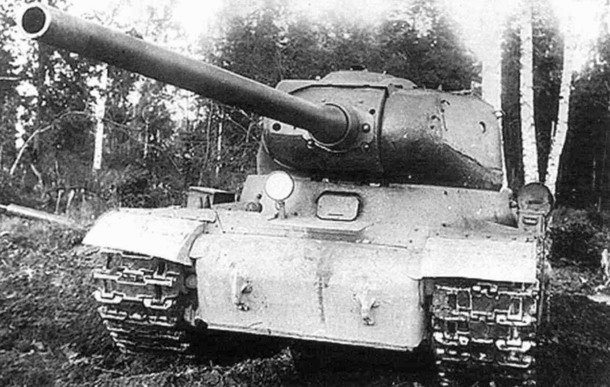
another unsuccessful prototype Object 248 with S-34 gun of 100 mm calibre, source: Topwar.ru with permission of the operator, modified
The D-25T Gun
The D-25T had a barrel 43 calibres long (5.25 metres) and a maximum range of 14.2 km. The maximum effective range was, however, "only" around five kilometres. The gun used high-explosive fragmentation shells OF-471 and OF-471N and armour-piercing rounds BR-471 and BR-471B. The armour-piercing rounds weighed around 25 kg and left the barrel at approximately 800 m/s. At a range of one kilometre, the projectile could penetrate a vertically placed steel plate 150 mm thick. The kinetic energy of the 122 mm round was 2.7 times greater than that of a round from the KV-1's 85 mm gun, and 3.5 times greater than a round from the T-34's 76.2 mm gun. The IS-2 carried 28 main gun rounds on board, plus 2,331 rounds of 7.62 mm machine gun ammunition.
Technical Description
The first production IS-2 tanks differed from the IS-1 only in the gun and the way it was mounted in the turret's frontal plate. Everything else was carried over unchanged. The suspension on each side consisted of six twin solid road wheels with star-shaped indentations, each independently suspended and sprung by torsion bars. At the front was an idler wheel identical in size to the road wheels. At the rear was the toothed drive sprocket, the largest wheel in the entire running gear. Three evenly spaced return rollers supported the track from above.
The lower front hull plate was followed by a sharply angled glacis, above which the driver's frontal plate rose above the level of the mudguards. The centre of this plate was flat and housed the driver's rectangular, closable vision port. When the port was shut due to combat danger, the driver could only see through a narrow slit in the cover. A pair of periscopes passing through the roof above his station gave him a view to the sides. The glacis curved on both sides, flowing rearward into the turret ring. Behind the turret ring the hull maintained a constant width all the way to the stern, with only the slightly wider track mudguards projecting to the sides. The lower front hull plate was 100 mm thick, the angled glacis above it 60 mm, and the driver's frontal plate a full 120 mm.
The turret was positioned closer to the front of the hull and was largely cast, giving it rounded shapes with no hard edges. All turret walls were 100 mm thick, with a 30 mm roof. In the bulged frontal wall of the turret was mounted the aforementioned D-25T gun of 122 mm calibre, and coaxially with it a DT machine gun of 7.62 mm calibre. A second machine gun of the same type was fitted in a ball mount in the right half of the rear turret wall. A third DT machine gun was carried loose inside the hull.
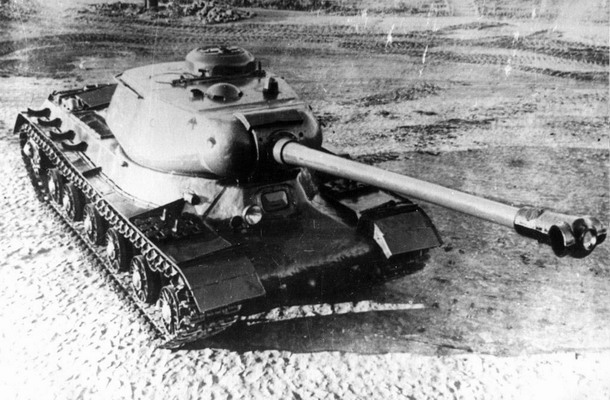
Object 240 prototype with the original dangerous type of muzzle brake, source: Topwar.ru with permission of the operator, modified
Both side walls of the turret had small, closable pistol ports for the crew to fire their personal weapons. In the left rear section of the turret roof was a commander's cupola fitted all around with a ring of vision ports. The cupola had a circular hatch closed by a two-piece lid. A second circular hatch, this one with a single-piece lid, was located to the right of the commander's cupola. The turret roof also featured a ventilator outlet, a rotating periscope and various other fittings. Handrails for infantry riders were welded to the sides of the turret.
The crew consisted of four men: driver, commander, gunner and loader. The driver sat in the front of the hull while the rest of the crew occupied the turret. The driver had no dedicated hatch of his own and had to squeeze into his station through the turret hatches, just like the rest of the crew. When required, the commander operated the machine gun in the rear turret wall. Behind the turret was the engine and transmission compartment. Inside sat a twelve-cylinder diesel engine V-2IS with a maximum output of 520 horsepower at 2,000 rpm. The 46-tonne tank was capable of reaching an impressive top speed of 37 km/h on roads.
The engine compartment was separated from the rest of the interior by a bulkhead with only a service opening for the most essential repairs that could be carried out from inside the vehicle. The roof of the engine compartment had louvred grilles for air intake. In the rear wall were access panels for servicing. On each side of the engine compartment, two additional fuel drums were mounted, one on each side. On the upper edge of the rear hull plate was a folding travel lock for the gun barrel. During longer road marches and when transported by rail, the turret was rotated to face rearward and the barrel was rested on this support to prevent unnecessary vibration and wear during travel.
Upgrades
In March 1944, the Soviets subjected the IS-2 to thorough firing trials to identify weak points in its armour. The analysis revealed that if the front hull armour were to be truly impervious to fire from the German Tiger (with its 88 mm gun) and the Panther (with its 75 mm gun), it would need to be increased to 150 mm — a significant weight increase that would also shift the tank's centre of gravity forward. The designers therefore chose instead to change the shape of this section of the hull, achieving better protection without having to dramatically thicken the armour.
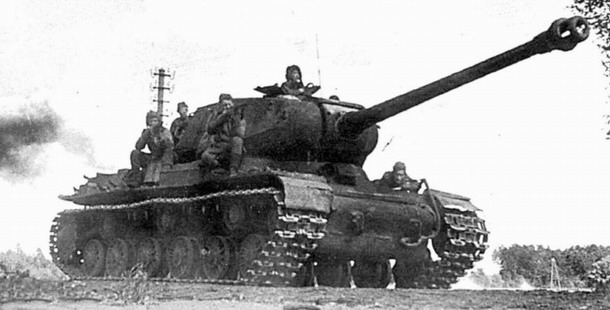
early-production IS-2 tank with the "German-style" muzzle brake, source: Topwar.ru with permission of the operator, modified
In mid-1944 a new IS-2 variant appeared with a simpler frontal hull design. The step between the upper hull plate and the driver's frontal plate was eliminated. In its place was a single plate that rose smoothly from the very nose of the hull up to the turret ring, 120 mm thick. The driver's vision port was also redesigned: instead of the original closable hatch, there was now only a slit protected by bulletproof glass. Even after this change the driver still had no dedicated hatch and continued to enter and exit through the turret. The upgraded version with the new hull front is sometimes referred to in the literature as IS-2m. Other sources maintain that this version received no separate official designation and that all tanks, before and after the upgrade, are simply designated IS-2.
There were also proposals to thicken the frontal turret armour. Analysis of that plan revealed, however, that the resulting shift in the turret's centre of gravity would have required a complete redesign of the turret traverse mechanism, so the plan was rejected. Nevertheless, the turret did receive at least a partial upgrade in May 1944, when the positions of the commander's cupola and periscope were adjusted. The commander's cupola also gained a mount for a DShK heavy machine gun of 12.7 mm calibre, which could be used to engage low-flying enemy aircraft.
Unit Organisation
IS-2 tanks were organised into independent Guards heavy tank regiments (Otdelnyj gvardeijskyj tjazhelyj tankovyj polk, or OGTTP). According to the 1943 tables of organisation, each such regiment consisted of four tank companies. Each company comprised two platoons of two tanks each, plus the company commander's tank, giving the regiment a total of 20 IS-2 tanks in its companies plus one command vehicle. The regiment also included a considerable amount of additional combat and support equipment and personnel. From December 1944, independent tank brigades also began to be formed. Each brigade consisted of three regiments and fielded a total of 65 IS-2 tanks along with a range of support vehicles such as BA-64 armoured cars, SU-76 self-propelled guns and American M3 half-track armoured personnel carriers. At full strength such a tank brigade numbered 1,665 men. A total of five such brigades were formed.
The IS-2's combat debut came during fighting in Ukraine in April 1944. The 11th OGTTP, equipped with these tanks, was deployed in the area of the town of Obertin in the Ivano-Frankivsk region. Between 20 April and 10 May — twenty days of continuous fighting — the regiment destroyed 41 German tanks and self-propelled guns, including heavy Tiger tanks, while losing only eight IS-2s of its own.
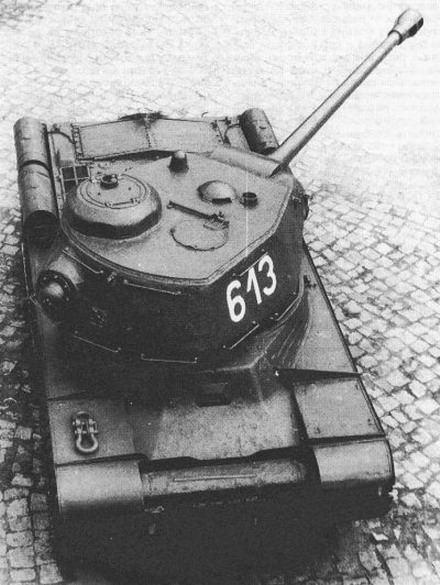
excellent top-down view of an IS-2; the vehicle has the production-type muzzle brake and the original hull front armour design, source: Aviarmor.net with permission of the operator, modified
IS-2 vs. Tiger
A theoretical comparison between the IS-2 and the Tiger I does not, however, come out as one-sidedly as the combat results above might suggest. The Tiger was nearly 11 tonnes heavier, yet thanks to its more powerful engine it was faster and easier to handle than the IS-2. The Tiger's 88 mm gun also had better armour-penetration characteristics than its opponent's 122 mm weapon. At the same time, however, the Tiger had thinner frontal armour than the IS-2. All things considered, both tanks could penetrate each other's frontal armour at roughly the same distance, around 1,000 to 1,200 metres. The Tiger did have superior sighting optics, giving it a better chance of scoring a hit at long range — though in practice, accurate hits at such distances were the exception rather than the rule.
IS-2 vs. Panther
How did the IS-2 compare with the medium German tank, the Panther? First, it is worth noting that although the Panther was classified as a medium tank and the IS-2 as a heavy tank, the difference in their weight was just 1.2 tonnes. The Panther had thinner frontal armour, and the IS-2 could deal with it at a range of around 1,100 metres. The German tank, on the other hand, needed to close to approximately 700 metres to penetrate the IS-2's frontal plate.
IS-2 vs. Königstiger
The only truly dangerous opponent for the IS-2 was the heaviest German tank, the Königstiger. It could penetrate the Soviet tank's frontal armour at a range at which it was itself invulnerable. On the other hand, the Königstiger was slower, more expensive to produce, and no match for the IS-2 when it came to destructive effect against infantry or fortifications. It was also less reliable than the IS-2. In practice, however, encounters between these two giants were rare. They did occur, for example, near Budapest in November 1944 and on the Oder in January 1945.
It must also be repeated that the IS-2 was primarily designed for a somewhat different type of combat than the late-war German tanks. While the Germans were increasingly specialising their vehicles for tank-versus-tank engagements, the IS-2 was designed more for destroying fortified positions, engaging infantry and similar tasks. Statistics bear this out: IS-2 crews used high-explosive fragmentation ammunition approximately 70% of the time, and armour-piercing rounds only around 30% of the time.
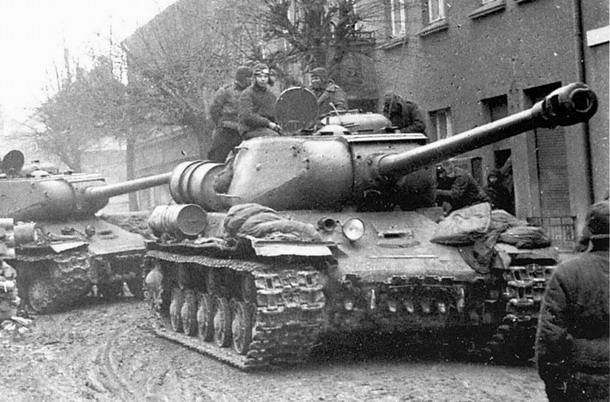
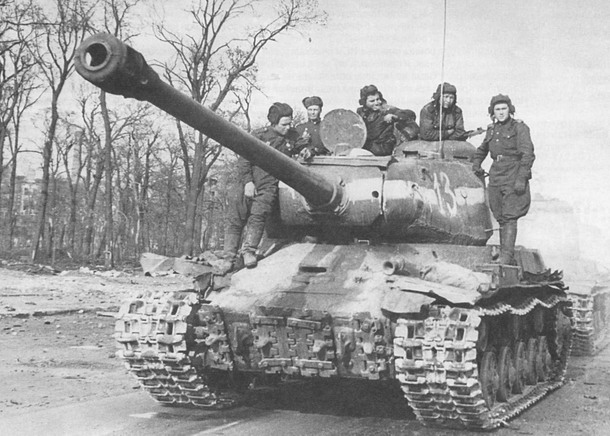
IS-2 tank with the later-production hull front armour design, source: Waralbum.ru with permission of the operator, modified
The street fighting of the war's final phase brought a new danger for Soviet tanks: infantry armed en masse with Panzerfausts and Panzerschrecks. Soviet soldiers called both weapons simply "faust" and the infantry carrying them "faustniks". It is reported that up to 70% of tanks lost in street fighting during this period fell victim to "faustniks". Soviet crews therefore began fitting their vehicles with add-on spaced armour, similar to that which the Germans had long been using. The armour was mounted only on the turrets, as that was where most "fausts" were aimed. The spaced armour caused the shaped-charge warhead to detonate far from the main armour, robbing it of its penetrating effect. All that remained on the turret armour were small black scorched craters, which Soviet soldiers aptly nicknamed "witch's kisses".
Production of the tank continued until 1945, when it was wound down to make way for production of the new IS-3. A total of 3,385 of these tanks were built during the production run. The IS-2 holds one distinction among the tanks of the Second World War: it was the heavy tank produced in the greatest numbers.
Post-War IS-2M
The IS-2 remained in Red Army service long after the end of the Second World War — the last examples are said to have been retired only in the mid-1960s. In the 1950s these tanks underwent a modernisation programme. They received new, more powerful engines and transmissions, new sights, night-vision equipment, a semi-automatic fire suppression system and other improvements. The vehicles also received new mudguards, and the sides of the driver's compartment were widened at the front. These widened side sections incorporated stowage boxes for various equipment which also served to reinforce the side armour, particularly against shaped-charge rounds. This modernised version received the designation IS-2M.
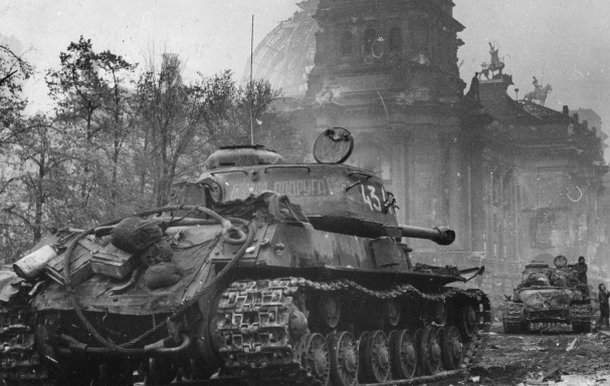
IS-2 tanks in the streets of Berlin, source: Waralbum.ru with permission of the operator, modified
The Soviets also supplied IS-2 tanks to their allies, both during and after the war. Polish units serving within the Red Army received a total of 71 IS-2 tanks during 1944. A small number of IS-2s were delivered to Czechoslovak units in the Soviet army right at the very end of the war, too late to see combat, though they subsequently appeared frequently on post-war military parades bearing Czechoslovak markings.
After the war, IS-2 tanks were purchased from the Soviet Union by a number of countries, including China, Egypt, North Korea and Cuba. China and North Korea actually deployed their tanks in combat during the Korean War. Egyptian tanks also saw action, during the Six-Day War with Israel. Cuba kept the IS-2 in service the longest of all, right through to the 1980s.
Technical Specifications
Weight |
46 t |
Length |
9.83 m |
Width |
3.07 m |
Height |
2.73 m |
Engine |
V-2IS |
Maximum power |
520 hp |
Maximum speed |
37 km/h |
Hull armour |
front 100 – 120 mm sides 90 mm rear 60 mm |
Turret armour |
walls 100 mm roof 30 mm |
Armament |
1 × D-25T gun, 122 mm 3 × DT machine gun, 7.62 mm |
Crew |
4 men |

ARTICLE
CONTENTS:
Reproducing text from the Tankist website without the written consent of the operator is prohibited.