DIRECTIONAL GYROSCOPE
a navigation aid for German tank crews
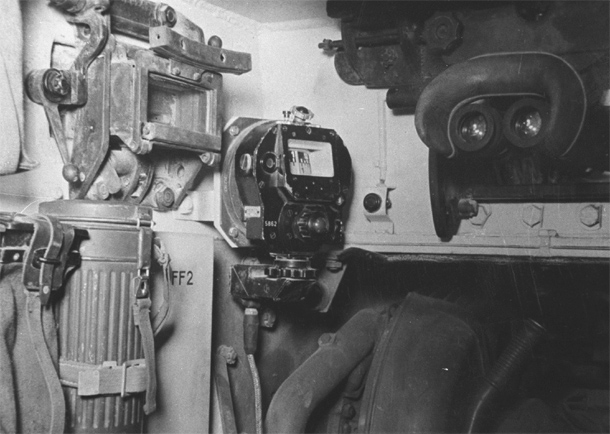
The Kurskreisel, or directional gyroscope, here installed in a Panzer III tank, source: Flickr.com, edited
Introduction
A large proportion of German tanks in the Second World War were equipped with one particularly interesting instrument — the so-called directional gyroscope (German: Kurskreisel). At first this navigation aid was fitted mainly to command tanks, but later also to standard combat tanks, and by the time of later types such as the Panther and Tiger it had become essentially standard equipment. The device is fairly frequently described in the literature as a gyrocompass, which is not quite accurate. A true gyrocompass, like an ordinary magnetic compass, indicates direction according to the cardinal points — its "needle" points north. The directional gyroscope operates on the same principle as a gyrocompass, but is not meant to show the cardinal points; rather, it shows a specific chosen direction (or azimuth) and any deviation from it. Let us start from the very beginning, as usual.
Why was an ordinary pocket compass not sufficient for tank crews, and why did they need something special? The classic compass that most of us are familiar with relies on the Earth's magnetic field. Its magnetic needle always points toward the Earth's north magnetic pole. Tanks (and other armoured vehicles), however, are made of iron, which is a ferromagnetic material — meaning it exhibits spontaneous magnetisation and therefore disrupts the functioning of a magnetic compass. In short, a standard compass enclosed inside a large iron box may not work correctly. The interference caused by the tank's metal hull is in fact so great that if a tank crew member wanted to use an ordinary magnetic compass, he had to move at least 20 metres away from his tank (as stated, for example, in the Panther crew manual).
A Little History
A magnetic compass was thus entirely unsuitable for determining direction aboard a tank. Fortunately, another principle for finding north had been known since the mid-19th century, and it was on this basis that the German inventor Hermann Anschütz-Kaempfe built the first practically usable gyrocompass in 1906. This device does not rely on the Earth's magnetic field to find north, but on the Earth's rotation about its axis. As a result, a gyrocompass does not point toward the magnetic north pole, but toward the geographic north pole — the point where the Earth's axis meets its surface. (Incidentally, these two poles are by no means the same. In 2013 the two poles were 800 kilometres apart, and this distance continues to grow as the magnetic pole shifts.)
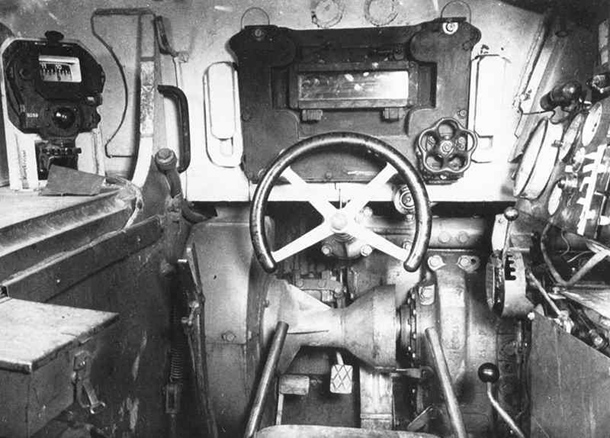
The directional gyroscope aboard a Tiger tank (to the left of the driver), source: Flickr.com, edited
Such a compass was a true blessing for the military, as it could be installed in warships, submarines, armoured cars, and later of course in tanks as well. The gyrocompass does have its drawbacks, however. First of all, it requires a power source, since it contains a spinning gyroscope that must rotate at very high speed (typically tens of thousands of revolutions per minute). A gyrocompass also responds more slowly to changes in direction and speed than a magnetic compass, so corrections must either be calculated or one must simply wait for the gyrocompass to settle again. For long-distance navigation (particularly at sea) and at the relatively low speeds of tanks, however, this is not much of an issue.
A Gyroscope is Not a Compass
As noted in the introduction, German tanks were fitted not with true gyrocompasses but with directional gyroscopes. Although these instruments operate on the same principle (i.e. they make use of the Earth's rotation), what they show the user is different from where north is. The typical application in a tank was to establish the direction of advance or the bearing toward a target, thereby enabling the coordinated movement of multiple vehicles — a tank platoon, for instance. This type of navigation was most useful in wide open terrain with no roads or obvious landmarks. In densely populated areas criss-crossed by roads it was of course unnecessary, but in the Russian steppes or the African desert such a tool was invaluable. The directional gyroscope thus served primarily the tank driver and was positioned accordingly at his station.
Description of the Instrument
The German tank gyroscope was housed in a Bakelite casing with a transparent window and several controls. Visible through the window were two horizontal scales, each marked from 1 to 12 (following the principle of a clock face). The upper scale, with a black background and white numerals, served as the command scale (German: Befehlsrose — literally "command rose"). This scale was not directly connected to the gyroscope mechanism and was set manually only, using the upper control knob. The lower scale, called the Folgenrose ("follower rose"), had a yellow to light orange background with black numerals. This scale was connected to the gyroscope, so when the gyroscope was switched on and the rose was unlocked (see below), it rotated to reflect changes in the tank's direction of travel. On the right side of the Bakelite casing was a switch with positions marked with the letters A and E (A = ausschalten = off, E = einschalten = on).
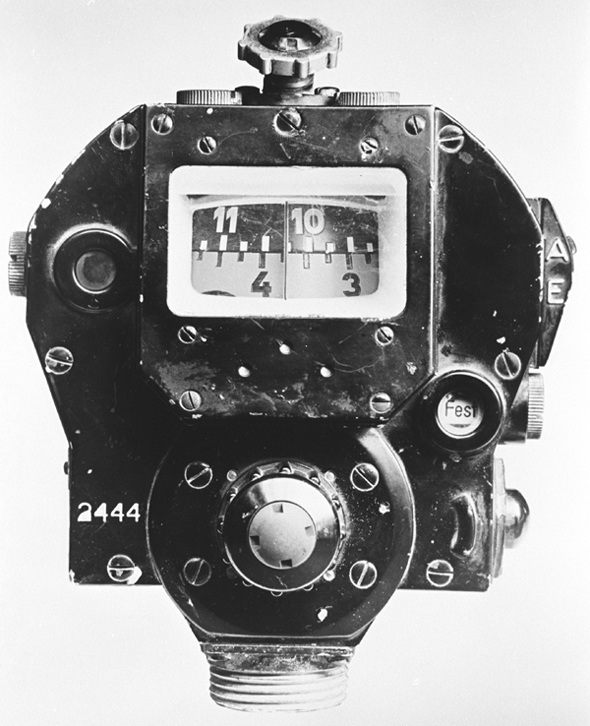
The German tank directional gyroscope in all its glory: on the upper dark scale, the azimuth of the march destination was set permanently; on the lower scale, the starting azimuth corresponding to the tank's actual heading was set, and the driver then manoeuvred until the lower scale showed the same value as the target on the upper scale, source: internet, Public Domain, edited
On the front face of the instrument, just below the window, was a large control knob that could be used to manually reposition the lower follower rose. The procedure began by pressing the knob inward, which locked the lower rose in its current position (effectively disconnecting it from the gyroscope). At that moment the word Fest appeared in a small transparent panel to the right. Turning the control knob then allowed the lower rose to be set to any desired position. To unlock the rose (reconnecting it to the gyroscope), the button located at the bottom of the right side of the casing was pressed. The word Fest in the panel then changed to Frei, and the lower rose could move freely once again. A power cable entered the Bakelite casing at the bottom.
How it Was Used in Practice
How was this instrument actually used in the field? First of all, all the tanks involved had to be aligned in the same direction. If they were concentrated in one location, this was straightforward. It was more complicated when the vehicles were dispersed across a larger area with separations of several hundred metres — in that case a suitable reference point had to be identified toward which all tanks could face (such as the rising sun), or each crew had to align its vehicle independently using a standard magnetic compass. In the next step too, the magnetic compass and a map played the central role.
The group commander stood facing the same direction as his tanks (at a sufficient distance from them), used his compass to find north, then located his current position on the map and plotted the direction of advance toward the objective. The various bearings identified on the map then had to be converted into numbers that could be entered into the gyroscope (i.e. azimuths had to be determined). The typical approach was to assign the value 12 to north and then derive the numerals for two further directions from this — like on a clock face — specifically the direction the stationary tanks were currently pointing, and the direction of the intended march to the objective. If this is not entirely clear, perhaps THIS diagram will help.
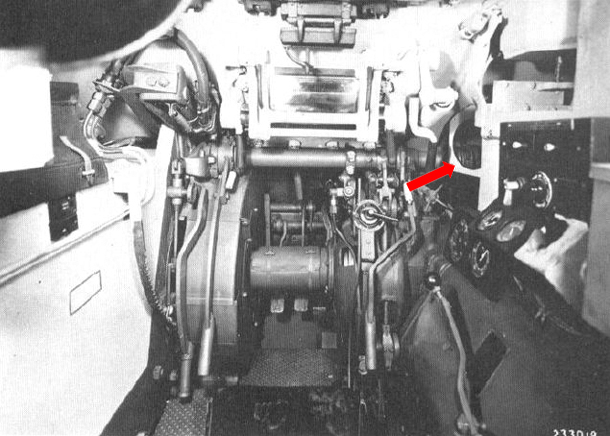
A Panther tank — to the right of the driver is the empty bracket for the directional gyroscope, source: Flickr.com, edited
Once the bearings had been worked out, the commander reported two numbers — two directions — to the crews of his tanks: the so-called Grundrichtung (the current heading of the stationary tanks) and the Marschrichtung (the march direction, i.e. the bearing toward the objective). The driver of each tank then performed the following steps. He switched on the gyroscope (by moving the side switch to position E) and waited until it reached operating speed and aligned itself to north (indicated by the lower rose settling on a stable value). He then locked the lower rose (Folgenrose) — disconnecting it from the gyroscope — and used the front knob to set it to the number corresponding to the current heading of the stationary tank (the Grundrichtung) as reported by the group commander. He then set the upper command rose (Befehlsrose) to the number corresponding to the direction of the march objective (the Marschrichtung), also as reported by the commander. Finally, the driver unlocked the lower rose by pressing the button at the bottom of the right side of the casing, reconnecting it to the gyroscope (in the small panel to the right, Fest was replaced by Frei). Everything was now ready. The gyroscope was aligned to north in the same way as the commander's magnetic compass; the lower scale showed the current azimuth of the stationary tank; and the upper scale showed the azimuth of the objective. When the driver now set off and began to turn, the lower scale rotated accordingly. All the driver then had to do was steer the tank until the upper and lower scales showed the same number — at which point he knew he was heading in the direction of the designated objective (his heading matched the set Marschrichtung).
If a halt was needed during the march, the driver had to lock the lower scale in its current position before switching off the engine (and thus the gyroscope's power supply). Once he restarted and the gyroscope had returned to operating speed, the driver must not forget to unlock the scale again. If he drove off without doing so, misalignment would occur. In other words, the gyroscope would adjust its internal position to reflect the tank's actual direction of travel, but the locked scale would remain frozen in the old position. In this case there was unfortunately no going back — the tank would have to perform a fresh orientation and establish the correct direction of advance from scratch. Simply unlocking the scale and reconnecting it to the gyroscope was not a remedy, because the scale was now showing an incorrect value and there was no way to correct it.
The last feature of the directional gyroscope worth mentioning is the red warning light on the front face of the instrument, to the left of the window with the scales. According to some authors, this indicator light showed that the instrument was operating, or that it had reached full operating speed (since the gyroscope did not spin up instantaneously). One would naively expect such an indicator to be green. Red is more commonly associated with a warning, and this would match the description given in other sources. According to these, the red warning light was supposed to illuminate whenever misalignment had occurred between the scale and the gyroscope — typically in the situation described above, where the driver restarted the engine after a halt, switched on the gyroscope and drove off without unlocking the lower scale. Such a warning was certainly appropriate: if the driver failed to notice his mistake and continued navigating by the gyroscope, he would be heading in the wrong direction.
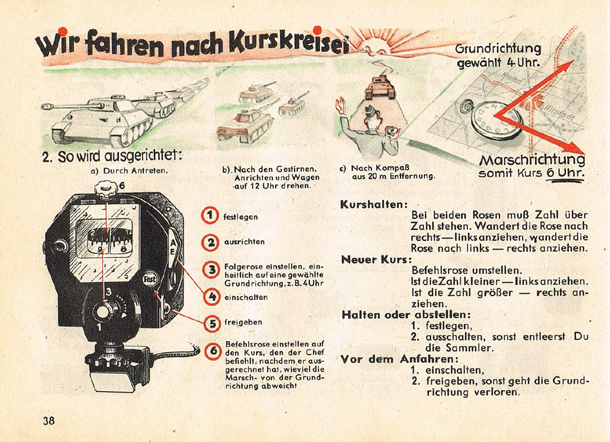
A page from the Panther crew manual explaining the use of the directional gyroscope, source: internet, public domain, edited
The directional gyroscope also attracted the attention of Allied intelligence officers. In September 1942, the magazine Tactical and Technical Trends published an article about one of these instruments captured from a Panzer II tank in Libya. The Allies incorrectly described it as a gyrocompass, and their account of some of the instrument's controls did not accurately reflect their actual function. They did, however, praise the first-rate quality and craftsmanship of the device, as well as its completely maintenance-free yet reliable operation.

ARTICLE
CONTENTS:
Reproducing text from the Panzernet website without the written consent of the operator is prohibited.