TURRET NUMBERS
and other tank identification markings
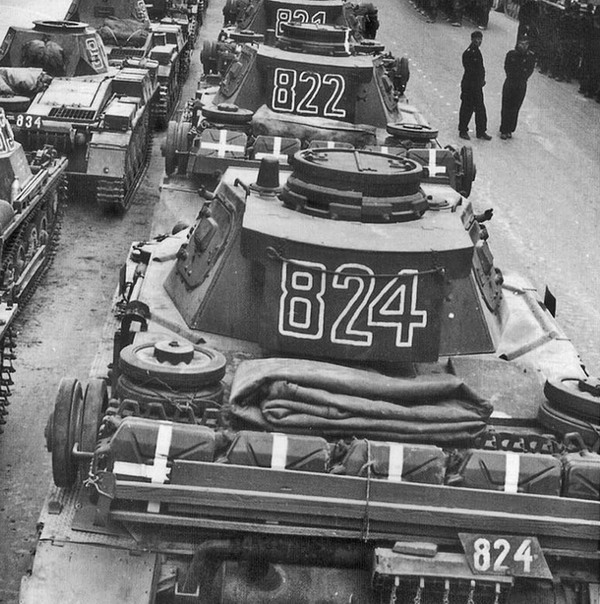
The turret number on this PzKpfw IV tells us it is the fourth tank of the second platoon, eighth company (and we further know it belongs to the 5th Panzer Regiment, 5th Light Division, and is currently standing in the streets of the Libyan port of Tripoli). Note that the number is displayed in the old style on a removable rhombus-shaped plate and simultaneously in the new style painted directly on the turret, source: Flickr.com with permission of the publishing user, edited
Introduction
During the First World War the Germans had no need to deal with the challenges of deploying tanks on a mass scale. This applied equally to the question of identifying individual vehicles on the battlefield, where Roman numerals and combat nicknames served perfectly well – each of the A7V tanks deployed was given its own name such as Hagen, Wotan, Mephisto, Isolde, Elfriede, and so on. The mass deployment of tanks in their hundreds and thousands in rapid manoeuvre warfare, which the Germans planned for the next war, demanded a somewhat more sophisticated approach to identification. There was also one new element that the First World War had never known: the ability to maintain continuous "live" communication with every individual tank at any point during a battle. A platoon commander, for instance, might sometimes need to address his entire unit, but at other times give an order or a warning to a single specific tank. And while he knew his subordinates well and could quite easily address a vehicle commander by name over the radio, the official call sign was the number of the tank in question.
But it was not only a matter of call signs or tactical numbers. The battlefield also required other levels of identification: a symbol to show which side a given vehicle was fighting on – a national marking. On the armour of German tanks (and others) during the Second World War, a whole range of different graphic markings could therefore be seen. In addition to the numbers and national symbols (in this case crosses) already mentioned, these included unit insignia (photo HERE), various tactical symbols (photo HERE), service and transport markings (photo HERE), chassis production numbers (photo HERE), command pennants (photo HERE), letters indicating membership of a Panzergruppe (photo HERE), kill markings on gun barrels or elsewhere on the armour (photo HERE), special symbols such as the medical cross (photo HERE), unofficial vehicle nicknames (photo HERE), and even the names of individual crew members' girlfriends (photo HERE)... and no doubt others besides (including, for instance, a memorial notice for a former crew member). In this article, however, we will look a little more closely at only the first three of these marking types: national symbols, turret numbers, and unit insignia.
The Balkenkreuz
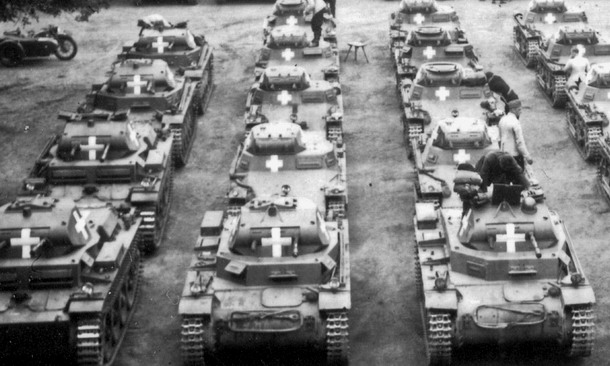
For the attack on Poland in September 1939, German tanks were fitted with large white Balkenkreuz crosses, including on the front armour – a decision that proved not entirely fortunate, source: Flickr.com with permission of the publishing user, edited
The national symbol used on German fighting vehicles was the instantly recognisable Balkenkreuz – the straight-armed cross. It was first introduced in the German Army in April 1918 to replace the original flared-arm cross (the Tatzenkreuz) on German aircraft and tanks. At that time it was used in black on a white field, or with just a thin white outline (photo HERE). The Balkenkreuz was reintroduced in the Wehrmacht as early as 1935 but was not actually applied to tanks in practice until the beginning of the Second World War – during pre-war manoeuvres such permanent vehicle markings were not required. Only in July 1939, less than two months before the attack on Poland, did Army command issue an order requiring all tanks, command tanks, armoured cars, and armoured radio vehicles to be fitted with white Balkenkreuz crosses to clearly distinguish them from enemy vehicles. The order reportedly stated literally that any fighting vehicle seen without this marking was to be treated as hostile.
The order included very precise instructions as to where the crosses were to be placed on each vehicle type and how large they were to be. As to why the Army command opted for an all-white cross (when the First World War had already seen the cross used in black with a white outline), no satisfactory explanation has been found. Some authors suggest it was intended to make German tanks more recognisable to Luftwaffe pilots, but this reasoning alone does not hold up, since the same order also defined a special recognition marking to be painted on engine covers specifically as a signal to aircraft.
In any case, the choice of large white crosses proved most unfortunate. They had a strong unmasking effect and became a very useful aid for Polish anti-tank gunners in spotting tanks, estimating range, and directing fire. No wonder: the Balkenkreuz on the front turret wall of a PzKpfw II was required by the regulation to measure 40×40 cm with arms 10 cm wide – quite a target (the concentration of hits shown in THIS photograph is very telling). Many German crews dealt with the problem in their own way. They smeared the large white crosses with mud, scraped them off (photo HERE), or painted over their centres in a less conspicuous colour – typically either the yellow used for divisional insignia and turret numbers (photo HERE), or the grey that formed part of the tank's own two-tone camouflage scheme (photo HERE). Some crews simply replaced the official large crosses with much smaller ones, painted by hand directly on the armour (photo HERE).
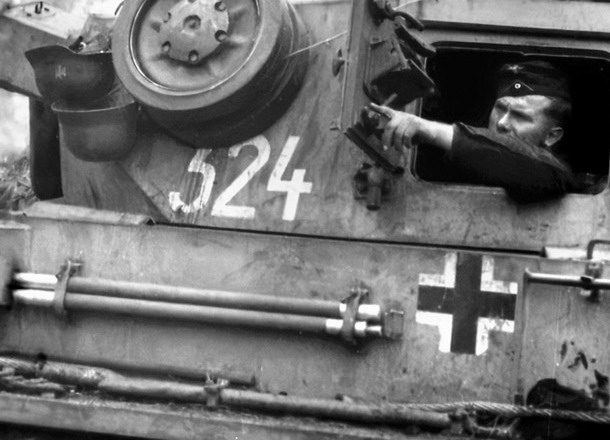
The pattern of the Balkenkreuz with a black centre and open white outline, introduced in October 1939, remained in use until the end of the war. It appeared in a vast variety of forms with different arm lengths and widths, source: Flickr.com with permission of the publishing user, edited
Army command took note and immediately after the Polish campaign issued a new regulation in October 1939 governing both the appearance and placement of Balkenkreuz crosses on tanks. Henceforth, crosses were forbidden anywhere on the front armour of tanks and armoured vehicles. The responsible authorities had apparently realised that German tanks normally face the enemy on the battlefield rather than each other, so conspicuous markings at the front served more as an aid to the enemy than as a prevention of what is now called friendly fire. Similarly, crosses were no longer to be painted on fighting turrets at all, but only on the hull sides and rear – directly linked to this was also a reduction in the size of the crosses.
According to most authors, precise dimensions were not specified in the new official regulation, but the area available on the hull side already limited the cross height to something like 20 to 25 cm. The Balkenkreuz itself was also to become less conspicuous: it was now to have a black centre partially outlined in white (except at the ends of the arms). Before this new standard was fully adopted, an "open" Balkenkreuz without a black centre – formed only by white outlines with the grey or grey-brown base coat of the vehicle showing through between them – also appeared on tanks from time to time.
Turret Numbers
The purpose of a tactical number, call sign, or turret number – whichever term you prefer – is of course to identify a specific vehicle for the purposes of controlling its operational activity. The turret number system introduced by the German Army in the Second World War appears very clear and simple at first glance, but you quickly discover that a whole range of deviations and exceptions existed. Do not therefore expect to find in this article an explanation for every unusual turret number you might encounter in a period photograph.
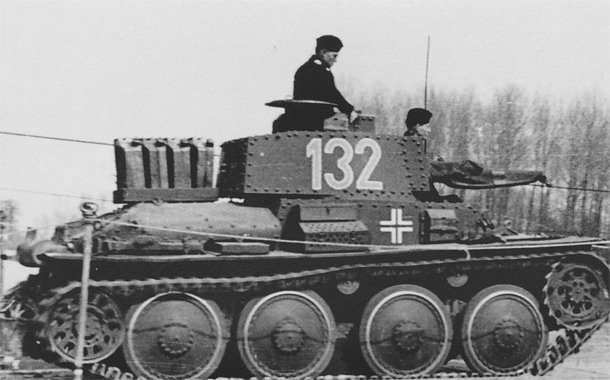
First company, third platoon, tank number two – when it follows the standard like this, it practically reads itself, source: Flickr.com with permission of the publishing user, edited
The standard was a three-digit number, of which the first digit indicated which tank company (Kompanie) the vehicle belonged to. The second position indicated the platoon (Zug) number, and the final position gave the individual vehicle's number within its platoon. A tank bearing turret number 432, for example, was the second tank of the third platoon of the fourth company. A tank platoon had either four or five tanks (depending on the type of platoon, the period, and the type of tank), which means the last digit of a turret number should never exceed 5 – though naturally exceptions existed. A tank company normally had four platoons, meaning the second digit of a turret number should never exceed 4 – with exceptions again. And the first digit – the company number? Here things were somewhat more complicated. Four tank companies together made up one tank battalion (Abteilung), so one might expect the first digit never to exceed 4. Wrong! Companies were numbered consecutively across the whole tank regiment (Regiment), which consisted of two battalions. Two battalions in a regiment meant eight tank companies in total, so the first digit of a turret number could quite legitimately run from 1 to 8 – with exceptions again, as we shall see shortly.
Tank regiment organisation was far from uniform during the early war years, and frequent temporary reinforcement of regiments with additional battalions or companies occurred in preparation for specific operations. Excellent examples can be found when examining the composition of individual tank regiments before the launch of Operation Barbarossa in June 1941. For instance, the 11th Panzer Regiment of the 6th Panzer Division was at that time composed not of two but of three battalions, each with only three companies – giving nine tank companies in total, so the digit 9 could quite legitimately appear in the first position of a turret number. A more extreme case was the 25th Panzer Regiment of the 7th Panzer Division, which had three battalions of four companies each – twelve tank companies in all. The remarkable thing here is that the number of companies in the regiment exceeded a single digit, so turret numbers had to be expanded from three digits to four (with the first two positions occupied by the two-digit company number), as can be seen for example in THIS photograph of a Pz.Kpfw 38(t) – the second vehicle of the 2nd platoon, 11th company of the 25th Panzer Regiment, carrying turret number 1122. Even more interesting is the tank in THIS photograph, whose turret number would place it in the 5th platoon of the 12th company – a non-standard number of both companies and platoons simultaneously (though this could also have been a special command vehicle marking, as we shall discuss shortly). Further four-digit turret numbers can be seen for example HERE and HERE.
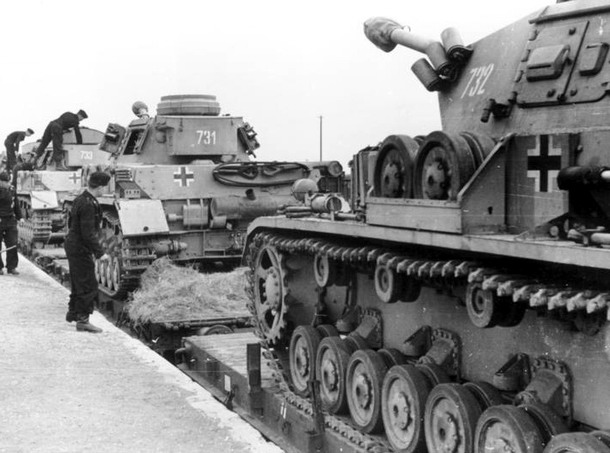
Three Panzer IV tanks from the third platoon, seventh company (731, 732, 733) of an unidentified battalion, regiment, and division travelling together by rail, source: Bundesarchiv_Bild_101I-175-1264-06, Wikimedia, Creative Commons, edited
We promised plenty of exceptions – so here we go! Some units simply adapted the official turret number system to their own preferences. For example, when the 1st Panzer Division still had two tank regiments (i.e. in 1939 and 1940), the turret numbers of tanks in the 1st regiment (Panzer Regiment 1) were supplemented by a white dot, while numbers on tanks of the 2nd regiment were underlined with a white line (though some sources say it was the other way around). Other units painted various additional pictograms on their tanks alongside the standard turret numbers (photos for example HERE, HERE, or HERE).
Some units deviated from the standard far more significantly. For instance, the 15th Panzer Regiment (then part of the 5th Panzer Division) used two-digit numbers indicating only the platoon and vehicle during the Polish campaign, supplemented by a rhombus symbol whose colour identified the tank company (photo HERE or HERE). Later, when the 15th Panzer Regiment became part of the 11th Panzer Division, its tanks could still be seen with two-digit numbers, but without the additional rhombus (e.g. HERE). The 15th Panzer Regiment was not the only unit to use a graphic symbol for company identification. In other units too – possibly including the 4th Panzer Regiment of the 2nd Panzer Division – a small white rhombus with a tiny digit indicating the company number could often be seen on the front armour (photos for example HERE, HERE, or HERE) (the rhombus was, incidentally, the general symbol used to represent tanks in organisational charts). The 8th Panzer Regiment of the 10th Panzer Division also used additional graphic symbols during the French campaign – specifically short white stripes painted mostly on the rear wall of the fighting turret, whose number and orientation identified the tank company. One to three horizontal and one to three vertical stripes can be seen in photographs (e.g. HERE).
Some units went even further in departing from the standard, choosing to use single-digit turret numbers indicating only company membership, with no platoon or vehicle number. Such single-digit numbers can be seen in photographs either alone (e.g. HERE, HERE, HERE, or HERE), or combined with a graphic symbol (e.g. HERE or HERE) that perhaps substituted for the platoon number. Other single-digit marking "systems" also existed. The elite Grossdeutschland Panzer Regiment, for instance, used single-digit turret numbers supplemented by short horizontal dashes for at least a certain period. The digit was the tank's own number, while the number of dashes identified the company (photos HERE, HERE, or HERE). Fairly often in photographs one also encounters a combination of the standard three-digit number supplemented by a large digit emphasising the company number. This system was used consistently by tank crews of the 15th Panzer Division serving in North Africa (photos e.g. HERE or HERE).
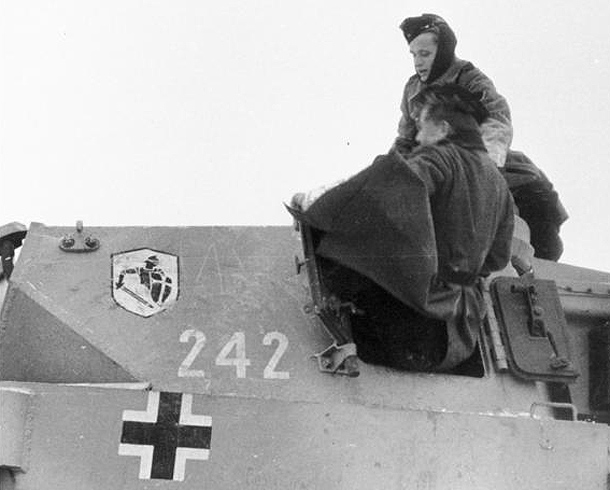
Another fine example of the various markings on the side of a Panzer IV: Balkenkreuz, turret number, and the symbol of the 18th Panzer Regiment (a knight with sword and shield), source: Bundesarchiv_Bild_101I-273-0446-26, Wikimedia, Creative Commons, edited
This style of emphasising the company number was not exclusive to African units. According to some sources, the system can occasionally be seen on tanks from the 8th, 10th, 12th, and 13th Panzer Divisions as well. Tanks carrying their standard three-digit number on a removable plate with the company number again displayed separately in a large digit on the turret side can be seen in photographs HERE, HERE, or HERE. On THIS Panzer III from the 10th Panzer Division, only the platoon number (1) and vehicle number (6) are painted in small figures directly on the turret, while the company number is emphasised by a large and prominent 1 above them. With single-digit turret numbers it is also necessary to distinguish cases of temporary markings used for exercises and manoeuvres. In THIS photograph, for example, a tank numbered 841 has been given the exercise number 2 for the duration of a training exercise. A similar origin probably explains THIS photograph of a tank with a prominent number 4, or THIS one with a large 8.
Sources mention one more non-standard numbering approach, in which the company number was followed by a sequential vehicle number without regard to platoon membership – all tanks in the company were simply numbered one after another. This means the value in the last two positions of the turret number ran consecutively from 01 up to perhaps 20. This is most likely the case with THIS tank bearing the otherwise inexplicable turret number 419, captured by the British in Africa and today on display in the Bovington Museum – it was presumably the nineteenth tank within the entire fourth company. Higher command apparently tolerated deviations from the numbering standard as long as they were generally accepted and understood within a given unit.
Turret numbers were standardly painted – as one might expect – on the fighting turrets of tanks. Before the Second World War, however, the Germans experimented with placing numbers on removable rhombus-shaped metal plates (the rhombus again) attached to the hull sides and rear. The idea was to link the call sign to the crew rather than to the specific vehicle. If the number is painted on the turret it simply belongs to that physical vehicle, and when the tank breaks down or is damaged and sent away from the unit for extended repair, the crew receives a new vehicle with a different number that has to be repainted. The removable plate was meant to solve this simply by travelling with the crew from their old vehicle to their new one.
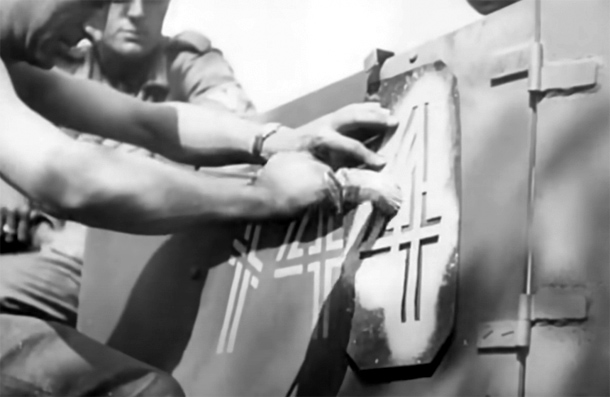
In a field workshop, turret number 744 (7th company, 4th platoon, 4th tank) is being painted on the spaced armour of a Panzer IV, source: Flickr.com with permission of the publishing user, edited
There were, however, two problems with the plate system. The small digits on the plate were not easy to read in combat conditions and at any distance, and wartime experience also showed that the Army was simply not able to supply a replacement vehicle to the crew of a knocked-out tank quickly enough. The norm was rather that the crew simply had to wait for their original tank to be repaired, so transferable number plates made little practical sense. It is therefore no surprise that in addition to the removable plates, call signs began to be painted directly on the turrets as well – in much larger digits – and over time the plates were abandoned entirely. How to interpret the puzzling cases where a tank displays a completely different number on its plate and on its turret remains uncertain (photos for example HERE or HERE).
Company Command
Up to this point we have been discussing the numbering of tanks in combat platoons. Now we turn to the numbering of staff and command tanks – which is where things become truly interesting. To understand what follows, at least a basic grasp of the organisational structure of German armoured units is essential. Working from the bottom up: the lowest fixed organisational level was the platoon (Zug), above it the company (Kompanie), then the battalion (Abteilung), then the regiment (Regiment), and above that the division (Division). Until 1940 there was also a brigade level (Brigade) between regiment and division, which we will touch on briefly below. The platoon commander's tank carried essentially the standard three-digit number, but it always ended in 1 – it was always the first tank of its platoon. So for example the commander of the 2nd platoon of the 3rd company had the number 321 on his turret, and his counterpart commanding the 3rd platoon of the same company used 331. In some units, however, platoon commanders reportedly sometimes used 0 rather than 1. In such cases the 2nd platoon commander of the 3rd company would have tank number 320 rather than 321, and all the other tanks in the platoon would be numbered accordingly.
For tanks belonging to company headquarters (Kompanie), things were slightly more complex. According to the organisational table of 1 November 1941, the staff of a so-called light company consisted of two Panzer III tanks and five light Panzer II tanks. As these vehicles did not belong to any platoon, the second digit of their turret number was simply 0. The company commander himself also had 0 in the third position. The numbering of the 3rd company headquarters tanks might therefore look like this: the company commander carried number 300, his deputy 301, and the five light Panzer IIs carried numbers 302 to 306. A few examples can be seen in the following photographs: the 3rd company commander's tank number 300 (photo HERE), the 5th company commander's tank number 500 (photo HERE), the 8th company commander's tank number 800 (photo HERE), and further staff tanks numbered 101 (photo HERE), 201 (photo HERE), 401 (photo HERE), or 304 (photo HERE). According to some authors, however, company commanders sometimes used numbers with a 0 and a 1 rather than two zeros (so 301 instead of 300), with all the other company staff tank numbers shifted accordingly. And again there were exceptions: the already-mentioned 15th Panzer Regiment of the 11th Panzer Division reportedly used single-digit numbers for its company headquarters tanks, supplemented by graphic symbols probably indicating battalion membership (such as a number and circle symbol in the photograph HERE).
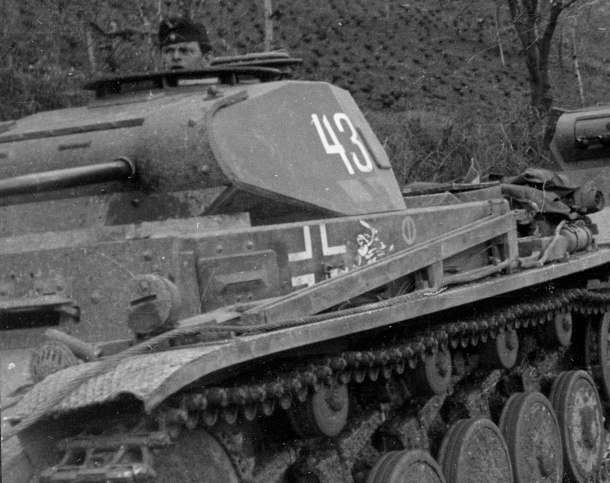
A Panzer II covered in markings: the yellow half-circle is the symbol of the 11th Panzer Division, the ghost is an additional symbol of the same division, then there is the obligatory Balkenkreuz, and a two-digit turret number with a coloured rhombus below it – a speciality used by the 11th Panzer Division (specifically the 15th Panzer Regiment), source: Flickr.com with permission of the publishing user, edited
Battalion Command
The next organisational level above the company was the battalion (Abteilung). The standard marking for battalion headquarters tanks was a two-digit number preceded by a Roman numeral indicating the battalion number – typically I and II, or III if the regiment had three battalions. Returning to the organisational table of 1 November 1941, the tank battalion staff was officially to consist of one Panzer III, two Panzerbefehlswagen III command tanks, a platoon of five light Panzer II tanks, and a pioneer platoon with three further Panzer IIs – eleven tanks in the battalion staff in total. In practice, however, most units had a mixture of whatever vehicles were available, including older command tanks based on the Panzer I. In any case, the 1st battalion commander's tank was to carry turret number I00, the 2nd battalion commander II00, and other staff vehicles might be numbered for example I02 (photo HERE), II01 (photo HERE), III03 (photo HERE), or III01 (photo HERE).
It sounds straightforward, but as always there are plenty of caveats. Surviving photographs show tanks that evidently belonged to tank battalion staffs and carried markings consisting of Roman numerals alone, with no Arabic digits – for example a tank with the number I in the photograph HERE, II HERE, or III HERE. Further puzzles exist too. As mentioned above, according to the tables valid from November 1941 to January 1943, the battalion staff was to have eleven tanks. Yet photographs frequently show tanks with battalion headquarters markings (the leading Roman numeral) and a sequential number higher than 11. The literature does, however, offer a fairly plausible explanation. Some units – reportedly including the 21st and 25th Panzer Regiments – used non-standard numbering for their staff tanks. The command tanks of the 1st battalion staff, for instance, reportedly carried numbers I1, I2, and I3, while the staff light platoon's Panzer IIs received I11, I12, I13, I14, and I15. The same applied to the 2nd battalion, whose light Panzer IIs received II11 to II15. This explanation is supported by surviving photographs, which show virtually without exception vehicles of the Panzer II type (photos HERE, HERE, or HERE).
The soldiers of the 201st Panzer Regiment of the 23rd Panzer Division also introduced their own variation, using the letter L (leichte = light) in the numbers of Panzer IIs in the light platoons attached to battalion staffs. The 1st battalion's light staff platoon tanks thus carried numbers IL1 to IL5, and the 2nd battalion's light platoon tanks IIL1 to IIL5 (photo HERE). The soldiers of the 29th Panzer Regiment (12th Panzer Division) also contributed to the confusion of future researchers, replacing the Roman numerals I, II, and III with the letters A, B, and C for battalion staff vehicles, and substituting a 9 for the 0 in the first position (since the regiment had no 9th company). This means a tank that would by the standard have carried I06 received the number A96 in this unit (photo HERE).
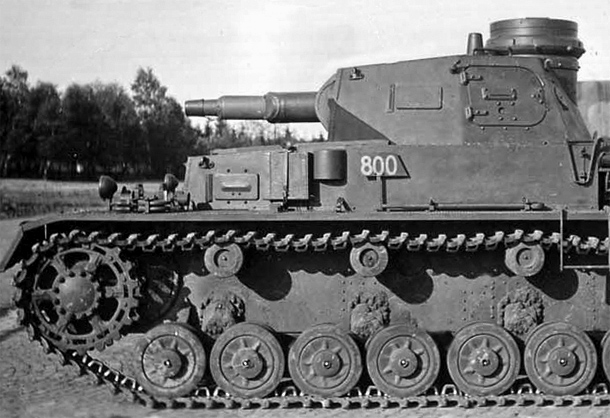
A Panzer IV of the 8th company commander (hence number 800) of an unidentified battalion, regiment, and division – the number is still displayed in the old style on a removable plate, source: Flickr.com with permission of the publishing user, edited
And to ensure this list of exceptions and specialities is long enough, we should also mention tank battalions that were not part of a regiment but were directly subordinate to a division. The 6th Panzer Division provides an excellent example. This division had a standard tank regiment (Panzer Regiment 11) with its own two integral tank battalions. In addition, from the division's formation until mid-1942, it also had a separate independent tank battalion – Panzer Abteilung 65 – which was not under the command of Panzer Regiment 11 but directly under the division. A similar situation existed temporarily in 1940 in the 7th and 8th Panzer Divisions. For the numbering of tanks in the staff of such an independent battalion, Roman numerals were not used; instead the letter A (Abteilung = battalion) was employed. Two such staff tanks from the 65th Battalion of the 6th Panzer Division can be seen in the photograph HERE, carrying turret numbers A01 (Lieutenant Schenk) and A03 (Lieutenant Marquart).
Before leaving the topic of battalion command, we should briefly note the battalion signals platoon, or Nachrichten Zug. This was part of each battalion staff, and the numbers of its tanks incorporated both the Roman numeral identifying the battalion and the letter N. Thus vehicle No. 3 of the 1st battalion staff signals platoon carried turret number IN3 (photo HERE), vehicle No. 3 of the 2nd battalion staff signals platoon carried IIN3 (photo HERE), and vehicle No. 1 of the 2nd battalion signals platoon carried IIN1 (photo HERE).
Regimental Command
Now let us move up from battalion level and look at the tank regiment (Regiment). The standard was again fairly simple. Tanks belonging to the regimental staff were to carry two-digit turret numbers preceded by the capital letter R – so for example R01 (photo HERE), R02 (photo HERE), R03 (photo HERE), or R04 (photo HERE). Photographs also exist of tanks with just the letter R alone and no digits (photo HERE), or with R followed by a relatively high number – e.g. HERE (though in this case the tank evidently belongs to Waffen-SS units). Returning again to the organisational scheme of 1 November 1941, the regimental staff also included, in addition to three staff tanks, a light platoon of five Panzer II tanks. Some units reportedly used the special turret numbers RL1 to RL5 for these vehicles. Photographs also show the letter combination RA (photo HERE), which according to some authors indicates the regimental medical officer's vehicle (RA = Regiment Arzt). Now that we know how battalion and regimental staff tanks were marked, we can enjoy a fine example of both levels operating together in THIS photograph, where a Panther command tank numbered I01 and a Panzer III command tank numbered R01 are seen together.
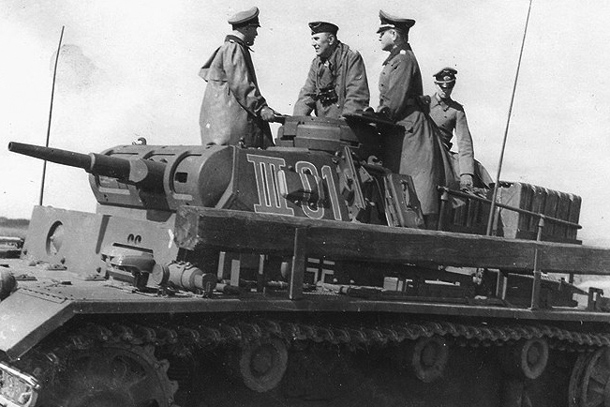
A Panzerbefehlswagen III belonging to the 3rd battalion commander (or his deputy) – some tank regiments did indeed have three battalions, making such command numbers possible, source: Flickr.com with permission of the publishing user, edited
Just as at battalion level, the tank regiment staff also had its own signals platoon (Nachrichten Zug). Turret numbers of such tanks therefore incorporated both the letter R and N – for example the vehicle numbered RN3 in the photograph HERE. The tank with the brief turret number N1 may also have belonged to the regimental signals platoon.
Brigade and Division Command
We have now worked through the numbering of command tanks at platoon, company, battalion, and regiment level. Above these, however, were two further levels: the tank brigade and the tank division. The Germans used the brigade level only until 1940, after which it was removed from the tank division structure. While it existed, the tank brigade naturally also had its own staff, and according to some sources this included as many as four command tanks, carrying turret numbers B00 to B03 (B = Brigade). Brigade staff command tanks can be seen for example in the photographs HERE and HERE. Turret numbers beginning with the letter B, however, also frequently appeared on command versions of the PzKpfw 38(t). In these cases it was most likely not tanks serving at brigade headquarters, but rather some deviation from the standard – perhaps the use of letters A and B instead of Roman numerals to indicate the battalion? According to some authors, the letter B in these cases simply stood for Befehlspanzer, meaning command tank (examples HERE or HERE). Finally, division (Division) headquarters: few sources address this, but some do mention that the divisional staff also had three command tanks, carrying turret numbers D00 to D02. One such tank can be seen in the photograph HERE.
Special turret numbers with a letter or Roman numeral attracted unwanted enemy attention. For this reason, senior commanders sometimes used alternative, less conspicuous numbering that was nonetheless instantly distinguishable from the other tanks in the unit. Sometimes they simply dropped the letter R, leaving just the digits – perhaps 01 (photo HERE or HERE), or replaced the letter R with an additional zero to produce for example 001 (photo HERE). Photographs also exist of tanks with simply a 0 as the turret number (photo HERE). To conceal staff tanks, numbers were sometimes used that matched the format of standard combat vehicle numbers but contained digits too high to correspond to any real company – such as 902 – or any real platoon – such as 451. For the same reason, apparently nonsensical turret numbers like 555 (photo HERE) or 777 (photo HERE) were probably also created.
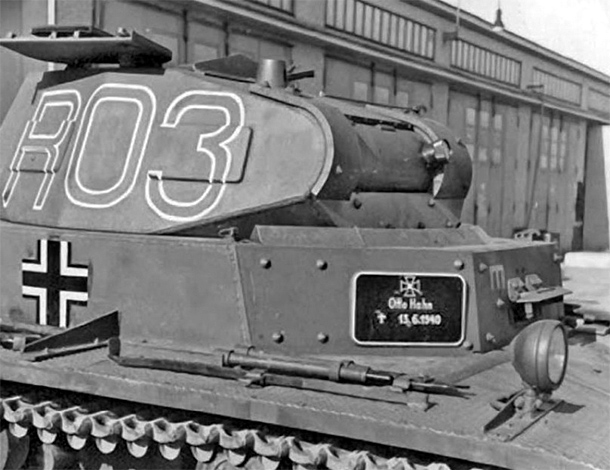
Turret numbers of regimental staff vehicles began with the letter R (Regiment); the 3rd Panzer Division symbol is visible on the front armour, source: Flickr.com with permission of the publishing user, edited
In photographs one frequently encounters turret numbers beginning with various letters not yet mentioned here. We must admit that we do not have an explanation for all of them – for instance the tank numbered V01 in the photograph HERE, or K01 in the photograph HERE. It should be borne in mind, however, that tanks did not serve only in tank divisions but also in a wide variety of other formations, many of which used their own specific vehicle marking systems (including, for example, incorporating the first letter of the commander's surname).
One such very unusual letter in a turret number we can explain, however. Specifically, the letter F on the tank in the photograph HERE. This was a tank from the staff of the flame-thrower battalion Panzer Abteilung 100 (Fl). The letter F in the turret number refers to the word Flamm or Flammenwerfer – meaning flame or flamethrower. The unit's membership is further confirmed by the letter G shown on the tank's mudguard. Panzer Abteilung 100 (Fl) was in the second half of 1941 part of the XXXXVII Panzerkorps, which was subordinate to General Guderian's 2nd Panzer Group, also known as Panzergruppe Guderian – hence the G.
In April 1944 a new regulation was issued intended to standardise the numbering of staff vehicles across tank divisions. The letters R and Roman numerals for regimental and battalion staff vehicles were to be abandoned, replaced by two-digit numbers beginning with 1 for battalion level and 2 for regimental level, followed by the vehicle's own number. This new numerical standard, however, had virtually no chance of being adopted given that the existing conventions were deeply entrenched after five years of war – and in April 1944, the soldiers had rather more pressing concerns.
Divisional Insignia
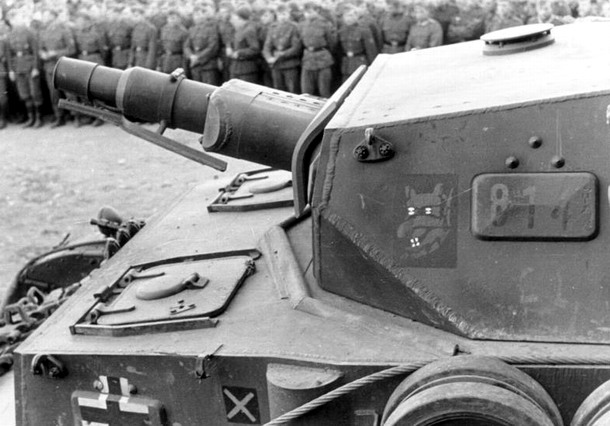
Another fine example of "complete" tank marking: Balkenkreuz, symbol of the 31st Panzer Regiment (devil's head on the turret side), symbol of the 5th Panzer Division (X symbol on the hull side), and turret number 814 (harder to make out here as it was most likely painted in red… as was the devil's head), source: Bundesarchiv_Bild_101I-271-0302-26, Wikimedia, Creative Commons, edited
While divisional symbols were relatively rare on tanks during the Polish campaign of September 1939, a year later in France they were already to be seen on armour quite frequently – and this remained true in subsequent war years, though far from universally. Official symbols were assigned to tank divisions by Army high command and took the form of very simple pictograms intended to allow easy identification of a vehicle's parent division while remaining meaningless to an uninformed enemy. Alongside these, however, many divisions had their own semi-official emblems chosen by the unit itself, reflecting a historical tradition or the division's home region. These served more to boost morale and unit loyalty – the divisional emblem was meant to be something like a battle standard the men could be proud of.
Individual tank regiments sometimes also had their own insignia – for example Panzer Regiment 31, whose emblem was a devil's head, or Panzer Regiment 7, which used a bison silhouette – so on some tanks these regimental emblems were painted alongside the divisional symbols. Some divisions received their emblems at the moment of formation (the 1st Panzer Division, for instance, received its oak leaf as early as 1935), but a comprehensive set of official emblems only came into being before the outbreak of war – ahead of the invasion of Poland. At the end of 1940, however, Army command issued a completely new set of emblems intended to be even simpler to paint and remember than the originals. This was undoubtedly connected with the fact that in 1940 the number of German tank divisions essentially doubled (in preparation for the invasion of the USSR), and since new emblems had to be devised for the new divisions anyway, the existing ones were revised at the same time. It quickly became apparent, however, that some of the new divisional emblems were too similar to each other, so in 1941 some units updated theirs again (this affected the 5th, 6th, and 7th Panzer Divisions, among others). In subsequent war years there were essentially no further changes to existing emblems.
In preparation for the great summer offensive of 1943 – Operation Zitadelle – some of the participating tank divisions received special temporary emblems (examples visible for example HERE). Their purpose was of course to improve the secrecy of the preparations. If, for instance, various informants reported to Red Army soldiers that large numbers of fighting vehicles had passed through a particular railway station and described the temporary emblem they had seen on the tanks, the Soviets would find no such emblem in their records and would be unable to identify the specific tank division that had passed through.
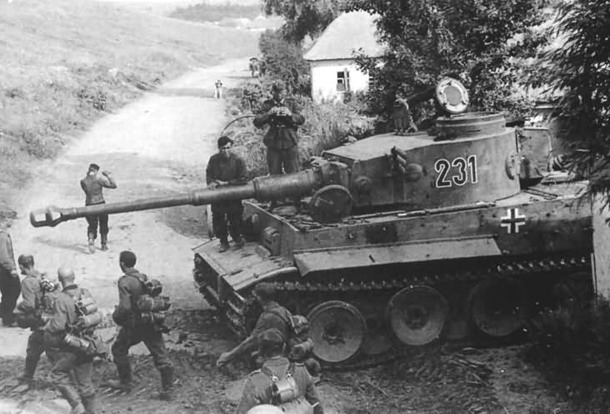
A Tiger tank from the 103rd Heavy Tank Battalion – turret number 231 indicates the first vehicle of the third platoon, second company, source: Flickr.com with permission of the publishing user, edited
The tank numbering system was not designed to enable the precise identification of a single specific vehicle within the entire German Army. The three-digit turret number indicating platoon and company membership was unique only to battalion level. Since company and platoon structures within battalions were identical – at least in theory – every battalion contained a tank with the same turret number, meaning there were in the order of dozens of tanks across the whole Army carrying the same call sign on their turret. If this number was supplemented by a regimental or divisional emblem, identification became considerably more precise, but still not unique. From the number and division symbol one could determine which platoon, company, and division or regiment the tank belonged to – but a tank regiment still had two or sometimes three battalions, so there might be two or three tanks in the regiment with exactly the same turret number and divisional emblem. Nobody was troubled by this, since the purpose of the numbering was not to maintain an inventory of army vehicle assets but primarily to coordinate operational activity on the battlefield.
Tiger Tanks
Everything discussed so far has concerned the organisation and numbering of tanks belonging to tank divisions (or Panzergrenadier divisions). Alongside these, however, various other independent armoured formations existed within the Wehrmacht – some even formed ad hoc for specific operations as so-called Kampfgruppen. We will now look briefly at the independent heavy tank battalions – in German schwere Panzer Abteilung or sPzAbt – in which Tiger and Tiger II tanks were organised. While the structure of these battalions changed over time, we will simplify matters somewhat and use the organisation valid from March 1943, under which a battalion consisted of three companies each with three platoons of four Tigers.
The heavy tank battalion had its own headquarters, which had three Tiger tanks. Their turret numbers in most battalions were written as Roman numerals and were simply I, II, and III (photos HERE, HERE, or HERE). Each of the battalion's three companies also had its own headquarters, in this case equipped with two Tigers. Their turret numbers were already fairly conventional three-digit numbers: the first digit indicated the company number, and the following two were 00 for the company commander and 01 for his deputy (executive officer) – so for example 100 for the 1st company commander (photo HERE) or 300 for the 3rd company commander (photo HERE). For the ordinary combat Tiger tanks the same standard applied as for other types in regular tank divisions: a three-digit number where the first digit indicates the company, the second the platoon, and the third the vehicle's sequential number.
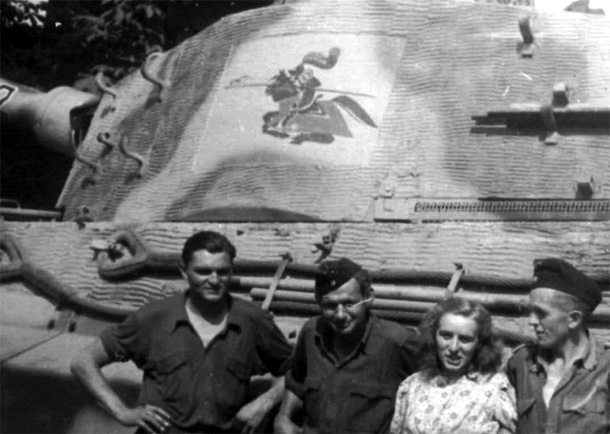
The arguably most elaborate emblem of all the heavy tank battalions was that of sPzAbt 505, seen here on the turret of a Königstiger, source: Flickr.com with permission of the publishing user, edited
Here again there were numerous exceptions. It is known, for instance, that for a period during 1944 sPzAbt 502 and sPzAbt 504 used turret numbers 001, 002, and 003 for their battalion headquarters tanks instead of the usual Roman numerals (photo HERE). The Tiger tanks of the sPzAbt 506 headquarters carried the single-digit turret numbers 1, 2, and 3 for some time between 1943 and 1944 (photos HERE or HERE). The headquarters of the 507th battalion (sPzAbt 507) used the letters A, B, and C for its Tigers between 1943 and 1944 (photos HERE or HERE).
Tiger tanks did not serve exclusively in independent heavy battalions. Some elite Panzergrenadier divisions – both Wehrmacht and Waffen-SS – received their own heavy tank company, including the Grossdeutschland and Das Reich divisions. Both of these introduced turret numbers beginning with the letter S, indicating membership of the heavy tank company (schwere = heavy). The letter was followed by digits giving the platoon and vehicle number (e.g. S24 or S32). Tigers belonging to the company headquarters carried turret numbers S01 and S02 (photos for example HERE or HERE). When the Grossdeutschland division received a full battalion of Tiger tanks in place of the original single company, a new numbering system was introduced. Individual companies in the battalion were designated by the letters A, B, and C. So for example the second tank of the second platoon of the first company carried the number A22 (photo HERE). Company headquarters tanks carried 01 and 02 after their letter – so for example A02 or C01. And as if there were not enough special cases already, there were also various ad-hoc Kampfgruppen that incorporated the first letters of their commander's surname into the turret numbers of their tanks. This was the case with Kampfgruppe Fehrmann, whose Tiger tanks therefore carried the letter F in their numbers – for example F01 in the photograph HERE or F02 in the photograph HERE.
Like regular tank divisions, the heavy Tiger battalions also had their own emblems. In many cases these were considerably more inventive and interesting than the standard divisional pictograms. Schwere Panzerabteilung 501 (sPzAbt 501), for instance, used a crouching tiger as its emblem, while sPzAbt 507 depicted an armourer forging a sword. The most elaborate emblem of all was probably that chosen by sPzAbt 505: a knight charging at full gallop with a lance. To paint such an emblem on tank armour required not only a certain amount of artistic talent but also sufficient clear space – and to create that space, the soldiers did not hesitate to scrape away part of the Zimmerit anti-magnetic paste from the turret (as seen in the photograph above).

ARTICLE
CONTENTS:
Reproducing text from the Panzernet website without the written consent of the operator is prohibited.