GERMAN TANKS – INTRODUCTION
later than the rest, but all the better for it
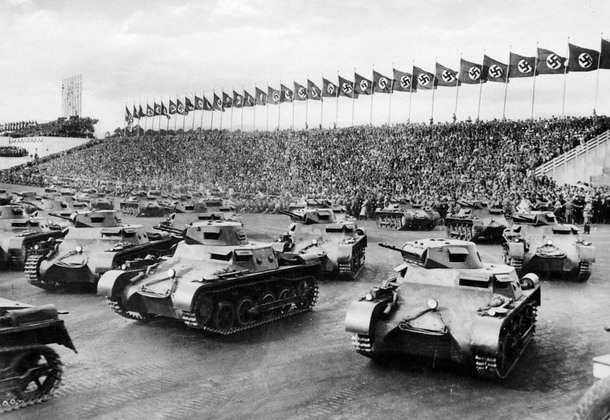
PzKpfw I tanks on pre-war manoeuvres, source: Flickr.com with permission of the publishing user, edited
The First World War
The history of German tanks began to be written at the end of the First World War. Germany, however, was not the driving force behind the development and use of this new weapon. Quite the contrary — the Germans were reacting to the deployment of tanks by the British and French. While the first British tanks were committed to action in dozens at the Somme as early as September 1916, the first example of the German tank A7V (not counting its prototypes) was not built until October 1917 and did not enter combat before March 1918.
In response to the deployment of the first enemy tanks, a transport department numbered 7 was created within the general war administration in 1916, tasked with developing tanks of domestic design. By the end of the First World War the Germans had worked up or completed several projects, all of which shared a common father in the designer and reserve captain Joseph Vollmer.
Of all these projects, only the already mentioned A7V actually reached small-scale production and saw combat. The designation A7V probably derived from the name of the transport department (Abteilung 7 Verkehrswesen). It was an ungainly monster of considerable dimensions whose crew numbered as many as 18 men. The vehicle was based on the chassis of a Holt crawler tractor. The chassis had very limited ground clearance and the tank's hull extended well beyond it on practically all sides — which severely restricted its cross-country performance. On roads, however, the A7V was capable of higher speeds than comparable British tanks of the time.
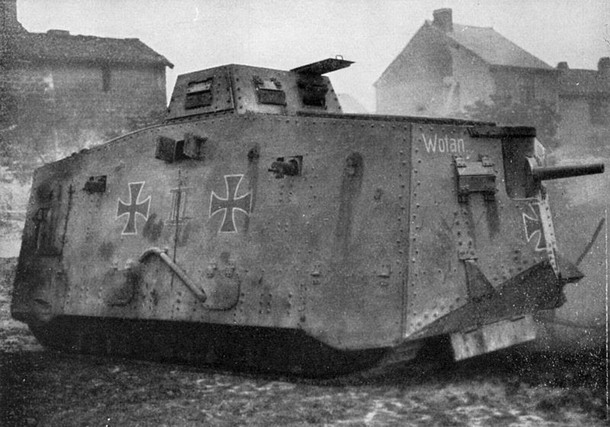
the first German tank, the A7V, source: Wikimedia, public domain, edited
Everything about the tank showed that it had been designed very quickly and under considerable pressure — hardly surprising given the lead that the enemy had built up in tank development. On top of the tractor chassis sat a boxy superstructure bristling with weapon barrels. The tank carried six machine guns in total, plus one gun in the front wall. The A7V's hull showed no attempt at design refinement. Were it not for the front-mounted gun, it would not even have been immediately obvious which end was the front. Thanks to its height the tank was also quite unstable on uneven ground. Its main strengths were its powerful armament and, in places, reasonably thick armour for the period.
The army ordered 100 of these iron beasts, but only 20 were actually built (though other figures are sometimes given). Each tank received its own combat name — Hagen, Wotan, Mephisto, Isolde and so on. These were by no means a standardised series of identical vehicles; individual tanks differed from one another in many details for several reasons: progressive design changes during production, custom fitting of individual components, and modifications carried out in field workshops.
A project designated A7V/U was also drawn up, where the U apparently stood for Umlaufende Ketten (encircling tracks). Its design was strongly inspired by the British Mark IV tanks. It was never built, however, as the single prototype constructed brought none of the hoped-for improvements.
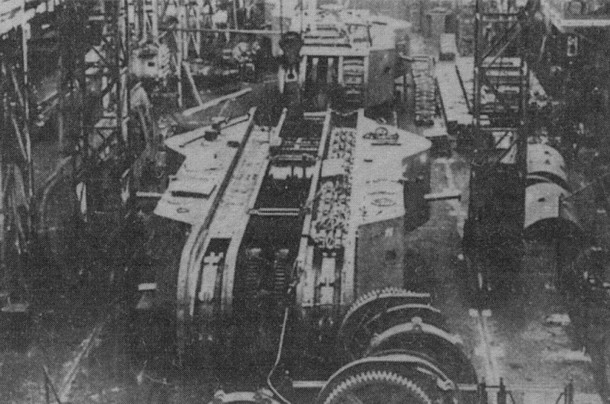
unfinished prototype of the super-heavy K-Wagen tank, source: Flickr.com, public domain, edited
Among the other German projects was the super-heavy K-Wagen (K = Kolossal). This was a tank approximately 13 metres long and weighing up to 165 tonnes (lower figures are also sometimes quoted). Due to its sheer size and weight, the tank had to be designed as a knock-down vehicle so it could be loaded onto a train and transported to the front at all — where the individual sections would be reassembled before the vehicle went into action. The tank was to carry four 77 mm guns and 7 machine guns, with a crew of 22 to 27 men. Given the size of the crew compartment, a modified submarine communication system was to be installed to allow the crew members to talk to one another. Despite the obvious absurdity of this project, construction of two test prototypes was begun. Neither was completed before the end of the war, even though both were already in an advanced state. After the war both unfinished monsters were scrapped.
Far more promising were the results of two successive light tank projects, the LK-I and LK-II. The letters LK abbreviated Leichter Kampfwagen — literally "light combat vehicle." The LK-I was strongly inspired by the British medium tank Mark A Whippet. As the first of the German tanks, the LK-I was fitted with a rotating fighting turret — though at this stage it carried only machine gun armament. Two prototypes of this vehicle were built in the middle of 1918, and that was essentially the end of its career, as development continued with an improved second generation, designated LK-II.
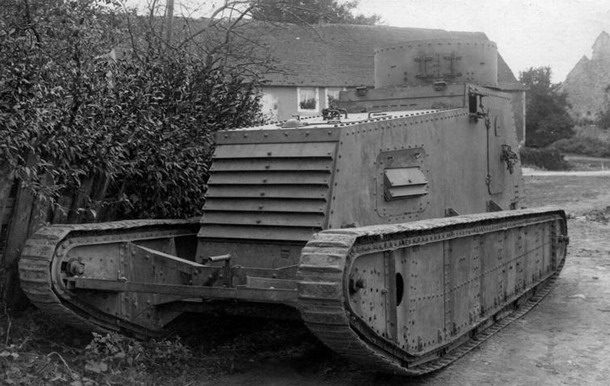
prototype of the LK-I light tank, source: Bundesarchiv_Bild_146-1971-092-26, Wikimedia, Creative Commons, edited
The LK-II could already be considered a tank of modern design. It had a rotating turret armed with either a German Krupp 37 mm gun or a Russian Sokol 57 mm gun. It was powered by a Daimler-Benz engine developing 55 to 60 horsepower, and the 8.75-tonne tank could reach a speed of up to 18 km/h. It arrived too late, however, and only two prototypes were built before the end of the war. After the war, components for the production of 10 of these tanks were sold to Sweden, where the modified LK-II found use under the designation Stridsvagn m/21, and was later further modernised. As a historical footnote: during his visit to Sweden in 1929, Heinz Guderian himself drove one of these modernised vehicles — and it was, incidentally, the first tank the future creator of the German Panzerwaffe had ever sat in.
Several further tank projects were of course also developed before the end of the First World War, but none of them progressed beyond the drawing board.
The Interwar Period
The Treaty of Versailles prohibited Germany from producing many types of weapons, including tanks. Despite this, the Germans secretly continued their development — and this was already happening before Adolf Hitler came to power in 1933.
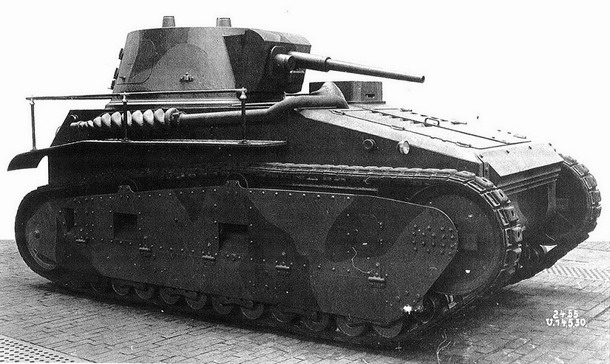
prototype of the Leichttraktor light tank by Rheinmetall-Borsig, source: Flickr.com with permission of the publishing user, edited
From 1925 onwards, Rheinmetall-Borsig, Krupp and Daimler-Benz were working on army contracts developing medium and later light tanks, disguised as tractor production. The prototypes designated Grosstraktor and Leichttraktor did not end in any spectacular success, but they provided German designers and soldiers with invaluable experience that they could not have obtained any other way given their isolation from the Western powers.
An irony of history is the fact that Germany's greatest ally in armoured vehicle development during this period was the Soviet Union — the very country against which Germany would fight the largest tank battles of the Second World War a few years later. Germans and Russians jointly tested their vehicles at the secret test ground at Kama near Kazan.
In 1932, development began on Germany's first post-war heavy tank, designated Neubaufahrzeug — literally "newly built vehicle." Although it did ultimately see actual combat, it never reached series production. That was reserved for an entirely different type: the light and simple training tank PzKpfw I.
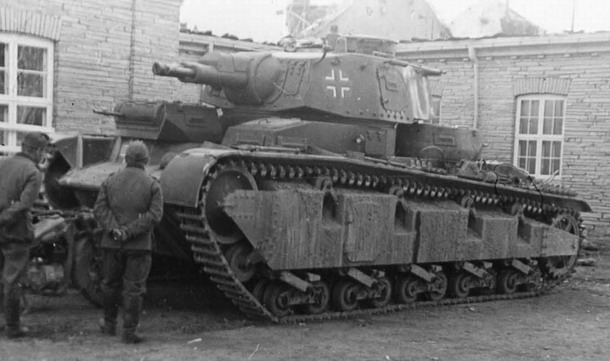
one of the Neubaufahrzeug tanks deployed in Norway, source: Flickr.com with permission of the publishing user, edited
Perhaps partly thanks to their isolation from Western influence, the Germans managed to free their tanks from subordination to other traditional arms of service. The Germans did not design their tanks around which other weapon they were to support, as the British and French did — dividing tanks into infantry tanks (supporting infantry) and cavalry tanks (supporting the cavalry). In the Western armies the influence of the traditional arms of service prevailed, and the novelty called the tank remained under their control. The German tankers, by contrast, succeeded in reversing this relationship of supported and supporting arm, winning for themselves the status of a new primary weapon. Infantry, artillery and air force were henceforth all to support the tanks as the main attacking force — not the other way around. The practice of Blitzkrieg demonstrated that this concept was correct. By the end of the Second World War even the British had abandoned their traditional tank classification and began dividing them into light, medium and heavy.
Tanks for Blitzkrieg
After the conclusion of the Neubaufahrzeug project, Germany began to move away from complex multi-turreted tanks toward simpler designs in which mobility rather than firepower was the primary priority. All previous projects were essentially abandoned and a new tank development doctrine was adopted, based on theories championed by officers such as Heinz Guderian, who advocated the creation of independent and modern armoured formations.
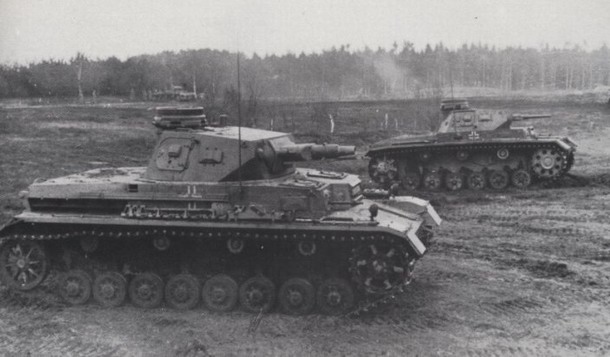
the backbone of the German Panzerwaffe: PzKpfw III (background) and IV (foreground), source: Flickr.com with permission of the publishing user, edited
In this vision, tanks were to serve as the primary offensive weapon. The backbone of the armoured force was to consist of two tank types — a lighter one armed with an anti-tank gun of 50 mm calibre (initially only 37 mm) to destroy enemy armour, and a heavier one with a 75 mm gun to deal with infantry, fortified positions and other obstacles to the advance. These ideas were realised in the form of the PzKpfw III and PzKpfw IV.
Before these, however, two types of light tanks were created: the PzKpfw I and PzKpfw II. These were armed only with light weapons and were not originally intended as fully capable fighting vehicles. They had other important roles to fill. They were to give German designers experience in building modern, fast tanks and to help German industry master the series production of tanks. They were to serve as training vehicles on which future crews would practise the art of manoeuvring and combat. They were then used, during various pre-war manoeuvres and exercises, for the practical testing of theoretical concepts of combined arms warfare at larger formation level. Not least, they also served to convince the conservative army high command of the effectiveness of this "new" type of weapon. The fact that both light types ultimately took part in major combat operations in large numbers was a consequence of Hitler's rush to start the war, which meant there were simply not enough of the heavier tanks available.
The greatest emphasis in German tank development was therefore placed on mobility and cross-country performance. "Only movement brings victory," as the inspector of armoured troops Heinz Guderian put it. Tanks were no longer to be large and unwieldy, but fast and agile, capable of manoeuvring across difficult terrain. The early versions of these tanks therefore also had relatively thin armour and not the most powerful armament — the first PzKpfw III ultimately received a 37 mm gun, which seemed adequate for fighting other tanks in the pre-war years.
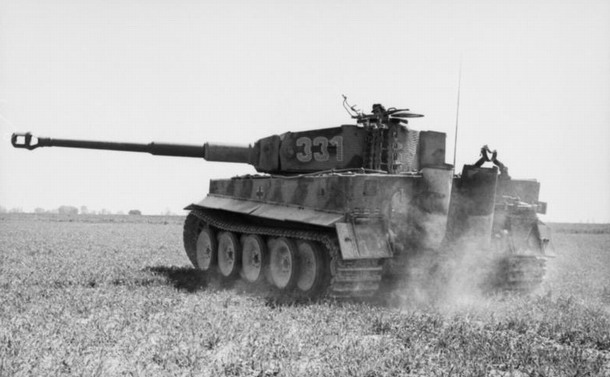
the heavy tank PzKpfw VI Tiger, source: Bundesarchiv_Bild_101I-299-1805-12, Wikimedia, Creative Commons, edited
The Second World War brought rapid further development, however. Anti-tank weapons grew ever more powerful and tank-versus-tank engagements became increasingly frequent. The original specialisation of the PzKpfw III and PzKpfw IV began to blur, and both types were increasingly expected to be capable of fighting enemy armour. Armour was thickened, gun calibre increased (in the case of the PzKpfw III), and muzzle velocity and penetrating power grew. The Panther, Tiger and Königstiger, developed during the war itself, had to match the vast numerical superiority of Soviet armour through their protection and firepower. With the last-named Königstiger, the Germans had already violated their own principles, sacrificing speed for the sake of armour thickness. But that was a different era and a very different situation on the battlefield.
ARTICLE
CONTENTS:
Reproducing text from the Panzernet website without the written consent of the operator is prohibited.