TANK DESTROYERS – INTRODUCTION
what tanks have nightmares about
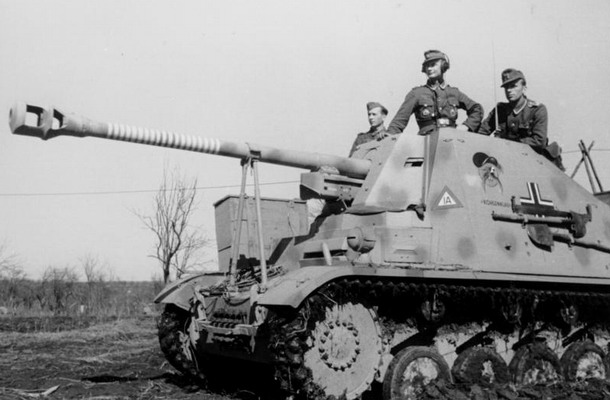
tank destroyer Marder II — note the number of kill rings on the barrel, source: Bundesarchiv_Bild_101I-197-1235-15, Wikimedia, Creative Commons, modified
The Treaty of Versailles, signed in the aftermath of the First World War, placed sweeping restrictions on the size and armament of the German military. Among the weapons whose development and production were explicitly prohibited by the treaty were, of course, tanks. Interwar Germany was thus left to watch as its former — and potentially future — enemies built and trained their armoured forces, while pondering whether it would be capable of defending itself against a possible attack. Before long, voices within the Reichswehr (the name given to the German army after 1919) began arguing that if Germany could not have tanks of its own, it must at least work intensively on its ability to defend effectively against enemy armour. The Germans not only grasped the enormous potential of tanks themselves, but also recognised the critical importance of dedicated anti-tank defence units — Panzerabwehrtruppen.
The Anti-Tank Gun
In 1926, the German arms procurement office drew up requirements for a new gun designed primarily to destroy tanks. Development was entrusted to Rheinmetall, and the new weapon entered production in 1928 under the designation 3,7cm TaK, where TaK stood for Tankabwehr Kanone. Then came 1929, and the Great Depression hit Germany hard. The army was forced to cut spending, and by October 1932 it had managed to purchase a mere 264 of the new guns. Frankly, however, this was not quite as much of a loss as it might seem. The 3,7cm TaK had been designed for transport at low speed by horse-drawn teams, and its carriage therefore had only wooden spoked wheels with no suspension whatsoever.
Speed is Everything!
In the first half of the 1930s, a group of "visionary" officers centred on the Inspector of Motorised Transport, Major General Oswald Lutz, was steadily gaining influence within the German army. Lutz and his colleagues — among them his chief of staff, Lieutenant Colonel Heinz Guderian — were utterly captivated by the possibilities that motor vehicles offered. Nor did they limit themselves to the transport units that officially fell under their authority; they pressed by every available means the idea that speed was absolutely paramount, above all for combat units. Major General Lutz held the view that what Germany lacked in size, it had to compensate for with speed and mobility. The Reichswehr, hobbled by Versailles, could never hope to withstand a numerically superior enemy in static defensive warfare. It therefore had to be capable of rapidly abandoning threatened positions, outflanking the advancing enemy and striking at his flank or rear — only in this way was there any chance of success. And for anti-tank defence, Lutz believed this applied doubly: tanks were, after all, fast vehicles, and anti-tank units therefore had to be equally fast. Yet the main German anti-tank gun, the 3,7cm TaK with its wooden wheels and no suspension, was wholly unsuited to such a fast-moving style of warfare.
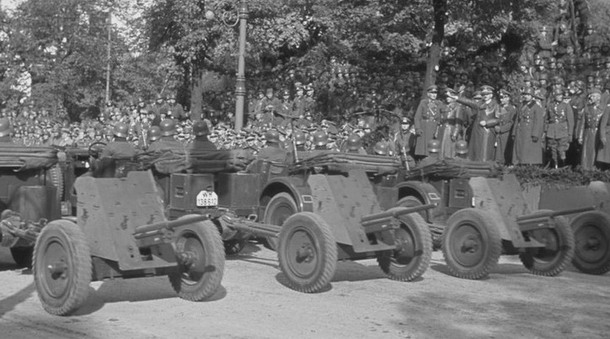
the 37 mm Pak 36 gun formed the backbone of German anti-tank units for a long time; in armoured divisions it was towed by fast cross-country vehicles, source: Flickr.com with the permission of the publishing user, modified
In August 1933, Lutz accordingly prepared a memorandum for the arms procurement office calling for the modernisation of anti-tank units. Horse-drawn teams were to be replaced by motor vehicles, and the anti-tank guns themselves were to be redesigned for high-speed travel. The arms office was evidently persuaded, and in 1934 it commissioned a major upgrade of the 3,7cm TaK. The weapon received a new carriage with sprung wheels fitted with steel disc rims and rubber tyres. The modernised gun was redesignated the 3,7cm Pak 36, and it could now be towed at speed behind a cross-country vehicle without any difficulty.
Time moved on, and developments within the German army continued apace. In 1935, the first German armoured division was formally established. Tanks formed its heart, but what made these divisions so revolutionary was above all that they were self-contained combined-arms formations. A Panzer division therefore included its own infantry, its own artillery, its own reconnaissance, its own engineers, its own signals section — and, naturally, its own anti-tank artillery. At this point, an informed reader might pause and wonder. Surely the most numerous tank type in a Panzer division was to be the PzKpfw III, deliberately armed to defeat enemy armour? What need was there, then, for additional anti-tank guns within the division?
Yes, tanks were the primary striking force of the Panzer division and therefore led the advance as its battering ram. Standing up to a charge of some two hundred tanks head-on was, of course, no small matter. But if the enemy was sufficiently shrewd and sufficiently well informed about the situation on the battlefield, he might try to avoid a frontal engagement, use his own tanks to bypass the German armour, and strike at its flank or rear — in other words, precisely the style of fighting that the Germans themselves considered correct when dealing with tanks. When such an enemy counterattack threatened the flanks or rear of the German tanks, it was the divisional anti-tank defence that came into play. During an advance, these units kept a short distance back behind the tanks to cover their flanks and rear, and when enemy armour appeared in those sectors, it fell to the German anti-tank guns to neutralise it.
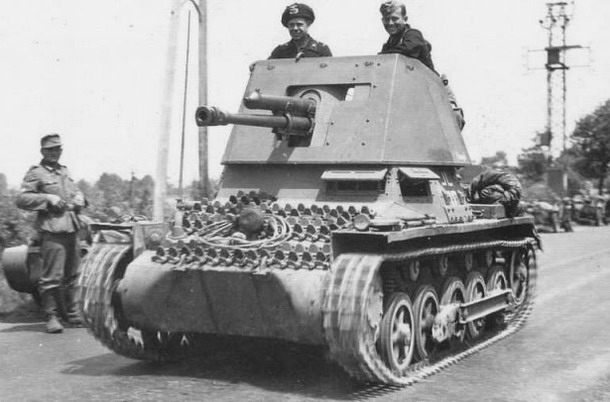
Germany's first mass-produced tank destroyer was the Panzerjäger I, combining the chassis of the PzKpfw I with a Czechoslovak 47 mm gun, source: Flickr.com with the permission of the publishing user, modified
Active Tank Hunting
For the entire Panzer division to function as one effective whole, however, every component had to be capable of keeping pace with its main striking force — the tanks. And since tanks were an inherently offensive weapon, the other elements of the division also needed to be able to fight in an offensive manner. This brought to the fore the question of how to transform the divisional anti-tank defence into an active hunt for enemy armour. Through the course of 1935, the outlines of an entirely new type of vehicle began to emerge from the fog of initial uncertainty — the tank destroyer, or Panzerjäger in German. In defining the requirements for such a vehicle, the arms procurement office drew inspiration from other branches of the military, specifically aviation and the navy, following roughly this logic: if you want to attack an enemy bomber, you do not send another bomber against it, but a much smaller, more agile — and cheaper — fighter; if you want to sink an enemy ship, you can, among other options, send a small, fast, and inexpensive torpedo boat against it. Against tanks, therefore, a vehicle should fight that is lighter than a tank, faster than a tank, and ideally also cheaper than a tank — while still being able to carry effective anti-tank armament and cross equally difficult terrain.
In the mid-1930s, a half-tracked chassis seemed the ideal basis for such a new fighting vehicle. In the workshops of Hansa Lloyd, Büssing and Rheinmetall, several designs and prototypes of half-tracked tank destroyers armed with 37 mm (HERE) and 75 mm (HERE) guns took shape. None of them, however, was accepted for series production, because none met the army's expectations. The proposed vehicles were neither faster nor cheaper than tanks — in fact, they were even more expensive — and so the army temporarily shelved its efforts to acquire a Panzerjäger, continuing to rely on towed guns, primarily the 37 mm models, for its anti-tank work.
Panzerjäger
Time passed once again, and several decisive changes followed. In March 1939 the Germans completed their takeover of Czechoslovakia — a portion of which they had already acquired the previous year through the Munich Agreement — and in September 1939 they invaded and conquered Poland, thereby unleashing the Second World War. As 1940 approached and the German army prepared to strike at its western neighbours, the anti-tank artillery — still relying primarily on the 3,7cm Pak 36 — suddenly found itself with a serious problem. France possessed a considerable number of tanks with frontal armour exceeding 40 mm in thickness, such as the Renault R35, the Somua S35 and the Char B1 bis, and against such armour the 37 mm gun was no longer adequate, at least when firing standard PzGr 39 ammunition. The more powerful 50 mm Pak 38 was not yet in production, so the Germans were forced to look elsewhere for a solution. What they found was the originally Czechoslovak 4,7 cm KPÚV vz. 38 gun, which was now being manufactured for its new masters by the Protectorate's Škoda Plzeň works under the German designation 4,7cm Pak 38(t).
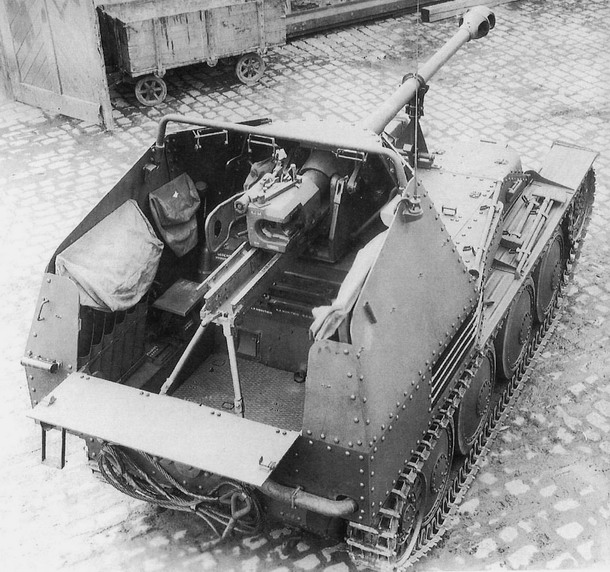
the Marder III was a classic representative of the Panzerjäger family — a light tank chassis, a powerful anti-tank gun, and a lightly armoured, open-topped fighting compartment, source: Flickr.com with the permission of the publishing user, modified
While the German efforts to develop specialised Panzerjäger vehicles in the mid-1930s had foundered partly on grounds of cost, the Germans now found themselves with entirely new opportunities to acquire such a vehicle quickly and cheaply. On one hand, there were the aforementioned Czechoslovak 47 mm guns; on the other, hundreds of their own light Panzer I tanks, which had little left to offer in their original role and urgently needed a new purpose. The wheels of history meshed neatly together, and in March 1940 the first German mass-produced tank destroyer appeared: the Panzerjäger I. Since only 132 were available, the decision was made not to distribute them among the Panzer divisions but to concentrate them instead in independent army-level tank destroyer battalions — the so-called Panzerjäger-Abteilung. These battalions came under the command of individual armies, providing anti-tank support to all units at army level rather than to the Panzer divisions alone.
It was admittedly a makeshift solution of sorts — working with what was to hand — yet the Panzerjäger I vindicated itself convincingly during the campaign in France, proving it had earned its place in the Wehrmacht's arsenal. It came as no surprise, therefore, that a second production run soon followed, along with another similar type of tank destroyer built on the chassis of the captured French Renault R35 and likewise armed with the Czechoslovak 47 mm gun. After the invasion of the Soviet Union in June 1941, however, it became clear that even the Czechoslovak 4,7cm Pak 38(t) fell short against the armour of the modern Russian T-34 and KV tanks. The existing Panzerjäger I and its cousin on the Renault R35 chassis were suddenly near-useless, and the search for a new solution began once again.
The new tank destroyers needed to help the Germans on the Eastern Front would clearly have to carry far more powerful guns. But where to find them quickly when the German-developed 75 mm Pak 40 was still under development? Once again, the Germans had to fall back on a captured weapon — and, paradoxically, a Russian one. In the first months of the eastern campaign, vast quantities of Soviet 76.2 mm divisional guns, the F-22, fell into their hands, with estimates ranging from 1,300 to 2,000 pieces. The Germans modified these weapons to fire a new, more powerful cartridge and introduced them into service under the designation 7,62cm Pak 36(r). A gun was now available — but what about a chassis capable of carrying it? Once again the army reached for a light tank that had long since passed its prime — in fact, for two of them: the PzKpfw II and the PzKpfw 38(t). Mounting the ex-Soviet gun on the Panzer II chassis produced the Marder II, while the same weapon on the Panzer 38(t) chassis received the designation Marder III.
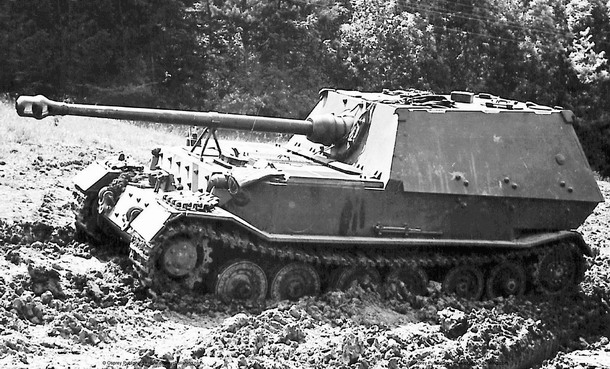
the Ferdinand was the first representative of the new generation of fully enclosed tank destroyers — the Jagdpanzer — heavily armoured and powerfully armed, but unfortunately also expensive, complicated and unreliable, source: Flickr.com with the permission of the publishing user, modified
Using a light tank chassis to carry such a powerful and heavy weapon naturally imposed significant constraints. Consider that the Panzer II had originally been armed with a 20 mm gun, and its chassis was now being asked to carry a gun of 76.2 mm calibre — many times more powerful! The load capacity of the chassis was quite limited, leaving little room for armour protection. The ratio of the gun's size and weight to the chassis's size and carrying capacity also ruled out mounting the weapon in a rotating turret. The gun was therefore once again installed on a mount with a limited traverse. Given the intended role of these vehicles, however, this was not as serious a drawback as it might seem. Tank destroyers were not meant to advance at the tip of the attack, but to follow behind the German tanks. They would go into action when enemy armour launched a counterattack against the flanks or rear of the advancing German tanks — meaning the direction of engagement was more or less known in advance, and a rotating turret was therefore not strictly necessary. The range of the guns fitted was also great enough that even a limited traverse could cover the required area. The gun of the Marder III Sd.Kfz. 139, for example, had a lateral traverse of 50 degrees — 25 degrees to each side — meaning that when engaging a target at a range of one kilometre, it could cover a frontage of more than 900 metres.
With the introduction of these new types, the Germans at last had enough tank destroyers to begin equipping the anti-tank battalions of their Panzer divisions — a process that had previously been impossible. Divisional anti-tank battalions carried two-digit numbers, while those at army level were identified by three-digit numbers. Even so, the transition had to be gradual: initially, only one or two of a battalion's three companies might be re-equipped while the remainder continued to use towed guns. The steady increase in production also allowed the number of vehicles per battalion to grow. A divisional Panzerjäger Abteilung fully equipped according to the February 1942 table of organisation fielded 27 tank destroyers; by December 1942 this had risen to 30, and under the June 1943 regulation to as many as 45. In addition, the battalion was authorised 22 reconnaissance motorcycles, 45 cars, 85 trucks, 13 half-tracked prime movers, one Sd.Kfz. 251 armoured personnel carrier, and a complement of 650 men.
Jagdpanzer
Once the domestic 75 mm Pak 40 gun was finally available in sufficient numbers, several further tank destroyers armed with this weapon followed in succession: the Marder I, additional variants of the Marder II and III, and improvised tank destroyers built on the chassis of the French Hotchkiss 38H and FCM-36 tanks. The last of the Panzerjäger series was the vehicle known by the combat name Nashorn, which entered production in February 1943. All Panzerjäger shared essentially the same basic design: a powerful gun mounted on a minimally modified tank chassis, with the fighting compartment enclosed by a tall, fixed and more or less open-topped superstructure made of thin armour plate that offered only limited protection. This was the common and fundamental weakness of all Panzerjäger — the vulnerability of their crews. The Germans themselves regarded the Panzerjäger as a stopgap solution and were already working steadily on a far more advanced new generation of tank destroyers.
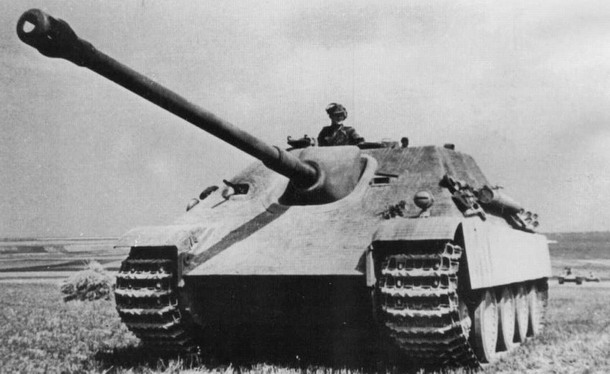
the most successful member of the Jagdpanzer family was arguably the so-called Jagdpanther, built on the Panther chassis and armed with the legendary 88 mm gun, source: Flickr.com with the permission of the publishing user, modified
This new generation of tank destroyers is known collectively as the Jagdpanzer — literally a hunting tank or pursuit tank. The fundamental difference from the earlier Panzerjäger was their fully enclosed and comparatively well-armoured fighting compartment, which offered the crew a level of protection comparable to — and sometimes even exceeding — that enjoyed by the crews of conventional tanks. The first Jagdpanzer was the heavy tank destroyer Ferdinand, which appeared in February 1943. Unfortunately, it was once again a vehicle built largely from available components. On paper it looked impressive — strong armour, a powerful engine, a powerful gun — but in practice it was complex, unreliable and very costly to operate. The arrival of the Ferdinands reopened the question of unit organisation. With only 90 of these heavy tank destroyers available and no further production planned, distributing them among Panzer divisions made no sense, and so new dedicated units were formed for them — the so-called heavy tank destroyer battalions (schwere Panzerjäger-Abteilung), which were again deployed at army rather than divisional level. Strictly speaking, this organisational model also applied to the Nashorn.
Early 1944 then saw two further new tank destroyers enter production: the Jagdpanzer IV and the Jagdpanther. The latter, based on the chassis of the Panther, was without question the most successful vehicle of the entire Jagdpanzer family. Yet it only appeared in 1944, and some 415 were built in total — far too late and far too few. In April 1944, production began on the light tank destroyer Hetzer. More than 2,800 were completed before the end of the war, making the Hetzer the most numerous of the Jagdpanzer types — unless one includes the versatile assault gun StuG III in that category. The last series-produced Jagdpanzer was the 75-tonne behemoth Jagdtiger, which entered production in October 1944. This super-heavy, super-expensive and fuel-hungry machine proved more of a burden than an asset to those who fielded it.
No other nation fighting in the Second World War devoted as much attention to the development and production of tank destroyers as Germany. Two factors drove this. First was an early recognition of the decisive importance of tanks in modern warfare, which went hand in hand with an equally clear understanding of the importance of specialised anti-tank defence. Second was sheer necessity, which caught up with the Germans after the invasion of the Soviet Union, when they were desperately searching for anything that could be meaningfully employed against the staggering numbers of Russian tanks.
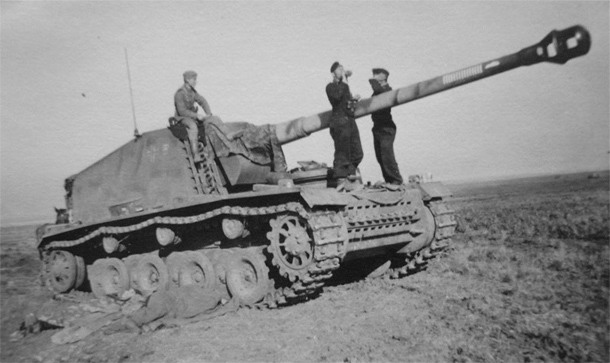
originally a bunker-buster, ultimately an experimental tank destroyer — the Sturer Emil, source: worldwarphotos.info with the permission of the site operator, modified
Others
Two specific groups of fighting vehicles also deserve a mention as distinct sub-chapters in the history of German tank destroyers. The first comprises the Sturmgeschütz III and the Sturmgeschütz IV. The former was developed even before the Second World War, not at the initiative of the armoured forces but at the request of the infantry, who were looking for a self-propelled gun capable of keeping pace with advancing foot soldiers and engaging enemy strongpoints — machine gun nests, bunkers, and anti-tank guns — as soon as they were identified. After the invasion of the Soviet Union, however, the StuG III was whether it liked it or not pressed into the new role of tank killer, simply because so many Soviet tanks were pouring in from the east that the Germans could not deal with them quickly enough by any other means. Rearmed with a new gun, the StuG III soon became one of the most effective tank killers of the entire war. The StuG IV built directly on those successes and, despite retaining the designation "assault gun," was effectively designed from the outset for the anti-tank role. Both Sturmgeschütz vehicles had a fully enclosed armoured fighting compartment, which might tempt one to classify them as Jagdpanzer — but that would be an oversimplification. In the historical record, these vehicles remain assault guns, with the footnote that they also proved highly effective at destroying tanks.
The second group comprises two vehicles that were originally designed to destroy bunkers and fortifications but ultimately saw combat as tank destroyers — and acquitted themselves well in that role. Both types were built in only two prototype examples each, and they went down in history under the nicknames Dicker Max and Sturer Emil.
ARTICLE
CONTENTS:
Reproducing text from the Panzernet website without the written consent of the operator is prohibited.