SELF-PROPELLED GUNS – INTRODUCTION
when the artillery has to keep pace with the tanks
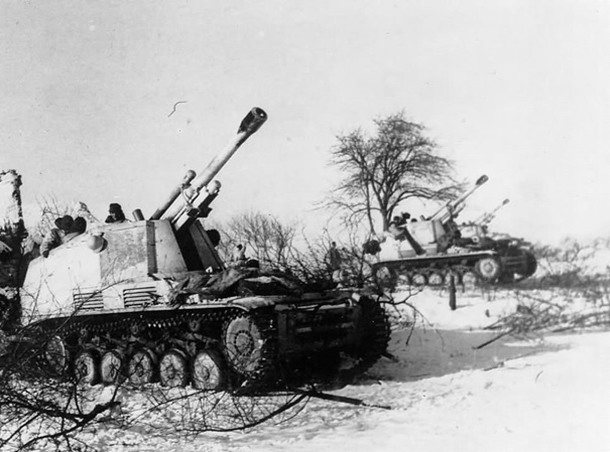
a battery of light self-propelled howitzers Wespe, source: worldwarphotos.info, courtesy of the site operator, edited
When it came to self-propelled guns, the Germans in World War II distinguished between two (or, one might say, three :-)) distinct categories of these fighting vehicles, which differed considerably in their purpose and also in their design (self-propelled anti-tank guns are deliberately excluded here, as they are covered in the tank destroyers section). The basic category of German self-propelled artillery was the so-called Selbstfahrlafette — literally a self-propelled carriage or mount for a gun. These were intended to fulfil the same battlefield role as conventional artillery, but with the advantage of being self-sufficient in terms of transport and capable of opening fire at any time from any position. Thanks to their speed and cross-country mobility, they could — unlike towed guns — keep pace with armoured formations. The level of armour protection on vehicles in this category was secondary, since Selbstfahrlafetten were not expected to come into direct contact with the enemy. The second category was the so-called assault guns, or Sturmgeschütze in German. These were developed specifically for providing direct artillery support to the infantry (though their role later changed considerably). Within the assault gun category, a further sub-category eventually emerged whose members are sometimes referred to collectively as Sturmpanzers. Despite the misleading name, these were not tanks (Panzer) but assault guns designed specifically for destroying large and resilient targets at close range — primarily residential buildings in the streets of large cities. For this purpose they were comprehensively and heavily armoured, and the emphasis in their armament was on destructive power rather than long range. But let us start at the very beginning…
A History of Artillery
Artillery as an arm of service, and guns themselves, have a very long history. Their original purpose was above all the destruction of strong fortification walls. Early artillery therefore fought in a largely static manner during sieges of towns and fortresses, and did not need to be particularly mobile. It took many centuries of technological progress before guns became light and manoeuvrable enough to provide fire support to an army in the field — giving rise to what became known as field artillery, capable of travelling routinely with the troops. One milestone in the history of the gun was the weapon designed by the British engineer William Armstrong in 1855. Armstrong's gun had a rifled barrel and was loaded from the breech through the chamber. Rifling imparts a spinning motion to the projectile, which stabilises its flight and results in significantly greater accuracy — especially at longer ranges. Rifling had been used in small arms several centuries earlier, but cutting precise and regular rifling into a gun barrel remained a major engineering challenge until the mid-nineteenth century.
Breech-loading had also been tested much earlier, but all attempts had foundered on the inability to manufacture a breech block strong enough to withstand the energy generated by the firing charge. Only the advances in metallurgy and metalworking that the Industrial Revolution brought made it possible to put the concept into practice. The uniquely innovative feature of Armstrong's gun, however, was the two-layer construction of its barrel. A forged inner barrel was wrapped in an outer layer applied while red-hot, which on cooling contracted slightly and from that point permanently compressed the inner barrel. This made the inner barrel better able to withstand the expansive pressure generated by firing. This type of construction allowed the barrel to have thinner walls overall than had previously been possible, making the gun lighter and therefore more mobile.
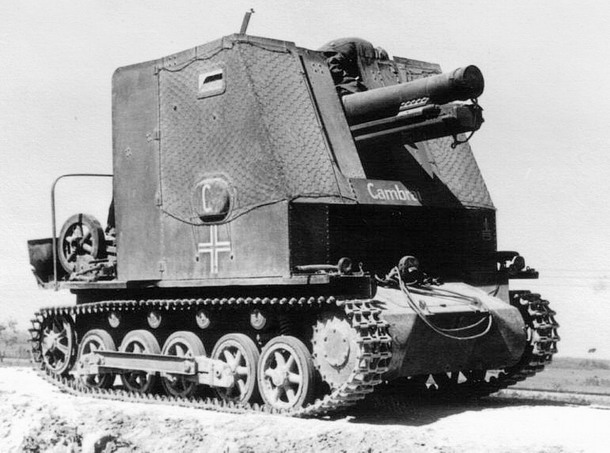
in the early years of the war the German army had to make do with improvised self-propelled guns such as the "Sturmpanzer I," source: worldwarphotos.info, courtesy of the site operator, edited
The next milestone came soon after in the form of the French Modèle 75 gun of 1897. For the first time in a field gun, a barrel recoil system with a hydro-pneumatic recuperator was used. On older guns, the recoil after firing was transferred to the entire weapon, so a wheeled gun carriage always rolled back slightly. The crew then had to return the weapon to its correct firing position (or the carriage wheels were set into prepared depressions, so the gun would roll back to their edge and settle back). On the new French weapon, however, only the barrel moved rearward — sliding back — and was then returned to its original position by the recuperator, while the carriage remained essentially stationary.
The adoption of rifled guns also allowed the abandonment of the older type of spherical projectile — the cannonball — in favour of modern cylindrical shells with a pointed nose. Projectiles of this design permitted the installation of impact fuzes, since it was now clear which end would strike the target (unlike with the older cannonball), and this naturally improved their effectiveness considerably. The increasing range of guns was necessarily accompanied by progress in the field of aiming, within which indirect fire — shooting at targets not directly in the line of sight — became ever more important. In indirect fire, the gun is not aimed directly at the target (the target is not in line with the sights as it would be with a pistol, for example), but rather the shell follows an arcing trajectory to the target, whose path must be estimated, calculated, or determined from range tables.
World War One
All this progress meant that in the First World War, artillery could be deployed with an intensity never seen before. Guns were cheaper — and therefore more could be produced than ever previously; guns were lighter — and therefore relatively easy to bring to the front; guns fired farther, more accurately and at a higher rate, and their shells were more effective than at any time before. The massive deployment of artillery first contributed to making the war positional, and as the fighting became bogged down, both sides paradoxically pushed more and more guns forward in hopes of finally breaking through the enemy's defensive lines and restoring movement to the war. The range of artillery weapons used during the Great War was very diverse, encompassing everything from heavy mortars in fixed emplacements to modern light guns and trench mortars.
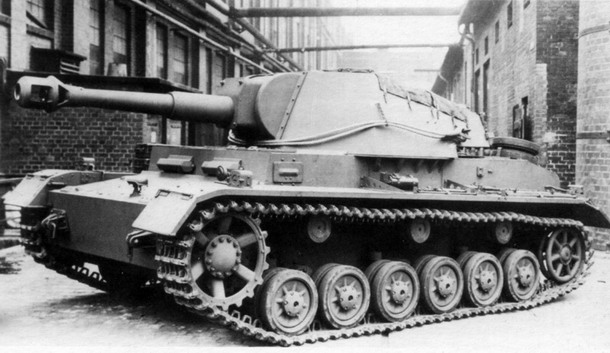
the first German self-propelled gun specifically developed for the purpose was this Sd.Kfz. 165/1; the ordnance office failed to recognise its potential and the project was cancelled, source: flickr.com, courtesy of the publishing user, edited
Germany emerged from the First World War not only as the defeated party but as the principal culprit — and therefore also the one most heavily punished. Enormous war reparations were imposed and the German army, the Reichswehr, was severely restricted in both size and the quality of its equipment. On the artillery front, the army retained the most modern weapons left over from the war years that the Treaty of Versailles allowed — chiefly the 7.7 cm Feldkanone 16 (FK 16), the 10.5 cm leichte Feldhaubitze 16 (leFH 16), the 15 cm Kanone 16 (K 16), and the 15 cm schwere Feldhaubitze 13 (sFH 13). While these had been reasonably modern weapons at the end of the First World War, a decade later that was no longer entirely true.
New German Guns
The German army therefore commissioned Krupp and Rheinmetall to develop new guns in several categories — light and heavy field guns and infantry guns — towards the end of the 1920s, regardless of the prohibitions in force. It was at this time that most of the guns that would later form the backbone of the Wehrmacht's field artillery were born, including the 7.5 cm leIG 18, the 10.5 cm leFH 18, the 15 cm sFH 18, and the 15 cm sIG 33. The attentive reader will notice that all of these except the last carry the number 18 in their designation. That number normally indicates the year a weapon entered service. Why 18, then, given that these new guns were not adopted until the early 1930s? On the German side this was a deliberate measure intended to deceive the Western powers overseeing compliance with the Treaty of Versailles. When weapons bearing the number 18 appeared in unit reports, they looked at first glance like guns introduced during the First World War — old types, in other words. More than ten years after the war, closer examination was apparently no longer something anyone bothered with.
The Order: Speed Up!
All the new guns mentioned had one more thing in common — the mode of transport for which they were designed. In this respect both manufacturers and the army remained conservative, so the primary method was horse-drawn. To be fair, the Reichswehr did not have enough motor vehicles capable of towing guns cross-country, so using horses made sense and was cheaper. With the exception of the heaviest 15 cm sFH 18, all the guns were therefore originally fitted with carriages on wooden spoked wheels, suitable only for movement at roughly walking pace. The 15 cm sFH 18 alone received steel wheels with solid rubber tyres from the outset, though without any springing — so rapid movement was not an option there either.
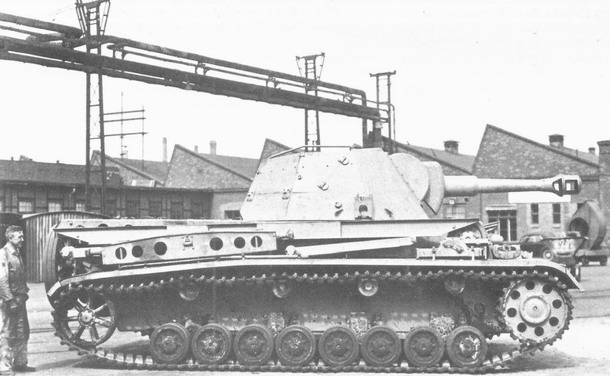
the standard German self-propelled gun was intended to be a type developed under the Grille/Heuschrecke programme, such as this Heuschrecke IVb; the over-engineered and complex vehicle never entered production, source: flickr.com, courtesy of the publishing user, edited
In the early 1930s, however, certain circles within the German army were engaged in feverish theoretical work about the future — about lightning attacks carried out by highly mobile forces spearheaded by tanks. As early as 1932, military exercises were being held using various dummies to test possible approaches to fast mobile warfare. The conclusions were clear. Whether they liked it or not, tanks needed the support of the other arms — including artillery. But for artillery to provide that support it had to keep pace with the tanks, which meant it had to speed up considerably. Horse-drawn transport was therefore out of the question. In 1933 a large programme was accordingly launched to develop specialised half-track artillery tractors in several weight classes — the programme that produced the half-tracks Sd.Kfz. 6, Sd.Kfz. 7, Sd.Kfz. 8, Sd.Kfz. 9, Sd.Kfz. 10, and Sd.Kfz. 11.
Half-track tractors naturally could not be supplied in numbers sufficient to replace horses throughout the entire army, nor was that the intention. They were primarily intended for artillery units assigned to the planned panzer divisions. Artillery in conventional infantry formations could perfectly well remain horse-drawn for now, at least. The new motor tractors offered high road speeds and solid cross-country performance. The guns themselves also had to be adapted for the new mode of transport, however — wooden spoked wheels had to go, replaced by wheels with steel discs fitted with either solid rubber tyres or conventional inflatable pneumatics. Modernising the guns themselves could not be done overnight, so some interim measures were adopted to improve the mobility of older types, including separate wheeled trailers onto which older guns were loaded to be towed by a half-track or lorry (a photograph of this arrangement can be seen HERE).
Selbstfahrlafette
The introduction of motor tractors substantially increased the speed of gun transport, especially on roads. One fundamental delay still remained, however — the need to unhitch the gun at the destination, prepare it for action, and then before departure to "pack it up" again (folding down the trail legs above all) and re-attach it to the tractor. In this respect little had changed compared to the horse-drawn era. It is therefore no surprise that representatives of the armoured troops soon came forward with the requirement that the artillery in their divisions be capable of opening fire immediately, at any time and from any position. The only way to achieve this was to mount the gun directly on the carrier on which it would travel and from which it would fire — in other words, a self-propelled gun: a Selbstfahrlafette in German terminology.
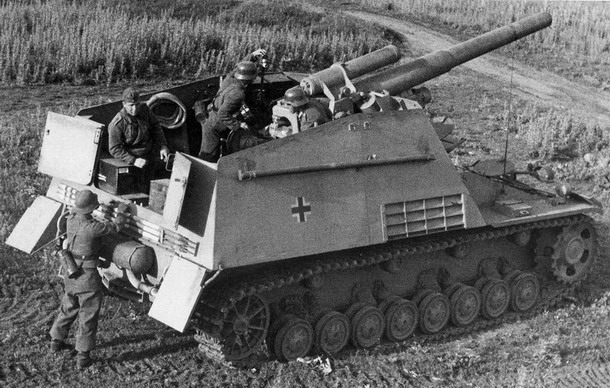
the Hummel (and Wespe) self-propelled howitzers were only intended as a temporary solution while the more advanced Grille/Heuschrecke types were being developed; in the end, however, they formed the backbone of German self-propelled artillery through to the end of the war, source: flickr.com, courtesy of the publishing user, edited
The Selbstfahrlafette had to be able to cross the same difficult terrain as the tanks themselves, which meant it had to have a fully tracked chassis. It had to be at least as fast as the tanks — ideally faster, so that it could catch up with them again after spending time firing from one position. Where it did not need to match the tanks was in armour protection. The Selbstfahrlafette was to fulfil the same role as conventional artillery — providing fire support to the main combat arm. It was not to lead the attack alongside the tanks, but to operate nearby, just behind the advancing spearhead, and therefore was not expected to come into direct contact with the enemy. Heavy armour was therefore unnecessary; protection against rifle and machine-gun fire and smaller shell fragments was sufficient. The weight saved on armour was to be used to increase the vehicle's speed and/or its on-board ammunition supply.
In August 1935, the first three German panzer divisions (Panzer Divisionen) were formed. Each included among its components its own artillery regiment (Artillerie Regiment) consisting of two battalions (Abteilungen), each with three batteries (Batterien) of four 105 mm guns. One battalion was to be equipped with conventional towed guns and motor tractors, while the other was to have self-propelled guns. None yet existed, but that was expected to change soon.
The development and procurement of new weapons for the German army was overseen by the ordnance office (Waffenamt). And it was here that the armoured troops encountered a degree of resistance when it came to negotiations over self-propelled guns. Responsibility for tanks and related equipment within the Waffenamt lay with the department Waffen Prüfwesen 6 (WaPrüf 6). Weapons for the artillery — and therefore also self-propelled guns — fell under the department Waffen Prüfwesen 4 (WaPrüf 4). It is quite possible that behind this resistance to self-propelled guns lay a general antipathy on the part of the "old" arms of service (artillery certainly being among the oldest) toward the young and assertive Panzerwaffe, which so impertinently claimed to be the centrepiece of the modern army.
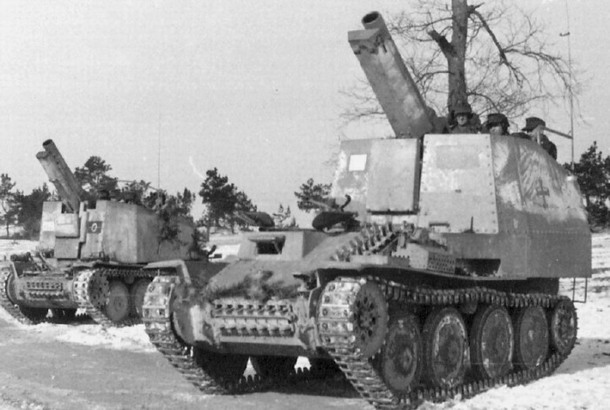
just like the Wespe, the Grille self-propelled guns represented a sound use of chassis from obsolete light tanks (in this case the Panzer 38(t)), source: worldwarphotos.info, courtesy of the site operator, edited
WaPrüf 4 argued that a self-propelled gun was considerably more expensive to produce than the combination of a towed gun and a tractor. If a self-propelled gun was hit, it was simply lost. If an ordinary gun was hit, at least the tractor survived; and if the tractor was destroyed, the soldiers at least still had the gun. When a half-track tractor delivered a conventional gun to its firing position, it could drive away and carry out other duties — bringing up ammunition, for example. A self-propelled gun not only permitted no such flexibility, but actually required an additional vehicle to supply it with ammunition and fuel. And finally, if a self-propelled gun broke down, recovering it was far more demanding than recovering a broken-down tractor with its towed gun. The ordnance office therefore did not fully share the enthusiasm for self-propelled guns. Its officials continued to view the gun as a static weapon that merely needed to be moved to a different location from time to time. Why should a gun need to keep moving, when its range was over 10 kilometres? What the artillerists apparently failed to appreciate was that when tanks were attacking, the front could move those 10 kilometres in under an hour.
The Waffenamt eventually embarked on the self-propelled gun project, of course, but its first attempt in 1935 unmistakably smelled of penny-pinching. The ordnance office instructed Krupp — which was at the time developing the new medium tank PzKpfw IV — to design a modified turret for that tank capable of mounting a 105 mm howitzer. The vehicle was apparently designated Nebeltank or Rauchwagen (abbreviated R.W.). Krupp's designers decided to make use of the prototype chassis designated B.W. II — one of two alternative chassis Krupp had proposed for the PzKpfw IV (B.W. I and B.W. II). The army had chosen the B.W. I chassis for series production of the Panzer IV, leaving the B.W. II prototype without a purpose.
The new turret for the 105 mm howitzer was completed in 1938 and fitted to the above chassis. The resulting vehicle clearly did not meet the army's expectations, however, as in November 1938 Krupp received orders to dismantle the turret so that the B.W. II chassis could be freed for other purposes. After this experience the ordnance office agreed that the Selbstfahrlafette would be developed as a new type tailored to its purpose. The first such vehicle was to be the self-propelled howitzer 10.5 cm leFH 18/1 on the Pz.Sfl. IVb chassis. Development of this vehicle dragged on, however, and in September 1939 — when war broke out — it still existed only on paper. The Germans therefore had to improvise, building their first self-propelled guns — Sturmpanzer I (1940) and Bison (1941) — on the chassis of obsolete light tanks, the Panzer I and Panzer II respectively. It was a quick and cheap solution, and the results reflected that.
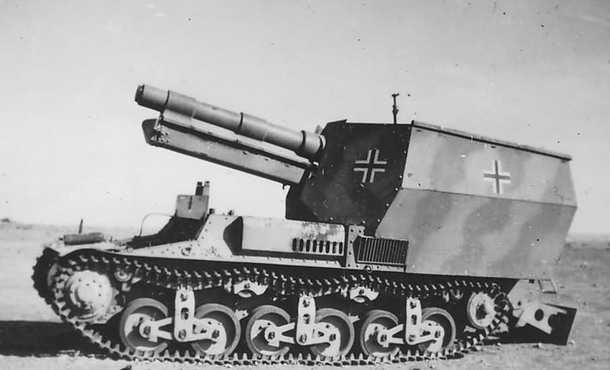
a more marginal contribution to the German self-propelled gun arsenal came from conversions of captured French vehicles carried out by the so-called Baukommando Becker — here a 15 cm howitzer on the Lorraine 37L tractor chassis, source: worldwarphotos.info, courtesy of the site operator, edited
The first prototypes of the fully capable self-propelled howitzer 10.5 cm leFH 18/1 auf Pz.Sfl. IVb were finally produced in late 1941. While it was by no means a bad fighting vehicle — compared with the improvised types the Wehrmacht had been forced to use at the time it was genuinely excellent — in the eyes of WaPrüf 4 it was simply not quite right. The representatives of WaPrüf 4 were evidently still wrestling with how to reconcile the concept of the Selbstfahrlafette with their vision of the gun's role. They eventually concluded that the ideal self-propelled gun would be one from which the weapon could easily be removed from the chassis and placed on the ground. In the attack the gun would function as a self-propelled weapon; in defence the dismounted gun could fight independently in a static position, just like an ordinary gun. The tracked carrier could then move elsewhere, so it and the gun would no longer constitute a single target for enemy fire, and the carrier would no longer be subject to wear and strain from the firing. The armoured troop representatives must have been tearing their hair out in horror — all of this ran directly contrary to their vision. Self-propelled guns were supposed to be self-propelled in order to move, not to stand still!
The Grille / Heuschrecke Programme
There was nothing to be done about it. The 10.5 cm leFH 18/1 auf Pz.Sfl. IVb project was cancelled, and in early 1942 the ordnance office launched a new, far broader and more ambitious programme. Its goal was to obtain self-propelled guns in three categories — light (105 mm), medium (128 mm), and heavy (150 mm) — that would meet two fundamental requirements: full 360-degree traverse of the weapon and the ability to remove it from the chassis for use in a static firing position on the ground. The ordnance office resolved to use the most modern components available or expected to be available soon. The carrier for the light 105 mm howitzer was to be based on the still-in-development tank VK 16.02 Leopard, while the carrier for both heavier weapons was to use components of the also-still-in-development Panther tank. The vehicles designed within this programme — and there were quite a few of them — became known collectively as the Heuschrecke (grasshopper) and Grille (cricket) (note: not to be confused with the series-produced self-propelled gun Grille, also known as the Sd.Kfz. 138/1).
The ambition to use the very latest and most modern components would under other circumstances certainly have been commendable, but in early 1942 this was a luxury the German army could not quite afford. Staking everything on chassis that were themselves still in development meant the troops would be waiting a long time for their new self-propelled guns. And on top of that, the two technically very demanding requirements of WaPrüf 4 — the fully rotating weapon and the utterly absurd ability to remove the gun from the chassis to the ground.
The Temporary Solution
It was abundantly clear that development work on the new self-propelled guns would be complex and lengthy. A temporary solution (in German, Zwischenlösung) was therefore needed — one that would provide the army with self-propelled guns of a less advanced design, but available and usable far sooner. That temporary solution took the form of the Wespe and Hummel self-propelled howitzers (and essentially also the Grille (Sd.Kfz. 138/1)).
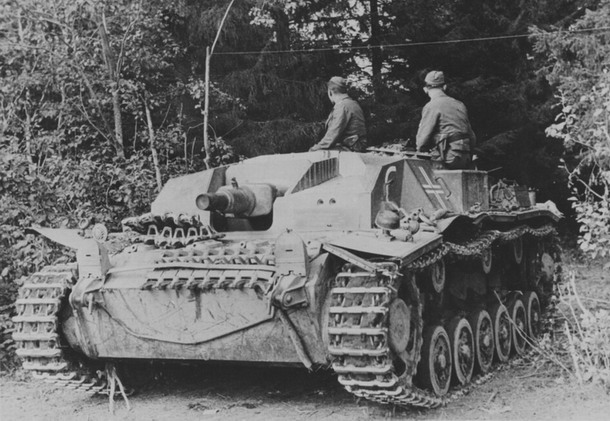
a specific category of self-propelled gun was the so-called assault gun — originally intended for infantry support, it later excelled particularly in destroying tanks, source: worldwarphotos.info, courtesy of the site operator, edited
The overall approach was therefore similar to that taken with German tank destroyers: get some usable fighting vehicles to the army as quickly as possible, thereby buying time for the development of more advanced and capable vehicles that would become the standard. In the case of self-propelled guns this did not work out, however, and the entire Heuschrecke / Grille programme ended in very poor fashion. While the "temporary" self-propelled guns Wespe, Hummel, and Grille (Sd.Kfz. 138/1) were performing their duties capably on the front, representatives of WaPrüf 4 sat for long months alongside the designers of Krupp and Rheinmetall-Borsig, poring over stacks of drawings and calculations, studying wooden models, and devising various modifications and improvements — none of which led anywhere. The first design submissions from Krupp were designated Heuschrecke 12 (128 mm gun) and Heuschrecke 15 (150 mm gun), while the second series received the designations Grille 12 and Grille 15. At least one of Rheinmetall's four proposals received the designation Skorpion (scorpion). Not one of these proposals so much as reached prototype stage.
The year 1943 brought two utterly fatal complications to the Heuschrecke / Grille programme. First, the VK 16.02 Leopard project was cancelled; then came the decision that Panther tank components would not be made available for self-propelled gun production in the future, as all production capacity was indispensably needed to maximise output of the tank itself. The Heuschrecke / Grille programme had thus lost both chassis on which it had long been counting. Theoretical work on the programme continued even after this, but by 1944 the entire initiative was inevitably and definitively closed down. In truth the Heuschrecke / Grille programme had been doomed from the start — by the ordnance office's stubborn insistence on full gun rotation and the ability to dismount the weapon for a static firing position. Throughout all the years of development work, designers never found a simple and reliable way of achieving this.
What is depressing is that the representatives of WaPrüf 4 apparently learned nothing. When it became clear that Panther chassis were not going to be available, they launched in May 1943 the project Heuschrecke IVb, intended to use the chassis of the "temporary" self-propelled gun Hummel. The technical specification again featured the same familiar requirements: a fully rotating turret and the ability to dismount the gun under its own power. And sure enough, Heuschrecke IVb also ended in failure — for exactly the same reason: the practical impossibility of meeting the ordnance office's absurd requirements. The temporary solution in the form of Wespe, Hummel, and Grille (Sd.Kfz. 138/1) thus became the permanent solution, and the Wehrmacht had to make do with these self-propelled guns through to the end of the war. For completeness it should be added that they were supplemented by further types built on the chassis of captured French and British tanks, produced by the so-called Baukommando Becker in occupied France — though these can be considered a peripheral matter.
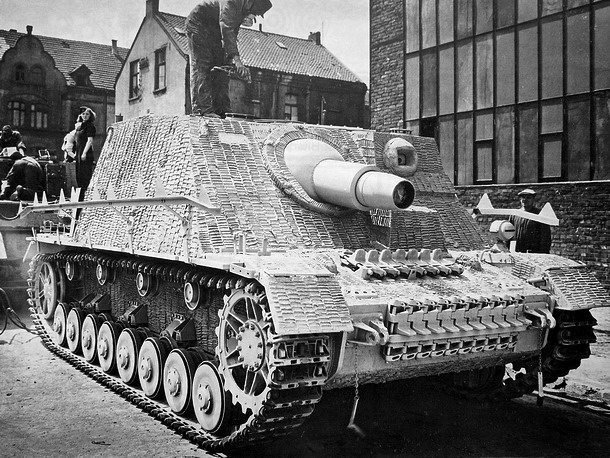
a typical representative of the so-called Sturmpanzer category was this Brummbär on the Panzer IV tank chassis, source: worldwarphotos.info, courtesy of the site operator, edited
Also belonging to the Grille programme was one further type — the super-heavy self-propelled gun Grille 17/21 in 170 mm or even 210 mm calibre. This project was launched somewhat later and it too did not escape those two absurd ordnance office requirements. Given the truly enormous weight, power, and dimensions of the 170 mm and 210 mm weapons under consideration, however, the officials eventually made a partial concession on the full gun rotation requirement. Perhaps partly because of this, this least-needed of the projects ended up progressing the furthest — all the way to a prototype, even if an incomplete one.
Assault Guns
As mentioned at the outset, in addition to the lightly armoured Selbstfahrlafetten discussed so far, the Germans also distinguished assault guns and assault tanks. In practical terms, the assault gun category consisted of essentially only one type — the famous Sturmgeschütz III (StuG III). This was a specialised vehicle whose purpose was to accompany the infantry and provide close fire support directly in the front line. This role implied specific requirements: it did not need long range, since it was to destroy targets the infantry would encounter on its advance — machine-gun nests, bunkers, and so on. It did, however, need to be well armoured, as it operated directly in the front line where it was exposed to enemy fire. And finally, its height could not exceed that of a standing man, so that the vehicle would not stick out too conspicuously and give away the position of the infantry. After the invasion of the Soviet Union, however, the StuG III began a gradual transformation into a tank destroyer, and the second generation of German assault guns, the StuG IV, was developed from the outset more as a tank destroyer than as a true assault gun.
Sturmpanzers
The last announced "category" of self-propelled guns is the group of vehicles sometimes referred to as Sturmpanzers. The Germans themselves apparently did not regard these fighting vehicles as a distinct category of self-propelled gun and simply classified them with the assault guns. The Sturmpanzers did, however, have their own specific history and their own specific battlefield role. Their origins lay in German experience with capturing large cities — Stalingrad, for example. In the hard street fighting it was essential to have a vehicle capable of rapidly and effectively demolishing entire buildings hidden within the urban fabric. This was a task for which German tanks and ordinary assault guns were too lightly armed, while conventional Selbstfahrlafetten were too lightly armoured. The solution was a comprehensively and heavily armoured self-propelled gun, armed with a powerful weapon of modest range — since it was effectively firing across a street or a square. The Sturmpanzer family comprised three basic types: SIG 33, Brummbär, and Sturmtiger. The project of the heavy self-propelled mortar Bär, also intended for the same purpose as the above vehicles, remained on paper only.
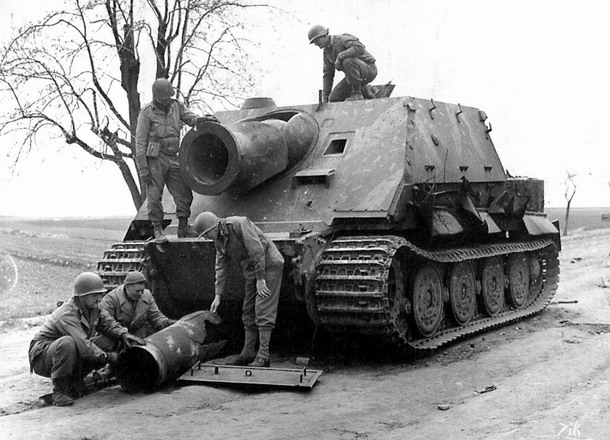
the development of Sturmpanzers culminated in the monstrous Sturmtiger, armed with a 38 cm rocket launcher, source: worldwarphotos.info, Public domain, edited
While in the field of tank destroyers the Germans managed to achieve a generational transition — gradually moving from the simple and "temporary" Panzerjägers to the more advanced and considerably more capable Jagdpanzers — with self-propelled guns this step was never accomplished. Those responsible seemed incapable of distinguishing what was and was not important, and demanded for future self-propelled guns characteristics that would have contributed little to their combat value while fundamentally complicating their design — so fundamentally, in fact, that they were never actually achieved before the end of the war. It is almost as though someone at WaPrüf 4 did not actually want the German army to have self-propelled guns at all.
ARTICLE
CONTENTS:
Reproducing text from the Panzernet website without the written consent of the operator is prohibited.